
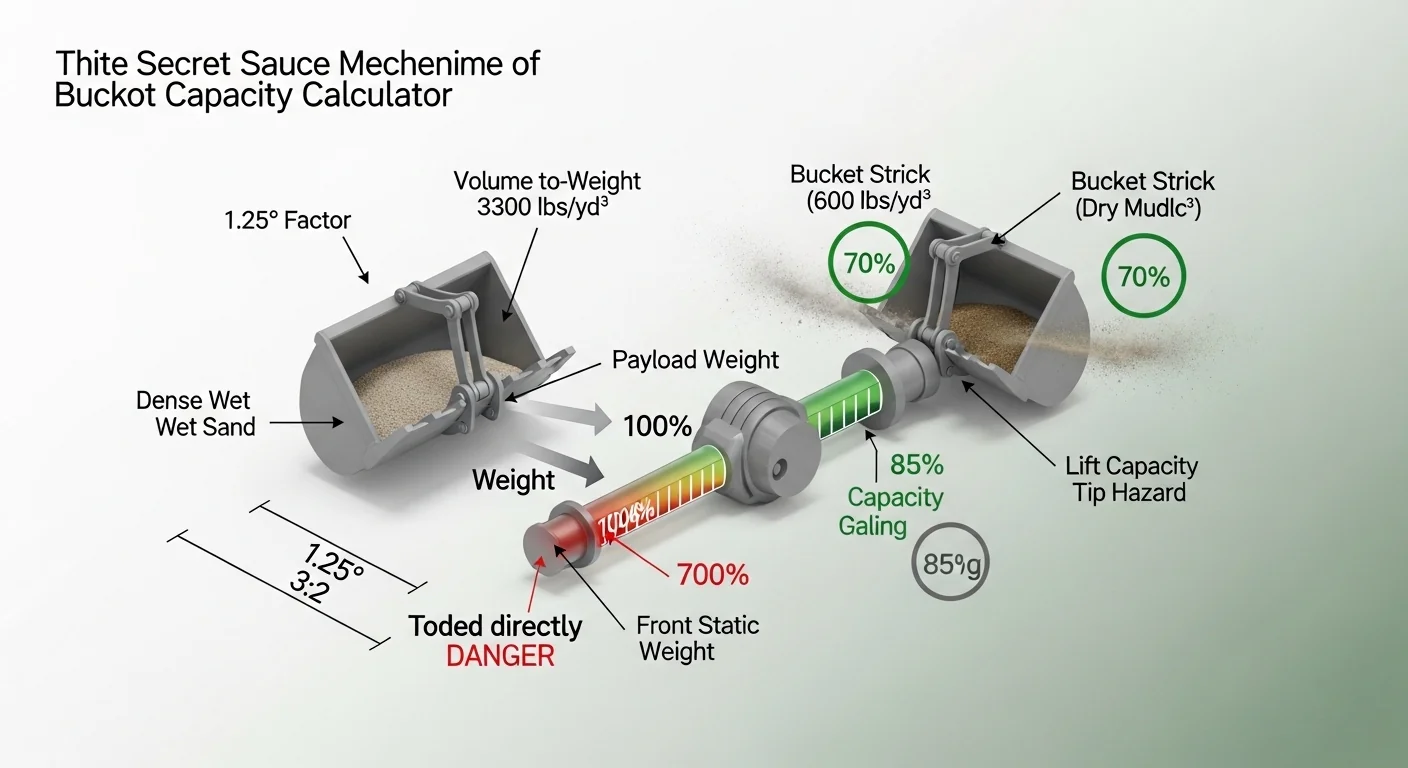
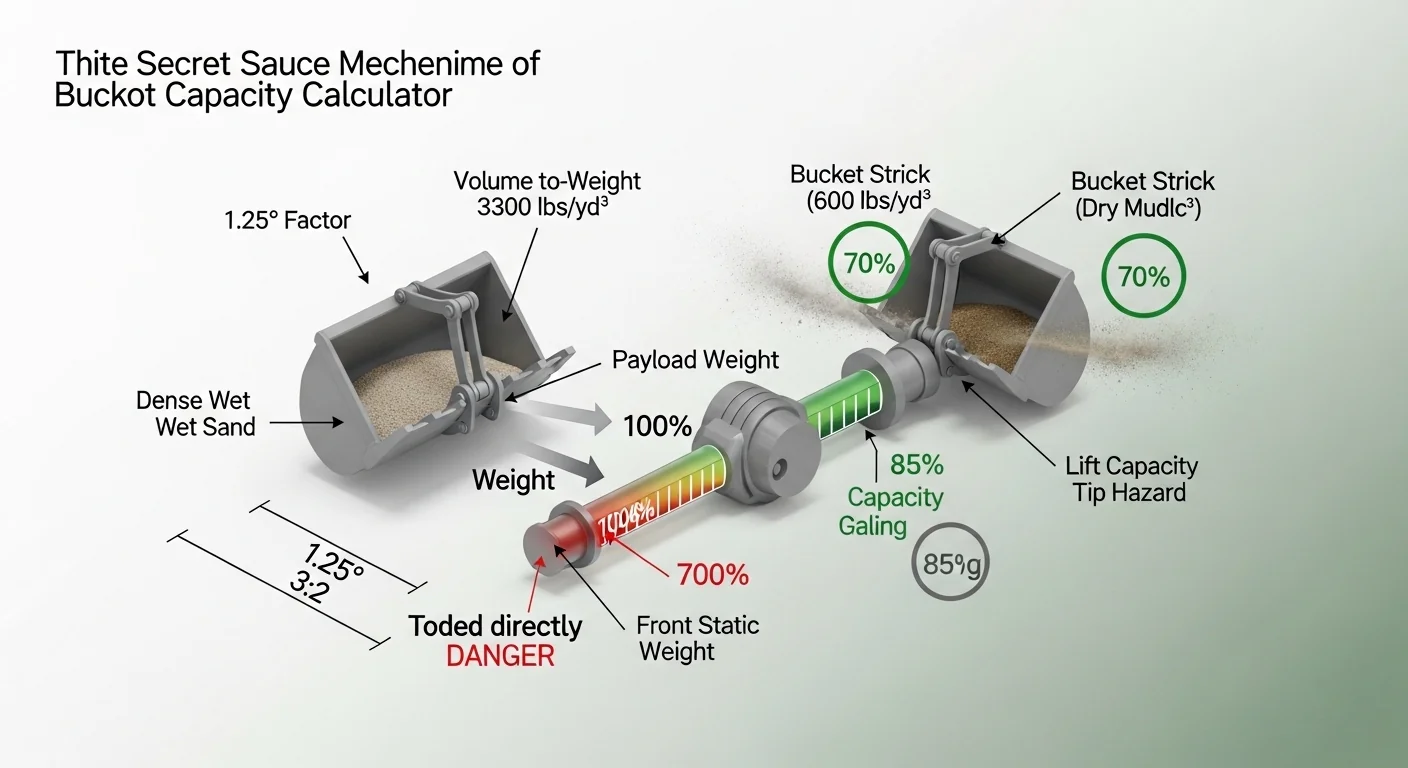
The danger with front-end loaders is not the material that looks heavy. It is the material that looks ordinary. Topsoil after three days of rain, gravel stored on a wet site, and especially sand left out overnight can more than double the effective payload compared to the same bucket of dry material. The front axle of a compact tractor experiences that weight difference directly, because loader geometry transfers nearly all bucket weight forward onto the axle housing, not the rear wheels.
This tractor bucket capacity calculator computes payload in pounds from your bucket’s volume and fill type, then estimates total front axle load by combining that payload with your tractor’s factory front-axle static weight. It also checks whether the payload exceeds 85% of your hydraulic lift capacity, the threshold at which tip hazard becomes a real concern. What this tool does not do: it does not model dynamic impact loads from bumps, does not account for sloped terrain, and does not replace your tractor or loader manufacturer’s specification sheet. For verified lift ratings from your specific loader model, the tractor loader lift capacity reference page is a useful companion.
After running this calculator, you will know whether your planned load is within safe axle limits, which specific hazard threshold it is approaching, and whether adding a 3-point hitch ballast box would bring the load back into a safe operating zone.
Use the Tool
| Material | Density (lbs/yd³) | Payload (lbs) | vs. Axle Limit |
|---|
How this calculator works
Step 1 — Effective Volume:
If Heaped fill is selected, volume is multiplied by 1.25 to approximate the mounded load above the struck line.
Effective Volume = Bucket Capacity × Fill Factor (1.0 or 1.25)
Step 2 — Payload:
Material density (lbs/yd³) is multiplied by effective volume.
Payload (lbs) = Effective Volume × Material Density
Step 3 — Estimated Front Axle Load:
The payload transfers weight forward onto the front axle via the loader arm’s leverage. An industry-standard leverage factor of 1.0 is used (conservatively, nearly all payload load transfers to the front axle when the bucket is raised or traveling).
Total Axle Load = Tractor Front Static Weight + Payload
Step 4 — Tip Hazard Check:
If payload exceeds 85% of the hydraulic lift capacity, a tip hazard flag is raised. The loader may physically lift the load, but the front axle experiences severe stress on any bump or uneven terrain.
Tip Hazard if: Payload > Lift Capacity × 0.85
Step 5 — Axle Overload Check:
Axle load is compared to the rated axle static limit. Exceeding 70% triggers a caution; exceeding 100% is a critical danger zone. Ballast reduces effective axle stress by shifting weight rearward.
Safety Margin = Axle Limit − Total Axle Load
Density values: Dry Mulch 600 lbs/yd³ · Topsoil 2,000 lbs/yd³ · Gravel 2,800 lbs/yd³ · Wet Sand 3,300 lbs/yd³
Assumptions & Limits
- Payload leverage factor assumed at 1.0 (full front-axle load transfer) — actual transfer varies by arm geometry but this is the conservative engineering approach.
- Wet Sand density ~3,300 lbs/yd³ is a widely cited industry benchmark; saturated conditions may increase this further.
- Heaped volume factor of 1.25× is an approximation; SAE J764 standard defines heaped differently by bucket profile.
- Ballast counterweight effect: rear ballast redistributes machine weight but does not reduce peak dynamic axle load during sudden stops or bump impacts.
- This tool is for educational estimation only. Always consult your tractor and loader manufacturer’s specifications and a qualified dealer before operating heavy loads.
- Not a substitute for professional safety assessment. Operating over-capacity equipment is dangerous and may void your warranty.
| Material | Density (lbs/yd³) | 0.5 yd³ Payload | 1.0 yd³ Payload | Risk Profile |
|---|---|---|---|---|
| Dry Mulch | 600 | 300 lbs | 600 lbs | Low |
| Topsoil | 2,000 | 1,000 lbs | 2,000 lbs | Moderate |
| Gravel | 2,800 | 1,400 lbs | 2,800 lbs | High |
| Wet Sand ⚠ | 3,300 | 1,650 lbs | 3,300 lbs | CRITICAL |
⚠ Wet Sand Axle Snap Warning: A heaped cubic yard of wet sand weighs over 3,300 lbs. Many compact tractor front axle housings are cast aluminum with ratings under 2,500 lbs. A loader that physically lifts wet sand can still snap the front axle on a single bump while driving. This is the most common under-estimated hazard in compact tractor operation.
Before entering values, have four numbers ready: your bucket’s rated capacity in cubic yards (check the loader spec sheet, not the bucket stamp), whether you plan to load struck or heaped, your tractor’s front axle static weight from the operator’s manual, and your hydraulic lift capacity in pounds. For the ballast field, enter zero if you have no rear counterweight. If you are using a 3-point hitch implement as a counterweight, the 3-point lift capacity calculator can help confirm your hitch’s weight-handling limit before you add a ballast box.
Quick Start (60 Seconds)

- Bucket Capacity (cubic yards): Use the struck capacity from the loader spec sheet. Common compact tractor buckets range from 0.25 to 0.75 yd³. Do not use the number stamped on the outside of the bucket if it conflicts with the manual.
- Fill Type (Struck vs. Heaped): Struck means level with the cutting edge. Heaped means mounded above the lip, approximately 25% more volume. When in doubt, choose Struck for safety calculations.
- Material Type: Select the specific material you are moving. Wet Sand is its own category because rain-saturated sand weighs roughly 3,300 lbs per cubic yard, not the 1,600-1,800 lbs per cubic yard that many operators assume.
- Front Axle Static Load Limit (lbs): This is the rated static limit printed in the tractor’s operator manual or technical data sheet. It is not the same as the loader’s lift capacity. Both numbers are needed.
- Hydraulic Lift Capacity (lbs): Maximum rated lift at the bucket pin, found in the loader spec sheet. Enter this number as-is.
- Tractor Front Static Weight (lbs): The factory front axle load without the loader installed, available from the manufacturer’s weight distribution table. If unknown, a conservative assumption is 45% of total machine weight.
- Ballast Box Weight (lbs): Weight of any rear-mounted counterweight or 3-point hitch implement used for stability. Enter zero if none is installed.
Inputs and Outputs (What Each Field Means)
| Field | Unit | What It Means | Common Mistake | Safe Entry Guidance |
|---|---|---|---|---|
| Bucket Capacity | cubic yards (yd³) | The measured volume of the bucket at struck fill; the baseline for all payload math | Using heaped volume for the capacity field, then also selecting Heaped fill type (double-counting ~25%) | Use the struck capacity from the manufacturer spec sheet; range 0.01 to 10 yd³ |
| Fill Type | Toggle (Struck / Heaped) | Whether the bucket is loaded level (struck) or mounded above the cutting edge (heaped, multiplied by 1.25) | Defaulting to struck when the actual loading practice is heaped, underestimating payload by up to 25% | Choose the fill type that reflects actual field practice, not best-case scenario |
| Material Type | Dropdown selection | Sets the material density constant used in the payload calculation (lbs/yd³) | Selecting Topsoil for wet or recently rained-on soil that should be treated as near-gravel density | When unsure, select the denser adjacent material; density only increases with moisture |
| Front Axle Static Load Limit | lbs | The maximum static weight rating of the front axle housing per the manufacturer; the structural ceiling the calculation checks against | Confusing this with the loader lift capacity; they are different specifications from different sections of the manual | Find this in the operator’s manual under “axle loads” or “weight distribution”; range 500 to 30,000 lbs |
| Hydraulic Lift Capacity | lbs | Maximum weight the loader’s hydraulic system is rated to raise at full height; used only for the tip hazard check | Entering breakout force instead of lift capacity; breakout force is higher and would mask the tip hazard warning | Use the rated lift capacity at full height from the loader spec sheet; range 100 to 20,000 lbs |
| Tractor Front Static Weight | lbs | The factory-documented front axle load before the loader adds payload; forms the baseline for total axle load | Leaving this blank or entering total tractor weight instead of the front axle portion specifically | Check the manufacturer’s weight distribution table; if unavailable, use 45% of total tractor weight as a conservative assumption |
| Ballast Box Weight | lbs | Rear-mounted counterweight that shifts machine center of gravity rearward, reducing the net front axle stress effect | Entering the maximum ballast box capacity rather than the actual weight currently installed | Enter the actual ballast weight; range 0 to 5,000 lbs; enter zero if none is fitted |
| Payload (output) | lbs | Computed weight of material in the bucket: Effective Volume x Material Density | Treating this as the only risk indicator; axle load and tip threshold are separate and must both be checked | Use this number to compare against rated lift capacity independently |
| Total Front Axle Load (output) | lbs | Sum of tractor front static weight plus payload; compared against the rated axle limit | Assuming this equals payload alone; the tractor’s own front weight is additive | This is the number that should stay under 70% of the axle limit for loaded travel |
| Safety Margin (output) | lbs | Difference between the rated axle limit and computed axle load; negative values indicate overload | Interpreting a small positive margin as safe; it provides no buffer for dynamic impact loads | Aim for at least 30% margin below the axle limit for loaded travel over rough ground |
Worked Examples (Real Numbers)
Example 1: Dry Mulch, Small Compact Tractor (Safe)
- Bucket capacity: 0.5 yd³, Struck fill
- Material: Dry Mulch (600 lbs/yd³)
- Tractor front static weight: 1,200 lbs
- Front axle static load limit: 2,500 lbs
- Hydraulic lift capacity: 1,500 lbs
- Ballast: 0 lbs
Calculation: Effective volume = 0.5 x 1.0 = 0.500 yd³. Payload = 0.500 x 600 = 300 lbs. Total axle load = 1,200 + 300 = 1,500 lbs. Axle load is 60% of the 2,500 lb limit. Tip hazard check: 300 lbs vs. 1,275 lbs threshold (85% of 1,500 lbs lift) = no hazard.
Result: 300 lbs payload, 1,500 lbs total front axle load. SAFE on both checks.
Dry mulch at struck fill on a compact tractor produces very manageable front axle loads. This is the material that gives operators false confidence before they try the same bucket on wet sand.
Example 2: Wet Sand, Heaped Fill, Same Tractor (Critical Danger)
- Bucket capacity: 0.5 yd³, Heaped fill
- Material: Wet Sand (3,300 lbs/yd³)
- Tractor front static weight: 1,200 lbs
- Front axle static load limit: 2,500 lbs
- Hydraulic lift capacity: 1,500 lbs
- Ballast: 0 lbs
Calculation: Effective volume = 0.5 x 1.25 = 0.625 yd³. Payload = 0.625 x 3,300 = 2,063 lbs. Total axle load = 1,200 + 2,063 = 3,263 lbs. Axle load is 130.5% of the 2,500 lb limit. Tip hazard check: 2,063 lbs vs. 1,275 lbs threshold = TIP HAZARD.
Result: 2,063 lbs payload, 3,263 lbs total front axle load. OVER LIMIT by 763 lbs on axle. TIP HAZARD active.
The loader’s hydraulic cylinders may physically lift this load. The front axle is simultaneously at 130.5% of its rated limit. A single pothole or abrupt steering input at this load creates a dynamic impact spike that the axle housing is not designed to absorb.
Example 3: Topsoil, Struck Fill, Mid-Size Tractor with Ballast (Caution Zone)
- Bucket capacity: 0.5 yd³, Struck fill
- Material: Topsoil (2,000 lbs/yd³)
- Tractor front static weight: 1,400 lbs
- Front axle static load limit: 3,000 lbs
- Hydraulic lift capacity: 2,000 lbs
- Ballast: 500 lbs
Calculation: Effective volume = 0.5 x 1.0 = 0.500 yd³. Payload = 0.500 x 2,000 = 1,000 lbs. Total axle load = 1,400 + 1,000 = 2,400 lbs. Axle load is 80% of the 3,000 lb limit. Tip hazard check: 1,000 lbs vs. 1,700 lbs threshold (85% of 2,000 lbs lift) = no tip hazard.
Result: 1,000 lbs payload, 2,400 lbs total front axle load. CAUTION: 80% of axle limit; above the 70% loaded-travel threshold. No tip hazard.
The 500 lb rear ballast helps shift the machine center of gravity rearward, but does not reduce the front axle’s structural load during loaded travel. Reducing speed over rough terrain and limiting loaded haul distance is the practical mitigation at this load level.
Reference Table (Fast Lookup)
The following table shows computed payload and estimated total front axle load for common bucket sizes and materials, assuming a 1,200 lb tractor front static weight and a 2,500 lb axle limit. The “Axle Load” column is computed. The “Status” column applies the 70% caution and 100% danger thresholds used by the calculator.
| Bucket Size (yd³) | Fill Type | Material | Density (lbs/yd³) | Payload (lbs) | Total Axle Load (lbs)* | Status vs. 2,500 lb Limit |
|---|---|---|---|---|---|---|
| 0.5 | Struck | Dry Mulch | 600 | 300 | 1,500 | Safe (60%) |
| 0.5 | Heaped | Dry Mulch | 600 | 375 | 1,575 | Safe (63%) |
| 0.5 | Struck | Topsoil | 2,000 | 1,000 | 2,200 | Caution (88%) |
| 0.5 | Heaped | Topsoil | 2,000 | 1,250 | 2,450 | Caution (98%) |
| 0.5 | Struck | Gravel | 2,800 | 1,400 | 2,600 | Over Limit (104%) |
| 0.5 | Struck | Wet Sand | 3,300 | 1,650 | 2,850 | Over Limit (114%) |
| 0.5 | Heaped | Wet Sand | 3,300 | 2,063 | 3,263 | Over Limit (131%) |
| 0.33 | Struck | Wet Sand | 3,300 | 1,089 | 2,289 | Caution (92%) |
| 0.33 | Struck | Gravel | 2,800 | 924 | 2,124 | Caution (85%) |
| 0.25 | Struck | Wet Sand | 3,300 | 825 | 2,025 | Caution (81%) |
| 0.25 | Heaped | Topsoil | 2,000 | 625 | 1,825 | Safe (73%) |
| 0.75 | Struck | Dry Mulch | 600 | 450 | 1,650 | Safe (66%) |
*Total axle load assumes 1,200 lbs tractor front static weight and no rear ballast. Thresholds: Caution above 70% of axle limit; Over Limit above 100%.
How the Calculation Works (Formula + Assumptions)
Show the calculation steps
Step 1: Effective Volume
The struck capacity from the spec sheet is multiplied by a fill factor. Struck fill uses a factor of 1.0 (no adjustment). Heaped fill uses a factor of 1.25, approximating the mounded volume above the cutting edge.
Effective Volume (yd³) = Bucket Capacity x Fill Factor
Step 2: Payload
The effective volume is multiplied by the material density constant for the selected material.
Payload (lbs) = Effective Volume x Material Density (lbs/yd³)
Density constants used: Dry Mulch = 600, Topsoil = 2,000, Gravel = 2,800, Wet Sand = 3,300 (all in lbs/yd³). All values are rounded to the nearest whole pound.
Step 3: Total Front Axle Load
The loader arm geometry transfers essentially the full payload weight forward to the front axle during operation. A leverage factor of 1.0 is applied, meaning payload weight is added directly to the tractor’s front static weight.
Total Axle Load (lbs) = Tractor Front Static Weight + Payload
Step 4: Axle Load Check
Total axle load is expressed as a fraction of the rated front axle static limit. Results above 70% trigger a caution state; results above 100% trigger a danger state.
Axle Load Fraction = Total Axle Load / Front Axle Static Limit
Step 5: Tip Hazard Check
Payload is compared against 85% of the hydraulic lift capacity. Exceeding this threshold indicates the loader may be physically able to raise the bucket but will be at high risk of tipping if the bucket is raised fully, operated on a slope, or driven over uneven terrain.
Tip Hazard if: Payload > Lift Capacity x 0.85
Rounding: All intermediate values are computed in floating-point arithmetic. Display values are rounded to the nearest whole pound. Percentages shown in the gauge are rounded to the nearest whole number.
Assumptions and Limits
- The leverage factor of 1.0 is a conservative engineering estimate. Actual front-axle load transfer varies by loader arm length, attachment point geometry, and bucket height. In some configurations it can be lower; it can also exceed 1.0 under dynamic braking.
- Heaped fill factor of 1.25 is an approximation. The SAE J764 standard defines heaped capacity using a fixed angle of repose; actual heaped volume depends on material and operator practice.
- Material density constants are fixed. Real-world values vary: wet topsoil can approach 2,400 to 2,700 lbs/yd³, and saturated sand can exceed 3,500 lbs/yd³. When material conditions are uncertain, select the next heavier material category.
- Ballast weight is noted in the results but is not subtracted from the computed axle load in the primary formula. Rear ballast shifts the machine’s center of gravity and reduces the likelihood of rearward tip when the bucket is empty, but does not reduce the structural load on the front axle during loaded forward travel.
- Dynamic impact loads from bumps, potholes, or abrupt braking are not modeled. A front axle at 95% of its static rating is not 5% away from safety when operating over rough terrain at speed.
- This calculator assumes the tractor is on level ground. Uphill travel with a raised bucket increases front-axle load; downhill travel reduces it temporarily but increases tip risk.
- Results are estimates only. This tool does not replace the tractor operator’s manual, loader specification sheet, or advice from a certified agricultural equipment dealer.
Standards, Safety Checks, and “Secret Sauce” Warnings
Critical Warnings
- The Wet Sand Axle Snap: A compact tractor can move 20 loads of dry mulch at the same bucket size with no mechanical stress. Moving a single heaped scoop of wet sand with the same tractor and loader can put the front axle at 130% or more of its rated limit. The hydraulic system lifts the load successfully, giving no warning. The axle housing, often cast aluminum on sub-40-horsepower machines, absorbs the full weight plus road-impact shock. One bump at travel speed is sufficient to fracture the housing.
- Lift Capacity Is Not Axle Capacity: The loader’s hydraulic lift rating and the tractor’s front axle load rating are specified independently by different engineering teams. A loader rated at 1,800 lbs can be mounted on a tractor with a 2,200 lb front axle limit. At 1,800 lbs payload plus 1,200 lbs tractor front static weight, the axle is already at 136% of its limit before the bucket leaves the ground. Knowing only the lift capacity and not the axle limit is a single-point-of-failure knowledge gap.
- Struck vs. Heaped Misidentification: Operators who load by visual habit typically load heaped. If the capacity entered in the calculator is the struck rating but the actual field practice is heaped, every calculated result underestimates true payload by approximately 25%. This error compounds on dense materials.
- Rear Ballast Does Not Eliminate Front Axle Risk: Adding rear counterweight improves rear stability and reduces tip hazard when the bucket is raised and empty. It does not reduce the compressive load the front axle bears when a heavy bucket is in the travel position. Relying on ballast to fix an overloaded front axle is a common and structurally incorrect assumption.
Minimum Standards
- Front axle total load during loaded travel should not exceed 70% of the rated static axle limit to maintain a meaningful buffer for dynamic loading. The 70% threshold reflects industry-standard conservative practice for loaded equipment travel over non-prepared surfaces.
- Payload should not exceed 85% of rated hydraulic lift capacity when operating on slopes or rough terrain. The 85% threshold allows for the additional moment arm effect when the bucket is raised and the machine is on a grade.
- Any ballast box added to a 3-point hitch must be within the hitch’s rated lift capacity. Adding 600 lbs of steel plate to a hitch rated at 400 lbs creates a secondary overload failure point at the rear of the machine.
Competitor Trap: Most competing calculators for front-end loader payload compute only payload weight from bucket volume and material density. They report a number in pounds and stop there. The critical missing step is comparing that payload not just to the loader’s lift capacity, but to the tractor’s front axle static load limit as a separate and often lower constraint. A tractor owner who checks only the loader lift spec and finds it is not exceeded may proceed into an axle-destroying load without any tool warning. The combination of payload plus baseline front axle weight is the number that matters for axle integrity, and the two specifications come from different pages of different manuals.
For operators planning to use a rear ballast box as part of their weight management strategy, the tractor tire ballast calculator can help determine appropriate total ballast levels based on tire load ratings. For those evaluating whether their loader setup is operating within hydraulic capacity before moving dense materials, the loader lift capacity reference provides manufacturer-specific context for rated lift figures.
Common Mistakes and Fixes
Mistake: Using Loader Lift Capacity as the Only Safety Check
The loader’s rated lift capacity tells you what the hydraulic system can raise. The tractor’s front axle limit tells you what the machine’s frame can safely carry. These are different numbers from different engineering specifications. Operators who confirm their load is within lift capacity but never check axle load are missing the more common structural failure mode on compact tractors. The axle limit is nearly always lower than the lift capacity on sub-50-horsepower machines.
Fix: Always enter both numbers in this calculator separately. If you do not know your front axle limit, find it in the operator’s manual under weight distribution or axle load data before moving any dense material.
Mistake: Treating All “Heavy” Materials the Same
Gravel and wet sand are both described casually as “heavy,” but their densities differ by nearly 500 lbs per cubic yard. That difference translates to a 312 lb payload gap for a half-cubic-yard bucket and a proportionally larger front axle load difference. Operators who have safely moved gravel often assume wet sand is similar. It is not.
Fix: Always select the specific material, not a general heavy-material approximation. When unsure whether sand is wet or dry, use the Wet Sand option.
Mistake: Assuming Heaped and Struck Capacities Are Interchangeable
The manufacturer’s bucket capacity stamp may show struck capacity. Experienced operators load by eye and routinely fill to a heaped condition. When struck capacity is entered but heaped is the actual practice, the calculator underestimates payload by 25%, which on a high-density material like gravel or wet sand is several hundred pounds. The tractor turning radius calculator illustrates a related point: machine behavior changes substantially with a raised, heavy bucket, and turn stability degrades faster than operators anticipate when fill type assumptions are wrong.
Fix: Observe your actual loading practice for one cycle before entering values. If the bucket looks mounded, select Heaped. Calculate conservatively.
Mistake: Ignoring Travel Speed When Approaching Axle Limits
Static axle ratings apply to stationary or near-stationary conditions. Driving over a rut, pothole, or uneven ground at travel speed creates impact loads that can multiply the axle’s effective load by a factor of two or more in the fraction of a second the wheel drops into the depression. An axle at 90% of its static rating while traveling at fieldwork speed is not 10% away from its limit; it may be fractionally close to a dynamic spike that exceeds it. The ground speed calculator can help operators confirm they are staying within speed ranges appropriate for loaded conditions.
Fix: Treat the 70% axle load threshold not as a caution but as a travel speed limit signal. Above 70%, reduce ground speed over any non-smooth surface.
Mistake: Confusing 3-Point Hitch Lift Capacity with Ballast Capacity
A 3-point hitch rated at 1,500 lbs lift can physically lower a 1,500 lb implement to the ground. It cannot safely act as a ballast anchor for 1,500 lbs of steel plate at all hitch positions and travel conditions. Ballast boxes exert rearward torque on the hitch frame, particularly when the tractor goes over a rise. Exceeding the hitch’s design load for ballast applications creates a rear structural failure risk that mirrors the front axle problem on the other end of the machine.
Fix: Consult your tractor manufacturer for the approved ballast weight limit for your specific 3-point hitch category. Many manufacturers specify a ballast weight limit that is lower than the stated maximum lift capacity.
Next Steps in Your Workflow
Once you have confirmed a safe payload and axle load combination, the next practical step is deciding how many loads are needed for the task and what route you will travel with the bucket loaded. If the project involves moving material across rough ground or a graded slope, verifying your tractor’s drawbar and travel capacity for the terrain is worth the few minutes it takes. The drawbar horsepower calculator helps quantify whether the tractor has enough pulling and travel capacity for loaded movement over the specific surface conditions you are working on.
For operators working with a box blade after using the loader, weight transfer and draft force become the next set of variables to check. Moving from front loader work to rear implement work on the same machine often involves reconfiguring ballast, which directly affects both the box blade’s ground engagement and the tractor’s front axle load with the blade attached. The box blade draft force calculator is a logical follow-on tool for any operator alternating between FEL and 3-point implement work in the same session.
FAQ
What is the difference between struck and heaped bucket capacity?
Struck capacity is the volume of material that fills the bucket exactly level with the cutting edge and top of the sides, with no material rising above the rim. Heaped capacity includes a mound of material above the bucket’s edge, typically approximated at 25% more volume than struck. For safety calculations, struck is the conservative baseline; heaped reflects typical field practice but adds payload unpredictably depending on material angle of repose.
Why does wet sand pose a higher front axle risk than gravel?
Wet sand has a density of approximately 3,300 lbs per cubic yard compared to gravel at approximately 2,800 lbs per cubic yard. That is roughly 500 lbs more per cubic yard. On a half-cubic-yard bucket at heaped fill, wet sand produces about 312 lbs more payload than gravel. More critically, operators rarely perceive wet sand as heavier than gravel by feel or appearance, so they do not reduce bucket fill in compensation.
Can adding a ballast box fix an overloaded front axle?
No. Rear ballast shifts the machine’s weight distribution rearward and reduces the risk of backward tip when the bucket is raised and empty. It does not reduce the compressive structural load the front axle carries when a loaded bucket is in the travel position. An axle over its rated static limit with a loaded bucket is still over its limit regardless of rear ballast. Ballast is a stability tool, not a load capacity tool.
What happens if the payload exceeds 85% of the lift capacity?
The calculator flags a tip hazard. At loads above 85% of rated lift capacity, the loader’s center of mass combined with the bucket load creates conditions where operating on a slope, making a sharp turn, or encountering uneven terrain can cause the machine to rotate forward around the front axle. The hydraulic system may be able to lift the load, but the machine’s stability margin is too narrow for routine field use at that weight.
How do I find my tractor’s front axle static load limit?
The front axle static load limit is documented in the tractor operator’s manual or the technical specification sheet from the manufacturer, typically under sections labeled “weights and dimensions” or “axle loads.” If it is not in the manual, contact your dealer and request the tractor’s weight distribution data by serial number. Do not confuse this figure with the front axle’s dynamic rating or the loader’s rated lift capacity.
Is the tractor bucket capacity calculator applicable to skid steers?
The payload calculation (volume x density) applies to any bucket-equipped machine. The axle load check in this calculator is specific to articulated or rigid-frame tractors with a distinct front axle. Skid steers distribute load differently across four drive motors and a rigid frame; the axle snap failure mode modeled here does not directly apply. The reference table and material density values remain useful for payload estimation regardless of machine type.
Conclusion
The calculation that changes how operators approach this problem is not the payload number alone but the front axle load check that follows it. For years, most loader payload tools stopped at “your bucket holds X lbs.” The structurally consequential question is what that X lbs does to the axle housing when it is added to the tractor’s own front weight and then driven across a rut. A bucket that safely carries dry mulch all season becomes an axle hazard on the first load of wet sand without any change in technique or observable warning.
The single most important mistake to avoid is using hydraulic lift capacity as the only safety benchmark. Confirm your front axle static load limit independently, enter it here, and check both outputs before moving dense materials. If you are also working with rear implements and need to assess full-machine weight balance during a combined FEL and rear-hitch session, the PTO post hole digger torque reference covers the rear drivetrain loading considerations that complement the front-end work covered by this calculator.