
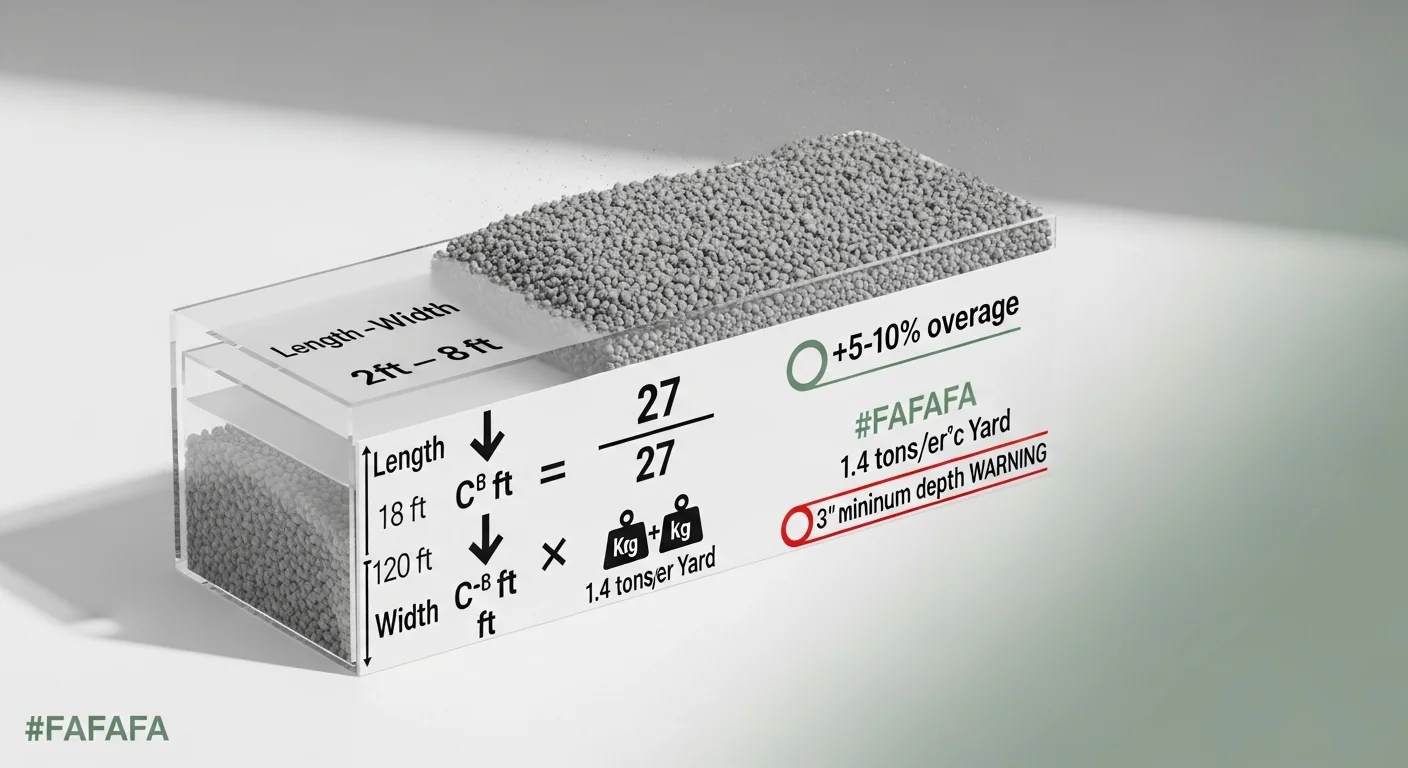
Gravel is sold by weight, not volume. That single fact is responsible for a large portion of short orders, wasted trips, and half-finished driveways. The calculation chain from square footage to tons passes through three unit conversions, and each one is a place where an off-the-cuff estimate goes wrong. This tool closes that gap by running the full formula from dimensions you already have on a tape measure.
What the calculator produces is a tonnage estimate based on standard crushed gravel at 1.4 tons per cubic yard. It does not account for compaction rates after installation, variations in gravel type density, or slope-related volume changes. If you are working with river rock, lava rock, or other specialty aggregates, density can differ meaningfully from the standard figure; a separate tool such as the river rock calculator handles those material-specific conversions.
After using this tool, you will have a ton figure you can hand directly to a bulk supplier for a quote, with enough precision to decide whether a single delivery covers the job.
Use the Tool

Gravel & Path Calculator
Estimate gravel tonnage for driveways, paths & landscaping
| Measurement | Value |
|---|
| Area (sq ft) | Depth (in) | Cubic Yards | Tons |
|---|
How this calculator works
- Area: Length (ft) × Width (ft) = Area in square feet.
- Convert depth: Depth (in) ÷ 12 = Depth in feet.
- Volume in cubic feet: Area (sq ft) × Depth (ft) = Volume (cu ft).
- Volume in cubic yards: Volume (cu ft) ÷ 27 = Volume (cu yd).
- Tonnage: Volume (cu yd) × 1.4 = Tons of gravel.
Standard gravel density is approximately 1.4 tons per cubic yard. Actual weight may vary by material type (pea gravel, crushed stone, river rock, etc.).
Assumptions & Limits
- Gravel density assumed at 1.4 tons per cubic yard (standard crushed gravel).
- Results are estimates; order 5-10% extra to account for settling and spillage.
- For walking paths, a minimum depth of 3 inches is recommended for stability.
- Supported input range: Length & Width 0.1 – 10,000 ft; Depth 0.1 – 120 in.
- This calculator assumes a rectangular, flat area with uniform depth.
Before entering values, have your measurements ready in the correct units: length and width in feet, depth in inches. Measure the actual area to be covered, not an estimated footprint. If the path or driveway has irregular edges, break it into rectangles, calculate each one, and add the totals. If you are also planning a hardscape border or base layer, the paver base calculator handles that companion material estimate.
Quick Start (60 Seconds)

- Length (feet): Measure from end to end along the longest axis. Do not estimate; a 5-foot error on a 50-foot driveway changes your tonnage by nearly 10 percent of the total.
- Width (feet): Measure the widest span of the gravel area. For tapered driveways, measure the average width, not the widest point.
- Depth (inches): Enter target depth, not existing depth. For new installations on bare soil, this is your full target. For top-ups on existing gravel, measure only the gap between current surface and desired height.
- Unit check: Depth must be in inches, not feet. Entering "4" for four feet instead of four inches will inflate the result by a factor of 12.
- Minimum depth: The tool flags any depth below 3 inches. That threshold exists because sub-3-inch gravel layers on walking paths tend to shift underfoot and expose the base.
- Run the calculation, then add overage: The widget result is the net estimate. Plan to order 5 to 10 percent above that figure to account for settling, spreading waste, and low spots.
- Irregular areas: Split the area into rectangular sections. Calculate each one separately, then sum the tonnage outputs before placing the order.
Inputs and Outputs (What Each Field Means)
| Field | Unit | What It Means | Common Mistake | Safe Entry Guidance |
|---|---|---|---|---|
| Length | Feet (ft) | The longest dimension of the rectangular gravel area | Including the approach or transition zone that won't receive gravel | Measure only the area receiving material; 0.1 to 10,000 ft accepted |
| Width | Feet (ft) | The perpendicular dimension to length | Measuring the total property width rather than the gravel path width | Use the narrowest consistent width for safety; 0.1 to 10,000 ft accepted |
| Depth | Inches (in) | Target coverage depth after spreading | Entering feet instead of inches (e.g., "0.33" when "4" is correct) | Standard range is 2 to 6 inches; minimum 3 in for paths per tool warning |
| Tons Needed (output) | Tons | Estimated weight of gravel at 1.4 t/yd3 density | Ordering this exact number without an overage buffer | Add 5 to 10 percent to this figure before calling a supplier |
| Volume (output) | Cubic yards (yd3) | The fill volume converted from cubic feet | Confusing cubic yards with cubic feet (factor of 27) | Useful for suppliers who quote by volume rather than weight |
Worked Examples (Real Numbers)
Example 1: Narrow Garden Walking Path
- Length: 20 ft
- Width: 3 ft
- Depth: 3 in
Area = 20 x 3 = 60 sq ft. Depth = 3 / 12 = 0.25 ft. Volume = 60 x 0.25 = 15 cu ft = 15 / 27 = 0.56 cu yd. Tonnage = 0.56 x 1.4 = 0.78 tons.
Result: 0.78 tons (approximately 0.56 cubic yards)
A narrow residential garden path at the minimum recommended depth. This is a half-ton bag order from most landscape suppliers. The depth meets the 3-inch minimum, so no depth warning fires in the widget.
Example 2: Standard Residential Driveway
- Length: 60 ft
- Width: 12 ft
- Depth: 4 in
Area = 60 x 12 = 720 sq ft. Depth = 4 / 12 = 0.333 ft. Volume = 720 x 0.333 = 240 cu ft = 240 / 27 = 8.89 cu yd. Tonnage = 8.89 x 1.4 = 12.44 tons.
Result: 12.44 tons (approximately 8.89 cubic yards)
A typical one-car driveway at a standard 4-inch depth. Most bulk suppliers deliver in 10-ton or 15-ton loads; this example falls between those tiers, making the 15-ton load the practical choice when a 5 to 10 percent overage buffer is added.
Example 3: Large Landscaped Parking Area
- Length: 100 ft
- Width: 25 ft
- Depth: 4 in
Area = 100 x 25 = 2,500 sq ft. Depth = 4 / 12 = 0.333 ft. Volume = 2,500 x 0.333 = 833.3 cu ft = 833.3 / 27 = 30.86 cu yd. Tonnage = 30.86 x 1.4 = 43.2 tons.
Result: 43.2 tons (approximately 30.86 cubic yards)
A commercial-scale gravel area. At this volume, coordinating two separate deliveries is often more practical than a single oversized load. The calculation also helps you verify that your supplier's quoted cubic-yard price matches the expected weight.
Reference Table (Fast Lookup)
| Area (sq ft) | Depth (in) | Volume (cu ft) | Volume (cu yd) | Tons Needed | With 10% Overage (tons) |
|---|---|---|---|---|---|
| 100 | 2 | 16.7 | 0.62 | 0.87 | 0.96 |
| 100 | 3 | 25.0 | 0.93 | 1.30 | 1.43 |
| 100 | 4 | 33.3 | 1.23 | 1.72 | 1.89 |
| 200 | 3 | 50.0 | 1.85 | 2.59 | 2.85 |
| 200 | 4 | 66.7 | 2.47 | 3.46 | 3.80 |
| 500 | 4 | 166.7 | 6.17 | 8.64 | 9.50 |
| 1,000 | 4 | 333.3 | 12.35 | 17.29 | 19.02 |
| 1,000 | 6 | 500.0 | 18.52 | 25.93 | 28.52 |
| 2,000 | 4 | 666.7 | 24.69 | 34.57 | 38.03 |
| 5,000 | 4 | 1,666.7 | 61.73 | 86.42 | 95.06 |
How the Calculation Works (Formula + Assumptions)
Show the calculation steps
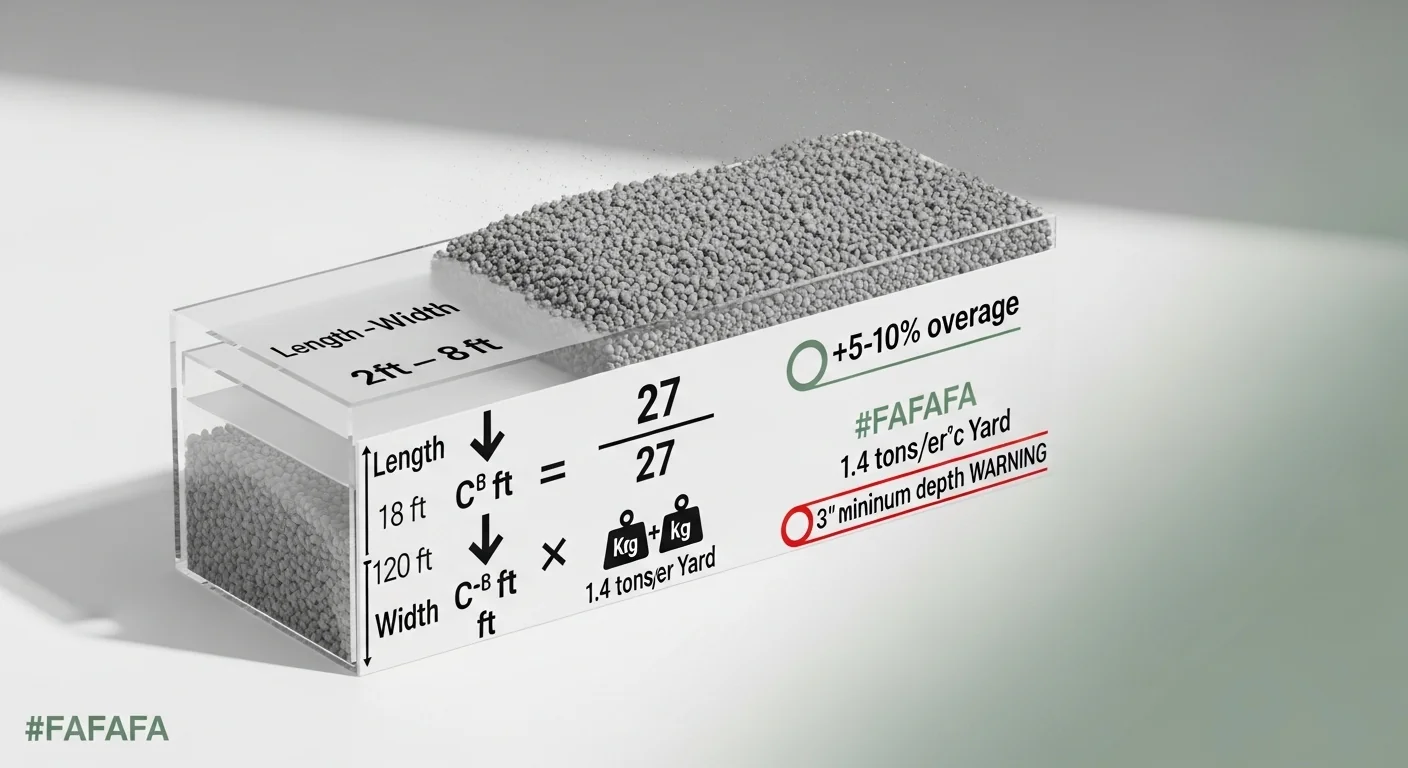
The formula converts three physical measurements into a supplier-ready tonnage figure through four sequential steps:
- Area: Length (ft) x Width (ft) = Area in square feet.
- Depth conversion: Depth (in) / 12 = Depth in feet. This step is where unit errors most often occur.
- Volume in cubic feet: Area (sq ft) x Depth (ft) = Volume (cu ft).
- Volume in cubic yards: Volume (cu ft) / 27 = Volume (cu yd). There are exactly 27 cubic feet in one cubic yard.
- Tonnage: Volume (cu yd) x 1.4 = Tons. The 1.4 factor is the assumed bulk density of standard crushed gravel.
Rounding: all intermediate values are carried at full precision. The final tonnage output is rounded to two decimal places for display.
Assumptions and Limits
- Density is fixed at 1.4 tons per cubic yard, which represents standard crushed gravel. Pea gravel, decomposed granite, lava rock, and river rock all have different densities.
- The area is assumed to be rectangular and flat. Sloped surfaces require more material on the uphill face and less on the downhill side; the calculator does not adjust for slope.
- Depth entered is the target finished depth, not pre-compaction depth. Some installers add 10 to 15 percent additional depth to account for compaction loss, then use this calculator to find that adjusted tonnage.
- The tool does not account for existing gravel layers. For a top-up, measure only the gap between the current surface and your target height, not the total installed depth.
- Maximum supported inputs are 10,000 ft for length and width, and 120 inches for depth. Values outside those ranges require manual calculation or a commercial estimating service.
- Results are net estimates. Order 5 to 10 percent above the calculated figure to allow for spreading waste, low spots, and minor measurement error.
- This tool does not calculate material cost. Pricing varies by region, gravel type, and delivery fee; use the tonnage output when requesting supplier quotes.
Standards, Safety Checks, and "Secret Sauce" Warnings
Critical Warnings
- Below-minimum depth on walking paths: Gravel installed at fewer than 3 inches on pedestrian surfaces tends to migrate, expose the substrate, and create uneven footing. The calculator displays a yellow warning when depth is below this threshold. Do not override it based on cost savings alone.
- Density mismatch for specialty aggregates: The 1.4 tons-per-cubic-yard figure is valid for crushed limestone, crushed granite, and general-purpose driveway gravel. Lighter aggregates like lava rock or pumice will produce overestimates; denser materials like trap rock will underestimate. Confirm bulk density with your supplier before using this result for large orders.
- Ignoring settled depth: Freshly installed gravel will compress 10 to 20 percent over the first several months under foot or vehicle traffic. For driveways that must remain at a target grade long-term, factor in the expected compaction when entering your depth value.
Minimum Standards
- Walking paths: 3-inch minimum depth. This is the threshold encoded into the widget's warning logic.
- Residential driveways: 4 inches is the widely cited baseline for single-vehicle use; high-traffic driveways often specify 6 inches.
- Decorative landscaping beds: 2 to 3 inches is sufficient for weed suppression when installed over landscape fabric.
Competitor Trap: Many basic gravel calculators output only cubic yards, leaving users to do the tons conversion manually or skip it entirely. Suppliers sell by weight. A user who orders "9 cubic yards" without confirming the tonnage equivalent may receive the right volume but pay for a different weight class, or discover at delivery that the quoted price was per ton, not per yard. This calculator outputs tonnage as the primary result precisely because that is the number that matches a supplier's invoice line.
If your project includes a gravel driveway on sloped terrain, the gravel driveway slope calculator helps determine whether your grade is within the range where gravel will stay in place without significant washout or creep.
Common Mistakes and Fixes
Mistake: Measuring the Wrong Dimension for Width
On tapered or irregular driveways, some people measure the widest point rather than the average usable width. A driveway that flares from 10 feet to 20 feet at the entrance has an average width far below 20 feet. Using the widest point inflates the area and the resulting tonnage.
Fix: For tapered areas, calculate the average width: (narrowest + widest) / 2, then use that figure as your width input.
Mistake: Using Cubic Yards for a Bulk Tonnage Order Without Cross-Checking
Gravel suppliers quote differently. Some use tons; some use cubic yards. If a supplier quotes per ton but the buyer provides only a cubic yard number, the conversion is assumed by the supplier, often at a density different from 1.4. That mismatch can result in receiving less material than calculated.
Fix: Provide both the tonnage and the cubic yard output from this calculator when talking to suppliers. Ask them which unit their delivery is priced on, and confirm their density assumption.
Mistake: Not Accounting for the Existing Gravel Layer in Top-Up Projects
On driveways or paths that already have gravel, entering the total target depth rather than the gap depth dramatically overestimates the order. If the target finished depth is 4 inches and there is already 2.5 inches of existing material, the top-up depth is 1.5 inches, not 4.
Fix: Measure the existing depth at multiple points and average them. Enter only the difference between that average and your target. For projects with highly irregular existing depth, consider a separate estimate for each significantly different zone. The same discipline applies when calculating topsoil volume; the topsoil calculator handles that material with identical measurement logic.
Mistake: Skipping the Overage Buffer on Large Orders
Ordering exactly the calculated tonnage leaves no margin for low spots, spreading waste, or measurement rounding. On large projects, running short means a second delivery, which adds both cost and schedule delay.
Fix: Add a minimum 5 percent buffer on small jobs. On large commercial jobs where a second delivery is expensive, a 10 percent buffer is the more practical choice. This is noted in the widget's assumptions section.
Mistake: Using a Gravel Calculator When the Project Is Actually a Retaining Wall Backfill
Retaining wall backfill, drainage fill, and compacted base material have different density and compaction requirements than surface gravel. Using a surface gravel tonnage formula for a structural backfill project underspecifies the material and may lead to wall failure or drainage problems.
Fix: For projects that combine a retaining structure with a gravel drainage or backfill layer, calculate them separately. The retaining wall calculator addresses the structural dimensions, which should be planned before the gravel fill quantity is finalized.
Next Steps in Your Workflow
Once you have a tonnage figure, the next step depends on what is going below and around the gravel. If the path will have decorative edging or stepping stones integrated into it, sizing those elements before finalizing the gravel order saves re-measurement. The stepping stone calculator helps determine spacing and quantity for that companion element, so both materials can go on the same supplier order.
If the surface will receive jointing material between pavers or a stabilizing sand layer, calculate that separately as well. For paths where polymeric sand or stabilizer is used to firm up the gravel edges, a companion estimate from the polymeric sand calculator covers that secondary layer. Having both numbers before the delivery schedule is finalized eliminates the need for a second trip.
FAQ
How many tons of gravel do I need for a 100-square-foot area at 4 inches deep?
At standard crushed gravel density of 1.4 tons per cubic yard: 100 sq ft x (4/12) ft = 33.3 cu ft, divided by 27 = 1.23 cu yd, multiplied by 1.4 = 1.72 tons. Add a 5 to 10 percent buffer for a practical order quantity of approximately 1.9 tons.
What is the difference between cubic yards and tons for gravel?
Cubic yards measure volume; tons measure weight. The conversion depends on material density. For standard crushed gravel, one cubic yard weighs approximately 1.4 tons. That ratio shifts with material type: river rock runs lighter, trap rock runs heavier. Always confirm the density with your supplier for specialty aggregates.
What gravel depth is recommended for a walking path?
The widely cited minimum is 3 inches for residential walking paths. Below that depth, loose gravel tends to migrate under foot traffic, exposing the compacted base or bare soil beneath. High-traffic paths or those installed in areas with frost heave may benefit from 4 inches.
What gravel depth is recommended for a driveway?
A common baseline for residential driveways is 4 inches for standard single-vehicle use. Driveways that accommodate heavier vehicles or heavy traffic often specify 6 inches. In regions with significant freeze-thaw cycles, a compacted gravel base layer below the surface gravel is standard practice.
Can this calculator be used for crushed stone, pea gravel, and decomposed granite?
The calculator applies the 1.4 tons-per-cubic-yard density of standard crushed gravel to all inputs. Crushed stone at similar sizes is close to that figure. Pea gravel and decomposed granite have slightly different densities. For rough estimates the difference is minor; for large orders, confirm the specific material's bulk density with your supplier before finalizing.
How do I calculate gravel for a circular or irregular-shaped area?
For circles, calculate the area using the standard formula (pi x radius squared) in square feet, then convert that area manually to a rectangular equivalent before entering it. For irregular shapes, divide the area into overlapping rectangles, estimate each, and sum the results. The overage buffer accommodates the approximation error in irregular-area estimates.
Conclusion
The most consequential number in a gravel project is not the square footage of the area; it is the tonnage on the delivery order. Square footage tells you how much surface you are covering. Tonnage tells you what you are actually paying for and what the truck will carry. Getting from one to the other requires three unit conversions, and every shortcut in that chain carries a real cost.
The single most frequent mistake in gravel estimation is ordering by volume without confirming the weight equivalent. That gap between cubic yards and tons is where short orders and unexpected charges appear. Use the tonnage output from this calculator as your primary ordering figure, confirm the density assumption with your supplier, and account for weed suppression fabric below the gravel to reduce long-term maintenance; the landscape fabric overlap calculator handles that layer if your project includes one.