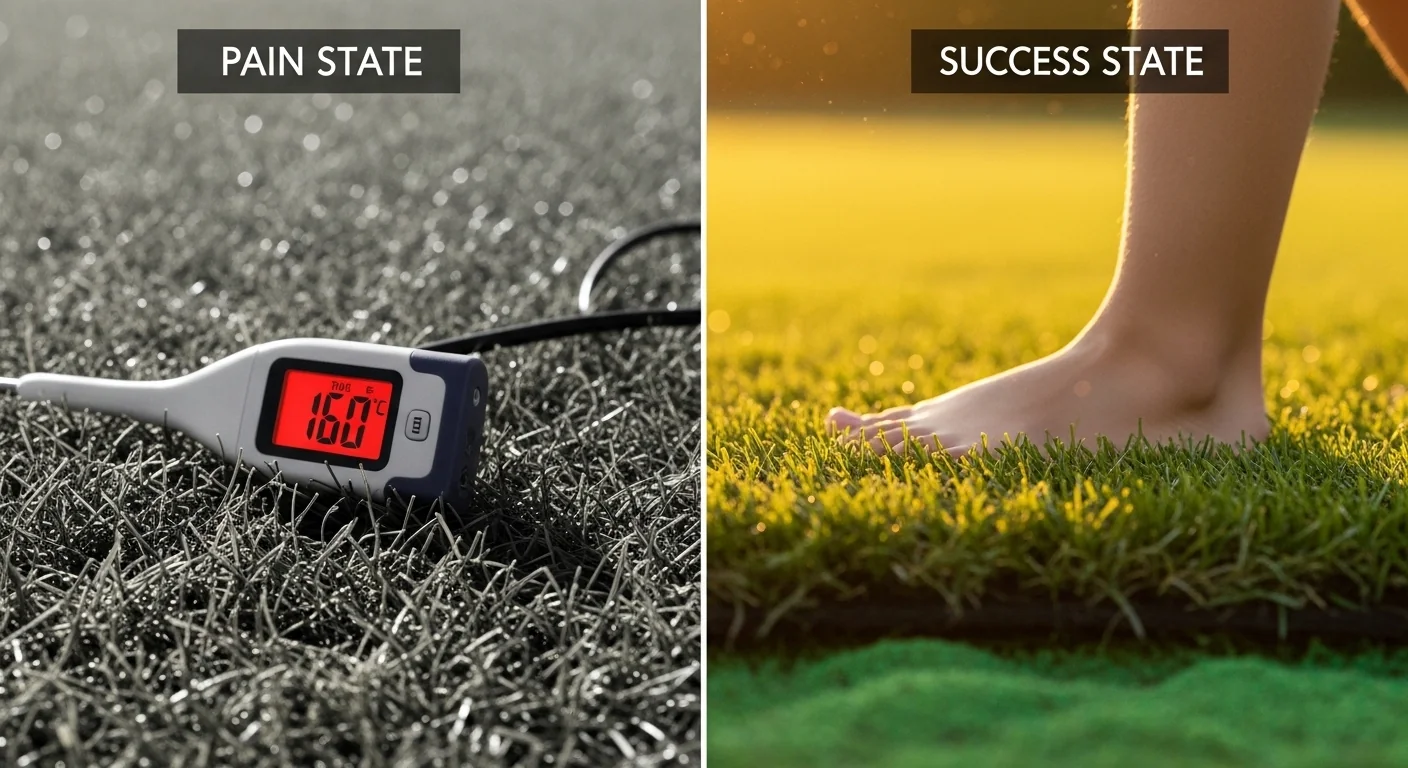
Synthetic turf does not behave like soil. It is a plastic matrix with no thermal mass of its own, which means it absorbs and re-radiates heat from direct sun with almost no buffering. An un-infilled artificial lawn installed on a 90°F day can reach 160°F at the blade tips within minutes. That number is not a warning label formality: it exceeds the surface temperature threshold for third-degree contact burns on soft tissue in under three seconds. The infill layer is not an optional upgrade. It is the primary thermal control system for the installation.
This calculator quantifies the exact weight of infill material required for any combination of turf area, pile height, material type, and traffic load. It outputs total pounds, cubic feet of volume, a 50-lb bag count, lbs-per-square-foot density, and an estimated surface temperature under direct-sun conditions. What it does not do: it does not account for slope, seam waste, or brand-specific pile density ratings. Those variables require a site survey.
After running your numbers, you will know whether your infill density lands in the safe zone, the caution zone, or the burn-risk zone, and which material upgrade resolves the shortfall.
Use the Tool
Artificial Grass Infill Calculator
Estimate infill weight, 50-lb bags, fill depth and modeled surface temperature.
Before entering inputs, have three measurements ready: the total turf area in square feet (length multiplied by width for rectangular runs; break irregular shapes into rectangles and add them), the pile height specification from the turf product sheet or the blade tip measurement with a ruler, and a clear understanding of whether dogs or children will use the surface daily. If you are comparing multiple turf products at different pile heights, run the calculator once per product. For projects that involve both artificial turf and subsurface drainage aggregate, the artificial turf drainage calculator handles the base layer separately.
Quick Start (60 Seconds)
- Total Turf Area (sq ft): Measure the installed turf footprint only. Do not include border edging or concrete surrounds. Minimum entry is 1 sq ft; maximum is 100,000 sq ft. Entering the full lot size instead of the turf zone is the most common input error.
- Turf Pile Height: Read this from your product specification sheet, not from a visual estimate. Options run from 1.0 inch (putting-green style) to 2.5 inches (premium landscape). If unknown, 1.5 inches is the standard residential default.
- Infill Material: Choose the material you plan to install, not the material the turf came with. Crumb rubber, raw silica, antimicrobial hydro-chill silica, and zeolite have different densities and very different thermal properties.
- Foot Traffic and Pet Usage: Select the highest-intensity use case that applies. A backyard with one dog qualifies as Pet Heavy, even if human traffic is low. Underreporting usage results in an infill density that compacts out of spec within one season.
- Units reminder: Area is in square feet. Pile height is in inches. All outputs are in U.S. customary units (pounds, cubic feet, bags of 50 lbs).
- Run the calculation before ordering: The bag count includes a compaction multiplier based on usage level. Do not order based on the raw volume estimate from the supplier; this tool applies traffic-specific density correction.
- Check the temperature gauge: Even if the lbs total looks acceptable, verify that the estimated surface temperature result puts the installation in the safe range before finalizing material selection.
Inputs and Outputs (What Each Field Means)
| Field | Unit | What It Represents | Common Mistake | Safe Entry Guidance |
|---|---|---|---|---|
| Total Turf Area | sq ft | The installed surface footprint of the artificial turf, not including borders or substrate | Using the full yard or lot dimensions instead of the turf-only zone | Measure the turf face, subtract any planters, stepping stones, or bare areas |
| Turf Pile Height | inches | The blade height from the backing to the tip; determines the available depth for infill fill | Estimating by eye rather than reading the product spec sheet | Check the turf roll label or manufacturer data sheet; 1.5 in. is standard residential |
| Infill Material | n/a (type) | The bulk material filling the space between blades; density and cooling properties vary significantly | Selecting crumb rubber for a pet area due to lower per-bag cost | Match material to use case: zeolite for pets, hydro-chill silica for heat-exposed installs |
| Foot Traffic / Pet Usage | n/a (level) | Usage intensity that drives the compaction multiplier applied to the base infill formula | Selecting "Medium" when a dog uses the space daily, understating the compaction rate | Choose the highest-intensity tier that applies; err toward heavier usage |
| Total Infill Required | lbs | Gross weight of infill material needed, including the traffic compaction multiplier | Ordering based on this number without adding 5–10 overage for waste and edge losses | Multiply the output by 1.08 when placing the final material order |
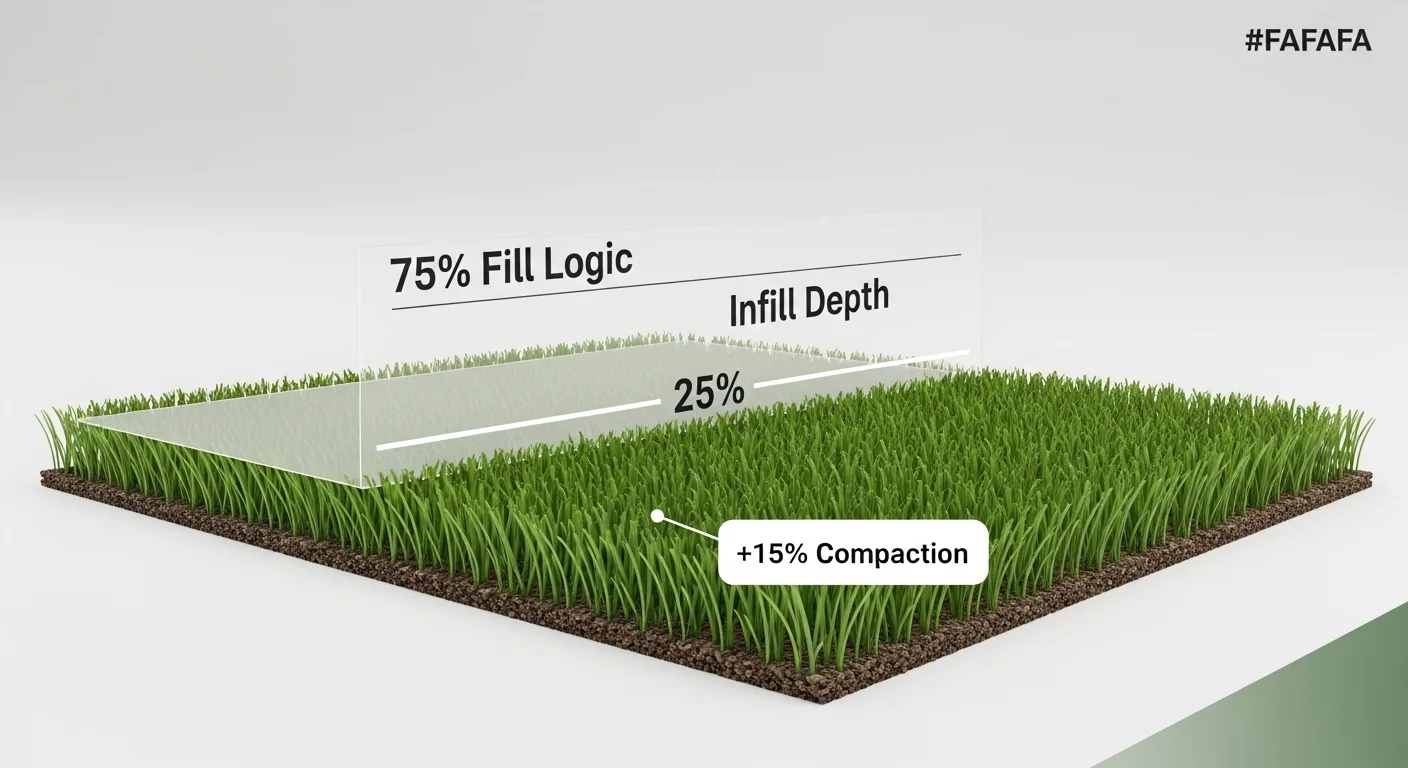
| Fill Depth Used | inches | The target infill depth, set at 75% of pile height to keep the top 25% of blades exposed | Filling to full pile height, which buries blades and causes matting | Do not exceed the fill depth shown; blade exposure is required for drainage and recovery |
| Lbs per Sq Ft | lbs/sq ft | The infill density across the installed surface; the key quality metric for thermal and structural performance | Ignoring this figure and focusing only on total bags | Minimum 1.0 lbs/sq ft for any application; 1.5+ recommended for pet-heavy zones |
| Volume | cu ft | Total cubic footage of infill required before converting to weight | Using this number to order material without accounting for material-specific density | Volume is an intermediate calculation; use the lbs figure for ordering |
| 50-lb Bags Needed | bags | Rounded-up bag count at standard 50-lb bag packaging | Forgetting that zeolite and crumb rubber ship at different weights per bag in some markets | Confirm bag weight with your supplier; the calculator assumes 50 lbs per bag |
| Est. Surface Temperature | °F | Modeled surface temp in direct 90°F sun based on infill density and material cooling properties | Treating this as an actual measured reading; it is a decision threshold model | Any reading above 110°F warrants a material upgrade or a watering protocol before peak use |
Worked Examples (Real Numbers)
Example 1: Standard Residential Backyard, Raw Silica, Medium Traffic
- Area: 500 sq ft
- Pile height: 1.5 in.
- Material: Raw Silica Sand (100 lbs/cu ft)
- Traffic: Medium (multiplier 1.05)
Fill depth = 1.5 × 0.75 = 1.125 in.
Volume = 500 × 144 × 1.125 / 1,728 = 46.875 cu ft
Infill = 46.875 × 100 × 1.05 = 4,921.9 lbs
Result: 4,922 lbs total | 99 bags (50 lb) | 9.84 lbs/sq ft
At this density with silica, the estimated surface temperature model places this installation well within the safe range. However, raw silica carries no odor-control properties. If any pet use occurs, the material choice should be revisited even at this density.
Example 2: Small Pet Run, Zeolite Infill, Pet-Heavy Use
- Area: 200 sq ft
- Pile height: 2.0 in.
- Material: Zeolite (55 lbs/cu ft)
- Traffic: Pet Heavy (multiplier 1.15)
Fill depth = 2.0 × 0.75 = 1.5 in.
Volume = 200 × 144 × 1.5 / 1,728 = 25 cu ft
Infill = 25 × 55 × 1.15 = 1,581.25 lbs
Result: 1,581 lbs total | 32 bags (50 lb) | 7.91 lbs/sq ft
Zeolite's lower bulk density (55 lbs/cu ft vs. 100 for silica) means more volume is required than a weight-only estimate would suggest. The tradeoff is direct ammonia ion adsorption in the infill matrix, which is the only infill mechanism that addresses uric acid odor at the source rather than masking it.
Example 3: Large Landscape Install, Antimicrobial Hydro-Chill Silica, High Traffic
- Area: 1,000 sq ft
- Pile height: 1.75 in.
- Material: Antimicrobial Silica (100 lbs/cu ft)
- Traffic: High (multiplier 1.10)
Fill depth = 1.75 × 0.75 = 1.3125 in.
Volume = 1,000 × 144 × 1.3125 / 1,728 = 109.375 cu ft
Infill = 109.375 × 100 × 1.10 = 12,031.25 lbs
Result: 12,031 lbs total | 241 bags (50 lb) | 12.03 lbs/sq ft
At over 12,000 lbs, this is a project-scale delivery, not a retail run. Hydro-chill silica earns its cost premium here: the coating absorbs and evaporates water, reducing surface temperature under active sun loads. For a 1,000 sq ft surface in a southern climate, this is the minimum-viable material choice for unrestricted barefoot and pet access.
Reference Table (Fast Lookup)
| Area (sq ft) | Pile Ht (in.) | Material | Fill Depth (in.) | Total Infill (lbs) | Bags (50 lb) | Lbs/sq ft | Est. Surface Temp (°F)* |
|---|---|---|---|---|---|---|---|
| 200 | 1.5 | Raw Silica | 1.125 | 1,890 | 38 | 9.45 | 82 (Safe) |
| 500 | 1.5 | Raw Silica | 1.125 | 4,725 | 95 | 9.45 | 82 (Safe) |
| 500 | 2.0 | Raw Silica | 1.5 | 6,300 | 126 | 12.60 | 82 (Safe) |
| 500 | 2.0 | Crumb Rubber | 1.5 | 4,284 | 86 | 8.57 | 141 (Danger) |
| 1,000 | 1.75 | Hydro-Chill Silica | 1.3125 | 12,031 | 241 | 12.03 | 82 (Safe) |
| 1,000 | 1.75 | Crumb Rubber | 1.3125 | 8,181 | 164 | 8.18 | 156 (Danger) |
| 200 | 2.0 | Zeolite | 1.5 | 1,581 | 32 | 7.91 | 82 (Safe) |
| 2,500 | 1.5 | Hydro-Chill Silica | 1.125 | 24,328 | 487 | 9.73 | 82 (Safe) |
| 2,500 | 2.5 | Crumb Rubber | 1.875 | 17,171 | 344 | 6.87 | 156 (Danger) |
| 0 (un-infilled) | any | None | 0 | 0 | 0 | 0 | 160+ (Burn Risk) |
*Estimated surface temperature model: 90°F ambient air, direct unshaded southern exposure. Silica/zeolite cooling coefficient: 2.2°F per lbs/sq ft. Crumb rubber: 0.5°F per lbs/sq ft. Floor: 82°F. This is a decision threshold tool, not a measured surface reading.
How the Calculation Works (Formula + Assumptions)
Show the calculation steps
Step 1: Calculate Fill Depth
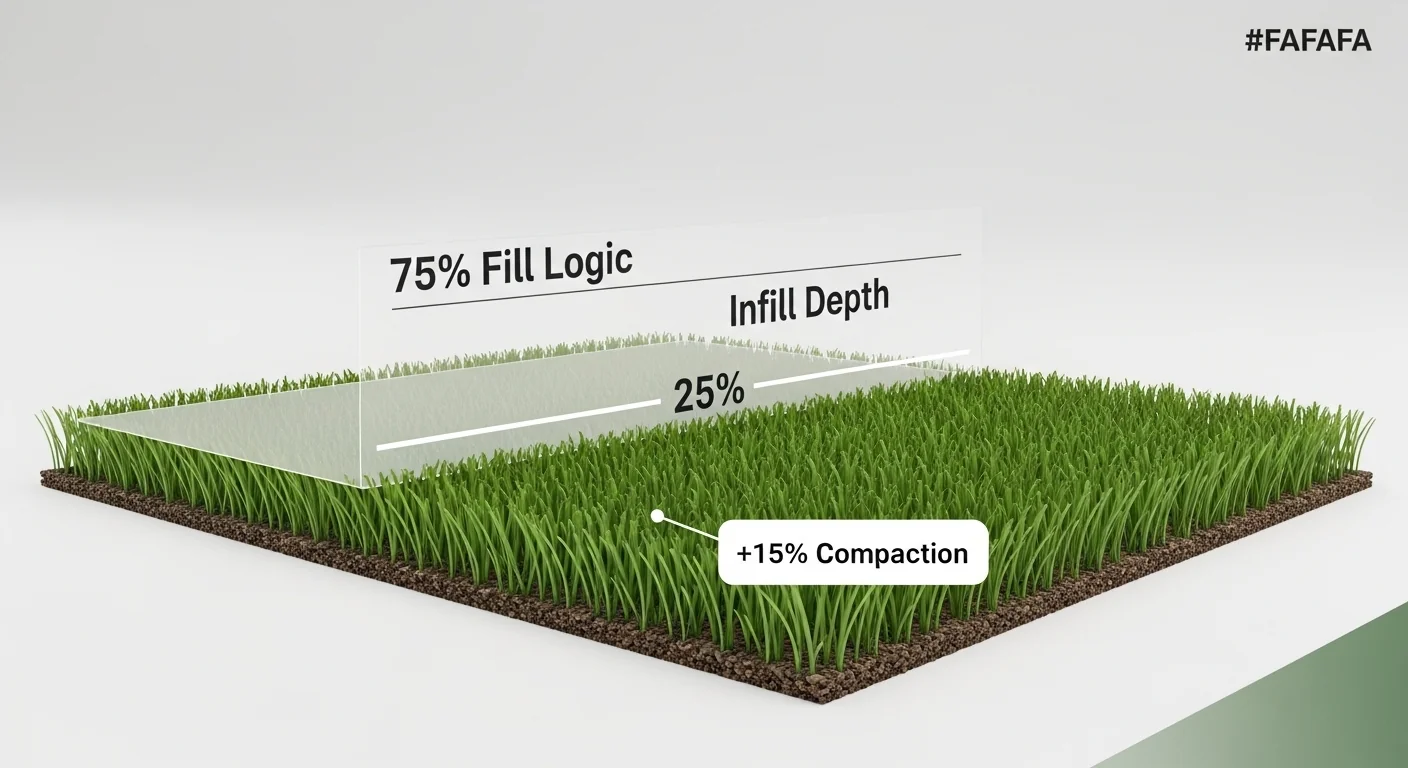
The target fill depth is 75% of the pile height. Filling to the full pile height buries blade tips, causes matting, and traps heat. The top 25% of each blade must remain exposed to stand upright and allow drainage.
Fill Depth (in.) = Pile Height (in.) × 0.75
Step 2: Volume in Cubic Inches
Area is converted from square feet to square inches (multiply by 144), then multiplied by the fill depth in inches to produce volume in cubic inches.
Volume (cu in.) = Area (sq ft) × 144 × Fill Depth (in.)
Step 3: Convert to Cubic Feet
There are 1,728 cubic inches in one cubic foot.
Volume (cu ft) = Volume (cu in.) / 1,728
Step 4: Apply Material Density and Traffic Multiplier
Each material has a different bulk density. A traffic multiplier accounts for long-term compaction.
- Raw Silica Sand: 100 lbs/cu ft
- Antimicrobial Hydro-Chill Silica: 100 lbs/cu ft
- Zeolite: 55 lbs/cu ft
- Crumb Rubber: 68 lbs/cu ft
Traffic multipliers: Low = 1.00, Medium = 1.05, High = 1.10, Pet Heavy = 1.15
Infill (lbs) = Volume (cu ft) × Density (lbs/cu ft) × Traffic Multiplier
Step 5: Bag Count
The bag count is the total weight divided by 50 lbs, rounded up to the nearest whole bag.
Step 6: Estimated Surface Temperature
Un-infilled turf starts at a modeled 160°F under direct sun. Each lbs/sq ft of silica or zeolite reduces the model temperature by 2.2°F via evaporative and conductive cooling. Crumb rubber applies a 0.5°F reduction per lbs/sq ft due to its heat-retention properties. The result floors at 82°F.
Est. Temp (°F) = 160 - (lbs/sq ft × cooling coefficient), minimum 82°F
Assumptions and Limits
- Silica sand bulk density is assumed at 100 lbs/cu ft for dry, angular-grain material; rounded or wet silica may vary
- The temperature model assumes 90°F ambient air temperature, full direct sun, no shade overhang, and no active watering immediately before use
- The 75% fill depth target is an industry-standard default; some manufacturers specify different fill ratios for their backing systems
- The calculator does not apply a waste factor for seams, edges, or irregular shapes; add a minimum of 5–10% to all orders
- Crumb rubber's thermal behavior varies significantly by granule size, color, and UV coating; the 0.5°F coefficient used here reflects uncoated black SBR rubber
- Zeolite adsorption capacity degrades over time; the infill quantity calculation does not model ammonia saturation or regeneration cycles
- Traffic multipliers are compaction estimates; actual compaction rates depend on soil subbase firmness, irrigation frequency, and granule shape
- The tool does not account for slope. On grades above 2%, lateral infill migration is a factor that requires a geo-grid or retention border detail
Standards, Safety Checks, and "Secret Sauce" Warnings
Critical Warnings
- The 160°F Surface Burn Threshold: In direct 90°F sun, un-infilled synthetic turf consistently tests above 150°F due to the heat-sink behavior of polyethylene and polypropylene filaments. Third-degree burns to the paw pads of dogs and the bare feet of children can occur within three seconds of contact at these temperatures. Every pound of infill below the minimum density threshold extends the time the surface spends in the burn-risk zone. This is not a marginal concern for small or shaded lawns; it is a hard physical limit.
- Ammonia Crystallization with Raw Silica and Pet Use: Silica sand is chemically inert. It does not bind, adsorb, or neutralize ammonia ions from urine. When pet urine contacts raw silica infill, uric acid dries and crystallizes between granules. Heat and humidity cause those crystals to volatilize, producing the persistent ammonia odor common in poorly specified pet turf installations. No enzyme spray applied to the surface reaches the crystallized uric acid embedded in the infill layer. The solution is specifying zeolite at the infill stage, not after installation.
- Crumb Rubber Heat Amplification: Crumb rubber (shredded SBR tire rubber) has a dark color, low albedo, and high specific heat capacity relative to silica. It absorbs solar radiation efficiently and releases it slowly. In direct sun, crumb rubber infill does not provide meaningfully better thermal protection than bare backing. Surface temperatures on crumb-rubber-infilled turf frequently approach those of un-infilled turf in hot climates. This material is not appropriate for any installation where barefoot or unprotected-paw access is expected during summer hours.
- Underfill Blade Collapse: At less than 1.0 lbs/sq ft, infill density is insufficient to keep synthetic blades upright. Matted blades reduce drainage, create pooling, and re-expose the backing surface to direct sun, recreating the thermal conditions the infill was meant to prevent.
Minimum Standards
- Minimum infill density for any outdoor turf application: 1.0 lbs/sq ft
- Minimum infill density for pet-heavy zones: 1.5 lbs/sq ft (zeolite or blended zeolite/silica)
- Hydro-chilling silica is the minimum-viable material for full-sun installations in USDA hardiness zones 7 and warmer where children or pets use the surface without restricted hours
- Maximum fill depth: 75% of pile height; never fill to the full blade height
Competitor Trap
Most infill calculators published by turf retailers return only a bag count using a simple area-times-factor formula, with no material differentiation and no thermal output. That approach fails on two counts: it treats zeolite (55 lbs/cu ft) identically to silica (100 lbs/cu ft), producing a significant underorder when zeolite is selected; and it provides no surface-temperature feedback, so an installer specifying crumb rubber for a pet yard in a hot climate receives no signal that the material choice itself is the safety failure. For projects comparing base layer aggregate options, the paver base calculator is useful for sizing the crushed stone sub-base beneath the turf backing, a step that affects both drainage rate and heat insulation from below.
For installations where the turf surface will be actively irrigated for cooling, the turf watering calculator provides run-time and volume estimates for drip or misting systems layered under the infill surface.
Common Mistakes and Fixes
Mistake: Using the Installer's Bag Count Without Checking Material Density
Many installers quote infill quantities based on silica, then substitute zeolite or crumb rubber at delivery without recalculating. Since zeolite is 45% less dense than silica by weight-to-volume, a silica-derived bag count underfills a zeolite job by nearly half. The surface looks infilled but the density falls below any meaningful threshold.
Fix: Run the calculator once per material type being quoted. Compare the bag counts side-by-side before confirming any substitution.
Mistake: Ordering Exact Calculated Quantity With No Overage
The calculated lbs figure represents the theoretical volume for a flat, seamless, regular-shaped install. Real installations have seam overlaps, edge tuck-unders, and irregular cutouts around posts, trees, and drain covers. Each of these features reduces the effective infill area while requiring full coverage at the perimeter.
Fix: Add a minimum of 8% to all infill orders. For complex shapes with multiple cutouts, increase that to 12%.
Mistake: Selecting "Low" Traffic for a Yard With a Dog
The traffic multiplier is not about visual busyness. It represents the rate at which infill compacts below the target fill depth over time. A single large-breed dog generates more impact loading per unit area than moderate human foot traffic, because the force is concentrated on four small paw-pad contact points. Selecting Low or Medium for a pet-use installation results in a surface that falls below its minimum density within a single season.
Fix: Default to Pet Heavy for any installation with regular dog access. The additional bags ordered upfront are far less expensive than a premature infill top-up. If you are also installing adjacent hardscape, a polymeric sand calculator can help size the joint filler between pavers surrounding the turf border.
Mistake: Filling to the Full Pile Height
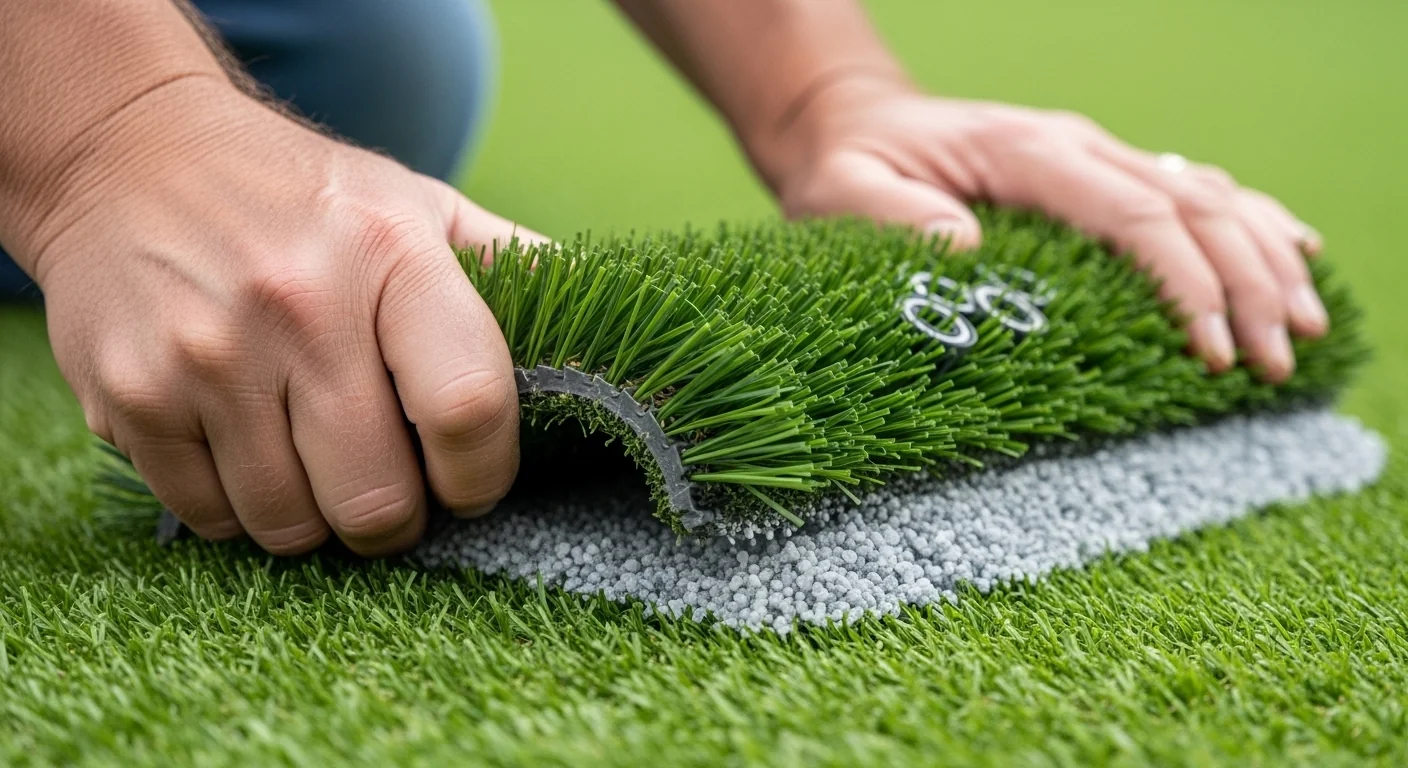
Intuition suggests that more infill is better. The opposite applies above 75% of pile height. Infill above the blade mid-point begins to bury the filaments, reducing their ability to spring back after compression. Matted blades trap moisture, prevent drainage, and create an anaerobic layer at the backing where bacteria proliferate. In pet-use zones, this accelerates odor development by an order of magnitude.
Fix: Use the fill depth output from the calculator as a hard ceiling. After installation, drag a power broom across the surface to stand blades upright; this also distributes infill evenly across the mat.
Mistake: Treating Crumb Rubber as a Cost-Effective Default
Crumb rubber's lower per-bag cost relative to silica is offset entirely by its thermal performance. It retains heat rather than dissipating it, provides no evaporative cooling, and its dark granule color absorbs solar radiation. Installations in climates with more than 20 days per year above 85°F ambient are not appropriate candidates for crumb rubber in any zone where barefoot or paw contact will occur. The surface temperature difference between a correctly-specified silica install and a crumb-rubber install can exceed 60°F on the same day.
Fix: Use the estimated surface temperature output in this calculator to compare material options side-by-side at the same area and pile height. If crumb rubber places the surface in the caution or danger zone, it is not a cost savings. For natural lawn alternatives, the sod calculator provides a useful cost and coverage benchmark for projects weighing synthetic against natural turf.
Next Steps in Your Workflow
After confirming your infill total and material selection, the next step is subsurface preparation. Infill performance depends on the drainage rate of the base layer beneath the turf backing. Compacted decomposed granite, crushed aggregate, or a geosynthetic drainage mat all affect how quickly irrigation or rainfall exits the profile, which in turn affects how long the infill stays saturated enough to provide evaporative cooling benefit. For drainage aggregate sizing, the gravel calculator handles base material by volume and coverage depth, which is the same input structure as infill planning.
Once infill is installed, the surface should be power-broomed in two passes at 90-degree angles to ensure even depth distribution and upright blade recovery. Schedule a follow-up infill top-up at the six-month mark for pet-heavy installations, as compaction under high-traffic zones tends to be uneven regardless of the initial installation quality. For projects that involve any fabric underlayment beneath the aggregate base, sizing the overlap correctly at seams prevents long-term migration. The landscape fabric overlap calculator handles that detail before the base goes in.
FAQ
How much infill does artificial grass need per square foot?
The standard minimum is 1.0 lbs per square foot for low-traffic decorative applications. Active residential use with foot traffic requires 1.0–1.5 lbs per square foot depending on pile height. Pet-heavy zones are typically specified at 1.5 lbs per square foot or higher when zeolite is used, due to zeolite's lower bulk density (55 lbs/cu ft vs. 100 lbs/cu ft for silica sand).
What is the difference between silica sand and zeolite for pet turf?
Silica sand is chemically inert and provides structural support and thermal management. It does not address odor. Zeolite is a naturally occurring aluminosilicate mineral that adsorbs ammonia ions directly into its crystalline matrix, addressing pet urine odor at the source. For pet-heavy installations, zeolite or a silica-zeolite blend is the industry-standard specification.
How hot does artificial grass get without infill?
In direct sun at 90°F ambient temperature, un-infilled synthetic turf surfaces have been documented above 150°F. The plastic filaments act as a thermal heat sink, absorbing and concentrating solar radiation. Third-degree contact burns to paw pads and bare skin can occur within seconds at these temperatures. Silica infill at adequate density is the primary mitigation method.
Can I use crumb rubber infill for a dog yard?
Crumb rubber is not recommended for pet applications. Its dark-colored rubber granules absorb and retain heat rather than dissipating it, providing minimal improvement over un-infilled turf in direct sun. It also provides no odor management and has been a subject of ongoing concern among researchers studying rubber granule leachate in outdoor settings. Zeolite or hydro-chill silica are the preferred alternatives.
How often does turf infill need to be replaced or topped up?
Infill does not degrade, but it does migrate. High-traffic zones, seams near play areas, and edges adjacent to hardscape tend to lose infill density as granules shift laterally or are displaced by foot impact. Pet-heavy installations typically require a top-up at 6–12 months. Low-traffic decorative lawns may need attention every 3–5 years depending on the subbase and maintenance regimen.
What does "hydro-chill" or "antimicrobial" silica infill mean?
Hydro-chill silica is angular silica sand coated with a polymer layer that increases the granule's capacity to hold and evaporate water. This evaporative process reduces surface temperature through the same mechanism as sweating. The antimicrobial designation refers to a secondary coating or additive that inhibits bacterial growth in the infill layer, reducing odor from microbial decomposition of organic material. Both coatings are applied at the mill and do not change the 100 lbs/cu ft bulk density of the base sand.
Conclusion
The artificial grass infill calculator resolves a calculation that most DIY and even professional installs get wrong, not because the math is complex, but because the material variable changes the output dramatically and the thermal consequence of that variable is not visible until a hot afternoon proves the point. Crumb rubber may save on upfront cost per bag; the surface temperature it produces in direct sun removes any safety margin for dogs, children, or barefoot adults. Running the numbers before the material is ordered is the entire point of a tool like this.
The single most preventable mistake in artificial turf infill is selecting raw silica for a pet-use installation because it is the most widely available and least expensive option. The ammonia crystallization problem it creates is not solvable with surface enzyme treatment after the fact. Specification happens before the infill is broomed in. After your calculation is complete, verify that the temperature output is in the safe range and that the material type matches the actual usage pattern of the surface. For a complete picture of the surrounding landscape's material needs, the river rock calculator handles any decorative border aggregate that typically frames artificial turf perimeters in modern landscape designs.