
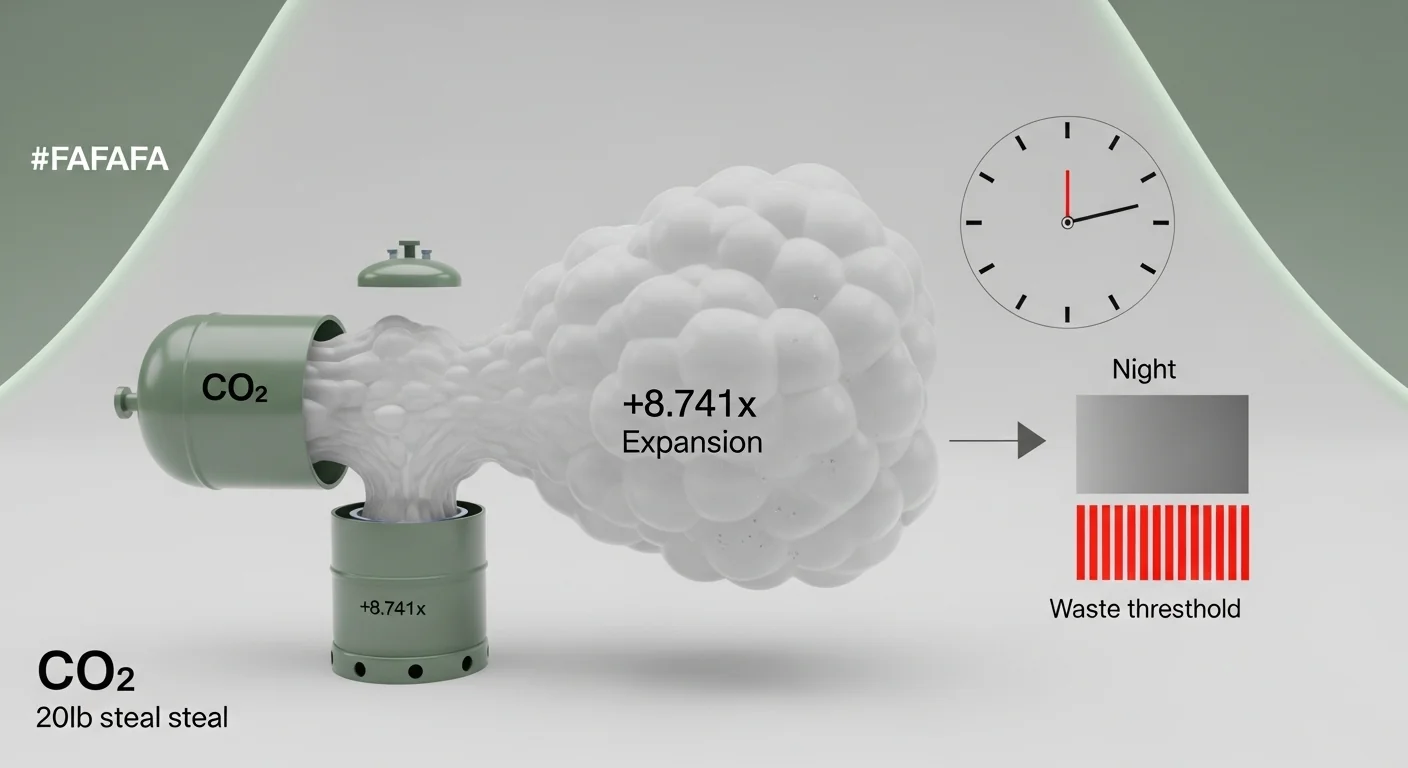
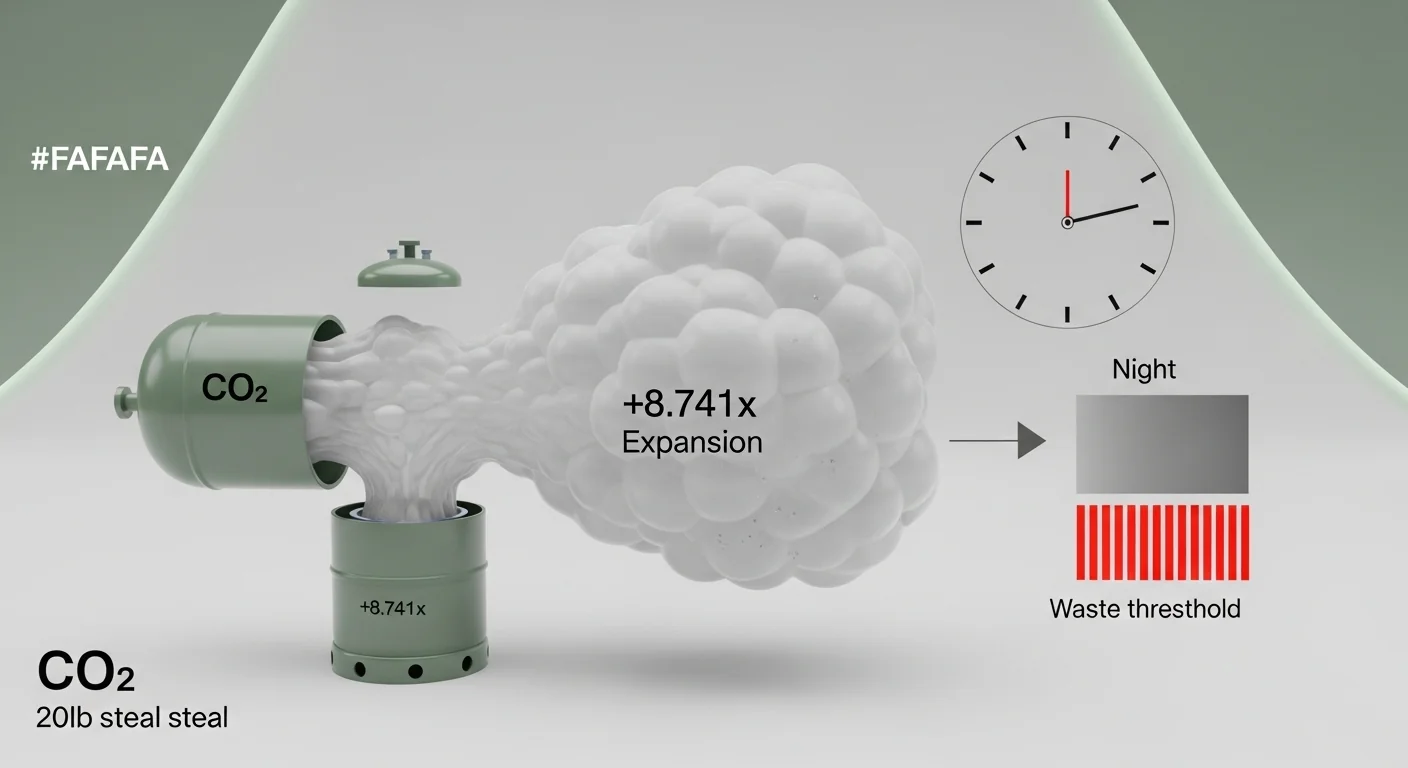
A CO2 regulator set to the wrong timer schedule does two things simultaneously: it drains a tank in days instead of weeks, and it chemically impairs the very plants it was meant to boost. The math behind CO2 supplementation is straightforward, but the setup error that causes both problems is almost universally absent from competing guides. One pound of liquid CO2 expands to 8.741 cubic feet of gas at standard conditions. That number, divided by your regulator’s flow rate, tells you exactly how many hours your tank will last. Divided again by your photoperiod, it tells you how many useful grow days you actually purchased.
This calculator computes tank lifespan based on tank weight, regulator CFH setting, and your lights-on schedule. It does not model room volume, canopy saturation curves, or the rate at which ambient CO2 is replenished through air exchange. For a complete room-level CO2 analysis that accounts for air changes and enrichment targets, the greenhouse CO2 calculator covers those variables. What this tool gives you is a precise burn-rate answer and a clear warning when your timer schedule is working against you.
After running this calculator, you will know whether your current tank-plus-CFH combination will outlast your grow stage, and whether your timer schedule is burning CO2 during the dark cycle when plants cannot use it.
Use the Tool
CO2 Tank Duration Calculator
Calculate how long your CO2 tank lasts — and avoid the nighttime poison mistake.
How this calculator works
Step 1 — Total gas in cubic feet: CO2 tanks are sold by weight (lbs). One pound of liquid CO2 expands to 8.741 cubic feet of gas.
Step 2 — Burn rate in hours: Divide total gas by your regulator’s CFH setting to find how many hours the tank will last if run continuously.
Step 3 — Lifespan in days: Plants only use CO2 during the light cycle (photosynthesis). Divide the burn rate by your photoperiod.
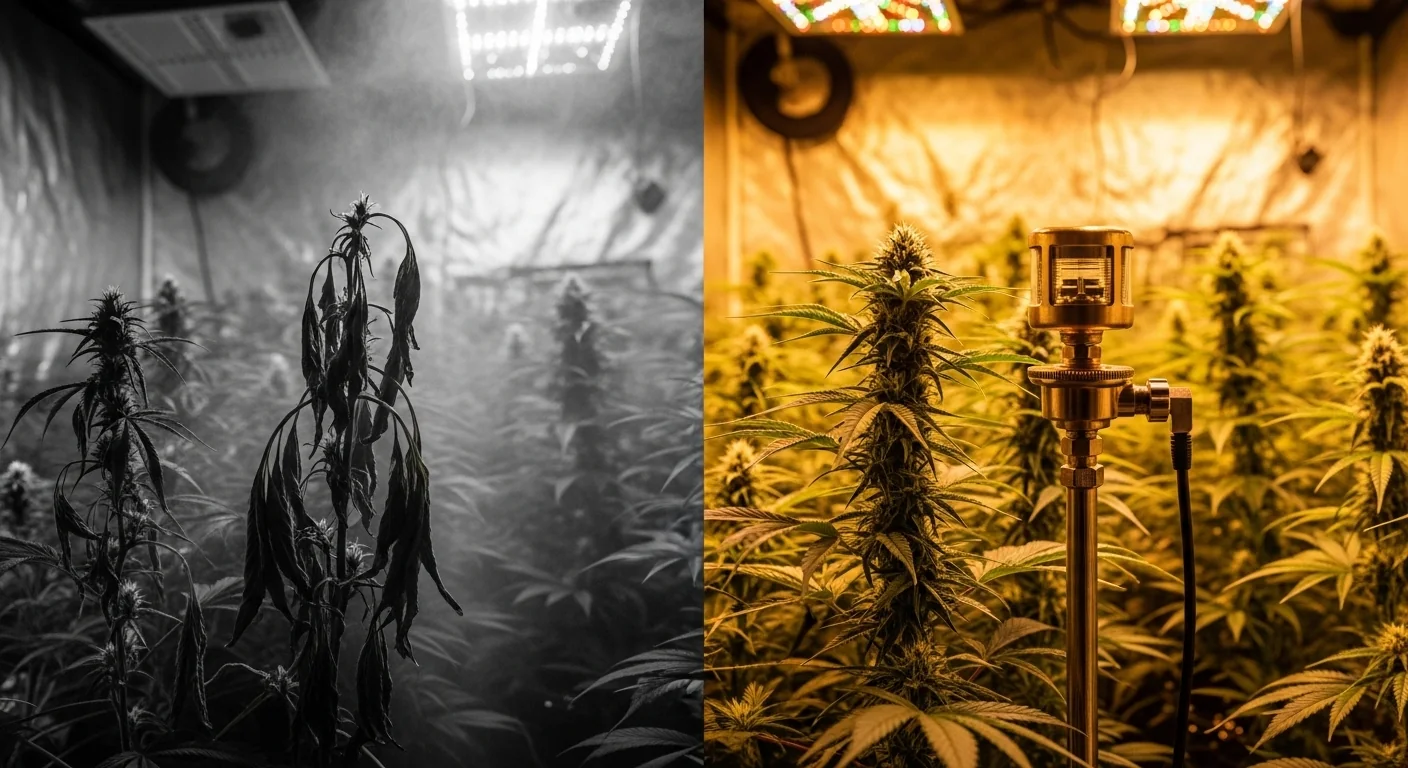
Key insight: If you run your regulator 24/7, you waste all nighttime CO2 and can chemically poison your plants by forcing stomatal closure.
| Tank Size | Total Gas (cu ft) | Burn Rate (hrs) | Duration (days) | 24/7 Waste Rate |
|---|
- Titan Controls CO2 Regulator with Photocell Sensor — auto-shuts off at night
- Autopilot Desktop CO2 Monitor — real-time PPM readout for precise control
- 50 lb Aluminum CO2 Cylinder — fewer refills, lower cost per cu ft
- Teflon Tape — seal regulator fittings to eliminate slow CO2 leaks
Assumptions & Limits
- Conversion factor: 1 lb of liquid CO2 = 8.741 cu ft of gas at standard temperature and pressure (STP, 68°F / 1 atm). Actual yield may vary slightly with ambient temperature.
- Regulator efficiency: Assumes the regulator runs at a constant CFH. Solenoid-based timers or photocell sensors will dramatically improve real-world duration by cutting nighttime flow.
- CO2 PPM input: Used for safety classification only. The duration calculation is based on CFH flow rate — PPM affects how quickly a room reaches target concentration, not how long the tank lasts per day.
- Room size not modeled: This calculator estimates tank depletion time, not whether your flow rate is appropriate for your room volume. For room-size matching, use a dedicated CFH-per-cubic-foot calculator.
- Nighttime definition: “Lights off” hours = 24 − Photoperiod. CO2 released during lights-off is 100% wasted and potentially harmful to plants above 2000 PPM.
- Safe PPM range: 1000–1500 PPM during lights-on is the standard grow range. Above 2000 PPM can stress plants. Below 400 PPM limits photosynthesis.
Before entering your numbers, have the following on hand: the weight printed on your CO2 cylinder (in pounds), your regulator’s flow rate dial reading (in cubic feet per hour, or CFH), your target room CO2 level in PPM, and your daily light schedule. CFH is not the same as PSI — PSI is tank pressure, CFH is the actual gas flow rate set by your regulator needle valve or preset knob. If you are unsure of your flow rate, check the regulator label or your brand’s spec sheet before entering a number.
Quick Start (60 Seconds)
- Tank size in pounds: Use the weight on the cylinder label, not the tare weight. A “20 lb CO2 tank” holds 20 lbs of liquid CO2; the cylinder itself weighs more. Enter only the CO2 content weight.
- Target room CO2 (PPM): This is your enrichment setpoint, not ambient air. Ambient air runs near 400 PPM. Most grow room targets fall between 1,000 and 1,500 PPM. The tool uses this value for safety classification, not lifespan math.
- Regulator flow rate (CFH): Enter the rate your regulator is currently set to deliver. Common settings range from 1 to 4 CFH. Do not enter PSI. If your regulator shows both, you want CFH.
- Photoperiod (lights-on hours per day): Enter only the hours your lights are actually on. Vegetative stages typically run 16 to 18 hours; flower typically runs 12 hours. This is the most commonly entered wrong field — do not enter a 24/7 photoperiod unless your room genuinely runs continuous light.
- Click Calculate: Results appear below the button. The gauge bar shows how much of your tank gas is available to plants vs. wasted overnight. A result below the 50% marker signals a serious timer problem.
- Reset between scenarios: Use the Reset button to clear fields when comparing tank sizes or CFH settings side by side.
Inputs and Outputs (What Each Field Means)
| Field | Unit | What it represents | Most common entry mistake | Safe entry guidance |
|---|---|---|---|---|
| CO2 Tank Size | Pounds (lbs) | Weight of liquid CO2 inside the cylinder, which expands to gas at 8.741 cu ft per pound | Entering the cylinder’s total weight (including the steel shell) instead of the CO2 fill weight | Use the weight printed after “CO2” or “Net Weight” on the label. Common fills: 5, 10, 20, 50 lb. |
| Target Room CO2 | PPM | The CO2 concentration setpoint for the grow room during lights-on periods | Entering ambient outdoor CO2 (around 420 PPM) instead of the enrichment target | Enter your desired enrichment level. Optimal grow range is 1,000 to 1,500 PPM. Valid range: 400 to 2,000 PPM. |
| Regulator Flow Rate | CFH (cubic feet per hour) | The volume of CO2 gas delivered per hour by the regulator needle valve | Confusing PSI (tank pressure) with CFH (actual flow). PSI tells you how much gas remains; CFH tells you how fast it leaves. | Read the CFH dial on the regulator face. Most grow room regulators are set between 1 and 4 CFH. Valid range: 0.1 to 50 CFH. |
| Photoperiod (Lights ON) | Hours per day | The number of hours per day that grow lights are active and plants can perform photosynthesis | Entering 24 hours because the timer controls the CO2 independently, or entering total waking hours instead of light hours | Enter only the light-on hours. Veg: 16 to 18 hrs. Flower: 12 hrs. This directly controls how many usable hours of CO2 your tank provides per day. |
| Tank Lifespan (output) | Days | How many grow days the tank will last when CO2 is dispensed only during the photoperiod | N/A (output) | Compare this number against your grow stage length. A 12-day flower stage needs a tank that lasts at least 12 days. |
| Efficiency Gauge (output) | Visual (0 to 100) | Ratio of photoperiod hours to total daily hours — shows what fraction of dispensed CO2 reaches plants during photosynthesis | N/A (output) | Readings below the 50% marker indicate that more than half your CO2 is released at night. This signals a timer or photocell sensor issue. |
For context on how photoperiod interacts with daily light integral, the DLI calculator shows how cumulative light energy maps to your lights-on schedule and affects the photosynthesis window available to CO2 enrichment.
Worked Examples (Real Numbers)
Example 1: Beginner Vegetative Setup with 20 lb Tank
- Tank size: 20 lb
- Target CO2: 1,200 PPM
- Regulator CFH: 2 CFH
- Photoperiod: 18 hours per day
Calculation:
Total gas: 20 × 8.741 = 174.82 cu ft
Burn rate: 174.82 ÷ 2 = 87.41 hours
Lifespan: 87.41 ÷ 18 = 4.86 days
Result: Approximately 4.9 days.
A 20 lb tank at 2 CFH in an 18-hour veg room lasts less than five days. If the grow stage runs three to four weeks, this setup demands six or more refills per stage. Upsizing to a 50 lb cylinder or dropping to 1 CFH would extend coverage significantly.
Example 2: Flowering Room with 50 lb Tank
- Tank size: 50 lb
- Target CO2: 1,500 PPM
- Regulator CFH: 1.5 CFH
- Photoperiod: 12 hours per day (flower schedule)
Calculation:
Total gas: 50 × 8.741 = 437.05 cu ft
Burn rate: 437.05 ÷ 1.5 = 291.37 hours
Lifespan: 291.37 ÷ 12 = 24.3 days
Result: Approximately 24.3 days.
A 50 lb tank at 1.5 CFH with a 12-hour flower schedule covers a full 60-day flower stage in under three refills. This is the configuration most growers targeting 1,400 to 1,500 PPM should benchmark against.
Example 3: The 24/7 Mistake (What Happens Without a Timer)
- Tank size: 20 lb
- Target CO2: 1,200 PPM
- Regulator CFH: 2 CFH
- Photoperiod entered: 24 hours (regulator running continuously, no timer)
Calculation:
Total gas: 20 × 8.741 = 174.82 cu ft
Burn rate: 174.82 ÷ 2 = 87.41 hours
Lifespan: 87.41 ÷ 24 = 3.64 days
Result: Approximately 3.6 days.
The same tank that lasted 4.9 days in a properly timed 18-hour room runs dry in under four days when the regulator runs around the clock. Every dark-cycle hour burns gas with zero photosynthetic benefit. At 2 CFH, the 6 dark hours in an 18-hour schedule waste 12 cubic feet of CO2 per night. Over a week, that is 84 cubic feet lost while plants are sleeping.
Reference Table (Fast Lookup)
All values below are computed from the formula using the stated CFH and photoperiod. The “Wasted per Night” column assumes the regulator runs continuously around the clock with no timer or photocell control.
| Tank Size (lb) | CFH Setting | Total Gas (cu ft) | Burn Rate (hrs) | Lifespan at 12-hr Photo (days) | Lifespan at 18-hr Photo (days) | CO2 Wasted per Night (12-hr dark, cu ft) |
|---|---|---|---|---|---|---|
| 5 | 1.0 | 43.7 | 43.7 | 3.6 | 2.4 | 12.0 |
| 10 | 1.0 | 87.4 | 87.4 | 7.3 | 4.9 | 12.0 |
| 10 | 2.0 | 87.4 | 43.7 | 3.6 | 2.4 | 24.0 |
| 20 | 1.0 | 174.8 | 174.8 | 14.6 | 9.7 | 12.0 |
| 20 | 2.0 | 174.8 | 87.4 | 7.3 | 4.9 | 24.0 |
| 20 | 3.0 | 174.8 | 58.3 | 4.9 | 3.2 | 36.0 |
| 50 | 1.5 | 437.1 | 291.4 | 24.3 | 16.2 | 18.0 |
| 50 | 2.0 | 437.1 | 218.5 | 18.2 | 12.1 | 24.0 |
| 50 | 3.0 | 437.1 | 145.7 | 12.1 | 8.1 | 36.0 |
| 100 | 2.0 | 874.1 | 437.1 | 36.4 | 24.3 | 24.0 |
How the Calculation Works (Formula + Assumptions)
Show the calculation steps
Step 1 — Convert tank weight to gas volume.
One pound of liquid CO2, when it vaporizes at standard temperature and pressure (68°F, 1 atmosphere), produces 8.741 cubic feet of gas. Multiply your tank’s fill weight in pounds by this factor to find the total gas volume your cylinder holds.
Total Gas (cu ft) = Tank Size (lb) × 8.741
Step 2 — Calculate the burn rate.
Divide the total gas volume by the regulator’s CFH setting. This gives the number of hours the tank would last if the regulator ran continuously around the clock. This is the raw “continuous” lifespan, which is not the same as grow days.
Burn Rate (hrs) = Total Gas (cu ft) ÷ CFH Setting
Step 3 — Convert to grow days using photoperiod.
Plants can only use CO2 during photosynthesis — meaning during the lights-on window. Divide the burn rate in hours by the number of hours lights are on per day. This converts continuous-runtime hours into useful grow days, assuming the regulator is triggered only during the photoperiod.
Lifespan (days) = Burn Rate (hrs) ÷ Photoperiod (hrs/day)
Rounding: Results are displayed to one decimal place. For planning purposes, round down to the nearest whole day as a conservative refill buffer.
Units check: lb × (cu ft / lb) = cu ft. cu ft ÷ (cu ft / hr) = hrs. hrs ÷ (hrs / day) = days. Unit chain is consistent throughout.
Assumptions and Limits
- Conversion factor precision: The 8.741 cu ft/lb factor applies at standard temperature (68°F) and standard pressure (1 atm). At significantly higher ambient temperatures (above 85°F), liquid CO2 vaporizes faster and tank pressure rises, but the total gas volume per pound remains nearly identical for planning purposes.
- Constant CFH assumption: The formula treats CFH as a fixed flow rate. In practice, regulators with non-compensated designs may deliver slightly different flow rates as tank pressure drops near empty. This introduces a small underestimate in duration as the tank depletes below 25%.
- PPM setpoint is informational: The target PPM input is used by the tool for safety classification and warnings only. It does not alter the lifespan calculation. How quickly a room reaches a target PPM depends on room volume, air exchange rate, and canopy density — factors not modeled here.
- Perfect timer assumed: The lifespan calculation assumes the regulator delivers gas only during photoperiod hours. If the regulator runs continuously (no solenoid, no photocell), actual duration is shorter and equals Burn Rate ÷ 24 instead.
- No leak factor: The tool does not account for slow leaks at fittings, worn regulator seats, or overpressure relief events. Real-world duration may be shorter if fittings are not sealed with Teflon tape and periodically leak-tested.
- Room size not modeled: This calculator answers “how long will the tank last” — not “is this CFH rate appropriate for my room volume.” Matching CFH to room size requires a room-volume-based calculation that factors in air changes per hour and target PPM rise rate.
- Nighttime CO2 accumulation: In sealed rooms with poor dark-period ventilation, CO2 released at night can accumulate to concentrations above 2,000 PPM by morning. This tool does not model accumulation curves; it only flags continuous-flow operation as a risk pattern.
Standards, Safety Checks, and “Secret Sauce” Warnings
Critical Warnings
- 24/7 regulator operation is a two-sided failure. Running CO2 continuously drains the tank faster than growers expect and simultaneously exposes plants to elevated CO2 during the dark cycle. Plants exhale CO2 at night rather than absorbing it. Concentrations above 1,500 PPM in complete darkness have been documented to force stomata into a closed position — a stress response that carries into the next light cycle, reducing uptake efficiency exactly when you want CO2 working hardest.
- The tank empties silently. There is no audible or visual alert when a pressurized CO2 cylinder drops to empty. Growers running high CFH settings on small tanks frequently discover an empty cylinder days after it ran dry. A desktop CO2 monitor with an alarm set to trigger when room PPM drops below your setpoint is the only reliable early warning system.
- PPM above 2,000 in an unventilated room poses a health risk to humans. OSHA sets the permissible exposure limit for CO2 at 5,000 PPM (time-weighted average). In a sealed 4×4 tent running 1,500 PPM with a 3 CFH regulator and no ventilation, CO2 concentrations can reach dangerous levels within minutes if a person enters. Always ventilate before entering a sealed CO2-enriched space.
- Regulator flow drift at low tank pressure. When a CO2 cylinder drops below approximately 200 PSI, the liquid CO2 inside is nearly depleted and the tank begins delivering gas-phase CO2. Flow rates can become erratic, and some cheaper regulators may creep to a higher CFH than the dial setting. Monitor actual room PPM in the final days of a tank’s life rather than relying on the calculated schedule.
Minimum Standards
- CO2 enrichment is only productive when grow lights are on and plants are actively photosynthesizing. Regulator operation must be tied to the light schedule via a timer, solenoid valve, or photocell-equipped regulator.
- Optimal CO2 enrichment range for most crop species in a sealed grow room: 1,000 to 1,500 PPM. Below 800 PPM, supplemental CO2 provides minimal measurable benefit over ambient air. Above 1,500 PPM, returns diminish and the risk of nighttime toxicity increases if the timer fails.
- Tank sizes below 10 lb are suitable for small-scale trials and propagation spaces only. For any flowering room running a 60-day cycle, a 50 lb aluminum cylinder is the practical minimum for continuous supplementation without weekly refills.
The Competitor Trap: Nearly every “how long does a CO2 tank last” article and calculator on the web computes burn rate as Total Gas ÷ CFH and stops there — outputting a number in raw hours that the grower must manually divide by their photoperiod. That approach buries the critical insight. Raw hours make a 20 lb tank at 2 CFH look like it lasts 87 hours, which sounds reasonable. Divided by the correct 18-hour photoperiod, that is 4.9 grow days. Divided incorrectly by 24 because the regulator has no timer, it becomes 3.6 days — and the plants are being chemically stressed every night. The distinction between burn rate and grow days is not a minor rounding difference; it is the variable that determines whether a setup is sustainable or a recurring problem.
Stomatal behavior under elevated nighttime CO2 is one variable among many that affect grow room climate health. If your room also shows signs of moisture stress or leaf curl in the morning, the VPD calculator can help determine whether vapor pressure deficit — not CO2 toxicity — is contributing to those symptoms. The two variables interact: a stomata-closing CO2 event at night reduces transpiration, which alters the next day’s VPD baseline.
If your setup uses a CO2 burner rather than a compressed cylinder, heat output from combustion is a separate sizing consideration. The CO2 burner heat calculator handles the BTU contribution from natural gas or propane burners, which affects HVAC load in a way that compressed tank CO2 does not.
Common Mistakes and Fixes
Mistake: Running the Regulator Without a Timer or Photocell Sensor
This is the single most expensive CO2 mistake in controlled environment agriculture. A regulator dispensing CO2 through the dark cycle burns through a tank in a fraction of the expected time while delivering zero photosynthetic benefit. At 2 CFH and a 12-hour dark period, that is 24 cubic feet of CO2 released per night with no uptake. The fix is direct: wire the regulator’s solenoid valve to the same timer circuit as the grow lights, or purchase a regulator with an integrated photocell that shuts off at light loss.
Mistake: Choosing Tank Size Based on Physical Convenience Rather Than
Grow Stage Length
A 20 lb tank fits neatly in most grow tents and is easy to transport for refilling. It is also frequently undersized for the job. At 2 CFH and a 12-hour photoperiod, a 20 lb tank lasts 7.3 days. A 60-day flower cycle requires more than eight full tank swaps at that configuration. The refill disruption — and the risk of the tank running dry mid-week — makes the small cylinder a false economy. A 50 lb aluminum cylinder at the same CFH covers 18 days per fill, cutting refills to roughly three per flower cycle. Size the tank to the stage, not to the tent door.
Mistake: Confusing PSI with CFH When Setting the Regulator
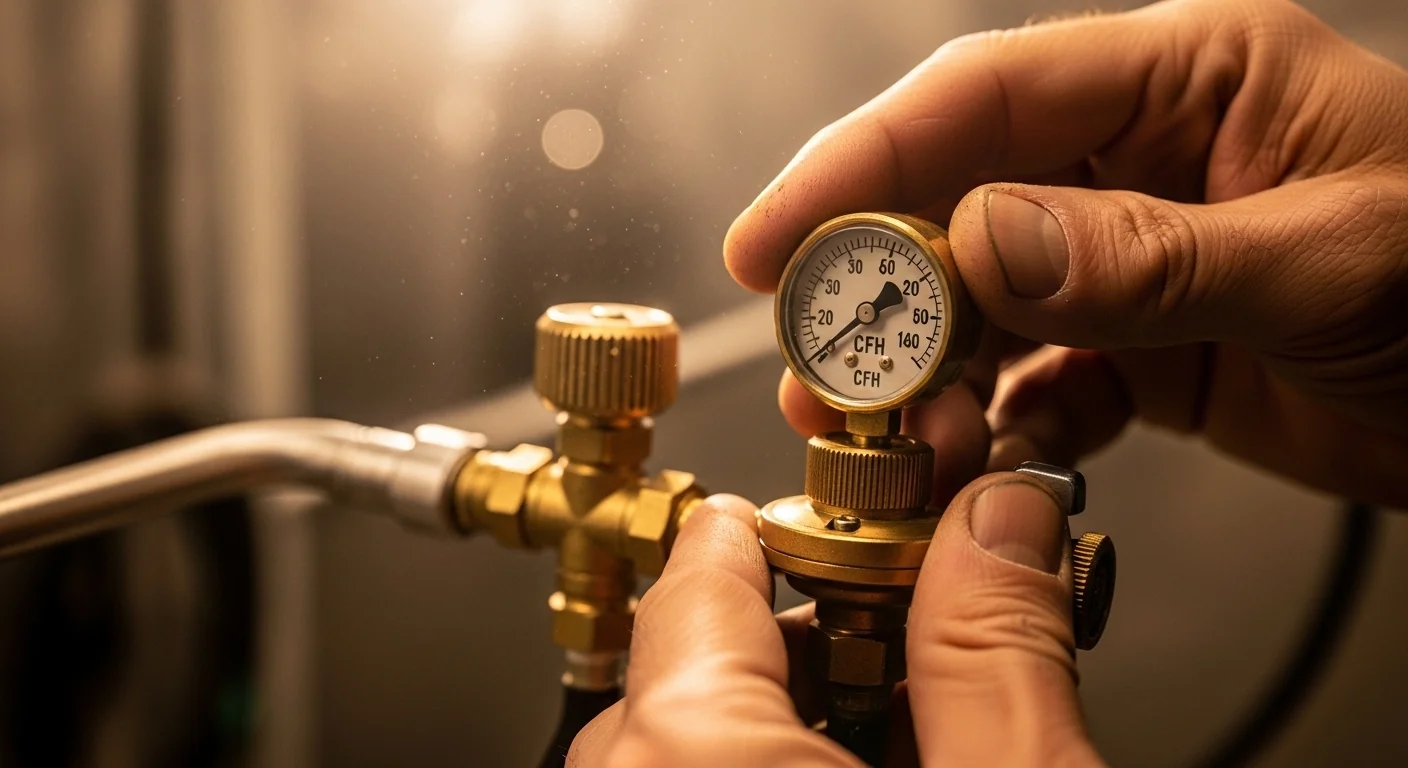
Regulators have two gauges: a high-pressure gauge (PSI) showing remaining tank pressure, and a low-pressure or flow gauge (CFH or LPM) showing the delivery rate. Growers new to CO2 supplementation sometimes read PSI as their flow rate, then enter that number into a calculator. A 20 lb tank at 800 PSI (a typical full-tank reading) entered as 800 CFH would produce a wildly incorrect result. Always read the flow rate gauge — the one on the output side of the regulator body — not the tank pressure gauge.
Mistake: Ignoring Air Exchange Rate When Setting CFH
CO2 enrichment only works in sealed or near-sealed grow environments. A room with active exhaust fans running continuously bleeds enriched air faster than a regulator can replenish it. The result is a tank that drains at the calculated rate while room CO2 never climbs above ambient. Before investing in supplemental CO2, confirm that your exhaust strategy includes a CO2-aware control mode — such as running exhaust only when temperature or humidity thresholds are exceeded, not continuously. Managing tent climate for CO2 retention requires right-sizing your grow tent fan to handle temperature and humidity spikes during the CO2 accumulation window rather than running at full speed around the clock.
Mistake: Not Accounting for Tank Lifespan Against the Grow Stage
Calendar
Calculating tank duration as a standalone number without mapping it against the actual grow stage schedule leads to mid-cycle shortages. A 50 lb tank lasting 18 days seems comfortable until you realize your flower stage is 63 days and your CO2 supplier is closed on weekends. The correct approach is to compute how many tanks you need for the entire stage (stage days ÷ tank lifespan, rounded up) and schedule refills at least three days before the predicted empty date. Build in a two-day buffer minimum to account for flow rate inconsistency near the end of tank life.
Next Steps in Your Workflow
Once you have confirmed your tank-to-CFH ratio will cover your grow stage, the next calibration step is verifying your room’s temperature and humidity response under a sealed CO2 regime. Sealed rooms accumulate heat and moisture faster than rooms with continuous exchange. After sealing for CO2 retention, most growers find they need to revisit their dehumidification capacity — the grow room dehumidifier calculator sizes removal capacity against your canopy’s transpiration rate and ambient infiltration, which changes when you close the exhaust damper for CO2.
The second planning task is odor management. CO2 supplementation and carbon filtration are often planned separately, but they share the same air handling system. If your exhaust runs only episodically (to preserve CO2), your carbon filter sees less total airflow — which can affect odor control performance during those non-exhaust windows. Before finalizing your system, use the grow room carbon filter sizing calculator to confirm your filter capacity matches the episodic peak flows your exhaust strategy will produce, not just the average CFM.
FAQ
How long does a 20 lb CO2 tank last in a grow room?
It depends on your regulator’s CFH setting and your photoperiod. At 2 CFH with an 18-hour light schedule and a properly timed regulator, a 20 lb tank lasts approximately 4.9 days. At 1 CFH with the same schedule, it lasts about 9.7 days. Entering your specific settings into the calculator above gives a precise figure for your configuration.
What CFH setting should I use on my CO2 regulator?
CFH depends on room volume, target PPM, and air exchange rate. For a sealed 4×4 tent (roughly 128 cubic feet), 1 to 2 CFH is typical. Larger sealed rooms may require 3 to 4 CFH to maintain 1,200 to 1,500 PPM. There is no universal correct setting — the right CFH is the rate that holds your target PPM stable without rapid cycling. A desktop CO2 monitor is necessary to dial in the correct flow for your specific room.
Can high CO2 levels hurt plants at night?
Yes. Plants do not absorb CO2 in darkness because photosynthesis requires light. More critically, CO2 concentrations above 1,500 PPM during the dark period have been associated with stomatal closure, a defensive response that can persist into the next light cycle. This reduces CO2 and water uptake when the lights come on, partially negating the benefit of supplementation during the day.
What is the difference between PSI and CFH on a CO2 regulator?
PSI (pounds per square inch) measures the pressure remaining in the tank — it indicates how much CO2 is left, not how fast it is flowing. CFH (cubic feet per hour) is the actual delivery rate set by the needle valve on the output side of the regulator. The duration calculator requires CFH. PSI is useful for monitoring tank fill level only.
Why does my CO2 tank seem to empty faster than the calculator
predicts?
The most common causes are: the regulator running during dark-cycle hours (no timer), slow leaks at fittings not sealed with Teflon tape, a higher-than-dialed flow rate from a worn needle valve, or the tank being only partially filled at the last refill. If your actual duration is consistently shorter than calculated, leak-test all connections with soapy water and verify your actual CFH output with a flow meter rather than relying solely on the dial.
Is a 5 lb CO2 tank enough for a small grow tent?
For very small tents (2×2 or propagation chambers) at 1 CFH, a 5 lb tank lasts approximately 3.6 days at a 12-hour photoperiod — under four days. This is a viable short-term option for seedling or clone stages measured in days, not weeks. For any vegetative or flowering stage lasting more than two weeks, a 5 lb tank creates a refill burden that most growers find impractical. A 20 lb or 50 lb cylinder is more appropriate for extended grow cycles.
Conclusion
After running your numbers, the two highest-impact fixes available to any CO2 user are switching to a timer-controlled solenoid (or a photocell-equipped regulator) and upsizing to a 50 lb aluminum cylinder if your stage duration exceeds ten days. Both changes reduce refill frequency, protect against nighttime exposure, and lower effective cost per cubic foot of CO2 delivered to plants. For growers integrating CO2 enrichment into a broader climate control strategy, the grow room AC sizing calculator can help account for the additional sensible heat load a sealed, CO2-enriched room accumulates when exhaust cycles are reduced.