
Soil pH is not a setting you dial in once and forget. It drifts, it varies by depth, and it responds differently depending on whether you are working sandy loam versus heavy clay. The practical problem most applicators face is not knowing the rate: how many pounds of lime, for a specific area, based on the actual gap between their current and target pH values.
Soil pH Lime Calculator
Calculate lime application rate to raise soil pH to your target level.
| pH Change Needed | Rate (lbs/1k sq ft) | Total for Area |
|---|
How This Calculator Works
Formula: The lime requirement is calculated using a standard lookup table where a known number of pounds per 1,000 sq ft is needed to raise pH by 1.0 unit. This base rate is then adjusted for lime type and scaled to your total area.
Units: Area in square feet (sq ft), lime in pounds (lbs).
Assumptions & Limits
This calculator assumes:
- Standard loam or clay-loam soil buffer capacity. Sandy soils may need less; heavy clay soils may need more.
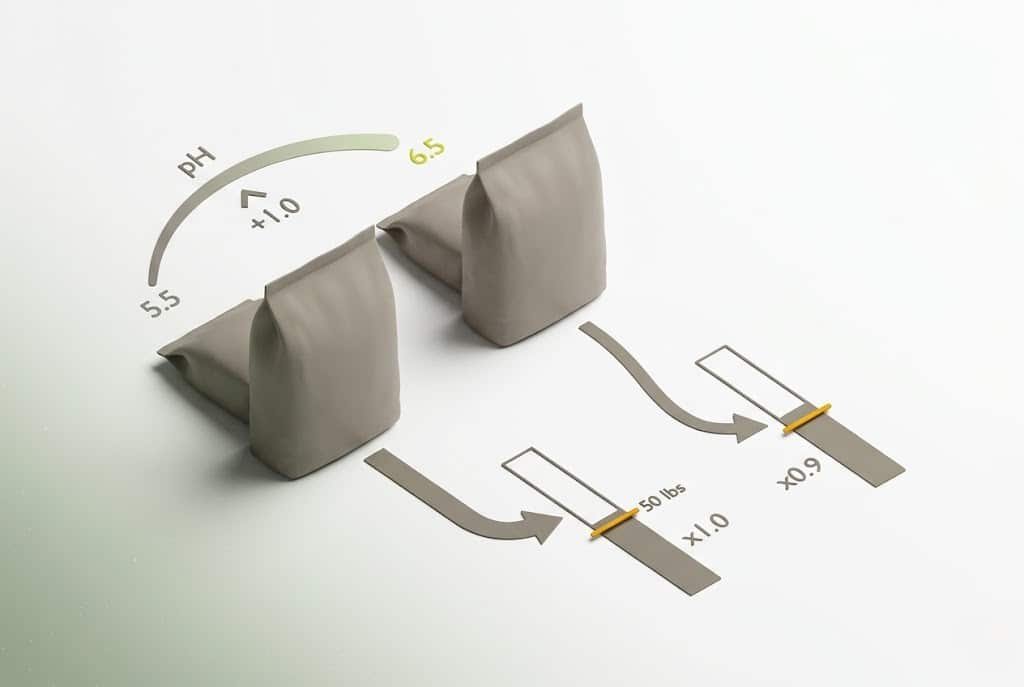
- Base rate of 50 lbs per 1,000 sq ft raises pH by 1.0 unit — this is an industry-average estimate.
- Calcitic lime uses a neutralizing factor of 1.0×; Dolomitic uses 0.9× (slightly more efficient per pound).
- Application is to the top 6–8 inches of soil, tilled in for best results.
- Results are estimates — a certified soil test from your local cooperative extension is recommended before large applications.
- Do not apply more than 50 lbs per 1,000 sq ft per season without professional guidance.
- Input pH range: 3.5–8.5. Output capped at pH raises up to 3.0 units at a time.
This soil pH lime calculator takes three measured inputs (current pH, target pH, and area in square feet) plus your lime product type and returns a pound-based lime requirement derived from the standard benchmark of 50 lbs per 1,000 sq ft per 1.0 pH unit. It does not replace a laboratory soil buffer test, and it does not account for organic matter content or precise cation exchange capacity. What it does provide is a defensible starting estimate tied to a named formula.
After using this calculator, you can decide how many bags of lime to purchase and whether your required correction is large enough to warrant splitting across two growing seasons.

Use the Tool
Before you run the calculation, have four pieces of information ready: your soil test result showing current pH (a number like 5.4 or 6.1), your target pH for the crop or lawn type you are growing, the total area in square feet that you plan to treat, and the lime product type (calcitic or dolomitic) listed on your bag or bulk order. Area must be in square feet; if you know your lot in acres, multiply by 43,560 to convert.
If you are working with a large agricultural footprint rather than a residential lawn or garden, see the agricultural lime calculator for acreage-based outputs that also account for lime fineness grades.
Quick Start (60 Seconds)
- Current Soil pH: Enter the active pH from your soil test report. Accepted range is 3.5 to 8.5. Do not enter the buffer pH here; that is a separate lab value.
- Target Soil pH: Enter your goal pH. For most vegetable crops and cool-season turfgrasses, 6.0 to 6.8 is the standard range. The target must be higher than the current pH or the tool will flag an error.
- Area (sq ft): Measure the area to be treated, not your total property. Treating only a raised bed? Enter only that footprint.
- Lime Type: Select calcitic if your product is labeled as calcium carbonate (CaCO3). Select dolomitic if it contains both calcium and magnesium (CaMg(CO3)2). When unsure, check the guaranteed analysis on the bag.
- Common input mistake: Entering the target pH lower than or equal to the current pH. Lime raises pH; the tool will return an error if target is not greater than current.
- Unit reminder: All area inputs are in square feet. The output is in pounds (lbs). Convert acres to sq ft before entering if needed (1 acre = 43,560 sq ft).
- Click Calculate, not Enter: The calculation runs only when the Calculate button is pressed after all four fields are filled. Incomplete forms will show inline field errors, not a result.
Inputs and Outputs (What Each Field Means)
| Field | Unit | What It Means | Common Mistake | Safe Entry Guidance |
|---|---|---|---|---|
| Current Soil pH | pH units (3.5 to 8.5) | The active pH of your soil as measured by a soil test. Represents hydrogen ion concentration on a logarithmic scale. | Entering the buffer pH or EC reading from the same report instead of the active pH value. | Use the value labeled "Soil pH" or "Active pH" on the lab report. If your test only shows buffer pH, contact the lab for active pH. |
| Target Soil pH | pH units (4.0 to 8.0) | The pH level required for your intended crop, lawn grass, or plant type. Defines the size of the correction needed. | Using a crop's optimal range midpoint without accounting for soil type, which may require a different target for proper buffer. | Must exceed current pH. Research the pH preference for your specific plant; for most grasses and vegetables, 6.0 to 6.8 is appropriate. |
| Area | Square feet (sq ft) | The actual ground surface to receive lime application. Determines the total volume of product needed by scaling rate per 1,000 sq ft. | Entering total property size instead of the specific treatment zone, resulting in a dramatic overestimate. | Measure length x width for rectangular areas. For irregular areas, break into sections and sum. Minimum entry: 1 sq ft. |
| Lime Type | Category (Calcitic or Dolomitic) | Product type determines the neutralizing efficiency factor applied. Dolomitic lime uses a 0.9 factor; calcitic uses 1.0. | Selecting calcitic when the bag contains dolomitic, skewing the estimate by about 10% per application. | Read the guaranteed analysis on your bag. "High-calcium lime" is calcitic. "Ag lime" with Mg listed is typically dolomitic. |
| Total Lime Required (Output) | Pounds (lbs) | The total pounds of lime product needed to achieve the target pH correction across the specified area. | Treating this output as a single-application maximum. If it exceeds 50 lbs per 1,000 sq ft, splitting is required. | Compare the per-1,000 sq ft rate shown in the breakdown. If it exceeds 50, plan to apply in two or more seasonal applications. |
| Rate per 1,000 sq ft (Output) | lbs per 1,000 sq ft | The application density derived from the formula before area scaling. This is the operational number to watch against the 50 lbs threshold. | Ignoring this field and only looking at the total pounds figure, which can be large for big areas without triggering a per-unit flag. | If this value exceeds 50, split the application. Do not apply more than 50 lbs per 1,000 sq ft in a single season. |
| Lime Type Factor (Output) | Multiplier (0.9 or 1.0) | The efficiency coefficient applied to the base rate based on lime product type. Dolomitic is slightly more efficient at neutralization per pound. | Assuming both lime types require the same quantity. Dolomitic needs roughly 10% fewer pounds than calcitic for the same pH shift. | No entry required; this is a computed output. Verify it matches your selected product type in the results breakdown. |
Worked Examples (Real Numbers)
Example 1: Residential Lawn, Minor Correction
- Current pH: 5.5
- Target pH: 6.5
- Area: 2,000 sq ft
- Lime type: Calcitic (factor 1.0)
pH Change = 6.5 - 5.5 = 1.0 unit
Rate per 1,000 sq ft = 1.0 x 50 x 1.0 = 50 lbs per 1,000 sq ft
Total = 50 x (2,000 / 1,000) = 50 x 2 = 100 lbs
Result: 100 lbs of calcitic lime across 2,000 sq ft.
This falls exactly at the single-application threshold (50 lbs per 1,000 sq ft), so it can be applied in one pass with no seasonal split required. The correction is straightforward for a loam-type lawn soil.
Example 2: Vegetable Garden, Moderate Correction with Dolomitic Lime
- Current pH: 5.0
- Target pH: 6.5
- Area: 500 sq ft
- Lime type: Dolomitic (factor 0.9)
pH Change = 6.5 - 5.0 = 1.5 units
Rate per 1,000 sq ft = 1.5 x 50 x 0.9 = 67.5 lbs per 1,000 sq ft
Total = 67.5 x (500 / 1,000) = 67.5 x 0.5 = 33.75 lbs (rounded to 34 lbs)
Result: 34 lbs of dolomitic lime across 500 sq ft.
Although the per-1,000 sq ft rate (67.5 lbs) exceeds the single-season threshold, the small area means the total product volume is manageable. The rate flagging matters here: if this garden were 5,000 sq ft instead, the calculation would require a seasonal split to avoid over-liming. Since the area is small and the total is 34 lbs, applying at once is acceptable, but monitoring pH at 90 days post-application is advisable.
Example 3: Backyard Field Plot, Large-Area Agricultural Correction
- Current pH: 5.8
- Target pH: 6.8
- Area: 10,000 sq ft
- Lime type: Dolomitic (factor 0.9)
pH Change = 6.8 - 5.8 = 1.0 unit
Rate per 1,000 sq ft = 1.0 x 50 x 0.9 = 45 lbs per 1,000 sq ft
Total = 45 x (10,000 / 1,000) = 45 x 10 = 450 lbs
Result: 450 lbs of dolomitic lime across 10,000 sq ft.
The per-1,000 sq ft rate of 45 lbs stays under the 50 lbs threshold, so a single-season application is within the standard safe range. At this scale, buying in bulk (per-ton pricing) is typically more cost-effective than purchasing 50 lb bags. Tilling in the lime after spreading is strongly recommended to accelerate pH response in the root zone.
Reference Table (Fast Lookup)
All values below are computed using the formula: Rate = pH Change x 50 x Lime Factor. Area-scaled totals assume calcitic lime unless noted. Use this table to quickly estimate whether your correction requires splitting across seasons (threshold: 50 lbs per 1,000 sq ft per application).
| pH Change Needed | Calcitic Rate (lbs / 1k sq ft) | Dolomitic Rate (lbs / 1k sq ft) | Total: 1,000 sq ft (Calcitic) | Total: 5,000 sq ft (Calcitic) | Total: 10,000 sq ft (Calcitic) | Split Applications Needed? |
|---|---|---|---|---|---|---|
| +0.5 units | 25 | 22.5 | 25 lbs | 125 lbs | 250 lbs | No |
| +1.0 units | 50 | 45 | 50 lbs | 250 lbs | 500 lbs | At threshold (monitor) |
| +1.5 units | 75 | 67.5 | 75 lbs | 375 lbs | 750 lbs | Yes (2 seasons) |
| +2.0 units | 100 | 90 | 100 lbs | 500 lbs | 1,000 lbs | Yes (2 seasons) |
| +2.5 units | 125 | 112.5 | 125 lbs | 625 lbs | 1,250 lbs | Yes (3 seasons) |
| +3.0 units | 150 | 135 | 150 lbs | 750 lbs | 1,500 lbs | Yes (3 seasons) |
| +3.5 units | 175 | 157.5 | 175 lbs | 875 lbs | 1,750 lbs | Yes (4 seasons) |
| +4.0 units | 200 | 180 | 200 lbs | 1,000 lbs | 2,000 lbs | Yes (4+ seasons) |
Note: Dolomitic values are 10% lower per row. To compute totals for dolomitic lime at any area, multiply the Dolomitic Rate column by your area divided by 1,000.
How the Calculation Works (Formula + Assumptions)
Show the calculation steps
Step 1 - pH Change: Subtract current pH from target pH.
pH Change = Target pH - Current pH
Step 2 - Base Rate: The industry standard benchmark is 50 lbs of ground agricultural lime per 1,000 sq ft to raise pH by 1.0 unit in average loam soil. This is the constant used in the formula.
Step 3 - Lime Type Factor:
Calcitic lime (CaCO3): factor = 1.0
Dolomitic lime (CaMg(CO3)2): factor = 0.9 (slightly higher neutralizing efficiency per pound due to magnesium carbonate content)
Step 4 - Adjusted Rate per 1,000 sq ft:
Rate = pH Change x 50 x Lime Type Factor
Step 5 - Scale to total area:
Total Lime (lbs) = Rate x (Area in sq ft / 1,000)
Rounding: The tool outputs the exact decimal result; round up to the nearest whole pound when purchasing. Never round down on a lime purchase.
Unit note: All outputs are in pounds (lbs). No unit conversion is applied inside the formula. Area must be entered in square feet.
For soil buffer capacity context, see the CEC soil calculator, which quantifies how strongly your soil resists pH change based on clay and organic matter content.

Assumptions and Limits
- The base rate of 50 lbs per 1,000 sq ft per 1.0 pH unit applies to average loam or clay-loam soils with moderate buffering capacity. Sandy soils typically require 30 to 40 lbs per 1,000 sq ft for the same shift; heavy clay can require 60 to 80 lbs or more.
- The tool does not account for organic matter content. High-organic soils (peat, muck, compost-amended beds) have significantly higher buffer capacity and may require two to three times the estimated quantity.
- Calcitic lime purity varies by product. This calculator assumes standard agricultural-grade limestone with a neutralizing value (NV) near 90 to 100. Hydrated lime or burnt lime (quicklime) has a different NV and should not use these rates.
- Results assume lime is incorporated into the top 6 to 8 inches of soil by tilling. Surface-only application slows pH response substantially and makes the estimate less reliable for the first season.
- The dolomitic lime factor of 0.9 is an approximation based on typical NV comparisons between product types. Actual product NV should be checked on the label for precision applications.
- pH corrections beyond 2.0 units in a single season carry meaningful risk of over-liming. The tool flags this condition but does not automatically cap the result; the decision to split applications remains with the applicator.
- This calculator uses active soil pH, not buffer pH. If only buffer pH is available from a lab report, the estimated lime requirement will differ from what a full buffer-pH-based recommendation would produce.
Standards, Safety Checks, and "Secret Sauce" Warnings
Critical Warnings
- Do not exceed 50 lbs per 1,000 sq ft in a single application. Applying more than this threshold in one pass risks rapid pH overshoot, which locks out manganese, boron, and iron from plant uptake even before visual symptoms appear. The standard threshold exists because soil buffering lags behind product dissolution by several weeks.

- Raising pH by 2.0 or more units requires a multi-season plan. The logarithmic nature of the pH scale means each full unit represents a 10x change in hydrogen ion concentration. Attempting to bridge a 2.0-unit gap in one application is both inefficient (lime cannot dissolve fast enough) and risky. Apply half the calculated amount, retest after 60 to 90 days, then apply the remainder.
- Do not substitute hydrated lime or quicklime quantities for agricultural lime. Hydrated lime (Ca(OH)2) and quicklime (CaO) have neutralizing values roughly 1.3 to 1.8 times higher than standard calcitic agricultural lime. Using agricultural lime rates for these products results in severe over-application.
- Dolomitic lime is not universally superior to calcitic. If soil magnesium is already at adequate levels, adding more magnesium via dolomitic lime can displace potassium at cation exchange sites and create imbalance. Check your soil test's base saturation data before selecting dolomitic automatically.
Minimum Standards
- The 50 lbs per 1,000 sq ft per 1.0 pH unit figure is a widely cited extension-service benchmark for medium-textured soils. It is a starting point, not a precision prescription; a laboratory buffer pH test produces a more calibrated site-specific recommendation.
- Lime should be applied and incorporated at least 2 to 3 months before the growing season to allow sufficient time for pH shift. Fall application ahead of a spring crop is the standard timing in temperate climates.
- Re-test soil pH after every correction cycle (typically once per year) to avoid cumulative overshoot from repeated applications.
For situations where pH is too high and needs to be reduced rather than raised, the soil pH sulfur calculator quantifies elemental sulfur application rates. For a broader soil fertility picture, the base saturation calculator helps interpret calcium, magnesium, and potassium ratios in relation to your pH correction plan.
Competitor Trap: Many lime calculators online use a single flat rate for all lime products with no distinction between calcitic and dolomitic types, and no per-season application threshold warning. This leads applicators to purchase the correct total quantity but apply it all at once, causing pH overshoot and micronutrient deficiencies that are misdiagnosed as fertilizer problems for an entire growing season. The lime type factor and the 50 lbs per 1,000 sq ft seasonal ceiling are not optional refinements; they are the two most practically important outputs the tool provides, and most competitor tools omit both.
Common Mistakes and Fixes
Mistake: Using Lot Size Instead of Treatment Area
Entering the full property square footage when only a lawn section, garden bed, or field block will receive lime inflates the result by a large factor. A 10,000 sq ft property may have only 3,500 sq ft of actual treated turf once driveways, beds, and structures are excluded.
Fix: Measure and sum only the areas that will receive lime. Use separate calculator runs for zones with different pH targets.
Mistake: Applying the Full Calculated Amount When the Rate Exceeds 50
lbs per 1,000 sq ft
The total pounds figure is the full correction quantity, not the per-application cap. When the pH change needed is greater than 1.0 unit, the calculated rate per 1,000 sq ft will exceed 50 lbs, meaning a single full application would breach the safe limit. This results in rapid pH overshoot and secondary nutrient deficiencies.
Fix: Check the "Rate per 1,000 sq ft" field in the results breakdown. If it exceeds 50, divide the total into two or more applications spaced one season apart.
Mistake: Selecting the Wrong Lime Type
Dolomitic and calcitic lime have a 10% difference in effective neutralizing quantity per pound. Choosing the wrong type from the selector leads to either under-ordering (calcitic selected when you have dolomitic) or over-ordering. At large areas this translates to meaningful dollars and application errors.
Fix: Read the guaranteed analysis panel on the lime bag or bulk order sheet. If magnesium carbonate (MgCO3) is listed, it is dolomitic. If only calcium carbonate (CaCO3) is listed, it is calcitic.
Mistake: Using Buffer pH as the Input for Current pH
A standard soil test often reports two pH values: the active (water) pH and the buffer pH (measured with a buffering solution like SMP or Woodruff). Buffer pH is used by labs to calculate lime recommendations internally. Entering the buffer pH value (which is typically higher than active pH) into the current pH field will underestimate the correction needed.
Fix: Use only the active soil pH value, labeled "soil pH," "water pH," or "field pH" on the report. If uncertain, contact the testing laboratory and ask which value to use for a manual lime calculation.
Mistake: Assuming Lime Works Immediately
Lime does not shift pH within days of application. Ground agricultural limestone typically takes 2 to 6 months to substantially affect active pH, depending on particle size, moisture, and incorporation method. Applicators who apply, then test two weeks later, see no change and add another round, resulting in cumulative over-liming discovered only at the next season's crop failure.
Fix: Apply lime, incorporate it, wait at least 60 to 90 days before re-testing. Treat the first post-application test as a monitoring check, not a diagnostic event requiring immediate action.
Related Tools and Next Steps
If your soil pH is too high and needs to come down rather than go up, the lower soil pH calculator computes elemental sulfur quantities for acidification corrections using the same area-based approach.
Once pH is corrected, fertilizer needs shift. The NPK calculator helps translate soil test recommendations into specific product quantities for nitrogen, phosphorus, and potassium applications.
Lawn applicators who have completed a lime run often need to address fertility in the same treatment window. The lawn fertilizer calculator provides rate guidance calibrated to turf species and growth stage.
Compost applications can buffer pH change over time by increasing organic matter and improving cation exchange capacity. The compost calculator helps size compost volume to area for soil health amendments that complement lime programs.
Soil texture plays a direct role in how much lime a site actually requires. Sandy soils need less; clay soils need more. The soil texture calculator can help classify your soil by sand, silt, and clay composition before finalizing a lime rate.
FAQ
How much lime do I need to raise pH by 1 point?
The standard benchmark is approximately 50 lbs of agricultural lime per 1,000 sq ft to raise soil pH by 1.0 unit in average loam soil. This rate applies to calcitic lime. For dolomitic lime, the equivalent is approximately 45 lbs per 1,000 sq ft due to its slightly higher neutralizing efficiency. Sandy soils typically require less; clay-heavy soils may require more.
What is the difference between calcitic and dolomitic lime?
Calcitic lime is primarily calcium carbonate (CaCO3) and raises pH by supplying calcium ions. Dolomitic lime contains both calcium and magnesium carbonates and adds magnesium to the soil in addition to raising pH. Dolomitic is appropriate when soil magnesium is deficient. When magnesium levels are already adequate, calcitic is the preferred choice to avoid base saturation imbalances.
Can I apply lime and fertilizer at the same time?
In most cases, lime and granular fertilizers should not be blended and applied simultaneously. Lime can temporarily increase soil pH around fertilizer granules, accelerating ammonia volatilization from nitrogen-based products and reducing fertilizer efficiency. Apply lime, incorporate it, and allow at least two to four weeks before applying nitrogen fertilizers. Phosphorus and potassium fertilizers have lower sensitivity to simultaneous lime application.
How long does it take for lime to change soil pH?
Ground agricultural lime typically produces measurable pH change within 2 to 6 months after incorporation. Reaction time depends on lime fineness (finer particles react faster), soil moisture, and soil temperature. Surface-applied lime without tillage can take 12 to 24 months to substantially affect the root zone. Hydrated lime reacts faster but carries higher over-application risk.
Is it possible to over-lime soil?
Yes. Over-liming raises pH above 7.0 to 7.5, at which point manganese, boron, iron, and zinc become chemically unavailable to plant roots. Symptoms include interveinal chlorosis and stunted growth that can resemble nitrogen or micronutrient deficiency. Correcting over-limed soil requires acidification with elemental sulfur, which is a slower process than the original lime application. Staying within the 50 lbs per 1,000 sq ft seasonal application cap significantly reduces this risk.
Do I need a soil test before using this calculator?
A soil test is the necessary input for this calculator to function correctly. The current pH field requires a measured value, not an estimate. Without a soil test, you cannot enter a valid current pH, and any guessed value will produce an unreliable lime quantity. Basic soil pH tests are available through cooperative extension services, university labs, and commercial testing kits at low cost.
Conclusion
The single most important practice when using any lime calculator is to verify your result against the per-1,000 sq ft rate before purchasing or spreading. Total pounds can look reasonable at small areas and become dangerously high per unit at larger ones. For anyone beginning a multi-year pH improvement program, pairing lime calculations with a raised bed soil calculator or an annual soil test schedule will produce better long-term outcomes than any single-application estimate alone.