
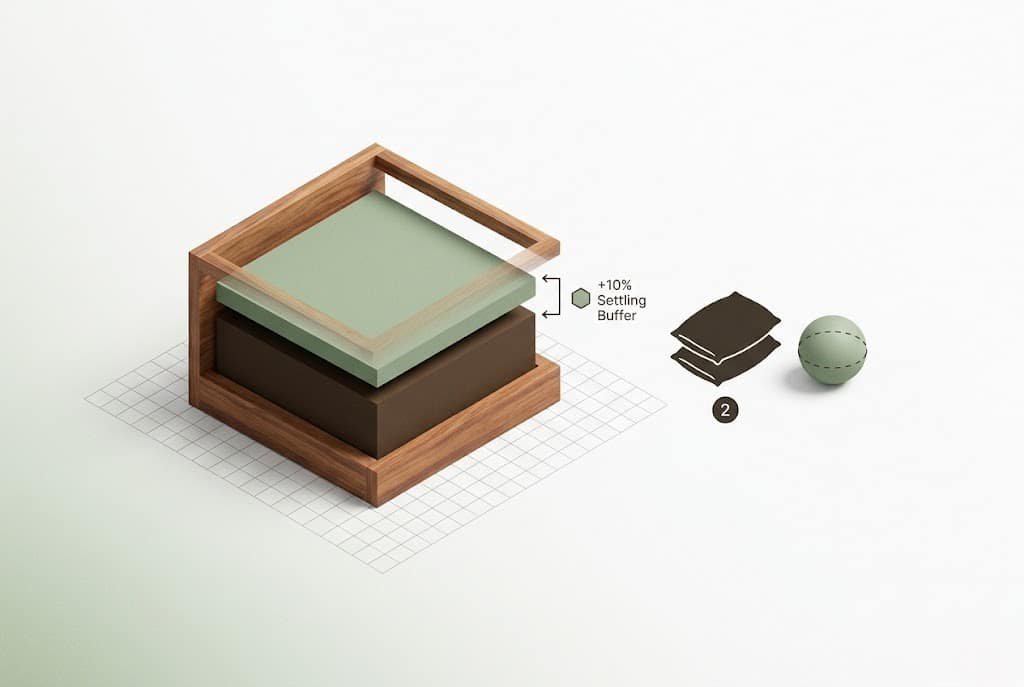
Filling a raised bed sounds straightforward until the soil settles after the first rain and drops two inches below the frame.

The reason that happens is almost never the gardener’s fault; it is the result of skipping a shrinkage allowance that bagged soil brands rarely print on the label. Soil volume calculation requires one extra step beyond simple geometry, and that step is the difference between a full bed and a bed that needs a second store run.
This raised bed soil calculator computes the net cubic footage of your bed, adds a 10% settling buffer automatically, and converts that total into a bag count for three standard bag sizes (1 cu ft, 1.5 cu ft, and 2 cu ft). For large beds exceeding 27 cubic feet, it also displays a cubic yard figure so you can compare bulk delivery pricing. What it does not do: it does not account for fill layers (gravel, straw bale bases, or wood chip cores) or predict compaction from clay-heavy mixes. The result is a purchase target, not a soil recipe.
After entering your bed dimensions and choosing a bag size, you will have a purchase number with the settling buffer already included, plus a flag if ordering soil in bulk by the cubic yard is worth pricing out.
Use the Tool
Before you begin, have a tape measure handy. Measure the interior dimensions of your bed frame, not the outer board dimensions. For circle or keyhole beds, measure the widest span across the center (diameter). Depth should be measured in inches from the bottom of the bed to the top of the frame. If you are comparing bag sizes at the store, check the label; not all bags marketed as “large” hold 2 cubic feet.
For container or pot projects instead of in-ground frames, the potting soil calculator is better suited to curved vessel shapes and smaller volumes.
Raised Bed Soil Calculator
Calculate soil volume & bags for your raised garden bed
| Bed Size | Depth | Net Vol (cu ft) | +10% (cu ft) | Bags (2 cu ft) |
|---|---|---|---|---|
| 4 × 4 ft | 12 in | 16.0 | 17.6 | 9 |
| 4 × 8 ft | 12 in | 32.0 | 35.2 | 18 |
| 4 × 12 ft | 12 in | 48.0 | 52.8 | 27 |
| 3 × 6 ft | 8 in | 12.0 | 13.2 | 7 |
| 2 × 4 ft | 6 in | 4.0 | 4.4 | 3 |
| 4 × 8 ft | 18 in | 48.0 | 52.8 | 27 |
| 5 × 10 ft | 12 in | 50.0 | 55.0 | 28 |
How This Calculator Works
Formula (Rectangle):
Volume = Length (ft) × Width (ft) × (Depth (in) ÷ 12)
Result is in cubic feet (cu ft).
Formula (Circle):
Volume = π × (Diameter ÷ 2)² × (Depth (in) ÷ 12)
Result is in cubic feet (cu ft).
Shrinkage buffer:
Recommended Volume = Net Volume × 1.10
Soil settles ~10% after watering and over time. We add this automatically.
Bags needed:
Bags = ceil(Recommended Volume ÷ Bag Size)
Always rounded up so you never run short.
Bulk threshold:
If your recommended volume exceeds 27 cu ft (1 cubic yard), a bulk delivery option is shown. Bulk is typically more economical above this quantity.
Assumptions & Limits:
- Assumes uniform bed depth throughout.
- Soil compaction/shrinkage estimated at 10% (industry standard).
- Available bag sizes: 1 cu ft, 1.5 cu ft, 2 cu ft.
- Bulk threshold: 27 cu ft = 1 cubic yard.
- Rectangle dimensions: 0.1–500 ft; Depth: 1–120 inches.
- Circle diameter: 0.1–500 ft.
- This tool provides an estimate; actual needs may vary by soil brand and compaction.

Quick Start (60 Seconds)
- Shape: Choose Rectangle for standard framed beds. Choose Circle for round, spiral, or keyhole designs. The formula changes between the two, so an incorrect shape selection will produce a wrong result.
- Length and Width (rectangles): Enter in feet, including decimals. A bed measuring 4 feet 6 inches is entered as 4.5. Do not enter centimeters or inches here.
- Diameter (circles): Measure across the widest point through the center. If the bed is not a perfect circle, use the average of the longest and shortest spans.
- Depth: Enter in inches. Twelve inches is typical for most vegetables; root crops like carrots need 18 inches or more. Shallow herb beds often use 6 to 8 inches.
- Bag Size: Match this to the bags you plan to buy. The default is 2 cu ft, which is the most common size for raised bed mixes sold in big-box stores. Premium or specialty mixes often come in 1.5 cu ft bags.
- Calculate: Click the button once all fields are filled. Results will not appear with any empty required field.
- Reset: Use the Reset button if you want to price out a second bed without carrying over previous inputs.
Inputs and Outputs (What Each Field Means)
| Field | Unit | What It Represents | Common Mistake | Safe Entry Guidance |
|---|---|---|---|---|
| Shape | Toggle | Determines which formula is applied (L x W vs. pi x r squared) | Leaving on Rectangle for a circular spiral bed | Confirm the bed footprint before selecting |
| Length | Feet (ft) | Interior long-side measurement of a rectangular bed | Measuring outer board edge instead of interior soil space | Measure inside the frame boards; subtract board thickness if thick lumber |
| Width | Feet (ft) | Interior short-side measurement of a rectangular bed | Entering the same value as length for non-square beds | Measure both dimensions independently even for nearly square beds |
| Diameter | Feet (ft) | Full span across center of a circular bed | Entering radius instead of diameter, doubling the volume error | Measure from one edge across the center to the opposite edge |
| Depth | Inches (in) | How deep the soil layer needs to be inside the frame | Entering depth in feet instead of inches (e.g., typing 1 instead of 12) | Re-read the unit label; 12 inches is one foot |
| Bag Size | Cubic feet (cu ft) | Volume per individual bag; used to compute bag count | Assuming all bags are 2 cu ft when many premium mixes are 1.5 cu ft | Read the cubic-foot volume on the bag label, not just the weight |
| Net Volume (output) | Cubic feet | Raw geometric volume of the bed without any adjustment | Using this number to buy soil directly; settling is not yet included | Always use the recommended volume, not net, for purchasing |
| Recommended Volume (output) | Cubic feet | Net volume plus 10% for settling; this is the purchase target | Ignoring this value and buying to net volume only | Base all bag and bulk calculations on this figure |
| Bags Needed (output) | Count (whole bags) | Number of bags at the selected bag size, rounded up to a whole bag | Rounding down to save money and ending up short | Always round up; a partial bag is not sold at a partial price |
| Cubic Yards (output) | Cubic yards (cu yd) | Recommended volume expressed in yards for bulk delivery comparison | Ignoring this when volume exceeds 27 cu ft and overpaying for bags | Get a bulk quote if this number is 1 cubic yard or more |
Worked Examples (Real Numbers)
Example 1: Standard 4 x 8 Vegetable Bed at 12 Inches Deep
- Shape: Rectangle
- Length: 8 ft
- Width: 4 ft
- Depth: 12 in
- Bag size: 2 cu ft
Result: Net volume = 8 x 4 x (12/12) = 32 cu ft. Recommended volume = 32 x 1.10 = 35.2 cu ft. Bags needed = ceiling(35.2 / 2) = 18 bags.
This is the most common residential setup. At 18 bags the cost adds up quickly, so checking a local landscape supplier's bulk pricing per cubic yard (35.2 / 27 = 1.30 cu yd) is worthwhile before heading to the garden center.
Example 2: Circular Herb Bed, 6 ft Diameter, 10 Inches Deep
- Shape: Circle
- Diameter: 6 ft (radius = 3 ft)
- Depth: 10 in
- Bag size: 1.5 cu ft
Result: Net volume = 3.14159 x 3 x 3 x (10/12) = 23.56 cu ft. Recommended volume = 23.56 x 1.10 = 25.92 cu ft. Bags needed = ceiling(25.92 / 1.5) = 18 bags.
The circle formula produces a meaningfully different result from a rough rectangle estimate. A 6 x 6 ft rectangle approximation would yield 30 cu ft net, a 27% overestimate that would result in buying 4 to 5 extra bags unnecessarily.
Example 3: Large Production Bed, 5 x 12 ft, 18 Inches Deep
- Shape: Rectangle
- Length: 12 ft
- Width: 5 ft
- Depth: 18 in
- Bag size: 2 cu ft
Result: Net volume = 12 x 5 x (18/12) = 90 cu ft. Recommended volume = 90 x 1.10 = 99 cu ft. Bags needed = ceiling(99 / 2) = 50 bags. Cubic yards = 99 / 27 = 3.67 cu yd.
At nearly 4 cubic yards, bagged soil is almost never the economical choice. A single bulk delivery order at 4 cubic yards eliminates 50 individual bag purchases, the labor of loading them, and the packaging waste.
Reference Table (Fast Lookup)
| Bed Size | Depth (in) | Net Volume (cu ft) | +10% Buffer (cu ft) | Bags at 2 cu ft | Bags at 1.5 cu ft | Cubic Yards |
|---|---|---|---|---|---|---|
| 2 x 4 ft rectangle | 6 | 4.0 | 4.4 | 3 | 3 | 0.16 |
| 3 x 6 ft rectangle | 8 | 12.0 | 13.2 | 7 | 9 | 0.49 |
| 4 x 4 ft rectangle | 12 | 16.0 | 17.6 | 9 | 12 | 0.65 |
| 4 x 8 ft rectangle | 12 | 32.0 | 35.2 | 18 | 24 | 1.30 |
| 4 x 8 ft rectangle | 18 | 48.0 | 52.8 | 27 | 36 | 1.96 |
| 4 x 12 ft rectangle | 12 | 48.0 | 52.8 | 27 | 36 | 1.96 |
| 5 x 10 ft rectangle | 12 | 50.0 | 55.0 | 28 | 37 | 2.04 |
| 6 x 12 ft rectangle | 12 | 72.0 | 79.2 | 40 | 53 | 2.93 |
| Circle, 4 ft diameter | 12 | 12.6 | 13.8 | 7 | 10 | 0.51 |
| Circle, 6 ft diameter | 10 | 23.6 | 25.9 | 13 | 18 | 0.96 |
The Cubic Yards column is the derived field. It converts the recommended buffered volume into the unit used for bulk soil pricing, enabling a direct comparison between per-bag cost and per-yard delivery quotes without manual conversion.
How the Calculation Works (Formula + Assumptions)
Show the calculation steps

Step 1: Calculate net volume.
For rectangles: multiply Length (ft) by Width (ft) by the result of Depth (in) divided by 12. The division by 12 converts inches to feet so all three dimensions are in the same unit.
Net Volume = L x W x (D / 12)
For circles: multiply pi (3.14159) by the radius squared, then by depth converted to feet. Radius equals Diameter divided by 2.
Net Volume = pi x (Diameter / 2)^2 x (D / 12)
Step 2: Apply the shrinkage buffer.
Multiply Net Volume by 1.10. This adds exactly 10% to account for settling after watering and over the course of the growing season. The buffer is applied before the bag count is computed.
Recommended Volume = Net Volume x 1.10
Step 3: Calculate bag count.
Divide Recommended Volume by the bag size in cubic feet, then round up to the next whole number. Rounding down is never appropriate because a partial bag is not a half-price purchase at the store.
Bags = ceiling(Recommended Volume / Bag Size)
Step 4: Convert to cubic yards.
Divide Recommended Volume by 27 (there are 27 cubic feet in one cubic yard). This value is shown for bulk delivery comparison. If Recommended Volume exceeds 27 cu ft, the tool surfaces a prompt to consider bulk ordering.
Cubic Yards = Recommended Volume / 27
Assumptions and Limits
- Depth is assumed to be uniform across the entire bed floor. Beds built on uneven ground, sloped surfaces, or with internal partitions will have variance the calculator cannot capture.
- The 10% shrinkage buffer is an industry-standard estimate for commercial raised bed and potting mixes. Heavier, clay-amended, or compost-rich mixes may compact more; lightweight perlite-heavy mixes may compact less.
- Bag sizes are treated as exactly 1.0, 1.5, or 2.0 cubic feet. Some brands underfill slightly; read the label value, not the bag weight.
- The bulk threshold of 27 cu ft (1 cubic yard) is a trigger for a recommendation, not a guarantee that bulk is less expensive. Minimum delivery quantities and local pricing vary by supplier.
- The tool does not calculate fill media volumes for lasagna beds, Back to Eden methods, or hugelkultur mounds where wood or organic layers take up part of the frame depth.
- Input ranges are 0.1 to 500 ft for length, width, and diameter; 1 to 120 inches for depth. Values outside these ranges will produce a validation error.
- The circle formula assumes a true circular plan. Oval or elliptical beds require separate length and width measurements; use the rectangle formula as an approximation for ovals, or split the shape manually.
Standards, Safety Checks, and "Secret Sauce" Warnings
Critical Warnings
- Do not buy to net volume. The geometric volume of the bed (length x width x depth) is not the purchase quantity. Soil compresses after the first irrigation cycle. Skipping the 10% buffer is the single most common reason gardeners end up with a half-filled bed after settling.
- Bag size is not standardized across brands. A bag of "raised bed soil" from one brand may hold 1.5 cu ft while a visually similar bag from a competing brand holds 2.0 cu ft. Buying the wrong bag size and using a 2 cu ft count will leave the purchase 25% short of the actual volume needed.
- The 27 cu ft threshold is a trigger to compare, not a mandate to buy bulk. Some local suppliers have minimum delivery quantities of 3 to 5 cubic yards. Confirm minimums before calling a bulk order the cheaper option.
- Depth in the wrong unit breaks the result completely. Entering depth as 1 (meaning 1 foot) instead of 12 (meaning 12 inches) produces a result that is 12 times too small. The input field expects inches.
Minimum Standards
- Most vegetables require a minimum soil depth of 12 inches for adequate root development. Shallow beds at 6 inches limit root crops and drought tolerance. For context on how soil composition affects depth requirements, the soil bulk density calculator can help assess compaction risk in deeper fills.
- Bag count should always be rounded up to a whole number. Never round down or use a fractional bag count as a purchase guide.
- If bulk soil is purchased, verify cubic yard contents with the supplier before unloading. Bulk loads are measured at the supplier's yard, and short-loads are possible.
Competitor Trap: Most raised bed soil calculators online provide only a raw cubic foot number with no shrinkage adjustment and no bulk delivery trigger. A gardener who buys exactly to that number, fills the bed, waits two weeks, and finds the soil level dropped by 1 to 2 inches is not making a measurement error; the calculator simply omitted the settling step. Checking whether a calculator includes a buffer before relying on it is a two-second quality check that saves a second store trip. For soil mixes that require pH correction before or after filling, the soil pH lime calculator pairs directly with the volume output from this tool.
Common Mistakes and Fixes
Mistake: Measuring Outer Board Dimensions Instead of Interior Soil Area
A raised bed built with 2x6 lumber has boards that are 1.5 inches thick on each side. On a nominally labeled 4x8 bed, the true interior dimensions may be closer to 3.75 x 7.75 feet. The difference in volume across a 12-inch-deep bed is about 2 cubic feet, or roughly one full bag.
Fix: Measure length and width from the inside face of one board to the inside face of the opposite board.
Mistake: Treating All Bags as 2 Cubic Feet
Premium raised bed mixes, specialty cactus soils, and many organic blends commonly come in 1.5 cu ft bags. The exterior bag dimensions may look nearly identical to a 2 cu ft bag. Applying a 2 cu ft count to 1.5 cu ft bags results in a shortfall that only becomes obvious when the last bag is opened.
Fix: Read the cubic foot volume printed on the bag front or back panel before entering a bag size in the calculator.
Mistake: Skipping the Depth Conversion Check
Depth is the most commonly miskeyed field. Entering 1 instead of 12 for a 12-inch-deep bed produces a volume result of roughly 2.7 cubic feet for a 4x8 bed, instead of the correct 32 cubic feet. The error is not always obvious at a glance on a small screen.
Fix: After calculating, divide the net volume result by the bed's square footage (length x width). The quotient should equal the depth in feet. For a 12-inch bed it should be 1.0; for a 6-inch bed, 0.5.
Mistake: Calculating Only One Bed When Building Multiple
Gardeners building two or three beds at once often calculate one and multiply mentally, then round down on the total bags. Each bed needs its own settled volume calculated before the totals are summed, because the rounding-up step must happen per bed, not on the aggregate.
Fix: Run the calculator once per bed, note the bag count for each, and sum the individual rounded-up counts rather than dividing a pooled total.
Mistake: Ignoring the Cubic Yard Output When Volume is High
At 40 cubic feet recommended volume, that is roughly 1.5 cubic yards. Purchasing 20 bags of 2 cu ft soil at a retail price of $10 to $15 per bag totals $200 to $300, while a cubic yard of quality raised bed blend from a landscape supplier may cost $60 to $100 delivered. Many gardeners only discover bulk pricing after the project is complete.
Fix: When the calculator flags a bulk recommendation or when the cubic yard output exceeds 1.0, get one bulk delivery quote before committing to bagged soil purchases.
Related Tools and Next Steps
Soil volume is only the first number. Once the bed is filled, the soil mix itself determines plant performance. The soil mix calculator helps proportion topsoil, compost, and aeration materials for a custom blend.
Compost is one of the most common amendments added during bed filling or annual top-dressing. The compost calculator figures out how much finished compost is needed based on application depth and area.
Beds built with peat moss as a structural component of the mix require their own volume math. The peat moss calculator handles peat volume by layer thickness and coverage area.
Coco coir is increasingly used in raised beds as a peat substitute with better water retention per dry weight. The coco coir calculator converts brick weights and expansion ratios into usable cubic footage.
After filling, soil nutrient levels often need adjustment. The NPK calculator determines fertilizer application rates based on bed area and nutrient analysis.
pH correction is frequently needed for new raised bed mixes, especially those with high peat content. The soil pH sulfur calculator quantifies how much elemental sulfur is needed to lower pH to the target range.
For beds that will receive a compost tea drench, the compost ratio calculator helps build a consistent brew formula scaled to bed area.
FAQ
How many bags of soil do I need for a 4x8 raised bed?
At 12 inches deep with 2 cu ft bags, a 4x8 raised bed requires 18 bags after including the 10% settling buffer. At 1.5 cu ft bags, the count rises to 24. At 6 inches deep, those numbers drop to approximately 9 and 12 bags respectively. The answer changes significantly with depth, which is why the calculator asks for all three dimensions.
What does cubic feet mean for soil?
A cubic foot is the volume of a cube measuring one foot on every side. Bagged soil is sold by cubic foot volume because weight varies by mix composition and moisture content. Two bags of different brands that weigh the same may hold different volumes of soil. Calculating by cubic feet, not pounds, gives an accurate fill estimate regardless of brand.
Why add 10% for settling?
Loose soil contains air pockets between particles. After watering and over time, those gaps compress, especially in mixes with high organic matter content. The volume loss is not recoverable by adding water; additional soil is needed to top off. A 10% buffer built into the purchase prevents a return trip to the store mid-season when stock may be limited.
When should I order bulk soil instead of bags?
The general threshold is when recommended volume exceeds 27 cubic feet (one cubic yard). At that scale, bulk delivery from a landscape supplier typically offers a lower per-cubic-foot cost, eliminates packaging, and requires less physical labor. Confirm minimum delivery quantities with the supplier; some have 2 or 3 cubic yard minimums that affect the math for smaller projects.
Can I use this calculator for a partially filled bed I am topping off?
Yes, but you need to calculate the volume of the gap, not the full bed. Measure the depth of the existing soil from the top of the soil surface to the top of the frame. Enter that gap depth (in inches) as your depth input, along with the interior dimensions. The result will be the volume needed to bring the bed level to the top, plus the settling buffer.
Does the formula change if my bed is on a slope?
The calculator assumes a flat, horizontal bed floor. On a sloped site, the soil depth varies from one end to the other. The most practical approach is to average the deep end and shallow end measurements and enter that average as your depth. For precise results on a significant slope, the bed should be leveled before filling, or the volume should be calculated in two sections with different depths.
Conclusion
The geometry of a raised bed is simple; the purchase decision is where most errors occur. A calculator that returns only a raw cubic foot number leaves the settling buffer as an afterthought, and skipping it reliably produces a bed that drops below frame level after the first week. This raised bed soil calculator builds the 10% buffer into every result so the recommended volume and bag count are ready to use directly at the point of purchase.
The single mistake worth repeating: do not buy to the net geometric volume. Multiply by 1.10, then round bags up. For any bed approaching or exceeding 27 cubic feet, pull the cubic yard figure from the results and get one bulk quote before loading bags into a cart. For ongoing soil health and amendment planning after the bed is filled, the soil organic matter nitrogen release calculator helps estimate how much nitrogen your organic matter contributes over the season, reducing unnecessary fertilizer applications.