
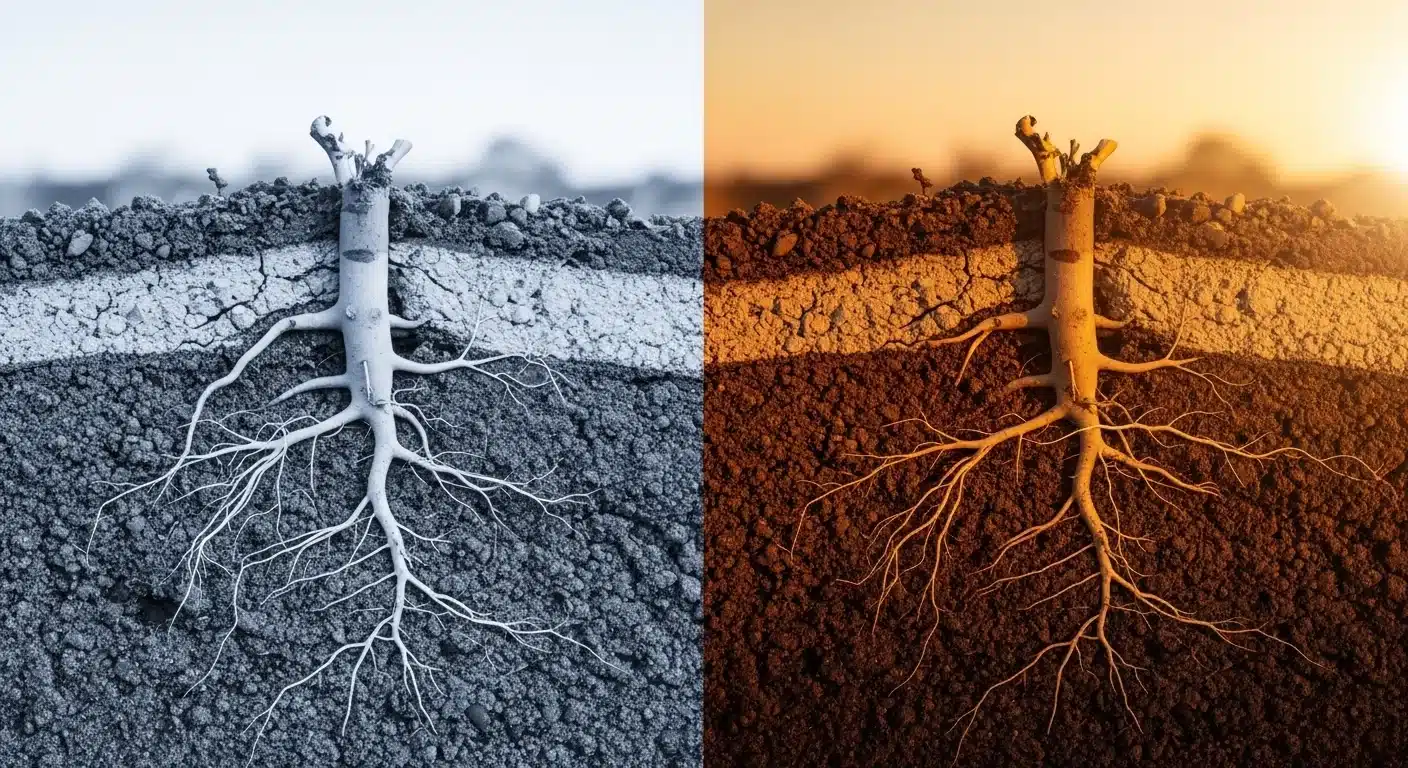
Compaction does not look like anything. A field can be green, moist, and visually healthy while harboring a zone of soil so dense that roots physically cannot enter it. The physics are specific: once the mechanical resistance of a soil exceeds the hydrostatic pressure a root tip can generate, the root stops elongating. It does not die immediately. It circles. It thickens at the tip. It exhausts the plant’s energy budget pushing against a wall it will never break through. By the time symptoms appear above ground, the root architecture has already failed.
This calculator takes two direct measurements from a soil core sample, and one textural classification, and returns bulk density in g/cm³, total porosity as a derived value, and a texture-specific root restriction status based on USDA-NRCS thresholds. It does not estimate compaction from symptoms, surface tests, or visual inspection. It does not account for stoniness, saturated conditions, or organic soils above 5% organic matter. Those are judgment calls that belong to a certified agronomist working with additional lab data.
If the calculator returns a restriction flag for your soil texture, mechanical intervention is required before planting. Core aeration, deep tillage, or vertical mulching are the interventions. Fertilizer and irrigation cannot fix a physical barrier.
Use the Tool
Soil Bulk Density & Root Penetration
Diagnose compaction & root restriction from your core sample
| Soil Texture | Optimal Range | Restriction Point | Porosity @ Threshold | Risk Level |
|---|---|---|---|---|
| Sand | 1.20 – 1.60 g/cm³ | > 1.80 g/cm³ | 32.1% | Low |
| Silt | 1.00 – 1.40 g/cm³ | > 1.55 g/cm³ | 41.5% | Moderate |
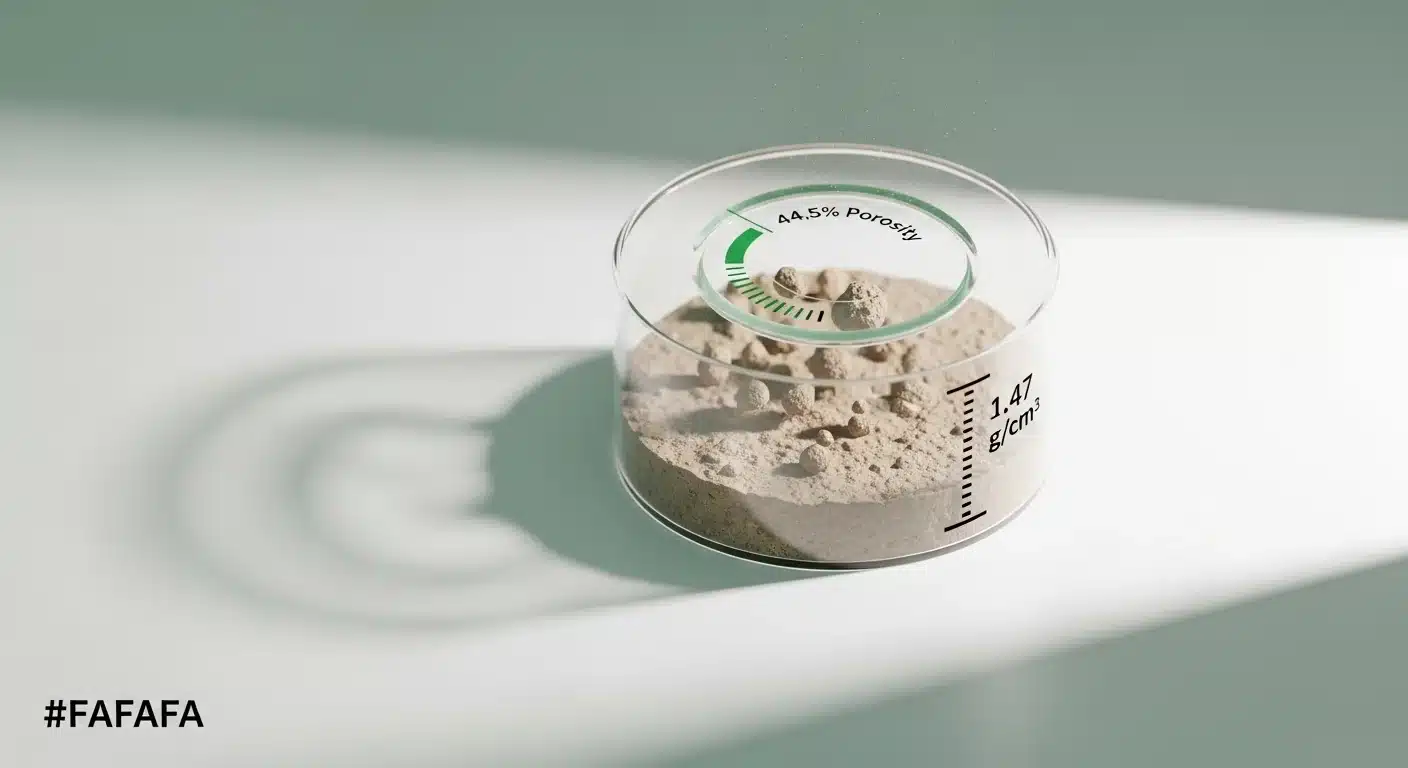
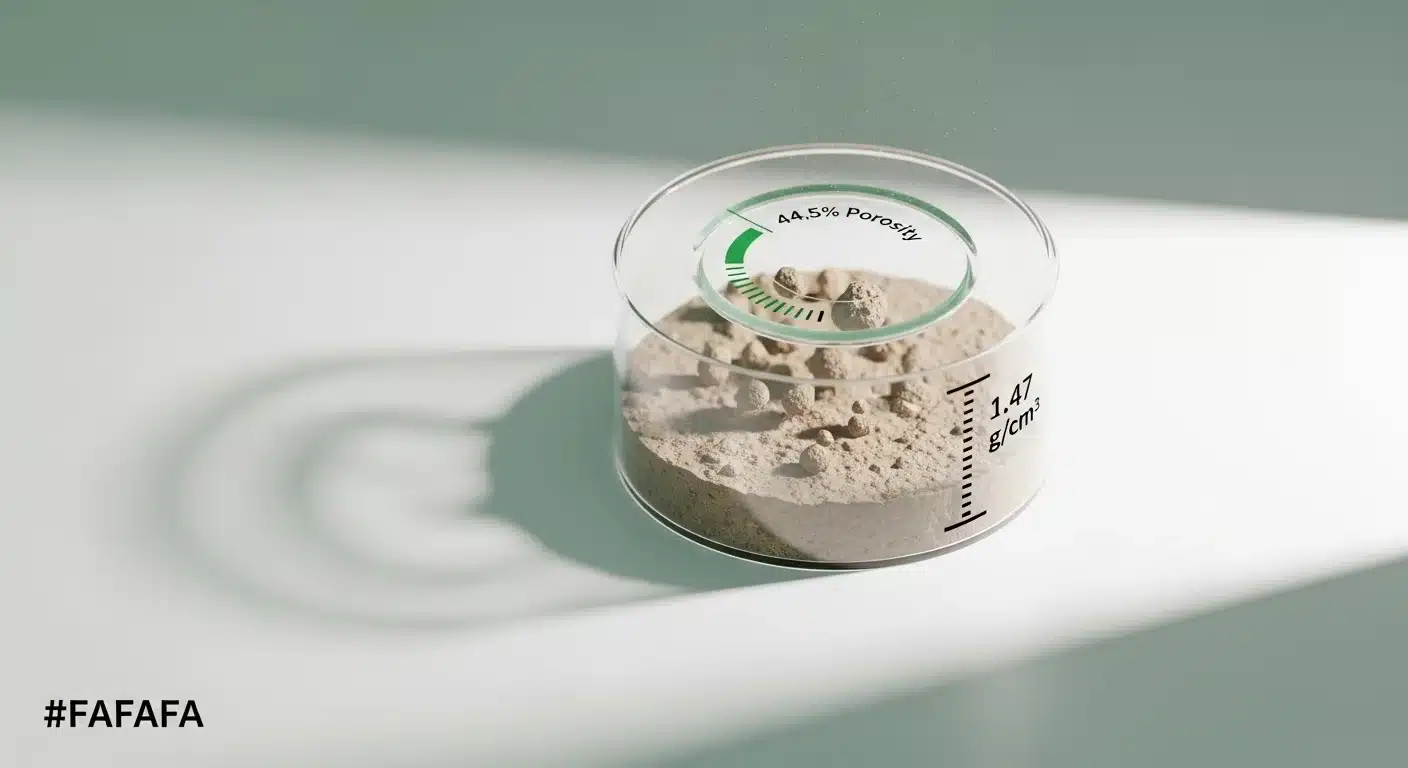
| Clay | 0.90 – 1.30 g/cm³ | > 1.47 g/cm³ | 44.5% | High Risk |
How this calculator works
Step 1 — Bulk Density (ρb)
Dry mass is the oven-dried weight of the core. Volume is the interior volume of the sampling ring. Result is in grams per cubic centimeter (g/cm³). If you enter volume in in³, it is automatically converted to cm³ (1 in³ = 16.387 cm³).
Step 2 — Porosity (%)
2.65 g/cm³ is the mean particle density of mineral soil (quartz). Porosity represents the fraction of soil volume occupied by air and water pores — the space roots need to grow.
Step 3 — Root Restriction Threshold (by texture)
Silt: Root restriction when ρb > 1.55 g/cm³
Sand: Root restriction when ρb > 1.80 g/cm³
These thresholds are based on USDA-NRCS and peer-reviewed soil science research. Clay soils compact more readily because the platy structure of clay minerals closes pore channels at lower bulk densities than coarser-textured soils.
U5 — Assumptions & Limits
- The particle density constant of 2.65 g/cm³ is valid for most mineral soils dominated by quartz/silicate minerals. Organic-rich soils (> 5% OM) may have a lower particle density (~2.4 g/cm³), causing porosity to be slightly underestimated.
- Dry mass must represent a truly oven-dried (105°C) sample. Air-dried samples contain residual moisture and will underestimate bulk density.
- Volume must match the actual interior volume of the core ring — measure diameter and depth precisely to verify manufacturer specs.
- Thresholds apply to the fine earth fraction only. Gravel or rock fragments occupy volume without contributing to resistance, so cores with stones should be corrected for coarse fragment volume.
- Root restriction thresholds reflect typical conditions for tap-rooted and fibrous annual crops. Established perennials and some tree species with high turgor pressure may tolerate slightly higher densities.
- This tool is for educational and diagnostic purposes. Consult a certified agronomist or soil scientist for management prescriptions.
Before entering values, have three things ready: the oven-dried weight of your core sample in grams, the interior volume of your coring cylinder (either in cm³ or in³), and your soil texture classification. If you are using a standard 5 cm diameter by 5 cm depth ring, the interior volume is approximately 98.2 cm³. If you are unsure of your soil's texture, the soil texture calculator walks through the feel method and hydrometer approach to classify loamy, sandy, silty, and clay-dominant soils.
Quick Start (60 Seconds)
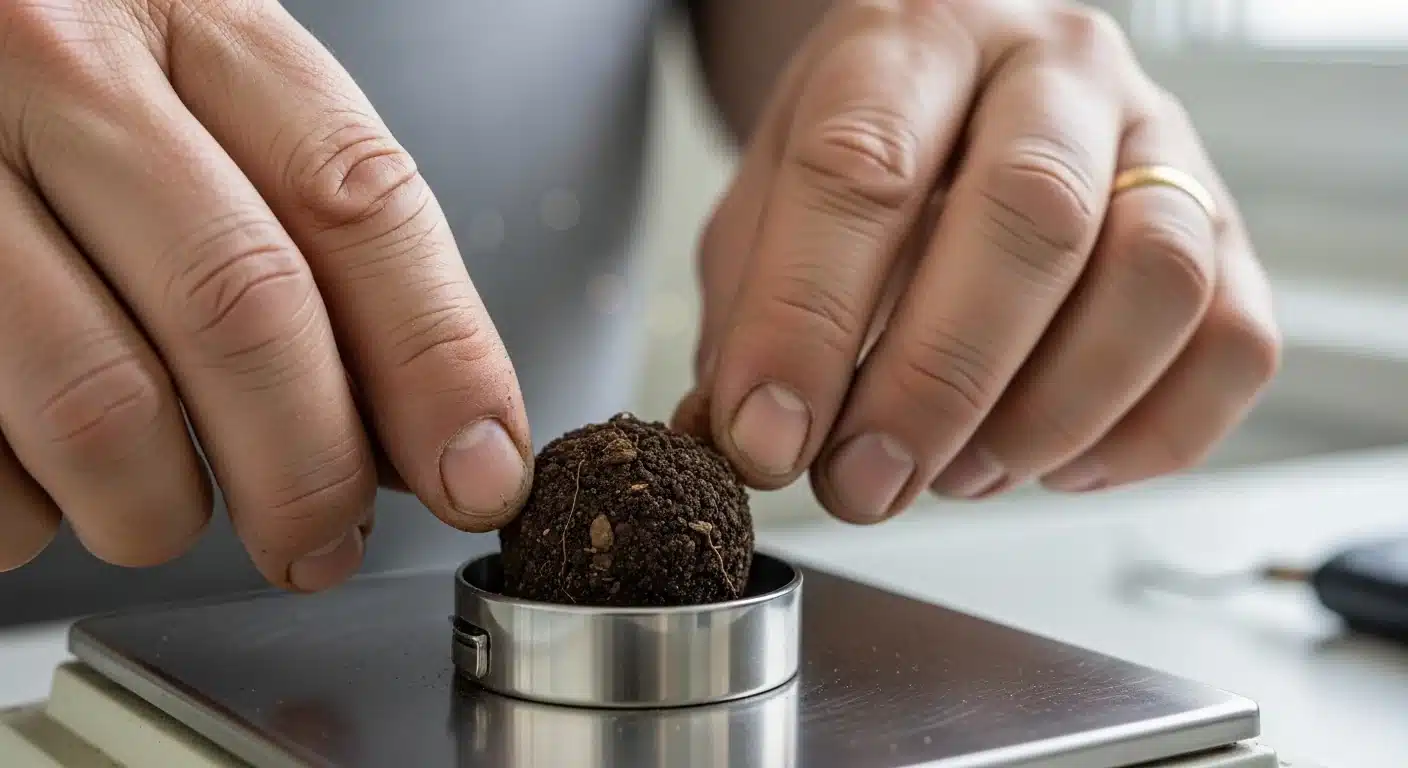
- Dry Soil Core Weight: Enter the mass of the core after oven-drying at 105°C (221°F) for 24 hours. Air-dried mass is not the same. Field-moist mass will produce a reading that underestimates bulk density. Unit is grams only.
- Core Cylinder Volume: Enter the interior volume of the metal ring or coring tube. This is not the exterior volume. Use the toggle to choose cm³ or in³. The calculator converts in³ to cm³ automatically using the factor 16.387.
- Soil Texture: Select Sand, Silt, or Clay. The restriction threshold changes by texture. Selecting the wrong texture does not affect bulk density or porosity, but it will display the wrong pass/fail standard.
- Volume tip: Verify your ring's interior dimensions. Manufacturer-labeled volumes are sometimes exterior measurements. Measure inner diameter and depth with calipers: V = π × r² × h.
- Texture tip: Mixed-texture soils (sandy loam, clay loam, silty clay) do not have a single threshold in this tool. Use the dominant fraction or enter your two most likely textures separately and compare.
Inputs and Outputs (What Each Field Means)
| Field | Unit | What it measures | Common entry mistake | Safe entry guidance |
|---|---|---|---|---|
| Dry Soil Core Weight | grams (g) | Mass of mineral solids in the sample after all moisture is driven off | Entering field-moist or air-dried weight instead of oven-dried | Dry at 105°C for 24 hours minimum. Weigh after cooling in a desiccator. |
| Core Cylinder Volume | cm³ or in³ (auto-converted) | Interior volume of the sampling ring that defines the soil sample's spatial extent | Using exterior or labeled volume without verifying interior dimensions | Measure inner diameter (d) and depth (h) with calipers: V = 0.7854 × d² × h |
| Soil Texture | Categorical (Sand / Silt / Clay) | Dominant particle-size class; governs which restriction threshold applies | Selecting texture by guesswork rather than by testing or feel-method classification | Use a hydrometer test, ribbon test, or soil texture triangle for classification |
| Bulk Density (output) | g/cm³ | Mass of oven-dried soil per unit of total volume including pore space | Confusing bulk density with particle density (2.65 g/cm³ constant) | Bulk density always falls below particle density. Values above 2.0 in most soils indicate a measurement error. |
| Porosity (output) | % of total volume | Fraction of soil volume occupied by pores (air and water channels that roots explore) | Treating porosity as a direct measure of drainage rate | Porosity reflects total pore space, not pore connectivity. Two soils can have equal porosity and very different drainage. |
| Restriction Threshold (output) | g/cm³ | The bulk density at which root penetration becomes mechanically impeded for the selected texture | Applying the clay threshold to a sandy loam or vice versa | Use the closest single-texture match. Run both Sand and Clay if classifying a mixed texture. |
Worked Examples (Real Numbers)
Scenario 1: Post-Construction Clay Subsoil Exposed by Grading
- Dry soil core weight: 200 g
- Core cylinder volume: 100 cm³
- Soil texture: Clay
Result: Bulk density = 2.00 g/cm³, Porosity = 24.5%, Status: Root Restriction Detected
This reading is 0.53 g/cm³ above the clay restriction threshold of 1.47 g/cm³. Porosity has collapsed to a level where most mesophytic woody plants cannot sustain root extension. Grading operations that strip topsoil and expose or compress subsoil clay layers are one of the most reliable pathways to this failure state.
Scenario 2: Well-Managed Sandy Garden Bed
- Dry soil core weight: 165 g
- Core cylinder volume: 120 cm³
- Soil texture: Sand
Result: Bulk density = 1.375 g/cm³, Porosity = 48.1%, Status: Optimal
Sandy soils with regular compost incorporation typically fall in this range. At 1.375 g/cm³, bulk density is 0.425 g/cm³ below the sand restriction threshold of 1.80 g/cm³. The 48.1% porosity reading indicates ample air-filled pore space for aerobic root respiration and unimpeded elongation.
Scenario 3: Silt Soil Approaching the Warning Zone (Volume Entered in Cubic Inches)
- Dry soil core weight: 180 g
- Core cylinder volume: 7.32 in³ (auto-converted to 120.0 cm³)
- Soil texture: Silt
Result: Bulk density = 1.50 g/cm³, Porosity = 43.4%, Status: Moderate Compaction
This sample sits above the optimal upper limit of 1.40 g/cm³ for silt but below the restriction point of 1.55 g/cm³. The calculator flags this as a warning zone. At 1.50 g/cm³, root penetration is still possible but increasingly labored for fine-rooted annuals and turf grasses. Preventive core aeration at this stage is far less disruptive than remediation after restriction is established.
Reference Table (Fast Lookup)
All porosity values are derived from the formula Porosity = (1 - Bulk Density / 2.65) × 100, using the standard mineral soil particle density of 2.65 g/cm³.
| Soil Texture | Bulk Density (g/cm³) | Derived Porosity (%) | Zone Classification | Root Risk | Recommended Action |
|---|---|---|---|---|---|
| Sand | 1.20 | 54.7 | Optimal | None | Maintain. Avoid compacting traffic. |
| Sand | 1.60 | 39.6 | Optimal upper limit | Low | Monitor annually. Annual compost top-dress. |
| Sand | 1.70 | 35.8 | Warning zone | Moderate | Core aerate 2 passes. No new plantings. |
| Sand | 1.80 | 32.1 | Restriction threshold | High | Deep till or sub-soil to 10 in depth. No planting until resolved. |
| Silt | 1.10 | 58.5 | Optimal | None | Maintain. Protect from wet-soil traffic. |
| Silt | 1.40 | 47.2 | Optimal upper limit | Low | Annual aeration advisable. Check sub-surface drainage. |
| Silt | 1.55 | 41.5 | Restriction threshold | High | Deep core aeration (3-4 passes) + compost incorporation. |
| Clay | 1.10 | 58.5 | Optimal | None | Maintain aggregate structure. Minimize wet-soil disturbance. |
| Clay | 1.30 | 50.9 | Optimal upper limit | Low | Preventive aeration. Avoid heavy equipment when moist. |
| Clay | 1.47 | 44.5 | Restriction threshold | Critical | Immediate deep tillage required. No valuable plantings until resolved. |
How the Calculation Works (Formula + Assumptions)
Show the calculation steps
Step 1: Convert Volume if Entered in Cubic Inches
If volume is entered in in³, the calculator multiplies by 16.387 to produce cm³. All subsequent calculations use cm³.
Step 2: Calculate Bulk Density
Bulk Density (g/cm³) = Dry Mass (g) / Volume (cm³)
This divides the oven-dried mass of mineral solids by the total volume of the sample, including all pore space. The result is rounded to three decimal places in the output.
Step 3: Calculate Porosity
Porosity (%) = (1 - Bulk Density / 2.65) × 100
The constant 2.65 g/cm³ is the accepted mean particle density for mineral soils dominated by quartz and silicate minerals. The formula assumes all non-solid volume is pore space. Porosity is rounded to one decimal place. If calculated porosity is negative due to a measurement error, the calculator outputs 0.0 rather than a negative value.
Step 4: Apply Texture-Specific Restriction Threshold
The calculator compares the calculated bulk density against three thresholds sourced from USDA-NRCS soil survey methodology and peer-reviewed agricultural soil science:
- Clay: restriction at bulk density above 1.47 g/cm³
- Silt: restriction at bulk density above 1.55 g/cm³
- Sand: restriction at bulk density above 1.80 g/cm³
A warning zone applies when bulk density exceeds the upper optimal range for the selected texture (Clay 1.30, Silt 1.40, Sand 1.60 g/cm³) but has not yet crossed the restriction threshold.
Assumptions and Limits
- The particle density constant of 2.65 g/cm³ is valid for mineral soils with quartz and feldspar as dominant constituents. Soils with high organic matter content (above roughly 5% by weight) have a lower particle density closer to 2.4 g/cm³, which means porosity is slightly underestimated.
- Oven-dry mass requires drying at 105°C for a minimum of 24 hours. Air-drying at room temperature leaves residual hygroscopic moisture, producing a mass value that is too high and a bulk density that is also too high, typically in the range of 5 to 15% error depending on soil type and ambient humidity.
- The core ring must fully capture undisturbed soil. If the core was hammered in on dry, hard ground and fractured a clod, or if soil fell from the bottom of the ring before weighing, volume is misrepresented.
- Restriction thresholds reflect the point of mechanical impedance for most annual crop root systems and most temperate woody ornamentals. Some deep-rooted perennials with high cell turgor pressure may tolerate slightly higher densities; some fine-rooted turfgrasses may show symptoms below the threshold.
- The formulas apply to the fine earth fraction only. Gravel and rock fragments occupy cylinder volume without contributing mechanical resistance. Samples from stony soils require a coarse-fragment correction factor.
- Mixed-texture soils (sandy clay loam, silty clay, loam) have intermediate thresholds not represented by the three categories in this tool. The conservative approach is to use the tighter threshold of the two dominant fractions.
- This tool does not account for seasonal variation. Clay soils in particular exhibit dramatically different bulk density readings when measured in dry summer versus wet spring conditions due to shrink-swell behavior. Sample timing should be standardized for meaningful year-to-year comparisons.
Standards, Safety Checks, and Warnings
Critical Warnings
- The Invisible Root Wall: Soil at or above the restriction threshold does not signal distress visually. Turf can be green; beds can be moist; plants can persist for months or years on stored root reserves while producing no new root growth in the compacted layer. By the time chlorosis, dieback, or stunting appear, the root system has already been confined for one or more growing seasons.
- Air-Dried vs. Oven-Dried Mass: Using air-dried or field-moist mass produces an inflated bulk density reading. A sample that reads 1.52 g/cm³ from air-dried mass might be 1.39 g/cm³ at true oven-dry, which is the difference between a warning-zone silt and an optimal silt soil. Every measurement for decision-making should use the 105°C oven method.
- Post-Compaction Organic Amendments Do Not Remove the Barrier: Adding compost to the surface of compacted clay does not lower the bulk density of the compacted layer below. Surface amendments improve conditions above the restriction zone and can gradually reduce surface bulk density over years, but they do not substitute for mechanical disruption of a layer above 1.47 g/cm³.
- Wet-Season Machine Traffic on Clay is Permanent Damage: A single pass of a loaded skid-steer or tractor on wet clay can collapse macropore structure irreversibly. The clay platelet alignment after compression at high soil moisture resists re-expansion even after drying. Scheduling ground work for dry conditions is the only reliable prevention.
Minimum Standards (USDA-NRCS / Peer-Referenced)
- Clay soils above 1.47 g/cm³ are classified as root-restricting by USDA Soil Survey methodology.
- Sandy soils above 1.80 g/cm³ are classified as root-restricting. Note that sand can physically compact to this level primarily through vibration loading, not just static weight.
- Silt soils have a lower structural stability than either sand or clay and can reach the 1.55 g/cm³ threshold with lighter equipment passes than many practitioners expect.
- For newly graded or excavated sites, a baseline bulk density measurement before any planting is considered minimum due diligence in landscape construction standards.
Competitor Trap: Most soil compaction guides online frame the problem in terms of penetrometer resistance (PSI readings) without connecting those readings to the underlying bulk density math. Penetrometer resistance is a proxy. It changes with soil moisture. A soil can read low resistance when wet and high resistance when dry, with the same bulk density both times. Bulk density, calculated from a dried core sample, does not fluctuate with moisture. It is the actual structural state of the soil. Tools that only describe the penetrometer method leave users unable to make reliable year-to-year comparisons or to document improvement after remediation. Understanding this distinction also connects to how cation exchange capacity and compaction interact: highly compacted clay soils often have adequate CEC on paper but cannot deliver nutrients to roots that cannot reach the nutrient-holding particles.
Soil pH management is a related concern. Compacted soils often develop anaerobic microsites that shift pH locally, which in turn affects nutrient availability independent of what a surface sample shows. Running a lime requirement calculation alongside bulk density testing gives a more complete diagnostic picture for any new planting site.
Common Mistakes and Fixes
Mistake: Using the Labeled Volume on the Core Ring Instead of Measuring It
Manufacturers stamp or print the nominal volume on core rings, but this often reflects the exterior dimensions of the ring body, not the interior volume that actually holds soil. A ring labeled 100 cm³ may have an interior volume of 94 to 98 cm³ after accounting for wall thickness. Using the labeled figure systematically underestimates bulk density by 2 to 6%.
Fix: Measure the inside diameter with calipers and the actual sample depth. Calculate true volume as V = 0.7854 × d² × h.
Mistake: Sampling at the Soil Surface Only
Root restriction caused by tillage pans, subsoil clay layers, or construction compaction typically begins at 4 to 10 inches depth, not at the surface. A surface core showing optimal bulk density tells you nothing about what roots will encounter at depth.
Fix: Take cores at multiple depth intervals: 0 to 4 inches, 4 to 8 inches, and 8 to 12 inches. The base saturation calculator can complement this by identifying nutrient stratification that often mirrors depth-dependent compaction patterns.
Mistake: Entering Soil Volume in the Wrong Units Without Switching the Toggle
Entering a volume of 6.1 when the actual measurement is 6.1 in³ but leaving the unit on cm³ produces a bulk density approximately 16 times too high (since 1 in³ = 16.387 cm³). The result will appear clearly wrong, but some users adjust their mass figure instead of switching the unit selector.
Fix: Verify the unit toggle before entering any value. Enter volume in the native unit of your measuring device.
Mistake: Applying a Single Core Reading to an Entire Property
Soil compaction is spatially variable. A driveway edge, a gate entry, a high-traffic diagonal path across a lawn, and the center of the same lawn can differ by 0.4 g/cm³ or more within meters of each other. One core reading is a point measurement, not a property average.
Fix: Take a minimum of 3 to 5 cores from different areas and record each separately. Decision-making should be based on the worst-case readings in planting zones, not the average.
Mistake: Testing in Saturated Conditions and Interpreting Results as Compacted
If soil was recently saturated, the core may contain capillary water that was not fully expelled before collection. Even if dried properly, a core taken when the soil structure was distended by moisture may register slightly different than a core from the same location under field capacity conditions. Clay soils are particularly affected by this error.
Fix: Sample when soil is at or near field capacity, not at saturation or extreme drought. Allow 2 to 3 days after irrigation or rain before coring.
Next Steps in Your Workflow
A bulk density reading that shows an optimal result means the physical barrier is not present, but it does not mean soil fertility is adequate. Bulk density and nutrient status are independent variables. After confirming the absence of compaction, the logical next test is nutrient availability. Running a full fertility audit and then calculating amendment quantities through the compost calculator gives a clear path from baseline measurement to amendment prescription for both new plantings and established landscapes.
When the result shows restriction or a warning-zone reading, the first task is mechanical remediation, not fertilization. Deep core aeration or sub-soiling should be followed by organic matter incorporation to help rebuild aggregate structure. Mycorrhizal inoculants applied at planting time after remediation can help roots colonize the newly opened pore channels more quickly than the plant could achieve alone. Tracking bulk density with annual or biannual re-sampling is the only way to confirm that management changes are working. The soil organic matter nitrogen release calculator is a useful companion for planning the nitrogen contribution from compost and cover crop residues added during the recovery process, since increased organic matter addition is both a remediation tool and a fertility management decision simultaneously.
FAQ
What is a normal bulk density for garden soil?
For most cultivated garden soils, bulk density between 1.0 and 1.4 g/cm³ is considered healthy depending on texture. Sandy soils can run higher (up to 1.6 g/cm³) while remaining suitable for root growth. Clay and silt soils above 1.4 g/cm³ approach or enter zones where root extension becomes labored. The reference table on this page provides texture-specific optimal ranges and restriction points.
Why does soil texture change the restriction threshold?
Clay minerals are platy and pack tightly at lower bulk densities than sand or silt particles, which are more spherical. When clay platelets align under compression, they create a continuous restrictive layer at a lower overall mass-per-volume than a coarser-textured soil would require to produce the same mechanical resistance to root elongation. Sandy soils require higher bulk density to generate equivalent impedance because their larger particles create larger pores even at higher densities.
Can I use field-moist weight if I do not have an oven?
Field-moist mass will overestimate bulk density, sometimes substantially. Soils at field capacity can contain 15 to 30 grams of water per 100 cm³ of volume, depending on texture. Without oven-drying, you are measuring mineral solids plus water, not mineral solids alone. The USDA core method and all published restriction thresholds are based on oven-dried mass. Results using moist mass are not comparable to published standards.
What is the difference between bulk density and particle density?
Particle density is the mass of the solid mineral material itself per unit of solid volume, with no pore space included. For most mineral soils, this is approximately 2.65 g/cm³ and does not change meaningfully with compaction or tillage. Bulk density includes pore space in the volume measurement. It changes with compaction, organic matter, and tillage. Bulk density will always be lower than particle density.
Does organic matter affect the calculation?
Yes. The porosity formula in this calculator uses 2.65 g/cm³ as the particle density constant. Organic material has a much lower particle density, typically around 1.0 to 1.4 g/cm³. Soils with more than roughly 5% organic matter by mass will have a lower effective particle density, which means this formula will underestimate true porosity. For organic-rich soils, a weighted particle density correction is required for accurate porosity calculation.
How often should I re-test bulk density?
For managed landscapes under active improvement programs, annual sampling at the same depth and location provides the most useful trend data. For established plantings with stable management, sampling every two to three years is typically sufficient. After any significant event such as construction access, new utility trenching, or a wet-season traffic incident, re-sampling immediately and again the following season gives the most accurate picture of impact and recovery.
Conclusion
Bulk density is one of the few soil measurements that can directly confirm or rule out a physical failure mode before any money is spent on plants, amendments, or labor. The restriction thresholds in this calculator are not guidelines or suggestions. They represent the point at which the mechanical resistance of the soil exceeds what root cells can push through. A plant placed into soil above its texture-specific threshold will not thrive with better irrigation or more fertilizer. It will be contained by physics.
The single most preventable mistake in landscape and agricultural soil management is treating compaction as a secondary problem to be addressed after symptoms appear. Symptoms appear late, often when a significant plant investment has already been made. Testing with a core sample and this calculator before site preparation costs very little and can change every decision that follows. For sites where you have already confirmed restriction and completed remediation, revisit the seed inoculant application rate calculator to optimize biological establishment in the newly reopened pore space.