Hydroponic pH Buffer & Acid/Base Adjustment
Calculate exact phosphoric acid dose & alkalinity buffer needs — stop pH bounce for good
| Volume | pH Drop (1.0 unit) | pH Drop (2.0 units) | Water Type | Est. Doses (mL) |
|---|
How This Calculator Works
Acid (mL) = (CurrentpH − TargetpH) × Volume (gal) × BufferFactor
Step-by-step:
- pH Delta: Subtract target pH from current pH to get the required drop (e.g. 7.5 − 5.8 = 1.7 pH units).
- Volume: Your reservoir size in US gallons determines total water mass to acidify.
- Buffer Factor: This is the core variable that most calculators ignore. It represents how much acid the water’s carbonate content will absorb before pH changes:
- RO / Rain water (≈0 alkalinity): Buffer Factor =
0.6— soft water responds quickly to small doses - Soft tap / well (0–100 ppm): Buffer Factor =
1.0— standard baseline - Moderate tap (100–200 ppm): Buffer Factor =
1.5— 50% more acid needed; use two-dose method - Hard water / well (200–400 ppm): Buffer Factor =
2.2— carbonate sponge is significant; high bounce risk - Very hard water (400+ ppm): Buffer Factor =
3.0— consider RO pre-filtration for stable pH
- RO / Rain water (≈0 alkalinity): Buffer Factor =
- Result: Multiply all three values for the total mL dose of 85% phosphoric acid (standard “pH Down” commercial concentration).
- Two-dose strategy: For waters with alkalinity >200 ppm, split the dose 50/50. Add half, wait 30 min, check pH, then add the rest once the carbonate buffer is saturated.
Assumptions: pH Down product is 85% phosphoric acid at standard commercial dilution (~1 mL/gallon per 1 pH unit baseline). Final dose may vary ±20% based on exact product concentration and water mineral composition.
Assumptions & Limits
- Formula assumes 85% phosphoric acid (General Hydroponics pH Down standard concentration). If your product is different, results will vary proportionally.
- Buffer factors are empirical estimates derived from field data and carbonate chemistry; real water chemistry varies by mineral composition, temperature, and CO₂ levels.
- Calculator does not account for nutrient solution interactions — some fertilizer salts (e.g. calcium nitrate) can further increase buffering capacity.
- pH readings below 5.0 or above 9.0 trigger a safety alert — do not dose acid/base in these extreme ranges without expert guidance.
- The toxicity check threshold of pH 5.0 is based on the OMRI / Cornell Cooperative Extension hydroponics nutrient uptake data.
- Always add pH adjustment solutions slowly, in small increments, and mix thoroughly before re-measuring. Over-correction is common and can damage crops.
- This calculator is for educational and planning purposes. Always validate with a calibrated pH meter before applying to crops.
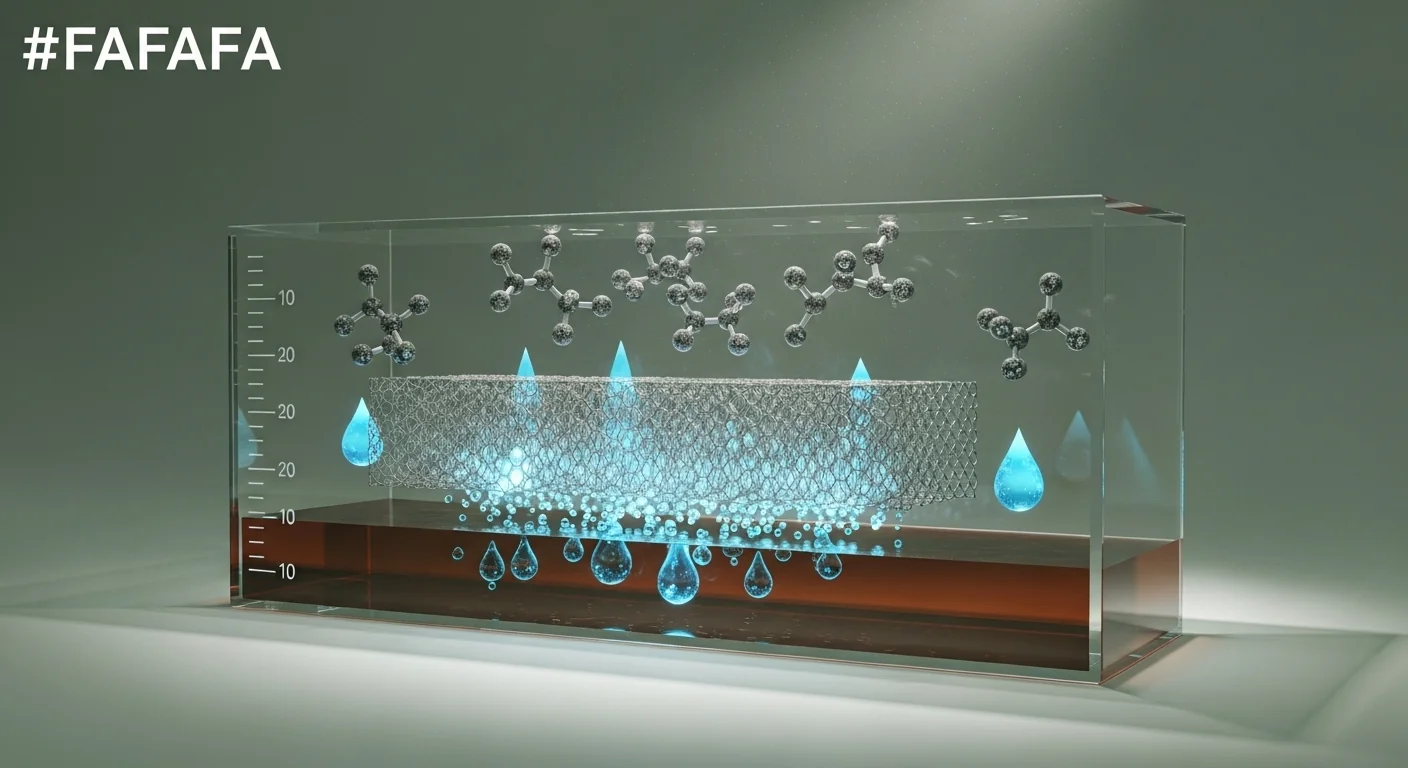
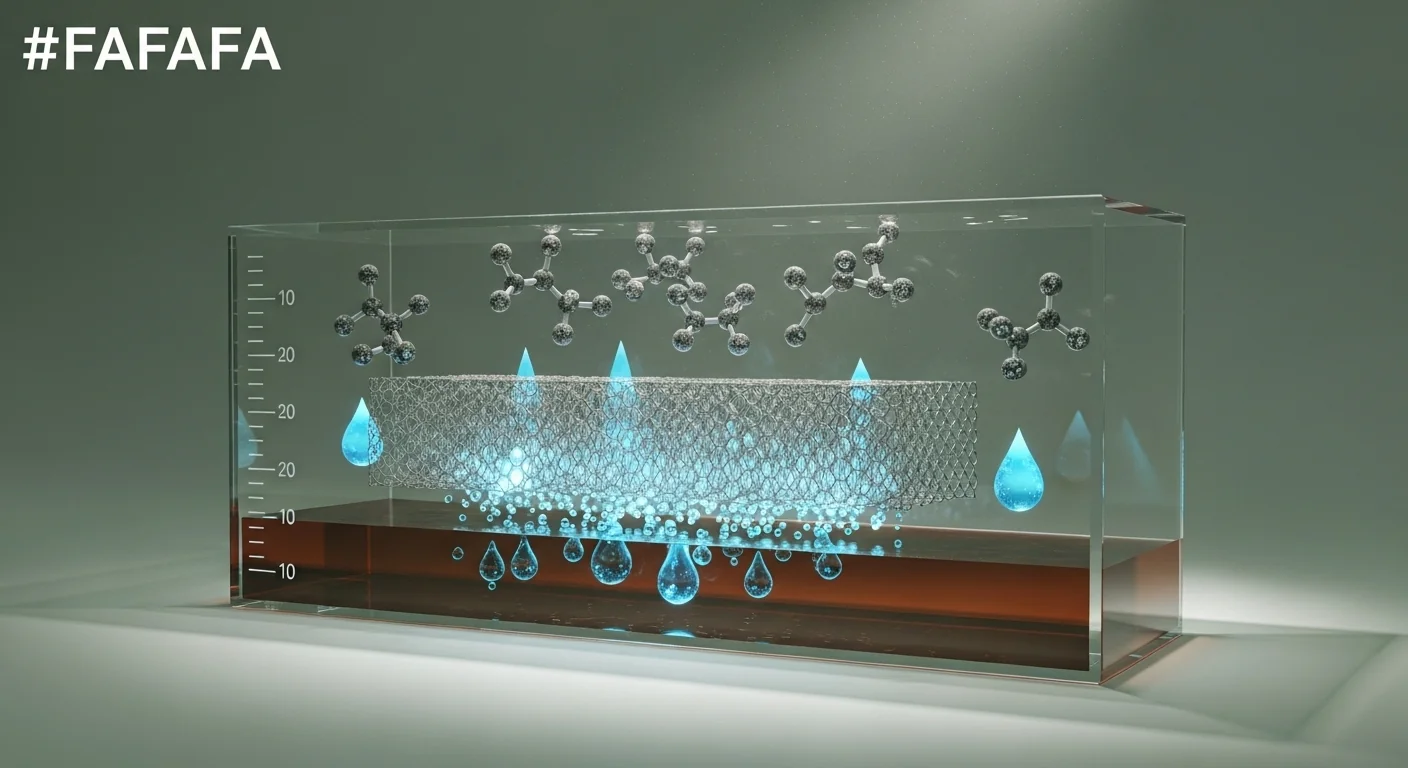
The reason pH keeps bouncing back in hard-water systems is not a meter problem or a technique problem. It is a chemistry problem. Tap water carries dissolved carbonates, primarily calcium and magnesium bicarbonate, that act as a chemical buffer. Every milliliter of phosphoric acid you add gets partially neutralized by that buffer before your water’s pH budges at all. Calculators that ignore carbonate alkalinity give you a dose figure that is guaranteed to fall short, often by a wide margin, in moderate-to-hard water.
This hydroponic pH down calculator corrects that by incorporating a water-type buffer factor into the core dose formula. You enter your reservoir volume, your current and target pH readings, and your water’s alkalinity (from a tap water report or home test kit). The tool returns a milliliter dose of standard phosphoric acid pH Down, flags alkalinity bounce risk, and, when your alkalinity is high enough to warrant it, splits the recommendation into a two-dose strategy. It does not substitute for a calibrated pH meter, and it cannot account for every mineral interaction in your specific nutrient solution. For reference, reservoir water temperature also affects pH meter accuracy and is worth monitoring alongside alkalinity; the water temperature calculator can help you track that variable.
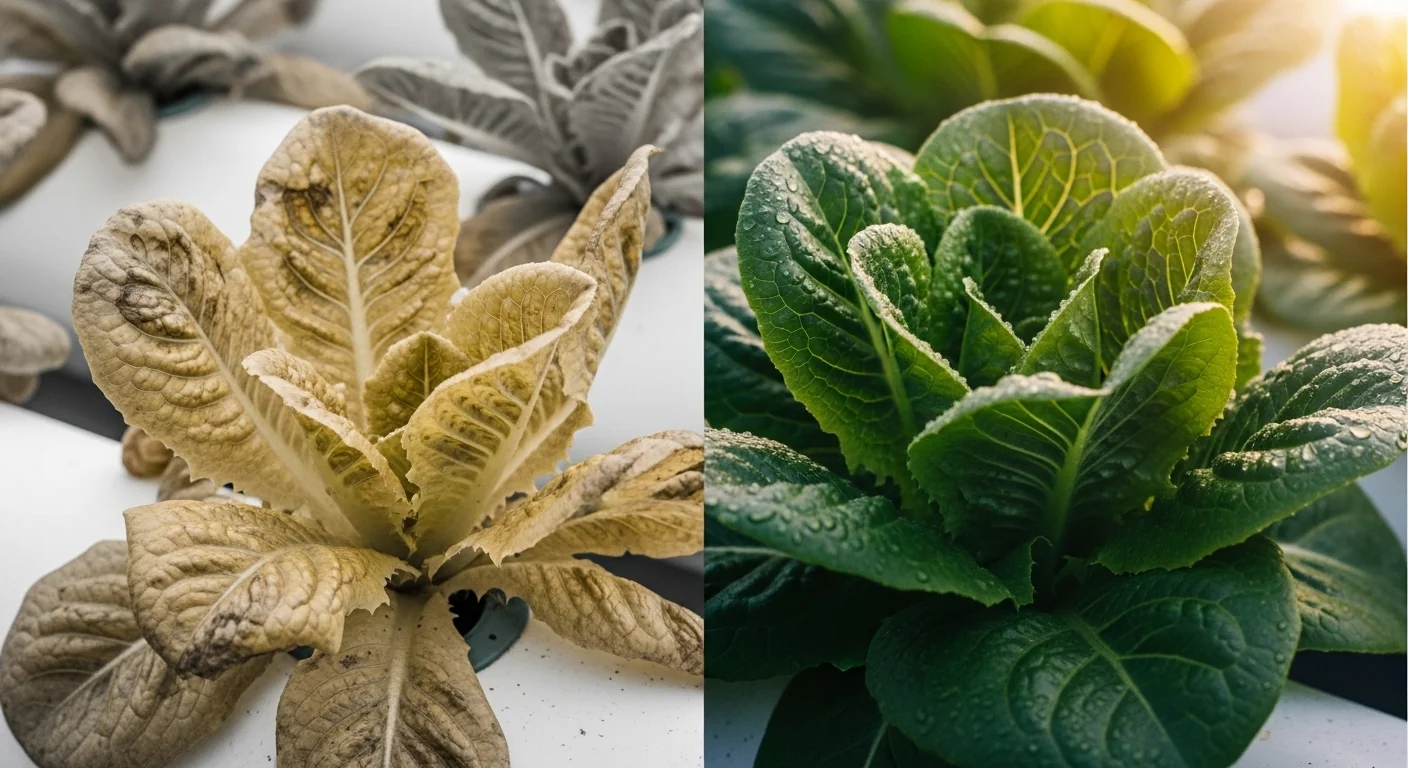
After running this calculator, you will know the total mL of pH Down required and whether your water chemistry requires a staged dosing approach to avoid the pH bounce cycle that yellows plants and frustrates growers who added “the right amount” and watched pH climb back overnight.
Use the Tool
Before you start, have three things ready: a fresh pH reading from your reservoir taken with a calibrated meter, your reservoir volume in US gallons, and, if possible, your municipal water report or a carbonate hardness (KH) test result in parts per million. If you use reverse osmosis water, your alkalinity is effectively near zero. If you have no water report, select your water source type and the calculator will apply a conservative buffer factor estimate. For context on how water quality metrics connect, the PPM to EC converter can help you read your water test numbers in the correct unit for your meter.
Quick Start (60 Seconds)
- Reservoir Volume: Enter the total water volume in US gallons, not the tank capacity. A 30-gallon container filled to two-thirds holds 20 gallons. Overestimating volume produces underdosing.
- Current pH Reading: Read your meter only after it has been circulating for at least 10 minutes. A fresh reservoir fill without circulation will read unevenly. Use a two-point calibrated pH pen; strip tests are not precise enough to feed this formula.
- Target pH: For most hydroponic crops, 5.8 is the standard starting point. If you grow leafy greens or herbs, 6.0 to 6.2 is often preferred. Do not set a target below 5.5 without a specific crop reason.
- Alkalinity (PPM): This is the most commonly skipped field and the source of most pH bounce failures. Check your municipal water report for “Total Alkalinity” or “Carbonate Hardness.” If unavailable, use a KH test kit (common in aquarium supply stores, accurate for hydroponics).
- Water Source: If you have no alkalinity reading, select your actual source type. RO and rainwater assume near-zero buffering. Tap and well water use higher buffer factor defaults.
- Missing alkalinity data: Leave the PPM field blank and let the source selector drive the calculation. You will get a usable estimate, but measuring actual alkalinity improves accuracy significantly.
- Do not run the calculation if your current pH is already below 5.0. The tool will flag a toxicity alert. You need to raise pH or dilute the reservoir, not add more acid.
Inputs and Outputs (What Each Field Means)
| Field | Unit | What It Represents | Common Mistake | Safe Entry Guidance |
|---|---|---|---|---|
| Reservoir Volume | US Gallons | Total volume of water currently in the system, not tank capacity | Using container size instead of actual fill volume | 0.5 to 10,000 gal; measure actual water level if in doubt |
| Current pH | pH units (0-14) | Measured pH of reservoir water after full circulation | Reading immediately after adding nutrients before mixing | Take reading after 10+ min of pump circulation; calibrate meter first |
| Target pH | pH units (4-8) | Desired final pH for your crop system | Setting target equal to or above current pH (acid is not needed in that case) | 5.5 to 6.2 for most crops; must be lower than current pH for this calculator |
| Water Alkalinity | ppm (mg/L) | Carbonate buffer concentration; how much acid is consumed before pH drops | Skipping this field entirely, causing systematic underdosing | 0 to 2000 ppm; from water report or KH test kit; leave blank if unknown |
| Water Source | Selection | Fallback buffer factor when alkalinity ppm is not entered | Selecting “RO” when blended RO/tap water is actually being used | Select based on majority water source entering the reservoir |
| Acid Dose (Output) | mL | Total mL of 85% phosphoric acid (standard pH Down) needed to reach target | Using this result with a different acid concentration without adjusting | Add slowly in increments; verify product is standard-concentration pH Down |
| Buffer Factor (Output) | Unitless multiplier | Reflects how much extra acid the water’s alkalinity consumes before pH responds | Assuming buffer factor is always 1.0 regardless of water type | Ranges from 0.6 (RO) to 3.0+ (very hard water); drives the dose multiplier |
| Two-Dose Split (Output) | mL each | Recommended 50/50 staged dose when alkalinity exceeds 200 ppm | Adding full dose at once in hard water, causing overshoot when buffer finally saturates | Wait 30 min between doses; re-check pH before applying second half |
For growers running nutrient-dense reservoirs, tracking EC alongside pH is essential. Acid additions change total dissolved solids, and pH and EC are not independent. The hydroponic EC calculator can help you keep both numbers in range simultaneously.
Worked Examples (Real Numbers)
Scenario 1: Small RO-Fed Deep Water Culture, 5 Gallons
- Reservoir Volume: 5 gallons
- Current pH: 7.2
- Target pH: 5.8
- Water Source: RO (alkalinity approximately 0 ppm)
- Buffer Factor: 0.6
Result: (7.2 – 5.8) x 5 x 0.6 = 4.2 mL of pH Down
RO water has almost no carbonate buffer, so the response is fast and small doses go a long way. Add 2 mL, circulate for 10 minutes, re-check, then add the balance. Micro-dosing matters at this scale because 1 mL over target in a 5-gallon system represents a much larger error per gallon than in a large reservoir.
Scenario 2: 20-Gallon Recirculating System, Hard Municipal Tap Water
- Reservoir Volume: 20 gallons
- Current pH: 7.8
- Target pH: 5.8
- Alkalinity: 280 ppm
- Buffer Factor: 2.2
Result: (7.8 – 5.8) x 20 x 2.2 = 88.0 mL of pH Down
This is the scenario where a “flat” calculator that uses a buffer factor of 1.0 would return 40 mL, a dose that would leave growers confused when pH returns to 7.5 the next morning. The two-dose strategy applies here: add 44 mL, wait 30 minutes, re-check, then add the remaining 44 mL once the carbonate buffer begins to saturate.
Scenario 3: 100-Gallon Commercial Ebb-and-Flow Reservoir, Moderate
Tap Water
- Reservoir Volume: 100 gallons
- Current pH: 7.5
- Target pH: 6.0
- Alkalinity: 150 ppm
- Buffer Factor: 1.5
Result: (7.5 – 6.0) x 100 x 1.5 = 225.0 mL of pH Down
At this volume and moderate alkalinity, 225 mL is a manageable single dose, but it should still be added slowly over 5 to 10 minutes with active pump circulation. At 225 mL in a 100-gallon system, the localized acid concentration during pouring can be damaging to any roots near the dosing point if added all at once.
Reference Table (Fast Lookup)
All values below are computed using the formula: Acid (mL) = pH Drop x Volume (gal) x Buffer Factor. Acid product assumed to be standard 85% phosphoric acid pH Down at commercial dilution.
| Volume (gal) | pH Drop | Water Type | Alkalinity (ppm) | Buffer Factor | Acid Dose (mL) | Two-Dose Split |
|---|---|---|---|---|---|---|
| 5 | 1.0 | RO / Very Soft | ~0 | 0.6 | 3.0 | No |
| 5 | 1.0 | Soft Tap | 50 | 1.0 | 5.0 | No |
| 5 | 2.0 | Hard Tap | 280 | 2.2 | 22.0 | Yes (11 + 11) |
| 20 | 1.0 | RO / Very Soft | ~0 | 0.6 | 12.0 | No |
| 20 | 1.0 | Soft Tap | 50 | 1.0 | 20.0 | No |
| 20 | 2.0 | Hard Tap | 280 | 2.2 | 88.0 | Yes (44 + 44) |
| 50 | 1.0 | Moderate Tap | 150 | 1.5 | 75.0 | No |
| 50 | 2.0 | Hard Tap | 280 | 2.2 | 220.0 | Yes (110 + 110) |
| 100 | 1.0 | RO / Very Soft | ~0 | 0.6 | 60.0 | No |
| 100 | 2.0 | Moderate Tap | 150 | 1.5 | 300.0 | Review |
| 250 | 1.0 | Hard Tap | 280 | 2.2 | 550.0 | Yes (275 + 275) |
| 250 | 2.0 | Very Hard | 500+ | 3.0 | 1,500.0 | Yes – Consider RO blending first |
How the Calculation Works (Formula + Assumptions)
Show the calculation steps
Core formula:
Acid (mL) = (Current pH - Target pH) x Volume (US gal) x Buffer Factor
- pH Delta: Subtract target pH from current pH. This gives the total pH units to lower. Example: 7.5 – 5.8 = 1.7 pH units. The result must be positive; if target is higher than current, acid is not the right approach.
- Volume multiplier: Multiply the pH delta by the reservoir volume in US gallons. Larger volumes dilute the acid more, so more is needed per pH unit of adjustment.
- Buffer Factor application: Multiply by the buffer factor to account for the carbonate alkalinity that will consume acid before the water’s pH responds. Buffer factors:
- RO or rainwater (0-30 ppm alkalinity): 0.6
- Soft tap or well (30-100 ppm): 1.0
- Moderate tap (100-200 ppm): 1.5
- Hard tap or well (200-400 ppm): 2.2
- Very hard water (400+ ppm): 3.0
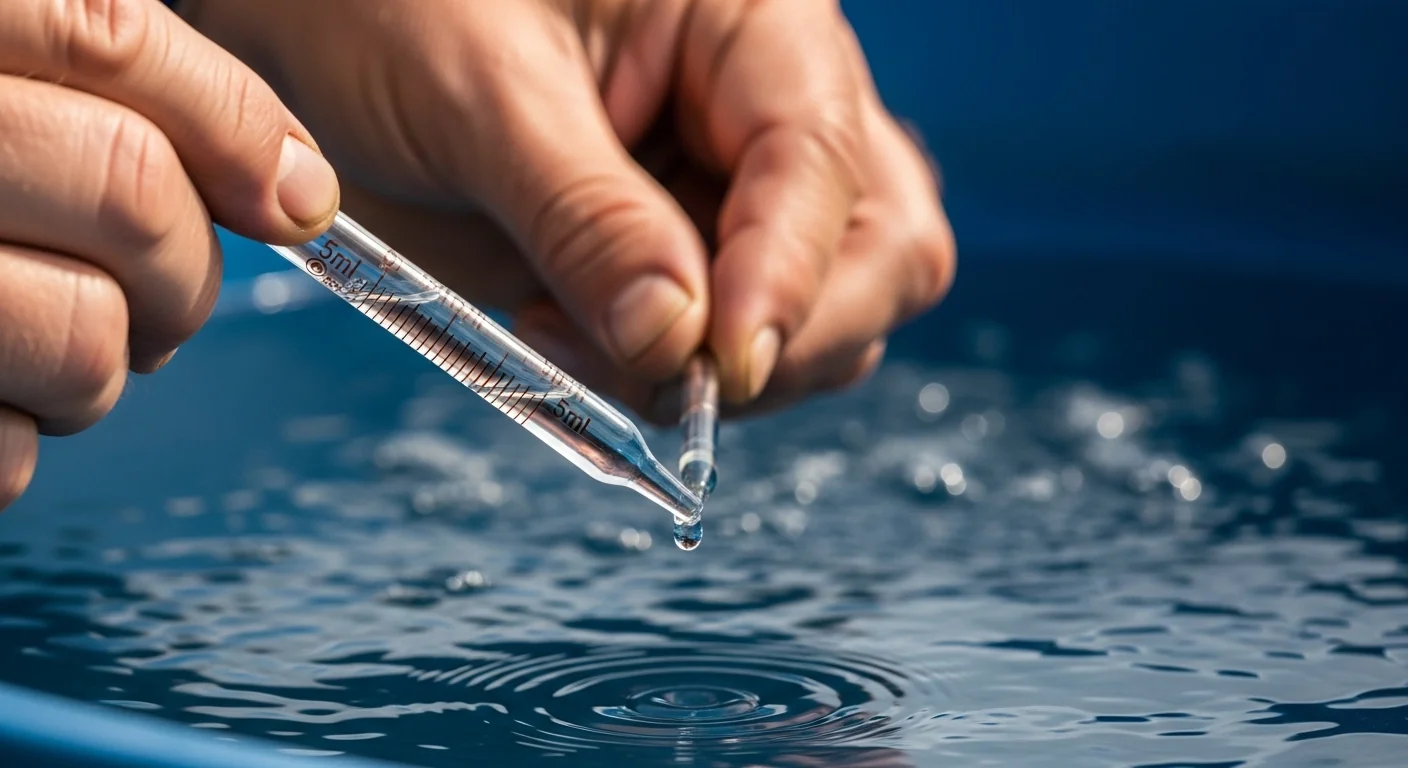
- Result rounding: The calculator rounds to one decimal place (nearest 0.1 mL). For doses below 5 mL, use a graduated glass pipette rather than a blunt-tip bottle; plastic dropper caps are not accurate enough.
- Two-dose trigger: When alkalinity exceeds 200 ppm or when the water source is classified as well water, the tool splits the dose 50/50. The first half partially saturates the carbonate buffer. After re-testing, the second half is applied to cross the remaining threshold.
Assumptions & Limits
- The formula assumes the pH Down product is 85% phosphoric acid at standard commercial concentration. Products sold in different concentrations (e.g., diluted retail formulas at 10%) require proportional scaling and should not use these outputs directly.
- Buffer factors are empirically derived estimates based on carbonate chemistry principles. Real water contains a variety of minerals, and the actual factor in any specific water may differ from the table values.
- The formula does not model nutrient solution interactions. High concentrations of calcium nitrate, ammonium-based fertilizers, or chelated iron can increase effective buffering beyond what alkalinity alone predicts.
- Temperature affects both pH meter readings and carbonate equilibrium. A significant temperature difference between calibration conditions and reservoir temperature will introduce measurement error upstream of the calculation.
- The toxicity threshold of pH 5.0 for the “do not add acid” warning is based on established nutrient availability curves for common hydroponic crops. Individual species vary.
- Calculations are point-in-time estimates. After dosing, biological activity, CO2 exchange, and plant uptake will continue to shift pH. Daily monitoring is expected for active reservoirs.
- Very large doses (above 50 mL for small systems) carry a localized concentration risk during application; the tool flags these and recommends slow, incremental addition.
- This tool is designed for phosphoric acid (pH Down) adjustments only. Adding pH Up (potassium hydroxide or calcium hydroxide) to raise pH uses different chemistry and a different factor.
Standards, Safety Checks, and “Secret Sauce” Warnings
Critical Warnings
- The Alkalinity Bounce: If your tap water alkalinity exceeds 200 ppm, a single-dose pH adjustment will not hold. Calcium and magnesium carbonates act as a chemical sponge, re-releasing alkalinity into the water 6 to 24 hours after dosing. The result is a pH that looks corrected at hour zero and has returned close to its original level by the next day. The two-dose strategy in this calculator is specifically designed to address this by saturating the carbonate buffer in stages rather than expecting one dose to do all the work.
- The RO Water Instability Risk: Reverse osmosis water solves the alkalinity bounce problem but introduces a different one. Without any carbonate buffer, the water has no resistance to pH movement in either direction. A small amount of CO2 from root respiration or a trace of acid from microbial activity can drop pH significantly. RO growers should add a cal-mag supplement to introduce 50 to 100 ppm of calcium and magnesium, which provides a minimal working buffer. The cal-mag dosage calculator can help you dial in that concentration.
- Toxicity Zone Below pH 5.0: If your current reservoir pH is already below 5.0, adding more phosphoric acid is contraindicated. At this pH, phosphorus accumulates to toxic levels in the root zone, and iron uptake becomes erratic. Corrective action is pH Up addition or fresh-water dilution, not further acidification.
- Lockout Zone Above pH 6.8: At pH values above 6.8, iron, manganese, and zinc precipitate out of solution regardless of how much is in the nutrient mix. Plants will show interveinal chlorosis that resembles a deficiency even with adequate nutrient concentrations. The target pH range of 5.5 to 6.2 keeps all major and minor elements in their most available ionic forms.
Minimum Standards
- Always use a two-point calibrated pH meter; pH 4.0 and pH 7.0 buffer solutions are the standard calibration pair for hydroponic ranges.
- Obtain a water alkalinity reading from your municipal supplier or use a KH test kit before setting up a new system. This single data point eliminates the most common source of pH management failure.
- Re-check pH 30 minutes after any dose and again at 12 hours to assess whether bounce is occurring in your specific water.
Competitor Trap: Most hydroponic pH calculators on the web apply a uniform dose formula: multiply pH drop by volume by a fixed constant of 1.0. That approach works acceptably for soft or RO water, but it produces systematically low doses for any grower using tap water with real carbonate hardness. The result is a calculation that looks correct on screen but fails in practice, leading growers to blame their meter, their nutrients, or their technique, when the actual problem is an unmodeled variable in the source water. The buffer factor in this calculator is the correction that flat-rate tools omit. For context on how water chemistry interacts with media buffering, the guide on buffering coco coir covers the same carbonate chemistry in a substrate-specific context.
Common Mistakes and Fixes
Mistake: Measuring pH Before Full Circulation
Freshly added nutrients or water creates localized concentration gradients in the reservoir. A pH reading taken at the surface of a still tank or immediately after mixing will not represent the true bulk pH. Circulation pumps need at least 10 minutes to homogenize the solution before a reading is reliable enough to input into a dose formula. Fix: always take your pH reading mid-reservoir after the pump has been running, then wait, then calculate.
Mistake: Treating pH Down as a Nutrient Additive
Some growers add a “maintenance shot” of pH Down daily as a preventive measure, regardless of current pH. This is unnecessary and dangerous because it bypasses the measurement step entirely. pH drift has directional causes: in most actively growing reservoirs, pH tends to rise from plant respiration and nitrate uptake, but the rate and direction change with plant stage. Dosing without measuring leads to accumulation of phosphate ions beyond useful concentrations. Fix: measure first, then calculate, then dose, every time, without exception. Pairing pH management with proper hydroponic nutrient dosing discipline reduces the frequency of pH corrections needed.
Mistake: Skipping the Alkalinity Field
Leaving the alkalinity field blank and relying on the water source selector alone degrades calculation accuracy, particularly for municipal water supplies that vary significantly by region and season. A tap water source in a region with limestone geology can have alkalinity above 300 ppm, while the same “tap” designation in a city served by a mountain reservoir might be 40 ppm. The buffer factor difference between those two scenarios is 2.2 versus 1.0, meaning the dose would be more than double. Fix: request your annual water quality report from your utility supplier; alkalinity is always listed.
Mistake: Pouring the Full Dose at Once in a Large System
In reservoirs larger than 50 gallons, adding the full calculated dose as a single pour creates a localized low-pH zone around the dosing point. Any roots near that area are briefly exposed to acid concentrations far beyond what the well-mixed final result will be. This is particularly problematic in deep water culture where roots grow densely near the return point. Fix: dilute the calculated dose in a cup of reservoir water first, then pour that diluted mix while the pump is running, distributing it across the surface.
Mistake: Ignoring pH Bounce After Apparent Success
A pH reading of 5.8 at 6 PM that drifts back to 7.4 by 6 AM is not a meter malfunction. It is the textbook signature of carbonate alkalinity reasserting itself after the initial acid dose was consumed. Growers who do not check at the 12-hour mark often conclude the first dose was sufficient and skip the second, then repeat the same frustrating cycle the next day. Fix: set a 12-hour reminder to recheck after every pH adjustment in hard-water systems, and use the two-dose strategy when this calculator recommends it. In DWC systems specifically, aeration intensity also affects CO2 off-gassing and pH; the DWC air pump calculator covers airflow sizing that influences this dynamic.
Next Steps in Your Workflow
Once you have made your pH adjustment and confirmed the reading is stable after 30 minutes of circulation, pH management becomes one layer of a broader environmental monitoring routine. Water chemistry does not operate in isolation from air conditions; a room with high vapor pressure deficit stresses roots and accelerates ion uptake, which directly drives pH movement in the reservoir. Running a VPD check alongside your pH log gives you a clearer picture of whether pH drift is being driven by plant demand or by water chemistry alone.
For growers moving toward data-driven crop management, pH adjustment frequency is also a useful input for crop steering decisions. Frequent pH correction requirements in a mature crop can signal high transpiration demand, excessive vegetative growth pace, or an approaching reservoir refresh point. Treating pH as a diagnostic indicator rather than just a number to correct opens up a more precise level of system management.
FAQ
What is a buffer factor in a hydroponic pH calculator?
The buffer factor is a multiplier that accounts for the dissolved carbonates in your water that absorb acid before pH drops. Water with high alkalinity (carbonate hardness) requires significantly more acid per gallon per pH unit of drop than RO or soft water. This calculator uses buffer factors ranging from 0.6 for RO water to 3.0 for very hard water above 400 ppm alkalinity.
Why does my pH keep bouncing back to 7.5 after I add pH Down?
This is the alkalinity bounce effect. Calcium and magnesium bicarbonates in your tap water act as a chemical buffer, neutralizing acid and pushing pH back toward the water’s natural equilibrium point. Your initial dose partially consumed the buffer, but the remaining carbonates reasserted themselves. The fix is to use a higher buffer factor in your dose calculation and apply the two-dose strategy to fully saturate the carbonate buffer before expecting a stable final pH.
Can I use this calculator for potassium hydroxide (pH Up) adjustments?
No. This calculator is specific to phosphoric acid (pH Down) adjustments and uses buffer factors calibrated for acid additions. Raising pH with potassium hydroxide or calcium hydroxide involves different chemistry and different dilution behavior. Using this formula for pH Up adjustments would produce inaccurate results. A separate pH Up calculation should account for the base’s specific concentration and your water’s existing buffering capacity from the acid side.
What phosphoric acid concentration does this calculator assume?
The formula assumes 85% phosphoric acid at standard commercial pH Down dilution, which is the concentration used in products like General Hydroponics pH Down. Retail formulas sold in more diluted forms (common in home and garden stores) will require a proportionally larger volume to achieve the same pH effect. Check your product label for active ingredient concentration before applying results from this tool.
How do I find my water’s alkalinity if I don’t have a water report?
Three practical options: request the annual water quality report from your municipal water utility (typically available online or by phone, and always includes total alkalinity in mg/L or ppm), purchase a KH test kit from an aquarium supply store (these test carbonate hardness and are accurate enough for hydroponic use), or use a complete water test kit that measures alkalinity directly. A freshwater aquarium KH drop test is often the least expensive option for hobby growers.
Is pH 5.8 the correct target for all hydroponic crops?
It is a reliable and widely accepted starting point for most fruiting crops, tomatoes, peppers, and cucumbers. Leafy greens and herbs often do well at 6.0 to 6.2. Strawberries and blueberries prefer slightly lower ranges around 5.5 to 5.8. The key principle is that every major nutrient has a specific pH range where its ionic form is most available to roots, and 5.5 to 6.2 is the range where the availability curves of the broadest set of nutrients overlap acceptably.
Conclusion
The most important habit this tool supports is testing alkalinity once before assuming all tap water behaves the same way. That single measurement changes the precision of every pH Down calculation made in that system for its entire operating life. The number one mistake to avoid is adding what a simple calculator says, checking pH at hour one, concluding success, and walking away, only to find pH has climbed back to its starting point by the next morning. For growers running large recirculating systems, the hydroponic water chiller calculator rounds out the water quality management picture, since temperature stability also affects pH meter accuracy and root zone health in ways that interact directly with the alkalinity dynamics covered here.