
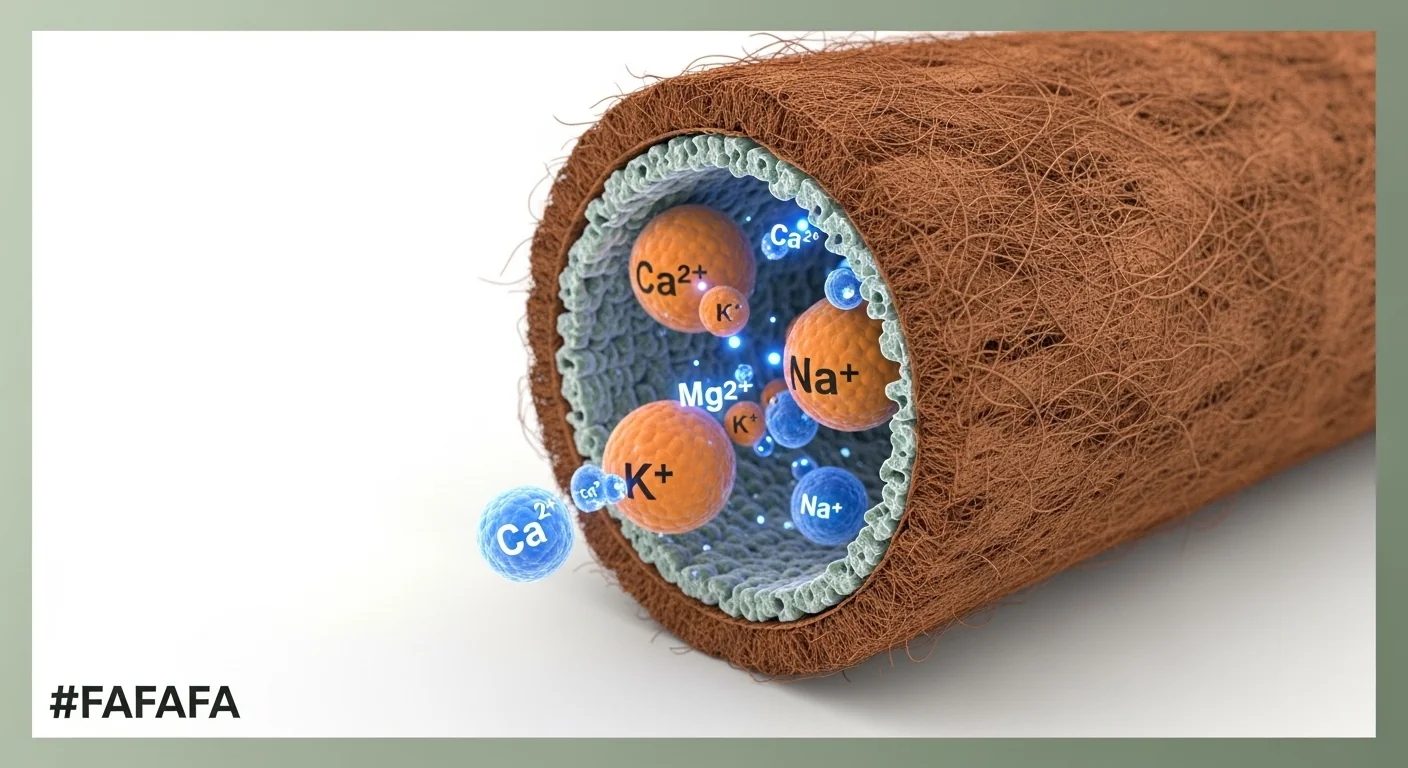
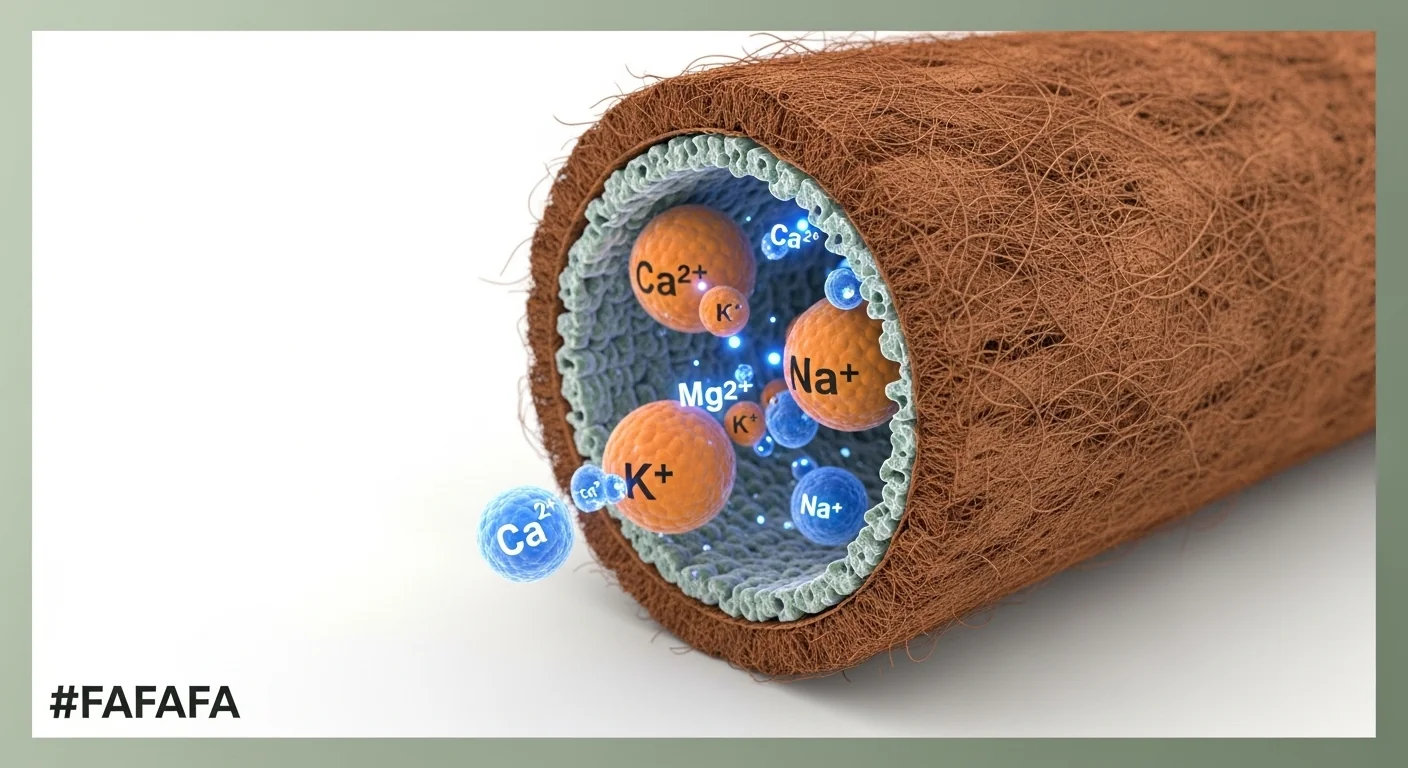
Coco coir does not behave like inert media. Raw or inadequately washed coco carries a high Cation Exchange Capacity (CEC), meaning its fiber matrix is pre-loaded with potassium (K+) and sodium (Na+) ions that displace calcium (Ca2+) and magnesium (Mg2+) the moment nutrient solution contacts the substrate. This is a physical chemistry process, not a fertilizer problem, and it cannot be fixed by increasing nutrient concentration after the fact.
This tool calculates the volume of CalMag solution needed to saturate the CEC of your specific coco substrate, the effective concentration after accounting for base water PPM, how much CalMag product to measure out, and how many soak cycles your chosen soak time justifies. It does not substitute for an EC/pH management plan, and it does not account for mid-cycle nutrient adjustments or proprietary buffering additives with undisclosed CEC figures.
After running this calculator, you will know whether your planned soak time and CalMag dose are sufficient to displace the K+ load in your coco before you plant anything into it.
Use the Tool
| Scenario | CEC Factor | CalMag Sol. (L/L coco) | Risk Level |
|---|---|---|---|
| Raw Brick, 4 hr soak | 0.95 | 3.8 | CRITICAL ⚠ |
| Raw Brick, 8 hr soak | 0.95 | 3.8 | High — minimum safe |
| Raw Brick, 24 hr soak | 0.95 | 3.8 | Moderate |
| Washed, 8 hr soak | 0.55 | 2.2 | Low-Moderate |
| Washed, 24 hr soak | 0.55 | 2.2 | Low ✓ |
| Premium Pre-Buffered, any soak | 0.18 | 0.7 | Minimal ✓ |
How This Calculator Works
The Potassium Poisoning Problem (Secret Sauce)
Raw and unwashed coco coir is naturally saturated with Sea Salt (Na⁺) and Potassium (K⁺) from its ocean-side growing environment. It has a high Cation Exchange Capacity (CEC) — meaning it magnetically strips positively charged ions (Ca²⁺, Mg²⁺) from nutrient solution, releasing its stored K⁺ in return. This causes Potassium Toxicity: your plant sees massive K⁺ while starving for Calcium and Magnesium simultaneously.
The Formula — Step by Step:
K⁺ Toxicity Trigger: If coco state is Raw Brick AND soak time < 8 hours, the calculator flags a CRITICAL toxicity risk — the CEC has not had sufficient time to exchange K⁺ for Ca²⁺/Mg²⁺.
Assumptions & Limits:
- CEC factors are averages — actual values vary by brand, batch, and rinsing history
- Base water PPM assumed 0 if left blank
- CalMag product dose uses Botanicare Cal-Mag Plus as reference (5 mL/gal ≈ 150 PPM)
- Formula assumes a single-soak buffering method. Double-soak adds ~40% extra security
- Results are a starting guide — always pH-test your runoff and adjust accordingly
- This tool covers Ca²⁺/Mg²⁺ buffering only; does not replace a full nutrient EC/pH plan
Before entering values, have the following ready: the total substrate volume in liters or gallons, the brand or processing state of your coco, your target CalMag concentration (check your product label for dose-to-PPM correlation), and a TDS reading of your source water if available. If you are working with a CalMag dosage calculator for ongoing fertigation, keep that dose separate from the pre-plant buffering flush calculated here. These are two different operations with different goals.
Quick Start (60 Seconds)
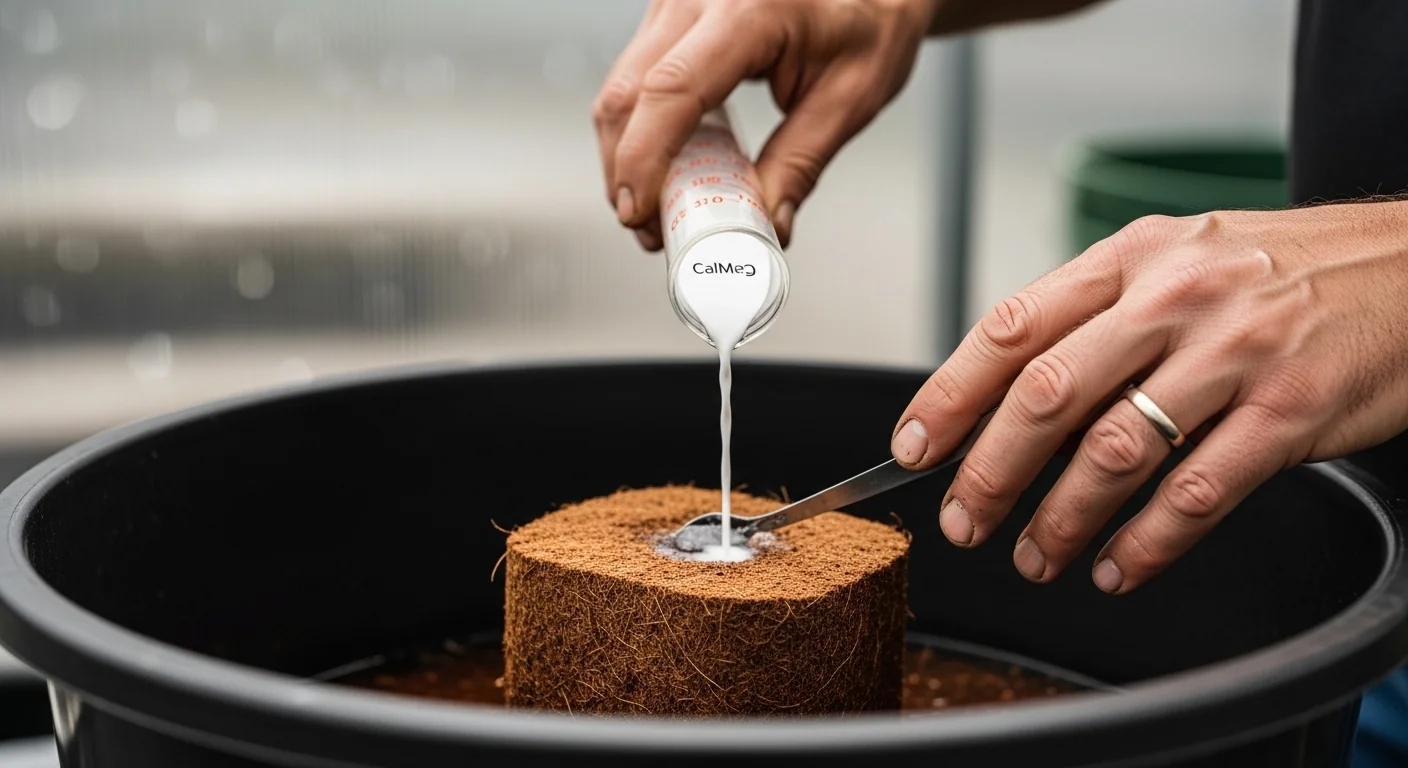
- Volume of Coco: Measure the total substrate you intend to buffer, not just what fits in one container. If hydrating a dry brick, note the expanded volume after hydration, not the dry block dimensions.
- Unit selection (L vs gal): The calculator converts automatically, but do not mix units. If your container is sized in gallons and your water supply is in liters, pick one system and convert before entering.
- Coco State: “Raw/Dry Brick” means imported compressed coco with no washing history. “Washed and Partially Buffered” covers product that has been salt-flushed but not fully charged with Ca2+/Mg2+. “Premium Pre-Buffered” applies to products like Canna Coco or brands that publish their buffering process. When in doubt, select Raw Brick — it is the conservative choice.
- Target CalMag Concentration: This is the concentration of your soak solution, not your normal nutrient run concentration. A 150-400 PPM CalMag-only solution is typical for buffering flushes. Enter PPM directly, or switch the unit toggle to EC if you measure in mS/cm.
- Soak Time: Enter your actual planned soak duration in hours. The tool uses this to flag K+ toxicity risk and recommend soak cycle count. Do not enter target soak time if you know you cannot maintain it.
- Base Water PPM: Leave blank or enter 0 only if you are using reverse osmosis water. For tap water, run a TDS meter before adding anything and record that number. High base water PPM directly reduces the effective CalMag concentration available for buffering.
- CalMag Product Strength: This defaults to the standard Botanicare Cal-Mag Plus dosing rate (5 mL per gallon = approximately 150 PPM Ca+Mg). Adjust to match your product label if you use a different formula.
Inputs and Outputs (What Each Field Means)
| Field | Unit | What It Means | Common Mistake | Safe Entry Guidance |
|---|---|---|---|---|
| Volume of Coco Coir | Liters or Gallons | Total substrate volume to be buffered, post-expansion | Using dry brick dimensions instead of expanded volume | Hydrate first, then measure container fill volume; 0.1-5,000 |
| Coco State / Brand | Categorical | Determines the CEC Displacement Factor used in calculation | Selecting “Washed” for pet-store bricks with no documented salt flush | Default to Raw Brick if processing history is unknown |
| Target CalMag PPM | PPM or EC (mS/cm) | Ca2+/Mg2+ ion concentration in the buffering solution | Confusing nutrient runline EC with buffering flush concentration | Use 150-400 PPM for flush; check your product’s PPM-per-mL spec |
| Soak Time | Hours | Duration the substrate will be saturated in buffering solution | Entering 8 hours because “that’s the standard” without actually waiting | Enter the time you will actually commit to; valid range 0.5-72 hrs |
| Base Water PPM | PPM (TDS) | TDS of your source water before any additives | Skipping this field and overstating effective CalMag concentration | Measure with TDS meter; enter 0 for confirmed RO water only |
| CalMag Product Strength | mL per gallon | Dose rate for the specific CalMag product being used | Using default 5 mL/gal for a product with a different concentration profile | Check product label; Botanicare Cal-Mag Plus is 5 mL/gal standard |
| OUTPUT: Solution Volume | Liters (and gal) | Total CalMag solution required to satisfy the CEC displacement demand | Treating this as gallons of product concentrate instead of mixed solution | This is total mixed solution volume; product mL is listed separately |
| OUTPUT: CalMag Product mL | mL | Milliliters of CalMag product concentrate to add to the total solution volume | Adding this to a smaller water volume than calculated | Mix into the full solution volume; diluting into less water raises PPM above target |
Table reflects widget fields extracted from widget code. EC conversion uses 1 EC = 500 PPM (the 500 scale used by most North American meters). If your meter uses the 700 scale, adjust target values accordingly. A PPM to EC converter can help reconcile readings from different meter scales before entering values here.
Worked Examples (Real Numbers)
Example 1: Raw Brick from a Pet Store, 50-Liter System, Tap Water
- Volume: 50 L (raw brick)
- CEC Factor: 0.95
- Target CalMag: 200 PPM
- Base water PPM: 50 (typical municipal tap)
- CalMag product: 5 mL/gal (standard dose)
- Soak time: 24 hours
Result: Buffer Requirement = 50 x 0.95 x 10 = 475 meq. Effective PPM = 200 – 50 = 150 PPM. Solution Volume = 475 / (150 / 100) = 316.7 L. Product to measure = (316.7 x 0.264) x 5 = approximately 418 mL of CalMag concentrate.
At 24 hours, the calculator recommends 2 soak cycles. The grower should prepare roughly 317 liters of mixed solution per cycle, discard all runoff between cycles, and verify runoff EC is within range before planting.
Example 2: Washed Coco, 20 Gallons, RO Water
- Volume: 20 gallons = 75.7 L
- Coco state: Washed and Partially Buffered
- CEC Factor: 0.55
- Target CalMag: 250 PPM
- Base water PPM: 0 (RO water)
- CalMag product: 5 mL/gal
- Soak time: 12 hours
Result: Buffer Requirement = 75.7 x 0.55 x 10 = 416.4 meq. Effective PPM = 250 – 0 = 250 PPM. Solution Volume = 416.4 / (250 / 100) = 166.6 L. Product = (166.6 x 0.264) x 5 = approximately 220 mL of CalMag concentrate.
RO water eliminates the base PPM penalty entirely, reducing solution volume requirements compared to the same setup using tap water at 100 PPM. The 12-hour soak qualifies for a single soak cycle recommendation.
Example 3: Premium Pre-Buffered Coco, 100 L, High-TDS Tap Water
- Volume: 100 L
- Coco state: Pre-Buffered Premium (CEC Factor: 0.18)
- Target CalMag: 150 PPM
- Base water PPM: 80
- CalMag product: 5 mL/gal
- Soak time: 8 hours
Result: Buffer Requirement = 100 x 0.18 x 10 = 180 meq. Effective PPM = 150 – 80 = 70 PPM. Solution Volume = 180 / (70 / 100) = 257.1 L. Product = (257.1 x 0.264) x 5 = approximately 339 mL of CalMag concentrate.
Note that high base water PPM (80) compresses the effective CalMag window to just 70 PPM, forcing a much larger solution volume to satisfy the buffer requirement. This scenario illustrates why RO water or pre-tested soft water significantly reduces flush volume even for premium coco substrates.
Reference Table (Fast Lookup)
All values below assume: target CalMag concentration = 200 PPM, base water PPM = 0 (RO), CalMag product dose = 5 mL/gal. Adjust using the calculator for different conditions.
| Coco State | Volume (L) | CEC Factor | Buffer Req. (meq) | Solution Vol. (L) | CalMag Product (mL) |
|---|---|---|---|---|---|
| Raw Brick | 10 | 0.95 | 95 | 47.5 | 62.7 |
| Raw Brick | 25 | 0.95 | 237.5 | 118.8 | 156.8 |
| Raw Brick | 50 | 0.95 | 475.0 | 237.5 | 313.5 |
| Raw Brick | 100 | 0.95 | 950.0 | 475.0 | 627.0 |
| Washed | 10 | 0.55 | 55.0 | 27.5 | 36.3 |
| Washed | 50 | 0.55 | 275.0 | 137.5 | 181.5 |
| Washed | 100 | 0.55 | 550.0 | 275.0 | 363.0 |
| Premium Buffered | 50 | 0.18 | 90.0 | 45.0 | 59.4 |
| Premium Buffered | 100 | 0.18 | 180.0 | 90.0 | 118.8 |
CEC factors (0.95 / 0.55 / 0.18) are model averages. Actual substrate CEC varies by source region, batch, and preparation. The “CalMag Product (mL)” column is the derived computed value: Solution_Vol (L) x 0.264 (gal/L) x 5 (mL/gal).
How the Calculation Works (Formula + Assumptions)
Show the calculation steps
Step 1: Convert volume to liters
If the user enters gallons, multiply by 3.78541 to get liters. All downstream calculations use liters as the base unit.
Step 2: Apply the CEC Displacement Factor
Each coco state carries a model CEC Factor: Raw Brick = 0.95, Washed = 0.55, Premium Pre-Buffered = 0.18. This factor represents the proportion of cation sites that are still occupied by K+/Na+ and require displacement.
Step 3: Compute Buffer Requirement
Buffer Requirement (meq) = Volume_L x CEC_Factor x 10. The multiplier of 10 scales from the per-liter CEC model to milliequivalents of displacement demand. This is a linearized model; actual CEC saturation curves are non-linear but this conservative linear estimate ensures adequate dose.
Step 4: Calculate Effective CalMag PPM
Effective_PPM = Target_PPM – Base_Water_PPM. If the result drops below 10 PPM (which would happen if base water PPM is near or above the target), the calculator enforces a minimum of 10 PPM effective concentration to avoid division near zero. In practice, if your base water PPM is approaching your target CalMag PPM, you need either RO water or a higher CalMag target.
Step 5: Calculate Solution Volume
Solution_Volume_L = Buffer_Req / (Effective_PPM / 100). Rounding: results are displayed to one decimal place for liters and one decimal place for gallons.
Step 6: Calculate CalMag Product Volume
Product_mL = (Solution_Volume_L x 0.264172) x Dose_mL_per_Gal. The 0.264172 factor converts liters to US gallons. Product mL is rounded to the nearest whole number.
Step 7: Recommend Soak Cycles
Raw Brick with soak under 24 hours: 3 cycles recommended. Raw Brick with soak 24 hours or more: 2 cycles. Washed with soak under 24 hours: 2 cycles. Washed 24 hours or more, and all Premium: 1 cycle.
Assumptions and Limits
- CEC factors are model averages derived from published coco coir CEC ranges (typically 40-60 meq/100g for raw coir). Individual batches from different production regions can fall outside these ranges.
- The linear Buffer_Req formula (Volume x CEC_Factor x 10) is a conservative over-estimate by design. Real CEC displacement follows a saturation curve, not a straight line. This means the tool may suggest more solution than strictly required, which is the safer direction of error.
- The EC conversion factor used is 1 EC (mS/cm) = 500 PPM (the 500 scale). If your meter uses the 700 scale (common in some European markets), your entered PPM values will be proportionally higher than actual ion concentration, and your results will be conservative.
- This calculator assumes CalMag product provides Ca2+ and Mg2+ ions as the primary displacing cations. Products with significant ammoniacal nitrogen or potassium content in the formula will provide less buffering capacity per mL than the pure Ca/Mg products the model assumes.
- The tool does not model pH effects on CEC. Coco coir CEC is pH-dependent; at pH below 5.5, exchange capacity drops. Ensure your buffering solution is within the 5.8-6.2 pH range for effective ion exchange.
- Substrate temperature is not modeled. CEC exchange kinetics slow significantly below 15C (59F). Cold soak environments will require longer soak times than the calculator can warn about directly.
- The soak cycle recommendation is a guide based on established minimum thresholds, not a guarantee of complete K+ displacement. Always verify with a runoff EC test before planting.
Standards, Safety Checks, and “Secret Sauce” Warnings
Critical Warnings
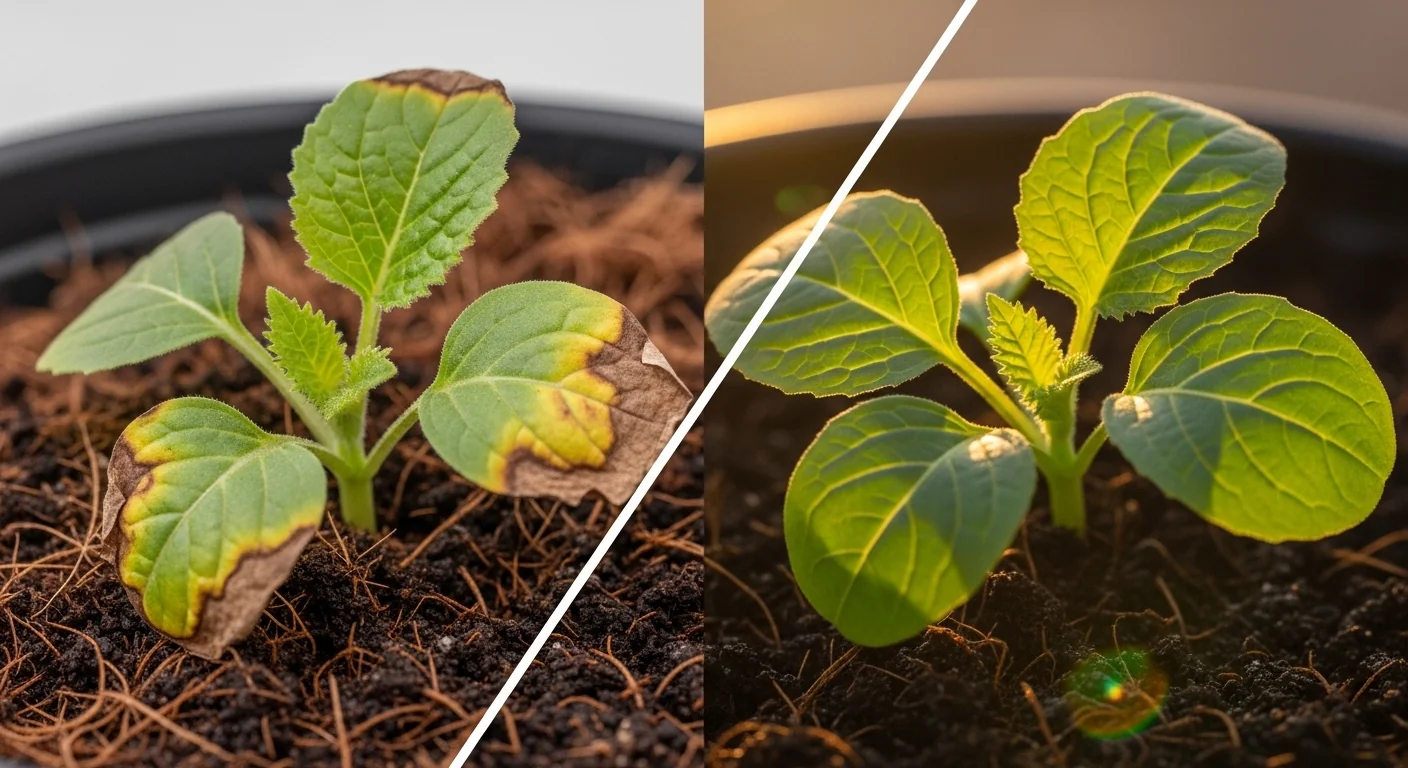
- K+ Toxicity Trigger (Raw Brick, soak under 8 hours): Planting into raw coco that has soaked for less than 8 hours is the single highest-risk action this calculator is designed to prevent. The coco’s cation sites have not had sufficient contact time to exchange K+/Na+ for Ca2+/Mg2+. Seedlings experience simultaneous potassium toxicity and calcium/magnesium deficiency. This presents as rapid interveinal chlorosis, brown scorching on leaf margins, and wilting that cannot be corrected by adjusting fertigation after the fact.
- Discarding Soak Runoff is Mandatory: The entire value of the buffering process depends on removing the displaced K+ and Na+ from the media. If you allow the coco to drain and then reuse that runoff (or fail to fully drain the substrate), you are re-saturating the cation sites with the same ions you just displaced. This is an invisible error that produces the same symptoms as no buffering at all.
- Base Water PPM Compression: Tap water at 150 PPM TDS entering a 200 PPM CalMag solution leaves only 50 PPM of effective Ca2+/Mg2+ for the exchange reaction. That is a four-fold reduction in buffering efficiency compared to RO water at the same nominal CalMag dose. The calculator surfaces this number explicitly; do not ignore it.
- CEC Displacement Demand Threshold: The gauge in the tool marks a 65% CEC displacement demand threshold. Scenarios at or above this level correspond to substrates where undershooting the soak will almost certainly produce visible deficiency symptoms within the first week of growth.
Minimum Standards
- Minimum soak time for raw brick coco before any planting: 8 hours at target CalMag concentration. This is a hard floor, not a starting point.
- Minimum of 2 soak cycles for raw brick; first runoff discarded, media re-soaked before second flush is discharged.
- Buffering solution pH should be held between 5.8 and 6.2 during the soak to maintain effective ion exchange kinetics.
- Runoff EC from the final soak cycle should be within 10% of input EC before the substrate is considered ready for planting and nutrient solution application.
Competitor Trap: The majority of coco coir buffering guides online focus on “how many teaspoons of CalMag per gallon” and skip the substrate volume calculation entirely. This produces single-concentration advice that applies to exactly one substrate volume (usually a 5-gallon grow bag) while being wrong for every other setup. The real question is not dose rate. It is: does the total ion-exchange demand of your substrate match the total available Ca2+/Mg2+ in your soak solution? A low-dose, large-volume soak and a high-dose, small-volume soak are not interchangeable. The buffering coco coir math in this tool resolves that ambiguity directly. If you are managing multiple growing systems at different scales, a hydroponic EC calculator can help you cross-check that your ongoing nutrient EC targets stay consistent with the pre-buffered baseline your soak establishes.
Once your substrate is buffered and planted, maintaining correct VPD throughout the growing environment is the next lever that determines whether the plant can actually uptake the calcium and magnesium that is now available. Crop steering parameters and VPD management interact directly with uptake efficiency in coco systems.
Common Mistakes and Fixes
Mistake: Using Dry Brick Volume Instead of Expanded Volume
A compressed coco brick may be labeled “expands to 60 liters” but is entered into the calculator as its dry dimensions, producing a fraction of the correct volume. The buffer requirement is then drastically undercalculated. One bag of dry brick does not equal one liter of substrate.
Fix: Always hydrate the coco in a mixing container first, measure the actual fill volume after full expansion, and enter that number.
Mistake: Assuming All “Washed” Coco Is Equivalent
The label “triple-washed” on a retail bag is a marketing claim, not a standardized process. Some washed cocos are rinsed once with fresh water at the processing facility; others undergo structured salt flushes with documented EC targets. Without processing documentation, a “washed” coir from an unverified source carries K+/Na+ levels closer to raw brick than to certified pre-buffered product.
Fix: Default to Raw Brick in the calculator when sourcing from retail bags without a buffering certificate or published processing protocol. It adds solution volume but eliminates the guesswork.
Mistake: Ignoring Base Water PPM When Mixing Buffering Solution
Adding CalMag to hard tap water at 200 PPM TDS and aiming for a 250 PPM flush solution leaves only 50 PPM of effective CalMag ions for exchange. The remaining 200 PPM consists of mineral compounds that contribute EC but do not provide Ca2+ or Mg2+ for CEC displacement. The grower measures a plausible EC and assumes the buffer is complete. It is not. Those using DWC systems face a similar concentration-management challenge, which is why accurate baseline measurements matter in systems covered by tools like the DWC air pump calculator where water chemistry interacts with oxygen delivery.
Fix: Measure source water PPM before mixing. Enter the actual number into the base water field. If tap water PPM exceeds 100, consider RO filtration for your buffering flush.
Mistake: Single Soak with No Runoff Verification
Completing one 8-hour soak of raw brick coco, dumping the water, and immediately planting without an EC runoff check treats the minimum standard as the success condition. CEC exchange is not uniform across the substrate; compacted zones and large chunks in the center of the media retain their K+/Na+ saturation longer than the surface layers.
Fix: After the soak period, collect a sample of runoff from several points in the substrate container. Measure EC. Compare to the input EC. If the spread exceeds 10% above input, the media requires an additional soak cycle before planting.
Mistake: Using the Buffering Flush Volume as the Ongoing Nutrient Target
A 300-400 PPM CalMag-only flush is appropriate for pre-plant CEC saturation. Once planted, this concentration as an ongoing nutrient solution is typically too low in nitrogen and phosphorus for active vegetative growth and too high in CalMag relative to a balanced formula. Growers who confuse buffering flush concentration with fertigation targets can either underfeed the plant or create antagonistic ion ratios during the growing phase.
Fix: After buffering is confirmed via runoff EC test, switch to a balanced nutrient solution formulated for the growth stage. Use the pH adjustment tool to bring your nutrient solution to the correct range before application.
Next Steps in Your Workflow
Once the calculator confirms your soak parameters and you have completed the required soak cycles with verified runoff EC, the substrate is ready for nutrient solution. Your first feed should be at a lower EC than your eventual target, allowing the freshly buffered coco to stabilize without salt build-up in the root zone. The specific EC ramp depends on your plant species and growth stage. A hydroponic nutrient dosing calculator is useful at this stage to translate target EC into actual product volumes for your reservoir or top-feed schedule.
Climate management becomes critical once plants are established in buffered coco, because calcium uptake is directly tied to transpiration rate. A high-VPD environment drives stronger transpiration and better mineral transport from root zone to canopy. Monitoring your grow environment with a VPD calculator during the first two weeks after transplant into freshly buffered coco helps confirm that calcium and magnesium deficiency symptoms, if they appear, are environmental in origin rather than a buffering failure that would require pulling and re-treating the media.
FAQ
What is CEC and why does it matter for coco coir?
Cation Exchange Capacity (CEC) is the measure of a substrate’s ability to hold and exchange positively charged ions. In raw coco coir, the CEC is saturated with K+ and Na+ ions that were absorbed during the plant’s growth in coastal conditions. These ions displace Ca2+ and Mg2+ from nutrient solution on contact, creating deficiencies that are independent of the nutrient concentration in your reservoir.
Can I use general-purpose nutrients to buffer coco instead of CalMag?
Technically some exchange will occur with any Ca-containing solution, but general-purpose nutrient formulas contain nitrogen, phosphorus, and potassium that can interfere with the exchange chemistry and reintroduce K+ to cation sites. CalMag-specific products with predominantly Ca2+ and Mg2+ ions are more efficient for CEC displacement. Using a balanced feed formula for pre-plant buffering is a known source of incomplete saturation.
How do I know if my coco is actually pre-buffered when the label says so?
Genuine pre-buffered coco from verified brands (Canna Coco, FoxFarm Coco Loco, and similar) will document their buffering process and typically carry lower K+ in product analysis sheets. If no analysis sheet is available and the source is uncertain, treating the product as “washed” rather than “premium buffered” in the calculator provides a conservative buffer requirement that covers undocumented K+ saturation.
Why does the calculator require so much more water than I expected for raw brick?
Raw brick coco has a CEC Factor of 0.95, the highest in the model, meaning nearly the full cation exchange capacity is loaded with K+/Na+. To fully displace that ion load, a large volume of Ca2+/Mg2+-rich solution must contact the substrate long enough for exchange equilibrium to shift. For 50 liters of raw brick at 200 PPM CalMag using RO water, the required solution volume is approximately 237 liters. This reflects real physical chemistry, not a calculation error.
What happens if I skip buffering and just start feeding with CalMag in my regular nutrient mix?
The substrate’s unfilled cation sites will continue stripping Ca2+ and Mg2+ from your nutrient solution throughout the early growth phase. The extent of stripping diminishes over time as sites gradually become occupied, but plants in the interim show calcium and magnesium deficiency symptoms that mimic pH problems or nutrient lockout, making diagnosis difficult. Pre-plant buffering eliminates this variable entirely.
Is a single long soak better than multiple shorter soak cycles?
Multiple shorter soak cycles with runoff discarded between them are generally more effective than one extended soak, because removing displaced K+/Na+ in runoff between cycles prevents re-equilibration where displaced ions can migrate back onto partially-vacated cation sites. For raw brick, two full cycles of 12-24 hours each with a complete drain between cycles is more thorough than one uninterrupted 24-48 hour soak without drainage.
Conclusion
Buffering coco coir is not a precaution. It is the step that determines whether the rest of your nutrient management actually connects with the plant’s root zone. The calculation is specific: buffer requirement scales with substrate volume, CEC Factor, and the effective CalMag concentration available after accounting for source water TDS. Skipping this math, or substituting a generic dose-rate rule from a single-bag tutorial, produces a substrate that looks ready but is not.
The single most costly mistake in coco growing is planting into raw brick with less than 8 hours of CalMag soak contact time, which the tool flags as a critical K+ toxicity event for exactly this reason. Run the numbers first, verify runoff EC after the soak, and only then introduce plant roots to the media. For growers scaling up to larger substrate volumes or more complex systems, a wicking bed calculator provides similar substrate-volume-based planning for passive hydroponic setups where pre-saturation and CEC management follow the same principles.