
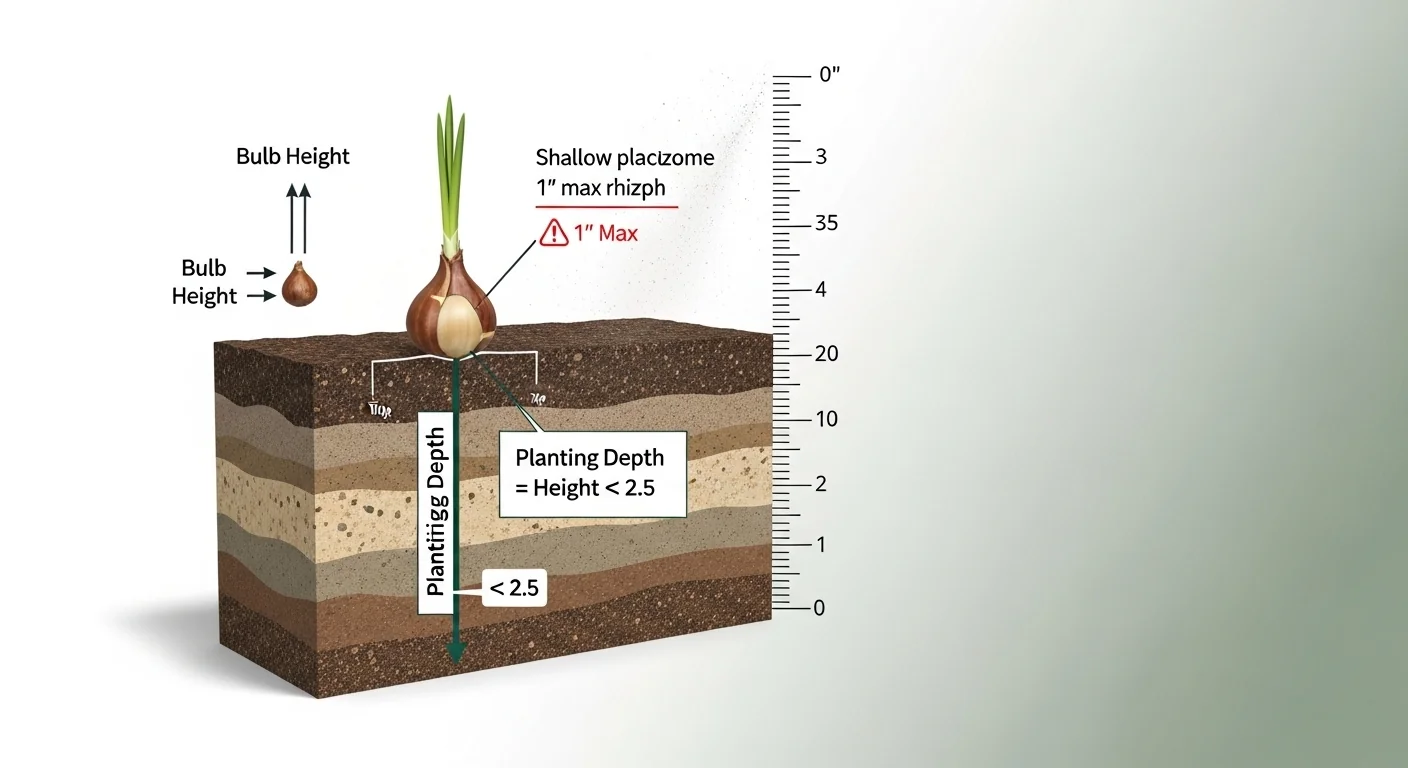
Planting depth controls three things at once: frost survival, anchorage strength, and the energy a bulb spends reaching the surface. Get it wrong by even an inch and the bulb may emerge weakly, skip a season entirely, or rot before it ever wakes. Depth is not a rough estimate; it is a structural decision tied directly to the physical size of the bulb you are placing in the ground.
Bulb Planting Depth Chart
Calculate the correct depth for planting flower bulbs using the 2.5× rule of thumb.
| Bulb Type | Bulb Height (in) | Plant Depth (in) | Notes |
|---|
▶ How this calculator works
Formula
Step-by-step
- Step 1: Measure the bulb from base to tip (in inches).
- Step 2: Multiply by 2.5 — the standard “rule of thumb” planting multiplier.
- Step 3: The result is how deep to set the bottom of the bulb below soil level.
Standards & Exceptions
- The horticultural rule of thumb is to plant bulbs 2.5× to 3× their diameter (height used as proxy here).
- Iris exception: Bearded iris rhizomes should be planted shallow — the tops of the rhizomes should sit at or just below the soil surface. Planting too deep will rot the rhizome and prevent flowering.
- Depth is measured from the soil surface to the bottom of the bulb.
Assumptions & Limits
- Bulb height is used as a proxy for bulb diameter. For most round/oval bulbs, these are similar.
- Formula applies to spring bulbs (tulips, daffodils, etc.) and summer bulbs in well-drained soil.
- Input range: 0.25 in – 12 in. Values outside this range are not typical planting bulbs.
- This calculator does not account for soil type, climate zone, or container planting.
- Iris rhizomes are a special case: maximum recommended depth is 1 inch below soil surface.
This tool calculates planting depth using the horticultural standard of 2.5 times the bulb’s height. It accepts either a direct measurement or a preset bulb type, then applies the formula and flags known exceptions. It does not account for soil type, container planting depth adjustments, or regional frost depth variation. Those factors require separate analysis.
After running this calculator, you will know the minimum planting depth for your specific bulb and whether the standard formula applies or needs to be overridden for species like iris.
Use the Tool
Before calculating, have the physical bulb in hand. Measure from the flat base to the pointed tip with a ruler or calipers; this is the height input the tool expects. If you are working with a named variety you have not measured yet, select the bulb type from the dropdown to populate a representative height. Results are given in inches and represent the depth from the soil surface to the bottom of the bulb. If you are planning spacing alongside depth, the plant spacing calculator handles the horizontal layout as a companion step.
Quick Start (60 Seconds)
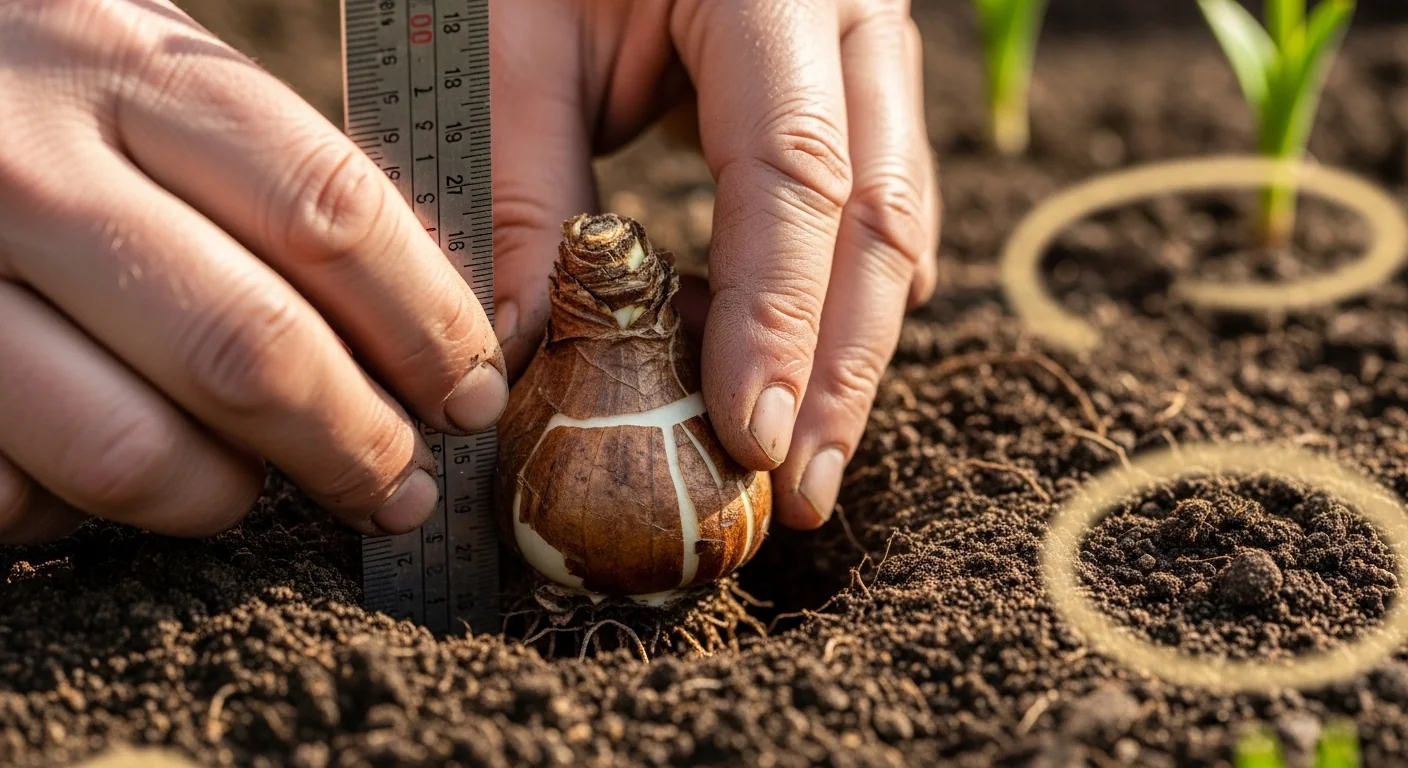
- Measure the bulb height first. Do not use the bulb’s label diameter as the height. Measure the actual tallest dimension tip to base in inches.
- Enter a decimal for small bulbs. Crocus and snowdrop bulbs are often under 1 inch tall. Enter values like 0.75 rather than rounding up to 1.
- Use the bulb type dropdown if you lack a ruler. Selecting a type auto-fills a standard height for that species. You can override it with your own measurement afterward.
- Do not apply this calculator to iris rhizomes without reading the warning. The tool flags iris as an exception and overrides the formula output automatically.
- Input range is 0.25 to 12 inches. Values outside this range are rejected. Bulbs outside that range (if they exist in your project) need species-specific guidance not covered here.
- Depth is measured to the bulb bottom, not the top. If your bulb is 2 inches tall and the tool returns 5 inches, the bottom of the bulb sits at 5 inches and the tip sits at 3 inches below soil.
- Click Calculate only after filling the height field. The results panel stays hidden until a valid number is submitted.
Inputs and Outputs (What Each Field Means)
| Field | Unit | What It Means | Common Mistake | Safe Entry Guidance |
|---|---|---|---|---|
| Bulb Height | Inches | The tallest vertical dimension of the bulb, measured tip to base | Using the diameter label from a seed packet instead of a physical measurement | Measure with a ruler; enter decimals (e.g., 1.75) for accuracy |
| Bulb Type (optional) | Selection | A preset species that auto-populates a representative bulb height | Assuming the preset height matches every cultivar of that species | Use as a starting point only; verify against your actual bulb when precision matters |
| Planting Depth (output) | Inches | How far below the soil surface the bottom of the bulb should be placed | Interpreting depth as the center of the bulb rather than the base | Set the hole depth so the base lands at this value; the bulb tip will be shallower by the bulb’s own height |
| Warnings and Standards (output) | Qualitative | A pass/flag display confirming whether the result is within the 2.5x to 3x standard range, or triggering the iris override | Ignoring the iris flag and planting rhizomes at the calculated formula depth | Read the warning box before digging; the iris exception requires a completely different approach |
Worked Examples (Real Numbers)
Example 1: Tulip (Standard Spring Bulb)
- Bulb Height: 2.0 in
- Formula: 2.0 x 2.5 = 5.0 in
Result: 5.0 inches deep
This is a textbook application of the rule. The bulb base sits at 5.0 in; the tip sits at 3.0 in below the surface. Both measurements fall well below typical frost penetration depth in temperate zones, providing adequate cold protection without demanding excessive emergence energy.
Example 2: Daffodil (Medium Bulb, Slightly Larger)
- Bulb Height: 2.5 in
- Formula: 2.5 x 2.5 = 6.25 in
Result: 6.25 inches deep
Daffodil bulbs are taller than tulips on average, which pushes the planting depth past 6 inches. This is within the accepted standard range of 6.25 to 7.5 in (2.5x to 3x). Planting too shallow with daffodils often causes toppling after emergence because the root system cannot anchor properly in compressed upper soil layers.
Example 3: Lily (Deep Planter)
- Bulb Height: 3.0 in
- Formula: 3.0 x 2.5 = 7.5 in
Result: 7.5 inches deep
Lilies are among the deepest-planted common bulbs. The standard formula places the base at 7.5 in, with the tip at 4.5 in. This depth supports the stem-root system that lilies develop along the buried section of their stem, which is a structural feature that shallow planting actively prevents from forming.
Reference Table (Fast Lookup)
| Bulb Type | Bulb Height (in) | Formula Depth (2.5x) in | Full Standard Range (2.5x-3x) in | Override Depth | Notes |
|---|---|---|---|---|---|
| Tulip | 2.00 | 5.0 | 5.0 to 6.0 | None | Classic spring bulb; standard formula applies |
| Daffodil | 2.50 | 6.25 | 6.25 to 7.5 | None | Naturalizes well at correct depth |
| Hyacinth | 2.00 | 5.0 | 5.0 to 6.0 | None | Same depth as tulip; heavy bulb needs firm seating |
| Crocus | 0.75 | 1.88 | 1.9 to 2.25 | None | Small corm; precise placement needed to avoid too-deep burial |
| Allium | 2.00 | 5.0 | 5.0 to 6.0 | None | Ornamental onion; formula applies across common varieties |
| Lily | 3.00 | 7.5 | 7.5 to 9.0 | None | Stem roots develop along buried stem section; depth is structural |
| Iris (Bearded) | 1.50 | 3.75 (formula) | Override applies | 0 to 1.0 max | Rhizome must stay at or near surface; formula depth causes rot |
| Snowdrop | 0.75 | 1.88 | 1.9 to 2.25 | None | Very small bulb; grouping helps emergence success |
How the Calculation Works (Formula + Assumptions)
Show the calculation steps
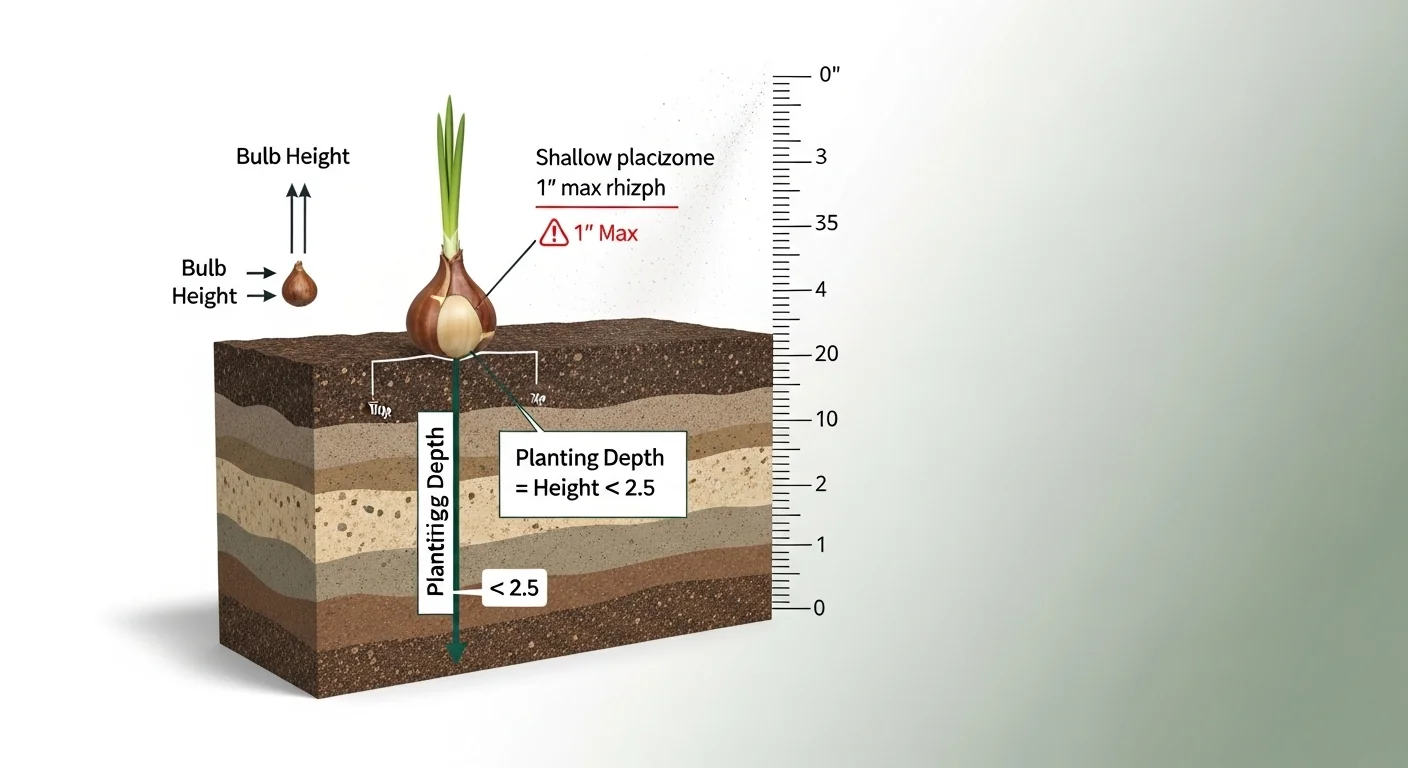
Formula: Planting Depth (inches) = Bulb Height (inches) x 2.5
- Obtain the bulb height. Measure the tallest vertical dimension of the bulb in inches, from its flat base to its pointed tip. This is the only variable in the formula.
- Multiply by 2.5. This is the lower bound of the standard horticultural planting multiplier range (2.5 to 3.0). The tool uses 2.5 as the default to calculate the minimum safe depth.
- Apply species override if triggered. For iris, the formula result is suppressed and replaced with the override maximum of 1.0 inch, because the 2.5x depth would bury the rhizome below its functional zone.
- Round to two decimal places. The tool displays results to one decimal place for readability. Full two-decimal precision is used internally before rounding occurs.
Unit notes: Inputs and outputs are entirely in inches. No unit conversion is performed. If you have measurements in centimeters, divide by 2.54 before entering.
Assumptions and Limits
- Bulb height is used as a proxy for bulb diameter. For round or ovoid bulbs, these measurements are similar, but elongated or irregular bulbs may have height and diameter values that diverge significantly.
- The formula assumes well-drained, loamy to sandy-loam soil. In heavy clay soils, reducing depth by 0.5 to 1 inch is a common field adjustment that this tool does not perform automatically.
- The 2.5x multiplier represents the lower bound. The full accepted range is 2.5x to 3x. Gardeners in colder climates often plant toward the deeper end of that range for additional frost protection. This tool outputs the conservative minimum.
- Container planting follows different rules. Pot depth constraints may make formula-depth planting physically impossible; this tool does not flag container scenarios.
- The tool treats all iris types as rhizome exceptions. Not every iris species is a bearded rhizome type; bulbous iris (such as Dutch iris) can tolerate somewhat greater depth. The tool uses the conservative maximum of 1.0 inch for all iris types as a safety default.
- Regional soil temperature and hardiness zone data are not inputs to this formula. In regions with minimal frost, some growers plant shallower successfully, but that adjustment is outside the scope of this calculator.
- The formula does not account for planting in raised beds, which may have shallower true soil depth than the calculated planting target.
Standards, Safety Checks, and “Secret Sauce” Warnings
Critical Warnings
- Iris rhizomes rot when planted at formula depth. The 2.5x result for a typical iris (3.75 in) places the rhizome in a zone with restricted airflow and excess moisture retention. The rhizome needs to remain at or just below the soil surface to breathe, photosynthesize slightly through the skin, and resist fungal infection. Planting deeper is the single most common reason bearded iris fails to rebloom.
- Planting too shallow invites frost heave and poor anchorage. Bulbs set at less than 2x their height may be pushed out of the soil by freeze-thaw cycles before spring emergence. They also lack the root depth to resist wind-rock, which causes stem damage in taller species like lilies. If you are uncertain, plant at the 3x end of the range rather than shallower.
- The formula breaks down for non-standard bulb shapes. Flat, disk-shaped corms and elongated tubers have height-to-diameter ratios that make the height proxy unreliable. Always verify against species-specific guidance for unusual forms.
Minimum Standards
- Planting depth must be at least 2.5x the bulb’s measured height for standard round bulbs in temperate climates.
- The bottom of the bulb should be set at the calculated depth. Depth is not measured to the tip or the midpoint.
- Iris rhizome depth must not exceed 1.0 inch below the soil surface under any standard planting scenario.
- In clay-heavy soils, reduce the formula result by 0.5 to 1.0 inch to avoid waterlogging at depth.
Competitor Trap: Most bulb depth charts present a simple lookup table of species names and single-number depths, with no formula exposed and no mention of how those numbers were derived. That approach collapses the moment a gardener has an unlisted variety or an unusually large or small specimen of a common species. A table telling you to plant tulips at “5 to 6 inches” does not help when your tulip bulb is 1.25 inches tall rather than the typical 2 inches. Measuring the actual bulb and applying the formula directly removes the guesswork that generic tables embed into every recommendation.
If you are planning across multiple crops that have different maturity windows, the succession planting chart is a useful follow-on for staggering planting dates after your depths are confirmed. For growers in climates where chill hour requirements affect bulb viability, the chill hours calculator can help verify whether your region provides enough cold accumulation for the species you are planting.
Common Mistakes and Fixes
Mistake: Measuring the Widest Point Instead of the Tallest
Bulbs like hyacinth are nearly spherical, so height and diameter are close, but elongated tulip bulbs can have a diameter notably narrower than their height. Using the widest horizontal measurement as the height input produces a shallower depth result than the formula intends. The tool asks for height specifically because that is the dimension that maps most directly to emergence distance from the tip to the surface.
Fix: Orient the bulb upright and measure from the flat base plate to the tip. That vertical measurement is the correct input.
Mistake: Applying the Formula to Iris Rhizomes
Bearded iris rhizomes have visible buds on the top surface that require light exposure to set flower buds for the following season. Placing a 1.5-inch rhizome at a formula-calculated 3.75-inch depth buries those buds completely. The result is a plant that leafs out but does not bloom, sometimes for multiple seasons before the rhizome exhausts its reserves.
Fix: Read the warning the calculator displays for iris selections. Plant rhizomes flat, roots down, with the tops sitting flush with or no more than 0.5 to 1.0 inch below the soil surface.
Mistake: Using Centimeter Measurements Without Converting
Entering a measurement of 5 (centimeters) as though it were 5 inches produces a depth result of 12.5 inches, which would bury even a large lily bulb unreachably deep. The tool accepts only inches. A 5 cm bulb is approximately 1.97 inches tall, and the correct depth result is around 4.9 inches.
Fix: Divide your centimeter measurement by 2.54 before entering it. Alternatively, use a ruler with an inch scale directly.
Mistake: Treating the Output as Center Depth Instead of Base Depth
The formula calculates how deep the bottom of the bulb should sit. If you interpret the result as where the center of the bulb goes, the tip ends up shallower than intended and frost protection is reduced. For a 2-inch tulip bulb with a 5-inch calculated depth, the tip ends up at 3 inches below the surface, not 5 inches. That distinction matters in climates with late hard frosts.
Fix: Dig the hole to the full calculated depth, seat the bulb base at that level, and backfill. The bulb’s own height accounts for the distance between base and tip automatically. For planning raised beds with limited depth, the pot size calculator can help you verify whether your growing medium is deep enough to accommodate the full planting depth.
Mistake: Using the Same Depth for Container and Ground Planting
Ground planting benefits from natural soil continuity below the bulb, which provides moisture buffering and root run. In a container, the soil column is finite, and placing bulbs at formula depth in a shallow pot can mean the roots hit the container bottom with almost no room to spread. Shallow containers also dry out faster near depth, creating moisture stress at the root zone.
Fix: For container planting, choose a container that is at least 1.5x the calculated planting depth in total interior height to allow adequate root run below the bulb.
Next Steps in Your Workflow
Once you have the planting depth confirmed, spacing between bulbs in the row or cluster is the immediate follow-on decision. Depth and spacing interact because crowded bulbs compete for the same soil moisture column, and the spacing you choose will affect how you lay out the planting bed before digging begins. Running the square foot gardening planner alongside your depth result gives you a grid-based framework for fitting multiple bulb varieties into a defined area without guesswork.
If you are growing spring-flowering bulbs and want to work backward from a target bloom date, your planting window matters as much as your depth. Combining your depth calculation with the harvest date calculator helps you build a planting timeline that accounts for your local conditions rather than relying on generic regional averages that may not match your microclimate.
FAQ
What is the bulb planting rule of thumb?
The standard horticultural rule is to plant bulbs at a depth of 2.5 to 3 times their diameter or height. For a 2-inch tulip bulb, that translates to a planting depth of 5 to 6 inches from the soil surface to the base of the bulb. The rule applies to most round and ovoid spring and summer bulbs, with iris rhizomes being the most commonly cited exception.
How deep should I plant tulip bulbs?
For a tulip bulb measuring 2 inches tall, the formula gives a depth of 5 inches. Most tulip bulbs fall in the 1.75 to 2.25 inch height range, so planting depths between 4.4 and 5.6 inches are typical. Measure your actual bulb rather than using a fixed number, since cultivar size varies more than most packaging indicates.
How deep should daffodil bulbs be planted?
Daffodils average 2 to 2.5 inches in bulb height. Applying the 2.5x formula puts the target depth at 5 to 6.25 inches. Daffodils planted toward the shallower end of that range are more susceptible to pushing out of the soil over winter, so erring toward 6 inches is reasonable in colder climates.
Why should iris be planted shallow?
Bearded iris grow from rhizomes, not true bulbs. The top surface of the rhizome contains the growth buds that produce next season’s flowers. Those buds need exposure to sunlight and air circulation to set properly. Burying the rhizome at formula depth deprives the buds of light, promotes fungal rot in the dense tissue, and typically results in foliage without flowers for one or more seasons.
Can I use this calculator for flower bulbs in containers?
The formula applies to containers as well as ground planting, but the limiting factor changes. In a container, the physical depth of the growing medium may be less than the calculated planting depth. The calculator does not detect this constraint. Verify that your container’s interior depth is at least 1.5 times the formula result before planting to allow adequate root space below the bulb base.
What happens if I plant bulbs too deep?
Excessive depth increases the energy required for the shoot to reach the surface, which can result in weak emergence, delayed flowering, or complete failure to emerge in small bulbs with limited stored energy. Very deep planting also keeps bulbs in a moister, potentially anaerobic zone, which raises the risk of fungal rot. The formula’s upper limit of 3x the bulb height is the boundary most agronomists recommend not exceeding.
Conclusion
The one mistake worth repeating is the iris exception. The 2.5x formula produces a number that looks reasonable for iris, but applying it will bury the rhizome’s growth buds below the functional zone and likely eliminate flowering for that season. The calculator flags this automatically, but understanding why the override exists is what prevents the same error from happening on unlisted species with similar rhizomatous growth habits. For growers managing larger garden layouts, the seed packet calculator can help extend the same precision-first approach to quantity planning across the full planting season.