
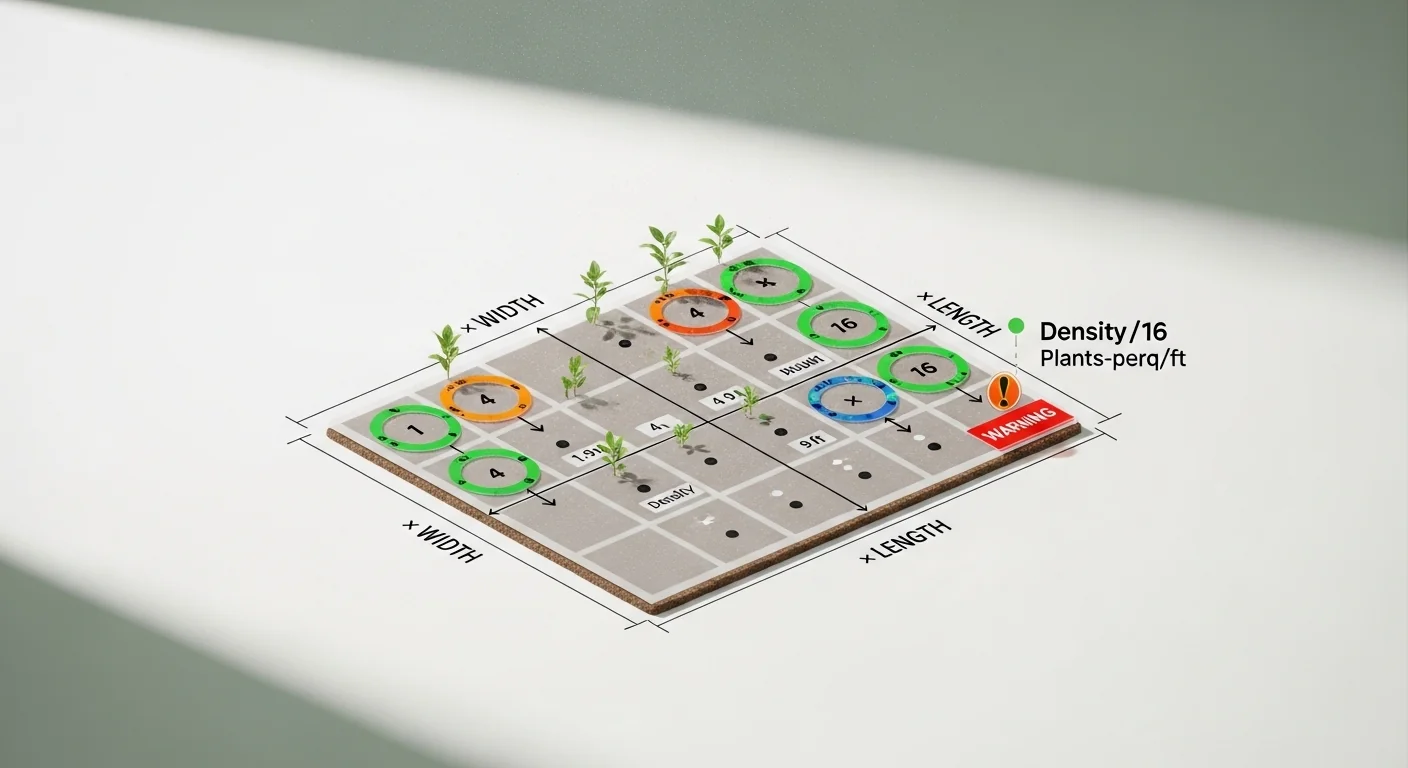
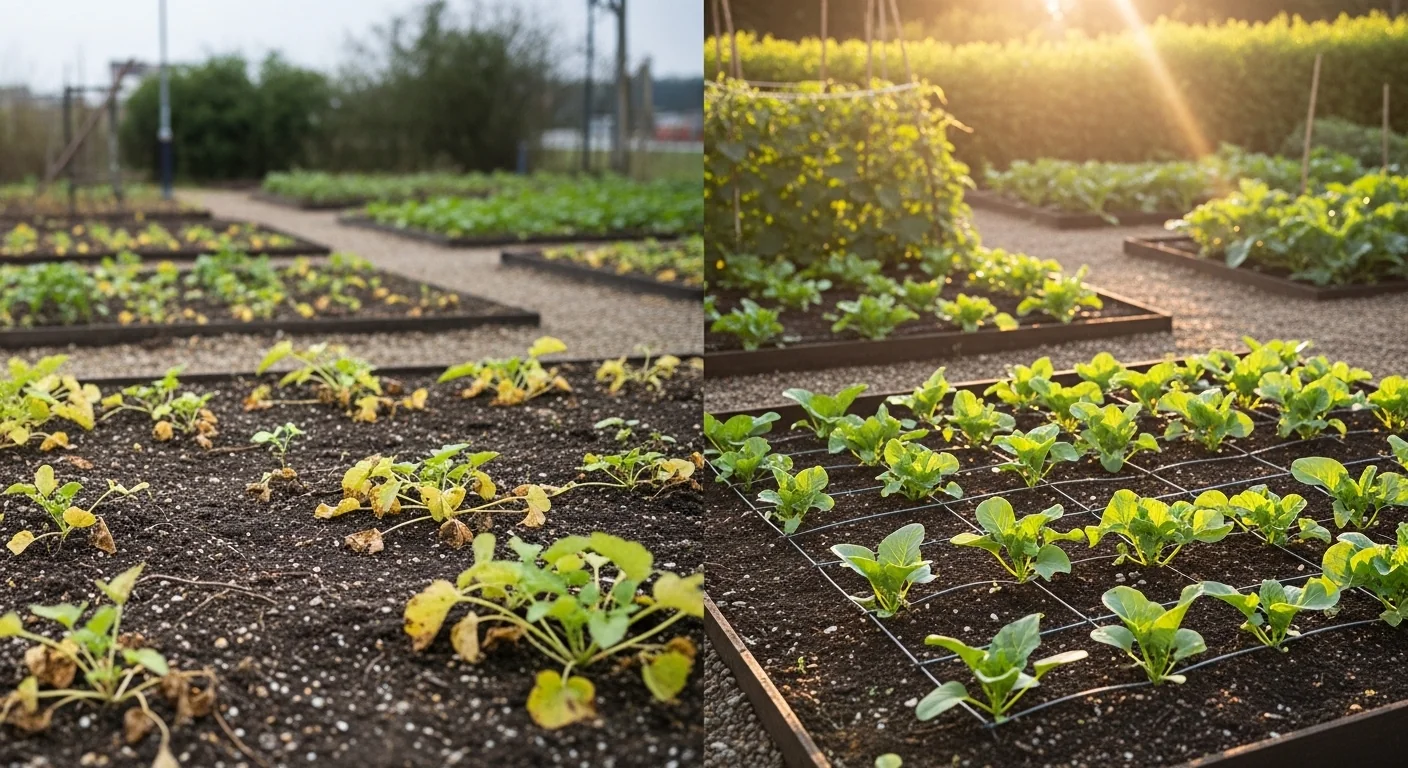
Planting more vegetables into a raised bed does not automatically mean a bigger harvest. Spacing too tight invites disease pressure, root competition, and premature bolting. Spacing too loose wastes productive soil surface that took weeks to prepare. The square foot gardening method resolves this tension by converting bed dimensions into a fixed grid and assigning each plant a precise number of cells based on its mature root and canopy width.
This planner calculates the exact number of plants for a given bed width, bed length, and chosen vegetable, using the plants-per-square-foot (ppsf) values from the Square Foot Gardening (SFG) system developed by Mel Bartholomew. It does not model sunlight requirements, companion planting interactions, soil depth adequacy, or seasonal timing. For raw spacing measurements between individual plants in conventional row layouts, a dedicated plant spacing calculator covers that separately.
After using this tool, you will know the total plant count for your bed, whether your bed width falls within the reachable 4-foot SFG maximum, and which density tier your chosen crop sits in so you can decide between direct sowing or transplanting starts.
Use the Tool
Square Foot Gardening Planner
The Yield Grid — Spacing, Yield & Plant Management
| Plant | Per Sq Ft | Spacing | In your bed | Density |
|---|
How This Calculator Works & Assumptions
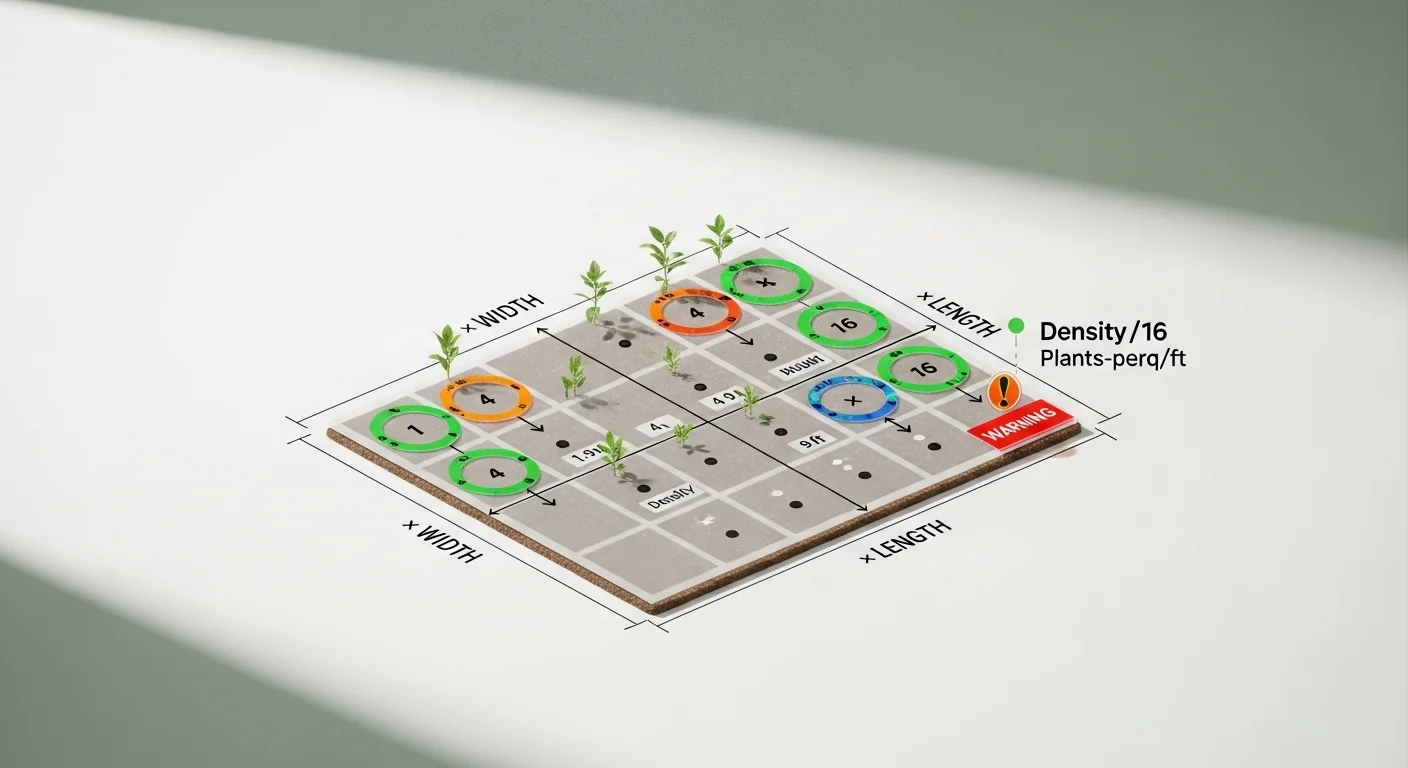
- Area: Multiply width × length to get total square feet (e.g. 4 ft × 4 ft = 16 sq ft).
- Density: Each plant type has a fixed SFG spacing value (1, 2, 4, 9, or 16 plants per sq ft).
- Total Plants: Multiply area by density to get the total number of individual plants or seeds to sow.
- Grid: The visual shows each 1 sq ft cell with the correct number of planting dots.
Assumptions & Limits:
- Bed dimensions: 1–20 ft per side (standard raised beds are 4 × 4 or 4 × 8 ft).
- Max recommended width is 4 ft for arm-reach access from both sides.
- Spacing follows Mel Bartholomew’s Square Foot Gardening method.
- This planner is for a single plant type filling the entire bed. Mixed beds: calculate each section separately.
- Soil depth, sunlight, and watering requirements are not modeled here.
Before entering values, measure your raised bed in whole feet. The planner accepts widths and lengths between 1 and 20 feet. Have your bed dimensions and your chosen vegetable ready. If you plan to sow from seed rather than transplant, note the seed count per square foot so you can cross-reference against your seed packet inventory using the seed packet calculator before purchasing supplies.
Quick Start (60 Seconds)
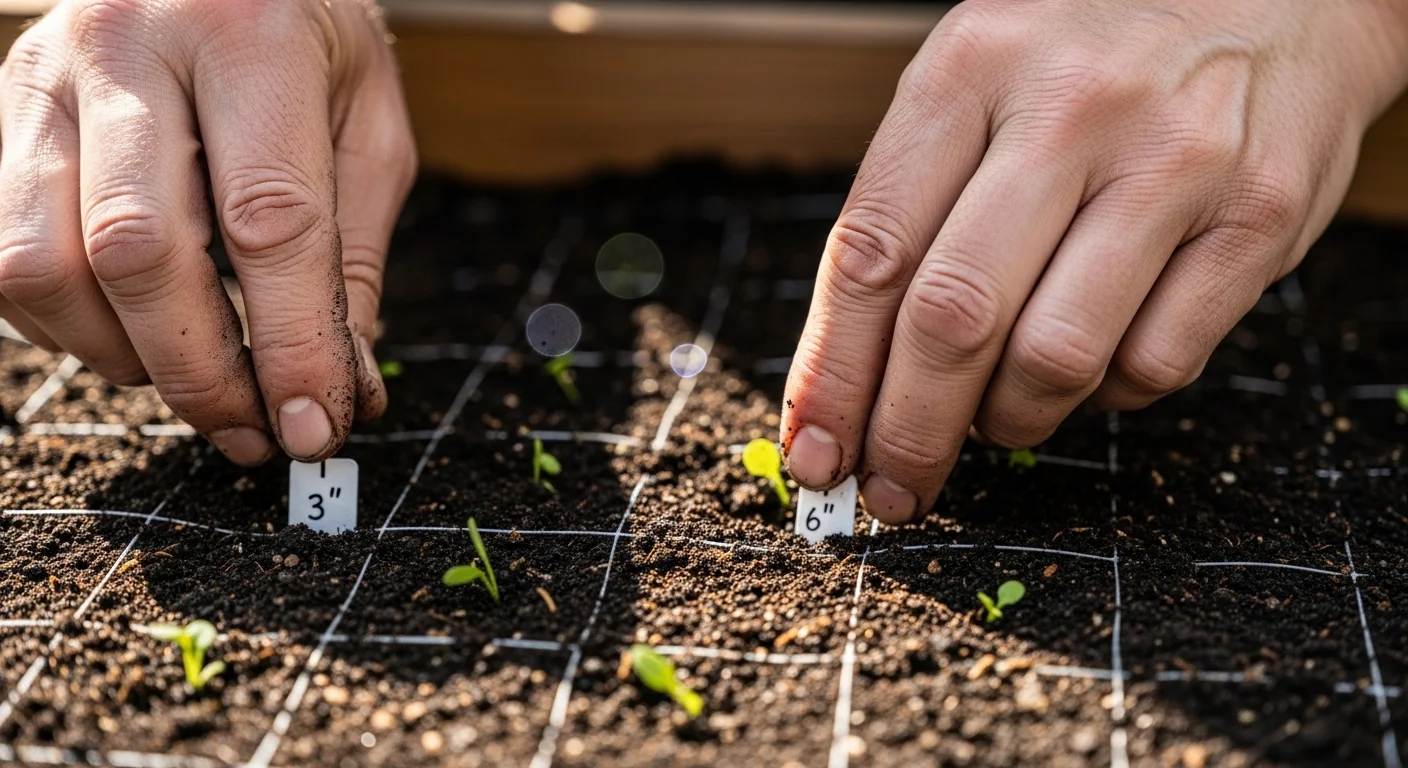
- Bed Width: Enter a whole number in feet (1 to 20). The SFG method caps practical width at 4 ft so both sides of the bed remain reachable without stepping on soil. Do not enter partial feet or centimeters.
- Bed Length: Enter a whole number in feet (1 to 20). A standard 4×8 ft bed is the most common; longer beds are fine but verify the total plant count is manageable before sowing.
- Vegetable / Plant: Select from the dropdown. Each option shows the SFG plants-per-square-foot value in parentheses. Choose the crop you intend to fill the entire bed with. Mixed beds require a separate calculation per section.
- Unit reminder: All dimensions are in feet, not inches, meters, or yards. Convert first if your tape measure uses a different unit.
- Common entry mistake: Do not enter the bed perimeter or total linear footage. Enter width and length as two separate dimensions.
- Click “Plan My Garden” only after both dimensions and a vegetable are selected. The results panel will not update if any field is incomplete.
- To recalculate a different crop or size: Click Reset, then re-enter values. The grid visualization updates to reflect the new combination.
Inputs and Outputs (What Each Field Means)
| Field | Unit | What It Means | Common Mistake | Safe Entry Guidance |
|---|---|---|---|---|
| Bed Width (ft) | Feet (whole number) | The shorter horizontal dimension of the raised bed frame | Entering inches instead of feet (e.g., 48 instead of 4) | Enter 1 to 20. SFG recommends a maximum of 4 ft for arm-reach access. |
| Bed Length (ft) | Feet (whole number) | The longer dimension running along the bed’s main axis | Confusing total perimeter with length (perimeter = 2W + 2L) | Enter 1 to 20. Common lengths: 4, 6, 8, or 12 ft. |
| Vegetable / Plant | Categorical selection | The crop type, which determines the plants-per-square-foot (ppsf) density value | Selecting a plant with a different mature size than intended (e.g., selecting Lettuce for a head lettuce variety that needs 12-inch spacing) | Match selection to the specific variety. Check the spacing column in the reference table below. |
| Total Plants (output) | Count (whole number) | The total number of individual plants or seeds placed if the full bed is filled with the chosen crop | Treating this as a row count rather than an individual plant count | Use this number when ordering transplants or calculating seed quantity needed. |
| Sq Ft Bed (output) | Square feet | Total growing surface area, computed as Width x Length | Assuming square footage already accounts for pathways or border frames | This is gross area. Subtract any permanent structures (irrigation lines, trellis posts) for net growing space. |
| Plants / Sq Ft (output) | Count per square foot | The SFG density value for the selected plant | Confusing this with plants per row foot (a different spacing convention) | Values are 1, 2, 4, 8, 9, or 16. Higher values mean smaller spacing in inches. |
Worked Examples (Real Numbers)
Example 1: Standard 4×4 Bed Planted with Lettuce
- Bed Width: 4 ft
- Bed Length: 4 ft
- Vegetable: Lettuce (4 plants per sq ft, 6-inch spacing)
Result: 4 x 4 = 16 sq ft. 16 sq ft x 4 plants/sq ft = 64 lettuce plants.
A 16 sq ft bed at this density produces a grid of 64 individual leaf lettuce or butterhead plants. Harvesting outer leaves from each plant extends yield across the entire season without uprooting the grid prematurely.
Example 2: 4×8 Bed Planted with Tomatoes
- Bed Width: 4 ft
- Bed Length: 8 ft
- Vegetable: Tomato (1 plant per sq ft, 12-inch spacing)
Result: 4 x 8 = 32 sq ft. 32 sq ft x 1 plant/sq ft = 32 tomato plants.
Thirty-two indeterminate tomato plants in a 32 sq ft bed is the SFG-compliant maximum. In practice, most gardeners plant 16 tomatoes (half the bed) and reserve the remaining 16 sq ft for a high-density companion like basil at 4 ppsf, computing each section separately.
Example 3: 3×6 Bed Planted with Carrots
- Bed Width: 3 ft
- Bed Length: 6 ft
- Vegetable: Carrot (16 plants per sq ft, 3-inch spacing)
Result: 3 x 6 = 18 sq ft. 18 sq ft x 16 plants/sq ft = 288 carrots.
At 16 ppsf, carrots are among the densest SFG crops. 288 seeds sown in an 18 sq ft bed requires thinning to avoid forked roots. Thin to one plant per cell position after germination rather than waiting until crowding is visible at the surface.
Reference Table (Fast Lookup)
| Plant | Per Sq Ft | Spacing | In 4×4 Bed (16 sqft) | In 4×8 Bed (32 sqft) | Density Tier |
|---|---|---|---|---|---|
| Tomato | 1 | 12 in | 16 | 32 | Low |
| Pepper | 1 | 12 in | 16 | 32 | Low |
| Cucumber | 2 | 6 in | 32 | 64 | Low-Medium |
| Lettuce | 4 | 6 in | 64 | 128 | Medium |
| Swiss Chard | 4 | 6 in | 64 | 128 | Medium |
| Pea | 8 | 3 in | 128 | 256 | Medium-High |
| Spinach | 9 | 4 in | 144 | 288 | High |
| Beet | 9 | 4 in | 144 | 288 | High |
| Carrot | 16 | 3 in | 256 | 512 | Very High |
| Radish | 16 | 3 in | 256 | 512 | Very High |
| Onion / Green Onion | 16 | 3 in | 256 | 512 | Very High |
How the Calculation Works (Formula + Assumptions)
Show the calculation steps
Step 1: Compute bed area
Grid Area (sq ft) = Bed Width (ft) x Bed Length (ft)
Example: 4 ft x 8 ft = 32 sq ft
No rounding is needed at this step since both inputs are whole numbers.
Step 2: Look up plants-per-square-foot (ppsf)
Each plant in the SFG system has a fixed ppsf value derived from its mature canopy and root spread. The lookup values used in this planner are: 1, 2, 4, 8, 9, or 16. There is no interpolation between values.
Step 3: Compute total plants
Total Plants = Grid Area (sq ft) x ppsf
Example: 32 sq ft x 4 ppsf (Lettuce) = 128 plants
Results are always whole numbers since both inputs are integers and ppsf is always a whole number.
Rounding rules: No rounding is required. All intermediate values are exact integers.
Unit conversions: None. The tool works exclusively in feet and counts. Do not convert feet to inches before entering values.
Assumptions and Limits
- Bed dimensions are entered in whole feet only. Beds measured in fractional feet (e.g., 3.5 ft x 7 ft) should be rounded down to the nearest foot to avoid oversowing the physical space.
- The planner assumes the entire bed is filled with one plant type. Mixed-crop beds require a separate calculation for each zone, treating each zone as its own independent rectangular area.
- ppsf values follow Mel Bartholomew’s original SFG system. Newer cultivar introductions with different mature sizes (e.g., miniature pumpkins vs. full-size) are not modeled separately.
- Soil depth, drainage, and soil composition are not factored in. Root-depth-sensitive crops like carrots require a minimum of 12 inches of loose soil regardless of the plant count produced by this formula.
- Bed maximum width of 20 ft is a software limit. Physically, beds wider than 4 ft compromise reachability and are flagged as a warning in the output.
- The planner does not account for germination failure rates. For direct-sown crops (carrot, radish, spinach), actual seed quantity should exceed the calculated plant count to compensate for expected germination gaps.
- This tool treats the bed as a flat, unobstructed rectangle. Beds with embedded irrigation risers, support posts, or permanent corner structures will have a lower effective planting area than the computed grid area.
Standards, Safety Checks, and “Secret Sauce” Warnings
Critical Warnings
- Bed width above 4 ft: The SFG method is built around a 4-foot maximum width because an average adult can comfortably reach 2 feet from each side of the bed. Beds wider than 4 ft require stepping onto the growing surface to tend interior squares, which compacts the soil and defeats the core benefit of the raised-bed system. The planner flags this automatically.
- Dense crops require thinning, not just sowing: Crops at 9 or 16 ppsf (carrot, radish, onion, spinach) are typically sown at a higher rate than the ppsf target and then thinned after germination. The planner calculates the final stand count, not the sowing count. Treating the output as a seed count for high-density crops will result in undercrowded beds.
- Vertical crops change the effective footprint: Vining cucumbers, peas, and indeterminate tomatoes have a canopy that expands far beyond their 1 sq ft ground position when not trained vertically. The 1 ppsf and 2 ppsf values assume vertical growing with appropriate support structures in place.
- One calculation covers one bed, one crop: The formula does not support irregular bed shapes or mixed planting zones in a single entry. Running separate calculations for each sub-zone is required for accurate totals. The succession planting chart provides a framework for sequencing multiple crops across the same bed over a growing season.
Minimum Standards
- Bed soil should be a minimum of 6 inches deep for shallow-rooted crops (lettuce, spinach, radish) and at least 12 inches for root crops (carrot, beet, onion). Plant count accuracy is meaningless if root depth is insufficient for the selected crop.
- Grid cells are defined as 1 ft x 1 ft squares. Any bed dimension entered in non-foot units will produce an incorrect area and incorrect plant count. Always convert measurements before entry.
Competitor Trap: Many square foot gardening planning tools present spacing in linear inches along a row, which is a row-crop convention, not an SFG convention. The SFG method distributes plants uniformly across a square cell, not along a single axis. A “6-inch spacing” in a row system places two plants per linear foot in one direction only. In an SFG grid, 6-inch spacing places four plants per square foot because the spacing applies in both dimensions simultaneously (6 in x 6 in = 0.25 sq ft per plant = 4 plants per sq ft). Tools that display only “spacing in inches” without converting to a per-square-foot count routinely cause gardeners to underplant dense crops like lettuce and spinach by a factor of two or more.
Common Mistakes and Fixes
Mistake: Entering bed perimeter instead of individual dimensions
A 4×8 ft bed has a perimeter of 24 linear feet. Entering 24 as either the width or length produces a gross area of 96 to 192 sq ft, which is six to twelve times larger than the actual bed. The total plant count becomes meaningless. Fix: always enter width and length as two separate values reflecting the actual frame dimensions.
Mistake: Treating the output plant count as a seed count for high-density crops
Carrot, radish, and onion germination is rarely 100% reliable under field conditions. Sowing exactly 256 seeds into a 16 sq ft bed expecting a full stand of 256 plants ignores germination gaps that leave empty cells. Fix: sow at 1.25 to 1.5 times the plant count for direct-seeded crops and thin to the target stand after emergence.
Mistake: Planning a mixed bed without splitting it into zones first
Entering the full bed dimensions and selecting a single crop, then mentally dividing that total across multiple plants, produces an incorrect density mix. A 4×8 bed split between tomatoes (half) and basil (half) is two separate 4×4 calculations, not one 4×8 calculation. Fix: divide the bed into rectangular sections on paper, measure each, and run separate calculations. For container-based sections, the pot size calculator handles non-rectangular growing volumes separately.
Mistake: Ignoring the 4-foot width warning and building wider beds
A 6-foot-wide bed sounds appealing because it adds 50% more growing area. In practice, the interior 2 feet become difficult to tend without stepping in, which compacts Mel’s Mix or similar loose growing medium over time. Soil compaction reduces root penetration depth and aeration, undermining the core SFG yield advantage. Fix: build two 4-foot-wide beds separated by a 2-foot pathway rather than one 8-foot-wide bed.
Mistake: Selecting the wrong plant entry for a non-standard variety
The dropdown entries reflect standard mature sizes. A cherry tomato plant occupies 1 sq ft in the SFG system, the same as a full-size beefsteak, because both are managed vertically. Selecting “Lettuce (4 per sq ft)” for a large crisphead variety like Iceberg that needs 12-inch spacing will double the calculated plant count. Fix: verify the specific variety’s mature head diameter before accepting the ppsf value from the dropdown.
Next Steps in Your Workflow
Once the plant count is confirmed, the next practical decision is whether to source transplants or sow seeds directly. For low-density crops at 1 or 2 ppsf (tomato, pepper, cucumber), transplant starts are more cost-effective because the bed requires only 16 to 64 plants for a standard 4×8 bed. For dense crops at 9 or 16 ppsf, direct sowing from seed is almost always more practical. To estimate expected output per plant before committing to a full bed, the vegetable yield calculator provides per-plant harvest estimates for common crops.
After confirming plant count and sourcing, timing is the second variable to resolve. Knowing when to sow relative to last frost date and expected days to maturity determines whether a crop will reach harvest before the end of the growing window. The harvest date calculator takes sowing date and days-to-maturity as inputs and returns an estimated harvest window, which helps sequence multiple bed plantings across a season without leaving productive space sitting idle between crops.
FAQ
What is the square foot gardening formula?
The core formula is: Grid Area (sq ft) = Bed Width x Bed Length. Total Plants = Grid Area x Plants Per Square Foot. The plants-per-square-foot value is a fixed lookup for each crop type, derived from its mature canopy and root spread. The SFG system uses values of 1, 2, 4, 8, 9, or 16 plants per square foot depending on the crop.
How many square feet do I need for a vegetable garden?
The answer depends entirely on what you plan to grow and how many plants are needed for your household. A single 4×4 ft bed (16 sq ft) produces 64 lettuce plants, 144 spinach plants, or just 16 tomato plants. Use this planner with your target crops to calculate the bed size required for a specific harvest quantity, then scale up accordingly.
Why is 4 feet the recommended maximum bed width?
The SFG method is designed so that every square foot of the bed is reachable from outside the frame without stepping in. An average adult reach from a standing position at the bed edge is approximately 2 feet. With access from both sides of a 4-foot-wide bed, every cell is within reach. Beds wider than 4 ft create interior zones that require stepping on the growing medium, causing compaction.
Can I use this planner for container gardens?
The planner works for any rectangular growing space, including large containers with measurable length and width dimensions in whole feet. Very small containers measured in inches rather than feet fall outside the minimum 1-foot input. For those, convert container dimensions to the nearest whole foot, or use a container-specific resource that works in smaller units.
What does “plants per square foot” mean compared to row spacing?
Row spacing describes the distance between individual plants along a single line in one direction. Plants-per-square-foot counts how many plants fit within a 12×12 inch block of growing area, distributing them equally in both dimensions. A 6-inch row spacing places 2 plants per linear foot; a 6-inch SFG spacing places 4 plants per square foot because spacing applies in both width and length simultaneously.
Does the planner account for succession planting?
No. This planner calculates the plant count for a single crop filling the full bed at one time. Succession planting divides the bed into zones that are sown at different intervals to stagger the harvest. To plan a succession schedule, calculate each sowing zone separately using its own rectangular dimensions, then sequence the sowing dates manually based on your target harvest window.
Conclusion
The square foot gardening planner converts two bed dimensions and a crop selection into a precise plant count, a density tier, and a visual grid that reflects how the bed will actually look at full occupancy. The underlying formula is straightforward: area times plants-per-square-foot. What makes this approach more useful than a generic spacing guide is that it surfaces the SFG system’s built-in standards, including the 4-foot width rule and the thinning requirement for dense crops, as active warnings tied to your specific inputs rather than footnotes in a static chart.
The single most common mistake in square foot garden planning is conflating row spacing in inches with the SFG per-square-foot density, which leads to systematic underplanting of leafy greens and overplanting assumptions for large fruiting crops. Run your bed dimensions through this tool first, confirm the plant count matches your sourcing plan, then work backward to sowing dates and harvest windows. For a complete picture of soil volume requirements per crop, the bulb planting depth chart covers depth minimums for root-sensitive crops that are otherwise easily overlooked at the planning stage.