
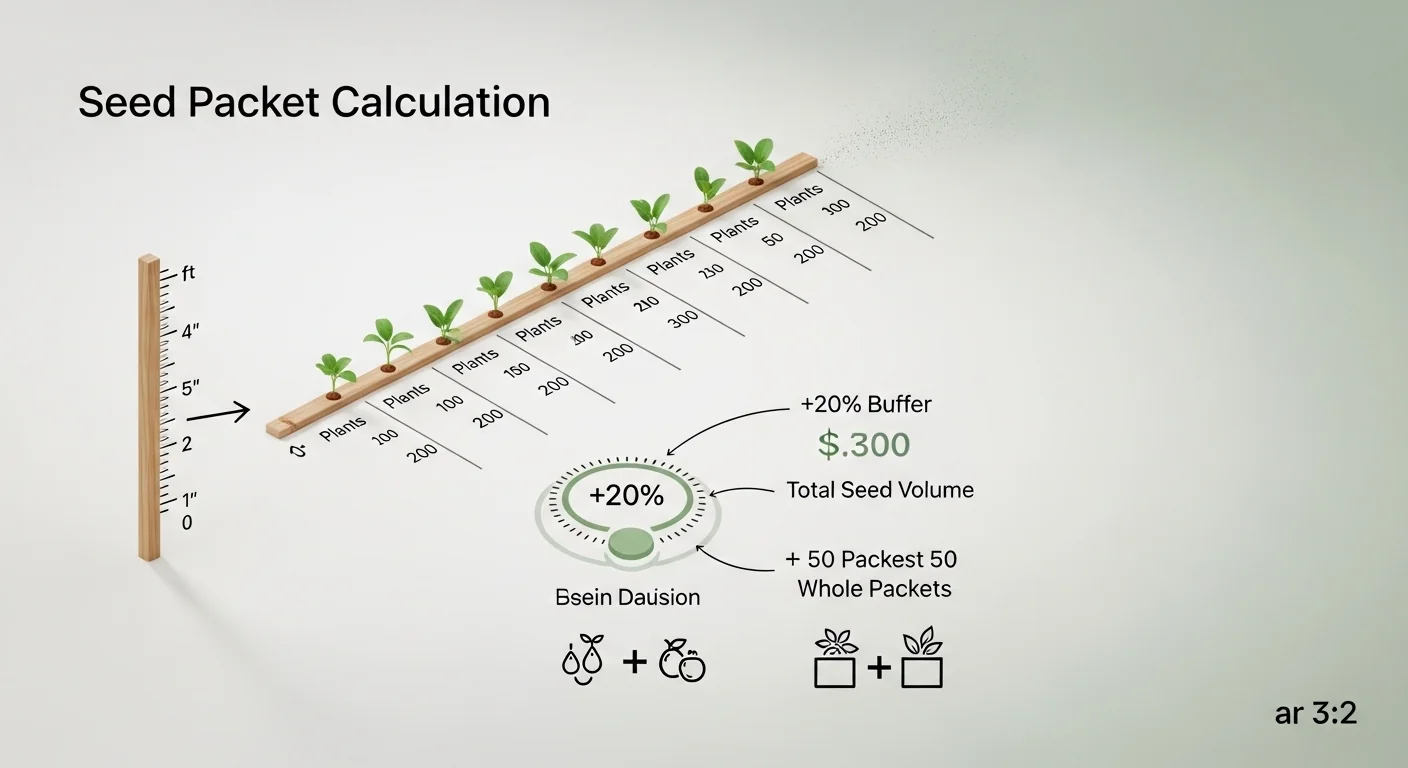
Buying seeds sounds simple until a third of your row fails to germinate and you are left scrambling mid-season for a restock that may no longer be in stock. The gap between “how many plants fit in this row” and “how many seeds should I buy” is exactly where most gardeners lose time and money. Plant spacing drives the seed count, but germination reliability drives the purchase quantity, and those two numbers are rarely the same.
This seed packet calculator takes your row length in feet and your intended plant spacing in inches, computes the raw seed count required to fill that row, adds a 20% germination buffer derived from the formula, then divides by an average packet size of 50 seeds to give you a packet count rounded up to the nearest whole packet. It does not predict your specific germination rate, account for soil temperature, or replace supplier seed-count data on the actual label. Those variables remain yours to verify.
after using this tool, you will know the minimum number of standard seed packets to purchase for a given row, with a germination buffer already built in, so you can place one informed order instead of two.
Use the Tool

Seed Packet Estimator
The Yield Grid · Spacing, Yield & Plant Management
| Step | Value |
|---|
| Spacing (in) | Base Seeds | +Buffer (×1.2) | Packets (50 seeds) |
|---|
How this calculator works
Seed Packet Calculator Formula
Base Seeds = (Row Length × 12) ÷ Plant SpacingConverts row length from feet to inches, then divides by the spacing between each plant.
Buffered Seeds = Base Seeds × 1.20Adds 20% extra to account for typical germination failure rates in home and market gardens.
Packets Needed = ⌈ Buffered Seeds ÷ Avg Packet Size ⌉Divides buffered seed count by average packet size (50 seeds) and rounds up so you never run short.
Assumptions & Limits
- Average packet size assumed to be 50 seeds — actual packets vary (25–500 seeds). Check your supplier.
- Germination buffer is a flat +20% — increase this for notoriously finicky seeds (e.g. parsley, celery).
- Formula assumes a single straight row; multiply results for multiple rows.
- Valid range: Row length 1–10,000 ft; Spacing 0.5–240 in.
- This tool estimates quantities only — local climate, soil quality, and seed age may affect actual germination rates.
Before entering values, have two measurements ready: the total row length in feet (measure from stake to stake, not the bed perimeter) and the plant spacing recommended on your seed packet or variety guide in inches. If you are working from a bed plan rather than a single row, calculate each row separately and add the packet totals together. For garden layouts that mix intensive and row-based spacing, the square foot gardening planner on The Yield Grid handles the grid-based calculation differently and may be a better fit for that scenario.
Quick Start (60 Seconds)

- Row Length (ft): Enter the full linear length of your row in feet. Do not convert to inches; the calculator handles that internally. Accepted range is 1 to 10,000 feet.
- Plant Spacing (in): Enter the final, in-ground spacing between mature plants in inches, not the seed drop interval. If direct-sowing densely and thinning later, enter the thinned spacing, not the drop spacing.
- Units matter: Row length must be in feet; spacing must be in inches. Mixing them up is the most common single-field error and produces wildly wrong outputs.
- Multiple rows: Run the calculator once per row and add packet counts. Do not multiply a single row result by row count if spacings differ between rows.
- Transplants vs. direct sow: If you are buying transplants, not seeds, this calculator does not apply. It is designed exclusively for direct-sow seed quantities.
- Click Calculate first: The results panel is hidden until you run the calculation. Entering values does not auto-update the result.
- Check the warnings box: The output includes a context-sensitive warning section. Read it before placing your seed order.
Inputs and Outputs (What Each Field Means)
| Field | Unit | What It Means | Common Mistake | Safe Entry Guidance |
|---|---|---|---|---|
| Row Length | Feet (ft) | The linear length of a single planting row from end to end | Entering inches instead of feet, or summing multiple row lengths into one entry | Measure with a tape; accept 1 to 10,000 ft; use decimals for partial feet (e.g., 12.5) |
| Plant Spacing | Inches (in) | The final desired gap between the centers of adjacent mature plants | Using drop spacing for thinned crops; confusing “edge to edge” with “center to center” spacing | Check seed packet or variety guide; accepted range is 0.5 to 240 in |
| Packets Needed (output) | Packets | Whole packets to purchase, rounded up, assuming 50 seeds per packet | Treating this as a final number without checking the actual seed count on your supplier’s packet label | Verify seed count per packet before purchase; adjust manually if your packet contains 25, 100, or 250 seeds |
| Buffered Seed Count (output) | Seeds | Base seed count multiplied by 1.2 to account for germination failure | Ignoring this figure and ordering only the base count, leaving no margin for poor germination | Use this number when comparing against bulk seed pricing; it is the minimum viable purchase quantity |
If you are planning a succession planting schedule across the same row, the succession planting chart can help you map out how many separate seed orders you will need across a full growing season, which changes the per-sowing packet calculation significantly.
Worked Examples (Real Numbers)
Example 1: Short Salad Greens Row (Dense Planting)
- Row Length: 10 ft
- Plant Spacing: 4 in
Base seeds: (10 × 12) ÷ 4 = 30 seeds
Buffered: 30 × 1.2 = 36 seeds
Packets: ⌈36 ÷ 50⌉ = 1 packet
Result: 1 packet covers this row with room to spare. The remaining seeds in the packet (roughly 14) can be stored for a succession sowing four to six weeks later.
Example 2: Mid-Length Carrot Bed (Standard Spacing)
- Row Length: 25 ft
- Plant Spacing: 4 in
Base seeds: (25 × 12) ÷ 4 = 75 seeds
Buffered: 75 × 1.2 = 90 seeds
Packets: ⌈90 ÷ 50⌉ = 2 packets
Result: 2 packets required. Carrot germination can be inconsistent in compacted or crusted soil, so the buffer is especially relevant here; do not drop it to save one packet cost.
Example 3: Long Tomato Row (Wide Spacing)
- Row Length: 100 ft
- Plant Spacing: 18 in
Base seeds: (100 × 12) ÷ 18 = 66.7, rounded up to 67 seeds
Buffered: 67 × 1.2 = 80.4, rounded up to 81 seeds
Packets: ⌈81 ÷ 50⌉ = 2 packets
Result: 2 packets. Wide-spaced crops like tomatoes are often started indoors as transplants, not direct-seeded. If that is your method, this result does not apply; use actual transplant count instead.
Reference Table (Fast Lookup)
All values below are computed from the formula: Base = (Row Length × 12) ÷ Spacing; Buffered = Base × 1.2; Packets = ⌈Buffered ÷ 50⌉. Packet size assumed at 50 seeds.
| Row Length (ft) | Spacing (in) | Base Seeds | Buffered Seeds (+20%) | Packets Needed (50 seeds/pkt) |
|---|---|---|---|---|
| 10 | 4 | 30 | 36 | 1 |
| 10 | 6 | 20 | 24 | 1 |
| 25 | 4 | 75 | 90 | 2 |
| 25 | 6 | 50 | 60 | 2 |
| 50 | 4 | 150 | 180 | 4 |
| 50 | 6 | 100 | 120 | 3 |
| 50 | 12 | 50 | 60 | 2 |
| 100 | 6 | 200 | 240 | 5 |
| 100 | 12 | 100 | 120 | 3 |
| 100 | 18 | 67 | 81 | 2 |
How the Calculation Works (Formula + Assumptions)
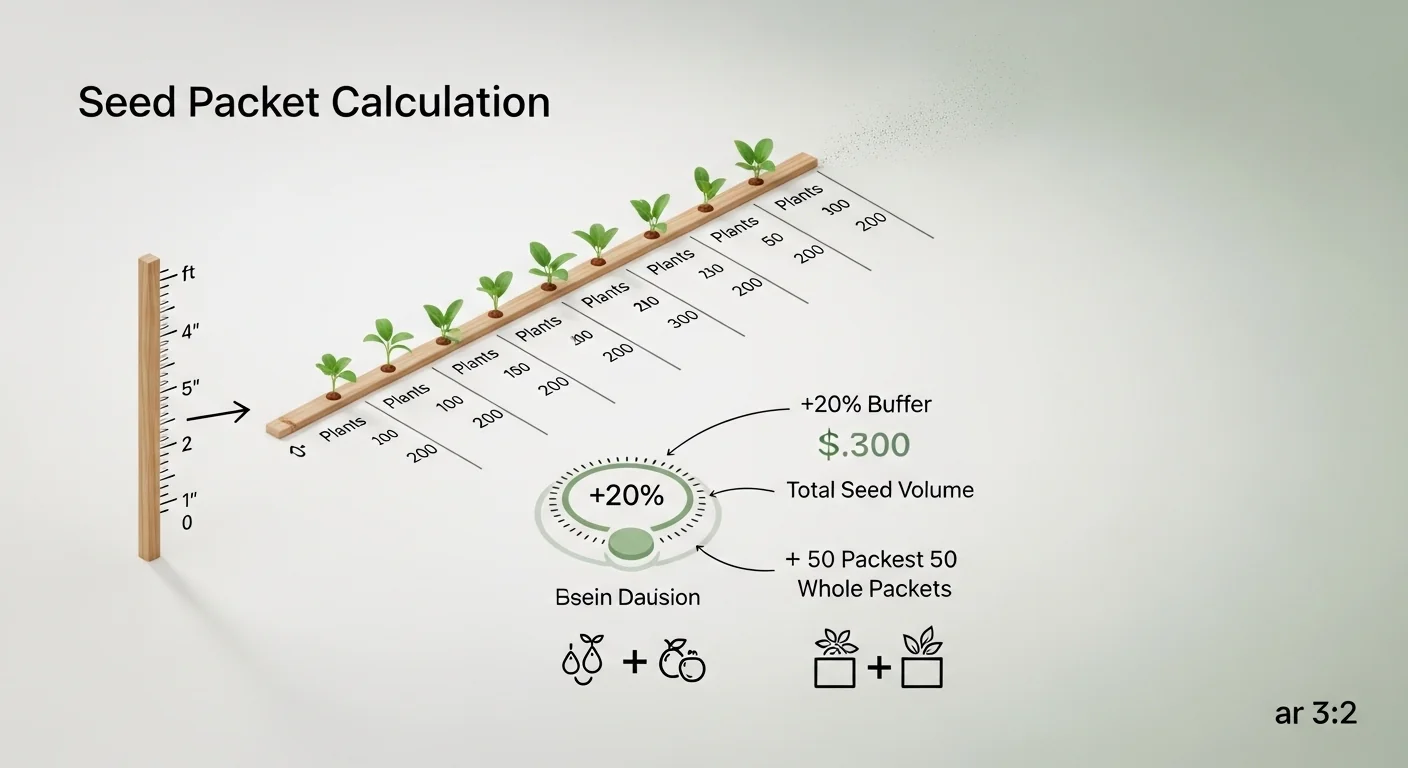
Show the calculation steps
Step 1 — Convert row length to inches:
Row length in feet is multiplied by 12 to produce a total length in inches. All spacing values are in inches, so this conversion is required before division.
Step 2 — Divide by plant spacing to get base seed count:
Base Seeds = (Row Length × 12) ÷ Plant Spacing
This gives the theoretical number of plants that fit in the row at the specified spacing. The result is a real number at this stage; rounding happens at the end.
Step 3 — Apply the germination buffer:
Buffered Seeds = Base Seeds × 1.20
A flat 20% is added to the base count to compensate for seeds that fail to germinate. This is a planning buffer, not a germination rate prediction.
Step 4 — Divide by average packet size and round up:
Packets = ⌈Buffered Seeds ÷ 50⌉
The calculator divides the buffered seed count by 50 (the assumed average packet size) and applies a ceiling function. Rounding up ensures you never purchase one seed short of a full row.
Rounding rule: Only the final packet count is rounded (ceiling). Intermediate values remain as real numbers to preserve accuracy across steps.
Assumptions & Limits
- Average packet size is assumed to be 50 seeds. Real packets range from 10 seeds (rare specialty varieties) to 500 or more (commodity crops). Always verify the seed count on your actual supplier label before placing an order.
- The germination buffer is a flat 20% addition. This is not a germination rate derived from scientific testing. Crops with historically difficult germination (parsley, celery, leeks) may warrant a buffer of 30% or higher.
- The formula assumes one straight row. For raised beds, wide beds, or block plantings, calculate each row individually and sum the results.
- Row length is accepted from 1 to 10,000 feet and spacing from 0.5 to 240 inches. Values outside these ranges are rejected by the input validation.
- The tool is designed for direct-sown seeds only. If you are purchasing starts or transplants, the packet count output is not applicable.
- Thinning practices are not modeled separately. If you intentionally sow at twice the final density and thin to the target spacing, double your row length input to approximate the additional seed quantity needed.
- Seed viability declines with age and improper storage. Seeds stored beyond their optimal viability window may require a higher buffer than the default 20%.
Standards, Safety Checks, and “Secret Sauce” Warnings
Critical Warnings
- Ordering only the base seed count (no buffer) is the most common cause of patchy rows. A 20% buffer accounts for the gap between seeds sown and plants established under typical field conditions.
- Packet seed counts are not standardized across suppliers. A packet labeled “50 seeds” by one brand may contain 30 or 75 from another. The calculator’s output is only as accurate as the seed count you verify on the label.
- For crops with fine seeds sown in clusters (beets, chard, spinach), each “seed” on the packet may actually be a multi-germ pellet or cluster. The spacing and count assumptions in this calculator may not apply; check the crop-specific guidance from your seed supplier.
Minimum Standards
- Always purchase at least the buffered seed count, never the base count alone. Germination failure is a planning certainty, not a possibility.
- Cross-reference the calculator result against the seeds-per-packet figure on the actual product listing before checkout. Adjust packet count manually when packet sizes differ from 50.
- For expensive or rare varieties, consider adding an additional packet above the calculated minimum to enable a succession sowing or gap-fill planting.
Competitor Trap: Most basic seed quantity guides online give you the raw division result and stop there. They calculate how many plants fit in a row and call it the seed count. That approach ignores the fundamental reality that not every seed becomes a plant. Buying to the base count guarantees gaps in your rows whenever germination runs below 100%, which it will. Any calculator that skips the germination buffer is giving you a materials list for a perfect world, not a working garden.
If you are managing space across multiple planting styles, the vegetable yield calculator can help you think through whether the expected harvest from those rows justifies the seed investment at current pricing.
Common Mistakes and Fixes
Mistake: Entering Row Length in Inches Instead of Feet
A 20-inch row entered as “20” into a feet field produces a base count for a 20-foot row, which is 12 times larger than the actual planting area. This inflates the packet recommendation dramatically and leads to excess seed purchase. The unit labels in the input field are explicit, but the error is easy to make when working from a sketch or notes that mix units.
Fix: Always convert your row measurement to feet before entering it. If your bed is measured in inches, divide by 12 first.
Mistake: Using Drop Spacing Instead of Final Plant Spacing
Crops like carrots, radishes, and beets are often sown at a drop spacing of 1 inch and thinned to a final spacing of 3 to 4 inches. Entering the drop spacing into the spacing field produces a seed count 3 to 4 times higher than necessary for a thinned row. The formula calculates final positions, not sow density.
Fix: Enter the post-thinning, final plant spacing. If you need to estimate seeds used before thinning, multiply the base seed count by your intended thinning ratio separately. For accurate spacing decisions across crop types, the plant spacing calculator breaks down final versus sow spacing by crop family.
Mistake: Treating the Packet Result as Universal Across Suppliers
The calculator outputs packet count based on 50 seeds per packet as a planning assumption. Seed packet sizes vary substantially by crop and supplier. Tomatoes often come in 25-seed packets; sunflowers may come in 15 or 200-seed packets. Using the calculator output without verifying the actual seed count can mean purchasing half the seeds you need or twice as many.
Fix: Look up the seeds-per-packet figure for your specific product listing and adjust the packet count manually using the buffered seed count shown in the breakdown table.
Mistake: Running One Calculation for a Multi-Row Garden Plan
Summing all row lengths into a single entry and using one spacing value works only if every row is the same crop at the same spacing. Mixed gardens with beans at 6 inches, squash at 24 inches, and lettuce at 4 inches require separate calculations per row type. A single averaged input produces an inaccurate packet count for every crop in the plan.
Fix: Run the calculator once per crop or row type and add the packet totals at the end. The calculation takes under 30 seconds per row. For bulb crops with depth considerations, the bulb planting depth chart can be a useful companion reference during the same planning session.
Mistake: Skipping the Germination Buffer for “Easy” Crops
Some crops like beans, peas, and squash are known for reliable germination under good conditions. Gardeners often skip the buffer for these varieties, reasoning that losses will be negligible. But soil conditions, seed age, moisture inconsistency, and pest pressure introduce variability even with hardy crops. A single late frost or dry week at sowing time can reduce germination enough to leave visible gaps.
Fix: Keep the 20% buffer in place regardless of crop reputation. The cost of one extra packet is always lower than the cost of a reorder mid-season when popular varieties sell out.
Next Steps in Your Workflow
Once you have your packet count, the next question is timing. Knowing how many seeds to order is separate from knowing when they need to be in the ground. If you have a target harvest date or a first frost deadline, working backward from that date tells you the latest viable sow date, which in turn determines how much buffer time you have before ordering becomes urgent. The harvest date calculator handles that reverse calculation from days-to-maturity and planting date, which pairs directly with this seed quantity output.
For gardeners growing in containers or raised beds with limited space, the seed packet result may be larger than what a single pot or small bed can realistically support. Checking your container volume against plant root requirements before finalizing your order can prevent over-purchasing for space-constrained growing. The pot size calculator helps match container volume to plant count for common vegetable varieties, giving you a plant maximum to work backward from when determining how many seeds you actually need for a confined space.
FAQ
How many seeds are typically in a standard seed packet?
There is no industry standard. Common ranges are 15 to 500 seeds depending on crop, variety, and supplier. Small-seeded crops like lettuce and carrots often come in packets of 200 to 500 seeds. Large-seeded crops like squash or cucumbers may contain only 15 to 25. The calculator assumes 50 as a planning default; always check your actual packet label before placing an order.
Why does this calculator add a 20% buffer instead of using actual germination rates?
Germination rates are variety-specific, seed-age-dependent, and heavily influenced by soil temperature, moisture, and sowing depth. Providing a “true” germination rate would require data this tool does not collect. The 20% flat buffer is a conservative planning minimum that reflects common field conditions for most vegetable crops when sown correctly. Higher-risk crops or older seeds may need more.
Can I use this calculator for flower seeds?
Yes, with the same constraints. The formula is spacing and row length based, so it applies to any direct-sown crop. The germination buffer and packet size assumption still apply. Some flower varieties are sold in very small quantities (10 to 15 seeds per packet) at premium pricing, so verify the label carefully before assuming the 50-seed default will hold.
What if I am planting in a wide bed, not a single row?
Run the calculator once per row within the bed. If your bed is 4 feet wide and you are planting in rows spaced 6 inches apart, you have roughly 8 rows across the width. Calculate each row length separately and add the packet totals. Do not enter the total bed square footage; the formula requires linear row length, not area.
Does this tool account for seeds that are thinned out?
No. The calculator outputs the seed count for a row at the specified final plant spacing. If you sow more densely and thin to that spacing later, you will need more seeds than the base count. To approximate thinning quantities, multiply the base seed count by your sow-to-thin ratio and then add the 20% buffer on top of that adjusted figure.
Is the packet count result always rounded up?
Yes. The calculator applies a ceiling function to the final packet count, meaning any fractional packet result is always rounded to the next whole number. Half a packet is not a purchasable unit. This rounding is deliberate; buying one packet short would leave you under the buffered seed count, which defeats the purpose of the buffer calculation.
Conclusion
The seed packet calculator closes the gap that most garden planning guides leave open: the distance between “how many plants fit in this row” and “how many seeds should I actually buy.” By folding the germination buffer and packet size into a single, rounded output, it converts two common failure points into one reliable number. The result is a purchase quantity you can act on directly, not a raw plant count that still requires manual adjustment.
The single most avoidable mistake in seed purchasing is buying to the base seed count and discovering mid-season that germination losses have created unfillable gaps. That error is not caused by bad luck; it is caused by skipping the buffer step. Use the buffered seed count, verify the seeds-per-packet figure on your supplier’s label, and your order will cover the row under realistic field conditions. For planning what grows where and how much room each plant ultimately needs, the plant spacing calculator is the natural starting point before this tool in the planting workflow.