
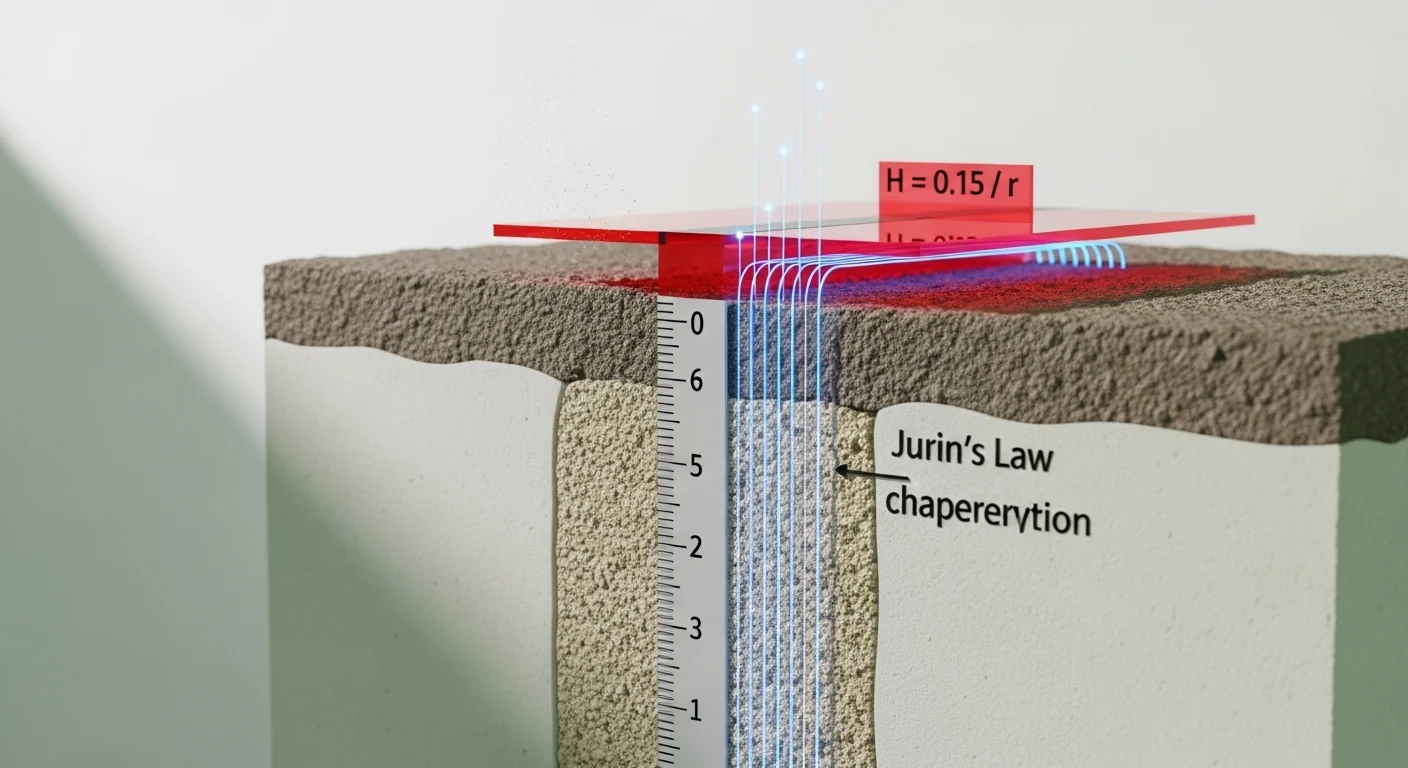
A sub-irrigated planter works by capillary action, not gravity. Water held at the bottom of a reservoir must be pulled upward through the soil column against the force of gravity, and whether it actually reaches your plant roots depends almost entirely on one variable that almost no garden content mentions: pore radius. The coarser the soil particles, the larger the air pockets between them, and the weaker the upward pull. Fill a tall wicking bed with the wrong growing medium and the physics guarantee failure, regardless of how well you build the reservoir structure.
This wicking bed calculator applies Jurin’s Law of capillary rise to your specific combination of soil texture, reservoir depth, and total bed height. It tells you the maximum height water can wick upward in your chosen medium, compares that against the distance from your water table to the soil surface, and flags any dry root zone above the wicking ceiling. What it does not do is predict how a multi-layer profile will behave, account for soil compaction over time, or replace a physical moisture-meter test at planting depth. For decisions about reservoir nutrient concentration, pair this tool’s output with your hydroponic EC readings to ensure the water your plants do receive is appropriately dosed.
After running this calculator, you will know exactly whether your planned bed height is physically compatible with your soil choice, or whether you need to either reduce bed height, amend your growing medium, or switch to a finer-textured mix before the first watering.
Use the Tool
SIP Capillary Rise Depth Calculator
Wicking Bed Calculator — Sub-Irrigated Planter Physics
Wicking Bed Assessment
Recommended Fix
Recommended Products for Your SIP Build
| Soil Type | Pore Radius | Max Rise | Safe Bed Height | Status |
|---|
How This Calculator Works
Formula Steps (Plain Language):
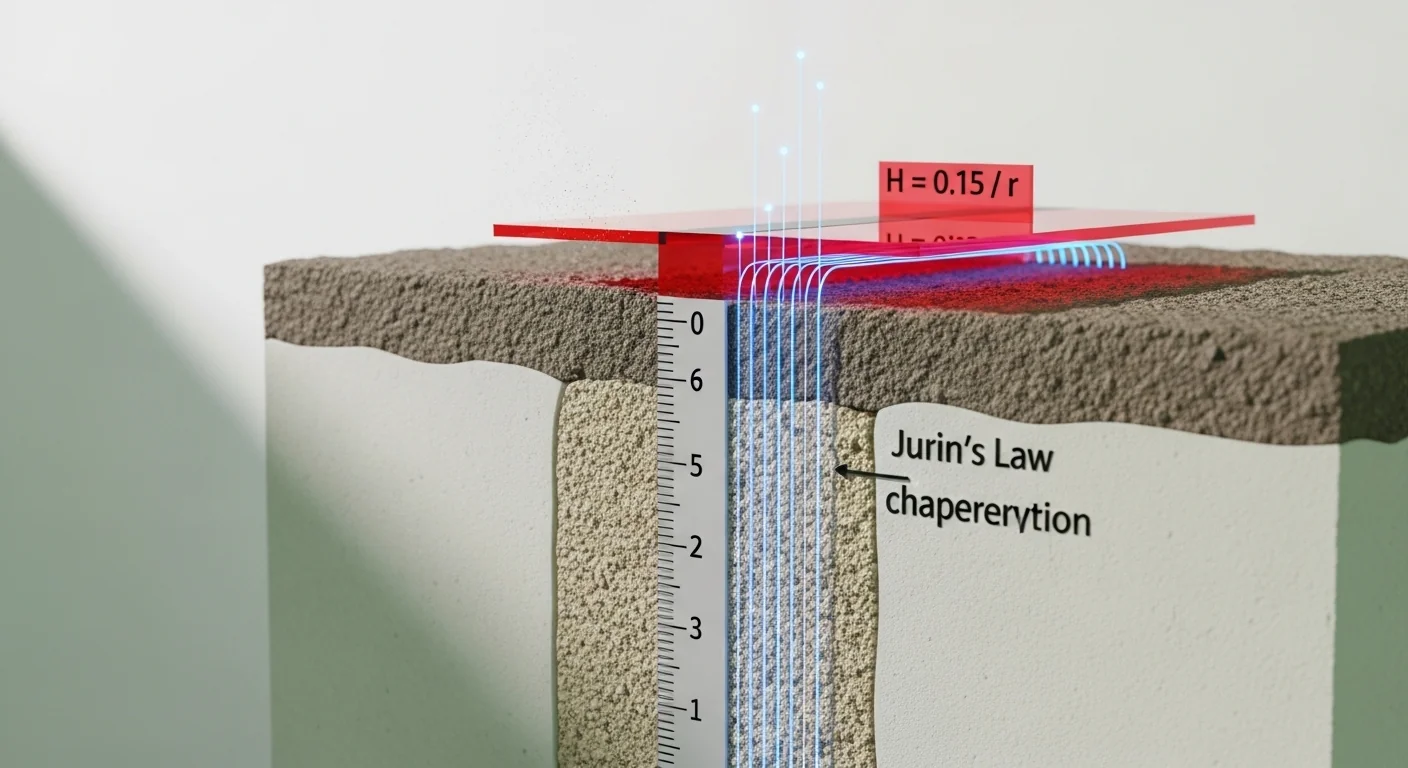
This is the Jurin’s Law approximation for capillary action. Smaller pores = higher wicking height.
This is how far water must wick upward to reach the plant roots near the soil surface.
The capillary action cannot reach the top portion of your bed.
This is the thickness of bone-dry soil at the top of the bed.
Assumptions & Units:
- Rise is calculated using the Jurin’s Law approximation: H = (2T·cosθ) / (ρ·g·r), simplified to H = 0.15/r for water in soil at 20°C.
- Pore radii are representative averages per USDA soil texture class.
- All user inputs in inches; converted internally to cm for physics calculation (1 in = 2.54 cm).
- The model assumes uniform pore size distribution; real soils have mixed pore sizes.
- Compaction, organic matter, and moisture history all influence real-world results.
- Result should be combined with a 20–30% safety margin for practical SIP design.
Assumptions & Limits of This Tool
- Idealized physics: Jurin’s Law assumes perfectly cylindrical, uniform capillary tubes. Real soil pores are irregular, tortuous, and heterogeneous.
- Temperature: Calculation assumes water at 20°C. Higher temperatures reduce surface tension slightly, lowering actual rise.
- Contact angle: The formula assumes zero contact angle (θ = 0°, perfect wetting). Hydrophobic soils or dry peat may have higher contact angles, reducing capillary rise significantly.
- Pore radius values: Coarse Sand 0.5 mm, Loam 0.05 mm, Peat Mix 0.01 mm, Silt 0.008 mm — these are representative averages, not precise measurements of your specific mix.
- Layered profiles: A layered system (e.g., gravel reservoir + soil above) creates a perched water table effect. This tool models a single-medium column only.
- Maximum bed height recommendation includes a 20% safety buffer beyond the raw capillary rise value.
- This tool is educational and should complement — not replace — physical testing with a moisture meter at various bed depths.
Before you start, have three measurements ready: your planned (or actual) soil texture classification, the depth of your water reservoir layer in inches measured from the bottom of the planter to the overflow or standpipe outlet, and the total height of the growing medium from the container floor to the soil surface. All depth inputs are in inches. The tool converts to centimetres internally for the capillary rise formula, then reports results back in inches.
Quick Start (60 Seconds)
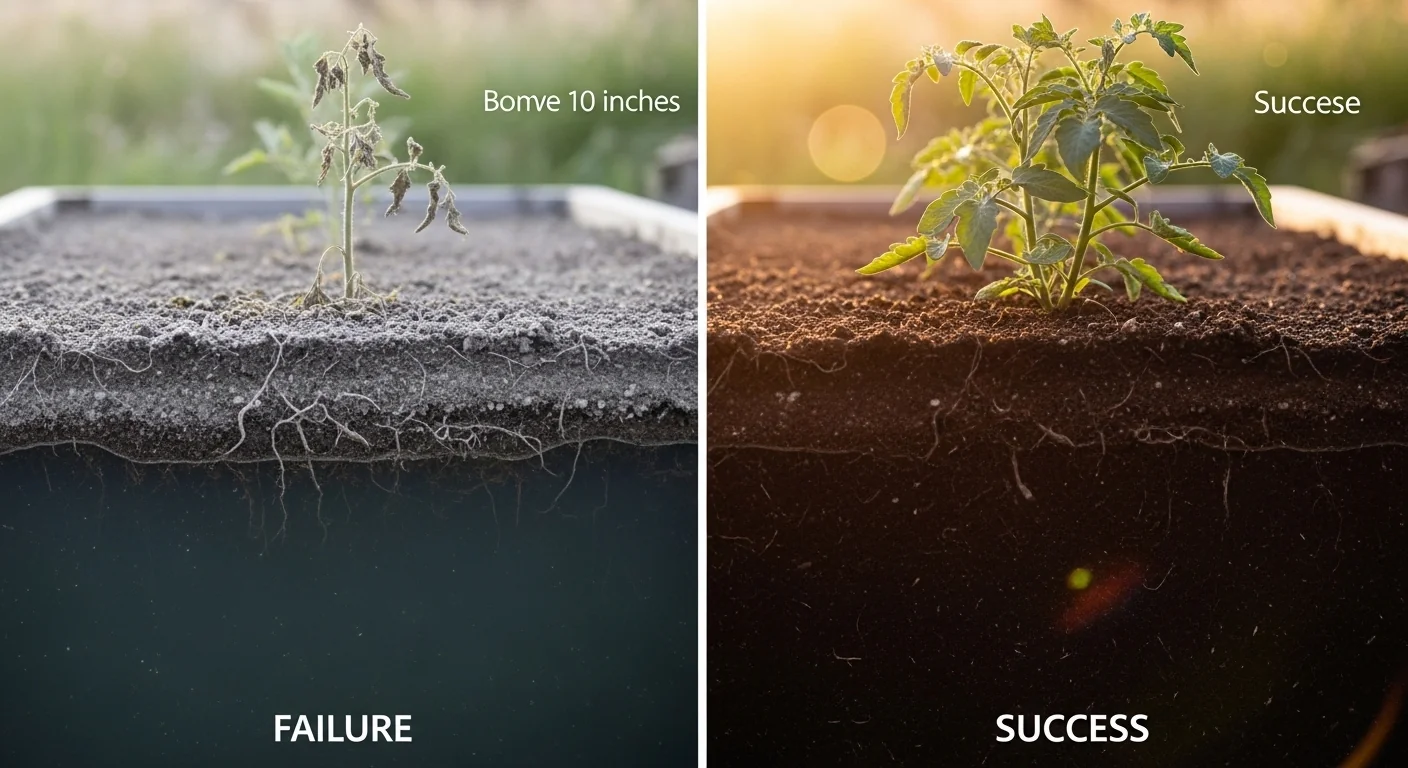
- Soil Texture: Choose the closest match to your primary growing medium. If you are using a commercial potting mix labeled “raised bed blend” or “topsoil mix,” it almost certainly contains enough coarse sand or bark to behave as Loam or coarser. When in doubt, select Coarse Sand to see the worst-case scenario first.
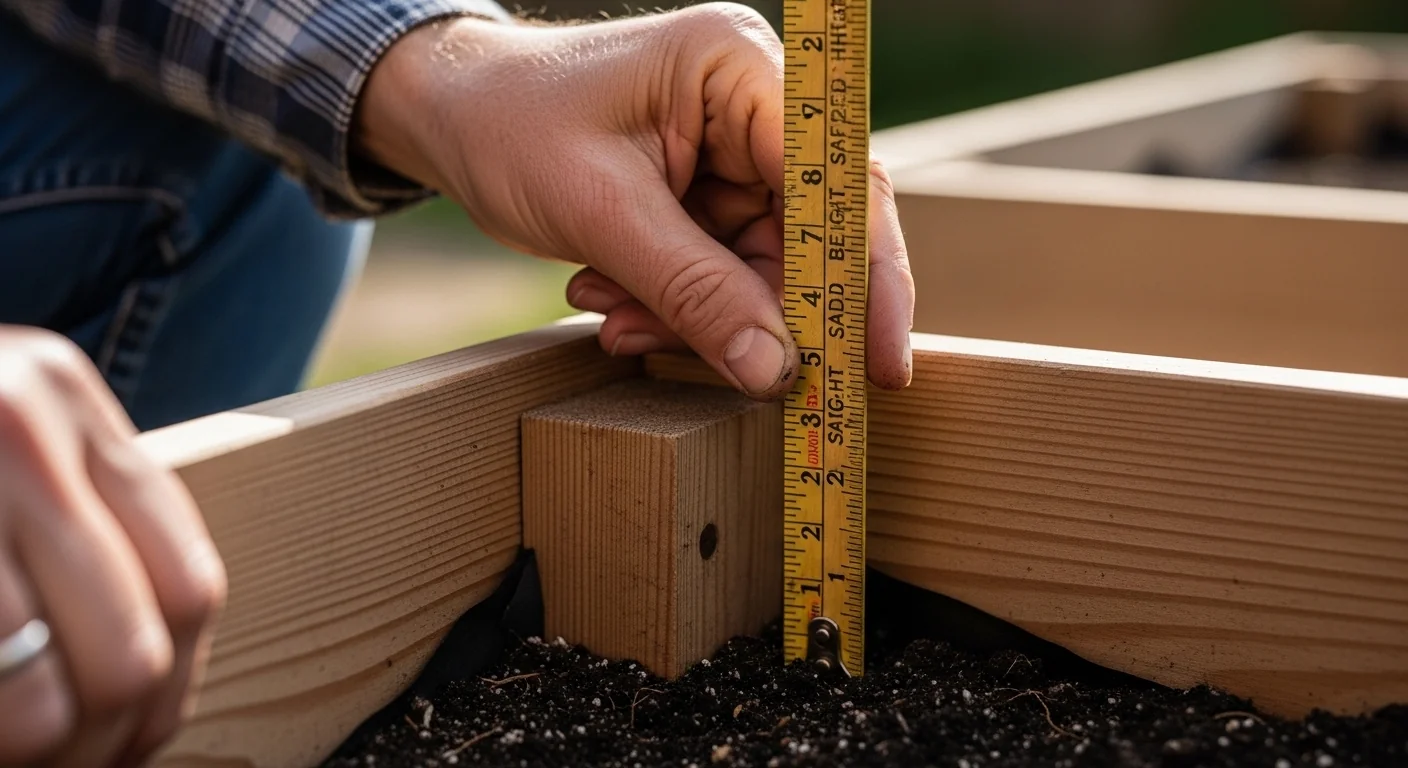
- Water Reservoir Depth: This is not the total container depth. Measure only the standing-water zone, from the floor to the bottom of your overflow standpipe or drain hole. Typical SIP reservoirs run 3 to 6 inches. Enter a value between 1 and 24 inches.
- Total Planter Bed Height: The full depth of growing medium above the container floor, including the reservoir zone. A 24-inch tall raised wicking bed entered correctly here means the soil surface sits 24 inches above the bottom. Enter a value between 4 and 72 inches.
- Reservoir must be shallower than bed height: The calculator enforces this automatically. A 4-inch reservoir inside an 18-inch bed is valid; a 20-inch reservoir inside an 18-inch bed is not a SIP, it is a bucket of water.
- Unit consistency: All inputs are in inches. Do not mix metric measurements without converting first.
- What you will see: The primary result (maximum capillary rise in inches), a colour-coded gauge showing how far the wicking action reaches relative to the soil surface, and a warnings panel that fires the “Dry Top, Swamp Bottom” alert if your setup fails the physics check.
Inputs and Outputs (What Each Field Means)
| Field | Unit | What It Represents | Common Mistake | Safe Entry Guidance |
|---|---|---|---|---|
| Soil Texture | Category | The primary growing medium, which determines pore radius and therefore maximum capillary rise height | Selecting Loam for a mix that contains more than 30% coarse sand or bark fines, which behaves closer to Coarse Sand | When uncertain, choose the coarser option to see the conservative (worst-case) capillary ceiling |
| Water Reservoir Depth | Inches | The depth of standing water at the base of the planter, from the container floor to the overflow outlet | Measuring to the top of the gravel or wicking layer instead of the actual standpipe overflow height | Measure to the underside of your overflow hole or standpipe outlet, not the top of any aggregate layer |
| Total Planter Bed Height | Inches | Full depth of growing medium from container floor to soil surface, including the reservoir zone | Entering only the soil depth above the reservoir, omitting the reservoir depth from the total | Measure from the very bottom of the container to the top of the soil surface; the tool subtracts the reservoir internally |
| Max Capillary Rise (output) | Inches | The theoretical maximum height water can wick upward through the selected soil using Jurin’s Law (H = 0.15 / pore radius in cm) | Treating this as a guaranteed reach rather than a physical ceiling under ideal conditions | Apply a 20% safety buffer: reliable wicking in practice reaches roughly 80% of the theoretical maximum |
| Distance to Surface (internal) | Inches | Bed height minus reservoir depth; the gap water must cross to reach the root zone near the soil surface | Not accounting for the fact that tall beds dramatically increase this distance | This is computed automatically; keep it in mind when planning bed height changes |
| Dry Zone Depth (output, when flagged) | Inches | The thickness of soil above the wicking ceiling that will receive no moisture from the reservoir | Assuming overhead irrigation or rain will compensate for a dry zone in an enclosed SIP design | Any dry zone above zero requires either a shorter bed, a finer growing medium, or a supplemental top-watering layer |
| Status Badge (output) | Qualitative | Traffic-light classification: Optimal (capillary rise exceeds distance by more than 10%), Marginal (just barely reaches), or Failure (dry root zone exists) | Accepting a “Marginal” rating without adding a safety buffer for compaction or temperature variation | Target Optimal status for any perennial crop or long-season vegetable; Marginal is acceptable only for shallow-rooted fast crops |
The pore radius values used internally for each soil category are representative averages derived from USDA soil texture classification research: Coarse Sand uses 0.5 mm, Loam uses 0.05 mm, Peat Mix uses 0.01 mm, and Silt uses 0.008 mm. If you are working with coco coir as your primary medium, its effective pore radius falls between Peat Mix and Loam depending on buffering and rinse history; treat it as Loam for a conservative estimate.
Worked Examples (Real Numbers)
Scenario 1: DIY Raised Bed Filled with Coarse Topsoil (Classic Failure)
- Soil Texture: Coarse Sand (pore radius 0.5 mm = 0.05 cm)
- Water Reservoir Depth: 4 inches
- Total Planter Bed Height: 18 inches
Max capillary rise = 0.15 / 0.05 cm = 3.0 cm = 1.18 inches
Distance to surface = 18 – 4 = 14 inches
Result: Dry zone = 14 – 1.18 = 12.82 inches. Status: Failure.
Water wicks just over one inch above the reservoir. The top 12.8 inches of growing medium receive no moisture from below. Plants rooted in the upper two-thirds of this bed will desiccate, while the bottom zone stays saturated and risks anaerobic decomposition. Reducing bed height would not solve the underlying problem; only switching to a finer medium will.
Scenario 2: Loam Mix in a Moderately Tall Bed (Borderline Pass)
- Soil Texture: Loam (pore radius 0.05 mm = 0.005 cm)
- Water Reservoir Depth: 4 inches
- Total Planter Bed Height: 14 inches
Max capillary rise = 0.15 / 0.005 cm = 30 cm = 11.81 inches
Distance to surface = 14 – 4 = 10 inches
Result: Rise (11.81 in) exceeds distance (10 in). No dry zone. Status: Marginal.
The capillary ceiling clears the surface by 1.81 inches, which is less than a 20% safety margin. Any compaction from foot traffic near the bed, or a temperature increase above 25 degrees Celsius reducing surface tension, could push this into failure. Reducing bed height to 12 inches or amending with 20 to 30% vermiculite would move it comfortably into Optimal territory.
Scenario 3: Peat-Vermiculite Mix in a Standard 24-Inch Wicking Bed (Strong Pass)
- Soil Texture: Peat Mix / Peat-Vermiculite (pore radius 0.01 mm = 0.001 cm)
- Water Reservoir Depth: 4 inches
- Total Planter Bed Height: 24 inches
Max capillary rise = 0.15 / 0.001 cm = 150 cm = 59.06 inches
Distance to surface = 24 – 4 = 20 inches
Result: Rise (59.06 in) vastly exceeds distance (20 in). Reach is at 295% of what is needed. Status: Optimal.
A peat-vermiculite mix creates pores fine enough to theoretically wick nearly five feet upward, far exceeding any practical wicking bed depth. This is why experienced SIP builders consistently recommend this combination: it provides an enormous margin of safety for any bed depth below about 51 inches (with a 20% buffer applied).
Reference Table (Fast Lookup)
All scenarios below use a 4-inch water reservoir. The “Dry Zone” column is a computed value showing how many inches of topsoil receive zero moisture from the reservoir. A dash indicates no dry zone.
| Soil Type | Bed Height (in) | Dist. to Surface (in) | Max Rise (in) | Dry Zone (in) | Status |
|---|---|---|---|---|---|
| Coarse Sand | 10 | 6 | 1.18 | 4.82 | Failure |
| Coarse Sand | 18 | 14 | 1.18 | 12.82 | Failure |
| Loam | 12 | 8 | 11.81 | none | Optimal |
| Loam | 14 | 10 | 11.81 | none | Marginal |
| Loam | 18 | 14 | 11.81 | 2.19 | Failure |
| Loam | 24 | 20 | 11.81 | 8.19 | Failure |
| Peat Mix | 18 | 14 | 59.06 | none | Optimal |
| Peat Mix | 36 | 32 | 59.06 | none | Optimal |
| Silt | 24 | 20 | 73.82 | none | Optimal |
The Dry Zone column reveals why soil type selection is more consequential than reservoir depth for SIP systems. Doubling the reservoir depth in a Coarse Sand bed from 4 to 8 inches reduces the distance-to-surface but does nothing to increase the 1.18-inch capillary ceiling. The water simply cannot climb higher regardless of reservoir volume.
How the Calculation Works (Formula and Assumptions)
Show the calculation steps
Step 1: Determine pore radius from soil texture category.
Each soil category maps to a representative average pore radius in millimetres: Coarse Sand = 0.5 mm, Loam = 0.05 mm, Peat Mix = 0.01 mm, Silt = 0.008 mm. These are converted to centimetres (divide by 10) before entering the formula.
Step 2: Apply the Jurin’s Law capillary rise approximation.
Max Rise (cm) = 0.15 / PoreRadius (cm)
This approximates the full Jurin’s equation (H = 2T cosθ / ρgr) at standard conditions: water at 20 degrees Celsius, zero contact angle, and standard gravity. The constant 0.15 combines the surface tension of water (approximately 0.0728 N/m), the cosine of a zero-degree contact angle (1.0), water density (998 kg/m3), and gravitational acceleration (9.81 m/s2).
Step 3: Convert result to inches.
Rise (in) = Rise (cm) / 2.54
Rounding is applied to one decimal place for display.
Step 4: Calculate distance from reservoir to soil surface.
Distance (in) = Bed Height (in) – Reservoir Depth (in)
Step 5: Determine whether a dry zone exists.
If Distance > Max Rise: Dry Zone (in) = Distance – Max Rise
If Distance ≤ Max Rise: No dry zone (status passes to Optimal or Marginal check).
Step 6: Classify the result.
Optimal: Max Rise ≥ Distance x 1.1 (at least 10% headroom above what is needed)
Marginal: Max Rise ≥ Distance but less than 110% of distance
Failure: Max Rise < Distance (dry zone exists)
Safe bed height recommendation:
Safe Bed Height (in) = (Max Rise x 0.8) + Reservoir Depth
The 0.8 multiplier applies a 20% safety buffer for compaction, temperature variation, and soil heterogeneity.
Assumptions and Limits
- Uniform pore size: Jurin’s Law assumes a single, consistent pore radius throughout the medium. Real soils have a distribution of pore sizes; actual wicking behaviour will differ from the theoretical ceiling.
- Zero contact angle: The calculation assumes water wets the soil particles perfectly (contact angle = 0 degrees). Dry, hydrophobic, or waxy growing media (including some commercial peat products that have dried out) may have significantly higher contact angles, reducing actual capillary rise.
- 20 degrees Celsius water: Surface tension decreases at higher temperatures. At 30 degrees Celsius, surface tension drops by roughly 6 to 7 units, which lowers the effective capillary ceiling slightly. Outdoors in summer, the real-world ceiling may be 5 to 10% below the calculated value.
- Single-layer medium: The tool models one homogeneous growing medium. Layered profiles (gravel reservoir beneath a soil column, for example) create a perched water table effect that the formula does not capture and which can actually increase effective moisture delivery to the zone just above the transition layer.
- No evapotranspiration modelling: The tool calculates static capillary rise in a saturated column. Active plant transpiration, which creates an additional upward tension, is not modelled. In practice, transpiration pull can supplement capillary action somewhat.
- Representative pore radii only: The four soil categories use fixed pore radius values as proxies. Your specific mix, depending on particle size distribution, organic matter content, and compaction state, may fall anywhere within or between categories.
- No lateral wicking: The model is one-dimensional (vertical). Horizontal wicking from a central reservoir to the edges of a wide planter involves additional resistance not captured here.
Standards, Safety Checks, and “Secret Sauce” Warnings
Critical Warnings
- The “Dry Top, Swamp Bottom” failure is the most common SIP build error and it is invisible until plants fail. Coarse or sandy growing media limit capillary rise to roughly 1 to 3 inches in typical topsoil and landscape mix products. A 24-inch bed filled with such material will have its bottom 4 to 5 inches permanently waterlogged (anaerobic, root-damaging) while the top 18 to 20 inches are bone-dry. Neither overhead watering nor adding more reservoir water corrects this; the physics ceiling cannot be overridden by adding volume.
- Increasing reservoir depth does not increase capillary rise height. A common attempted fix is deepening the reservoir to push more water upward. This is a misunderstanding of how capillary action works. The maximum wicking height is determined entirely by pore radius, not by reservoir volume or depth. Increasing reservoir depth beyond what is needed to maintain consistent water availability is simply waste.
- Marginal status is fragile over a growing season. A Marginal rating means capillary rise just barely clears the soil surface under ideal conditions. As organic matter decomposes over months, soil settles and pore sizes shift. A bed that starts Marginal in spring may develop a dry zone by midsummer without any change to watering practice.
- Silt’s theoretical advantage does not translate to practical recommendation. While Silt produces the highest capillary rise of the four categories (over 73 inches theoretically), pure silt compacts under wet-dry cycles, eventually reducing pore connectivity. Pure silt is not a practical growing medium for SIP systems despite the numbers.
Minimum Standards for a Reliable SIP Build
- Growing medium capillary rise must exceed distance-to-surface with at least a 20% safety margin (reflected in the Safe Bed Height recommendation the tool outputs).
- For beds taller than 12 inches, the growing medium should be at least Loam-class or finer; Coarse Sand is categorically unsuitable for any SIP application regardless of bed height.
- Beds taller than 18 inches should use Peat Mix or an equivalent medium with comparable pore structure to ensure reliable wicking to the surface.
- Water temperature in the reservoir affects surface tension. At elevated temperatures, verify your setup remains Optimal rather than drifting to Marginal. The water temperature calculator can help track seasonal reservoir temperatures if your SIP is outdoors or greenhouse-housed.
Competitor Trap: Most wicking bed guides instruct builders to “use a good quality potting mix” without specifying what “good” means for capillary physics. Many commercially available raised-bed and potting mixes are blended for outdoor drainage, not for SIP capillary performance, and contain enough coarse bark, perlite, and sand to function essentially as Coarse Sand by this tool’s physics model. Reading a bag label for “fast-draining” or “well-aerated” is a warning sign that the product is engineered for overhead-watered drainage, not upward capillary delivery. When building a SIP, source specifically: a peat-based or coco-based mix with fine vermiculite, not a generic all-purpose potting blend. Pairing this with the Dutch bucket irrigation calculator can help you think through alternative bottom-up delivery methods if your growing medium is coarser than ideal.
Common Mistakes and Fixes
Mistake: Using Cheap Topsoil or Landscape Mix as the Growing Medium
Topsoil and landscape blends sold in bulk are typically coarse, partially composted, and structurally similar to Coarse Sand or worse for capillary purposes. Builders choose them because they are inexpensive and already on-hand. In a SIP context, filling a bed with this material guarantees a failure condition regardless of how carefully the reservoir is constructed.
Fix: Use a purpose-blended peat-vermiculite or coco-vermiculite mix; if budget is a concern, amend any existing coarser medium with at least 30 to 40% fine vermiculite by volume to shift the effective pore size toward the Peat Mix category.
Mistake: Building the Bed First, Testing the Soil Second
Most SIP build tutorials show reservoir construction in detail, then add a note like “fill with your preferred growing mix.” By the time a gardener discovers their soil choice fails the capillary physics, the structure is already built, planted, and partially established. Correcting it requires emptying the entire bed.
Fix: Run this calculator with your intended soil type and dimensions before purchasing materials or constructing the planter. If the result is Failure or Marginal, adjust the soil selection or reduce bed height first.
Mistake: Assuming Overhead Rain or Hand-Watering Compensates for a Dry Zone
In an outdoor raised bed, rain percolates downward from the top, which can temporarily wet the dry zone. However, sub-irrigated planters are often covered, enclosed, or placed where rainfall is absent; and supplemental top-watering undermines the core SIP advantage of even bottom-up moisture delivery. Relying on overhead water in a SIP defeats the design’s purpose and creates a boom-bust moisture cycle that stresses roots. Monitoring how a successful SIP manages the vapour environment above the canopy is something the cal-mag dosing calculator touches on: consistent moisture delivery is a prerequisite for consistent calcium and magnesium uptake, which sub-irrigation is supposed to guarantee.
Fix: Design the bed to achieve Optimal capillary coverage from the start; do not plan on supplemental watering as a correction mechanism.
Mistake: Ignoring the Reservoir pH When Diagnosing Plant Problems
When plants in a correctly-built SIP show signs of nutrient deficiency or lockout, growers often diagnose a medium problem rather than checking reservoir water quality. The capillary system delivers whatever chemistry exists in the reservoir water directly to the root zone, concentrated by evapotranspiration. An unchecked reservoir can drift significantly in pH over a two-week period. The hydroponic pH-down calculator helps adjust reservoir pH when these drift issues appear.
Fix: Check reservoir water pH and EC at each refill, not just when plants show symptoms.
Mistake: Treating the Calculated Max Rise as Achieved Rise
Jurin’s Law describes the theoretical capillary ceiling in an idealised, uniform, fully-wetted column. Real growing media achieve somewhere between 60 and 90% of this theoretical maximum depending on compaction, organic matter heterogeneity, and contact angle. Treating the output as a guaranteed outcome rather than a physics ceiling leads to Marginal setups being treated as safe when they are actually at risk.
Fix: Apply the 20% safety buffer the tool provides in its Safe Bed Height output. For critical crops or long-season plantings, target Optimal status, not Marginal.
Next Steps in Your Workflow
Once you have confirmed that your planned soil and bed dimensions produce Optimal status, the next decision point is nutrient delivery. A SIP reservoir delivers water passively and continuously, but what the water carries is entirely within your control. If you are growing vegetables or fruiting crops, begin with a dilute base nutrient solution in the reservoir and adjust based on growth stage. The hydroponic nutrient dosing calculator can help you convert fertiliser EC targets into gram-per-litre inputs for your specific reservoir volume.
Environmental conditions above the growing medium also interact with how efficiently roots use the moisture the SIP delivers. A wicking bed in a poorly ventilated greenhouse can create persistently high canopy humidity that slows transpiration, reducing the plant-generated tension that supplements capillary pull. Monitoring vapour pressure deficit above your SIP plants using the VPD calculator and adjusting ventilation accordingly will help you get the full benefit of a correctly built sub-irrigated system.
FAQ
Can I use perlite instead of vermiculite to improve wicking?
No. Perlite has a relatively smooth, non-capillary surface and large inter-particle pores. Adding perlite to a growing mix increases drainage and aeration but reduces capillary rise. Vermiculite has a layered, accordion-like structure with fine internal channels that actively contribute to upward water movement. For SIP applications, vermiculite is the correct amendment; perlite works against the wicking mechanism.
What is the difference between capillary rise and soil field capacity?
Field capacity is the amount of water a soil holds after gravity drains excess from the profile. Capillary rise is the height water can be pulled upward against gravity through surface tension in soil pores. In a SIP, field capacity determines how much water the medium stores at any given level; capillary rise determines whether the reservoir can deliver water to a given height at all. Both matter, but capillary rise governs whether a SIP will work.
Does a wicking bed work with all types of containers?
The physics apply regardless of container material. What matters is that the container holds a sealed water reservoir at the base, has an overflow outlet to prevent over-saturation, and contains a growing medium with sufficient capillary properties. Fabric containers wick moisture sideways and lose water through the sidewalls, which undermines the reservoir-based SIP model and makes capillary rise calculations less predictable.
How often does a SIP reservoir need refilling?
Refill frequency depends on plant transpiration rate, reservoir volume, and ambient conditions. A well-built SIP may need refilling every 3 to 14 days depending on plant size and season. The capillary rise calculation does not predict refill frequency; it only confirms that when water is present in the reservoir, it can reach the root zone. Reservoir volume determines how long between refills, not wicking height.
Can I build a wicking bed taller than 24 inches?
Yes, but only with appropriate growing medium. With a peat-vermiculite mix (Peat Mix category in this tool), the theoretical capillary ceiling exceeds 59 inches, making even 36- to 48-inch beds physically viable with a standard 4- to 6-inch reservoir. Using any coarser medium in a bed taller than 12 to 14 inches is not viable for a SIP system based on the underlying physics.
Why does adding more water to the reservoir not help if there is a dry zone?
Capillary rise height is determined by pore size, not by the volume or pressure of water in the reservoir. Filling the reservoir to a higher level would only help if it raised the water table to within the capillary range of the dry zone, essentially requiring you to submerge more of the growing medium directly rather than relying on wicking. At that point you are no longer building a SIP; you are building a saturated container, which is harmful to most plant roots.
Conclusion
The SIP capillary rise calculator makes visible what most wicking bed guides treat as an afterthought: the soil physics that determine whether the entire system works or fails. The single most consequential decision in any sub-irrigated planter build is not the reservoir design, the standpipe height, or the container choice. It is the growing medium. Choose a medium with pores fine enough to carry water to the top of your soil column, and every other element of the SIP design can work as intended.
The number one mistake to avoid is filling a tall wicking bed with any medium that resembles standard raised-bed soil or topsoil blend. The physics are unambiguous on this: Coarse Sand-class media fail in any practical SIP depth. If you are scaling up to a larger production system where root zone steering and moisture delivery timing become more sophisticated, the principles from this calculator connect directly to how the crop steering calculator thinks about irrigation volume and timing. A correctly-sized SIP is the passive, low-maintenance version of the same root zone management logic that precision growers apply actively.