
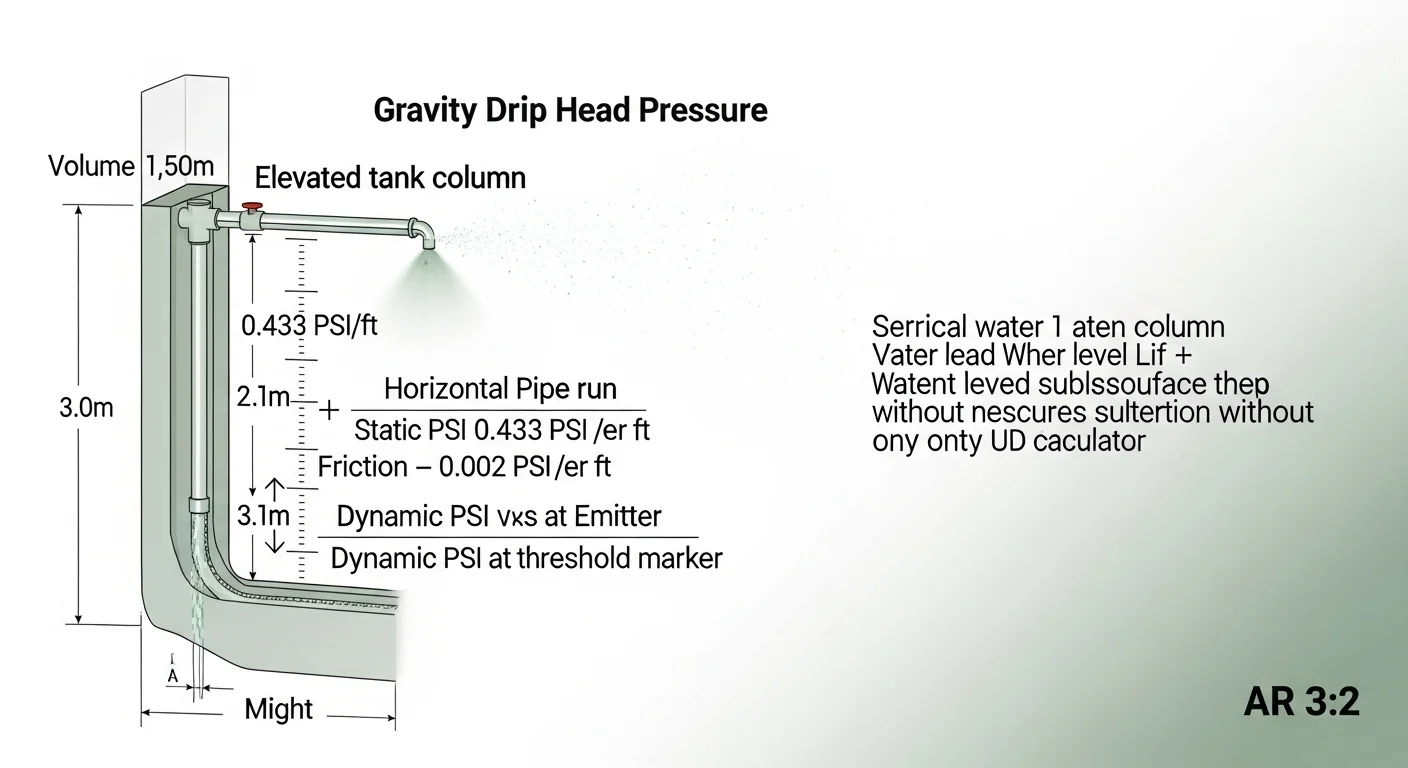
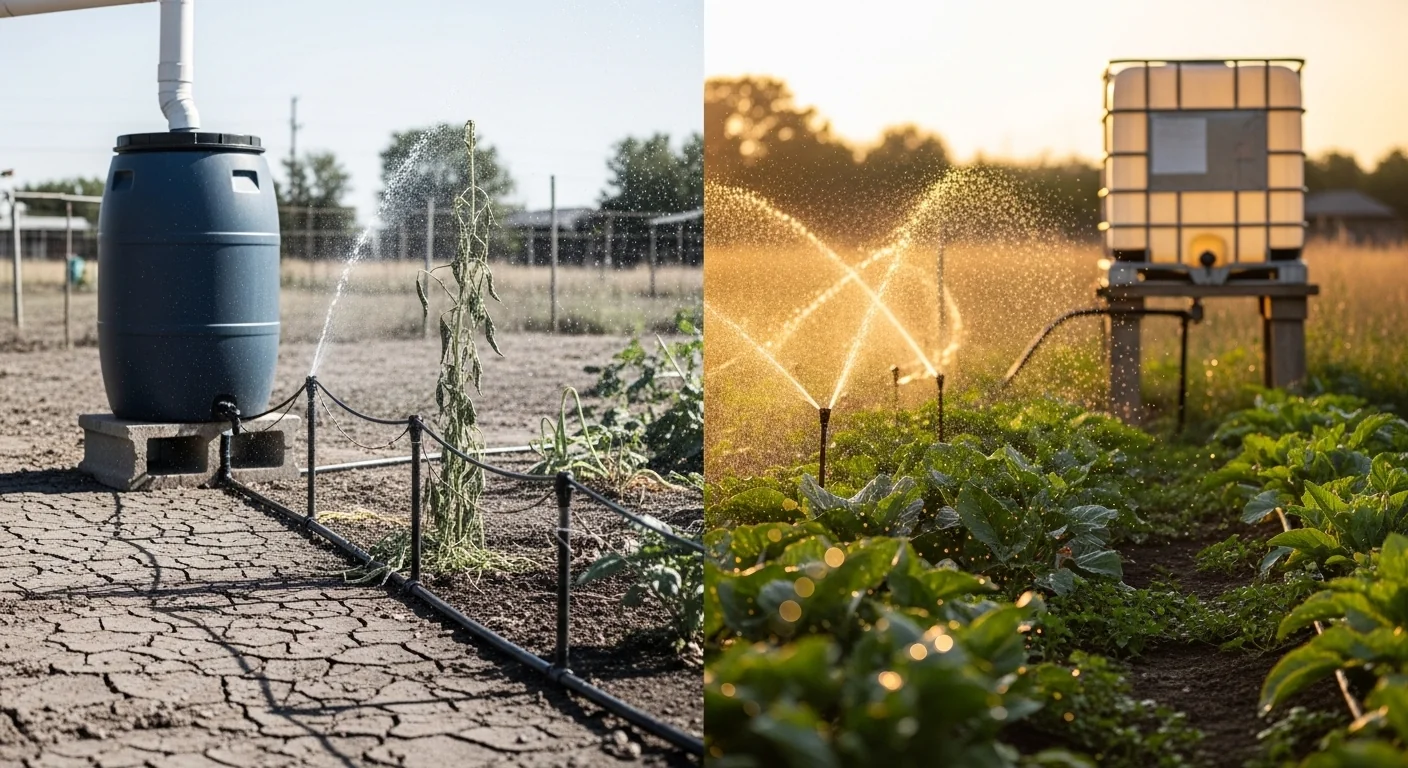
A gravity-fed drip system lives or dies on one number: the pressure at the emitter, measured in PSI. Not tank volume. Not tubing diameter. Not how full the barrel is when you start. The vertical drop from the water surface to the emitter is the only force pushing water through your system, and at 0.433 PSI per foot of elevation, that number gets small fast. A 55-gallon barrel sitting on a 3-foot cinder block stand produces roughly 2.6 PSI when completely full. Standard drip emitters from a hardware-store kit require 10 to 15 PSI to open. The math resolves itself immediately.
This calculator determines the dynamic pressure available at your drip emitters by combining your tank’s elevation, water level, pipe run length, and your emitter’s minimum operating specification. It calculates static head pressure using the 0.433 PSI-per-foot constant, subtracts a friction loss estimate based on pipe length, and compares the result against your entered emitter minimum. It does not model multiple emitters running simultaneously, account for fittings losses, or estimate flow rate in gallons per hour. Those are separate calculations. After confirming your system has adequate pressure, a drip irrigation run time calculator can help you determine how long to run the system to meet crop water demand.
After entering your four measurements, you will know whether your current setup will actually deliver water through your emitters, and if it will not, exactly how much additional elevation you need to make it work.
Use the Tool
Gravity Drip System — Head Pressure Calculator
Determine if your tank elevation delivers enough PSI for your drip emitters to actually work.
Results — Gravity Drip System Analysis
| Setup Description | Tank Elev (ft) | Water (ft) | Static PSI | Est. Dynamic PSI | Non-PC OK? |
|---|
How This Calculator Works — Formulas & Assumptions
This gravity-fed drip system calculator uses basic fluid statics to determine whether your tank’s elevation provides enough water pressure for your chosen drip emitters.
Step 2: Static PSI = Total Head × 0.433 (PSI per vertical foot of water)
Step 3: Friction Loss (PSI) ≈ Pipe Length × 0.002 (simplified Hazen-Williams for ½” poly at low flow)
Step 4: Dynamic PSI = Static PSI − Friction Loss
Step 5: PASS if Dynamic PSI ≥ Emitter Minimum Operating PSI
Key constant: One foot of vertical water height = 0.433 PSI at sea level (fresh water, 62.4 lb/ft³).
Friction loss note: A simplified coefficient of 0.002 PSI/ft is used for standard ½” polyethylene drip tubing at typical gravity-flow rates (<1 GPH per emitter). Larger diameter pipe (¾” or 1″) will have significantly less friction loss. Increase this estimate for long runs with many emitters.
Critical warning about PC emitters: Pressure-Compensating (PC) emitters contain a rubber diaphragm that requires 10–15 PSI minimum to open. A 3-ft cinder block stand only provides ~1.3 PSI static — nowhere near enough to open a PC emitter. Always use Non-Pressure-Compensating (Non-PC or “flag” style) emitters with gravity-fed systems.
Assumptions & Limits
- Elevation inputs are measured vertically. Sloped terrain may reduce effective head — measure the vertical rise, not the slope distance.
- Friction loss is approximated using 0.002 PSI/ft, suitable for ½” poly drip tubing at low flow (<0.5 GPM). Actual loss varies by pipe diameter, flow rate, and fittings.
- Water density is assumed to be fresh water at ~62.4 lb/ft³ (0.433 PSI/ft). Mineral-rich or brackish water may differ slightly.
- Elevation inputs must be 0–200 ft. Water level must be 0.1–20 ft. Pipe length must be 1–1000 ft. Emitter minimum PSI must be 0–60 PSI.
- This tool does not account for filter pressure drop, valve losses, emitter spacing density, or dynamic flow from multiple simultaneous emitters.
- Non-PC emitter threshold: The tool flags systems with Dynamic PSI < 2 PSI as insufficient for any drip system, and systems with Dynamic PSI between 2–8 PSI as marginal. >8 PSI is considered comfortable for Non-PC emitters.
- PC emitter threshold: Minimum 10 PSI is required to open the pressure-compensating diaphragm. 15 PSI is the rated operating pressure for most PC emitters.
Before entering values, have the following ready: a tape measure for the vertical height of the tank bottom above ground (not the slant height of a ramp), the current depth of water inside the tank, the total length of supply tubing from the tank outlet to the furthest emitter, and the minimum operating PSI printed on your emitter packaging or product spec sheet. Use vertical measurements only. If your site slopes, measure the rise, not the run. For projects that start with capturing rainfall, a rainwater collection calculator can help size the storage tank before you design the distribution system.
Quick Start (60 Seconds)
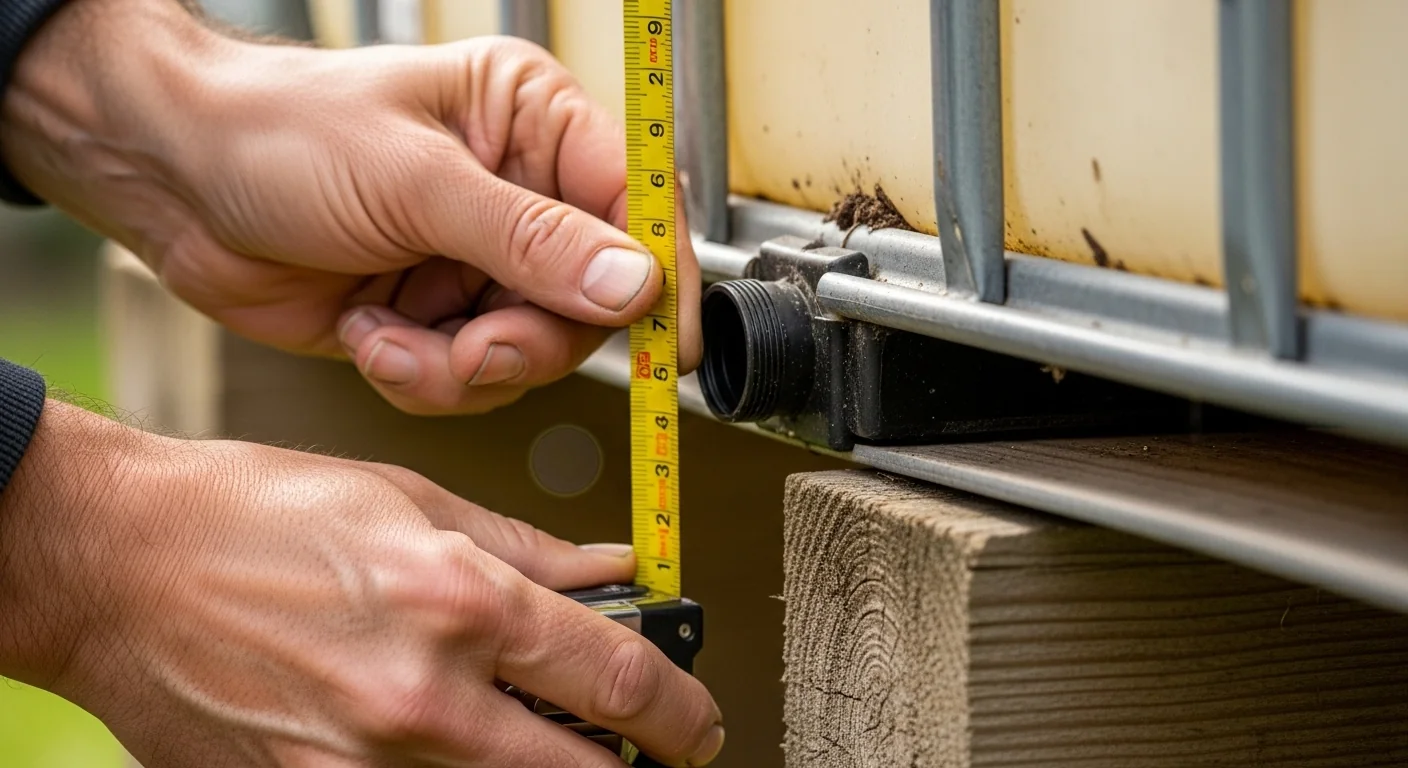
- Tank Bottom Elevation (ft): Measure the vertical distance from the ground directly below the tank to the bottom of the tank. A standard 55-gallon barrel on two cinder blocks is typically 2 to 3 feet. An IBC tote on a built frame often sits 3 to 5 feet. Do not measure the overall tank height.
- Water Level Inside Tank (ft): Measure the current depth of water sitting in the tank, not the tank's total height. A full 55-gallon barrel holds about 3 feet of water. A full 275-gallon IBC tote holds approximately 3.7 feet. As the tank drains, this number decreases and so does your pressure.
- Supply Pipe / Hose Length (ft): Measure the total length of tubing from the tank outlet to the last emitter in the run. Include any uphill sections, which create additional head loss not captured in the friction estimate. Common mistake: measuring only the main line and forgetting lateral runs.
- Emitter Minimum Operating PSI: This is on the emitter packaging or product data sheet. Non-pressure-compensating (Non-PC) emitters: typically 0 to 2 PSI. Pressure-compensating (PC) emitters: typically 10 to 15 PSI. If the package lists a range, enter the lower number.
- Unit consistency: All entries must be in feet (not inches, not meters) for elevation and pipe length. PSI for the emitter minimum. The calculator does not perform unit conversion.
- Click Calculate only when all four fields are filled. The result panel will not appear until every field passes validation. Errors appear inline next to the specific field that failed.
- Recheck as the tank drains: Run the calculator again at 50% and 25% tank capacity. Dynamic PSI drops proportionally as water level falls, and a system that passes when full may fail mid-cycle.
Inputs and Outputs (What Each Field Means)
| Field Name | Unit | What It Represents | Common Entry Mistake | Safe Entry Guidance |
|---|---|---|---|---|
| Tank Bottom Elevation | Feet (ft) | Vertical height of the tank's lowest point above the ground where emitters sit. This is the fixed component of total head pressure. | Entering the tank's total height instead of how high the bottom sits above grade | 0 to 200 ft. Most gravity setups fall between 2 and 15 ft. Measure vertically from ground at the emitter field up to the tank bottom. |
| Water Level Inside Tank | Feet (ft) | Current depth of water in the tank. This is the variable component of total head; it decreases as the tank empties. | Entering the tank's full height capacity rather than actual current water depth | 0.1 to 20 ft. Enter the actual fill level for real-world pressure. Re-run the calculator at lower fill levels to check minimum performance. |
| Supply Pipe / Hose Length | Feet (ft) | Total pipe or tubing length from tank outlet to the furthest emitter. Longer runs increase friction loss and reduce available dynamic pressure. | Measuring only the header line and omitting lateral drip tape runs | 1 to 1000 ft. For runs over 200 ft with many emitters, the simplified friction coefficient may underestimate actual loss. See the Assumptions section. |
| Emitter Minimum Operating PSI | PSI | The lowest pressure at which the emitter manufacturer guarantees rated flow. Below this threshold, flow is inconsistent or zero. | Entering the rated operating PSI instead of the minimum, or guessing without checking the spec sheet | 0 to 60 PSI. Non-PC emitters: 0 to 2 PSI. PC emitters: 10 to 15 PSI. The widget flags any entry of 10 PSI or higher as likely incompatible with gravity systems. |
| Dynamic PSI at Emitter (Output) | PSI | The estimated pressure delivered to the emitter after accounting for elevation, water level, and friction loss in the supply line. | Confusing static PSI with dynamic PSI; static ignores the friction penalty | Compare this value directly to the emitter minimum. The system needs a buffer above the minimum for reliable operation across the full tank cycle. |
| PASS / MARGINAL / FAIL Status (Output) | Classification | The tool's deterministic check: PASS if dynamic PSI exceeds emitter minimum by more than 2 PSI, MARGINAL if within 2 PSI, FAIL if below minimum. | Treating MARGINAL as acceptable; the system will fail before the tank is empty | Design for PASS at the intended minimum water level, not just at full capacity. |
Flow rate at these low pressures varies significantly by emitter design. A hose flow rate calculator can help estimate delivery volume once the pressure question is resolved.
Worked Examples (Real Numbers)
Scenario 1: Standard Rain Barrel on Cinder Blocks with PC Emitters
- Tank Bottom Elevation: 3 ft
- Water Level Inside Tank: 3 ft (full barrel)
- Pipe / Hose Length: 30 ft
- Emitter Minimum Operating PSI: 10 PSI (pressure-compensating kit)
Result: Total head = 6 ft. Static PSI = 6 x 0.433 = 2.60 PSI. Friction loss = 30 x 0.002 = 0.06 PSI. Dynamic PSI = 2.54 PSI. Status: FAIL.
The barrel is full, the stand is at a typical height, and nothing comes out. The PC emitter's rubber diaphragm requires 10 PSI to open. Gravity is delivering 2.54 PSI. Replacing the emitter kit with Non-PC flag emitters rated for 0 to 2 PSI is the immediate fix, not raising the barrel.
Scenario 2: IBC Tote on 5-Foot Stand with Non-PC Emitters
- Tank Bottom Elevation: 5 ft
- Water Level Inside Tank: 3.7 ft (full 275-gallon tote)
- Pipe / Hose Length: 50 ft
- Emitter Minimum Operating PSI: 1 PSI
Result: Total head = 8.7 ft. Static PSI = 8.7 x 0.433 = 3.77 PSI. Friction loss = 50 x 0.002 = 0.10 PSI. Dynamic PSI = 3.67 PSI. Status: PASS.
The IBC tote on a proper elevated frame with correctly specified Non-PC emitters gives a comfortable working pressure with a 2.67 PSI margin above the 1 PSI minimum. Even at half tank capacity (water level 1.85 ft), dynamic PSI would be approximately 2.50 PSI, still above the minimum.
Scenario 3: Hillside Tank at 15-Foot Elevation with Longer Run
- Tank Bottom Elevation: 15 ft
- Water Level Inside Tank: 3.7 ft
- Pipe / Hose Length: 100 ft
- Emitter Minimum Operating PSI: 2 PSI
Result: Total head = 18.7 ft. Static PSI = 18.7 x 0.433 = 8.10 PSI. Friction loss = 100 x 0.002 = 0.20 PSI. Dynamic PSI = 7.90 PSI. Status: PASS.
A hillside cistern at significant elevation changes the math entirely. With 7.90 PSI delivered, this system could even run some Non-PC drip tape rated at 4 to 6 PSI, with margin to spare. The 100-foot run costs only 0.20 PSI in friction loss under the simplified model.
Reference Table (Fast Lookup)
All rows assume 50 feet of 1/2-inch polyethylene supply tubing (friction loss = 0.10 PSI). Dynamic PSI = Static PSI minus 0.10 PSI. Non-PC threshold: 2 PSI minimum. PC threshold: 10 PSI minimum.
| Setup Description | Tank Elev (ft) | Water Level (ft) | Total Head (ft) | Static PSI | Dynamic PSI (50 ft run) | Non-PC Emitter OK? | PC Emitter OK? |
|---|---|---|---|---|---|---|---|
| Barrel on 3-ft stand, half full | 3 | 1.5 | 4.5 | 1.95 | 1.85 | No | No |
| Barrel on 3-ft stand, full | 3 | 3.0 | 6.0 | 2.60 | 2.50 | Yes (marginal) | No |
| Barrel on 5-ft platform, full | 5 | 3.0 | 8.0 | 3.46 | 3.36 | Yes | No |
| IBC tote on 3-ft stand, full | 3 | 3.7 | 6.7 | 2.90 | 2.80 | Yes | No |
| IBC tote on 5-ft stand, full | 5 | 3.7 | 8.7 | 3.77 | 3.67 | Yes | No |
| IBC tote on 8-ft stand, full | 8 | 3.7 | 11.7 | 5.07 | 4.97 | Yes | No |
| Hillside tank, 10-ft natural elevation | 10 | 3.7 | 13.7 | 5.93 | 5.83 | Yes | No |
| Hillside tank, 15-ft natural elevation | 15 | 3.7 | 18.7 | 8.10 | 8.00 | Yes | No |
| Elevated cistern, 20-ft stand, full | 20 | 4.0 | 24.0 | 10.39 | 10.29 | Yes | Marginal (10 PSI min) |
| Elevated cistern, 25-ft stand, full | 25 | 4.0 | 29.0 | 12.56 | 12.46 | Yes | Yes (15 PSI rated) |
How the Calculation Works (Formula + Assumptions)
Show the calculation steps
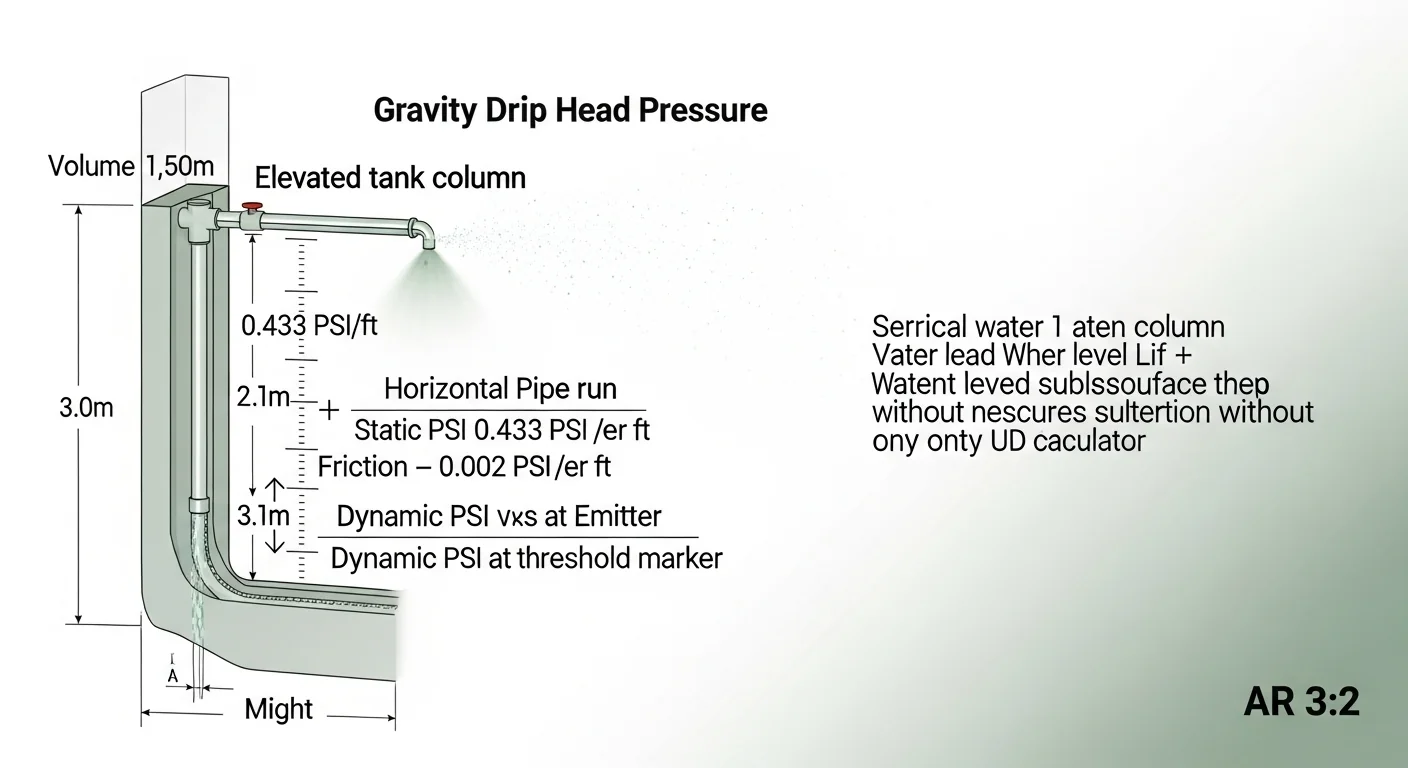
Step 1: Total Head (feet)
Add the tank bottom elevation to the current water level inside the tank. Both are measured in feet. This is the total vertical distance from the free water surface down to the emitter field, which is the driving force for pressure.
Total Head = Tank Bottom Elevation + Water Level Inside Tank
Step 2: Static PSI
Multiply total head by 0.433. This constant comes from the weight density of fresh water (62.4 lb/ft3) converted to PSI. One vertical foot of water exerts 0.433 pounds per square inch of pressure at the base.
Static PSI = Total Head x 0.433
Step 3: Friction Loss (PSI)
Multiply the supply pipe length by 0.002 PSI per foot. This simplified coefficient approximates the friction loss in 1/2-inch polyethylene drip tubing at gravity-flow rates (below 0.5 GPM total). The result is subtracted from static PSI.
Friction Loss = Pipe Length x 0.002
Step 4: Dynamic PSI
Subtract friction loss from static PSI. The result is the estimated pressure at the emitter. Dynamic PSI cannot be negative in practice; the tool displays 0 as the floor.
Dynamic PSI = Static PSI - Friction Loss
Step 5: Pass/Fail Check
Compare dynamic PSI to the emitter minimum operating PSI. PASS if dynamic PSI exceeds the minimum by more than 2 PSI. MARGINAL if within 2 PSI above the minimum. FAIL if dynamic PSI is at or below the minimum.
Rounding: All intermediate values are computed in full floating-point precision. Final displayed outputs are rounded to two decimal places. The pass/fail comparison uses unrounded values.
Assumptions and Limits
- Friction coefficient is simplified: The value of 0.002 PSI/ft is calibrated for 1/2-inch polyethylene tubing at very low flow (less than 0.5 GPM total system flow). Larger diameter supply lines (3/4 inch or 1 inch) will have substantially lower friction loss. Systems with many emitters running simultaneously will have higher actual flow and therefore higher friction loss than this model predicts.
- Elevation must be measured vertically: The formula requires the true vertical rise. If a tank sits on a hillside and the emitters are at a different horizontal position, only the vertical component of the height difference contributes to pressure. The calculator cannot correct for sloped terrain geometry.
- Water density is assumed to be fresh water at standard temperature: The 0.433 PSI/ft constant applies to clean fresh water at approximately 60 to 70 degrees Fahrenheit. Warm water, mineral-rich water, or water with dissolved solids will have slightly different density but the difference is negligible for practical gravity irrigation purposes.
- Fittings and filter pressure drops are not modeled: Every coupling, elbow, valve, and inline filter in the system adds resistance. An inline mesh filter at the tank outlet can account for 0.1 to 0.5 PSI of additional loss depending on mesh rating and debris load. The model treats the supply line as a smooth continuous run.
- The tool evaluates pressure at a single point in time: As the tank drains, water level drops and dynamic PSI decreases proportionally. A system that shows PASS at full tank may show FAIL when the tank is 25% full. Users should run the calculator at multiple fill levels to understand the operating envelope.
- Emitter spacing density is not considered: A single emitter on a 50-foot run behaves very differently from 50 emitters on the same run. High emitter density increases total flow demand, which increases friction loss beyond what this simplified model captures. Use this calculator for preliminary go/no-go decisions, not for final system engineering on large installations.
- Input ranges are bounded: Tank elevation: 0 to 200 ft. Water level: 0.1 to 20 ft. Pipe length: 1 to 1000 ft. Emitter minimum PSI: 0 to 60 PSI. Entries outside these bounds trigger a validation error.
For systems where friction loss is a significant factor, a dedicated pipe friction loss calculator can provide a more accurate loss estimate using full Hazen-Williams methodology across different pipe diameters and materials.
Standards, Safety Checks, and "Secret Sauce" Warnings
Critical Warnings
- Pressure-Compensating emitters are incompatible with gravity systems in almost all residential setups. The rubber diaphragm inside a PC emitter is engineered to regulate flow by flexing against internal pressure. That mechanism requires a minimum of 10 to 15 PSI to open at all. Even an IBC tote on a 5-foot stand delivers roughly 3.7 PSI. Unless a tank is elevated 25 feet or more, PC emitters will not flow under gravity alone. The tool flags any emitter minimum of 10 PSI or higher as a likely PC emitter and issues a warning to switch to Non-PC open-flow emitters.
- Dynamic PSI is not constant. It declines throughout every watering cycle as water level in the tank drops. A 55-gallon barrel at 3-foot elevation delivers 2.60 PSI static when full. At the halfway point (1.5 ft of water remaining), static PSI drops to 1.95 PSI. If the system was marginal when full, it will fail before the tank is empty. Designing with a buffer above the emitter minimum, not at the minimum, is the required approach.
- Pipe length can eliminate a borderline system. A run of 200 feet at 0.002 PSI/ft costs 0.40 PSI in friction loss under the simplified model. On a low-head gravity system producing 3 PSI static, that penalty is significant. Longer runs, multiple inline fittings, and inline filters compound these losses. Short, direct supply lines are a design requirement, not a convenience.
- Soaker hose is not equivalent to drip tape for pressure calculations. Soaker hose operates by weeping through a porous wall and is extremely sensitive to even minor pressure variation along its length. Manufacturers typically specify 5 to 10 PSI for consistent output. Gravity systems below 5 PSI will produce highly uneven moisture distribution across a soaker hose run.
Minimum Standards
- Any gravity-fed drip system must use Non-PC emitters with a rated minimum of 2 PSI or lower. Do not use emitters from standard residential drip kits without verifying the pressure rating on the product datasheet.
- Design for a minimum 2 PSI buffer above the emitter's minimum operating pressure at the lowest anticipated tank fill level, not at full capacity.
- Install a 150-mesh (100 micron) inline filter at the tank outlet. Low-pressure systems have insufficient velocity to flush sediment through emitter orifices. A clogged 0.5 GPH emitter under gravity pressure will not self-clear.
- Verify actual tank elevation with a tape measure from the ground to the tank bottom, not from memory or estimate. A 6-inch measurement error at low head translates to roughly 0.26 PSI, which can shift a result from PASS to FAIL.
Competitor Trap: Most gravity drip guides online tell you to "raise the barrel higher" as the universal fix for low pressure. That advice is incomplete. The correct sequence is: first confirm whether your emitter type is physically compatible with gravity pressure at all. Raising a barrel from 3 feet to 6 feet takes static PSI from 2.60 to 3.46 PSI. If the emitter requires 10 PSI to open, a 3-foot platform increase changes nothing. The emitter selection decision comes before the elevation decision. The tool enforces this sequence by flagging PC emitter PSI ranges before any pressure comparison is made.
For systems where gravity pressure cannot be made adequate and a pump is the correct next step, an irrigation pump sizing calculator can determine the pump head and flow requirements. For drip tape systems specifically, minimum flush velocity requirements are a separate standard covered by a drip tape flush velocity calculator.
Common Mistakes and Fixes
Mistake: Using a Standard Residential Drip Kit Purchased at a Hardware Store
Residential drip kits sold at home improvement stores are designed for municipal water supply systems, which operate at 40 to 80 PSI. The emitters, micro-sprinklers, and pressure regulators in these kits presuppose municipal pressure. The pressure regulator installed in the kit header is specifically designed to reduce pressure down to 25 to 30 PSI from a higher supply, and it will choke a gravity system entirely if installed. Verify every component's minimum operating PSI before using it in a gravity-fed configuration.
Fix: Purchase a drip kit explicitly marketed for low-pressure or gravity-fed applications, or assemble a custom system using Non-PC emitters with documented minimum operating pressures below 2 PSI.
Mistake: Measuring Tank Height Instead of Tank Elevation
Total head pressure depends on the vertical distance from the water surface to the emitter, not the height of the tank itself. A 275-gallon IBC tote is 3.7 feet tall. If the bottom of that tote sits 5 feet above the garden bed, the total head when full is 5 plus 3.7 = 8.7 feet. Entering the tank height (3.7 feet) instead of the combined elevation would produce a static PSI estimate of 1.60 PSI instead of 3.77 PSI, which could lead to an incorrectly optimistic system design.
Fix: Measure from the ground surface at the emitter field up to the bottom of the tank. Enter that value as Tank Bottom Elevation. Enter the actual water depth inside the tank separately.
Mistake: Calculating Pressure Only When the Tank Is Full
Pressure is highest when the tank is full and decreases continuously as water drains. A system that passes the pressure check at full capacity may fail halfway through the watering cycle. This is particularly consequential for 55-gallon barrels, where the water level drop from full to empty spans 3 feet, and for any system operating near the emitter's minimum threshold. The relevant pressure measurement for design purposes is the minimum expected pressure during operation, not the maximum.
Fix: Run the calculator at full, 50%, and 25% tank fill levels. Design the system to pass at the lowest expected operating level. If the system fails at 25% fill but passes when full, either raise the tank elevation or plan to refill before the tank reaches the failure threshold.
Mistake: Ignoring the Friction Penalty on Long Runs
On a high-pressure municipal system, friction loss across 100 feet of 1/2-inch tubing is a rounding error. On a gravity system producing 3 to 4 PSI, a friction loss of 0.20 PSI represents 5 to 7% of total available pressure. Add an inline filter (0.1 to 0.5 PSI loss), a few elbows, and a Y-connector, and the total friction and fitting penalty can exceed 0.5 to 1.0 PSI. The calculator uses a simplified friction model; users with long runs and many fittings should treat the dynamic PSI result as an optimistic upper estimate. For more detailed modeling by pipe diameter and flow rate, a dedicated pipe volume and flow calculator can help characterize the supply line before sizing the system.
Fix: Use the largest practical supply line diameter (3/4 inch or 1 inch) for the header run, and transition to 1/2-inch laterals only at the emitter rows. Minimize the number of fittings and always install a clean, high-mesh filter at the outlet to prevent sediment-driven blockage rather than pressure-driven flush.
Mistake: Selecting Emitter Minimum PSI from Memory Rather Than the Product Datasheet
Drip emitter ratings are not standardized in the way that electrical ratings are. Two emitters labeled "1 GPH" from different manufacturers may have minimum operating pressures of 0.5 PSI and 10 PSI respectively, depending on whether they are Non-PC or PC designs. Guessing the minimum operating pressure or entering a number that "sounds right" invalidates the entire calculation. The pass/fail decision depends directly on this input being accurate.
Fix: Look up the product datasheet for the specific emitter model installed or planned. The minimum operating pressure is listed in the specifications section, not on the front of the packaging. If the datasheet is unavailable, contact the manufacturer. Non-PC emitters will typically state a flow rate with no minimum PSI listed or a minimum of 0 to 2 PSI.
Next Steps in Your Workflow
Once the tool returns a PASS status, the pressure question is answered, but the irrigation design is not complete. The next critical variable is duration: how long must the system run to deliver the right amount of water to each plant root zone? That depends on emitter flow rate (in gallons per hour at the delivered PSI), plant water demand, soil type, and available water holding capacity. Knowing your soil's field capacity is necessary to avoid both under-watering and runoff; a field capacity and soil moisture calculator connects the pressure result from this tool to actual root zone water budgets.
If the pressure check returns a FAIL result and raising the tank elevation is not feasible, the off-grid watering path diverges. One option is to redesign around a small header tank on a higher natural landform and feed it from a lower primary storage tank using a manual or solar pump fill cycle. The primary storage tank handles collection capacity; the header tank handles operating pressure. For projects where rainwater is the supply source, a rainwater harvesting calculator can determine whether the catchment area and annual rainfall are sufficient to keep the header tank filled throughout the growing season.
FAQ
What is the minimum tank elevation needed to run drip emitters off gravity?
For Non-PC emitters with a 1 to 2 PSI minimum rating, you need at least 2.3 to 4.6 feet of total head (elevation plus water depth combined). That often means a tank bottom at 2 to 3 feet with 1 to 2 feet of water remaining. Designing for at least 5 feet of total head provides a functional buffer when the tank is partially drained.
Can a 55-gallon rain barrel run a drip system?
Yes, but only with Non-PC emitters rated for 1 to 2 PSI or lower and only if the barrel sits at least 2 to 3 feet above the garden bed. At full capacity on a 3-foot stand, a 55-gallon barrel delivers approximately 2.6 PSI static. That is enough to run low-pressure flag-style emitters but not enough to open a standard pressure-compensating emitter from a retail drip kit.
Why does gravity only produce 0.433 PSI per foot?
This constant comes from the weight of water. One cubic foot of fresh water weighs approximately 62.4 pounds. Converted to pressure over a one-square-inch column, that works out to 0.433 pounds per square inch per vertical foot of water. The constant applies universally to fresh water at standard temperatures and is the foundation of all hydrostatic pressure calculations.
What is the difference between static PSI and dynamic PSI?
Static PSI is the pressure at rest, calculated purely from the vertical head of water above the measurement point. Dynamic PSI is the pressure during flow, which is lower than static PSI because friction in the pipe consumes some of the available head. For system design, dynamic PSI is the correct comparison value against emitter minimums because the emitters operate during flow, not at rest.
Will an IBC tote on a 5-foot stand run standard drip emitters?
Not if "standard" means pressure-compensating emitters from a typical drip kit. A full 275-gallon IBC tote on a 5-foot stand delivers approximately 3.77 PSI static. That is sufficient for Non-PC emitters rated at 0 to 2 PSI but falls far short of the 10 to 15 PSI required to open a PC emitter's diaphragm. Emitter selection is the critical design decision, not tank size.
How does water level affect pressure throughout a watering cycle?
Pressure decreases proportionally as water drains. Every foot of water level lost reduces static PSI by 0.433 PSI. A tank that produces 3.77 PSI when full will produce roughly 2.64 PSI when the water level drops by 2.6 feet. On any system operating near the emitter minimum, this means the system transitions from PASS to FAIL during the watering cycle before the tank is empty.
Conclusion
The core insight behind this gravity fed drip irrigation calculator is that pressure is determined by vertical height, not by tank volume, not by hose size, and not by how new the equipment is. Water weighs what it weighs, and 0.433 PSI per vertical foot is a physical constant that does not negotiate. A system built around that constraint, with Non-PC emitters selected to match the pressure actually available, will run reliably. A system built around the assumption that any drip emitter will work simply because it has a low flow rate will produce nothing at all.
The single most preventable failure in off-grid gravity drip irrigation is purchasing a standard pressure-compensating drip kit and attaching it to a rain barrel. The emitters will not open, the system will appear broken, and the diagnosis is almost never reached because most available guides do not explain why PC emitters are incompatible with low-head gravity systems. Use this calculator before purchasing any components, verify the emitter minimum PSI from the product datasheet, and design for the pressure available at minimum tank fill, not maximum. If those checks pass, the system will work.