
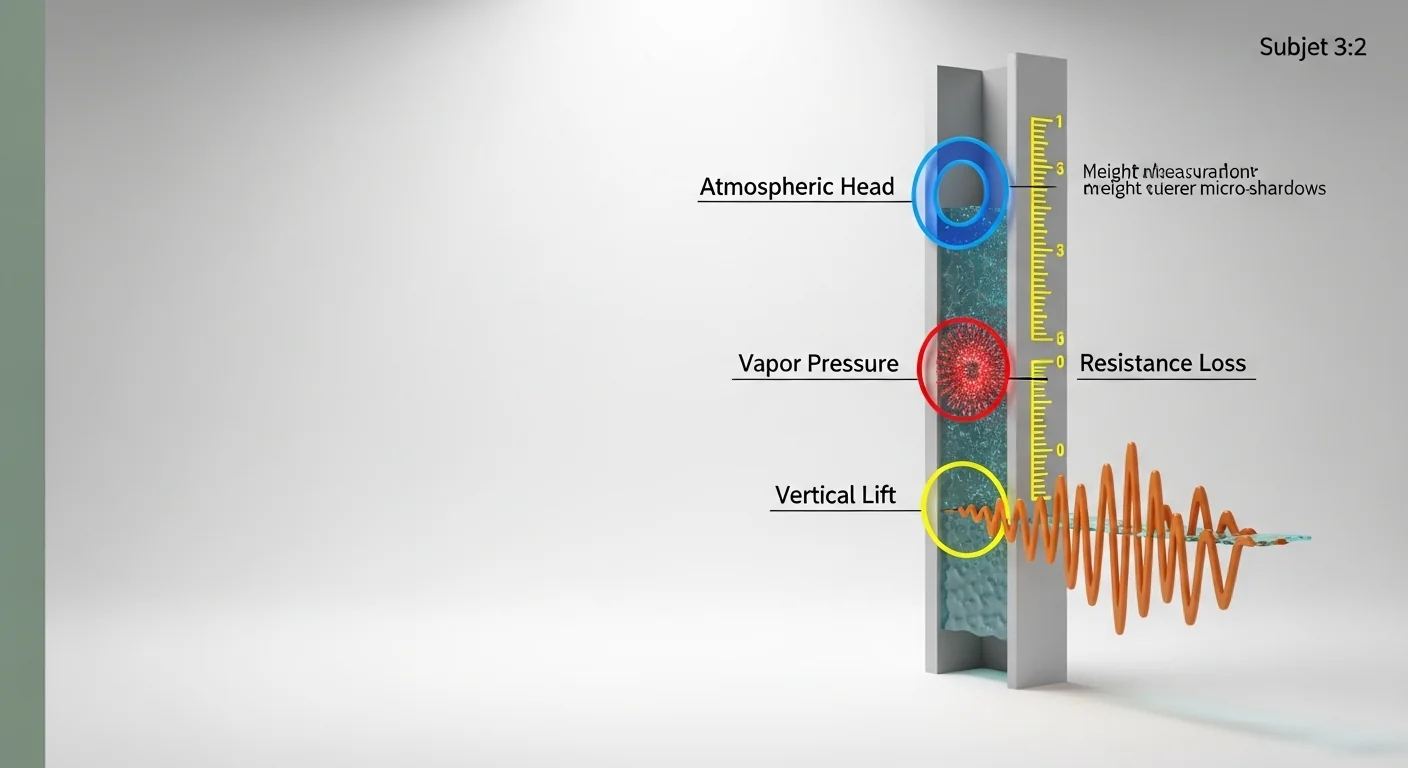
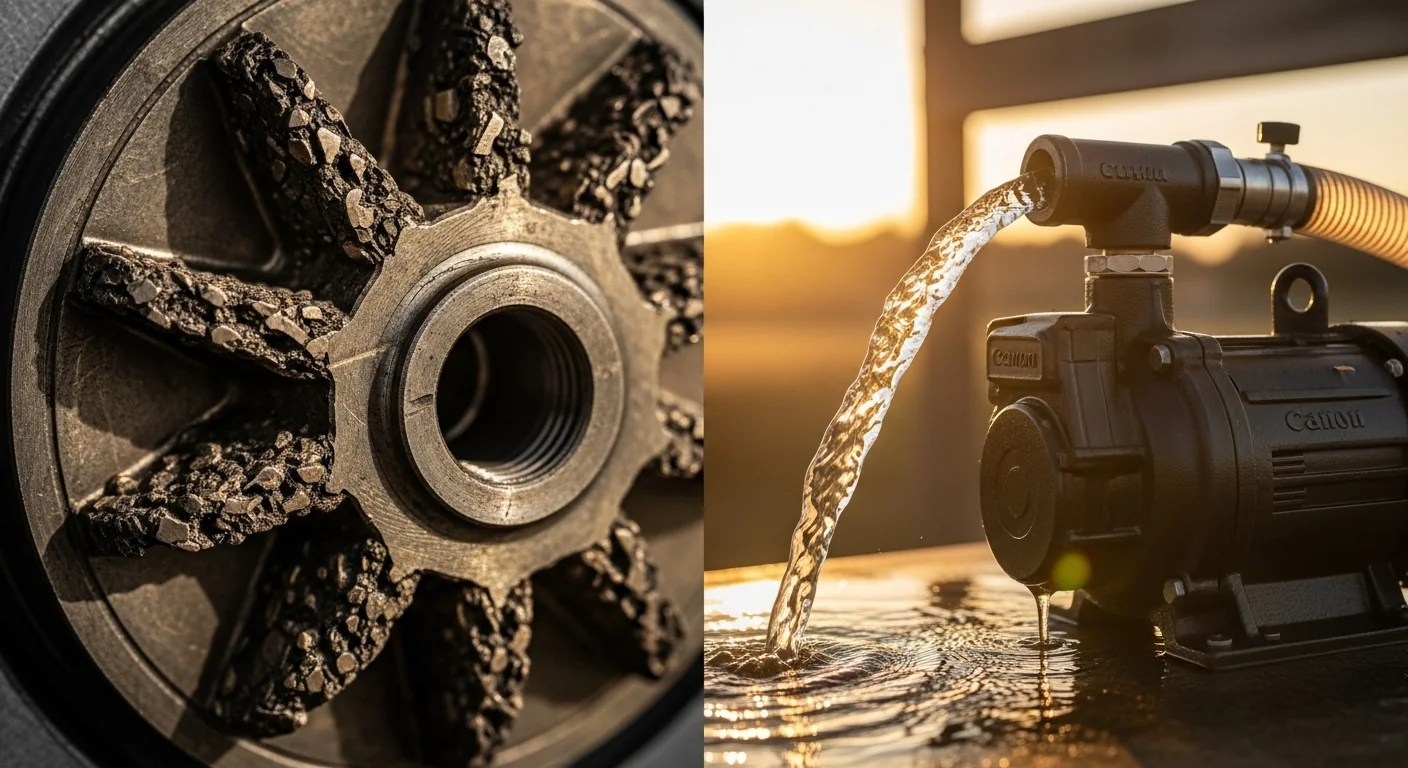
Centrifugal pumps do not pull water. They create a low-pressure zone at the inlet, and atmospheric pressure does the actual pushing. When that inlet pressure drops below the vapor pressure of the water being moved, the liquid flashes to steam inside the pump casing. The resulting vapor bubbles collapse with enough force to pit and erode a brass impeller within a single irrigation season. Net Positive Suction Head Available (NPSHa) is the measurement that tells you exactly how much pressure margin exists before that happens.
This NPSH calculator computes NPSHa from four site-specific inputs: elevation above sea level, water temperature, vertical suction lift, and suction pipe friction loss. It does not select a pump, predict flow rate, or account for velocity head. If you need to also determine flow velocity through your suction hose, that is a separate calculation. What this tool returns is the single number you compare against your pump manufacturer’s published NPSHr (required) value before committing to an installation.
After running the calculator, you can determine whether your suction geometry is physically safe for the pump you intend to use, or whether you need to reduce lift, increase pipe diameter, or choose a pump with a lower NPSHr rating.
Use the Tool
Centrifugal Pump NPSH Calculator
Net Positive Suction Head Available — cavitation risk analysis
Quick Reference — NPSH at Your Elevation & Conditions
| Lift (ft) | NPSHa (ft) | Status |
|---|
How This Calculator Works — Formula & Assumptions ▶
What is NPSH? Net Positive Suction Head Available (NPSHa) is the absolute pressure energy at the pump inlet, expressed as equivalent feet of water. It must always exceed the pump manufacturer’s required NPSHr. If it doesn’t — the water physically boils inside the pump, creating vapor bubbles that collapse with tremendous force against the impeller, destroying it within hours to months.
Step-by-step formula:
Atmospheric Pressure: Decreases with elevation. At sea level: ~34 ft of head (14.7 psia). At 5,000 ft: ~30.1 ft. At 10,000 ft: ~26.7 ft.
Vapor Pressure: Increases with temperature. At 60°F: ~0.59 ft. At 100°F: ~2.31 ft. At 150°F: ~9.6 ft. Warm water can boil inside the pump suction at pressures you wouldn’t expect.
Units & Assumptions:
- All head values are in feet of water (ft).
- Suction lift is vertical distance only — horizontal pipe run contributes to friction, not lift.
- Friction loss should include all fittings, valves, strainers, and foot valves on the suction line.
- NPSHr varies by pump model. A typical safety margin is NPSHa > NPSHr + 2 ft. Contact your pump manufacturer for exact NPSHr.
- Water density correction for temperature is included in the vapor pressure calculation.
- Maximum practical suction lift for surface pumps is approximately 25 ft at sea level under ideal conditions — less at altitude and with warm water.
Assumptions & Limits ▶
- Valid for cold and warm fresh water only (32°F–210°F). Not for saltwater, chemicals, or slurries.
- Elevation range: 0–15,000 ft. Above 15,000 ft, atmospheric pressure corrections may deviate significantly.
- Suction lift range: 0–30 ft. Physically impossible to exceed ~34 ft (theoretical vacuum) at sea level.
- This calculator yields NPSHa. You must obtain NPSHr from your specific pump’s performance curve.
- The standard safety margin recommended by the Hydraulic Institute is NPSHa ≥ NPSHr + 2 ft minimum.
- Pipe sizing (diameter), flow velocity, and pump speed affect friction loss — consult a hydraulic engineer for critical installations.
- Do not use this calculator for pump selection without cross-referencing the pump manufacturer’s data sheet.
- This tool is for educational and estimation purposes. The Yield Grid assumes no liability for pump sizing decisions.
Before entering values, have the following on hand: your site's elevation in feet (searchable by zip code via USGS or a topographic map), the measured or estimated water temperature at the source, the vertical distance from the water surface to the pump inlet centerline, and a friction loss estimate for your suction piping. Horizontal pipe run does not contribute to suction lift but does add friction head. If you have not yet calculated friction loss, the PVC friction loss calculator on this site can generate that value from pipe diameter, length, and flow rate before you return here.
Quick Start (60 Seconds)
- Elevation Above Sea Level (ft): Enter the elevation of the pump location, not the water source. Sea level equals 0. Mountainous installations significantly reduce available atmospheric head. A pump at 5,000 ft has roughly 18% less atmospheric pressure pushing water up than the same pump at sea level.
- Water Temperature (°F): Use the temperature of the water at the intake point, not ambient air temperature. Groundwater stays near 50-55°F year-round in most of the continental US; surface water from ponds and rivers can reach 80-90°F in summer. Hot water has much higher vapor pressure, which directly shrinks NPSHa.
- Vertical Suction Lift (ft): Measure the vertical distance only, from the water surface to the pump inlet centerline. Do not include horizontal pipe run here. Maximum practical lift for surface centrifugal pumps is roughly 25 ft at sea level under ideal conditions; elevation and warm water reduce this further.
- Suction Pipe Friction Loss (ft): This is the sum of all friction losses on the suction side only: straight pipe, elbows, foot valve, strainer, and any inline valves. A common default for a well-sized 2-inch suction line with a foot valve is 1.5-3.5 ft depending on length. Under-estimating this is one of the most frequent causes of field cavitation.
- Click Calculate: All four fields are required. The tool will flag missing or out-of-range entries before running.
- Read the gauge, not just the number: A result above 5 ft is a safe margin. Between 2 and 5 ft is marginal. Below 2 ft is a cavitation risk regardless of pump brand.
- Cross-reference your pump curve: The tool shows NPSHa. Your pump manual or spec sheet lists NPSHr. NPSHa must exceed NPSHr by at least 2 ft per Hydraulic Institute guidelines.
Inputs and Outputs (What Each Field Means)
| Field | Unit | What It Measures | Common Mistake | Safe Entry Guidance |
|---|---|---|---|---|
| Elevation Above Sea Level | ft | Altitude of the pump, which determines available atmospheric pressure head | Using water source elevation instead of pump location elevation | 0 to 15,000 ft; check USGS or GPS if unsure |
| Water Temperature | °F | Temperature of the water at intake; determines vapor pressure head | Using ambient air temperature; underestimating summer surface water temperature | 32°F to 210°F; measure at source, not at pump |
| Vertical Suction Lift | ft | Vertical rise from water surface to pump inlet centerline | Including horizontal pipe run or measuring to the pump discharge instead of the inlet | 0 to 30 ft; measure plumb, not along pipe slope |
| Suction Pipe Friction Loss | ft of head | Pressure energy consumed by pipe wall friction and fittings on the suction side | Ignoring foot valve head loss (typically 1.5-3 ft) or using discharge-side friction loss | 0 to 50 ft; calculate from pipe length, diameter, and fittings |
| NPSHa (output) | ft of head | Absolute pressure energy available at the pump inlet above vapor pressure | Treating NPSHa as the same as NPSHr; they are not interchangeable | Must exceed pump's rated NPSHr plus a 2 ft safety margin |
Worked Examples (Real Numbers)
Scenario 1: Sea-Level Well with Cold Groundwater
- Elevation: 0 ft (sea level)
- Water temperature: 60°F
- Vertical suction lift: 15 ft
- Suction pipe friction loss: 2.0 ft
Result: NPSHa = 16.41 ft
Atmospheric head at sea level is 34.00 ft. Vapor pressure at 60°F contributes only 0.59 ft. After subtracting lift and friction, 16.41 ft of positive suction head remains. This comfortably exceeds even demanding pump curves and represents a stable installation geometry.
Scenario 2: Farm Pond at Moderate Elevation, Warm Summer Water
- Elevation: 2,500 ft
- Water temperature: 75°F
- Vertical suction lift: 22 ft
- Suction pipe friction loss: 3.5 ft
Result: NPSHa = 4.40 ft
Atmospheric head drops to 30.89 ft at 2,500 ft elevation. Vapor pressure at 75°F consumes 0.99 ft. The 22 ft lift and 3.5 ft friction loss leave just 4.40 ft of margin. This falls in the marginal zone; a pump with NPSHr above 2.4 ft would be at risk, and any temperature rise or increased flow rate could push conditions into cavitation.
Scenario 3: High-Elevation Irrigation with Hot Late-Season Water
- Elevation: 5,000 ft
- Water temperature: 95°F
- Vertical suction lift: 20 ft
- Suction pipe friction loss: 4.0 ft
Result: NPSHa = 2.17 ft
At 5,000 ft, atmospheric head is only 28.05 ft. Water at 95°F has a vapor pressure head of 1.88 ft. With 20 ft of lift and 4 ft of friction, the system leaves only 2.17 ft of suction head above vapor pressure. This is critically close to the danger threshold. A pump with any NPSHr above 0.17 ft will cavitate, and this margin disappears entirely if water temperature rises a few more degrees or flow demand increases pipe friction.
Reference Table (Fast Lookup)
| Elevation (ft) | Water Temp (°F) | Suction Lift (ft) | Friction Loss (ft) | NPSHa (ft) | Status |
|---|---|---|---|---|---|
| 0 | 60 | 10 | 1.5 | 21.91 | Safe |
| 0 | 60 | 20 | 2.5 | 10.91 | Safe |
| 0 | 75 | 25 | 3.0 | 5.01 | Safe (minimal margin) |
| 0 | 100 | 25 | 3.0 | 3.81 | Marginal |
| 0 | 140 | 15 | 2.0 | 10.35 | Safe |
| 2,500 | 75 | 22 | 3.5 | 4.40 | Marginal |
| 5,000 | 60 | 20 | 2.0 | 5.46 | Safe |
| 5,000 | 95 | 20 | 4.0 | 2.17 | Marginal (near danger) |
| 7,500 | 80 | 18 | 3.0 | 3.31 | Marginal |
| 0 | 120 | 22 | 2.5 | 5.61 | Safe (minimal margin) |
Note: Rows with NPSHa below 5 ft require you to verify your specific pump's NPSHr before finalizing installation geometry. Values are computed from the barometric formula and Antoine vapor pressure approximation.
How the Calculation Works (Formula + Assumptions)
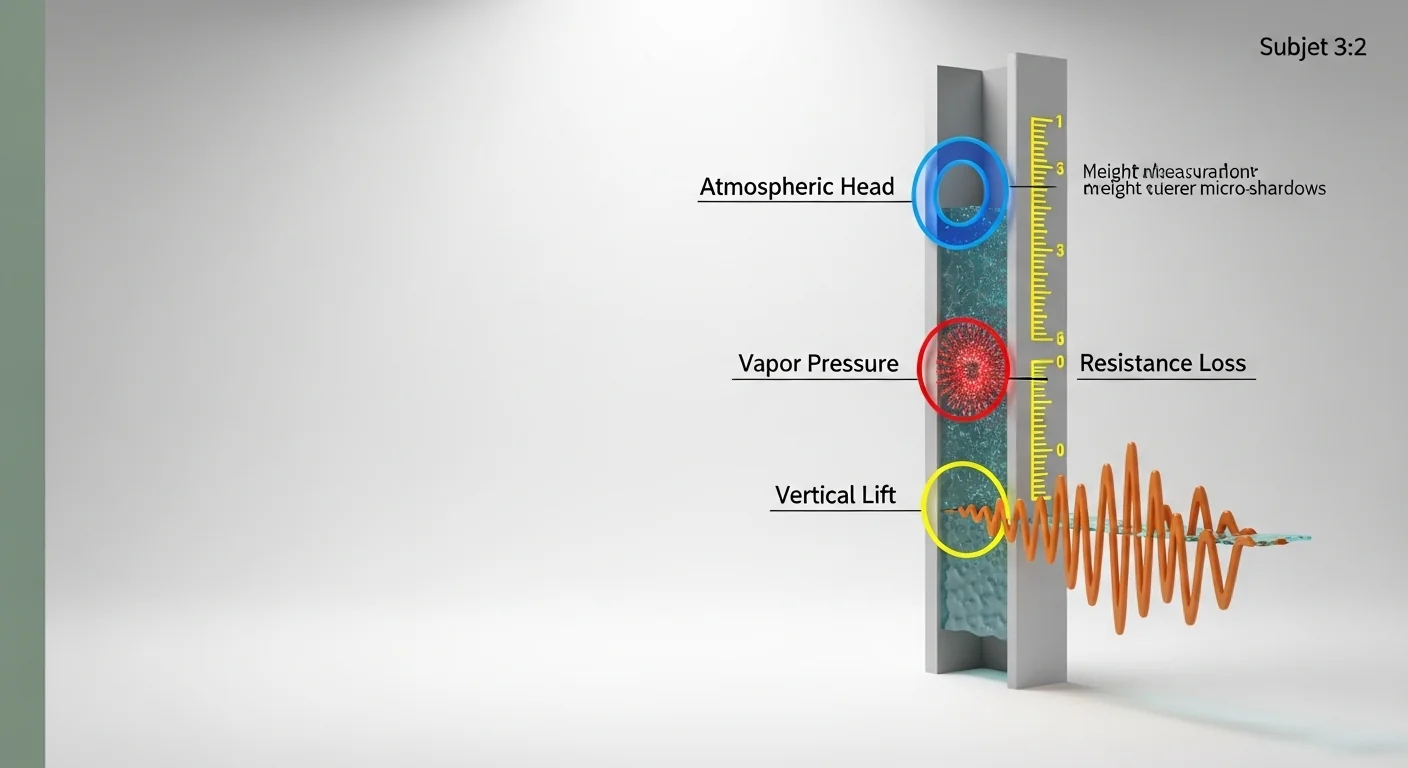
Show the calculation steps
Step 1: Atmospheric Head
Atmospheric pressure decreases predictably with altitude. The calculator uses the barometric formula:
Atmospheric Head (ft) = 34.0 × e(−Elevation / 26,000)
At sea level this yields 34.0 ft of head (equivalent to 14.7 psia). At 5,000 ft it yields approximately 28.05 ft. The value 34.0 ft is the standard atmospheric head for fresh water at sea level and 60°F; this calculator holds water density constant at the fresh-water reference. Unit: feet of head (ft).
Step 2: Vapor Pressure Head
The Antoine equation estimates saturated vapor pressure in mmHg from water temperature:
log10(Pv) = 8.07131 − 1730.63 / (233.426 + TCelsius)
Temperature conversion: TCelsius = (TFahrenheit − 32) × 5/9
Pv (mmHg) is then converted to psi by dividing by 51.715, then to feet of head by multiplying by 2.3067 ft/psi. This yields vapor pressure head in ft. Rounding is applied at the final NPSHa output only (two decimal places).
Step 3: NPSHa Formula
NPSHa = Atmospheric Head − Vapor Pressure Head − Vertical Suction Lift − Friction Loss
All terms are in feet of head. The result is NPSHa in feet. If NPSHa is negative, the suction geometry is physically impossible for liquid delivery under those conditions.
Step 4: Status Classification
NPSHa below 2 ft: Cavitation Danger. Between 2 and 5 ft: Marginal. Above 5 ft: Safe operating margin.
Assumptions and Limits
- Valid for fresh water only. Saltwater, chemical solutions, and slurries have different vapor pressures and densities.
- Elevation range: 0 to 15,000 ft. Above approximately 14,000 ft, corrections for non-standard atmosphere may produce meaningful deviation.
- Water temperature range: 32°F to 210°F. Below 32°F water is solid; above 212°F (at sea level) it is steam. The tool blocks entries outside this range.
- Suction lift range: 0 to 30 ft. Theoretical maximum at sea level is approximately 33.9 ft (absolute vacuum). Practical pumping limit is typically 20-25 ft due to friction, vapor, and imperfect priming.
- The friction loss input must represent the suction side only. Discharge-side friction does not affect NPSHa.
- Velocity head is not included. At low flow rates through adequately sized pipe this omission is negligible; at high velocities in small pipe, actual NPSHa will be lower than calculated.
- The calculator does not account for dissolved gases in groundwater or entrained air, both of which reduce effective NPSHa.
- This tool yields NPSHa only. Pump selection requires comparing this value against the manufacturer's NPSHr performance curve at the target flow rate.
Standards, Safety Checks, and "Secret Sauce" Warnings
Critical Warnings
- Water boils at temperatures you would not expect inside a pump. At 60°F, water vapor pressure is only 0.26 psia. If suction conditions lower absolute pressure below that threshold inside the impeller eye, the water flashes to steam at room temperature. The resulting vapor bubbles collapse at pump vane surfaces with localized pressure spikes that erode brass and cast iron through a process called cavitation. Impeller damage can begin within hours of sustained cavitation, and it does not require the water to be warm.
- A negative NPSHa result means the system cannot move liquid, period. If the calculator returns a negative value, it is not a rounding artifact. It means atmospheric pressure is insufficient to push water up to the pump inlet against the combined weight of the lift column, the friction losses, and vapor pressure. No pump can overcome this; it is a fundamental fluid-physics limit. Reducing lift or friction is the only fix.
- Elevation compounds every other variable. A pump installed at 5,000 ft elevation starts with approximately 5.95 ft less atmospheric head than a sea-level installation. On top of that, summer water temperatures are often higher at altitude due to shallow reservoir warming. The two effects combine to shrink NPSHa sharply in high-altitude agricultural settings.
- Flexible suction hose collapses under vacuum and destroys the calculation basis. Atmospheric pressure on the outside of flexible hose crushes the bore when suction pressure inside drops below ambient. Once the bore partially collapses, effective pipe diameter shrinks, friction loss spikes, and actual NPSHa plummets below the calculated value. Rigid Schedule 40 PVC suction pipe is the required baseline for any calculation here to remain valid.
Minimum Standards
- The Hydraulic Institute Standard (ANSI/HI 9.6.1) specifies that NPSHa must exceed NPSHr by a minimum margin of 2 ft for general service centrifugal pumps. Many system designers use a 5 ft margin to account for aging impellers, varying flow conditions, and measurement uncertainty.
- Suction pipe velocity should not exceed approximately 5 ft/s to keep friction losses and velocity head effects manageable. Use the irrigation pump sizing calculator to verify that your selected pipe diameter is appropriately sized for the target flow rate before finalizing the friction loss input.
- A foot valve and strainer at the intake source are required for priming retention. Foot valve head loss (typically 1.5 to 3 ft depending on size and condition) must be included in the friction loss input for this calculator to produce a valid result.
Competitor Trap: Many NPSH calculators online simply subtract lift from a fixed 34 ft atmospheric head and call it done. They omit vapor pressure entirely, which understates cavitation risk for any water above 50°F, and they ignore elevation, which makes them useless for any installation above 1,000 ft. An irrigation system at 4,000 ft elevation pumping a summer pond at 80°F has roughly 7.5 ft less usable suction head than those calculators would suggest. That error goes directly into impeller erosion.
Common Mistakes and Fixes
Mistake: Measuring Pipe Length Instead of Vertical Lift
Installers frequently enter the total suction pipe length rather than the vertical rise. A 30 ft pipe running at a 30-degree angle to a river below has only 15 ft of vertical lift. Entering 30 ft overstates lift by 100%, making a safe system appear dangerous or causing the user to re-engineer unnecessarily. The horizontal run contributes only friction loss, which belongs in the friction field separately.
Fix: Measure vertical lift with a level or surveying instrument from water surface to pump inlet centerline.
Mistake: Using Air Temperature Instead of Water Temperature
On a hot July afternoon, air temperature might be 95°F while a well-fed pond sits at 78°F. Entering the air temperature inflates the vapor pressure calculation and makes the result appear more dangerous than it is. The reverse error, assuming cold groundwater in a surface pond, is far more dangerous and far more common: an irrigation pond can reach 85-90°F by late summer in warm climates.
Fix: Measure water temperature at the intake location with a thermometer before entering the value, or use a conservative upper estimate for the season.
Mistake: Omitting Foot Valve and Strainer Head Loss from Friction
The foot valve holds prime and screens debris, but it is a significant restriction in the suction line. A 2-inch brass foot valve typically contributes 1.5 to 3 ft of head loss depending on age and debris accumulation. Omitting it from the friction loss input can shift a result from the marginal zone to an apparently safe zone, masking a real risk.
Fix: Add foot valve loss explicitly to the suction friction calculation. If using the well pressure tank calculator to establish system curve parameters, ensure foot valve loss is carried through consistently across all suction-side calculations.
Mistake: Ignoring Elevation for Any Installation Above 1,000 Feet
Many users at moderate elevations (1,000 to 3,000 ft) enter 0 for elevation out of habit or convenience, treating sea-level atmospheric head as a universal constant. At 2,000 ft, atmospheric head is approximately 31.6 ft rather than 34.0 ft. That 2.4 ft difference can push a marginal installation into cavitation danger when combined with warm water and a long suction line.
Fix: Look up the pump installation site elevation in feet from any topographic map, GPS device, or the USGS National Map. Enter the actual value, not zero.
Mistake: Confusing NPSHa with NPSHr
NPSHa is what the site provides. NPSHr is what the pump demands. The calculator returns NPSHa. A system with 8 ft of NPSHa will still cavitate if the chosen pump has an NPSHr of 10 ft at the operating flow rate. Users frequently assume that a positive NPSHa result means the pump is safe, without checking the pump curve at all.
Fix: After obtaining NPSHa from this tool, locate the pump's performance curve (from the manufacturer's datasheet or pump selection software) and confirm NPSHa exceeds NPSHr plus 2 ft at the target flow rate.
Next Steps in Your Workflow
Once you have a confirmed NPSHa value, the immediate next step is comparing it against the pump's published performance curve at the flow rate you intend to operate. Pump curves plot NPSHr against flow rate, and NPSHr always rises as flow rate increases. A pump that passes the NPSH check at low flow may fail it at design flow. If you are still in the pipe sizing phase, the pipe volume calculator can help you verify that your suction pipe diameter is consistent with the flow rate assumptions embedded in your friction loss estimate.
For systems that include pressure tanks, check valves, or distribution manifolds downstream of the pump, sudden valve closure can generate pressure transients that act back on the suction side and momentarily reduce effective inlet pressure below your static NPSHa calculation. That scenario is worth evaluating with a water hammer calculator before finalizing piping layout, particularly on long suction runs with multiple zones.
FAQ
What is a good NPSHa value for a centrifugal pump?
There is no universal "good" number because NPSHa is meaningless without knowing the pump's NPSHr. What matters is the margin: NPSHa should exceed NPSHr by at least 2 ft per Hydraulic Institute guidelines. Most farm irrigation and water-transfer applications target 5 ft or more of margin to account for impeller wear, flow surges, and temperature variation over a season.
Can I increase NPSHa without changing the pump?
Yes, through four site modifications: reduce vertical suction lift by repositioning the pump closer to the water surface; reduce suction pipe friction by increasing pipe diameter or reducing fittings; lower water temperature if feasible (shade the inlet or pump at cooler times of day); or decrease elevation by moving the pump to a lower point. Each change directly improves the NPSHa result.
Why does water temperature affect cavitation so strongly?
Vapor pressure is highly nonlinear with temperature. At 60°F, vapor pressure head is roughly 0.59 ft. At 100°F it is approximately 2.19 ft, and at 140°F it climbs to about 6.65 ft. Each degree of warming shrinks the available suction margin. Surface ponds used for summer irrigation can reach temperatures that make a geometry that worked fine in spring completely unusable by August.
What happens to the pump if it operates below minimum NPSHa?
Vapor bubbles form at the impeller eye where pressure is lowest. As those bubbles travel into higher-pressure zones near the vane tips, they collapse almost instantly. The implosion creates localized pressure spikes that erode metal surfaces through pitting and cratering. Early cavitation often sounds like gravel in the pump casing. Sustained cavitation accelerates impeller and casing wear, reduces flow and pressure, and ultimately causes pump failure.
Does the type of pump affect the NPSH calculation?
The calculation of NPSHa is purely site-dependent and does not change with pump type. What changes is NPSHr: different pump designs (end-suction, multi-stage, self-priming, submersible) have different NPSHr values at different flow points. Submersible pumps, for example, are installed below the water surface and have no suction lift at all, which eliminates most of the NPSHa calculation entirely.
Is NPSHa the same at all flow rates?
NPSHa changes with flow rate because friction loss on the suction side increases as velocity increases. Higher flow means higher friction loss, which lowers NPSHa. The inputs to this calculator should reflect the friction loss at your maximum expected flow rate, not at a partial load condition. Using low-flow friction values can make the system appear safer than it actually is at full operation.
Conclusion
The core failure mode this calculator is designed to catch is the one competitors consistently miss: a surface centrifugal pump operating at what appears to be a reasonable suction lift, but with water temperature, elevation, and friction combining to drop absolute inlet pressure below the vapor pressure of the liquid itself. The pump does not "run dry" in any conventional sense. The water boils at temperatures that feel cold to the touch, and the resulting vapor implosions destroy precision-machined internal surfaces silently and progressively until performance collapses.
The single most important habit this tool reinforces is separating NPSHa (what your site provides) from NPSHr (what your pump demands). Calculate NPSHa here, read NPSHr from your pump curve, verify the margin at operating flow, and design your suction piping to keep that margin intact across all expected seasonal conditions. For deeper-system analysis that extends from suction through discharge, the sump pump calculator covers total dynamic head for submersible and pedestal configurations where suction lift is either minimal or eliminated entirely.