
Sump Pump Basin Capacity & Short-Cycle Preventer
Calculate your pump cycle time and catch motor-damaging short cycles before they destroy your pump.
| Basin Ø (in) | Gal/inch | Op. Volume (gal) | Cycle Time (min) | Rating |
|---|
How This Calculator Works
Step 1 — Gallons per Inch of Basin
231 cubic inches = 1 US gallon. This gives us the liquid volume per vertical inch inside the cylindrical basin.
Step 2 — Operating Volume
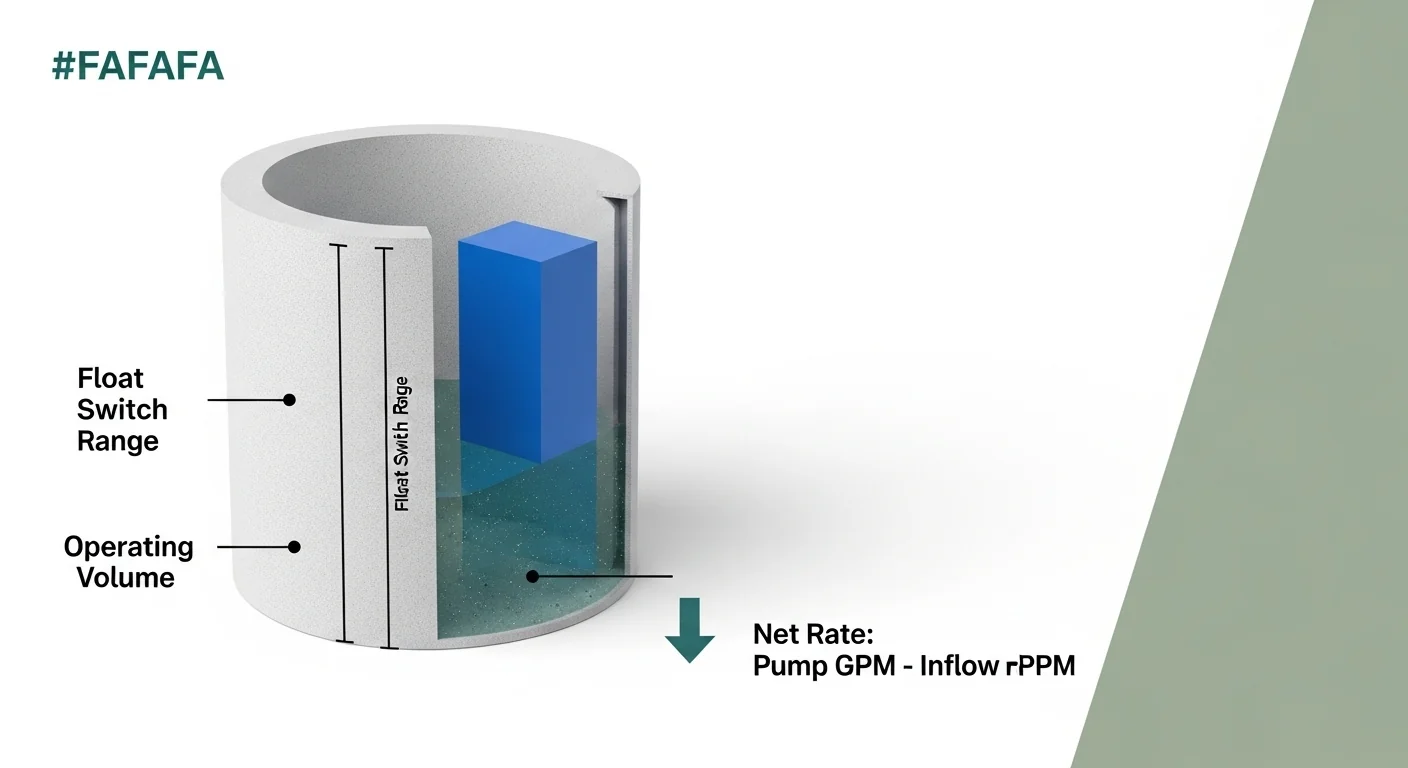
The float switch range is the vertical gap between the pump-ON and pump-OFF water levels — this is the volume the pump must remove each cycle.
Step 3 — Pump Cycle Time
The pump is fighting incoming water while it runs. Net pumping rate = Pump GPM minus Inflow GPM. If this is zero or negative, the pump can never empty the basin.
Step 4 — Safety Threshold
If Cycle Time < 3.0 min → CAUTION (accelerated wear)
If Cycle Time ≥ 3.0 min → SAFE operating range
Assumptions & Limits: Assumes a cylindrical basin. Pump output should be measured at actual vertical head (not max rating). Inflow rate measured during peak storm conditions. Float switch range is the vertical measurement only.
Assumptions & Limits
- Cylindrical basin only. Rectangular or irregular pits require a different volume formula. Measure the inside diameter at the waterline.
- Pump GPM at actual head. Always use the pump’s rated output at your specific head height (vertical rise + pipe friction). A 1/3 HP pump rated 30 GPM at 0 ft of head may only deliver 18 GPM at 10 ft.
- Steady inflow assumption. Storm runoff inflow can spike. Use your estimated peak (worst-case) inflow for the safest result.
- Float switch accuracy. Tethered floats have variable range; vertical (fixed) floats have a fixed switch point — measure your actual on/off activation gap.
- Motor startup amperage. Each motor start draws 3× normal running amperage (Locked Rotor Amps). More starts per hour = more heat stress on stator windings.
- Safe maximum starts: Most residential sump pump motors are rated for ≤ 8–10 starts per hour. Exceeding this voids most warranties.
- Inflow must be less than pump output. If inflow ≥ pump output, the pump cannot overcome the water; a larger pump or multiple pumps are needed.
Recommended Equipment for Correct Sizing
Sump pump failure is almost never random. The most common cause of premature motor death is a predictable, measurable physics problem: the pump cycles so fast that the motor never cools between starts. Each startup event draws roughly three times the running amperage through the stator windings. At a dozen or more starts per hour, that heat accumulates. The copper windings oxidize, insulation breaks down, and the motor fails, often within weeks of installation. The problem is not the pump quality. It is a sizing mismatch between the pump output, the basin volume, and the float switch range.
This sump pump calculator computes your pump cycle time in minutes using four measured inputs: water inflow rate, pump output at your actual head height, basin diameter, and the vertical float switch activation range. It produces cycle time, operating volume, net pumping rate, and estimated starts per hour. What it does not do is account for variable storm inflow rates, irregular basin shapes, or friction losses inside discharge piping. Those factors belong in your site-specific design process; this tool handles the basin sizing math.
Enter your four measurements, read the cycle time, and compare it against the 1-minute danger threshold and the 3-minute recommended minimum. If you are sizing a new installation, you can also experiment with different basin diameters in the reference table below. For sites with high inflow rates driven by large impervious surfaces, pairing this calculation with a French drain design to intercept runoff before it reaches the pit can reduce the inflow GPM input significantly and improve your cycle math.
Use the Tool
Before entering values, gather the following: the inflow rate in gallons per minute (estimated during peak storm conditions, not average conditions), the pump output at your actual vertical head height from the manufacturer's published curve, the inside diameter of your sump basin measured in inches, and the vertical distance in inches between the pump-on water level and the pump-off water level on your float switch. Use head-corrected pump GPM, not the zero-head rating. If you are comparing pump options, the pump sizing calculator can help you translate head height and flow requirements into appropriate pump selection before you run these numbers.
Quick Start (60 Seconds)
- Water Inflow Rate (GPM): Estimate the peak gallons per minute entering the pit during a heavy rain event. If you have a drainage area, measure or calculate runoff. A conservative (higher) estimate is safer than a low one.
- Pump Output at Head Height (GPM): Read this from the pump curve at your actual vertical lift, not the zero-head maximum on the box. A pump rated 40 GPM at 0 ft may only deliver 22 GPM at 10 ft of head.
- Basin Diameter (inches): Measure the inside diameter of the pit at the waterline, not the outside. Standard residential basins are typically 18 or 24 inches. Measure; do not assume.
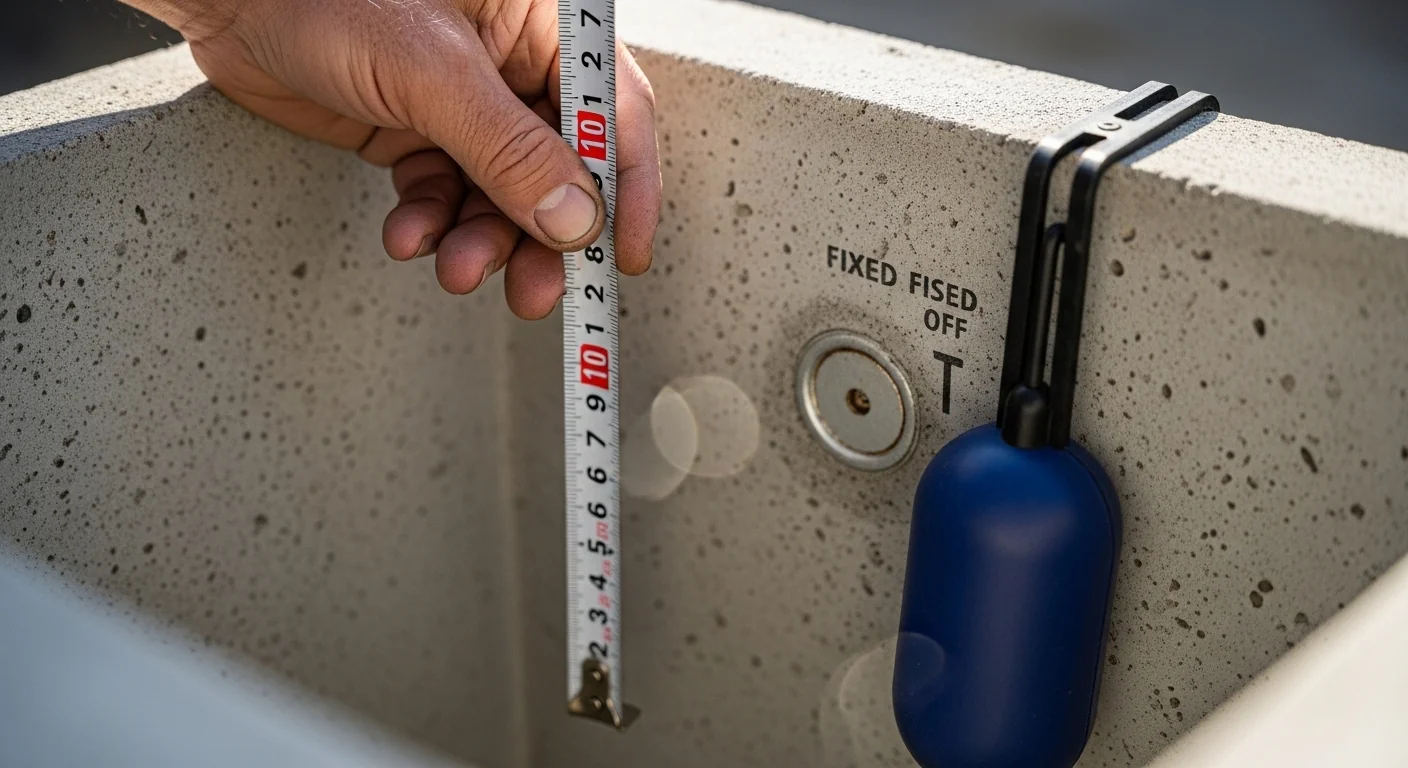
- Float Switch On/Off Range (inches): Measure the vertical gap between the water level that activates the pump and the level at which the pump shuts off. This is not the length of the float cord. It is the actual on/off activation height difference.
- Do not use the pump's "maximum head" GPM rating. Always use the head-corrected GPM from the performance curve at your installation's vertical lift.
- For tethered floats, the activation range can vary; a fixed vertical float switch gives more consistent and predictable results in this calculation.
- Inflow must be lower than pump output or the tool will return an error. If inflow equals or exceeds pump output, the pump cannot empty the basin under any conditions.
Inputs and Outputs (What Each Field Means)
| Field | Unit | What It Means | Common Mistake | Safe Entry Guidance |
|---|---|---|---|---|
| Water Inflow Rate | GPM | Gallons per minute entering the sump pit from soil, foundation walls, or drainage systems during the design storm event | Using average-day inflow instead of peak storm inflow; this dramatically underestimates short-cycling risk | Use your highest measured or estimated inflow; if unsure, err on the high side (accepted range: 0.1 to 200 GPM) |
| Pump Output at Head Height | GPM | The actual volume the pump delivers at the vertical rise from pit bottom to discharge outlet, per the manufacturer's pump curve | Using the box-label maximum rating, which is measured at zero head pressure | Look up the pump's published curve and read GPM at your actual head height (accepted range: 0.1 to 500 GPM) |
| Basin Diameter | Inches | Inside diameter of the cylindrical sump pit at the water surface; determines how many gallons each vertical inch holds | Using the outside dimension or assuming a standard size without measuring | Measure inside diameter with a tape; standard sizes are 18" and 24" but verify (accepted range: 6 to 96 inches) |
| Float Switch On/Off Range | Inches | Vertical distance in inches between the water level that turns the pump on and the level that turns it off | Confusing cord length for activation range, or not adjusting the float to maximize this distance | Measure the actual on/off height gap in the pit; wider range increases cycle time (accepted range: 0.5 to 48 inches) |
| Pump Cycle Time (output) | Minutes | How long the pump runs from turn-on to turn-off; the primary safety indicator for motor longevity | Assuming longer is always better; extremely long cycles with high inflow may indicate the pump is undersized | Safe target: 3 minutes or more; danger zone: below 1 minute |
| Gallons per Inch (output) | gal/in | Volume of water stored per vertical inch of basin height; a direct function of basin diameter and the key lever for improving cycle time | Not recognizing that doubling the basin diameter quadruples the gallons per inch, not doubles it | Use this value to understand the impact of basin size changes; larger diameter increases gal/in exponentially |
| Operating Volume (output) | Gallons | Total gallons the pump must move each cycle; gallons per inch multiplied by float switch range | Assuming this is fixed; it can be increased by widening the float switch range or by increasing basin diameter | Aim to maximize this value within installation constraints to extend cycle time |
| Net Pump Rate (output) | GPM | Pump output minus inflow; the actual rate at which the basin level drops while the pump is running | Selecting a pump with far more output than necessary, which shrinks cycle time rather than improving safety | A net rate much higher than inflow in a small basin is the primary short-cycling mechanism |
| Cycles per Hour (output) | Starts/hr | Estimated number of pump starts per hour under the entered conditions; used to evaluate motor startup stress | Ignoring this output because cycle time seemed acceptable; 8 to 10 starts/hr is the typical residential motor limit | If starts/hr exceeds 10, the motor is operating outside most manufacturer warranty parameters |
Worked Examples (Real Numbers)
Scenario 1: Oversized 1 HP Pump in a Standard 18-Inch Basin
- Water inflow rate: 10 GPM (typical during heavy rain)
- Pump output at head height: 45 GPM (1 HP pump at 10 ft head)
- Basin diameter: 18 inches
- Float switch range: 6 inches
Result: Gallons per inch = 1.102; Operating volume = 6.61 gallons; Net pump rate = 35 GPM; Cycle time = 0.189 minutes (approximately 11 seconds); Starts per hour = 318.
At 318 motor starts per hour, the stator windings experience locked rotor amperage surges continuously. This is the textbook "stator meltdown" scenario: an oversized, seemingly high-performance pump destroying itself in a pit that cannot supply enough water volume to keep the motor running long enough to cool. The fix is not a better pump; it is a correctly sized basin or a lower-output pump matched to the inflow rate.
Scenario 2: Moderate Mismatch in a 24-Inch Basin
- Water inflow rate: 15 GPM
- Pump output at head height: 25 GPM
- Basin diameter: 24 inches
- Float switch range: 10 inches
Result: Gallons per inch = 1.958; Operating volume = 19.58 gallons; Net pump rate = 10 GPM; Cycle time = 1.958 minutes; Starts per hour = 30.6.
The cycle time clears the 1-minute danger threshold but falls short of the 3-minute safe minimum. At roughly 30 starts per hour, motor stress is elevated. The simplest correction here is widening the float switch range to 18 inches, which would push operating volume to 35.2 gallons and cycle time to 3.52 minutes with no hardware changes.
Scenario 3: Properly Sized 30-Inch Basin
- Water inflow rate: 10 GPM
- Pump output at head height: 22 GPM
- Basin diameter: 30 inches
- Float switch range: 14 inches
Result: Gallons per inch = 3.060; Operating volume = 42.84 gallons; Net pump rate = 12 GPM; Cycle time = 3.570 minutes; Starts per hour = 16.8.
The cycle time sits above the 3-minute safe threshold and starts per hour are within reasonable operating range for most residential motors. This combination works because the basin diameter is large enough to hold meaningful volume per inch, and the pump output is appropriately matched to the inflow rather than dramatically oversized.
Reference Table (Fast Lookup)
The table below shows how basin diameter affects cycle time and starts per hour under a fixed condition set: pump output of 30 GPM, inflow of 10 GPM (net rate = 20 GPM), and float switch range of 10 inches. Use this as a fast-lookup guide when evaluating basin upgrade options or selecting a pit size for a new installation.
| Basin Diameter (in) | Gallons per Inch | Operating Volume (gal) | Cycle Time (min) | Starts per Hour | Safety Rating |
|---|---|---|---|---|---|
| 12 | 0.490 | 4.90 | 0.245 | 245.1 | DANGER |
| 15 | 0.765 | 7.65 | 0.382 | 156.9 | DANGER |
| 18 | 1.102 | 11.02 | 0.551 | 108.9 | DANGER |
| 21 | 1.499 | 14.99 | 0.750 | 80.0 | DANGER |
| 24 | 1.958 | 19.58 | 0.979 | 61.3 | DANGER |
| 30 | 3.060 | 30.60 | 1.530 | 39.2 | CAUTION |
| 36 | 4.406 | 44.06 | 2.203 | 27.2 | CAUTION |
| 42 | 5.998 | 59.98 | 2.999 | 20.0 | CAUTION |
| 48 | 7.834 | 78.34 | 3.917 | 15.3 | SAFE |
Key insight from this table: The gallons-per-inch value scales with the square of the radius, not linearly with diameter. A 36-inch basin holds 4.406 gallons per inch; an 18-inch basin holds 1.102. Doubling the diameter multiplies the gallons-per-inch by four. This is why small pit upgrades have disproportionate impact on cycle time. Under the reference conditions above, no basin smaller than 48 inches achieves a safe cycle time, which is a strong argument for right-sizing basin diameter during installation rather than compensating with a larger pump.
How the Calculation Works (Formula + Assumptions)
Show the calculation steps
Step 1: Gallons per Inch of Basin
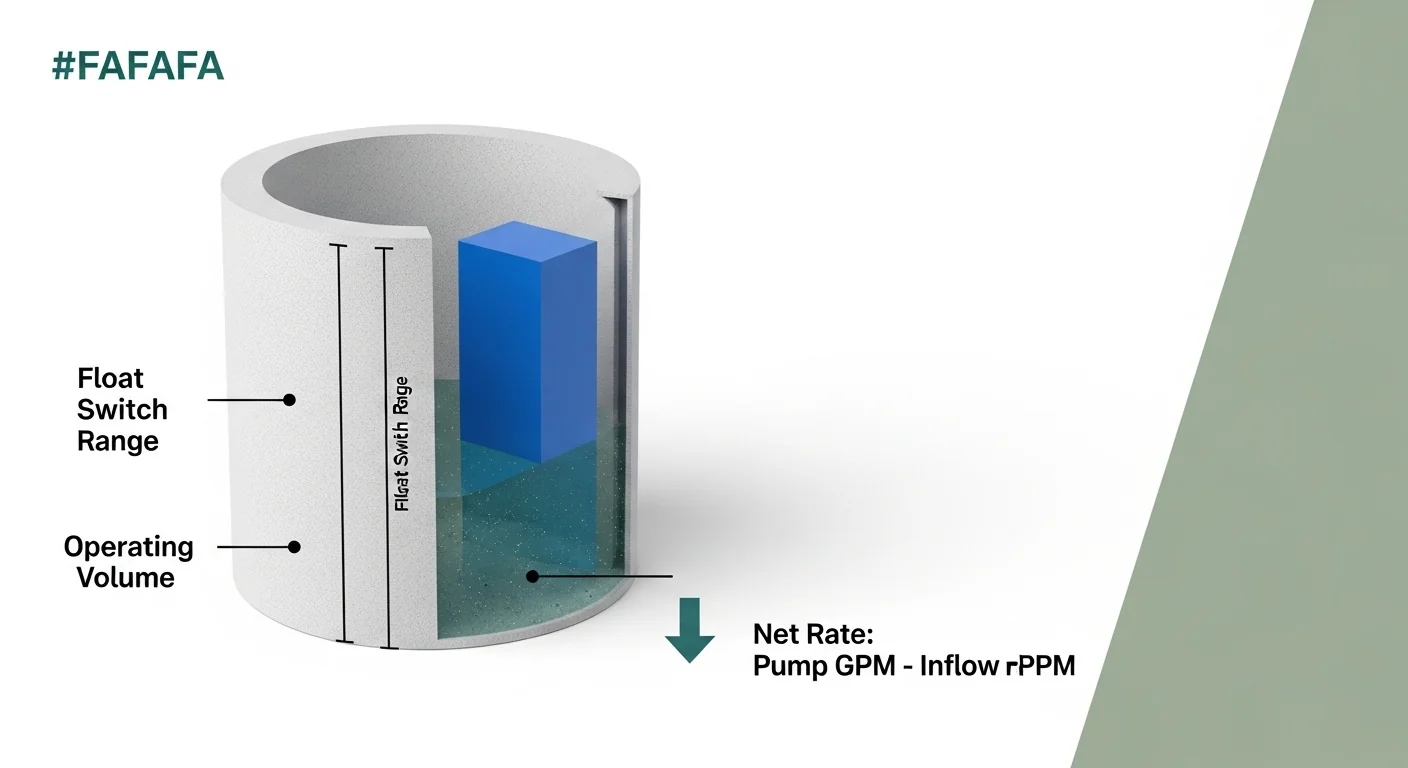
The basin is treated as a perfect cylinder. The cross-sectional area in square inches is computed using the standard circle area formula (pi times radius squared). That area is then divided by 231, which is the number of cubic inches in one US gallon. The result is how many gallons of water are added or removed for each vertical inch of level change inside the pit.
Formula: Gallons per Inch = pi x (Diameter / 2)^2 / 231
Units: diameter in inches; result in gallons per inch. No unit conversion is required for the intermediate step.
Step 2: Operating Volume
Operating volume is the total gallons the pump must remove each cycle. It is the product of gallons per inch and the float switch activation range in inches. This represents the column of water between the pump-on and pump-off water levels.
Formula: Operating Volume (gallons) = Gallons per Inch x Float Switch Range (inches)
Step 3: Net Pump Rate
While the pump runs, water is simultaneously entering the pit. The effective emptying rate is pump output minus inflow, both in GPM. If inflow equals or exceeds pump output, the net rate is zero or negative, meaning the pump cannot lower the water level at all.
Formula: Net Rate (GPM) = Pump Output (GPM) - Inflow (GPM)
Step 4: Cycle Time
Cycle time is how long the pump runs from turn-on to turn-off. It equals the operating volume divided by the net pumping rate. The result is in minutes if GPM and gallons are used consistently. No unit conversion is needed.
Formula: Cycle Time (minutes) = Operating Volume (gallons) / Net Rate (GPM)
Rounding: Results are displayed to three decimal places in intermediate steps and two decimal places in the final output. Gallons per inch is shown to three decimal places due to its impact on downstream precision.
Step 5: Starts per Hour
Starts per hour is derived by dividing 60 minutes by the cycle time. This assumes the fill time between cycles is negligible compared to cycle time, which is a reasonable approximation at high inflow rates but becomes less accurate at very low inflow rates where refill time is long.
Formula: Starts per Hour = 60 / Cycle Time (minutes)
Assumptions and Limits
- The basin is a perfect vertical cylinder. Irregular or rectangular pit shapes require a different volume calculation.
- Inflow rate is constant throughout the pump cycle. In reality, storm runoff inflow fluctuates; this calculator uses a steady-state approximation.
- Pump output is constant at the entered GPM. In practice, pump output can vary slightly with fluctuating head pressure as water level changes.
- Float switch range is measured as vertical inches only. Tethered float switches have variable effective range depending on cord length and mounting position; the calculation assumes a clean, repeatable on/off activation point.
- Pipe friction losses inside the discharge line are not accounted for in the inflow or output fields. The user is responsible for entering a head-corrected pump GPM that already reflects discharge pipe conditions.
- The refill time between cycles (pump off to pump on) is not included in the starts-per-hour estimate. At very low inflow rates, actual starts per hour will be lower than calculated because the pit takes longer to refill.
- Motor startup amperage draw is referenced qualitatively as a warning threshold trigger (cycle time below 1 minute), not computed numerically. Actual amperage depends on motor type, winding configuration, and supply voltage.
Standards, Safety Checks, and "Secret Sauce" Warnings
Critical Warnings
- Sub-1-minute cycle time triggers motor burnout risk. At startup, electric motors draw locked rotor amperage, which is approximately three times the normal running current. A pump cycling every 11 seconds (as in Scenario 1 above) experiences hundreds of these high-current surges per hour. Heat cannot dissipate from the stator windings between starts. Insulation degrades, copper oxidizes, and the winding fails. This process can destroy a new motor within days or weeks, not years.
- Starts per hour above 10 exceeds most residential motor ratings. Many residential sump pump motors carry a manufacturer-rated maximum of 8 to 10 starts per hour. Operating above this threshold voids warranties on most major brands and accelerates bearing wear in addition to winding stress. The calculator flags this threshold separately from the cycle-time danger zone.
- Zero or negative net rate means the pump cannot control the water level. If entered pump output is equal to or less than inflow, no cycle time exists. The basin will fill continuously. This is not a marginal condition; it requires a larger pump, reduced inflow, or both. Sites with heavy surface water contributions may need upstream catch basin drainage to reduce the inflow GPM before pump sizing makes sense.
- Head pressure degrades pump output more than most labels suggest. A pump marketed as a 1/2 HP, 35 GPM unit delivers that figure at zero head. At 10 feet of vertical head with a typical discharge run, output may drop to 18 to 22 GPM. Entering the zero-head rating into this calculator will produce a falsely optimistic cycle time.
Minimum Standards
- Target a minimum cycle time of 3 minutes to allow adequate motor cooling between starts.
- Keep starts per hour at or below 10 for residential pump motors unless the manufacturer's documentation specifies otherwise.
- Verify pump GPM from the manufacturer's published performance curve, not from product packaging or marketing materials.
- Float switch range should be maximized within the constraints of the basin depth and discharge pipe connection height to increase operating volume and extend cycle time.
Competitor Trap
Most sump pump sizing guides focus exclusively on whether the pump output is large enough to handle inflow, and stop there. That framing misses the core failure mechanism entirely. An oversized pump is often more dangerous than an undersized one in a typical residential basin. A pump that can outrun inflow by a factor of four empties a small pit in seconds, cycles hundreds of times per hour, and burns out in weeks, while a homeowner assumes it failed due to a defect. The correct question is not "is my pump big enough?" but "does my basin hold enough volume to keep my pump cycling at a safe rate?" This calculator addresses the second question, which the first question leaves completely unanswered. If you are also evaluating your property's total water collection and catchment volume from rain events, understanding how much water reaches your foundation helps inform a more accurate inflow estimate for this tool.
Common Mistakes and Fixes
Mistake: Using the Zero-Head Pump Rating
Pump packaging advertises the maximum GPM output at zero vertical lift. Every foot of head pressure reduces output. A pump rated 40 GPM on the box may deliver 18 GPM at your actual installation head. Entering 40 GPM produces a cycle time estimate nearly two times longer than what the pump actually delivers, masking a short-cycling condition.
Fix: Find the pump curve in the manufacturer's documentation and read GPM at your measured vertical head height. If this data is unavailable, contact the manufacturer directly before proceeding with the calculation. A flow rate calculation based on pipe diameter and discharge conditions can help verify reasonableness; the flow rate calculator is useful for cross-checking discharge capacity.
Mistake: Measuring Float Cord Length Instead of Activation Range
A tethered float switch has a cord of a certain length, but the actual water level difference between turn-on and turn-off depends on mounting position, cord tension, and basin diameter relative to float travel arc. The cord length and the activation range are not the same measurement.
Fix: Fill the basin to the turn-off level and mark it. Lower the water until the pump turns on and mark that level. Measure the vertical distance between the two marks. Use that number, not the cord length.
Mistake: Selecting a Larger Pump to "Fix" a Flooding Problem
When a basement floods despite having a sump pump, the instinct is to upgrade to a more powerful unit. If the issue is inflow exceeding pump output, more pump capacity is correct. But if the pump already outpaces inflow and the basin is small, a larger pump accelerates short-cycling and destroys the motor faster. The pump output column in this calculator must always be evaluated alongside the basin volume, not independently.
Fix: Run the calculator with the proposed larger pump's head-corrected GPM before purchasing. If cycle time drops below 3 minutes, prioritize basin diameter increase over pump horsepower increase.
Mistake: Ignoring Peak Inflow and Using Average Conditions
A sump pump is primarily stressed during peak storm events, not during dry-weather seepage. Designing the system to handle average inflow leaves the motor exposed during the moments it works hardest. Short cycling under storm conditions is when motor damage actually occurs; low-inflow quiet periods are not representative of failure risk.
Fix: Estimate peak inflow by considering the drainage area contributing to the pit, soil type, and your design storm intensity. Pipe and channel flow tools such as the pipe volume calculator can help estimate how quickly water moves through your drainage system into the collection point.
Mistake: Treating the 1-Minute Threshold as the Target, Not the Floor
Some installers consider a cycle time above 1 minute acceptable because it clears the "burnout" trigger. The 1-minute threshold is the lower edge of a danger zone, not a performance target. A cycle time of 1.05 minutes still means nearly 60 motor starts per hour, well above typical motor ratings and producing significant wear even if the winding does not immediately fail.
Fix: Design for 3 minutes or more. If basin constraints prevent achieving 3 minutes, widen the float switch range as far as installation allows and evaluate whether a battery backup system with a separate float set at a higher threshold can reduce cycling during peak storm events.
Next Steps in Your Workflow
Once you have a cycle time result, the next decision point is whether to adjust basin size, float switch range, pump selection, or inflow management. If cycle time is under 1 minute, basin volume is the highest-leverage fix; upgrading from an 18-inch to a 30-inch basin roughly triples the gallons-per-inch value and can transform a dangerous scenario into a marginal one without changing the pump. If you are managing a property with significant subsurface drainage, the design criteria that inform this calculation often connect to broader field drainage planning; the tile drainage calculator addresses subsurface drainage capacity for properties where groundwater management upstream of the pit is relevant.
For installations where inflow is difficult to reduce at the source, a battery backup pump with an independently set float is a practical operational safeguard, particularly during power outages when the primary pump is unavailable. If your discharge system involves any open-channel components or long pipe runs where hydraulic grade matters, flow characteristics through those sections affect the head pressure your pump operates against. The Manning's equation calculator covers open-channel and pipe flow conditions that may affect your effective head calculation and therefore the GPM input you use here.
FAQ
What is sump pump short cycling?
Short cycling is when a sump pump turns on and off very rapidly, completing multiple cycles per minute rather than running for several minutes per cycle. It occurs when the basin cannot hold enough water volume to keep the pump running long enough to cool between starts. Each startup event draws high amperage through the motor windings. Repeated short cycles concentrate heat faster than the motor can dissipate it, leading to insulation failure and winding burnout.
How do I calculate gallons per inch in a sump basin?
Gallons per inch equals pi multiplied by the basin radius squared, divided by 231 (the number of cubic inches in a US gallon). For an 18-inch diameter basin, the radius is 9 inches: 3.14159 times 81 divided by 231 equals approximately 1.10 gallons per inch. For a 24-inch basin the answer is approximately 1.96 gallons per inch. This value scales with the square of the radius, so basin diameter has a compounding effect on volume capacity.
What is a safe sump pump cycle time?
The widely accepted minimum is 1 minute per cycle, below which motor burnout risk becomes significant due to locked rotor amperage on each start. A more conservative and commonly recommended target is 3 minutes or more per cycle. At 3 minutes, a pump completes roughly 20 cycles per hour under continuous operation, which falls within or near the rated limits of most residential sump pump motors. Achieving 3-plus minutes typically requires appropriate basin sizing relative to pump output and inflow.
Why does inflow rate matter in sump pump sizing?
The pump is fighting incoming water while it runs. Only the difference between pump output and inflow (the net rate) actually lowers the water level. An inflow of 15 GPM against a 25 GPM pump leaves only 10 GPM of net emptying capacity. Cycle time is calculated on that net rate, not the full pump output. High inflow relative to pump output stretches cycle time, which is actually protective. Extremely low inflow with a high-output pump in a small basin is the most dangerous combination for motor longevity.
How does float switch range affect cycle time?
Float switch range directly multiplies the operating volume each cycle. A wider on/off activation gap means the pump must remove more water before shutting off, extending run time. Operating volume is gallons per inch times the float range in inches. Doubling the float switch range doubles the operating volume and doubles the cycle time, assuming all other inputs stay constant. This makes float switch adjustment one of the lowest-cost ways to improve cycle time without changing the pump or basin.
What happens if my pump output is less than water inflow?
If pump output in GPM is equal to or lower than inflow GPM, the net pumping rate is zero or negative. The pump cannot lower the water level; it can only slow the rate of rise. The basin will eventually fill regardless of how long the pump runs. This requires either a higher-output pump (properly sized for actual head conditions), a reduction in inflow through upstream drainage improvements, or a secondary pump in parallel. The calculator will return a validation error if this condition is entered, since no cycle time can be computed.
Conclusion
Run this calculator before selecting a pump, not after installing one. If your current installation is already short-cycling, the reference table provides a clear picture of how much basin diameter increase is needed under your specific conditions. For sites managing broader stormwater loads that affect foundation drainage, sizing the drainage system that feeds the pit is equally important; the culvert sizing calculator addresses one common upstream bottleneck where undersized culverts concentrate inflow faster than any sump pump can handle.