
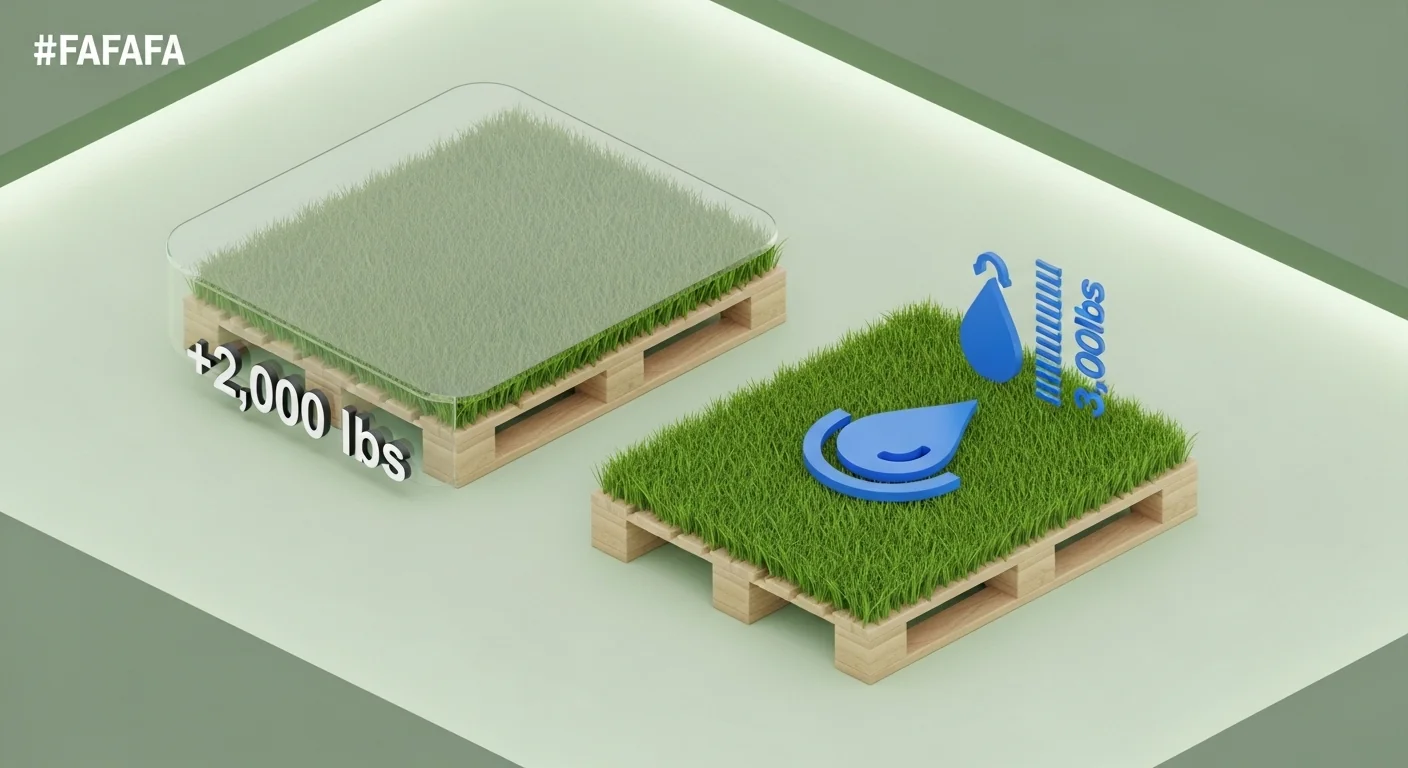
A lawn measured in square feet turns into pallets of living grass. A pickup truck’s payload sticker turns into a legal – and structural – limit. When rain hits the sod farm before pickup, that same pallet gains nearly half a ton of water weight. Most pallet-count estimates ignore the moisture variable, and that omission has snapped axles, destroyed leaf springs, and created highway hazards in half-ton trucks.
This sod pallet calculator computes the exact number of pallets your project requires, factors in dry or rain-soaked sod weights, checks that total load against your specific truck’s payload capacity, and tells you how many trips are truly safe. It does not add a waste factor, guarantee exact farm weights, or replace your truck’s door-jamb sticker. It shows the numbers, exposes the overload danger, and forces the wet-sod math that generic calculators skip.
Use the payload check to decide whether you can haul the sod yourself in one trip, need multiple trips, or should immediately arrange farm delivery or a flatbed trailer – a decision that prevents vehicle damage and a roadside citation.
Use the Tool
Sod Pallet Calculator
Area coverage, pallet count & truck payload safety check
| Pallets | Dry Weight (lbs) | Wet Weight (lbs) | Fits F-150? | Fits F-250? |
|---|
How This Calculator Works
Formula Steps:
-
Pallet Coverage: Look up square footage per pallet based on cut size.
SqFt/Pallet = 400–500 sq ft(varies by cut: 16×24 slabs ≈ 450, big rolls ≈ 500) -
Pallet Count: Divide total area by pallet coverage, rounded up to the nearest whole pallet.
Pallets = ⌈ Area (sq ft) ÷ SqFt_per_Pallet ⌉ -
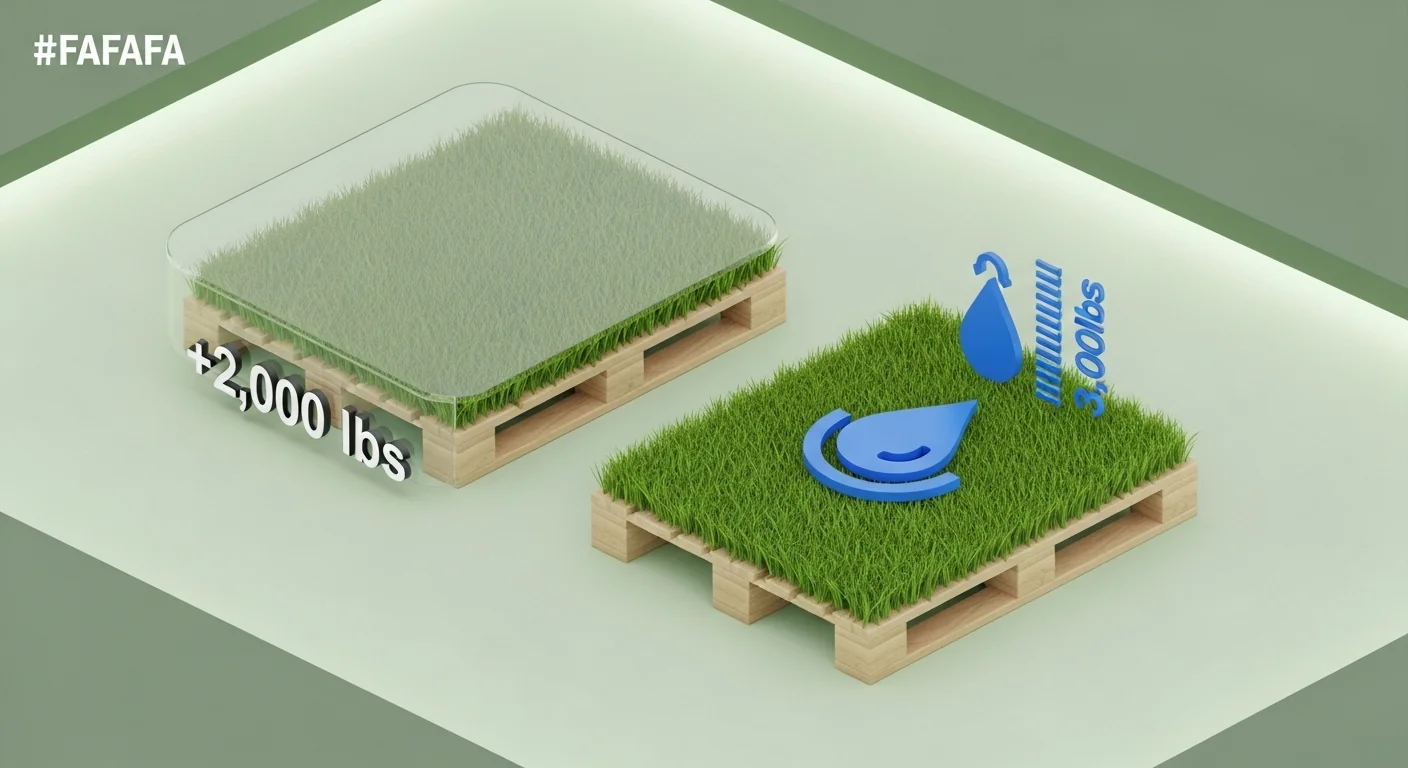
Pallet Weight: Dry sod weighs ~2,000 lbs/pallet. After heavy rain, water absorption adds ~1,000 lbs.
Dry: ~2,000 lbs/pallet | Wet: ~3,000 lbs/pallet -
Total Sod Weight:
Total Weight = Pallets × Weight_per_Pallet -
Payload Safety Check: Compare total weight to truck payload capacity.
If Total Weight > Truck Payload → OVERLOAD WARNING -
Trips Required:
Trips = ⌈ Total Weight ÷ Truck Payload ⌉
Assumptions & Limits:
| Variable | Assumption |
|---|---|
| Dry pallet weight | ~2,000 lbs (includes soil, grass, and pallet) |
| Wet pallet weight | ~3,000 lbs (adds ~1,000 lbs water per pallet) |
| F-150 payload | ~1,800 lbs (check door jamb sticker — varies by trim) |
| Pallet coverage | 400–500 sq ft (farm and cut size dependent) |
| Coverage rounding | Always round UP — never underestimate |
| Waste factor | Not included — add 5–10% for cuts and waste |
This calculator provides estimates only. Always verify pallet weight and coverage with your sod farm. Overloading a vehicle is dangerous and illegal — check your truck’s door jamb GVWR sticker before loading.
The “F-150 Axle Snapper” — Why Wet Sod Is Dangerous
A homeowner pulls up to the sod farm in their F-150. “Just one pallet,” they say. It rained the night before.
Here’s what happens when that pallet drops in the bed:
| Condition | Pallet Weight | F-150 Payload | Result |
|---|---|---|---|
| Dry sod | ~2,000 lbs | ~1,800 lbs | 10% over limit |
| Wet sod | ~3,000 lbs | ~1,800 lbs | 67% OVER LIMIT |
The suspension bottoms out. Tires bulge. The rear axle is under extreme stress. On the road, braking distances increase dramatically. A single wet pallet can cause: blown tires, bent axle, frame damage — and if it shifts, it becomes a 3,000 lb projectile.
The solution: rent a flatbed trailer, use a F-350 DRW, or ask the sod farm for delivery.
Have your total lawn square footage ready. Know which sod cut size your supplier offers – slab, big roll, or mini roll – and the approximate coverage per pallet if it differs from common defaults. For the truck, locate the payload rating on the driver’s door jamb sticker; it is often labeled “the combined weight of occupants and cargo should never exceed XXXX lbs.” Select the weather condition at the farm on the day of pickup; if it rained heavily within the last 24 hours, choose “Heavy Rain.”
Quick Start (60 Seconds)
- Measure the total lawn area in square feet – length × width for rectangular spaces, or break irregular shapes into measurable rectangles.
- Pick the sod cut type from the dropdown; 16×24-inch slabs cover roughly 450 sq ft per pallet, while 24×81-inch big rolls cover about 500 sq ft per pallet.
- If your farm sells a non‑standard pallet size, choose “Custom” and enter the exact square feet per pallet the farm quotes.
- Select your truck model or payload capacity; do not guess – the half‑ton label is a legacy class, not the actual payload. A modern F‑150 may carry only 1,800 lb of cargo.
- When your door jamb sticker shows a different number, pick “Custom payload” and type that exact figure in pounds.
- Choose Dry unless the farm reports standing water or the sod was harvested after a heavy rain; wet sod adds roughly 1,000 lb of absorbed water per pallet.
- Click Calculate; the tool rounds up pallets to the next whole number – you cannot buy a fraction of a pallet.
Inputs and Outputs (What Each Field Means)
| Field | Unit | What it means | Common mistake | Safe entry guidance |
|---|---|---|---|---|
| Lawn Area to Sod | sq ft | Total square footage of bare soil or existing lawn to be covered with sod. | Forgetting to subtract structures, patios, or beds; entering the property lot size instead of lawn area. | Measure on‑ground or use a satellite measurement tool; always validate with a tape. Enter a whole number between 1 and 500,000. |
| Sod Cut Size / Type | — | Determines how many square feet one pallet covers based on the roll or slab dimensions. | Assuming all cut types cover the same area; big rolls pack differently than slabs. | Ask the sod farm for the actual coverage per pallet for the specific cut. Use Custom if the number differs from the dropdown options. |
| Custom Sq Ft per Pallet | sq ft | Appears only when “Custom” is chosen; enter the farm‑provided coverage. | Entering total area instead of pallet coverage; confusing square feet per pallet with total project area. | Typical range is 400–500 sq ft. Confirm with the nursery before entering. |
| Truck / Payload Capacity | lbs | Maximum cargo weight your truck can safely carry in the bed, as listed on the door jamb. | Using the “half‑ton” nameplate (e.g., assuming 2,000 lb) instead of the sticker value, which may be lower after options and trim. | Always read the sticker. If the number is not in the dropdown, select Custom payload and enter it. |
| Custom Payload | lbs | Exact payload rating when it differs from the preset choices. | Entering Gross Vehicle Weight Rating (GVWR) instead of payload; payload is GVWR minus curb weight. | Look for “cargo should never exceed” on the sticker; do not subtract anything yourself. Enter between 500 and 30,000 lb. |
| Weather at Sod Farm | — | Select Dry (normal moisture) or Heavy Rain (soil saturated); this changes the assumed per‑pallet weight by 1,000 lb. | Assuming dry weight after a night of rain; failing to ask the farm about recent precipitation. | Call the farm before pickup. If there was significant rainfall, choose Heavy Rain even if the surface looks dry. |
| Pallets Needed (output) | pallets | Total pallet count, always rounded up to the next integer. | Assuming the raw division result is the order quantity; the tool rounds up automatically. | No customer action needed – the displayed number is the minimum pallet count to buy. |
| Trips Required (output) | trips | How many trips with your truck are needed to safely transport all the sod. | Ignoring the trip count and attempting to haul all pallets at once despite an overload warning. | If trips > 1, plan additional runs or arrange delivery. Each trip must not exceed payload. |
Before you measure, confirm the grade is ready – a level base prevents air pockets. Our topsoil volume calculator helps you estimate how much soil you need for leveling.
Worked Examples (Real Numbers)
Small City Lot – Dry Pickup with a Half‑Ton
- Lawn area: 1,200 sq ft
- Sod type: 16×24-inch slabs (450 sq ft/pallet)
- Truck: Half‑ton (F‑150 / 1500), 1,800 lb payload
- Weather: Dry
Result: 3 pallets needed, total weight 6,000 lb, 4 trips required. Hauling all three pallets at once would be an overload of 4,200 lb (233% over payload). The output warning marks this as a severe axle danger.
Even in dry conditions, a single pallet weighs more than the truck’s rated payload. This homeowner must make three separate trips or request delivery.
Suburban Renovation – Big Rolls After a Storm
- Lawn area: 4,500 sq ft
- Sod type: 24×81-inch big rolls (500 sq ft/pallet)
- Truck: 1‑ton SRW (F‑350 SRW), 3,500 lb payload
- Weather: Heavy Rain
Result: 9 pallets, total wet weight 27,000 lb, 8 trips required. Each trip can carry only 1 pallet because 3,000 lb per pallet nearly fills the 3,500 lb payload; the second pallet would overload.
Wet big rolls force a minimum eight trips or, more realistically, farm delivery. The pallet count is correct, but the logistics change drastically with moisture.
Farm Delivery Plan – Custom Slab Size
- Lawn area: 9,000 sq ft
- Sod type: Custom – 420 sq ft/pallet (farm‑quoted for 18×24 slabs)
- Truck: Custom payload 5,200 lb (1‑ton SRW with extra payload package)
- Weather: Dry
Result: 22 pallets, total dry weight 44,000 lb, 9 trips. Each trip can hold 2 pallets (4,000 lb) with a safe headroom. The gauge shows 77% payload usage per trip.
Even with a higher payload, cross‑town shuttling nine times is impractical – scheduling a single delivery keeps the sod fresh and avoids hours of driving.
Reference Table (Fast Lookup)
This table assumes standard dry-weight (2,000 lb/pallet) and wet-weight (3,000 lb/pallet). Find your pallet count in the first column to see total load and whether it fits common half‑ton and three‑quarter‑ton pickups.
| Pallets | Dry Weight (lb) | Wet Weight (lb) | Fits F‑150 (1,800 lb) Dry? | Fits F‑150 Wet? | Fits F‑250 (2,200 lb) Dry? | Fits F‑250 Wet? |
|---|---|---|---|---|---|---|
| 1 | 2,000 | 3,000 | Yes | No | Yes | No |
| 2 | 4,000 | 6,000 | No | No | No | No |
| 3 | 6,000 | 9,000 | No | No | No | No |
| 4 | 8,000 | 12,000 | No | No | No | No |
| 5 | 10,000 | 15,000 | No | No | No | No |
| 6 | 12,000 | 18,000 | No | No | No | No |
| 8 | 16,000 | 24,000 | No | No | No | No |
| 10 | 20,000 | 30,000 | No | No | No | No |
If you’ve considered artificial turf instead, our infill calculator for artificial grass helps you weigh that alternative’s material requirements.
How the Calculation Works (Formula + Assumptions)
Show the calculation steps
- Pallet coverage lookup: The selected sod cut type maps to a default square feet per pallet (slab 16×24: 450 sq ft; slab 18×24: 400 sq ft; big roll 24×81: 500 sq ft; mini roll 18×72: 420 sq ft). If Custom is chosen, the user‑supplied value is used.
- Pallet count: Total lawn area (sq ft) divided by coverage per pallet. The result is always rounded up to the next whole number using a ceiling function, because you cannot order a partial pallet.
- Weight per pallet: If weather is Dry, the tool uses 2,000 lb. If Heavy Rain, it uses 3,000 lb (adding 1,000 lb of absorbed water).
- Total sod weight: Number of pallets × weight per pallet.
- Payload check and trips: Total weight divided by truck payload, rounded up, gives the number of trips. If total weight exceeds payload, the tool issues an overload warning and calculates the overload percentage.
- Gauge display: Payload usage is shown as a percentage, capped at 100% for the visual gauge. The fill color shifts from green (safe) to orange (high usage) to red (over limit).
Assumptions & Limits
- Dry pallet weight is set to a conservative 2,000 lb – actual weight may vary by ±200 lb based on soil moisture and grass variety.
- Wet pallet weight adds exactly 1,000 lb of water; heavy clay soils may hold more, sandy soils less.
- Pallet coverage values are nominal farm averages; always confirm with your sod supplier before ordering.
- The tool does not include a waste factor. Add 5–10% extra square footage to your order for cuts, irregular edges, and damaged pieces.
- Truck payload capacity must be taken from the door jamb sticker; the preset dropdown values are typical but not guaranteed for your specific vehicle.
- The round‑up logic assumes pallets are indivisible; it does not account for the possibility of buying individual rolls if the farm sells loose pieces.
- Overload warnings are based solely on total weight; they do not consider weight distribution across the axles, which can also cause dangerous handling even if total weight is within limits.
For other weight‑critical landscaping projects, our planter weight calculator applies similar safety checks to filled containers.
Standards, Safety Checks, and “Secret Sauce” Warnings
Critical Warnings
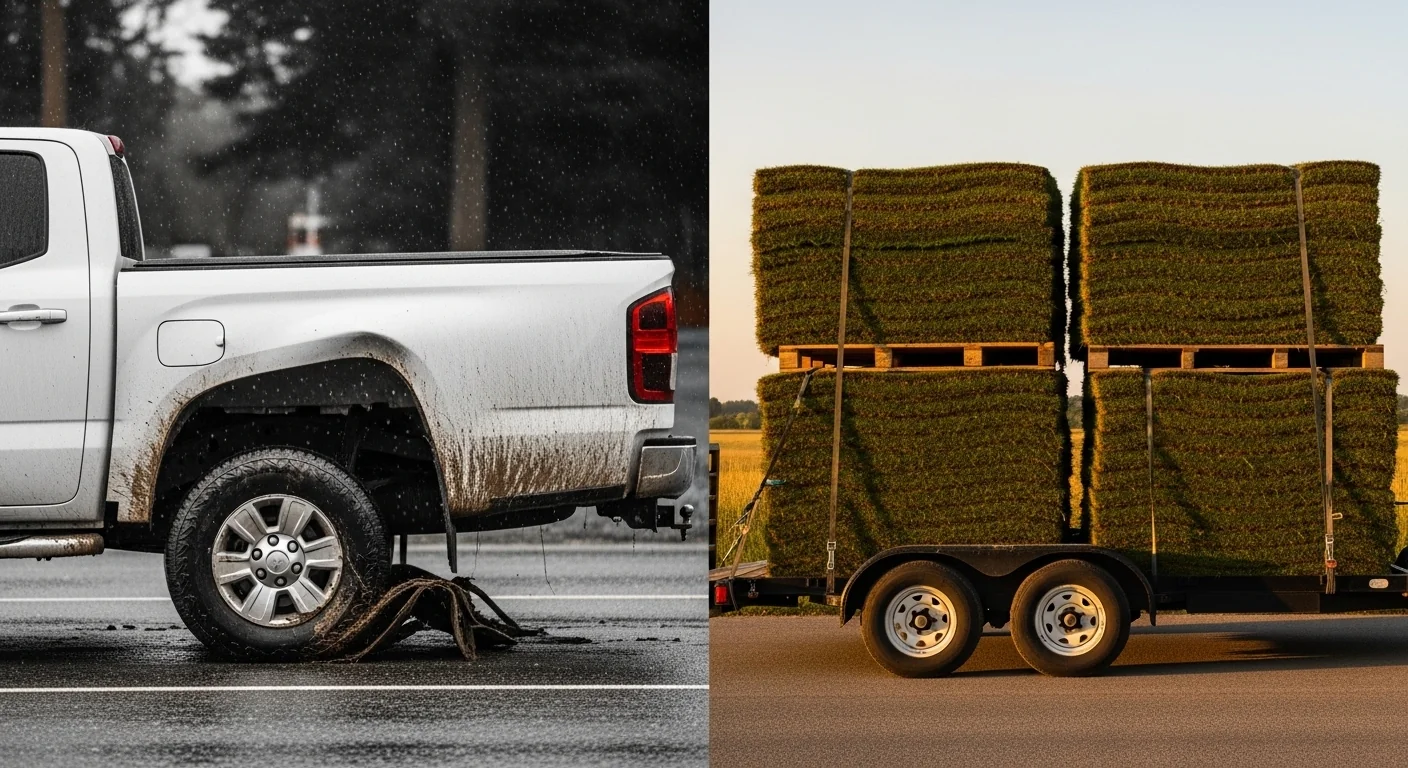
- Wet sod is an axle killer. One pallet of rain‑soaked sod can weigh 3,000 lb – far exceeding a half‑ton truck’s payload. The tool flags this as a severe overload and mimics the real‑world “F‑150 Axle Snapper” scenario where a single pallet collapses rear suspension.
- Payload stickers are law, not suggestion. Exceeding the posted payload can result in a citation, voided insurance, and structural damage. The tool does not let you ignore this number – it compares total sod weight directly.
- Wet weight is an assumption, not a measurement. The tool adds a flat 1,000 lb of water per pallet. The actual water retention depends on soil type. Call the farm and ask if the pallets are “field‑wet”; if they squish water when pressed, treat as wet.
Minimum Standards
- Always round pallet counts up – never down. The tool enforces this.
- Use the door jamb payload value, not the marketing “half‑ton” or “three‑quarter‑ton” class name.
- If the result shows more than one trip, do not try to squeeze the load into one run “just this once.” The physics does not negotiate.
- When working near trees, keep heavy pallets outside the root zone. Consult our critical root zone calculator to avoid soil compaction that damages roots.
Competitor Trap: Most online sod calculators stop at “pallets = area ÷ coverage.” They ignore the payload dimension entirely and never mention wet weight. That omission creates a false sense of capability for DIY haulers who then discover their truck is overloaded at the farm gate. The yield grid tool transparently inserts the truck’s load limit into the workflow, forcing a realistic transport plan before money is spent.
Common Mistakes and Fixes
Mistake: Using the “half‑ton” label instead of the door sticker
A 2023 F‑150 crew cab with 4WD may have a payload of only 1,500 to 1,800 lb, not 2,000. The nameplate refers to a vehicle class, not your specific truck’s capacity. Entering 2,000 lb when the actual number is 1,600 makes the tool show a safe load that is, in reality, 25% over limit.
Fix: Open the driver’s door, find the yellow “Tire and Loading Information” sticker, and use the “cargo should never exceed” number.
Mistake: Forgetting to change weather after it rained
Rain the night before pickup can add hundreds of pounds per pallet. Leaving the weather set to “Dry” under‑reports total weight by a third, masking an overload. The tool’s warnings only activate when it knows the sod is wet.
Fix: Call the farm and ask about ground conditions. If they halted cutting because of mud, select Heavy Rain.
Mistake: Assuming all cut types cover the same area
Big rolls (500 sq ft/pallet) cover 11% more than 18×24 slabs (400 sq ft). Mixing up types can cause a project to be short pallets or over‑order. The tool handles this if the correct dropdown is chosen, but many users select the first option without reading.
Fix: Confirm the exact product name and dimensions with the sod farm, then match it to the closest option or use Custom.
Mistake: Not adding a waste factor
The tool gives the exact pallet count for the measured area, but real‑world installation requires cuts around curves, trees, and odd angles. Ordering the calculated number without a 5–10% buffer often leaves the job unfinished with one small bare spot.
Fix: Multiply your measured area by 1.05 to 1.10 and enter that adjusted square footage into the calculator.
Mistake: Ignoring the trip count and attempting a single overloaded haul
The results panel may show “4 trips required,” but the impulse to “make it work” leads to stacking pallets far beyond payload. The warning is there to prevent bent frames and blowouts; skipping it transfers the cost to your repair bill.
Fix: Rent a trailer rated for the total load, split the purchase over multiple trips, or use the farm’s delivery service.
Once the sod is down, watering frequency matters. Use our turf watering calculator to set an irrigation schedule that prevents drying out the new turf.
Next Steps in Your Workflow
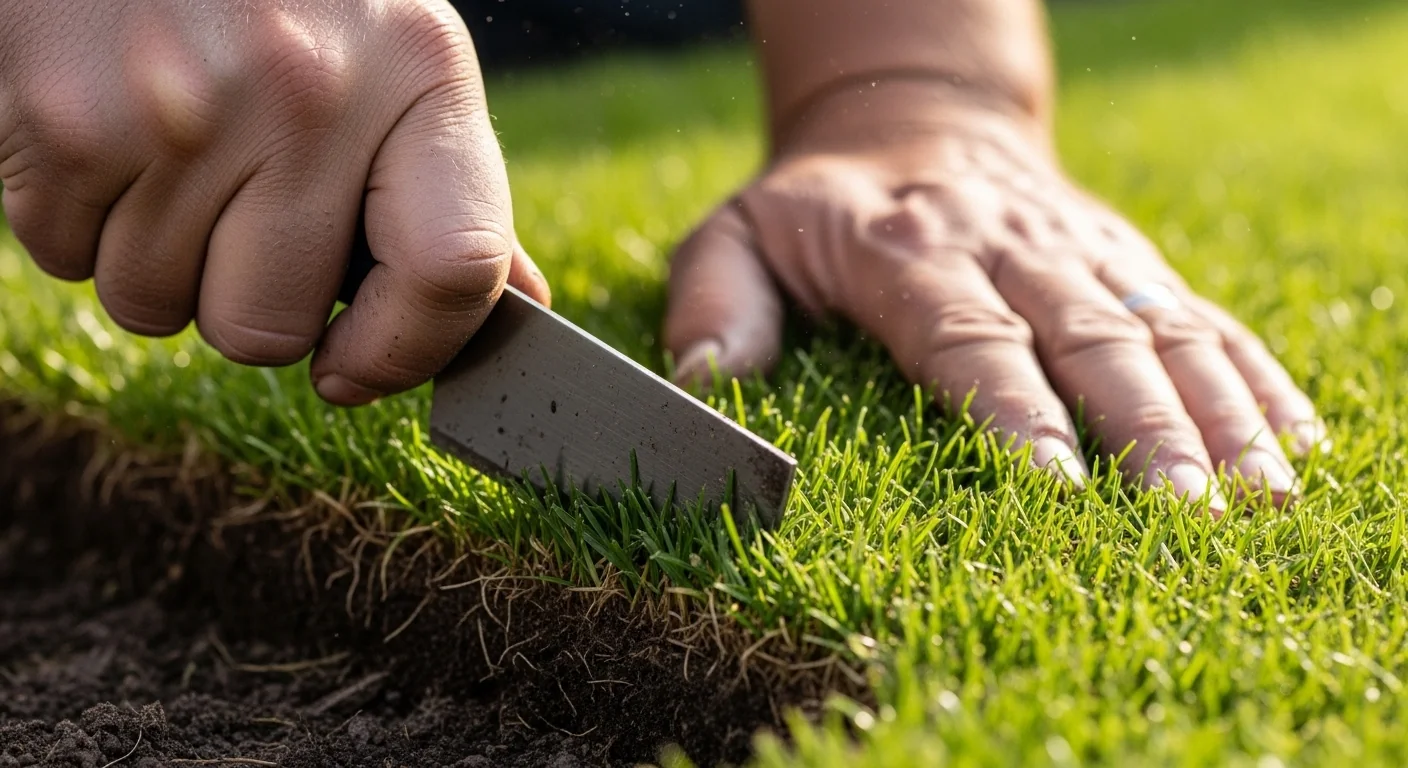
With the pallet count and a safe transport plan in hand, the next priority is site preparation. The soil should be raked smooth, lightly compacted, and moist but not muddy when the sod arrives. If your pallets are coming in multiple trips, keep the waiting rolls in a shaded area and lightly mist them to prevent the edges from drying out. Do not cover them with a tarp in direct sun – it traps heat and cooks the grass.
After installation, rolled or slab sod needs to be pressed into the soil to eliminate air gaps. A light lawn roller does this well. In the weeks that follow, monitor for thin areas that might need over‑seeding – a slit seeder calculator can help you plan that repair. If you later tackle hardscape that involves heavy materials, our boulder weight calculator applies similar load‑safety thinking to landscape stone.
FAQ
Why does the tool always round up pallets?
Sod farms sell whole pallets; you cannot buy a fraction. Rounding up ensures you have enough material to cover the area. A leftover half‑pallet can be used for patching or returned if the farm allows, but underestimating risks an incomplete lawn.
How accurate are the dry and wet weight assumptions?
The 2,000 lb dry weight and 3,000 lb wet weight are typical averages for a pallet of cool‑season sod on mineral soil. Actual weight can vary by a few hundred pounds. The tool provides a conservative baseline; always confirm with your supplier.
Can I use this calculator for artificial turf?
No – artificial turf is sold by the square foot or roll, not by pallet with a soil‑based weight. Our artificial grass infill calculator is the correct tool for synthetic lawns.
What if my truck’s payload is exactly the limit shown?
If the total sod weight matches the payload exactly, the tool will show 100% usage and may still issue a caution. It is safer to leave a headroom of at least 10% because real‑world loading distribution, passengers, and gear also consume payload.
Does the calculator include the weight of the pallet itself?
Yes, the per‑pallet weight includes the wooden pallet, soil, and grass. The pallet alone weighs roughly 40‑50 lb, which is a small fraction of the total.
Why does the reference table show “No” for almost all rows?
The table demonstrates that even one wet pallet exceeds the payload of popular half‑ton pickups. It is designed as a quick reality check: if you are hauling any pallets with a light‑duty truck, the safe path is almost always multiple trips or a trailer.
Conclusion
The sod pallet calculator removes the two biggest guesswork vectors – coverage per cut type and the invisible weight swing caused by rain. Instead of assuming one pallet equals 450 sq ft and ignoring the truck, you get a rounded‑up pallet count and a hard payload comparison that forces a honest transport plan. The unique emphasis on wet‑sod weight transforms the tool from a simple division utility into a safety gate that can stop a F‑150 from leaving the farm with a bent axle waiting to happen.
The one mistake worth repeating: never trust the “half‑ton” name. Find the door jamb sticker, read the real payload number, and let the calculator tell you how many trips the physics demands. That sequence – measure, verify, load to the sticker – keeps your truck intact and your sod project on schedule.