
| DBH (in) | CRZ Radius (ft) | Protected Area (sq ft) | Fencing (ft) |
|---|
Assumptions & Limits
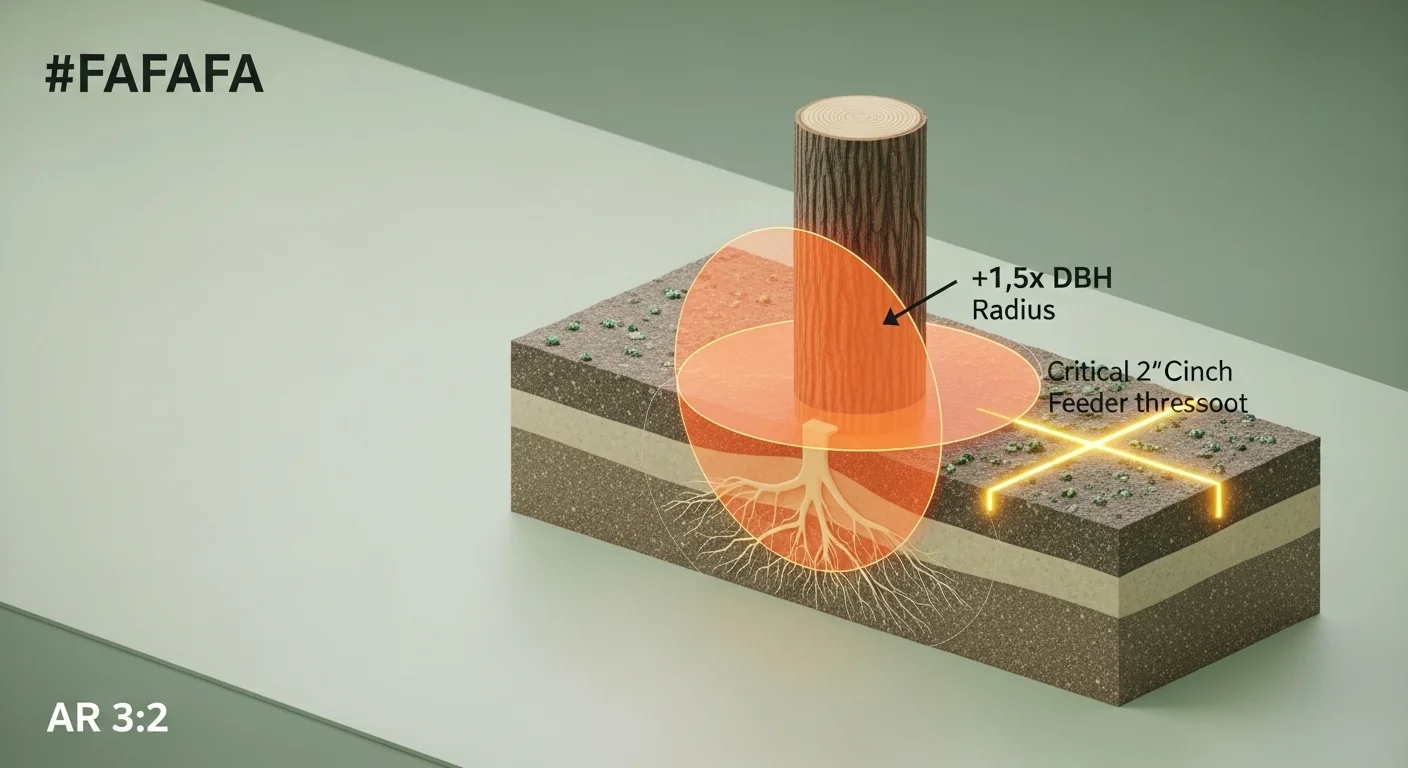
CRZ multiplier: Standard (young/resilient) = DBH × 1.5; Sensitive (old/heritage) = DBH × 2.0. Based on ISA (International Society of Arboriculture) and ANSI A300 standards.
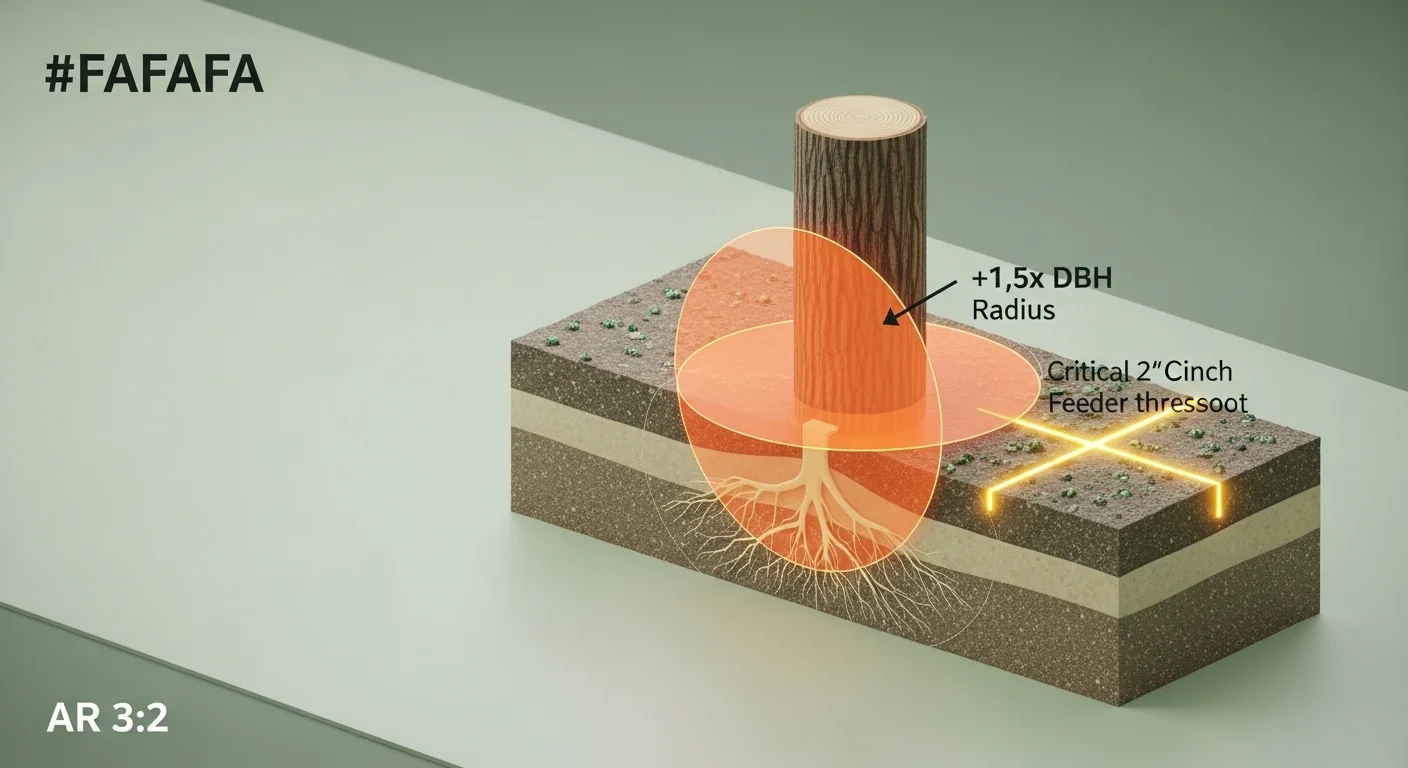
Excavation warning: Any excavation or soil compaction deeper than 2 inches inside the CRZ can sever critical feeder roots, leading to slow tree decline over 1–5 years.
Soil compaction: Heavy equipment (skid-steers, excavators) driving over the root zone compresses soil pores, suffocating roots even without digging. This is the #1 hidden cause of post-construction tree death.
Limits: This calculator assumes relatively flat terrain and typical soil conditions. Clay soils, slopes, and drainage issues may require expanding the CRZ. Always consult a certified arborist for high-value or protected trees.
DBH range: Valid for trees 1–200 inches DBH. Results are estimates; site-specific assessment recommended.
How This Calculator Works
Step 2: Apply the CRZ multiplier based on species sensitivity:
• Young / Resilient species:
CRZ Radius = DBH × 1.5 feet• Old / Sensitive species:
CRZ Radius = DBH × 2.0 feetStep 3: Calculate the protected circular area:
Protected Area = π × CRZ Radius²Step 4: Calculate fencing perimeter needed:
Fencing = 2 × π × CRZ RadiusStep 5: Check excavation depth against the 2-inch root severance threshold:
• If excavation inside the CRZ exceeds 2 inches, a Root Severance Warning is triggered.
• Depths beyond 6 inches indicate critical root damage risk — major structural and feeder roots are likely to be severed.
Standards: Based on ISA Best Management Practices and ANSI A300 (Part 5) — Tree, Shrub, and Other Woody Plant Management.
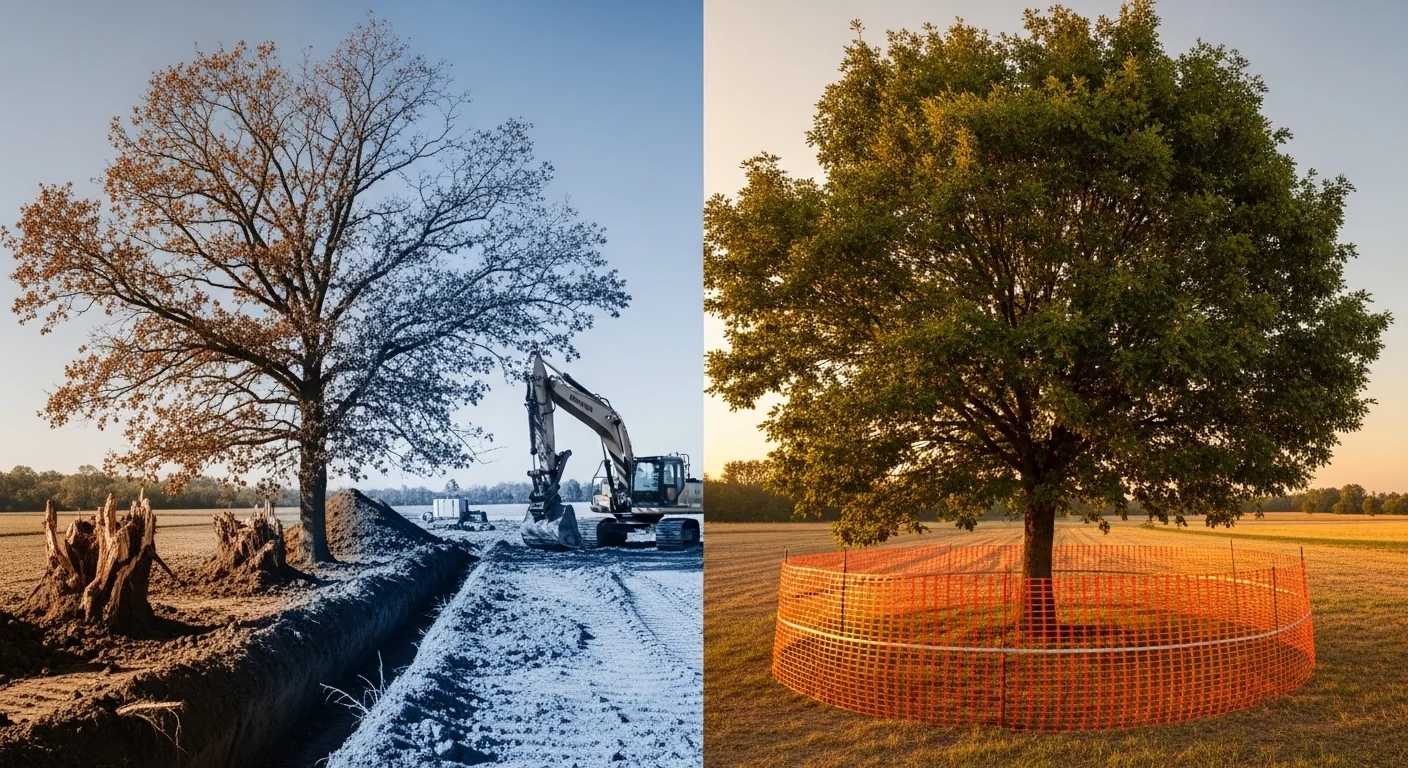
Tree death from construction activity rarely looks like tree death at the time it happens. Equipment rolls across what looks like bare dirt, a trench gets dug for a new patio footer, a skid-steer parks on compacted soil for a week, and the tree stands there, green and apparently indifferent. The damage is biological, invisible, and already done. Feeder roots, which occupy the top 12 inches of soil and extend far beyond the trunk in every direction, have been severed or suffocated. What follows is a slow starvation that can take one to five years to surface as visible canopy decline. Knowing how to use a tree age calculator to assess whether your tree qualifies as an old-growth or heritage species is the first step toward understanding which protection radius to apply.
This tool calculates the Critical Root Zone (CRZ) radius for any tree based on its trunk diameter at breast height (DBH) and species sensitivity classification. It outputs the protection radius in feet, the total protected area in square feet, and the linear fencing footage required to enclose that zone. What it does not do is replace a site assessment by a certified arborist, account for unusual soil conditions, or evaluate multi-tree scenarios where root zones overlap.
Once you have the CRZ radius, you can place orange safety fencing at exactly that distance from the trunk and enforce a hard equipment exclusion zone before any ground disturbance begins.
Use the Tool
Before running the calculation, have three pieces of information ready: the trunk diameter measured at 4.5 feet above ground (breast height) in inches, a judgment call on species sensitivity (young or fast-growing species versus old-growth or known-sensitive species), and the maximum depth of any proposed excavation or trenching that will occur inside the root zone. If no digging is planned, enter zero for depth. For a companion view of how root protection zones are defined under different regulatory frameworks, see the tree root protection calculator.
Quick Start (60 Seconds)
- DBH in inches only. This is not tree height or canopy spread. Wrap a flexible tape around the trunk at 4.5 feet above ground and divide the circumference by 3.14159 to get diameter, or use a DBH tape directly. Most mature street trees fall between 12 and 36 inches.
- Species sensitivity changes the multiplier. Young, fast-growing species such as silver maple, cottonwood, or willow tolerate moderate disturbance and use the 1.5x multiplier. Old-growth oaks, beech, dogwood, and heritage specimens require the 2.0x multiplier because their recovery capacity is significantly lower.
- Excavation depth means maximum depth inside the CRZ. If a crew will dig a footer at 6 inches and the footer falls inside the calculated radius, enter 6. Do not average across the site.
- Zero is a valid excavation depth. If no digging is planned but equipment will operate nearby, enter 0. The tool will still flag soil compaction risk through the traffic-light output.
- Read the traffic light before the number. The green/yellow/red status at the top of the results panel tells you the severity classification at a glance. The fencing footage output tells you exactly how much high-visibility perimeter fencing to order.
Inputs and Outputs (What Each Field Means)
| Field | Unit | What It Means | Common Mistake | Safe Entry Guidance |
|---|---|---|---|---|
| Tree Trunk Diameter (DBH) | Inches | Trunk diameter measured at 4.5 feet above ground level | Measuring at the base, where buttress roots flare outward, inflating the number | Measure at exactly 4.5 ft; for multi-stem trees, calculate each stem separately |
| Tree Species Sensitivity | Category (resilient / sensitive) | Classification based on species age and known tolerance to root disturbance | Defaulting all trees to “resilient” to minimize the required protection zone | When in doubt, classify as sensitive; the cost of extra fencing is far lower than tree removal |
| Excavation Depth Inside CRZ | Inches | Maximum depth of any proposed digging, grading, or trenching within the calculated radius | Entering 0 when shallow grading or regrading of a few inches is planned | Include any grading, drainage pipe trenching, footer work, or utility installation depth |
| CRZ Radius (output) | Feet | The calculated distance from the trunk center that must be kept free of all disturbance | Treating this as a suggestion rather than a hard physical boundary | Mark this radius with paint or flags on the ground before ordering fencing |
| Protected Area (output) | Square feet | The total circular area enclosed by the CRZ radius | Using area to estimate fencing, which is circular, not square | Use for permit applications and landscape plans that require area specifications |
| Fencing Needed (output) | Linear feet | The perimeter of the CRZ circle, which is the minimum fencing run required | Forgetting to add 10-15 linear feet for gate panels and post overlap | Order at least 10% more than the calculated value to account for terrain variation |
Worked Examples (Real Numbers)
Example 1: Heritage Live Oak, 30-Inch DBH, New Patio Construction
- DBH: 30 inches
- Species Sensitivity: Old / Sensitive
- Excavation Depth: 8 inches (patio base compaction)
Result: CRZ Radius = 60 ft | Protected Area = 11,310 sq ft | Fencing = 377 ft | Status: CRITICAL
The 8-inch excavation depth exceeds the 2-inch root severance threshold by a factor of four. At 60 feet from the trunk, the root system extends into what would appear to be “open yard.” Any patio construction at this proximity without pneumatic root-friendly excavation techniques will cause irreversible structural root damage.
Example 2: Young Silver Maple, 12-Inch DBH, Driveway Widening
- DBH: 12 inches
- Species Sensitivity: Young / Resilient
- Excavation Depth: 0 inches (no digging, equipment only operates nearby)
Result: CRZ Radius = 18 ft | Protected Area = 1,018 sq ft | Fencing = 113 ft | Status: SAFE
No excavation inside the zone keeps this tree in the safe category, but soil compaction from equipment parking or repeated passes within the 18-foot boundary still represents a real risk. Fencing at the CRZ radius prevents inadvertent equipment encroachment even when no formal digging is planned.
Example 3: Established Elm, 18-Inch DBH, Patio Base Grading at 4 Inches
- DBH: 18 inches
- Species Sensitivity: Young / Resilient
- Excavation Depth: 4 inches (compacted base for pavers)
Result: CRZ Radius = 27 ft | Protected Area = 2,290 sq ft | Fencing = 170 ft | Status: CAUTION
The 4-inch base preparation exceeds the 2-inch threshold, triggering the caution classification. Feeder roots in the top 4 inches will be severed across a portion of the 2,290-square-foot protected zone. This tree may survive if the disturbance is limited to one quadrant, but deep root fertilization and follow-up irrigation are warranted after construction concludes.
Reference Table (Fast Lookup)
| DBH (in) | Sensitivity | Multiplier | CRZ Radius (ft) | Protected Area (sq ft) | Fencing Needed (ft) |
|---|---|---|---|---|---|
| 6 | Resilient | 1.5x | 9.0 | 254 | 57 |
| 6 | Sensitive | 2.0x | 12.0 | 452 | 75 |
| 12 | Resilient | 1.5x | 18.0 | 1,018 | 113 |
| 12 | Sensitive | 2.0x | 24.0 | 1,810 | 151 |
| 18 | Resilient | 1.5x | 27.0 | 2,290 | 170 |
| 24 | Resilient | 1.5x | 36.0 | 4,072 | 226 |
| 24 | Sensitive | 2.0x | 48.0 | 7,238 | 302 |
| 30 | Resilient | 1.5x | 45.0 | 6,362 | 283 |
| 30 | Sensitive | 2.0x | 60.0 | 11,310 | 377 |
| 36 | Sensitive | 2.0x | 72.0 | 16,286 | 452 |
| 48 | Sensitive | 2.0x | 96.0 | 28,953 | 603 |
How the Calculation Works (Formula + Assumptions)
Show the calculation steps
Step 1 – Measure DBH. Diameter at breast height is the trunk diameter in inches at 4.5 feet above ground. If you measured circumference, divide by 3.14159 to get diameter.
Step 2 – Apply the multiplier based on species sensitivity.
- Young / Resilient species: CRZ Radius (ft) = DBH (in) x 1.5
- Old / Sensitive species: CRZ Radius (ft) = DBH (in) x 2.0
Step 3 – Calculate protected area. Protected Area (sq ft) = pi x CRZ Radius squared. Using pi = 3.14159, rounded to the nearest square foot.
Step 4 – Calculate fencing perimeter. Fencing (linear ft) = 2 x pi x CRZ Radius. This is the circumference of the protection circle, rounded to the nearest foot.
Step 5 – Evaluate excavation depth against the 2-inch threshold. Any proposed digging deeper than 2 inches inside the CRZ triggers a root severance warning. Depths above 6 inches are classified as critical.
Rounding rules: CRZ Radius is displayed to one decimal place. Area and fencing are rounded to the nearest whole number. No unit conversions are required if DBH is entered in inches as specified.
Assumptions and Limits
- The 1.5x and 2.0x multipliers are derived from ISA Best Management Practices and ANSI A300 (Part 5). They represent the minimum recommended radius, not a maximum safe distance.
- The tool assumes feeder roots extend radially in a roughly circular pattern. In practice, roots follow water and oxygen gradients, so actual root extent can be asymmetrical.
- Slope, soil type, and compaction history are not factored in. Clay soils compact faster and drain slower; roots on sloped sites often extend further downhill than uphill.
- The 2-inch excavation threshold assumes undisturbed soil. If the area has already been graded or compacted in prior seasons, even shallower disturbance can sever exposed surface roots.
- DBH input is valid from 1 to 200 inches. Trees below 1 inch DBH are typically too young for this formula to produce a meaningful exclusion zone.
- Multi-stem trees or trees with structural defects may require field assessment by a certified arborist regardless of the calculated radius.
- The tool does not account for regulatory tree protection ordinances, which in some jurisdictions set their own CRZ definitions that may differ from ISA formulas.
Standards, Safety Checks, and “Secret Sauce” Warnings
The CRZ formula used here aligns with the International Society of Arboriculture (ISA) Best Management Practices: Tree Risk Assessment and ANSI A300 Standard Part 5. These are the reference frameworks used by municipal arborists, building permit reviewers, and certified tree risk assessors in the United States.
Critical Warnings
- The “3-Year Starvation” delay. Root damage from construction does not produce immediate visible symptoms. A tree can lose a significant portion of its feeder root mass and continue to look completely healthy for one to three growing seasons, drawing on stored energy reserves. By the time canopy dieback appears, the biological damage is typically irreversible. This is the most dangerous characteristic of construction-related tree decline.
- Soil compaction kills without any digging. A skid-steer or concrete truck making repeated passes over the root zone, even on existing grass with no excavation at all, compresses soil pores and reduces oxygen availability to feeder roots. The root system suffocates over the following growing seasons. This effect is cumulative and is not reversed when the equipment leaves the site.
- The 2-inch threshold is not a margin of error. Two inches is the depth at which root severance risk becomes acute according to ISA guidance. It is not a “safe” depth; it is a threshold above which damage is essentially guaranteed.
- Grade changes are excavation. Adding four inches of fill soil over the root zone is functionally equivalent to excavating four inches from the root perspective: roots are buried deeper, oxygen penetration decreases, and feeder roots in the original surface layer may be killed. The mulch calculator is useful for planning a proper mulch layer within the CRZ as a protective buffer rather than adding compacted fill.
Minimum Standards
- Safety fencing must be installed at the calculated CRZ boundary before any equipment, materials, or personnel access the site. Post-installation fencing is not effective because compaction and root damage occur during the earliest site preparation phases.
- Orange high-visibility fencing is the ISA-recommended standard for CRZ marking. Standard orange construction mesh with T-posts at 8-foot intervals is sufficient for most residential and light commercial sites. For fencing installation that requires driven posts, see the fence post depth calculator to avoid post holes that themselves encroach on root zones.
- Any trenching that must occur within the CRZ should use pneumatic excavation (air spade) rather than mechanical digging. Air spades expose roots without severing them, allowing rerouting of utilities around existing root structure.
- Post-construction, a deep root liquid fertilization program is warranted for any tree that experienced compaction or minor root severance. This does not reverse root loss but supports recovery.
Competitor Trap: Many generic “tree protection” guides online recommend protecting to the dripline, which is the outermost edge of the canopy. For rounded, symmetrical canopies, the dripline and the CRZ radius may be similar. For trees with narrow crowns, recently pruned trees, or trees with asymmetrical canopy spread, the dripline can dramatically underestimate the true root extent. A 30-inch DBH oak with a narrow vertical canopy might have a dripline of only 20 feet, while its ISA-compliant CRZ radius is 60 feet. Using the dripline as the protection boundary for sensitive species is one of the most expensive mistakes in residential construction project management.
Common Mistakes and Fixes
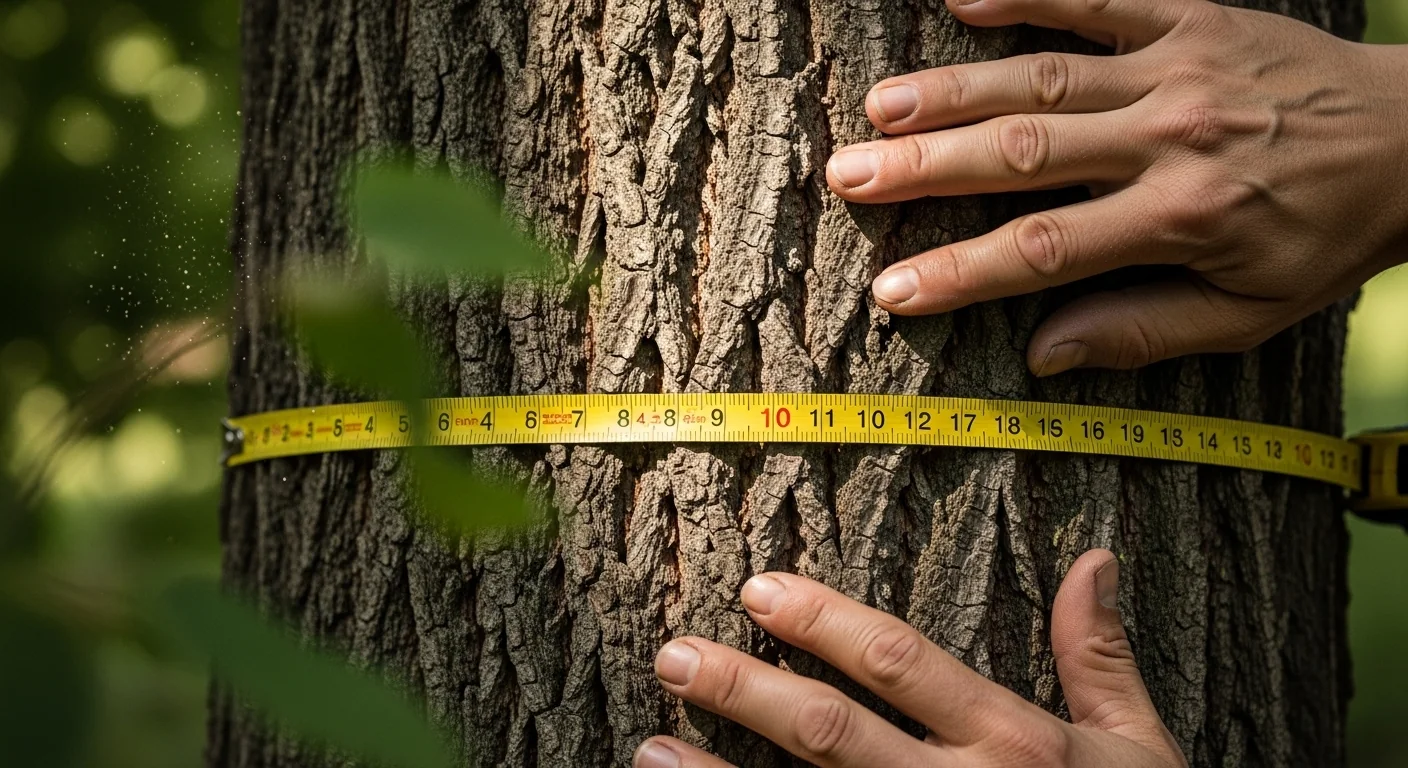
Mistake: Measuring Trunk Diameter at the Wrong Height
DBH must be measured at exactly 4.5 feet above ground. Measuring at the base captures root flare, which is always wider than the actual trunk. Measuring higher on a leaning or branching tree produces an artificially small number. Either error changes the calculated radius and the protection zone boundary.
Fix: Use a DBH tape or a standard measuring tape at the 4.5-foot mark, confirmed with a separate height measurement if needed. For trees on slopes, measure from the uphill side of the trunk.
Mistake: Classifying All Trees as “Resilient” to Reduce the Fence Run
The sensitivity selection directly determines whether the 1.5x or 2.0x multiplier applies, and that choice can produce a radius difference of dozens of feet on large trees. Contractors sometimes default to the smaller radius to reduce fencing costs or maintain closer equipment access.
Fix: When species sensitivity is genuinely uncertain, always use the sensitive classification. The cost of additional fencing material is a fraction of the cost of tree removal and replacement, which for a mature shade tree can run several thousand dollars or more. If you need to assess the tree’s age before classifying it, the tree height calculator can provide supporting context for estimating overall tree maturity.
Mistake: Omitting Shallow Grading from the Excavation Depth Field
Grading one to three inches of soil to level a patio pad or improve drainage is still excavation. Homeowners and contractors frequently enter “0” in the depth field because no deep digging is planned, when in reality, surface scarification, tilling, or fine grading will disturb root tissue in the top two inches of soil.
Fix: Enter the actual depth of all ground disturbance, including surface grading. If adding fill material, enter the fill depth as a positive number. When calculating topsoil volume needed for grade changes near the tree, the topsoil calculator can help plan quantities while keeping fill depth intentionally shallow.
Mistake: Installing Fencing After Equipment Has Already Accessed the
Site
Soil compaction damage from a single pass of a loaded concrete truck over compressible loam soil can reduce pore space by a significant amount in that area, and that change is not reversed when the truck leaves. Fencing installed after initial site preparation has already failed at its primary purpose.
Fix: Fencing must be the first physical item installed on a construction site with trees present. No exceptions. Include CRZ fencing in the site mobilization sequence, before any survey stakes are driven and before any equipment is unloaded.
Mistake: Assuming a Healthy Canopy Means Healthy Roots After
Construction
The delayed timeline of root-to-canopy decline is the single most dangerous characteristic of construction-related tree damage. A tree with 40 to 60 linear feet of feeder roots severed can sustain photosynthesis and canopy density for two to three full growing seasons before visible symptoms emerge.
Fix: If a tree experienced any soil disturbance inside its CRZ during construction, treat it as a compromised tree and implement a post-construction care program regardless of how the canopy looks at project completion.
Next Steps in Your Workflow
Once the CRZ radius is calculated, the immediate action is staking the perimeter. Drive stakes at the calculated radius in each cardinal direction from the trunk center, run a string line between them to confirm the circular boundary, and then install the orange safety fencing on T-posts at 8-foot intervals. The stakes stay in place for the entire duration of the project. Any subcontractor who arrives on site should be briefed on the fence boundary before equipment is unloaded. For trees that will remain in place after construction and may need additional physical support during ground disturbance, the tree staking tension calculator can help size guy-wire systems appropriately without over-tensioning.
After construction concludes, a recovery plan matters as much as the protection plan. Schedule a deep root fertilization treatment within the first growing season following project completion. If any grading or paving occurred near the tree, ensure adequate drainage is maintained so the remaining root zone does not become waterlogged. For new patio or hardscape work adjacent to the CRZ, the patio slope calculator helps ensure surface drainage directs runoff away from the trunk, which reduces both soil saturation and subsequent root oxygen deprivation.
FAQ
What does “critical root zone” actually mean in practice?
The critical root zone is the circular area around a tree trunk within which root density is high enough that damage there can threaten tree survival. It is not the total extent of root growth, which can extend two to three times the CRZ radius, but it is the zone where the concentration of structural and fine feeder roots makes disturbance particularly consequential.
Does the CRZ calculator account for underground utilities already in the root zone?
No. This tool calculates the biologically appropriate protection radius based on trunk diameter and species sensitivity. Existing utilities inside the CRZ are a separate problem requiring coordination between an arborist and the utility company. Air spade excavation is typically required to expose roots before any utility work proceeds inside the calculated zone.
Is the CRZ radius the same as the dripline?
Not reliably. The dripline reflects canopy spread, which varies by pruning history, available light, and species growth habit. The CRZ formula uses DBH, which is a direct measurement of trunk size and correlates more consistently with root extent. For trees with narrow crowns, the dripline can dramatically underestimate the actual root zone.
What should I do if I cannot avoid putting equipment inside the CRZ?
Consult a certified arborist before proceeding. Mitigation options include laying plywood or ground protection mats to distribute equipment weight and reduce compaction, air spade excavation for any trenching, and limiting access to a single designated route rather than random equipment movement across the root zone.
How does soil type affect the calculation?
The formula itself does not adjust for soil type, but soil compressibility significantly affects how much damage a given level of equipment traffic causes. Clay soils compact much faster than sandy loam and retain that compaction longer. In high-clay areas, expanding the exclusion zone beyond the calculated CRZ radius is advisable, particularly for sensitive species.
When is the 2.0x multiplier required versus recommended?
The 2.0x multiplier should be treated as required, not optional, for any tree species known to be compaction-sensitive, any tree with a trunk diameter above 24 inches, heritage trees with replacement value over several thousand dollars, and trees in areas with local ordinances designating them as protected specimens. When in doubt, use the larger multiplier.
Conclusion
The single most common mistake across all construction site tree protection is treating fencing as a formality to be installed when convenient rather than as a hard engineering boundary installed on day one. Use the calculated CRZ radius, stake the perimeter, install the fencing before mobilization, and keep it up until the project is complete. For related tree assessments that round out a full site protection plan, the tree staking tension calculator provides the remaining structural support calculations needed for trees adjacent to active construction zones.