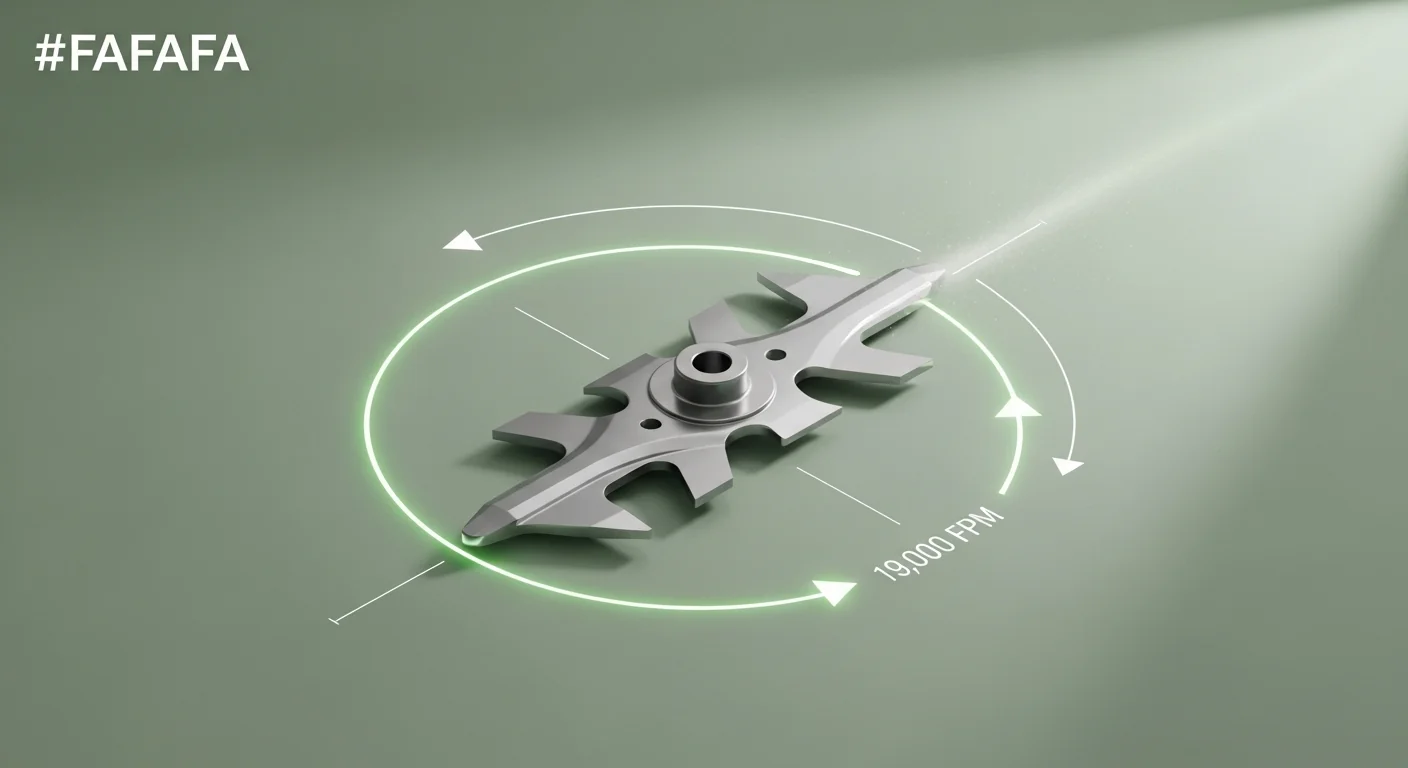
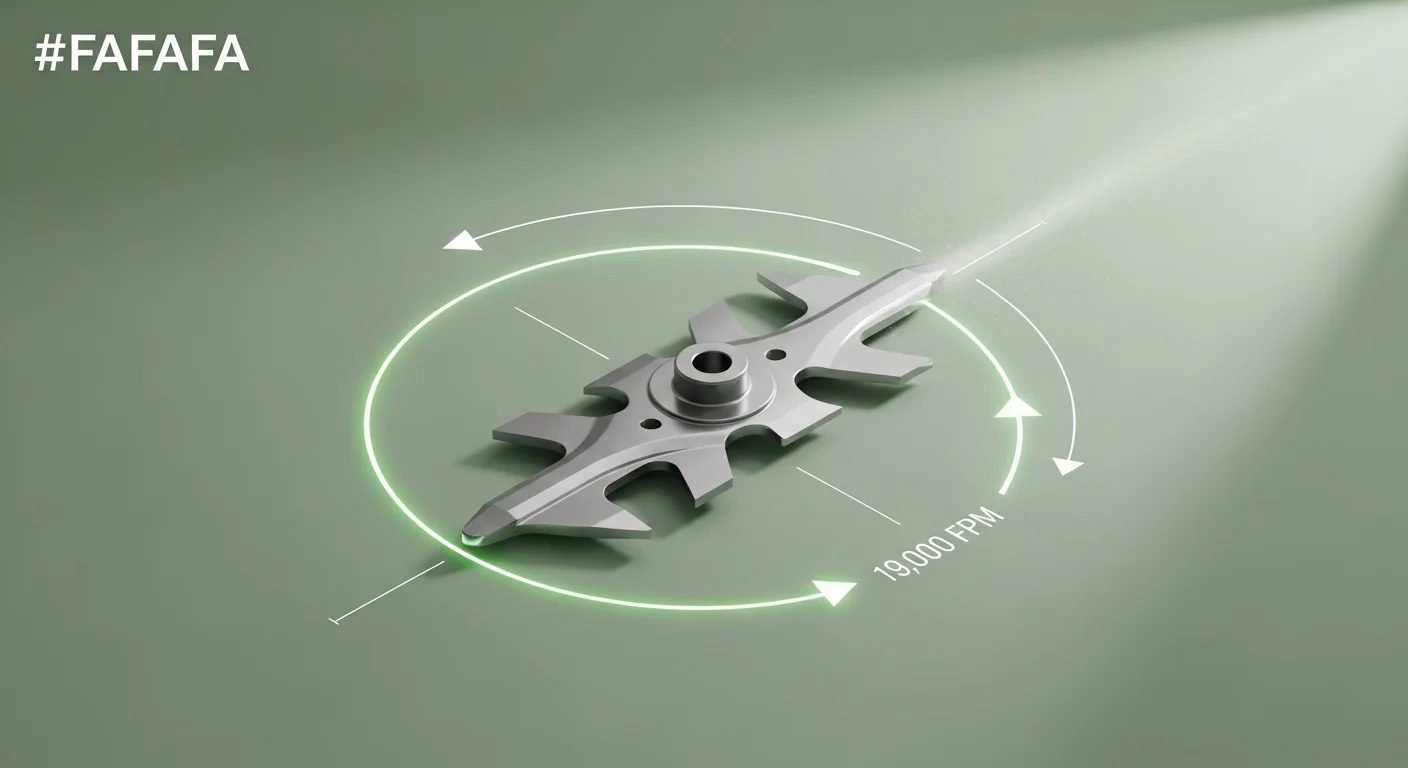
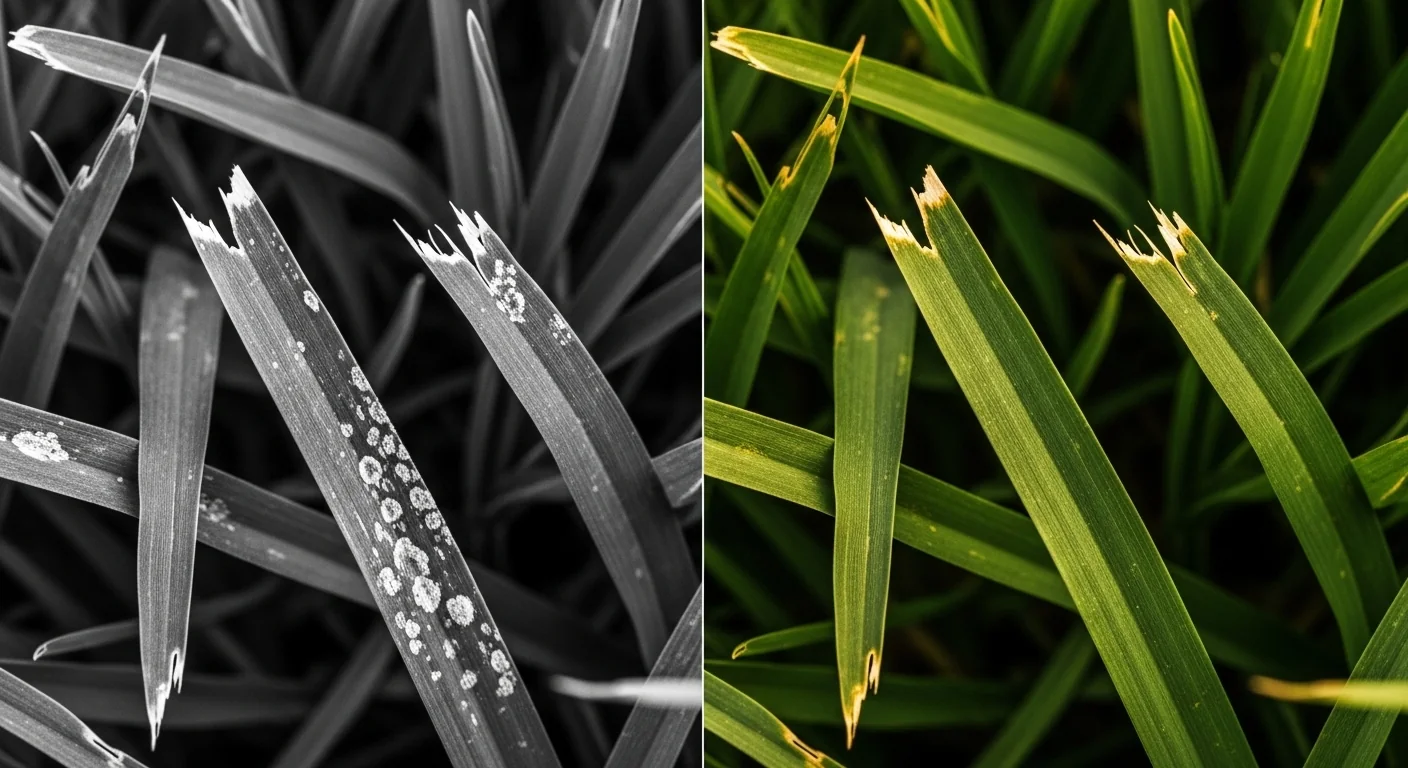
Blade tip speed is rarely visible, but it dictates whether your mower slices through grass like a guillotine or batters it into shredded, brown tips. At the wrong speed, a single pass across the lawn can introduce microscopic tears that dehydrate in hours, opening pathways for dollar spot, brown patch, and other fungal diseases. The industry has clear thresholds, yet most operators never check the number that matters most: feet per minute at the blade’s outer edge.
This calculator converts the three variables you already have—engine spindle RPM, actual blade length, and deck pulley ratio—into a precise FPM value and then cross-references that number against ANSI/OSHA safety limits and grass-specific cutting quality bands. It does not diagnose deck imbalance, belt slippage, or blade sharpness; those problems live downstream of tip speed. What it does is tell you whether your mower’s fundamental geometry is set up for a clean cut or a recurring lawn health problem.
After running your numbers, you will know exactly whether you need to adjust engine speed, swap a pulley, or choose a different blade length—and you will understand the risk level for both your turf and your safety. If the tip speed has already left your lawn with shredded tips, you may need to estimate replacement sod with our sod calculator.
Use the Tool
Mower Blade Tip Speed Calculator
Calculate FPM & cut quality for zero-turn & riding mowers
How this calculator works
Blade Tip Speed is the speed at which the outermost edge of your mower blade travels through the air, measured in Feet Per Minute (FPM). It determines whether your mower cuts or tears grass.
- Step 1 — Blade circumference: Multiply blade length (inches) by π (≈3.14159) to get the circle circumference.
- Step 2 — Convert to feet: Divide by 12 to convert inches to feet.
- Step 3 — Apply pulley ratio: Multiply the result by the deck pulley ratio (typically 1.0 – 1.1).
- Step 4 — Multiply by RPM: Multiply by engine spindle speed to get FPM.
Thresholds (ANSI/industry): Safe cut zone = 14,000 – 19,000 FPM. Below 14,000 = torn grass risk. Above 19,000 = ANSI/OSHA shrapnel warning.
- Circumference
- Effective RPM
- Grass Suitability
Reference: Tip Speed by Mower Type
| Mower Type | Typical RPM | Blade (in) | Tip Speed (FPM) | Rating |
|---|
🔧 Recommended Products for Best Cut Quality
- Digital Laser Tachometer (verify RPM)
- Gator / Oregon Mulching Blades
- Heavy-Duty Angle Grinder (blade sharpening)
- Magnetic Blade Balancing Cone
Assumptions & Limits
- This calculator models a single blade tip at the outermost edge of the blade. Real-world FPM varies slightly along the blade length.
- Blade length should be the full blade length in inches (e.g. 21″ for a standard 42″ deck with 2 blades, each 21″).
- The formula assumes the deck pulley directly drives the spindle at the stated ratio. Direct-drive and belt-driven systems may vary slightly.
- ANSI/OSHA 19,000 FPM maximum applies to walk-behind and riding mowers per industry standards. Commercial zero-turns operate at 18,000–18,500 FPM by design.
- Grass type affects recommended operating speed only. Thick/coarse grasses (Zoysia, St. Augustine) benefit from slightly higher FPM. Fine/thin grasses (Bermuda) cut cleanly at moderate FPM.
- Results assume blades are sharp and properly balanced. A dull blade tears grass regardless of tip speed.
- RPM valid range: 500–6,000. Blade length: 8–42 inches.
Have your engine’s rated spindle RPM handy (from the label or a tachometer), the precise blade length in inches—measured tip to tip on a single blade, not half the deck width—and your deck pulley ratio if you know it. For most mowers the pulley ratio is 1:1, but performance and mulching decks often deviate. For total job timing, pair this with our mowing time calculator.
Quick Start (60 Seconds)
- Enter the engine spindle RPM. Typical values: 2800–3600. Do not guess; check the engine manual or use a laser tachometer.
- Measure blade length in inches from tip to tip. A 42-inch deck with two blades generally uses 21-inch blades, not 42.
- Select your deck pulley ratio. When in doubt, choose 1:1. Only pick another value if your manual confirms a different drive ratio.
- Pick your grass type. Zoysia and St. Augustine tolerate higher FPM; thin Bermuda cuts well at lower speeds.
- Hit calculate and watch the gauge. Green means safe; orange means acceptable but not pro-zone; red means either torn-grass territory or shrapnel hazard.
- If the result lands below 14,000 FPM, increase RPM or check for a worn pulley—never just live with it.
- If the result exceeds 19,000 FPM, reduce RPM immediately or swap back to a standard pulley ratio.
Inputs and Outputs (What Each Field Means)
| Input / Output | Unit | What it means | Common mistake | Safe entry guidance |
|---|---|---|---|---|
| Engine Spindle Speed | RPM | Rotational speed at the blade spindle, not the engine crankshaft if there is a reduction drive. | Using engine PTO speed instead of spindle speed. | 500–6000; typical riding mowers: 2800–3600 |
| Mower Blade Length | inches | Full length of a single blade from tip to tip. | Entering deck width (e.g., 42) instead of individual blade length (21). | 8–42 inches; measure physically, don’t estimate |
| Deck Pulley Ratio | ratio | Drive ratio between engine pulley and blade spindle pulley. | Assuming 1:1 for all mowers, even performance decks. | Most are 1:1; only change if manual confirms |
| Grass Type | — | Species of turfgrass; affects optimal FPM recommendation. | Ignoring grass type entirely; dense species need higher speed. | Select from list; default to “Thick Fescue” if unsure |
| Blade Tip Speed | FPM | Linear speed of the outer blade edge in feet per minute. | Confusing FPM with MPH. | Safe: 14,000–19,000; Pro: 18,000–18,500 |
| Circumference | in / ft | Distance traveled by blade tip in one revolution. | — | Derived; no direct input needed |
| Effective RPM | RPM | Spindle speed after pulley ratio adjustment. | — | — |
| Grass Suitability | — | Indicates if tip speed falls within ideal range for the chosen grass type. | Assuming one speed fits all grass. | Adjust RPM or blade length to match grass range |
Worked Examples (Real Numbers)
Mid-Range Riding Mower (Safe Zone)
- Engine Spindle Speed: 3,200 RPM
- Blade Length: 21 inches
- Deck Pulley Ratio: 1.0
- Grass Type: Kentucky Bluegrass
Result: 17,593 FPM (rounded).
This speed is well above the 14,000 FPM tear threshold and safely below 19,000. The cut will be clean but not in the commercial pro zone. For Kentucky Bluegrass, it is within the ideal 16,000–18,500 range.
Pro-Tuned Zero-Turn (Pro Zone)
- Engine Spindle Speed: 3,400 RPM
- Blade Length: 21 inches
- Deck Pulley Ratio: 1.0
- Grass Type: Zoysia
Result: 18,693 FPM (rounded).
Right in the professional 18,000–18,500 window (slightly above, but still safe). Zoysia’s tough stem structure handles the extra energy; the grass gets a guillotine finish that minimizes moisture loss.
Walk-Behind Push Mower (Below Optimum)
- Engine Spindle Speed: 3,000 RPM
- Blade Length: 21 inches
- Deck Pulley Ratio: 1.0
- Grass Type: Thin Bermuda
Result: 16,493 FPM (rounded).
Safe, but undershooting the optimal 15,000–18,000 range for Bermuda. The grass will cut, yet without the crisp cellular shear of higher speeds. Slight tip browning may appear after a few dry days.
Reference Table (Fast Lookup)
| Mower Type | Typical RPM | Blade (in) | Ratio | Tip Speed (FPM) | Rating |
|---|---|---|---|---|---|
| Budget Box-Store Riding | 2,800 | 21 | 1.0 | 15,394 | Acceptable (low end) |
| Mid-Range Riding (42") | 3,200 | 21 | 1.0 | 17,593 | Acceptable |
| Pro Zero-Turn (48") | 3,600 | 24 | 1.0 | 22,619 | Shrapnel Risk |
| Commercial Zero-Turn (60") | 3,600 | 30 | 1.0 | 28,274 | Shrapnel Risk |
| Walk-Behind Push Mower | 3,000 | 21 | 1.0 | 16,493 | Acceptable |
| High-Performance ZT (1.1:1) | 3,600 | 24 | 1.1 | 24,881 | Shrapnel Risk |
| Residential Pro-Tuned | 3,400 | 21 | 1.0 | 18,693 | Pro Zone |
| Mulching Deck (0.95:1) | 3,200 | 21 | 0.95 | 16,713 | Acceptable |
Tip speeds calculated using the formula RPM × Ratio × π × Blade Length ÷ 12. All values rounded to nearest whole FPM.
How the Calculation Works (Formula + Assumptions)
Show the calculation steps
The formula: Tip Speed (FPM) = RPM × Pulley Ratio × π × Blade Length (inches) ÷ 12.
- Find blade circumference: Multiply blade length by π (3.14159) to get inches traveled per revolution.
- Convert to feet: Divide circumference by 12.
- Apply pulley ratio: Multiply the result by the deck pulley ratio to get effective spindle output.
- Multiply by RPM: Multiply by engine spindle speed to obtain linear feet per minute.
The calculator rounds the final FPM to the nearest whole number. No unit conversions are applied beyond inches to feet.
Assumptions & Limits
- The model calculates the tip speed of a single blade at its outermost edge. In reality, speed decreases linearly toward the blade’s center, but the tip governs cutting quality and safety.
- Blade length must be the full single-blade dimension; using half the deck width will underestimate FPM.
- Belt slip, worn pulleys, and deck vibration can cause actual tip speed to deviate from the theoretical value by a small margin.
- The ANSI/OSHA 19,000 FPM limit applies to walk-behind and riding mowers; some commercial zero-turns are engineered to operate just below it, but exceeding it introduces projectile risk.
- Grass type influences the recommended operating range only; the FPM calculation itself is species-agnostic.
- Results assume sharp, balanced blades. Dull edges will tear grass even at ideal tip speed.
Standards, Safety Checks, and “Secret Sauce” Warnings
Critical Warnings
- Below 14,000 FPM: Grass blades are torn rather than cut. Torn tips lose water rapidly, brown within 24–48 hours, and become entry points for dollar spot and brown patch fungi.
- Above 19,000 FPM: Violates ANSI/OSHA safety thresholds for consumer and commercial mowers. At these speeds, any object struck by the blade becomes a high-velocity projectile; the mower deck itself may not contain debris.
- Between 18,000 and 18,500 FPM: This is the professional zero-turn sweet spot where cutting transitions from a tearing action to a clean shear, minimizing moisture loss and disease pressure.
Minimum Standards
- The blade tip must travel at no less than 14,000 FPM to achieve a cut that does not require immediate irrigation to prevent tip dieback.
- The mower must not be operated above 19,000 FPM unless manufacturer documentation explicitly certifies a higher safe limit, which is rare.
Competitor Trap: Many online calculators ignore pulley ratio entirely, assume a fixed one-size-fits-all RPM, or neglect grass species. That can give a “safe” reading when a mulching deck’s 0.95:1 drive is actually pushing you below 14,000 FPM—or a performance 1.1:1 pulley is silently crossing the ANSI redline. Our tool flags both scenarios explicitly, because aeration and topdressing cannot fix a speed-induced disease spiral.
Common Mistakes and Fixes
Mistake: Entering deck width instead of blade length
A 42-inch deck with two blades uses 21-inch blades, not 42. Putting 42 into the calculator can produce FPM values that suggest the mower is safe when in reality the actual blade tips are running dangerously fast or excessively slow.
Fix: Remove one blade and measure its total length tip-to-tip before running any calculation.
Mistake: Assuming all mowers have a 1:1 pulley ratio
Performance, mulching, and older belt-drive decks sometimes use 1.1:1, 0.95:1, or even more extreme ratios. A 1.1:1 ratio on a 3,600 RPM spindle turns 21-inch blades at over 24,000 FPM—deep into shrapnel territory.
Fix: Check your owner's manual or count pulley teeth if the ratio is not marked.
Mistake: Running a dull blade at a high FPM to compensate
High tip speed cannot fix a dull cutting edge. At 18,000 FPM a dull blade will still smash and fray grass cells instead of shearing them, leading to white, shredded tips within hours.
Fix: Sharpen blades before adjusting RPM or pulley ratios; test cut quality on a small patch first.
Mistake: Ignoring grass type in the pursuit of a single “safe” number
St. Augustine at 15,000 FPM may look acceptable for a week until the thick stems show tearing, while thin Bermuda at 18,500 FPM scatters clippings and wastes energy. Grass-specific optimal bands are not marketing; they reflect cell wall thickness and stem toughness.
Fix: Use the grass type selector and aim for the recommended range, even if it means adjusting engine speed seasonally. When torn patches force overseeding, our grass seed calculator can help estimate seed needs.
Mistake: Not verifying actual spindle RPM with a tachometer
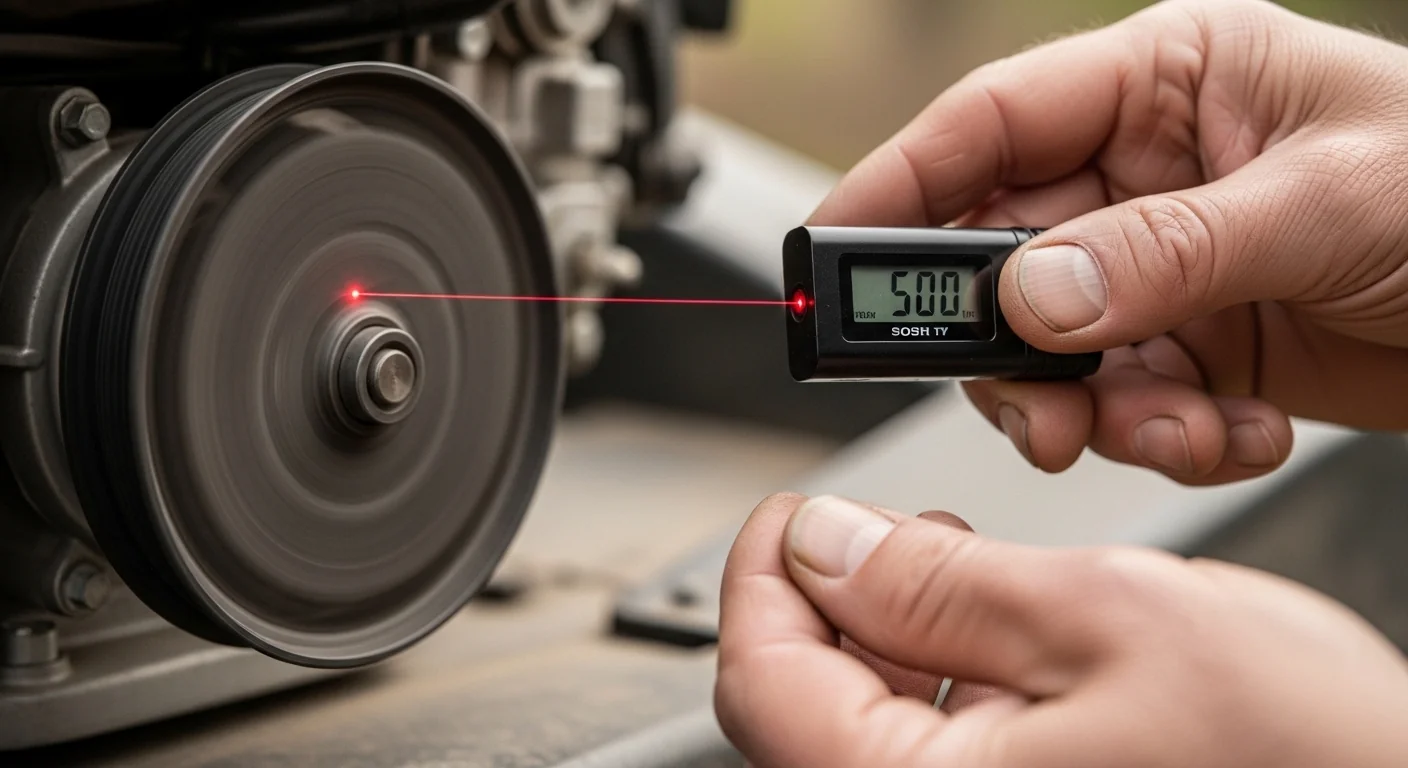
Engine labels often state a “high idle” RPM that may not match the governed speed under load. A mower labeled 3,600 RPM may only deliver 3,350 at the spindle, dropping tip speed by several hundred FPM.
Fix: Measure spindle RPM directly with a non-contact laser tachometer before trusting the nameplate number.
Next Steps in Your Workflow
Once you have your FPM value and a safety rating, adjust engine governor settings or pulley components only if the tool indicates a clear hazard or a significant grass-type mismatch. For many users, the result simply confirms that the factory setup is appropriate, and no change is needed. If your number lands in the professional 18,000–18,500 range, maintain your current configuration and shift your focus to blade sharpness and mowing frequency.
If the tool flags a torn-grass risk, correct the speed before investing in fungicides or overseeding; no chemical can outrun the physical damage of a slow blade. After adjusting RPM, recalibrate your irrigation schedule with our turf watering calculator and measure clippings decomposition with the grass clippings nitrogen calculator to ensure the entire cutting cycle supports turf health.
FAQ
What is a safe blade tip speed for a zero-turn mower?
ANSI/OSHA standards set a maximum of 19,000 FPM for consumer and commercial mowers. The professional sweet spot for cut quality is 18,000–18,500 FPM. Speeds below 14,000 FPM tear grass and invite disease.
Why does blade length affect tip speed more than RPM?
Tip speed scales linearly with both RPM and blade length, but blade length directly determines the circumference the tip travels. A 10% longer blade increases tip speed by 10%, while a 10% RPM increase does the same—but blade length is often guessed incorrectly, amplifying error.
Can I use the same tip speed for all grass types?
No. Coarse, thick-stemmed species like Zoysia and St. Augustine need higher FPM (up to 19,000) to shear cleanly. Fine Bermuda cuts well at 15,000–18,000 FPM. Using a single speed across grass types often forces one species into tearing or unnecessary energy waste.
What happens if blade tip speed exceeds 19,000 FPM?
Beyond 19,000 FPM, the blade’s kinetic energy turns debris into projectiles that can breach the deck. The mower operates outside ANSI/OSHA limits, creating a shrapnel hazard. Immediate RPM reduction or pulley change is warranted.
How do I measure my actual spindle RPM?
Use a non-contact digital laser tachometer. Place a small piece of reflective tape on the spindle pulley or blade holder, then aim the tachometer while the engine runs at full governed speed. The reading often differs from the engine label due to load and governor settings.
Does a sharper blade compensate for low tip speed?
No. A sharp blade at extremely low FPM still tears grass because the cutting edge cannot slice through the leaf’s cell walls fast enough to create a clean fracture. The tear occurs regardless of edge keenness. Both sharpness and speed are required.
Conclusion
The line between a healthy striped lawn and a fungal disaster is often a few hundred feet per minute at the blade tip. This calculator removes the guesswork by combining the exact formula with real-world operating limits and grass-specific thresholds. The number it returns is not an approximation; it is the same calculation used by mower engineers to design deck geometry.
The single most damaging mistake is assuming that if the mower “cuts,” the tip speed must be fine. Many torn-lawn problems blamed on dull blades or poor watering actually trace back to a tip speed that never left the danger zone. Run your numbers, correct the mechanical mismatch, and you immediately eliminate the biggest hidden variable in lawn quality.