
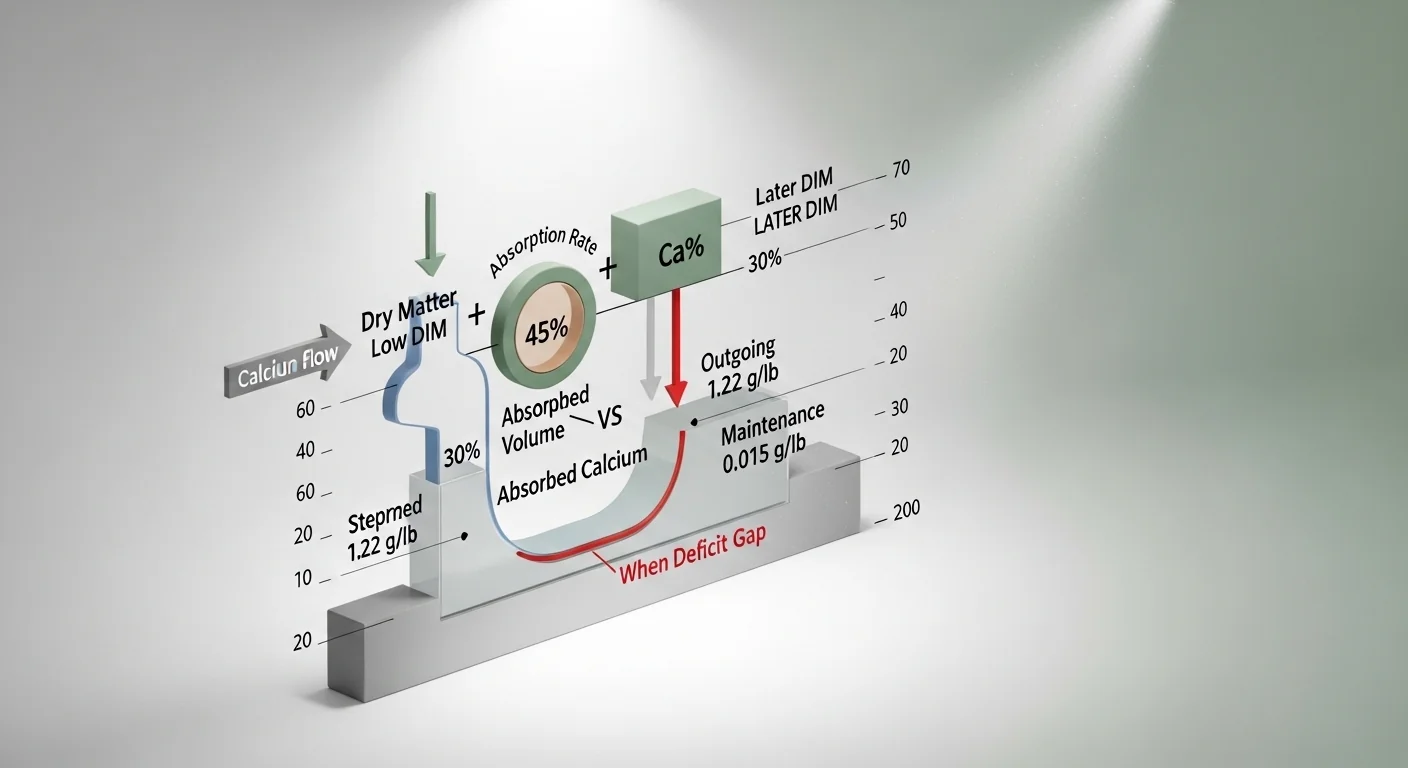
Peak lactation is a metabolic event, not just a production milestone. Within hours of calving, a high-producing dairy cow begins exporting calcium at a rate that can exceed what her digestive system physically absorbs from even a well-formulated ration. The gap between calcium required and calcium absorbed is not a nuance buried in a nutritionist’s spreadsheet; it is the direct biochemical trigger for hypocalcemia, the condition that drops a 1,400-pound animal to her knees. Most forage analyses report calcium content as a percentage of dry matter, but that number answers only half the question.
This dairy cow calcium calculator quantifies the other half: how much of that dietary calcium is actually absorbed, whether it covers both milk calcium export and daily maintenance requirements, and at what production level a specific cow’s ration crosses into milk fever territory. It also estimates phosphorus export, which drops in parallel with blood calcium and compounds neuromuscular dysfunction. What this tool does not do is model bone calcium mobilization, parathyroid hormone response timing, or breed-specific metabolic variation; those processes run concurrently and require veterinary blood panels to assess directly.
After running your numbers, you will know whether your current forage calcium percentage, at your cow’s actual milk production and estimated dry matter intake, produces an absorbed calcium surplus or deficit against her total daily requirement. That result determines whether pre-calving DCAD management and staged bolus administration are advisable interventions or unnecessary costs for this animal.
Use the Tool
Dairy Cow Calcium & Phosphorus Deficit Calculator
Instantly calculate your cow’s total calcium demand, absorption gap, and milk fever risk at peak lactation. Enter your cow’s stats below.
Veterinary Safety Checks & Standards
| Parameter | Value | Unit |
|---|
| Daily Milk (lbs) | Milk Ca Export (g) | Maint. Ca (g) @ 1,400 lb | Total Ca Required (g) | Risk Level |
|---|---|---|---|---|
| 40 | 48.8 | 21.0 | 69.8 | Low |
| 60 | 73.2 | 21.0 | 94.2 | Moderate |
| 80 | 97.6 | 21.0 | 118.6 | Elevated |
| 100 | 122.0 | 21.0 | 143.0 | High Risk |
| 120 | 146.4 | 21.0 | 167.4 | Critical |
Recommended Supplies for Calcium Management
How This Calculator Works
Milk Calcium Export: Each pound of milk exported from the cow’s body contains approximately 1.22 grams of calcium. Formula: Milk Ca Export = Milk (lbs) × 1.22 g/lb
Maintenance Calcium: The cow also needs calcium for basic body maintenance, estimated at 0.015 g per pound of body weight per day. Formula: Maintenance Ca = Cow Weight (lbs) × 0.015 g/lb
Total Ca Requirement: Adding both needs gives the total daily requirement. Formula: Total Ca = Milk Ca Export + Maintenance Ca
Dietary Ca Supplied: The cow consumes calcium from her forage ration. We estimate dry matter intake at 3% of body weight if not entered. Formula: Ca Supplied = DMI (lbs) × Ca% × 10 g/% lb
Calcium Absorbed: The gut only absorbs a fraction of dietary Ca (30–50%, based on DIM stage). Formula: Ca Absorbed = Ca Supplied × Absorption Rate
Net Deficit/Surplus: Negative values indicate hypocalcemia risk (Milk Fever). Formula: Net = Ca Absorbed − Total Ca Required. If Net < 0, TRIGGER MILK FEVER RISK.
Phosphorus Export: Milk contains approximately 0.90 g of phosphorus per pound. Formula: P Export = Milk (lbs) × 0.90 g/lb. Blood phosphorus also drops in step with calcium — worsening muscle and nerve function.
Assumptions & Limitations
- Milk calcium content assumed at 1.22 g/lb (approximate average; individual variation ±10%).
- Maintenance calcium requirement estimated at 0.015 g/lb of body weight per day (NRC 2001 standard).
- Dry matter intake estimated at 3.0% of body weight if not provided; actual intake varies by forage quality, palatability, and weather.
- Phosphorus export estimated at 0.90 g/lb of milk (NRC standard). DCAD and ruminal phosphorus recycling not modeled.
- Absorption rates (30–50%) are population averages from published dairy cow literature; individual cows may vary by breed, age, parity, and vitamin D status.
- This tool does not model bone calcium mobilization, PTH response, or vitamin D synthesis — which occur concurrently and affect actual blood calcium levels.
- Results are for educational and management reference only. Always consult a licensed veterinarian for clinical diagnosis and treatment of hypocalcemia.
- Breed differences (Holstein vs. Jersey vs. Guernsey) are not modeled; Jerseys are generally higher risk due to breed-level calcium metabolism differences.
Before entering values, have your most recent forage analysis report available. You will need the calcium percentage listed under macro minerals, typically expressed as a percentage of dry matter. If you are estimating dry matter intake rather than measuring it, the calculator will auto-estimate at 3% of body weight, which is a reasonable approximation for a mid-lactation cow on adequate feed; cows in the first week post-calving often eat less. For milk production, weigh actual daily output or use your DHIA records rather than relying on estimated bucket counts. If you manage multiple animals with similar rations, you can track how freshening cows compare against the feed cost calculator to model supplementation economics alongside the mineral gap this tool identifies.
Quick Start (60 Seconds)
- Cow Body Weight: Enter total live weight in pounds. Typical Holstein range is 1,200 to 1,600 lbs; Jersey cows often fall between 900 and 1,100 lbs. Do not use target weight or body condition score; use the actual current weight if possible.
- Days in Milk (DIM): Count from the calving date, with Day 1 being the first full day after calving. The tool flags the 0 to 21-day window as a heightened risk period regardless of other inputs.
- Daily Milk Production: Enter in pounds per day, not gallons. One gallon weighs approximately 8.6 pounds. Use a 24-hour weighed total, not a single milking multiplied by two unless your parlor records are consistent.
- Calcium Content of Forage Ration: Enter the percentage figure from your hay or TMR analysis report. Alfalfa hay typically runs 1.2 to 1.5%; grass hay runs 0.3 to 0.5%; mixed pasture falls between. Do not guess; a 0.3% error in this field materially shifts the result.
- Dry Matter Intake: Leave this field blank unless you have a measured or well-documented estimated value. The calculator applies the 3% of body weight default, which is conservative for high producers; actual intake at peak lactation can reach 3.5 to 4%.
- Calcium Absorption Rate: Select based on DIM stage. Day 1 to 3 post-calving: choose 30%. Days 4 to 14: use the default 35%. Mid to late early lactation: step up to 40 to 45%. Do not select 50% for a freshly calved cow; the gut upregulates absorption over time, not instantly.
- Run the calculation: All required fields must be filled before the results panel appears. Use the Reset button when switching between animals to clear all prior values.
Inputs and Outputs (What Each Field Means)
| Field | Unit | What It Measures | Common Mistake | Safe Entry Guidance |
|---|---|---|---|---|
| Cow Body Weight | lbs | Live body mass used to calculate maintenance calcium requirement (0.015 g per lb) and to estimate DMI if not provided | Using last year’s weigh-tape estimate on a cow that has lost body condition since peak production | 500 to 3,000 lbs; weigh or tape within the current lactation period |
| Days in Milk (DIM) | days | Elapsed time since calving; triggers the critical freshening window banner at DIM 21 or below | Counting the calving day itself as Day 0 and offsetting all downstream DIM records by one | 1 to 500; Day 1 = first full day after calving |
| Daily Milk Production | lbs/day | The primary driver of calcium export (1.22 g of calcium per pound of milk); the single variable with the greatest leverage on deficit magnitude | Using gallons without converting; 10 gallons per day equals 86 lbs, not 10 lbs | 1 to 400 lbs/day; use weighed 24-hour total |
| Calcium Content of Forage Ration | % of DM | The calcium concentration in the total forage or TMR ration; determines how much Ca is present before absorption losses are applied | Entering calcium as ppm instead of percentage (divide ppm by 10,000 to convert; 6,500 ppm = 0.65%) | 0.01 to 5.0%; reference your most recent forage test |
| Dry Matter Intake | lbs/day (optional) | Total forage consumed on a dry matter basis; determines total calcium supply before absorption is applied | Entering as-fed weight rather than dry matter weight; a 100-lb load of 50% moisture silage contributes 50 lbs of DM | 5 to 100 lbs DM; leave blank to auto-estimate at 3% of body weight |
| Ca Absorption Rate | % (as decimal) | Fraction of dietary calcium the gut absorbs; varies by DIM stage; the variable most often ignored when comparing ration Ca% across animals at different lactation stages | Applying a single rate across all animals regardless of DIM; a 30% vs 45% difference changes the absorbed total by 50% on the same diet | Use dropdown matched to DIM stage; do not select 50% for fresh cows |
| Net Ca Balance (output) | g/day | Absorbed calcium minus total calcium requirement; negative values indicate deficit and milk fever risk; positive values indicate adequacy | Treating a small positive balance as a large safety margin; high-producing cows have almost no buffer if feed intake drops even 5 lbs DM | Target: positive. Any result below -20 g/day warrants veterinary-guided intervention. |
| Phosphorus Export (output) | g/day | Estimated daily phosphorus removed in milk (0.90 g per lb); hypophosphatemia accompanies hypocalcemia and independently causes muscle weakness, downer cow syndrome, and immune suppression | Addressing calcium supplementation only while ignoring phosphorus, which drops concurrently and extends recovery time | Informational; compare against dietary P supply from your ration analysis |
| Ca Adequacy (output) | % of requirement met | Absorbed calcium as a fraction of total requirement; drives the gauge bar and status badge | Assuming 80% adequacy is a minor shortfall; at 80%, the cow is running a 20% daily deficit against a requirement that can exceed 140 g | Target: 100% or above. Below 75% in DIM 1 to 14 represents high clinical risk. |
Worked Examples (Real Numbers)
Scenario 1: High-Producing Holstein at Peak Freshening Risk
- Cow weight: 1,500 lbs
- Days in Milk: 3
- Daily milk production: 100 lbs
- Forage Ca content: 0.5% (grass hay dominant ration)
- DMI: 45 lbs (entered)
- Absorption rate: 30% (Day 1 to 3 post-calving)
Result: Net Ca balance = -77.0 g/day deficit. Ca adequacy = 46.7%.
At 100 lbs of daily production, milk calcium export alone is 122 g. Adding 22.5 g of maintenance need brings the total requirement to 144.5 g. The 45-lb DMI at 0.5% Ca delivers 225 g of dietary calcium, but at 30% absorption only 67.5 g enters the bloodstream. The 77 g daily gap is severe and, in a cow three days post-calving, represents a high-probability clinical milk fever scenario without intervention.
Scenario 2: Mid-Producing Cow with Marginal Ration Calcium
- Cow weight: 1,200 lbs
- Days in Milk: 14
- Daily milk production: 65 lbs
- Forage Ca content: 0.7% (mixed hay)
- DMI: auto-estimated at 36 lbs (3% of 1,200)
- Absorption rate: 35% (early lactation default)
Result: Net Ca balance = -9.1 g/day deficit. Ca adequacy = 90.6%.
This cow appears borderline adequate on paper but is running a daily shortfall. At 90.6% adequacy, her body is pulling the remaining deficit from bone reserves. Over several consecutive days, this pattern predisposes to sub-clinical hypocalcemia and secondary conditions including displaced abomasum and reduced immune function. The fix is small: raising forage Ca to 1.0% or confirming a measured DMI above the 3% estimate would likely close the gap.
Scenario 3: Lower-Production Cow on Alfalfa-Dominant Ration
- Cow weight: 1,100 lbs
- Days in Milk: 45
- Daily milk production: 45 lbs
- Forage Ca content: 1.2% (alfalfa hay)
- DMI: auto-estimated at 33 lbs (3% of 1,100)
- Absorption rate: 45% (adapting, Day 31 to 60)
Result: Net Ca balance = +106.8 g/day surplus. Ca adequacy = 249.7%.
A lower-producing cow at Day 45 on high-quality alfalfa hay generates a substantial calcium surplus. The risk here shifts from deficiency to excess: long-term Ca oversupply can blunt PTH responsiveness, which reduces the cow’s ability to mobilize bone calcium rapidly at the next calving. This is a documented reason why pre-calving DCAD management often uses low-calcium rations in the dry period rather than high-Ca supplementation.
Reference Table (Fast Lookup)
All values assume 35% Ca absorption rate and DMI estimated at 3% of body weight. The “Minimum Forage Ca Required” column shows the forage calcium percentage needed to exactly meet total requirements at 35% absorption. Values below this threshold indicate dietary inadequacy at the stated production level.
| Cow Weight (lbs) | Milk Production (lbs/day) | Milk Ca Export (g/day) | Maintenance Ca (g/day) | Total Ca Required (g/day) | Est. DMI (lbs) | Min. Forage Ca Required (%) | Risk Classification |
|---|---|---|---|---|---|---|---|
| 1,000 | 40 | 48.8 | 15.0 | 63.8 | 30 | 0.61 | Low |
| 1,000 | 60 | 73.2 | 15.0 | 88.2 | 30 | 0.84 | Moderate |
| 1,200 | 65 | 79.3 | 18.0 | 97.3 | 36 | 0.77 | Moderate |
| 1,200 | 80 | 97.6 | 18.0 | 115.6 | 36 | 0.92 | Elevated |
| 1,400 | 90 | 109.8 | 21.0 | 130.8 | 42 | 0.89 | Elevated |
| 1,400 | 100 | 122.0 | 21.0 | 143.0 | 42 | 0.97 | High Risk |
| 1,500 | 100 | 122.0 | 22.5 | 144.5 | 45 | 0.92 | High Risk |
| 1,500 | 120 | 146.4 | 22.5 | 168.9 | 45 | 1.07 | Critical |
| 1,800 | 120 | 146.4 | 27.0 | 173.4 | 54 | 0.92 | High Risk |
A practical observation from this table: a 1,400-lb cow producing 100 lbs per day requires forage calcium just under 1.0% at a 35% absorption rate. Grass hay at 0.35 to 0.5% Ca provides less than half of what is needed. Alfalfa at 1.2 to 1.5% Ca provides a surplus, but as noted in the worked examples, pre-calving dietary management that overshoots can suppress PTH responsiveness at the next freshening.
How the Calculation Works (Formula + Assumptions)
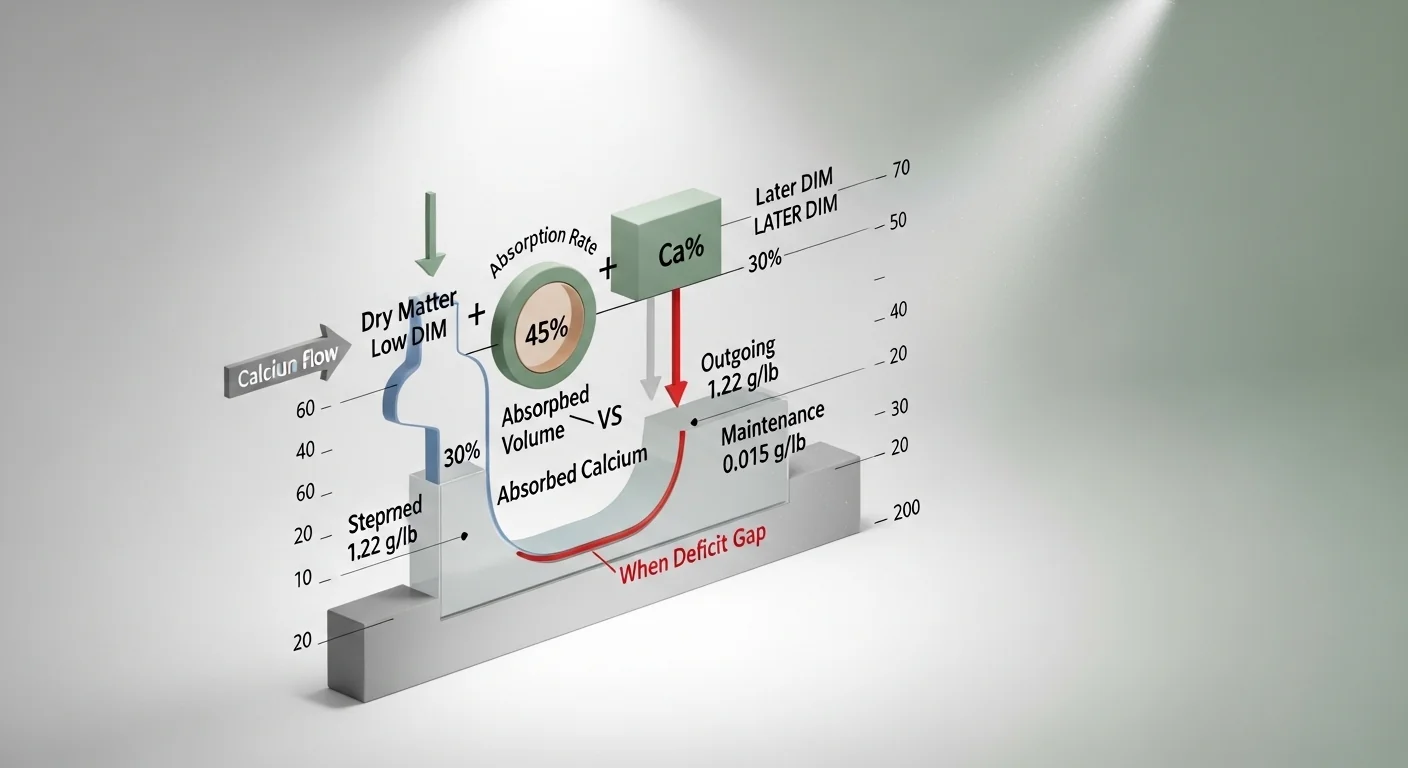
Show the calculation steps
Step 1: Milk Calcium Export
Each pound of milk produced exports approximately 1.22 grams of calcium from the cow’s body. This figure represents the calcium bound in casein proteins and dissolved in the aqueous phase of milk. It does not vary in this model by breed, stage of lactation, or milk fat content. Formula: Milk Ca Export (g/day) = Daily Milk (lbs) x 1.22
Step 2: Maintenance Calcium Requirement
The cow’s own metabolic processes require calcium for muscle function, nerve signal transmission, and cellular activity independent of milk production. The NRC 2001 standard estimates this at 0.015 grams per pound of body weight per day. Formula: Maintenance Ca (g/day) = Body Weight (lbs) x 0.015
Step 3: Total Daily Calcium Requirement
Formula: Total Ca Required = Milk Ca Export + Maintenance Ca
Step 4: Dietary Calcium Supplied
The forage or TMR ration supplies calcium at the percentage listed in the analysis. This is converted to grams by multiplying DMI (lbs) by the Ca fraction and then by 1,000 (converting kg-basis grams to a per-pound basis). Formula: Ca Supplied (g/day) = DMI (lbs) x (Ca% / 100) x 1,000
Step 5: Calcium Absorbed
The gastrointestinal tract absorbs only a fraction of dietary calcium. The selected absorption rate (30 to 50%) is applied to Ca Supplied. Formula: Ca Absorbed = Ca Supplied x Absorption Rate
Step 6: Net Calcium Balance
Formula: Net Balance (g/day) = Ca Absorbed – Total Ca Required. Negative = deficit. Positive = surplus. The milk fever risk threshold in this tool triggers when Net Balance falls below 0.
Step 7: Phosphorus Export
Formula: P Export (g/day) = Daily Milk (lbs) x 0.90. This follows NRC phosphorus concentration values for whole milk.
Rounding rule: All intermediate values are carried at full precision; only displayed values are rounded to one decimal place.
Assumptions and Limits
- Milk calcium content is fixed at 1.22 g/lb. Actual values vary by breed and stage; Jersey milk is typically higher in calcium and fat than Holstein, but breed-specific coefficients are not modeled.
- Maintenance calcium at 0.015 g/lb per day is the NRC 2001 default for adult lactating cattle. It does not account for growth in first-lactation heifers, who have an additional skeletal demand that this tool will underestimate.
- DMI auto-estimate at 3% of body weight is conservative for a well-fed mid-lactation cow but likely an overestimate for a fresh cow in the first 3 to 7 days post-calving, when intake commonly drops to 1.8 to 2.5% of body weight.
- Absorption rates (30 to 50%) are population averages. Individual cows can deviate substantially based on vitamin D status, rumen pH, age, and parity. A first-calf heifer at Day 1 may absorb at the low end or below the 30% estimate.
- Bone calcium mobilization is not modeled. The cow’s skeleton is a reserve that PTH can draw upon when blood calcium drops; this buffering mechanism delays clinical symptoms but does not eliminate the biochemical deficit this tool is measuring.
- DCAD interactions, anionic salt supplementation effects on absorption upregulation, and pre-calving dietary acid-base manipulation are outside the model’s scope.
- The phosphorus output is a single-compartment export estimate. Ruminal phosphorus recycling via saliva is substantial in cattle and means dietary P requirements are not a simple mirror of milk P export; consult a nutritionist for full P balancing.
- Results are for management reference and educational use. Clinical diagnosis and treatment of hypocalcemia require blood chemistry panels and licensed veterinary assessment.
Standards, Safety Checks, and “Secret Sauce” Warnings
Critical Warnings
- The absorption rate variable is the most dangerous field to guess. Two cows on the same ration with the same forage calcium percentage will have dramatically different absorbed calcium totals if one is at DIM 2 (30% absorption) and the other is at DIM 45 (45% absorption). A 15-percentage-point difference in absorption rate translates to a 50% change in absorbed calcium on identical diets. Producers who apply a single absorption rate across all animals in the herd will systematically underestimate fresh cow risk.
- Sub-clinical hypocalcemia is far more prevalent than clinical milk fever and far harder to detect. Blood calcium between 6.0 and 8.0 mg/dL (compared to the normal 8.5 to 10.0 mg/dL range) produces no obvious collapse but is associated with reduced immune function, higher incidence of displaced abomasum, impaired uterine contractions post-calving, and delayed return to estrus. A cow that does not go down is not necessarily a cow that is calcium-adequate.
- Fresh cow DMI depression is systematically underestimated. The first 7 days post-calving typically produce the largest mismatch between what the calculator’s 3% DMI default assumes and what the cow actually consumes. If a fresh cow is eating 2% of body weight rather than 3%, Ca Supplied drops by one-third, turning a marginal result into a clear deficit.
- Clinical milk fever threshold: blood Ca below 5.5 mg/dL. At this level, neuromuscular function fails, resulting in inability to stand, cold extremities, and, without IV calcium gluconate intervention, death. The target floor for blood calcium in a fresh dairy cow is 8.5 mg/dL.
Minimum Standards
- Total absorbed calcium should equal or exceed the sum of milk calcium export and maintenance calcium. Any shortfall, regardless of magnitude, represents a net negative balance that the cow is covering via bone resorption or clinical decline.
- Forage calcium percentage should be confirmed from laboratory analysis of the current batch, not from published average values for a forage type. A hay test from 18 months ago on a different cutting does not characterize what the cow is eating today.
- DCAD (Dietary Cation-Anion Difference) diet management in the 3 weeks pre-calving is the standard preventive protocol for high-risk cows. This calculator identifies which animals are high-risk; DCAD implementation is the upstream response. The pasture stocking rate calculator can help evaluate whether pasture-dependent herds are meeting baseline nutritional thresholds before mineral supplementation decisions are made.
- Ca-CMPK boluses administered at calving and 12 to 24 hours post-calving are a common preventive measure for cows flagged as high-risk by a deficit calculation like this one. Do not administer excess oral calcium to a cow that is already meeting requirements; oversupply suppresses PTH upregulation.
Competitor Trap: Many dairy calcium resources present a single “daily calcium requirement” number (often 100 to 150 g/day) without accounting for the absorption rate that determines how much of the dietary supply actually reaches the bloodstream. A ration that delivers 300 g of dietary calcium at 30% absorption provides the same 90 g absorbed as a ration delivering 200 g at 45% absorption, yet these two scenarios look very different on a forage analysis report. Evaluating calcium adequacy at the dietary supply level without accounting for fractional absorption produces systematically misleading conclusions, particularly in the first two weeks post-calving when absorption efficiency is at its lowest. Checking your feed budget with the hay cost calculator alongside this mineral gap analysis gives a more complete picture of whether a forage change is economically justified.
Common Mistakes and Fixes
Mistake: Using the Forage Analysis from the Previous Season’s Cut
Calcium content in hay varies between cuttings, fields, and harvest moisture levels. A second-cut alfalfa analysis from last year may show 1.4% Ca; the current first-cut grass-alfalfa mix being fed right now may be 0.6%. Feeding decisions made from stale data can turn an apparent surplus into a real deficit. Fix: Run a wet chemistry forage test on each new lot of hay or TMR component before the freshening group transitions to that feed.
Mistake: Applying a Single DIM Absorption Rate Across the Entire Herd
A single absorption rate applied to all animals at once misrepresents both fresh cow risk and mid-lactation reality. The difference between 30% and 45% absorption on the same ration is the difference between a 77 g deficit and a 40 g surplus for a 100 lb/day producer at 1,500 lbs. Fix: Segment your herd by DIM bracket (0 to 7, 8 to 21, 22 to 60, 60-plus) and run separate calculations using the absorption rate appropriate to each group.
Mistake: Treating Gallons as Pounds When Entering Milk Production
This is a unit conversion error that inflates the milk production input by a factor of roughly 8.6. A cow producing 10 gallons per day is producing approximately 86 lbs, not 10 lbs. At the correct value, milk calcium export is 104.9 g/day; at the incorrect value, the tool calculates 12.2 g/day, transforming a dangerous deficit into a falsely comfortable surplus. Fix: Always record and enter milk weight in pounds. Most DHIA and parlor management software records by weight; check your unit settings before exporting records.
Mistake: Ignoring the Fresh-Cow Intake Depression
The 3% of body weight DMI default is appropriate for a cow in steady-state mid-lactation intake. In the first 7 to 14 days post-calving, voluntary feed intake is suppressed by hormonal changes, uterine involution activity, and the metabolic demands of colostrum production transition. A cow at 80% of expected DMI has a proportionally lower Ca supply. Pairing this tool with a measured or closely observed intake figure during the transition period dramatically improves accuracy. For herds where winter feeding constraints affect intake, the winter cattle feed calculator provides a framework for total daily intake estimation alongside nutritional needs.
Mistake: Treating a Positive Balance as Permission to Skip Supplementation in High-Risk Cows
A positive net balance calculated from a 3% DMI estimate and a mid-range absorption rate still has multiple sources of error that could shift the real outcome negative. Jersey cows, older high-parity cows, and cows with a history of milk fever have structurally elevated risk regardless of what any single calculation shows. A calculated surplus of 10 g/day on uncertain DMI and absorption data is not a confident clinical all-clear. Fix: For animals with known risk factors, combine this calculator with a pre-calving or day-one blood calcium test to confirm that the math matches the biology. Rotational grazing systems that change forage composition frequently also benefit from more frequent testing; the rotational grazing calculator can help plan paddock timing relative to calving dates.
Next Steps in Your Workflow
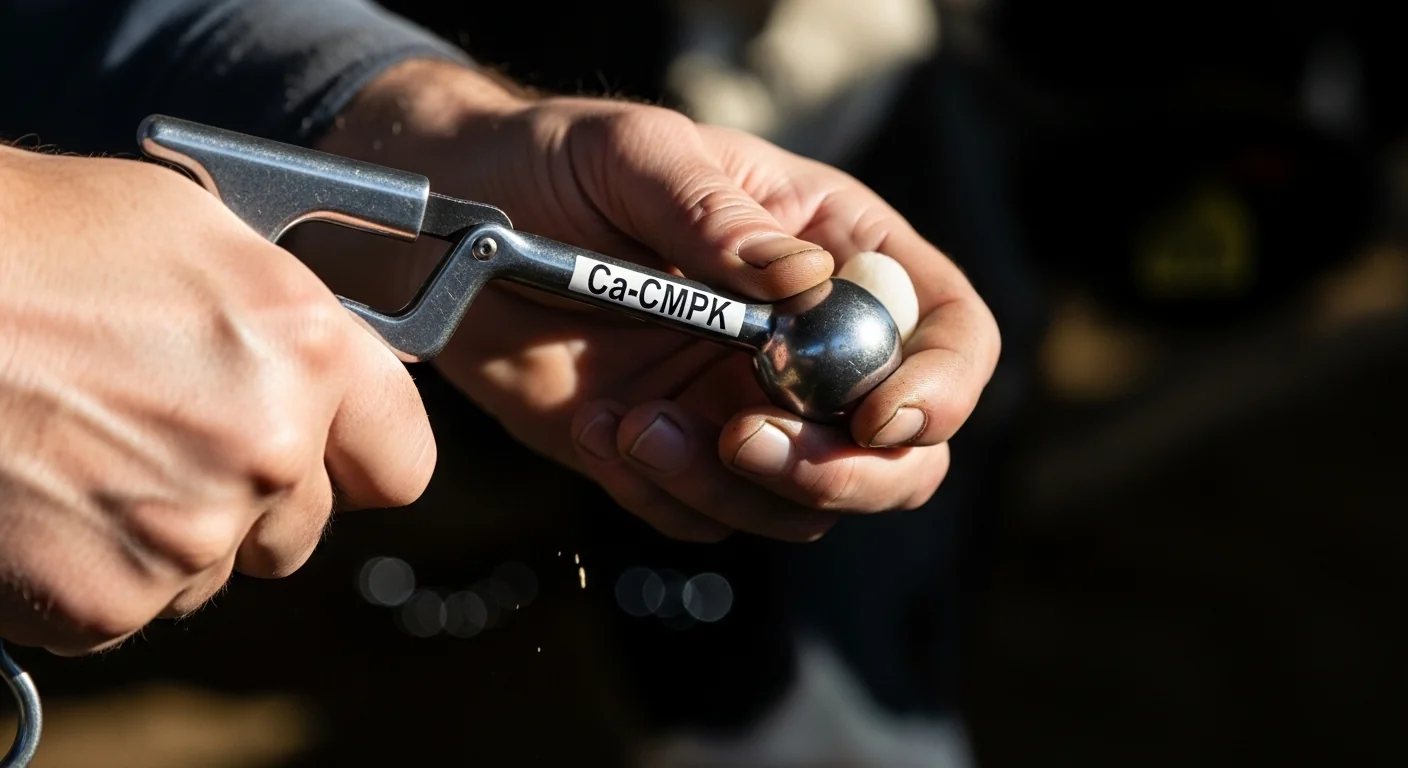
Once you have your calculated net balance, the immediate decision branches into three paths. A clear surplus with a healthy buffer means the current ration is likely adequate for this animal at this production stage, and the main action is repeating the calculation when production changes significantly (up or down 20 lbs per day) or when the forage source changes. A marginal result in the -20 to 0 g/day range warrants a closer look at whether the DMI estimate is accurate, whether the absorption rate selected matches the actual DIM stage, and whether a modest forage calcium upgrade or a preventive bolus at calving is cost-justified. A clear deficit below -20 g/day at DIM 1 to 14 calls for veterinary consultation and a pre-calving DCAD review before the next calving event.
Mineral status does not exist in isolation from the broader nutritional picture. A cow in negative calcium balance is often simultaneously in negative energy balance, which compounds immune suppression and slows the PTH response that would otherwise partially compensate for the dietary shortfall. Running the feed conversion ratio calculator alongside this tool helps identify whether the overall ration efficiency is tracking with expectations, or whether underlying intake and digestibility issues are widening the gap between what the forage analysis promises and what the cow is actually absorbing. For herds tracking water delivery as part of mineral management programs, the cattle water requirement calculator provides a baseline for ensuring adequate hydration, which affects both DMI and intestinal absorption rate.
FAQ
What is the difference between clinical milk fever and sub-clinical hypocalcemia?
Clinical milk fever involves a blood calcium drop below 5.5 mg/dL and produces visible symptoms: inability to stand, muscle tremors, cold extremities, and bloat. Sub-clinical hypocalcemia is a blood calcium of 6.0 to 8.0 mg/dL with no collapse, but with measurable consequences including suppressed immune function, increased mastitis incidence, and impaired uterine involution after calving. Sub-clinical cases are roughly four times more common than clinical cases in high-producing herds.
How often should I run this calculator for the same cow?
At minimum, run a calculation at each major transition point: the week before expected calving (using projected production), within the first 3 days post-calving, and again at DIM 14 and DIM 30. Any significant change in forage source, milk production trajectory, or body weight also warrants a recalculation. A single early-lactation result does not cover the entire freshening period.
Can I use this tool for beef cattle or other livestock?
This calculator uses dairy-specific constants: 1.22 g of calcium per pound of milk and maintenance Ca at 0.015 g/lb body weight per day. Beef cattle, nursing ewes, and goats have different milk composition, different body weight ranges, and different maintenance requirements. Applying dairy constants to beef cows or small ruminants will produce inaccurate results. The underlying formula structure is the same, but the constants need species-appropriate values.
What does DCAD mean and how does it connect to this calculator?
DCAD stands for Dietary Cation-Anion Difference, expressed as milliequivalents per kilogram of dry matter. A negative DCAD in the 3 weeks pre-calving induces a mild metabolic acidosis that upregulates the cow’s own calcium absorption and PTH response at freshening. This calculator identifies the magnitude of the calcium gap at peak demand; DCAD management is the upstream dietary strategy that narrows that gap before it occurs. These tools address different time points in the same problem.
Why does the tool show a large surplus for a cow on alfalfa hay?
Alfalfa hay typically contains 1.2 to 1.5% calcium on a dry matter basis, which is among the highest of common dairy forages. At a 45% absorption rate for a mid-lactation cow, an alfalfa-dominant ration may supply two to three times the absorbed calcium needed for a lower-production animal. This is not a problem in active lactation, but pre-calving, prolonged high-Ca feeding can suppress PTH responsiveness, which is one reason DCAD protocols often shift fresh cows away from alfalfa before calving.
Is this calculator a replacement for a ration-balancing consultation with a dairy nutritionist?
No. This tool quantifies one specific variable: the balance between absorbed dietary calcium and the combined milk export plus maintenance requirement. A complete ration analysis also covers energy balance, protein fractionation, rumen buffer status, trace mineral interactions, and DCAD calculations across the full diet. This calculator helps identify whether calcium is a likely problem and provides a starting point for a nutritionist conversation, not a substitute for one.
Conclusion
The core insight that makes this dairy cow calcium calculator different from a static reference chart is that it forces the absorption rate into the equation. A forage calcium percentage alone does not determine whether a cow is covered. The product of DMI, Ca concentration, and absorption efficiency determines what reaches the bloodstream, and that absorption rate is both highly variable across DIM stages and routinely omitted from farm-level conversations about milk fever prevention. The single most important action a producer can take before using this tool is to select the absorption rate that actually matches the DIM stage of the animal in question, not the one that produces the most comfortable result.
The number-one mistake this tool is designed to prevent is evaluating calcium adequacy at the dietary supply level while ignoring the 30 to 50% absorption gap that sits between the forage analysis report and the bloodstream. For herd managers building a complete freshening protocol, pairing this calcium analysis with a gestation timeline from the cattle gestation calculator helps align the pre-calving DCAD window, the bolus staging plan, and the freshening date into a single actionable sequence before the animal calves.