
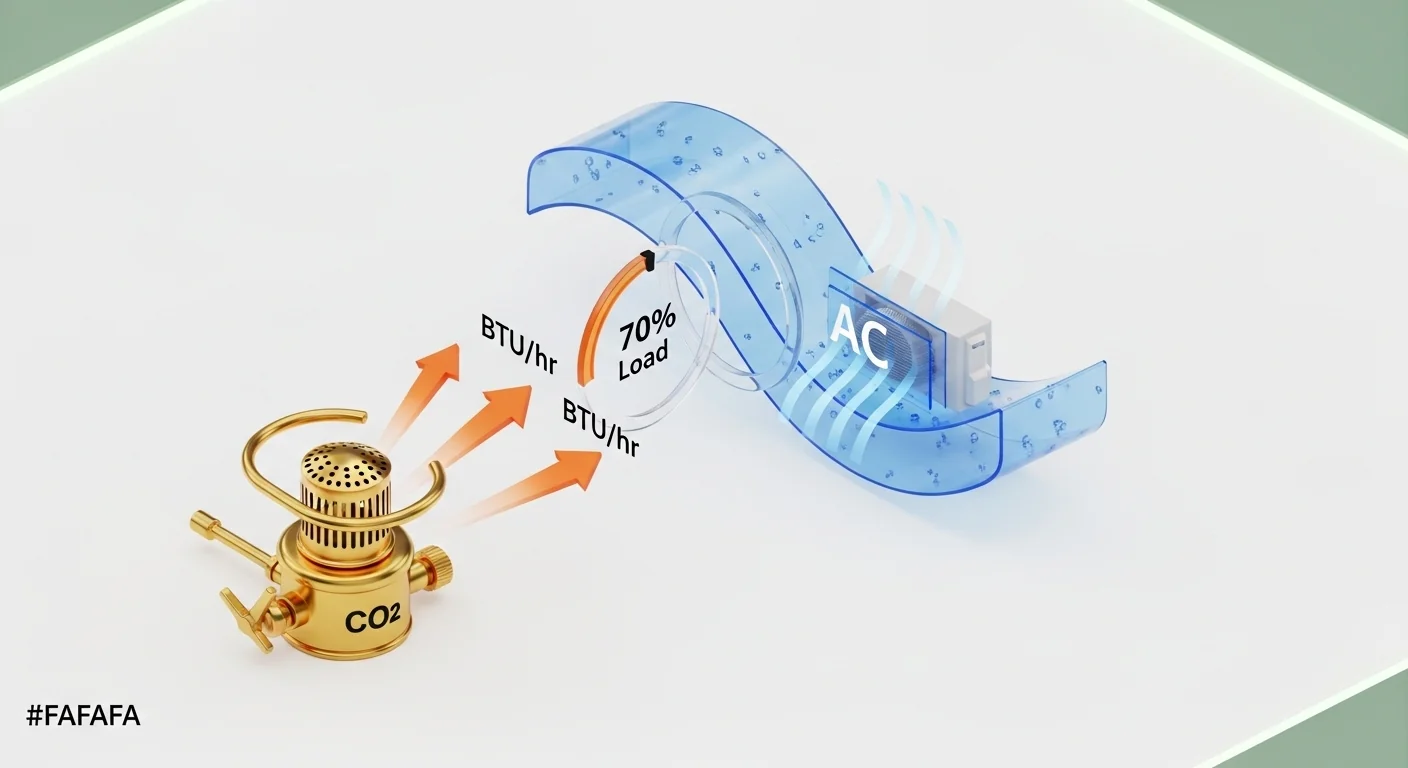
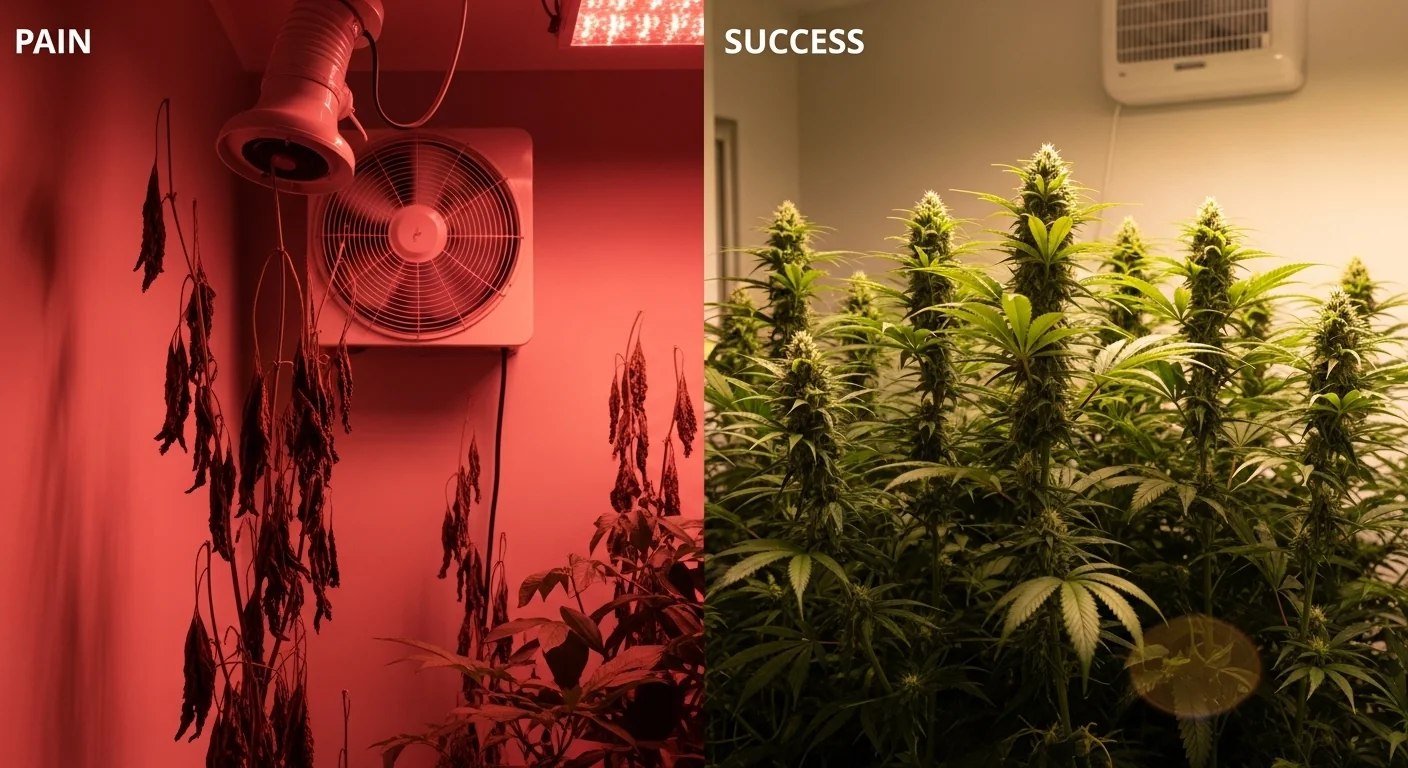
Every propane or natural gas CO2 generator is also a combustion heater running inside your grow room. That is not a side effect or an edge case; it is basic chemistry. Each burner unit converts hydrocarbon fuel into CO2, water vapor, and raw BTUs of heat, all of which enter the room simultaneously. Growers who calculate CO2 supplementation without accounting for the accompanying thermal load are solving half the problem and often creating a worse one. Understanding how your AC capacity maps to your actual heat load is what separates a stable CO2 enrichment strategy from an expensive exhaust loop.
This tool calculates the effective heat added to your room by a propane or natural gas CO2 generator based on burner count, duty cycle (runtime per hour), and fuel type. It outputs the average BTU/hr heat load, the percentage of your HVAC capacity consumed by the burner alone, the remaining thermal headroom, and a traffic-light status flag that triggers specific warnings when thresholds are crossed. What this tool does not do: it does not model ambient summer temperatures, lighting heat load, human metabolic heat, dehumidifier waste heat, or multi-zone HVAC systems. Those factors exist and matter; they should be layered on top of this calculation.
Once you know what percentage of your AC capacity the CO2 burner consumes, you can decide whether to keep running it, reduce the duty cycle, upgrade your cooling, or switch to compressed CO2 tanks for the season.
Use the Tool
CO2 Burner Heat Load & AC Offset Calculator
Greenhouse & indoor grow room thermal analysis
—
Thermal Load vs. HVAC Capacity
Warnings & Standards
Reference: Common Burner Configurations (Propane, 30 min/hr runtime)
| Burners | Full BTU/hr | At 30 min | Min AC Needed | Status |
|---|
Recommended for Your Setup
How This Calculator Works — Formula & Assumptions
Burner_BTU/hr = Number of Burners × BTU_per_burner
Propane: 2,800 BTU/burner/hr | Natural Gas: 2,500 BTU/burner/hr
Example: 8-burner propane = 8 × 2,800 = 22,400 BTU/hr at continuous run.
AddedHeat = Burner_BTU/hr × (RunTime_min / 60)
This converts the duty-cycle to an average hourly heat addition rate.
Example: 22,400 × (20 / 60) = 7,467 BTU/hr average added to room.
Ratio = AddedHeat / HVAC_Capacity × 100%
Remaining_Capacity = HVAC_Capacity − AddedHeat
If AddedHeat ≥ HVAC_Capacity: THERMAL RUNAWAY risk — AC cannot offset burner heat.
If Ratio > 70% and RunTime > 30 min/hr: High risk of exhaust fan activation loop — the AC overloads, exhaust fans fire, CO2 is purged, burner re-ignites, wasting fuel and CO2. Switch to compressed CO2 tanks in summer.
• Formula uses effective hourly average, not peak BTU. Real peak is always higher during the firing cycle.
• No additional grow-light heat load is factored — add your lighting BTU to the ratio for a conservative estimate.
• Model assumes single-zone room with one AC unit handling all heat.
• “Thermal Runaway” threshold is 100% ratio (AddedHeat = HVAC capacity). “Warning zone” starts at 70%.
• Summer Bake Trap fires when ratio exceeds 70% AND runtime exceeds 30 min/hr — both conditions required.
• Results are estimates. Consult a licensed HVAC technician for production room sizing.
Powered by The Yield Grid
Before running the calculator, have three numbers ready: the number of brass burner orifices on your CO2 generator (check the unit label or product specs), the average number of minutes per hour your CO2 controller triggers the burner, and your HVAC or mini-split’s rated capacity in BTU/hr. Your AC spec sheet or the unit label will show this; a standard 2-ton mini-split is 24,000 BTU/hr. If you are pairing this calculation with a CO2 concentration calculator to verify target PPM levels, run that first so you already know your target runtime before entering it here.
Quick Start (60 Seconds)
- Number of Brass Burners: Enter the count of individual burner orifices, not the model number. A “4-burner” unit has 4 orifices. Range is 1 to 32. Do not enter a decimal; the field requires whole numbers only.
- Burner Run Time per Hour: Enter how many minutes per hour the burner actually fires. If your CO2 controller is set to cycle on for 15 minutes every hour, enter 15. The maximum is 60. A common mistake is entering the total runtime per day instead of per hour.
- Room Total HVAC Capacity: Enter your cooling system’s rated BTU/hr. This must be your cooling capacity, not your heating rating. Mini-splits and window units list cooling BTU/hr prominently. Do not convert tons to BTU manually with guesswork: 1 ton = 12,000 BTU/hr exactly.
- Fuel Type: Select Propane or Natural Gas. This changes the BTU output per burner used in the formula (2,800 BTU for propane; 2,500 BTU for natural gas). Do not assume they are interchangeable; natural gas carries roughly 10.7% less energy per burner at equivalent orifice sizing.
- Click Calculate: All four fields must be filled before the button processes. Clicking Calculate with an empty field shows an inline error next to the missing input rather than running a partial result.
- Check the gauge bar first: The thermal load percentage bar gives the fastest read on whether your setup is in the safe zone (below 70%), the warning zone (70 to 99%), or thermal runaway territory (100% or above).
- Use Reset to clear: The Reset button clears all inputs and collapses the results panel. It does not refresh the page.
Inputs and Outputs (What Each Field Means)
| Field | Unit | What It Means | Common Mistake | Safe Entry Guidance |
|---|---|---|---|---|
| Number of Brass Burners | Count (integer) | The number of individual burner orifices that combust fuel simultaneously. Each orifice is modeled at a fixed BTU output per the selected fuel type. | Entering the model series number (e.g., “8” for an 8-series unit) when the physical unit has a different orifice count. | Check the unit’s physical label or specification sheet. Acceptable range: 1 to 32. |
| Burner Run Time per Hour | Minutes/hr | The average number of minutes per hour the CO2 controller activates the burner. This sets the duty cycle used in the heat calculation. | Entering total daily runtime instead of per-hour runtime, inflating the calculated heat load significantly. | Review your CO2 controller log or timer setting. Acceptable range: 1 to 60 minutes. |
| Room Total HVAC Capacity | BTU/hr | The rated cooling output of your air conditioning system. This is the ceiling against which the burner heat load is compared. | Using the heating BTU rating instead of the cooling BTU rating. On many units these differ by 15 to 30%. | Read the cooling spec from the unit nameplate or product data sheet. A 2-ton unit = 24,000 BTU/hr. |
| Fuel Type | Propane / Natural Gas | Sets the BTU/hr per burner constant. Propane: 2,800 BTU/burner/hr. Natural gas: 2,500 BTU/burner/hr. | Treating propane and natural gas as equivalent. A 10-burner natural gas unit produces 25,000 BTU/hr vs. 28,000 for propane. | Select the fuel your generator actually runs on. Do not leave on the default if you use natural gas. |
| Added Heat Load (output) | BTU/hr | The average hourly heat load the CO2 burner adds to the room, accounting for duty cycle. This is the primary result. | Confusing this figure with the peak BTU/hr at full continuous run, which is always higher during the active firing period. | Use this number to compare against HVAC capacity. Add grow-light heat load on top for a conservative total estimate. |
| Full-Hour Burner Output (output) | BTU/hr | The peak heat output if the burner ran continuously for a full hour with no cycling. Useful for worst-case sizing. | Using this figure as the operating average when the controller cycles. The actual average is lower by the duty cycle ratio. | Reference value. Use “Added Heat Load” for operating calculations, this value for peak/emergency sizing. |
| HVAC Remaining Capacity (output) | BTU/hr | How much cooling capacity remains after the CO2 burner heat is subtracted. A negative number indicates thermal runaway. | Ignoring that this remaining headroom must also absorb grow-light heat, ambient infiltration, and dehumidifier waste heat. | Treat this as the upper bound on additional heat sources you can add before HVAC is fully saturated. |
| Thermal Load Ratio (output) | % of HVAC capacity | The CO2 burner heat expressed as a fraction of total HVAC capacity. Below 70% is the safe operating zone. | Treating any value below 100% as acceptable, when values above 70% leave no headroom for other heat sources. | Target below 50% if you also run high-intensity lighting. The 70% threshold assumes no other significant heat load. |
If you are also accounting for heat contributed by high-intensity discharge or LED lighting in this same room, a greenhouse heater sizing check can help you establish the full seasonal heat balance rather than isolating just one heat source.
Worked Examples (Real Numbers)
Scenario 1: Small Room, Conservative Setup
- Burners: 4 (propane)
- Runtime: 20 minutes per hour
- HVAC Capacity: 24,000 BTU/hr (2-ton mini-split)
Calculation: Full-hour output = 4 x 2,800 = 11,200 BTU/hr. Added heat at 20-minute duty cycle = 11,200 x (20/60) = 3,733 BTU/hr. Thermal load ratio = 3,733 / 24,000 = 15.6% of HVAC capacity.
Result: 3,733 BTU/hr added heat load. Status: SAFE.
This configuration leaves 20,267 BTU/hr of HVAC headroom for grow lights, ambient heat gain, and dehumidification. Well within the safe zone even in summer, assuming adequate room insulation.
Scenario 2: Mid-Size Room, Moderate Duty Cycle
- Burners: 8 (propane)
- Runtime: 30 minutes per hour
- HVAC Capacity: 24,000 BTU/hr
Calculation: Full-hour output = 8 x 2,800 = 22,400 BTU/hr. Added heat at 30-minute duty cycle = 22,400 x (30/60) = 11,200 BTU/hr. Thermal load ratio = 11,200 / 24,000 = 46.7%.
Result: 11,200 BTU/hr added heat load. Status: Approaching caution threshold.
The CO2 burner alone consumes nearly half the HVAC capacity. In a room also running 1,000 watts of HPS lighting (approximately 3,412 BTU/hr), the combined burner-plus-lighting load hits 14,612 BTU/hr, pushing the HVAC to 60.9% utilization. Still within bounds, but with thin margin in summer ambient conditions.
Scenario 3: The Summer Bake Trap in Action
- Burners: 8 (propane)
- Runtime: 45 minutes per hour
- HVAC Capacity: 18,000 BTU/hr (1.5-ton unit)
Calculation: Full-hour output = 8 x 2,800 = 22,400 BTU/hr. Added heat at 45-minute duty cycle = 22,400 x (45/60) = 16,800 BTU/hr. Thermal load ratio = 16,800 / 18,000 = 93.3%.
Result: 16,800 BTU/hr added heat load. Status: DANGER (Summer Bake Trap conditions met: ratio above 70%, runtime above 30 minutes per hour).
This combination leaves only 1,200 BTU/hr of theoretical HVAC headroom, which is eliminated by any other heat source. The AC reaches saturation, the thermostat triggers exhaust fans, CO2 is purged through the ventilation, and the CO2 controller fires the burner again to recover target PPM. The loop repeats until either the fuel runs out or the runtime is manually reduced.
Reference Table (Fast Lookup)
All values below use propane fuel (2,800 BTU/burner) unless noted. The “Min AC for Safe 30-min Run” column shows the minimum HVAC capacity needed to keep the thermal load ratio below 70% at a 30-minute-per-hour duty cycle. Values are rounded to the nearest 100 BTU/hr.
| Burners | Fuel | Full BTU/hr (Continuous) | Added Heat at 20 min/hr | Added Heat at 30 min/hr | Added Heat at 45 min/hr | Min AC for Safe 30-min Run (BTU/hr) |
|---|---|---|---|---|---|---|
| 2 | Propane | 5,600 | 1,867 | 2,800 | 4,200 | 4,000 |
| 4 | Propane | 11,200 | 3,733 | 5,600 | 8,400 | 8,000 |
| 6 | Propane | 16,800 | 5,600 | 8,400 | 12,600 | 12,000 |
| 8 | Propane | 22,400 | 7,467 | 11,200 | 16,800 | 16,000 |
| 10 | Propane | 28,000 | 9,333 | 14,000 | 21,000 | 20,000 |
| 12 | Propane | 33,600 | 11,200 | 16,800 | 25,200 | 24,000 |
| 8 | Natural Gas | 20,000 | 6,667 | 10,000 | 15,000 | 14,300 |
| 12 | Natural Gas | 30,000 | 10,000 | 15,000 | 22,500 | 21,400 |
| 16 | Propane | 44,800 | 14,933 | 22,400 | 33,600 | 32,000 |
Derived column: “Min AC for Safe 30-min Run” = Added Heat at 30 min/hr divided by 0.70. This is the minimum HVAC rating that keeps the CO2 burner’s thermal contribution below the 70% warning threshold, with no other heat loads factored in.
How the Calculation Works (Formula + Assumptions)
Show the calculation steps
Step 1: Rated burner output
Full_BTU_per_hr = Number_of_Burners x BTU_per_Burner
Where BTU_per_Burner = 2,800 for propane, or 2,500 for natural gas.
This gives the continuous thermal output if the burner ran without cycling for a full hour.
Step 2: Effective added heat (duty-cycle adjusted)
Added_Heat_BTU_per_hr = Full_BTU_per_hr x (Runtime_minutes / 60)
This converts the cycled runtime into an hourly average heat load. At 30 minutes per hour, the effective load is exactly half of continuous output. At 45 minutes per hour, it is three-quarters.
Step 3: Thermal load ratio
Ratio = Added_Heat_BTU_per_hr / HVAC_Capacity_BTU_per_hr
Expressed as a percentage. Safe zone: below 70%. Warning zone: 70% to 99%. Thermal runaway zone: 100% or above.
Step 4: Remaining HVAC headroom
Remaining = HVAC_Capacity – Added_Heat_BTU_per_hr
A negative value means the burner heat load exceeds the HVAC rating. A value near zero means any additional heat source (lights, dehumidifier, ambient) will push into runaway.
Rounding: Added heat and remaining capacity are rounded to the nearest whole BTU/hr for display. Ratios are displayed to one decimal place.
Assumptions and Limits
- BTU output per burner is modeled as a fixed constant: 2,800 BTU/hr for propane and 2,500 BTU/hr for natural gas. Real-world output varies by orifice diameter, gas supply pressure, altitude, and burner age. The constants represent industry-standard averages for brass orifice CO2 generator units.
- The formula assumes a single-zone room with one continuous HVAC system. Rooms with multi-zone systems, radiant cooling, or chilled water cooling require different modeling.
- Grow-light heat load is not included. High-intensity lighting (HPS, CMH, HID) typically adds 3,000 to 6,000+ BTU/hr per kilowatt of electrical draw. This must be added manually to the remaining capacity figure for a realistic assessment.
- Dehumidifier heat output is not modeled. Dehumidifiers reject heat into the room as a byproduct of condensation. In humid climates, this can add 5,000 to 12,000 BTU/hr or more to the thermal load.
- The 70% warning threshold assumes no other significant heat sources beyond the CO2 burner. In rooms with active lighting and dehumidification, a safer operating target is below 40 to 50% of HVAC capacity for the burner alone.
- The Summer Bake Trap flag triggers when thermal ratio exceeds 70% and runtime exceeds 30 minutes per hour simultaneously. At lower ambient temperatures, the same setup may perform without issue; the trap is most destructive during peak summer heat when AC is already working near its rated output.
- Propane pressure drop is not modeled. A near-empty or undersized propane tank can cause supply pressure to drop, reducing BTU output and producing incomplete combustion (CO, not CO2). This tool assumes full tank pressure at all times.
Standards, Safety Checks, and “Secret Sauce” Warnings
Critical Warnings
- Thermal Runaway Threshold (100% ratio): When the CO2 burner’s effective heat load meets or exceeds HVAC capacity, the room temperature rises until the thermostat activates exhaust fans. Those fans pull room air out and with it all the CO2 that was just generated. The burner controller reads a drop in PPM and fires again, adding more heat. The loop continues, wasting fuel and CO2 enrichment while progressively heating the room. This is not a theoretical failure mode; it is a predictable outcome when thermal load ratio reaches 100%.
- Summer Bake Ventilation Trap (ratio above 70%, runtime above 30 min/hr): The combination of high duty cycle and high thermal load creates a high-probability exhaust fan loop even before thermal runaway is technically reached. Ambient summer temperatures reduce the effective BTU/hr capacity of AC systems below their nameplate rating. A unit rated at 24,000 BTU/hr at 95 degrees Fahrenheit outdoor ambient may deliver 18,000 to 20,000 effective BTU/hr in a hot attic space or poorly ventilated utility room. Growers relying on nameplate ratings during peak summer without derating are operating on false headroom.
- CO2 enrichment at night (lights-off) creates a different heat equation: Some growers run CO2 burners during lights-off periods to maintain CO2 levels overnight. Without lighting heat to offset, the room temperature drops and the CO2 benefit is negligible (plants do not photosynthesize without light). The burner heat, however, remains. Running a CO2 burner lights-off with reduced cooling is a thermal inefficiency with no biological benefit during the dark cycle.
- Natural gas pressure variation: Unlike a sealed propane tank, natural gas supply pressure can vary during peak demand hours. A pressure drop mid-cycle reduces burner BTU output and shifts combustion chemistry toward incomplete products. The thermal model in this tool does not account for supply-side pressure variation.
Minimum Standards
- The CO2 burner thermal load ratio should remain below 70% of HVAC capacity when operating during lights-on periods, assuming no other major heat sources. This is the safe operating floor.
- Any room running a CO2 burner should have a calibrated CO2 controller with a high-CO2 shutoff (typically 1,500 to 2,000 PPM maximum) to prevent over-enrichment during short purge cycles.
- Propane installations of 8 burners or larger should use a minimum 100-lb tank with a high-capacity regulator. Undersized supply creates pressure drop at full burner demand, degrading combustion quality.
- HVAC capacity for rooms running CO2 burners should be sized at a minimum 1.4x the combined heat load of all sources (lights, burner, dehumidifier, ambient gain), not just the CO2 burner in isolation. The exhaust fan sizing tool can help you model ventilation as a supplemental cooling path when the AC thermal budget is tight.
Competitor Trap: Most CO2 generator guides and BTU articles focus exclusively on the CO2 enrichment side of the equation: how many burners for a given room volume, what PPM target to set, how long to run. The thermal consequences of those same decisions are rarely addressed in the same content. A calculator that shows only CO2 output without flagging that an 8-burner propane unit running 45 minutes per hour adds 16,800 BTU/hr to the room is giving growers half the picture. The hidden cost is not just wasted fuel; it is the CO2 itself being vented through exhaust fans the moment the AC is overwhelmed. If you use a dehumidifier sizing calculator separately from your CO2 calculation, you are already modeling heat sources in silos. They all interact in the same thermal envelope.
Common Mistakes and Fixes
Mistake: Using Nameplate HVAC BTU Without Derating for Summer Conditions
Air conditioner BTU ratings are specified at standard test conditions, typically 95 degrees Fahrenheit outdoor temperature for SEER testing. In hot climates or poorly ventilated utility spaces where outdoor ambient exceeds that benchmark, effective cooling output drops. A unit rated at 24,000 BTU/hr may deliver 19,000 to 21,000 BTU/hr effective output on a 105-degree afternoon. Using the nameplate figure overstates available headroom and produces a false-safe reading on the thermal load gauge.
Fix: Apply a 10 to 15% derating to your HVAC BTU/hr input when running calculations for summer peak conditions, or enter the manufacturer’s performance data at your actual peak outdoor temperature.
Mistake: Treating Duty Cycle as Optional or Approximate
The runtime-per-hour entry is not cosmetic; it is the variable that converts peak BTU output into an effective hourly load. Entering 60 minutes when your controller actually runs the burner 20 minutes per hour produces a result that is 3x higher than the real operating load, which may cause unnecessary alarm or incorrect equipment decisions.
Fix: Check your CO2 controller’s cycle log or timer setting. If using a proportional controller without a fixed timer, observe and average several actual cycle durations over a representative growing period.
Mistake: Calculating CO2 Heat Without Including Lighting Heat in the Same Room
A 1,000-watt HPS fixture converts nearly all of its electrical draw to heat: approximately 3,412 BTU/hr. A room with four 1,000-watt fixtures adds roughly 13,648 BTU/hr of lighting heat to the HVAC load, before the CO2 burner is even switched on. Calculating the CO2 burner in isolation and finding a green “safe” status does not mean the room’s total thermal load is safe. The burner heat must be added to all other heat sources to assess total HVAC utilization. For a full accounting of how lighting contributes to your room’s heat budget, the grow light cost and heat calculator can model that separately.
Fix: After getting your CO2 burner’s added heat load from this tool, subtract that number plus your lighting BTU/hr from your total HVAC capacity manually, and confirm the combined load stays below 80% of rated capacity.
Mistake: Switching to Compressed CO2 Without Checking Tank Duration
The standard recommendation when a CO2 burner overwhelms the AC is to switch to compressed CO2 tanks during summer. That recommendation is correct in thermal terms, but compressed CO2 runs out. A 50-lb CO2 tank in a 10×10 room targeting 1,200 PPM may last only two to four days of lights-on enrichment depending on room leakage and injection rate. A grower who makes the switch without modeling tank duration often faces an uncontrolled drop to ambient CO2 levels mid-cycle. Use a CO2 tank duration calculator before committing to a compressed gas strategy for an extended summer run.
Fix: Model both the thermal benefit and the economic cost of compressed CO2 before making a seasonal switch. For most rooms over 500 square feet, 100-lb tanks manifolded in pairs are the minimum practical unit.
Mistake: Running CO2 Burners During Lights-Off Periods
Plants only utilize CO2 during photosynthesis, which requires light energy. Running a CO2 burner during dark periods maintains elevated CO2 PPM in the room air, but contributes zero photosynthetic benefit while still generating combustion heat and consuming propane. Some controllers are programmed to maintain 24-hour CO2 saturation without this caveat being addressed in the setup guide.
Fix: Wire the CO2 controller’s enable input to the same lighting timer circuit so the burner can only activate during lights-on hours. This eliminates lights-off fuel waste entirely and removes a heat source during the period when cooling demand is often already lower.
Next Steps in Your Workflow
Once you have your thermal load ratio and added heat load from this calculator, the immediate next question is usually how to optimize the full climate loop. Temperature, humidity, and CO2 interact. If your thermal load is above 70% but you are not yet in thermal runaway, the most effective intervention is often reducing runtime rather than upgrading hardware. A drop from 40 to 30 minutes per hour of runtime reduces added heat by 25% while keeping CO2 enrichment effective. Pair that with a check on your vapor pressure deficit to confirm that reduced ventilation isn’t driving humidity out of the optimal range; the VPD calculator can model that directly.
If the thermal load ratio is high and runtime is already at its minimum to maintain target CO2 PPM, the next step is addressing the cooling equation directly. This may mean modeling a larger AC unit, a supplemental exhaust path, or a seasonal switch to compressed CO2 tanks. Rooms with tight thermal budgets often benefit from a dedicated exhaust strategy modeled separately from the CO2 plan; the greenhouse fan calculator can help you size that ventilation path as a supplemental heat removal mechanism rather than a CO2-venting emergency release.
FAQ
What is the average BTU output of a CO2 burner per burner orifice?
For propane-fueled CO2 generators, the industry standard is approximately 2,800 BTU/hr per brass burner orifice. Natural gas burners of equivalent orifice sizing produce approximately 2,500 BTU/hr per orifice, reflecting the lower energy density of methane compared to propane. These are average figures; actual output varies by supply pressure, altitude, and orifice condition.
At what thermal load ratio does a CO2 burner become dangerous to operate?
The warning zone begins at 70% of HVAC capacity. This threshold is not arbitrary; it is the point at which other heat sources (lighting, dehumidifiers, ambient infiltration) are likely to push the total load toward saturation. The thermal runaway condition occurs at 100% or above, when added heat meets or exceeds HVAC cooling capacity and exhaust fans are forced to activate, purging CO2 from the room.
Should CO2 burners be turned off in summer?
Not necessarily turned off, but re-evaluated. In rooms where the burner’s thermal load ratio exceeds 70% during peak summer conditions after derating the AC for ambient heat, switching to compressed CO2 tanks eliminates the heat load entirely while maintaining CO2 enrichment. In cooler climates or rooms with high AC capacity, summer operation may remain viable with reduced duty cycles.
Does natural gas produce less heat than propane in a CO2 generator?
Yes. The calculator models natural gas at 2,500 BTU per burner per hour versus 2,800 for propane, a difference of approximately 300 BTU per burner. In an 8-burner unit running 30 minutes per hour, that is a difference of 1,200 BTU/hr in effective added heat load. The CO2 output per unit of combustion is also slightly different, but both fuels produce CO2 as the primary carbon product under complete combustion.
Can I use this calculator for greenhouse CO2 generators, not just indoor grow rooms?
The formula applies to any enclosed space with a CO2 generator and mechanical cooling, including commercial greenhouses with HVAC systems. Open or semi-open greenhouses with passive ventilation operate differently; the thermal load ratio concept assumes a sealed or near-sealed environment where the AC is the primary heat removal mechanism. Naturally ventilated greenhouses have a different heat balance and exhaust dynamic.
Why does the Summer Bake Trap warning require both a high ratio and high runtime?
Both conditions must be true because either alone is insufficient to trigger the failure loop. A high thermal load ratio with a short runtime may still leave HVAC headroom on a cool day. A long runtime with a low ratio simply means the AC has excess capacity. The trap activates when the AC is near saturation (ratio above 70%) and the burner is running frequently enough (above 30 minutes per hour) that any ambient temperature spike pushes the system into exhaust fan activation.
Conclusion
The core insight this calculator enforces is one that most CO2 enrichment guides skip: every unit of CO2 produced by a combustion-based generator comes with a fixed quantity of heat. The two outputs are inseparable. Optimizing CO2 without modeling the heat means optimizing one side of a coupled system while ignoring the other. The Summer Bake Ventilation Trap is not a fringe scenario; it is the predictable outcome for any grower running a high-burner-count unit against an undersized or summer-derated AC system. The single most common mistake is treating the generator’s thermal load as negligible because it is not the primary purpose of the device.
After you have your thermal load ratio and heat load numbers, the next calculation that connects directly to this one is CO2 concentration modeling for your specific room volume. The greenhouse CO2 calculator covers the PPM side of the equation, so you can cross-reference target CO2 levels, injection rates, and ventilation loss rates against the thermal constraints this tool quantifies. Running both calculations together gives a complete picture of whether a combustion CO2 strategy is viable for your specific setup, season, and cooling infrastructure.