
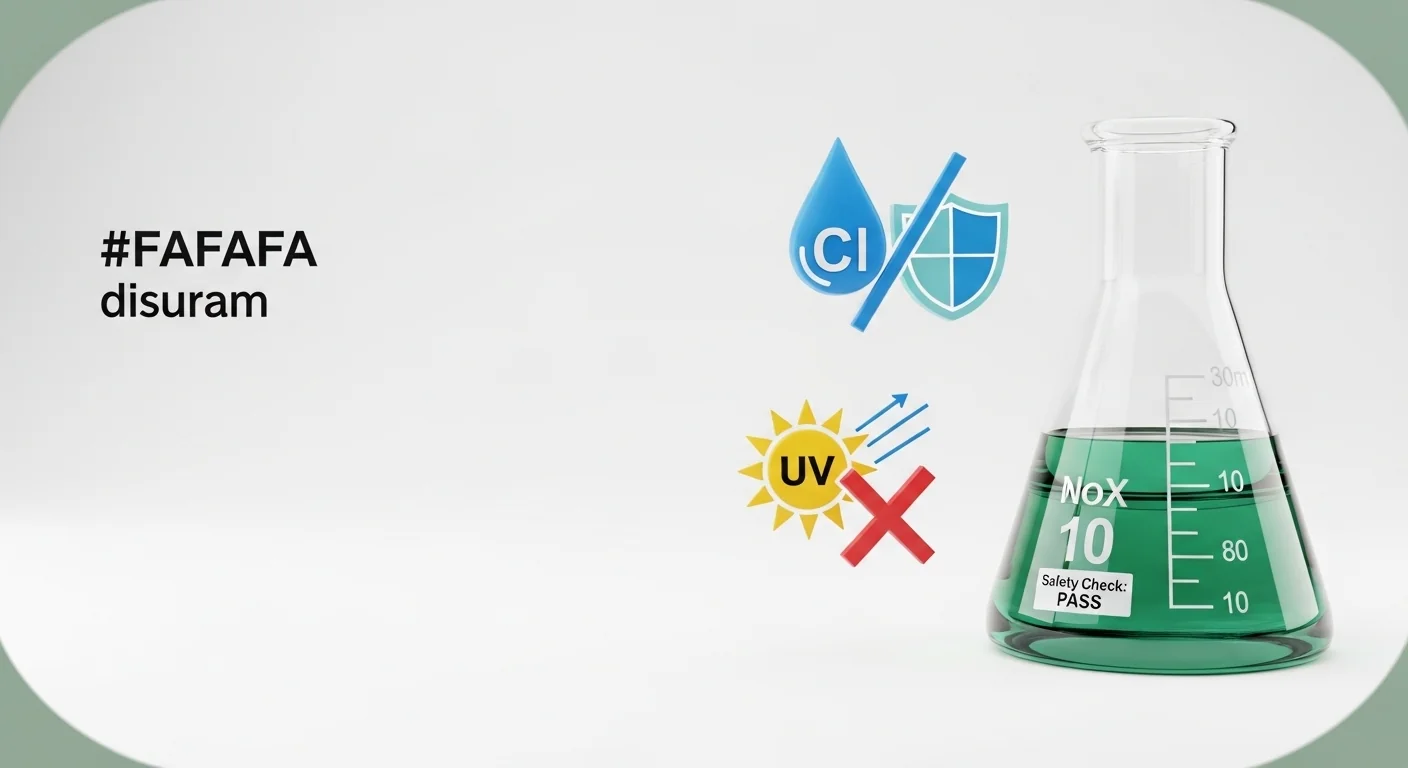
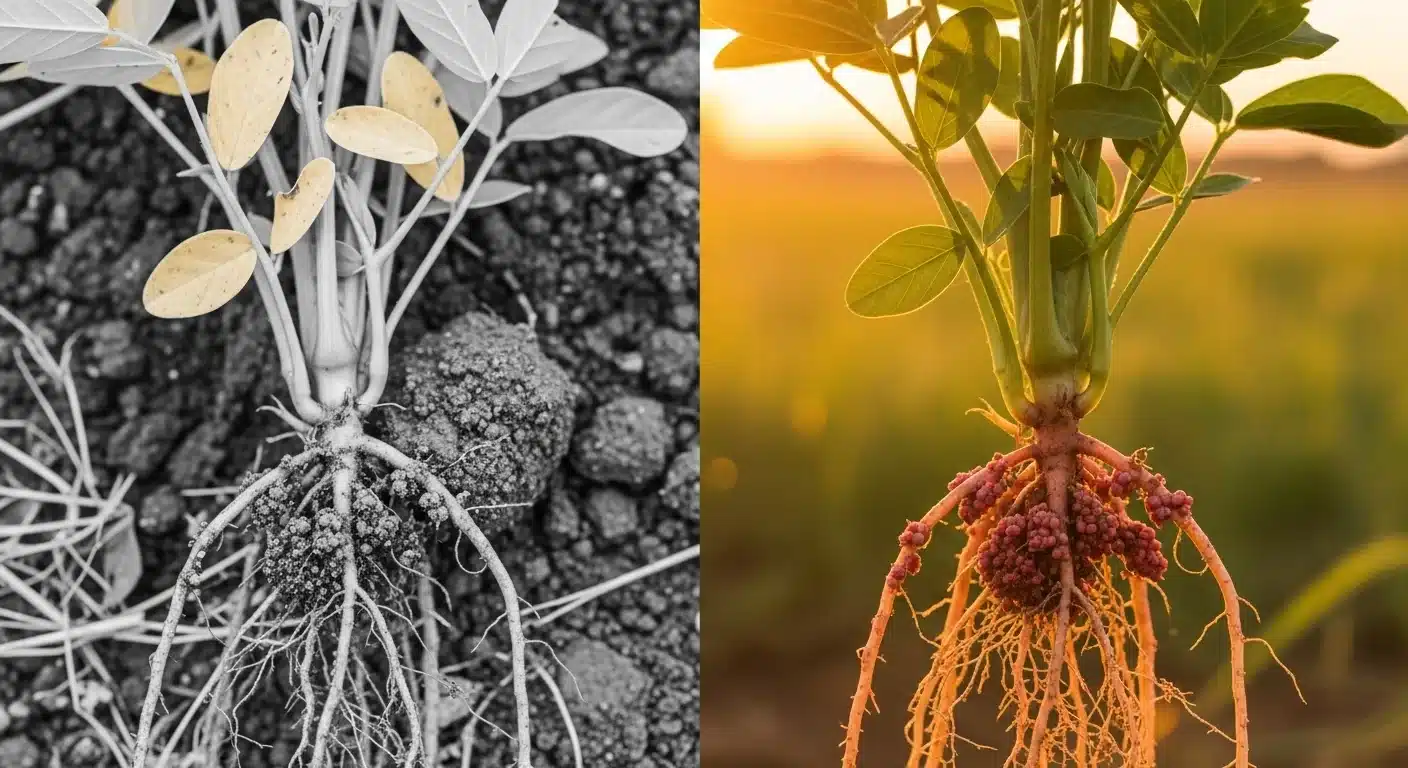
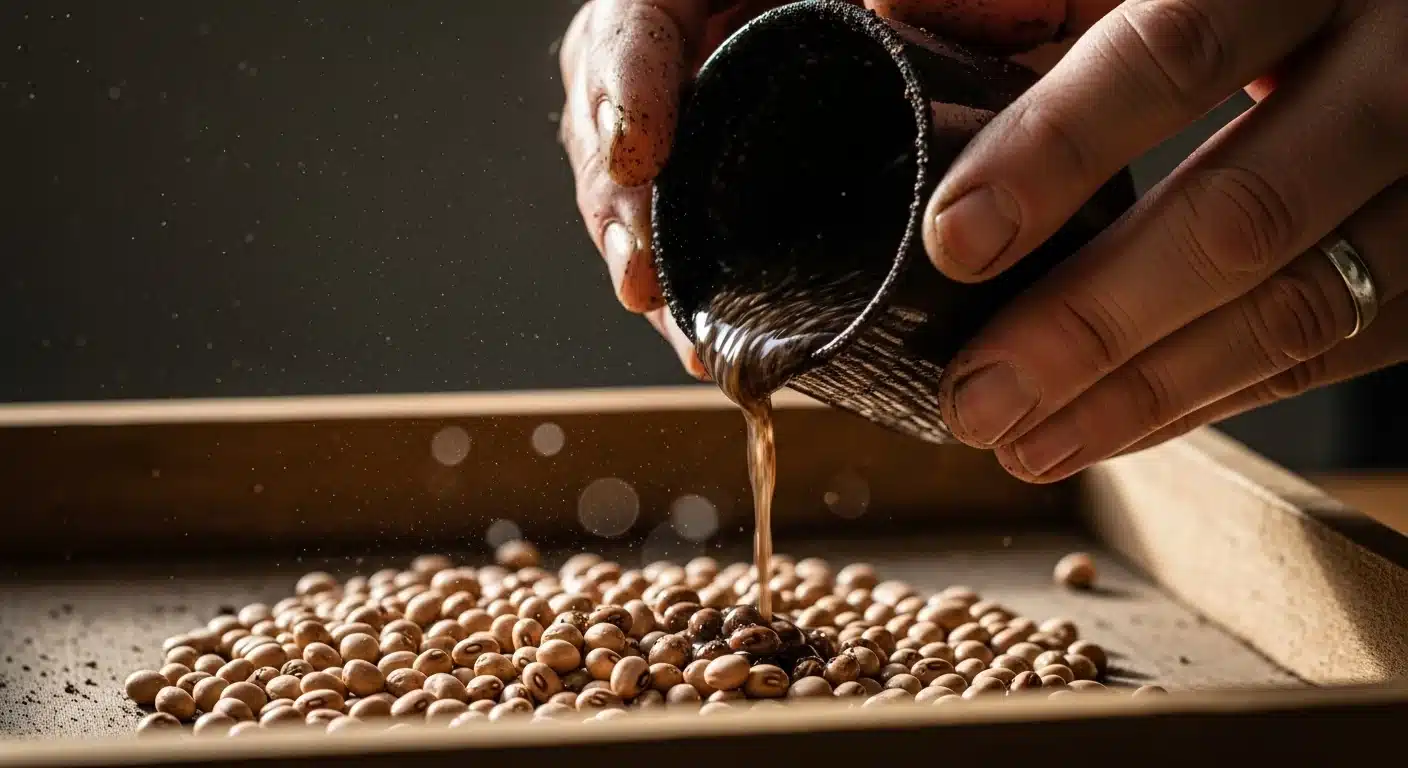
The math behind a seed inoculant application rate is simple: divide your seed weight by 100, multiply by your label rate, and you have your ounce target. What the label does not tell you is that a single step taken after that calculation can destroy every viable Rhizobia cell in the batch before planting begins. Chlorinated tap water mixed into a coating slurry, or freshly coated seed left in direct sunlight for an afternoon, results in sterile seed that looks perfectly treated and produces zero nitrogen-fixing nodules.
This tool calculates the exact quantity of peat-based or liquid Rhizobia inoculant required for a given seed lot and, if you are making a coating slurry, the correct water volume to pair with it. It also runs three deterministic biological safety checks against your inputs: chlorine exposure, UV sterilization risk, and application rate adequacy. What it does not do is predict yield outcomes, model soil nitrogen pools, or account for pre-existing Rhizobia populations already established in your field. Those variables sit outside the scope of any single-input calculator and require soil testing combined with local agronomist guidance. For a complete nitrogen fertility picture, a nitrogen calculator can help you model total crop nitrogen demand alongside what biological fixation realistically contributes.
After entering your seed lot size, crop type, formulation, and target rate, you will know the exact ounce quantity to purchase, how many standard bags or bottles to source, and whether your planned mixing method contains any bacteria-killing risks that need to be corrected before you coat a single seed.
Use the Tool
Calculate exactly how much live rhizobia inoculant you need and expose biological safety traps — chlorine water, UV exposure, slurry overload — before planting.
| Seed Weight | Rate (oz/100 lbs) | Inoculant Required | Slurry Water (if used) |
|---|
How This Calculator Works — Formula & Assumptions
Core Formula: Inoculant Required
Slurry Water Volume (when making a coating slurry)
The 2× multiplier is standard practice to create a pourable slurry consistency that fully coats seed surfaces without drowning the bacteria.
Biological Safety Checks (Secret Sauce)
- Chlorine Genocide: Standard city/municipal tap water contains chlorine (0.5–2 ppm) that destroys 100% of live rhizobia bacteria on contact. Always use well water, collected rainwater, or dechlorinated water.
- UV Sterilization: Direct sun exposure >4 hours kills live bacterial inoculant on coated seeds. Plant the same day or store treated seed in cool shade.
- Application Rate Threshold: Rates below 1 oz/100 lbs risk under-inoculation, especially in soils with no prior legume history. Rates above 8 oz/100 lbs provide diminishing returns.
Assumptions & Limits
- Formula applies to peat-based and liquid inoculant formulations — always verify against your specific product label.
- Standard bag sizes referenced: Dry Peat at 10 oz/bag; Liquid at 8 oz/bottle. Adjust based on your supplier.
- Nitrogen fixation nodulation effectiveness depends on soil pH (6.0–7.0 optimal), moisture, and proper seed-to-bacteria contact — this calculator covers the physical quantity only.
- Calculator valid for seed weights between 1 lb and 1,000,000 lbs.
- Application rate valid range: 0.1 – 32 oz per 100 lbs.
Assumptions & Limits — Biological Context
Why Inoculant Matters
Legumes (soybeans, clover, alfalfa, peas) can fix atmospheric nitrogen — converting N₂ gas to plant-usable ammonia — but only through a symbiotic relationship with Rhizobia bacteria that colonize root nodules. Without adequate, viable bacteria at planting, the plant grows like a regular crop and cannot fix nitrogen.
Seed Type & Rhizobia Strain Notes
- Soybeans: Require Bradyrhizobium japonicum. Heavy inoculant users — soils with no soy history need full-rate inoculation.
- Alfalfa: Require Sinorhizobium meliloti. Very sensitive to soil pH — lime to 6.5+ before planting.
- Clover: Use Rhizobium leguminosarum bv. trifolii. Often lower rates needed if soil has prior clover history.
- Peas: Use Rhizobium leguminosarum bv. viciae. Similar to clover strains but distinct — do not cross-inoculate.
Shelf Life Warning
Peat inoculants have a 12–18 month shelf life when refrigerated (2–7°C). Liquid inoculants last 6–9 months under refrigeration. Expired inoculant produces zero nodulation — check the viability date before every planting season.
Before you open the calculator, have the following on hand: the total weight of your seed lot in pounds, your inoculant product label (which lists the application rate in ounces per 100 lbs of seed), and your water source type if you intend to make a coating slurry. Rates vary by product and sometimes by crop; do not use a generic industry figure when your label specifies otherwise.
If you are uncertain how to convert a bushel count to pounds for your crop, look up the standard test weight for that species before entering the seed weight field. Entering bushels directly will produce a significantly understated result.
Quick Start (60 Seconds)
- Seed Type: Select the specific legume being planted. Different species require different Rhizobia strains; the calculator confirms your crop context for interpretation, though it does not change the core formula.
- Total Seed Weight (lbs): Enter the total pounds of seed you intend to treat in this batch. Do not enter field acreage here. Pounds of seed is the required unit, not acres or bushels.
- Inoculant Formulation: Select Dry Peat or Liquid. This affects how standard bag quantities are estimated (10 oz per bag for dry; 8 oz per bottle for liquid). Always confirm the actual package size from your supplier.
- Target Application Rate (oz per 100 lbs): Read this directly from your inoculant product label. Acceptable inputs range from 0.1 to 32 oz per 100 lbs. Rates below 1 oz per 100 lbs trigger an under-inoculation caution.
- Making a slurry: Check this box if you plan to mix the inoculant with water before coating. This unlocks the slurry water volume output and the chlorine safety check.
- Chlorinated tap water: This is the highest-risk flag in the tool. Check it if your water comes from a municipal supply. The calculator will trigger a Chlorine Genocide warning that explains exactly what this means for bacterial viability.
- Sun exposure after coating: Check this if treated seed will sit in direct sunlight for more than four hours before planting. UV radiation destroys live bacteria on seed surfaces.
Inputs and Outputs (What Each Field Means)
| Field Name | Unit | What It Means | Common Mistake | Safe Entry Guidance |
|---|---|---|---|---|
| Seed Type | Selection | The legume crop being inoculated; determines which Rhizobia strain context applies to interpretive warnings | Selecting the wrong crop when inoculant strains are crop-specific; cross-inoculating peas with an alfalfa product | Match exactly to your seed bag label. Soybeans, alfalfa, clover, and peas each require a distinct Rhizobium strain |
| Total Seed Weight | Pounds (lbs) | The full weight of the seed lot to be treated in this session | Entering field acreage instead of seed weight, or using bushel count without converting to pounds | Multiply seeding rate (lbs/acre) by total acres. Valid range: 1 to 1,000,000 lbs |
| Inoculant Formulation | Selection | Distinguishes dry peat granule inoculant from liquid concentrate; affects bag count estimation | Using a liquid application rate from a dry peat product label or vice versa | Match to the formulation type physically in your hand. Rates are not interchangeable across formulations |
| Target Application Rate | oz per 100 lbs seed | The manufacturer-specified quantity of inoculant to apply per 100 lbs of seed | Using an industry-average rate instead of reading the product-specific label; guessing at 1 oz/100 lbs as a “standard” | Read the label. Typical range is 1 to 6 oz per 100 lbs. Enter the exact figure stated for your formulation |
| Making a Slurry (checkbox) | Yes/No | Indicates whether water will be added to create a pourable coating mixture | Forgetting to flag slurry mode and then using city tap water, triggering undetected chlorine sterilization | Check this whenever your application method involves any water mixing, even a minimal amount |
| Chlorinated Tap Water (checkbox) | Yes/No | Flags whether the water source is a municipal chlorinated supply | Assuming “a little chlorine won’t matter” — even trace chlorine at standard municipal concentrations destroys 100% of live bacteria | Use well water, collected rainwater, or carbon-filtered water for any slurry. Check this box if you are even considering tap water so the warning displays |
| Sun Exposure After Coating | Yes/No | Flags if treated seed will be exposed to direct sunlight for more than four hours before planting | Treating seed in the morning and leaving it in the field staging area all day; UV kills bacteria faster than most operators realize | Treat in shade, store in a cool dark location, and plant within the same day. Check this box if any doubt exists |
| Inoculant Required (output) | oz (and lbs) | The calculated total ounces of inoculant needed for the entered seed lot at the specified rate | Purchasing inoculant by weight without checking standard package sizes; often leads to a partial-bag shortage mid-batch | Round up to the next full bag. The bags-needed output accounts for this automatically |
| Slurry Water Volume (output) | oz | The water quantity to combine with the inoculant when making a coating slurry; calculated at 2x the inoculant volume | Adding water by feel; over-diluted slurry does not adhere properly to seed surfaces | Measure water accurately. The 2x multiplier is a standard slurry consistency target, not an approximation |
| Bags / Bottles Needed (output) | Count | Ceiling-rounded count of standard package units required based on formulation type | Treating bag count as exact without verifying the actual oz/package from the specific brand purchased | Confirm the oz per package with your supplier. Standard reference sizes (10 oz dry, 8 oz liquid) may differ from your product |
Worked Examples (Real Numbers)
Scenario 1: 500-lb Soybean Lot, Dry Peat, No Slurry
- Seed Type: Soybeans
- Seed Weight: 500 lbs
- Formulation: Dry Peat
- Application Rate: 3 oz per 100 lbs
- Slurry: No
Result: (500 / 100) x 3 = 15 oz of dry peat inoculant. At 10 oz per standard bag, this requires 2 bags (20 oz purchased, 5 oz surplus).
This is a typical soybean planting scenario. The dry application eliminates the slurry water risk entirely, making it the lower-risk method for operators using municipal water sources.
Scenario 2: 1,000-lb Alfalfa Lot, Liquid Inoculant, Slurry Method
- Seed Type: Alfalfa
- Seed Weight: 1,000 lbs
- Formulation: Liquid
- Application Rate: 2 oz per 100 lbs
- Slurry: Yes
- Chlorinated Water: No (well water used)
Result: (1,000 / 100) x 2 = 20 oz of liquid inoculant. Slurry water volume: 20 x 2 = 40 oz. Total slurry: 60 oz. Bags needed: 3 bottles at 8 oz each (24 oz purchased, 4 oz surplus).
The slurry method is common for alfalfa because the small seed size benefits from a uniform wet coat. Well water eliminates the chlorine risk, but UV exposure during field staging still requires vigilance on sunny planting days.
Scenario 3: 250-lb Clover Lot, Dry Peat, Slurry Method
- Seed Type: Clover
- Seed Weight: 250 lbs
- Formulation: Dry Peat
- Application Rate: 4 oz per 100 lbs
- Slurry: Yes
- Chlorinated Water: Yes (tap water flagged)
Result: (250 / 100) x 4 = 10 oz of dry peat inoculant. Slurry water: 10 x 2 = 20 oz. Total slurry: 30 oz. Bags: 1 standard bag (10 oz, no surplus).
This scenario triggers the Chlorine Genocide warning. The math is sound; the biology is at critical risk. Switching to collected rainwater before mixing costs nothing and preserves the entire bacterial population.
Reference Table (Fast Lookup)
| Seed Weight (lbs) | Rate (oz/100 lbs) | Inoculant Required (oz) | Slurry Water at 2x (oz) | Total Slurry Volume (oz) | Dry Peat Bags (10 oz) |
|---|---|---|---|---|---|
| 50 | 2 | 1.0 | 2.0 | 3.0 | 1 |
| 100 | 2 | 2.0 | 4.0 | 6.0 | 1 |
| 250 | 3 | 7.5 | 15.0 | 22.5 | 1 |
| 500 | 3 | 15.0 | 30.0 | 45.0 | 2 |
| 1,000 | 3 | 30.0 | 60.0 | 90.0 | 3 |
| 1,000 | 5 | 50.0 | 100.0 | 150.0 | 5 |
| 2,000 | 4 | 80.0 | 160.0 | 240.0 | 8 |
| 5,000 | 4 | 200.0 | 400.0 | 600.0 | 20 |
| 10,000 | 3 | 300.0 | 600.0 | 900.0 | 30 |
| 10,000 | 6 | 600.0 | 1,200.0 | 1,800.0 | 60 |
Derived column: Total Slurry Volume = Inoculant Required + Slurry Water (inoculant x 3 in total, because water = inoculant x 2). Bag counts use ceiling rounding at 10 oz per dry peat bag; adjust if your product uses a different package size.
How the Calculation Works (Formula + Assumptions)
Show the calculation steps
Step 1: Inoculant Required
Divide the total seed weight by 100, then multiply by the target application rate:
Inoculant (oz) = (Seed Weight lbs / 100) x Application Rate (oz per 100 lbs)
Step 2: Slurry Water Volume (slurry method only)
Multiply the inoculant quantity by 2 to determine the water volume:
Slurry Water (oz) = Inoculant Required (oz) x 2
Step 3: Total Slurry Volume
Total Slurry (oz) = Inoculant (oz) + Slurry Water (oz)
Step 4: Bags/Bottles Needed
Ceiling-round the inoculant required by the standard package size:
Bags = ceiling(Inoculant Required / Package Size oz)
Unit Conversions: Inoculant is reported in oz and converted to lbs (oz / 16) for display. No other unit conversion is required by this formula.
Rounding Rule: Inoculant and water outputs are rounded to 2 decimal places for display. Bag counts always round up to the nearest whole number (ceiling function).
Assumptions and Limits
- The 2x slurry water multiplier is a standard field practice for achieving pourable slurry consistency. Specific products may specify a different dilution ratio; always check your inoculant label for slurry instructions.
- Standard package sizes used for bag count estimation are 10 oz (dry peat) and 8 oz (liquid). These are reference figures only. Confirm the exact package size with your supplier before purchasing.
- The tool does not account for pre-existing native Rhizobia populations in the soil. Fields with a documented legume history may support lower application rates, but this requires soil analysis to confirm.
- Application rate thresholds (under 1 oz triggers a caution; over 8 oz triggers a notice) are general agronomic references. Your product label supersedes these thresholds if it specifies a different effective range.
- Inoculant viability is assumed. Expired inoculant, product stored above recommended refrigeration temperatures (2 to 7 degrees Celsius for peat), or product past its printed viability date will not perform at the calculated rate regardless of quantity applied.
- The formula models quantity only. Coating quality (seed coverage uniformity), planting timing, soil moisture, and soil pH (optimal 6.0 to 7.0 for most legume Rhizobia pairings) all affect nodulation success and are not captured here.
- Valid input ranges are: seed weight 1 to 1,000,000 lbs; application rate 0.1 to 32 oz per 100 lbs. Inputs outside these bounds will trigger inline validation errors and prevent the calculation from running.
Standards, Safety Checks, and “Secret Sauce” Warnings
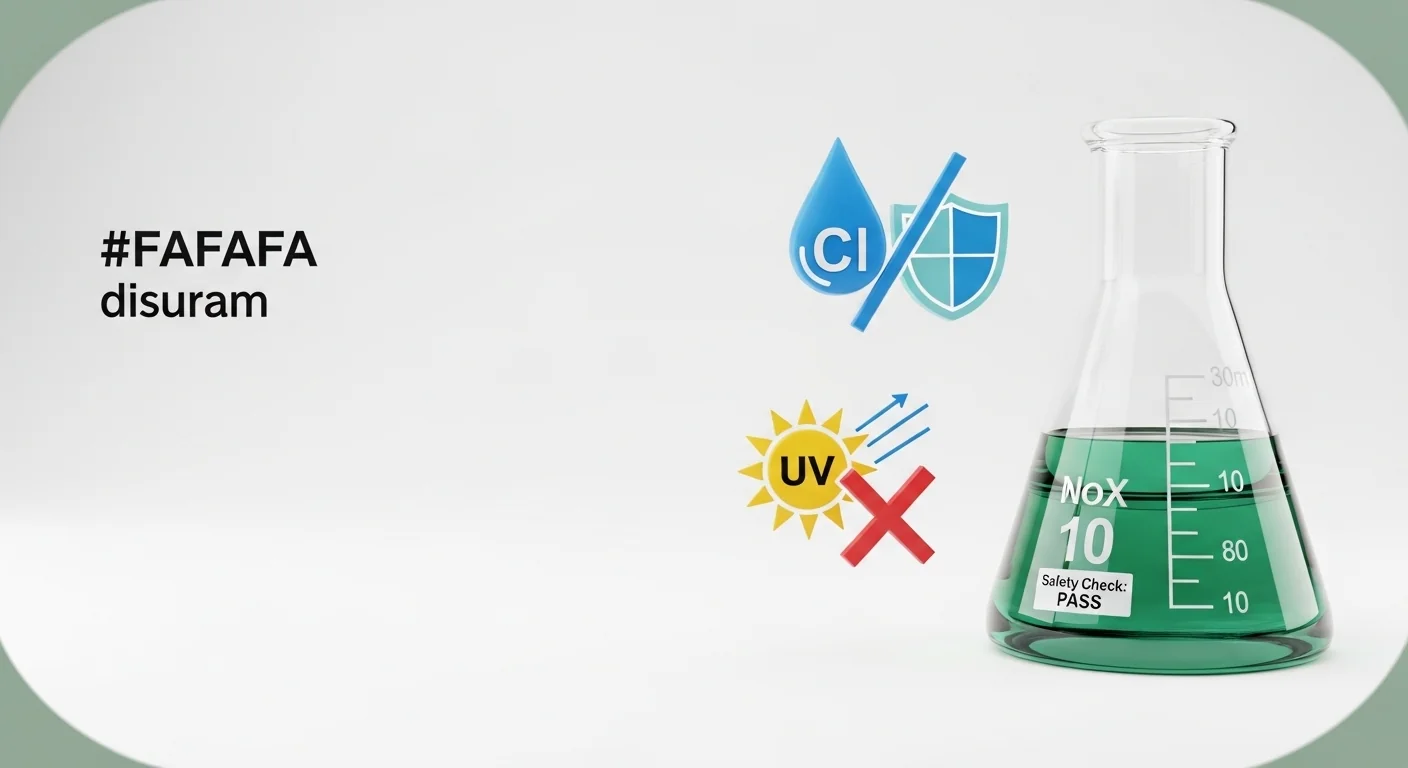
Two failure modes in Rhizobia inoculant use are nearly invisible in normal planning workflows. Both destroy the entire bacterial population after the calculation is complete and the product has been purchased. The math shows a safe result; the biology fails silently.
Critical Warnings:
- The Chlorine Genocide: Standard municipal tap water contains dissolved chlorine at concentrations that destroy 100% of live Rhizobia bacteria on contact. A farmer who purchases the correct quantity of inoculant, applies it at the correct rate, but mixes the slurry with city water plants sterile seed. The seeds appear coated. No nodules form. The crop fixes zero nitrogen from the atmosphere. Corrective action: use well water, collected rainwater, or water that has been treated through activated carbon filtration to remove chlorine before any contact with live inoculant. When planning fertilizer applications that account for biological nitrogen fixation, it is useful to separately model synthetic nitrogen contributions with an NPK calculator so you can separate what fixation was supposed to supply from what you need to supplement if nodulation fails.
- UV Sterilization After Coating: Live Rhizobia bacteria on seed surfaces are killed by direct ultraviolet radiation. Four hours of exposure in direct sunlight is sufficient to produce significant population loss. This is particularly relevant when seed is treated early in the day and left on the bed of a truck or in an open field staging area. Seeds must be planted the same day they are treated, or stored in shade at cool temperatures until planting occurs.
- Under-Inoculation in Naive Soils: Fields with no documented legume history have no established native Rhizobia population. In these conditions, application rates below 1 oz per 100 lbs carry a meaningful risk of insufficient bacterial density to colonize root hairs reliably. When soil pH also requires correction, addressing acidity before planting is equally important, since Rhizobia activity is suppressed below pH 5.8 in most legume systems. A soil pH lime calculator can help you determine how much ag lime is needed to bring the root zone into the effective Rhizobia range before planting.
Minimum Standards:
- Application rate: 1 oz per 100 lbs of seed is the practical minimum threshold for fields with no prior legume history. Higher rates apply in challenging soil conditions or where the label specifies a higher minimum.
- Water source for slurry: non-chlorinated only. Well water, collected rainwater, and activated carbon-filtered water are acceptable. Municipal tap water is not acceptable in any slurry application without dechlorination.
- Viability date: confirm the printed viability date on the package before application. Inoculant applied past its expiration date should be treated as having zero viable bacterial count regardless of apparent product quality.
- Planting window after coating: same-day planting is the target. Maximum holding time for treated seed in shade and cool temperature conditions is approximately 24 hours for most peat-based products.
Competitor Trap: Most online inoculant calculators stop at the math: divide by 100, multiply by rate, buy that many ounces. None surface the slurry water interaction with chlorine because it is a biology problem, not an arithmetic problem. Growers who use those tools walk away with the right quantity purchased and a plan that will sterilize the entire batch during mixing. This calculator exposes that failure point deterministically based on your actual inputs, not as a generic footnote buried in a product FAQ.
Common Mistakes and Fixes
Mistake: Using Tap Water for the Slurry Mix
This is the single most costly, least visible inoculant failure mode. The Rhizobia are killed instantly; the seeds look properly coated; there is no way to detect the problem until the crop emerges without nodules weeks later. Many growers attribute subsequent nitrogen deficiency to fertilizer program failures rather than tracing it to a water source decision made at coating time.
Fix: Use a dedicated water container filled from a well or a collection tank. If only municipal water is available, run it through an activated carbon filter and let it sit in an open container for at least 24 hours before use to allow chlorine off-gassing.
Mistake: Purchasing Inoculant Without Confirming Package Size
The calculator estimates bag count using 10 oz for dry peat and 8 oz for liquid as reference sizes. Actual products vary, sometimes significantly. Operators who rely on the bag count display without checking the specific product’s net weight often arrive at the field short on product mid-batch.
Fix: Before ordering, divide your calculated inoculant requirement by the actual net oz listed on the product you intend to purchase. Ceiling-round the result yourself using your supplier’s packaging.
Mistake: Treating Seed Too Far in Advance of Planting
Treating seed the evening before a full planting day and storing it in a barn overnight seems reasonable, but bacterial populations on seed surfaces decline over time even in dark, cool conditions. Treating a week in advance, which happens when farmers prepare for weather windows, can result in significant viability loss before a seed enters the soil. Proper soil amendment planning, including knowing your base nutrient levels from tools like a compost calculator for organic matter contributions, helps synchronize your planting timing so treated seed goes in the ground promptly.
Fix: Target same-day treatment and planting. If holding is unavoidable, store treated seed in sealed containers in a cool, dark location and plant within 24 hours.
Mistake: Applying One Strain to Multiple Legume Species
Soybean inoculant (Bradyrhizobium japonicum) does not colonize alfalfa roots. Alfalfa inoculant (Sinorhizobium meliloti) does not colonize pea roots. These are distinct bacterial strains with highly specific host-recognition chemistry. Cross-applying the wrong strain produces the same outcome as no inoculant: the plants grow without nodules and cannot fix atmospheric nitrogen.
Fix: Select the inoculant product specifically labeled for the crop being planted. If a mixed legume cover crop is being inoculated, use a blended product that contains strains for each species present.
Mistake: Entering Acreage or Bushels Instead of Pounds in the Seed Weight Field
The seed weight field expects pounds of seed, not acres to be planted or bushels. A grower entering “200” meaning 200 acres rather than 200 lbs of seed will calculate an inoculant requirement that is orders of magnitude too low for the actual lot size, depending on seeding rate. The resulting shortfall produces a batch where only a fraction of the seed gets properly treated.
Fix: Multiply your seeding rate in lbs per acre by the total number of acres being planted. Enter that product in pounds. For example: 60 lbs/acre x 200 acres = 12,000 lbs, not 200.
Next Steps in Your Workflow
Once you have your inoculant quantity calculated and your biological safety checks cleared, the next practical step is sourcing the product and confirming viability. Check the printed expiration date before purchasing; inoculant from a supplier who has stored it incorrectly, or product sitting on a shelf past its viability window, has no reliable bacterial count regardless of what the label says. Keep the product refrigerated at 2 to 7 degrees Celsius until planting day, and do not leave it in a truck cab, equipment cab, or anywhere that exceeds these temperatures during transport or staging.
After your inoculant is confirmed and your seed is treated, completing your nitrogen fertility plan for the season requires accounting for what biological fixation will supply versus what supplemental fertilizer needs to provide. Biological nitrogen supply depends heavily on nodulation success, which is itself a function of all the variables flagged in this tool. A manure nitrogen availability calculator can help you quantify organic nitrogen credits already applied to the field, and a NPK fertilizer calculator allows you to build out the complete fertility picture for your planting season once you know what biological fixation should contribute.
FAQ
What is the standard seed inoculant application rate for soybeans?
Most dry peat soybean inoculant products specify 2 to 4 oz per 100 lbs of seed, but this varies by product and bacterial concentration. Always read your specific product label rather than using an industry average. Higher rates are often recommended for fields with no prior soybean history or where soil conditions are challenging for Rhizobia survival.
Can I use the same inoculant for soybeans and clover?
No. Soybean inoculant contains Bradyrhizobium japonicum, which is specific to soybeans. Clover requires Rhizobium leguminosarum bv. trifolii. Applying soybean inoculant to clover seed, or vice versa, will not produce nodulation because the host-recognition chemistry is strain-specific. Each legume species requires its own matched Rhizobia strain.
Why does chlorinated water kill the bacteria in inoculant?
Chlorine is added to municipal water as a biocide to kill pathogens. It does not distinguish between harmful bacteria and beneficial Rhizobia. At standard municipal concentrations (0.5 to 2 ppm), chlorine contact with live inoculant destroys the bacterial population within minutes. The effect is complete and immediate; there is no threshold below which “a little” chlorine is safe for live inoculant slurry mixing.
How long after coating can I store treated seed before planting?
Same-day planting is the recommended target for most peat-based inoculant products. If holding is unavoidable, treated seed stored in shade at cool temperatures (below 25 degrees Celsius) and away from direct sunlight can remain viable for up to 24 hours. Longer holding periods result in progressive bacterial population loss on the seed surface even under optimal storage conditions.
Does increasing the application rate above the label rate improve nodulation?
Not meaningfully, and not reliably. Rates above 8 oz per 100 lbs provide diminishing returns because root nodule formation is limited by plant biology and soil conditions, not by excess bacterial supply. Spending more on inoculant beyond label-specified rates rarely improves outcomes and inflates input cost without a corresponding yield benefit.
Does inoculant replace the need for nitrogen fertilizer on legume crops?
Inoculant enables nitrogen fixation from the atmosphere, which can substantially reduce synthetic nitrogen requirements when nodulation succeeds. It does not replace nitrogen in the soil already present from prior applications or organic matter decomposition. Whether biological fixation fully meets the crop’s nitrogen demand depends on nodulation success, soil conditions, and the specific crop’s nitrogen requirement, none of which this calculator models.
Conclusion
The arithmetic of seed inoculant application rate is straightforward. The biology that makes the arithmetic meaningful is not. Purchasing the correct number of ounces solves only the quantity problem. Avoiding chlorinated water during slurry preparation, planting on the same day as coating, and confirming inoculant viability before purchase solve the biological problems that kill the investment after the math is already right. This tool surfaces those failure points as explicit, input-driven warnings rather than leaving them as footnotes growers may or may not read before they mix a batch.
The one mistake that accounts for the greatest proportion of inoculant failures, and the one that competes most invisibly with correct application rate math, is the chlorine-water trap. Confirm your water source before mixing anything. If there is any doubt about whether the water coming from your tap is chlorinated, treat it as if it is. A soil organic matter nitrogen release calculator can help you understand what nitrogen your soil is already mineralizing so that if nodulation does fail, you can diagnose the fertility gap quickly and respond with a supplemental application before yield loss compounds.