
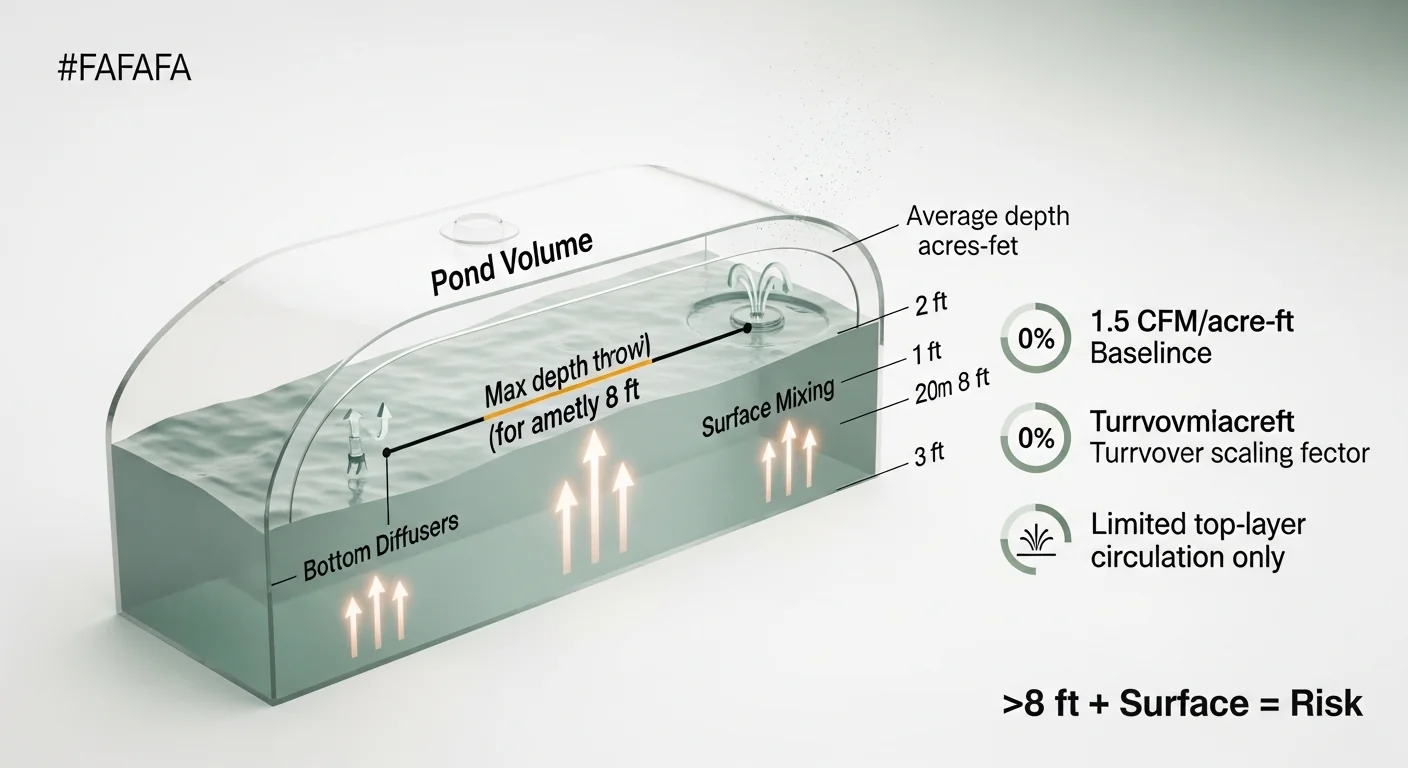
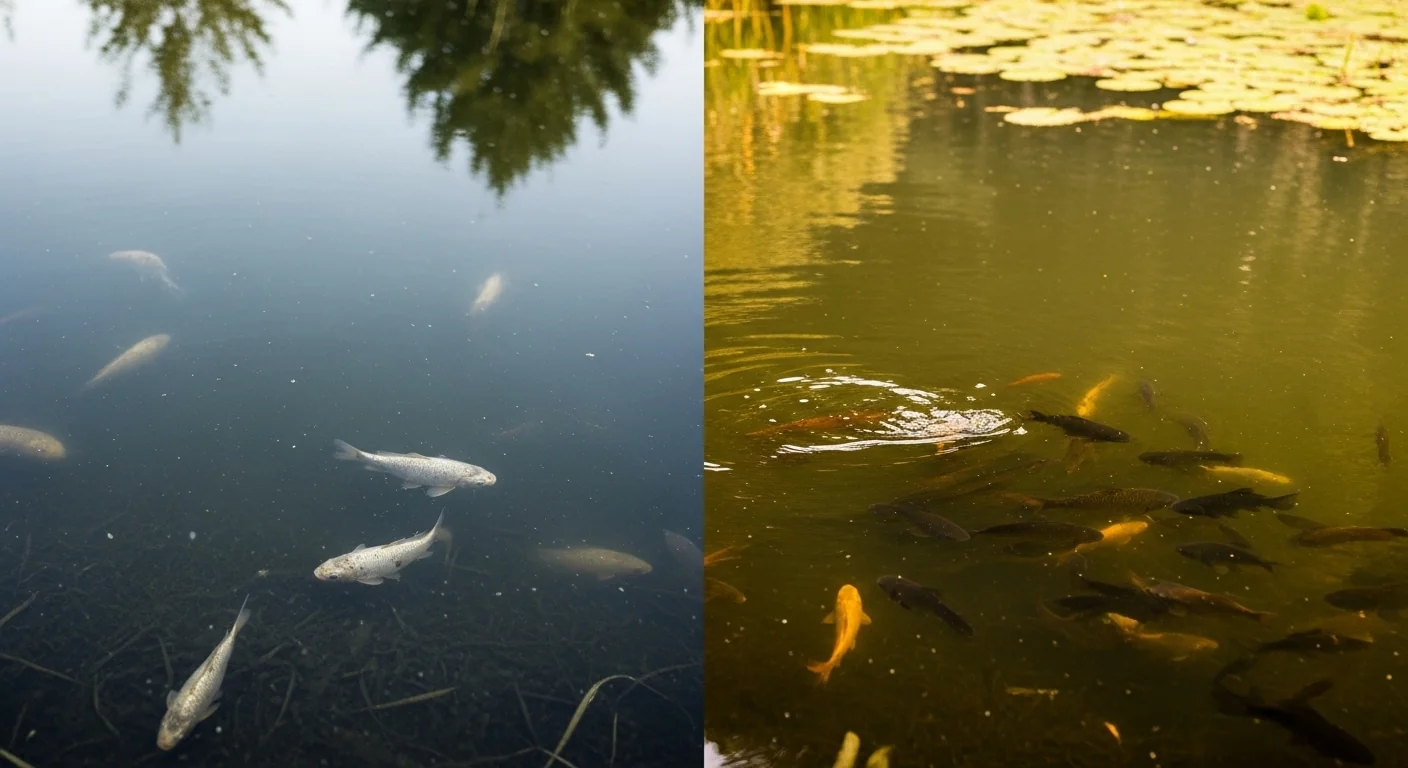
A pond does not need to be dirty to develop a zero-oxygen dead zone. Clear, well-maintained water can stratify into distinct temperature layers within weeks of summer heat, trapping toxic, oxygen-depleted water at the bottom with no way to escape until a storm mixes it upward. By then, the damage is already done. The physics of thermal stratification are well-established: warm surface water floats on cold bottom water, and once that barrier forms, photosynthesis and wind-driven re-oxygenation cannot reach below it. Sizing your aeration system to the actual water volume of your pond, not just its surface area, is the single most effective way to prevent that sequence from starting. If you need to understand the raw volume math behind your pond first, the pipe volume calculator covers the same acre-feet and gallon conversion logic used here.
This calculator computes the required airflow in cubic feet per minute (CFM) needed to achieve your target daily turnover rate for your specific pond volume, using the 1.5 CFM-per-acre-foot baseline that is the accepted industry starting point for bottom-diffused aeration systems. It also detects when your maximum depth and aeration type combination creates stratification risk and flags it with a deterministic warning. What it does not do: it does not simulate dissolved oxygen (DO) levels over time, model fish load or nutrient inputs, or substitute for a site-specific assessment by a certified pond management professional.
After running the calculation, you will know the minimum CFM your compressor must deliver and whether your planned aeration type (bottom diffuser vs. surface fountain) is appropriate for your pond’s depth profile.
Use the Tool
Pond Aeration CFM & Turnover Rate Sizer
Calculate required airflow (CFM) and identify stratification risks for bottom diffused vs. surface aeration.
| Pond Size | Avg Depth | Acre-Feet | Volume (gal) | Req. CFM | System |
|---|
- Airmax Rocking Piston Air Compressor (sized to required CFM)
- Weighted Airline Tubing — sinks to pond bottom for diffusion
- Membrane Diffuser Discs or Sticks — maximizes O₂ transfer
- Beneficial Pond Bacteria — reduces sludge, improves clarity
▶ How This Calculator Works — Formula & Assumptions
- Convert surface area to acres: If entered in sq ft, divide by 43,560 to get acres.
- Acre-Feet:
Acre-Feet = Area (acres) × Average Depth (ft) - Total Gallons:
Gallons = Acre-Feet × 325,851 - Required CFM (base):
CFM_base ≈ 1.5 CFM per Acre-Foot— industry standard for bottom diffused aeration targeting adequate dissolved oxygen in temperate climates. - Turnover adjustment:
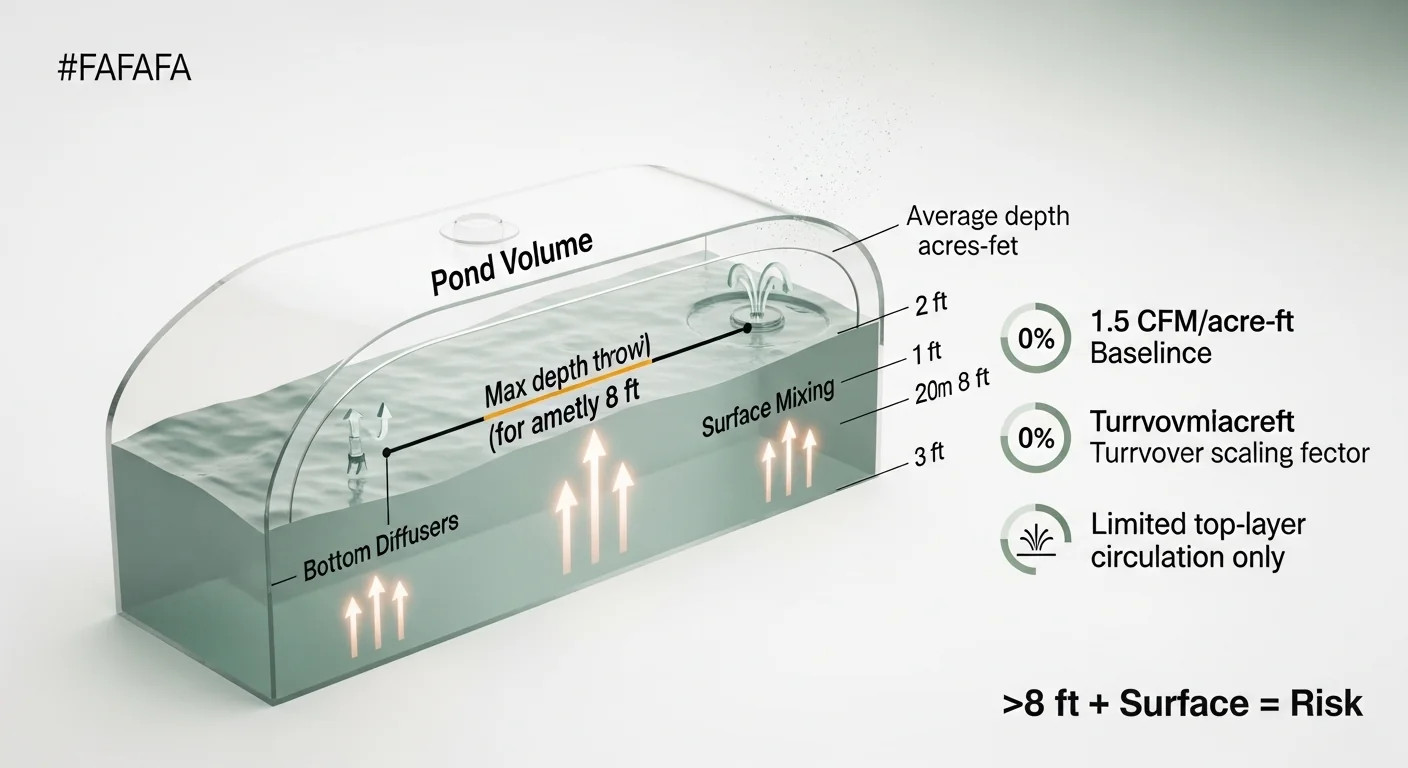
CFM_adjusted = CFM_base × (Turnover Rate / 2)— scales the airflow to your target daily turnover (default assumption is 2×/day at base rate). - Surface fountain adjustment: Surface aerators circulate only the top ~3 ft and are 30–40% less effective at full-column oxygenation. A 1.3× upsize factor is applied as a minimum, but a stratification warning is always triggered for depths >8 ft.
- Stratification threshold: If Maximum Depth > 8 ft AND aeration type is surface fountain, a Summer Fish Kill risk warning is shown.
Assumptions & Limits: Formula targets temperate freshwater ponds at summer temperatures. Saltwater, very cold water, high fish loads, or ponds with heavy algae may require 20–40% more CFM. Consult a pond professional for ponds over 10 acres. Turnover input capped at 10× per day. Results are planning estimates — actual equipment sizing should be confirmed with a certified pond manager.
▶ The Science: Thermocline, Stratification & Fish Kill Prevention
Why deep ponds stratify: In summer, sunlight warms the surface layer (epilimnion) while the deep water (hypolimnion) stays cold. Because warm water is lighter, it floats on top — creating a sharp temperature barrier called the thermocline. Natural mixing stops.
The oxygen trap: Photosynthesis and re-oxygenation from wind only occur in the top few feet. Below the thermocline, oxygen is consumed by decomposing organic matter with no replenishment. Within weeks, the bottom becomes a zero-oxygen dead zone.
The summer kill trigger: A sudden summer thunderstorm (or cool night) rapidly chills the surface, breaking down the temperature barrier. The cold, oxygen-depleted bottom water rises and mixes throughout the pond — instantly suffocating fish. This is the classic “summer fish kill.”
Bottom diffusers prevent this: Air bubbles released from the pond floor create a continuous upwelling current that constantly mixes the entire water column, preventing stratification from forming in the first place.
Before you start, gather two measurements: the surface area of your pond (in acres or square feet) and depth measurements at multiple points so you can determine both maximum and average depth. These are not the same number. A pond with 3-foot shallows and a 14-foot channel has a very different oxygen demand than those measurements suggest individually. If you are working from a survey or deed, confirm whether the recorded acreage refers to the water surface or the entire parcel.
Quick Start (60 Seconds)
- Pond Surface Area: Enter the open water area only, not surrounding land. Use acres for ponds over 10,000 sq ft; use sq ft for smaller water features. The unit toggle controls conversion automatically.
- Maximum Pond Depth: Measure at the deepest point, typically near the dam or center. Do not round down. This field drives the stratification risk check -- a one-foot difference at depths near 8 ft can change the warning status.
- Average Pond Depth: A rough field average, not the mean of max and min. For irregularly shaped ponds, estimate based on the majority of the floor profile. This number must be less than or equal to maximum depth.
- Target Turnover Rate: How many times per 24 hours you want the full pond volume to circulate. Two turnovers per day is the standard minimum for warm-weather fish health; high-density aquaculture or very warm climates may require three or more.
- Aeration Type: Select "Bottom Diffused" if you are using or planning a compressor-fed diffuser system on the pond floor. Select "Surface Fountain" if you are using a floating fountain or surface paddle aerator. The calculator applies a size adjustment and triggers depth-specific warnings for surface systems.
Inputs and Outputs (What Each Field Means)
| Field | Unit | What It Measures | Common Mistake | Safe Entry Guidance |
|---|---|---|---|---|
| Pond Surface Area | Acres or Sq Ft | Open water surface; used to compute acre-feet of volume with average depth | Using total lot/parcel acreage instead of water-only footprint | Trace only the waterline boundary; exclude banks, berms, and vegetation mats |
| Maximum Pond Depth | ft | Deepest recorded point; used exclusively for the stratification safety check | Using average depth here instead of the true maximum | Probe at the deepest location (dam face, center hole); enter the actual measurement |
| Average Pond Depth | ft | Representative depth across the pond floor profile; used to calculate total volume | Averaging only max and minimum, which overstates volume for bowl-shaped ponds | Must be less than or equal to maximum depth; entry is rejected if it exceeds max |
| Target Turnover Rate | Times per 24 hours | How frequently the full pond volume should be circulated; scales required CFM up or down from the 2x/day baseline | Leaving it at 1x for high-density fish ponds where 2x or 3x is needed | Range: 0.5 to 10; values below 1 are valid for ornamental ponds with minimal fish load |
| Aeration Type | Selection | Determines whether a stratification depth check is applied; affects CFM output for surface systems | Selecting "Surface Fountain" for a pond over 8 ft deep and trusting the CFM number alone | Bottom diffuser is always appropriate regardless of depth; surface fountain triggers warnings at depth > 8 ft |
| Required CFM (output) | CFM | Minimum continuous airflow the compressor must deliver to meet the target turnover rate | Confusing CFM with horsepower; compressor HP ratings do not translate linearly to CFM at depth | Match this number to the manufacturer-rated CFM at your pond's operating depth, not free-air CFM |
| Pond Volume (output) | Gallons | Total water volume based on surface area and average depth | Treating this as a precision measurement; it is an estimate based on averaged geometry | Use as a planning figure; actual volume may vary by 10 to 20 points depending on slope uniformity |
| Acre-Feet (output) | Acre-ft | Volume in the standard unit used for pond aeration calculations and water rights | Confusing with surface acres; 1 acre-foot is 1 acre of surface at 1 ft deep | This is the direct input to the 1.5 CFM/acre-foot formula used in the calculation |
Worked Examples (Real Numbers)
Example 1: Half-Acre Farm Pond, Moderate Depth
- Surface Area: 0.5 acres
- Maximum Depth: 8 ft
- Average Depth: 5 ft
- Turnover Rate: 2x per day
- Aeration Type: Bottom Diffused
Acre-feet = 0.5 × 5 = 2.50 acre-ft
Total gallons = 2.50 × 325,851 = 814,628 gallons
CFM base = 2.50 × 1.5 = 3.75 CFM
Turnover adjustment = 3.75 × (2 / 2) = 3.75 CFM
Result: 3.75 CFM required.
A single rocking piston compressor rated at 3.8 to 4.5 CFM at 8 ft depth covers this pond. At maximum depth exactly at the 8 ft stratification threshold, a bottom diffuser is the correct choice; this example clears the safety check without a warning.
Example 2: Quarter-Acre Residential Pond with Surface Fountain (The Trap Scenario)
- Surface Area: 0.25 acres
- Maximum Depth: 12 ft
- Average Depth: 8 ft
- Turnover Rate: 2x per day
- Aeration Type: Surface Fountain
Acre-feet = 0.25 × 8 = 2.00 acre-ft
Total gallons = 2.00 × 325,851 = 651,702 gallons
CFM base = 2.00 × 1.5 = 3.00 CFM
Surface fountain adjustment = 3.00 × 1.3 = 3.90 CFM
Result: 3.90 CFM required -- but a STRATIFICATION DANGER warning fires.
Even if the fountain delivers the adjusted CFM, it cannot physically reach the bottom 9 feet of the water column. The CFM figure is provided for reference, but the correct action from this result is to switch to bottom diffused aeration, not to buy a larger fountain.
Example 3: Five-Acre Lake at 1.5x Turnover
- Surface Area: 5 acres
- Maximum Depth: 15 ft
- Average Depth: 10 ft
- Turnover Rate: 1.5x per day
- Aeration Type: Bottom Diffused
Acre-feet = 5 × 10 = 50.0 acre-ft
Total gallons = 50.0 × 325,851 = 16,292,550 gallons
CFM base = 50.0 × 1.5 = 75.0 CFM
Turnover adjustment = 75.0 × (1.5 / 2) = 56.25 CFM
Result: 56.25 CFM required.
At this scale, a single compressor is rarely the answer. The calculator's large-pond advisory applies here: diffuser heads should be distributed across the pond floor at roughly one per surface acre to prevent dead zones from forming between stations.
Reference Table (Fast Lookup)
All rows use a 2x/day turnover rate and bottom-diffused aeration. The "Depth Risk" column flags any configuration where maximum depth exceeds 8 ft, indicating that surface fountain aeration is not appropriate at that depth.
| Pond Size | Avg Depth | Acre-Feet | Volume (gal) | Req. CFM (2x/day) | Depth Risk |
|---|---|---|---|---|---|
| 0.125 ac | 4 ft | 0.50 | 162,926 | 0.75 | Safe (shallow) |
| 0.25 ac | 5 ft | 1.25 | 407,314 | 1.88 | Safe (shallow) |
| 0.5 ac | 5 ft | 2.50 | 814,628 | 3.75 | Safe (shallow) |
| 0.5 ac | 10 ft | 5.00 | 1,629,255 | 7.50 | Stratification Risk |
| 1 ac | 6 ft | 6.00 | 1,955,106 | 9.00 | Safe (shallow) |
| 1 ac | 12 ft | 12.00 | 3,910,212 | 18.00 | Stratification Risk |
| 2 ac | 8 ft | 16.00 | 5,213,616 | 24.00 | Borderline (8 ft max) |
| 5 ac | 10 ft | 50.00 | 16,292,550 | 75.00 | Stratification Risk |
| 10 ac | 12 ft | 120.00 | 39,102,120 | 180.00 | Stratification Risk |
How the Calculation Works (Formula + Assumptions)
Show the calculation steps
- Unit conversion (if needed): If surface area is entered in square feet, divide by 43,560 to convert to acres. One acre = 43,560 square feet exactly.
- Acre-feet: Multiply surface area in acres by average depth in feet. This gives the standardized volume unit used by the aeration industry. Formula:
Acre-Feet = Area (ac) × Avg Depth (ft) - Total gallons: Multiply acre-feet by 325,851. This is the exact conversion factor: one acre-foot = 325,851 US gallons. Rounded to the nearest whole gallon in output.
- Base CFM: Multiply acre-feet by 1.5. This produces the minimum CFM to maintain adequate dissolved oxygen in a temperate freshwater pond at 2 turnovers per day. Formula:
CFM_base = Acre-Feet × 1.5 - Turnover adjustment: Scale the base CFM to match the target turnover rate. The baseline formula assumes 2x/day. Formula:
CFM_adjusted = CFM_base × (Turnover Rate / 2). A target of 1x/day halves the required CFM; 4x/day doubles it. - Surface fountain adjustment: If "Surface Fountain" is selected as the aeration type, the adjusted CFM is multiplied by 1.3 to account for the reduced column-mixing efficiency of surface systems. This does not address the stratification problem -- it only adjusts the volume throughput estimate.
- Stratification check: If maximum depth exceeds 8 ft and aeration type is "Surface Fountain," the tool generates a danger-level stratification warning regardless of the CFM output value.
Assumptions and Limits
- The 1.5 CFM/acre-foot baseline is an industry-standard planning figure for temperate freshwater ponds in warm-weather operation. It is not derived from a regulated standard body.
- The formula treats the pond as a uniform bowl with consistent depth. Irregular shapes, submerged islands, or deep central channels are not captured by a single average depth figure.
- The 8 ft stratification threshold is a field-established guideline. Actual thermocline formation depends on local climate, wind exposure, shading, and water clarity; shallow ponds in very hot, calm climates may stratify at lesser depths.
- CFM ratings must be confirmed at operating depth. Most compressor manufacturers publish both free-air CFM and pressure-rated CFM. At 10 ft of water depth (approximately 4.4 PSI backpressure), delivered CFM is meaningfully lower than the free-air spec.
- High fish density, heavy algae loads, warm water temperatures above 80 degrees F, and significant nutrient inputs (fertilizer runoff, manure) can increase oxygen demand substantially beyond what this calculator predicts.
- The tool does not model aeration efficiency differences between diffuser types (ceramic disc, membrane disc, air stone) or the effect of diffuser depth on bubble rise time and oxygen transfer rate.
- Results apply to freshwater ponds. Saltwater and brackish water have different dissolved oxygen saturation curves and should be calculated separately.
Standards, Safety Checks, and "Secret Sauce" Warnings
Critical Warnings
- The Summer Kill Event: Thermal stratification creates a hypolimnion layer with near-zero dissolved oxygen at the pond bottom. When a convective storm rapidly cools the surface, the density gradient collapses and the anoxic bottom water rises throughout the water column. Fish exposed to this mixing event can suffocate within hours. This mechanism is well-documented in limnology literature and is the most common cause of unexplained summer fish kills in private ponds.
- Surface Aerators Do Not Penetrate the Thermocline: A floating fountain or paddle wheel aerator circulates and re-oxygenates only the top portion of the water column, typically the top 2 to 4 feet. Below the thermocline, the bottom water remains stagnant regardless of how long the fountain runs. This tool fires a danger-level warning whenever maximum depth exceeds 8 ft and the aeration type is set to "Surface Fountain."
- CFM at Depth vs. Free-Air CFM: Compressor packaging often shows free-air CFM measured at sea level with no backpressure. At 10 feet of pond depth, the backpressure is approximately 4.4 PSI. Always use the manufacturer's pressure-rated CFM curve, not the nameplate free-air figure, when matching equipment to this calculator's output.
- Single Diffuser Coverage Limits: A single diffuser head creates a rising column of aerated water above its location. For ponds over 2 acres, one centrally located diffuser leaves edge areas with poor circulation. Distribute diffuser heads at roughly one per acre of surface area for uniform coverage.
Minimum Standards
- Any pond deeper than 8 ft with a fish population should be equipped with bottom-diffused aeration, regardless of surface area or aesthetic preferences for fountain features.
- The minimum recommended turnover rate for a warm-weather fish pond is 2x per 24 hours. Ornamental ponds with no fish may operate at lower rates, but dissolved oxygen should be monitored periodically.
- Weighted airline tubing should be used to keep the air supply line on the pond floor. Unweighted tubing floats and can displace the diffuser from its intended location, concentrating aeration in the wrong area of the water column.
Competitor Trap: Most aeration sizing guides on competing pages recommend equipment by surface acreage alone, listing rules like "1 HP per acre" for fountains. This approach is adequate for very shallow ponds under 5 feet deep, but it is dangerously misleading for ponds with significant depth variation. A 1-acre pond that is 3 feet deep and a 1-acre pond that is 14 feet deep require fundamentally different aeration strategies. The 14-foot pond cannot be safely managed by any surface fountain regardless of its horsepower rating, because the problem is not power output -- it is physics. Bottom aeration is required to disrupt stratification before it forms.
If your property also requires active water removal as part of a drainage management plan, the farm tile drainage calculator can help size subsurface drainage systems that interact with pond water table levels. And for sizing the pumping equipment that moves water into or out of a pond, the irrigation pump sizing calculator covers the flow rate and head calculations that complement your aeration system design.
Common Mistakes and Fixes
Mistake: Entering Lot Acreage Instead of Water Surface Area
A common data source error is pulling the pond's acreage from a deed or tax record, which may refer to the entire water feature parcel including berms, buffer zones, and access paths. Overstating surface area inflates the acre-feet calculation and produces a CFM recommendation that is higher than the actual pond requires. While this leads to oversizing rather than undersizing, it also leads to unnecessary equipment cost.
Fix: Measure or estimate only the open water footprint using a satellite image overlay or GPS boundary trace of the waterline.
Mistake: Using Maximum Depth as the Average Depth
Pond owners who probe at the deepest point and use that measurement for both depth fields are overstating pond volume, sometimes by a factor of two or more for bowl-shaped or sloped-bottom ponds. The average depth for a bowl-shaped pond is typically 40 to 60 percent of the maximum depth.
Fix: Take depth measurements at a grid of points across the pond and average them. For a roughly bowl-shaped pond with no site data available, starting with average depth equal to half the maximum depth is a conservative but reasonable planning assumption.
Mistake: Trusting Free-Air CFM on Compressor Specifications
Rocking piston and linear compressor specifications typically list CFM at zero backpressure, measured at the outlet with no load. Submerged diffusers at depth create hydrostatic backpressure that reduces delivered airflow. For a diffuser placed at 10 feet of depth, the effective CFM delivery is measurably lower than the free-air spec.
Fix: Request the pressure-rated CFM table from the compressor manufacturer. Size the unit so the rated CFM at your operating depth meets or exceeds the calculator's output, not just the free-air CFM. This principle parallels the concepts behind pressure-rated pump selection -- similar to how sump pump sizing accounts for total dynamic head rather than nameplate flow, as explained in the sump pump calculator.
Mistake: Treating the 8-Foot Threshold as a Hard Cutoff
The stratification depth check in this tool fires at maximum depths greater than 8 feet. This does not mean that a pond measuring 7.9 feet is safe for surface aeration in all climates. The threshold is a practical planning guide, not a physical law. Ponds in hot, humid climates with low wind exposure, dark water, or heavy algae can thermally stratify at shallower depths during peak summer conditions.
Fix: Treat the 8-foot threshold as a point at which bottom diffusion becomes essential, not as the only depth that matters. For ponds in the 5 to 8-foot range, monitor dissolved oxygen levels at multiple depths during summer and consider upgrading to bottom diffusion if readings at depth fall below 4 mg/L. For broader water drainage planning on your property, the French drain calculator can help manage surface and subsurface water that affects pond levels and water quality.
Mistake: Installing a Single Diffuser Head for Ponds over 2 Acres
Even when the CFM requirement is met by the compressor, a single diffuser point concentrates aeration in one location. Water on the far edges of a large pond may receive minimal circulation, allowing thermal stratification to persist in dead zones between the aerated column and the shoreline.
Fix: Distribute diffuser heads across the pond floor. Use the per-acre distribution guideline as a starting point and consult the compressor manufacturer's coverage charts to confirm that airflow at each diffuser station meets the local CFM requirement.
Next Steps in Your Workflow
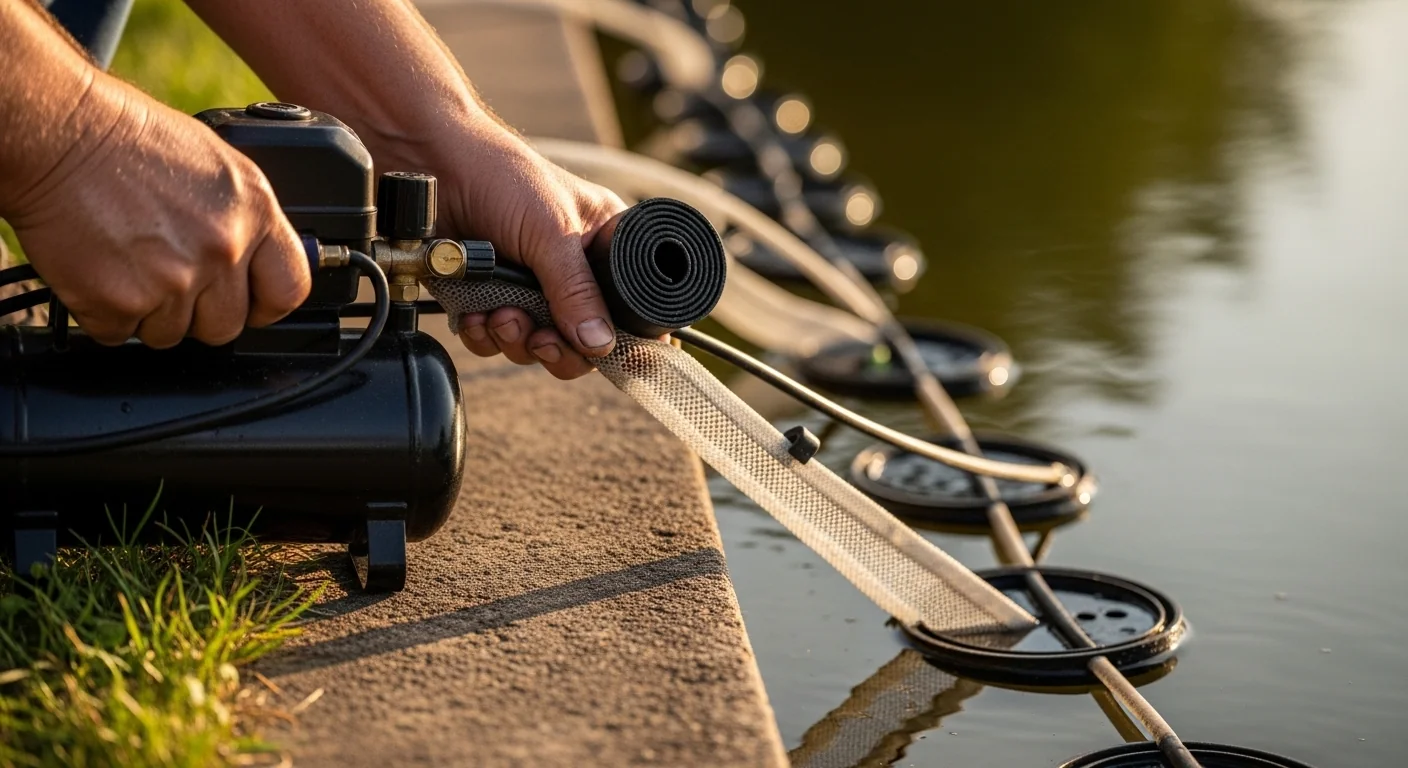
Once you have your required CFM figure, the next step is matching it to a specific compressor model rated for continuous duty at your operating depth. Not all compressors rated for pond aeration are designed for 24-hour daily operation -- look for units explicitly marketed as continuous-duty, particularly rocking piston designs, which are commonly used in bottom-diffused pond aeration systems. Confirm that the manufacturer's spec sheet shows a CFM curve at the depth of your deepest diffuser placement, not just at surface-level conditions. If your pond is served by a pressurized water supply system or a well, reviewing how pressure tank sizing interacts with your aeration compressor circuit is worthwhile, particularly if both systems share a power source or pressure zone -- the well pressure tank calculator covers that sizing logic in detail.
After equipment selection, diffuser placement is the next critical decision. For ponds requiring multiple diffuser stations, map the floor of your pond and assign one diffuser head per acre of surface area as a starting point, adjusting for irregular bottom topography or known dead zones. If your property involves surface or subsurface drainage that feeds into the pond, water routing and inlet sizing decisions interact with pond volume and turnover planning -- the yard drainage catch basin calculator addresses that side of the equation.
FAQ
What does CFM mean in pond aeration?
CFM stands for cubic feet per minute, the standard unit of airflow volume used to rate pond aeration compressors. In the context of bottom-diffused pond aeration, CFM describes how much air a compressor delivers to the submerged diffuser heads per minute. Higher CFM translates to greater water movement and oxygen transfer capacity. It is distinct from horsepower, which is a power input rating and does not translate directly to airflow output.
How many times per day should a pond turn over?
The standard planning target for a warm-weather fish pond is 2 full volume turnovers per 24 hours. This rate maintains adequate dissolved oxygen for most freshwater fish species under normal temperature and stocking conditions. Ponds with higher fish density, heavy organic input, or water temperatures above 80 degrees F benefit from 3 or more turnovers per day. Purely ornamental ponds with no fish may operate adequately at lower rates.
Can a surface fountain aerate a deep pond?
No, not effectively below the thermocline. Surface fountains and paddle wheel aerators circulate and oxygenate only the top portion of the water column. In a pond deeper than 8 feet, a stable thermocline typically forms during summer, creating a temperature barrier that surface turbulence cannot penetrate. The bottom water below the thermocline becomes progressively oxygen-depleted. Bottom-diffused aeration is required to disrupt stratification across the full water column.
What is an acre-foot and why does it matter for aeration?
An acre-foot is the volume of water that covers one acre of surface area to a depth of one foot, equivalent to 325,851 US gallons. It is the standard volume unit used in pond aeration calculations because the 1.5 CFM-per-acre-foot formula captures both surface area and depth in a single value. Using acre-feet rather than just surface acreage ensures that a shallow 1-acre pond and a deep 1-acre pond receive appropriately different CFM recommendations.
What causes a summer fish kill in a pond?
The most common mechanism is thermal stratification followed by sudden mixing. During warm months, solar heating creates a warm, oxygen-rich surface layer (epilimnion) floating above a cold, oxygen-depleted deep layer (hypolimnion). A storm, cold front, or heavy rain can rapidly cool the surface, collapsing the temperature gradient and mixing the anoxic bottom water upward throughout the pond. Fish exposed to this oxygen crash can suffocate within hours. Continuous bottom aeration prevents stratification from forming in the first place.
Is 1.5 CFM per acre-foot a regulated standard?
No. The 1.5 CFM-per-acre-foot figure is a widely used industry planning baseline for bottom-diffused pond aeration, not a value mandated by a specific regulatory body. It represents a practical starting point for temperate freshwater pond conditions. Actual requirements vary with water temperature, fish load, altitude, organic input rates, and the type and efficiency of diffuser equipment selected. For critical fish management or commercial aquaculture applications, oxygen modeling by a certified pond management professional is the appropriate next step.
Conclusion
The pond aeration calculator resolves the most dangerous gap in standard aeration guidance: the assumption that surface area alone determines how much aeration a pond needs. Depth is the variable that controls whether stratification forms and whether any given aeration type can actually reach the problem. A correctly sized bottom-diffused system prevents the thermocline from developing, keeps dissolved oxygen distributed throughout the water column, and eliminates the conditions that lead to summer fish kills. The CFM number this calculator produces is a starting point -- the equipment selection and diffuser placement decisions that follow are where the calculation becomes practice.
The single most costly mistake in pond aeration is installing a surface fountain on a deep pond and assuming the problem is solved. The fountain aerates the surface. The bottom accumulates a dead zone. The next convective storm mixes them together. Understanding that failure mode before purchasing equipment is the core value this tool delivers. For a broader look at how water moves through and around your property, the Manning's equation calculator covers open-channel flow calculations that apply to pond inlet and overflow design.