
Boom Sprayer Calibration Calculator
GPM per nozzle • Nozzle sizing • Drift safety check
| Color | Nozzle Size | GPM @ 20 PSI | GPM @ 30 PSI | GPM @ 40 PSI | Typical Use |
|---|
How This Calculator Works
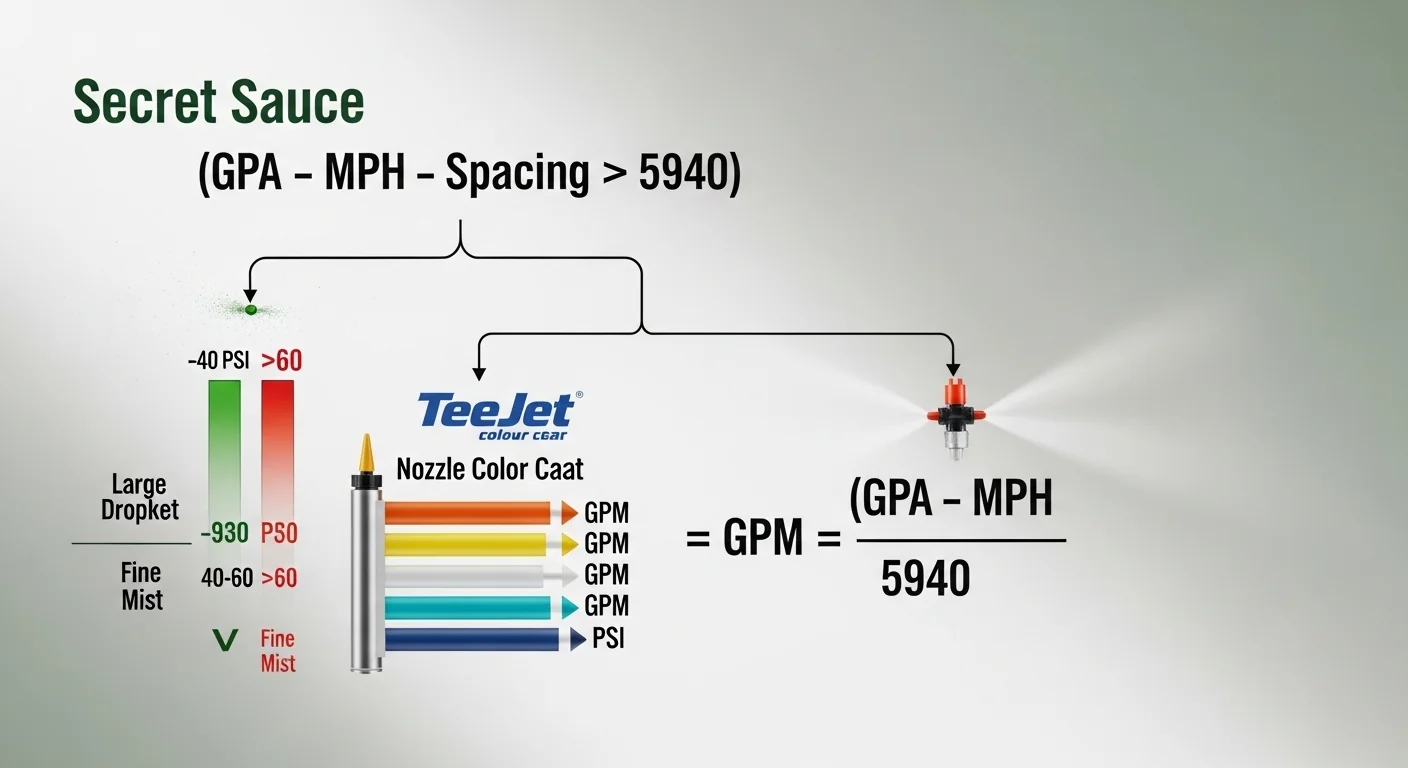
GPM Per Nozzle Formula — industry-standard calculation used in Cooperative Extension programs across the US:
- GPA = Target application rate (Gallons Per Acre)
- MPH = Tractor ground speed (miles per hour)
- Spacing = Distance between nozzles in inches (most booms: 20″)
- 5940 = Constant derived from unit conversions (1 acre = 43,560 sq ft; 1 gal = 231 cu in; 1 mile = 63,360 in)
Nozzle Selection — the GPM value is cross-referenced against the TeeJet nozzle color chart to find the smallest nozzle that covers your required flow at your target PSI (larger droplets = less drift).
Pressure Warning — standard flat-fan nozzles above 40 PSI atomize spray into droplets under 150 microns, which drift easily. Above 60 PSI, the risk of off-target movement and neighbor liability becomes severe.
Assumptions & Limits
- Formula assumes all nozzles on the boom are identical and evenly spaced.
- Tractor ground speed must be measured with a GPS speedometer — tire-slip errors in odometers can cause significant over/under-application.
- Nozzle GPM ratings assume standard water at 68°F. Chemical density variations (<5%) are generally negligible for calibration.
- Pressure readings must be taken at the nozzle, not at the pump — hose friction losses vary with boom length and hose diameter.
- Wind speed, temperature, and humidity affect actual drift even at safe pressures. Always check your herbicide label for application conditions.
- Results are for flat-fan nozzle patterns. Flooding nozzles use different pressure ranges (5–15 PSI).
- Nozzle wear: replace nozzles when output exceeds ±10% of nominal rating. Check annually or every 50,000 acres.
Chemical Drift & Liability Warning
Why drift matters: Herbicides like 2,4-D and Glyphosate at high pressure produce fine droplets (<150 microns). A 5 mph breeze can carry these 300+ yards — far enough to damage neighboring organic crops, orchards, or gardens.
Air Induction nozzles (TeeJet AIXR series) produce VMD droplets of 300–500+ microns, dramatically reducing drift while maintaining coverage efficiency.
Sprayer calibration is not a checkbox task. An error of 1 mph in measured ground speed, or a pump pressure 15 PSI above the nozzle's rated ceiling, changes your actual application rate significantly and, in the case of herbicides like 2,4-D or glyphosate, the consequences extend well beyond your field boundary. Fine droplets produced at high pressure do not fall straight down. They move with air currents and can settle on neighboring crops, gardens, and certified organic operations far from the source field.
This boom sprayer calibration calculator computes GPM per nozzle using the standard Cooperative Extension formula, cross-references that value against the TeeJet nozzle color chart, and applies deterministic pressure thresholds to flag drift risk before you fire up the pump. It does not account for wind speed at the time of application, product-specific label restrictions, or boom height above canopy. Those variables require site judgment on the day of spraying.
After running your numbers, you will know which nozzle color to install and whether your planned operating pressure is within the safe window for standard flat-fan nozzles or requires an upgrade to Air Induction tips. If accurate ground speed data is uncertain, the tractor ground speed calculator can help you nail that input first.
Use the Tool

Before entering values, have the following ready: your herbicide label's recommended application rate in gallons per acre (GPA), your actual field ground speed measured by GPS (not the tractor dash), your boom's center-to-center nozzle spacing in inches, and the operating pressure you intend to run at the nozzle body (not at the pump outlet). Pressure drops from pump to nozzle body can be significant on long booms, so measure as close to the nozzle as possible.
Quick Start (60 Seconds)
- Target Application Rate (GPA): Read this directly from your herbicide label. Field rates for broadcast herbicide applications commonly fall between 10 and 20 GPA. Do not guess or round this value.
- Ground Speed (mph): Use a GPS-based speedometer reading taken during an actual field pass, not the tractor's ground-drive gauge. Tire slip causes odometer-based readings to read high, which means your real application rate is higher than calculated.
- Nozzle Spacing (inches): Measure center-to-center between adjacent nozzle bodies on the boom. The most common spacing is 20 inches. Enter the actual measurement, since some older booms use 15 or 30 inches.
- Operating Pressure (PSI): Enter the pressure you plan to run at the nozzle, not the pump outlet. Use a gauge installed directly at a nozzle body for accuracy. Standard flat-fan nozzles are designed for 15 to 40 PSI.
- Read the nozzle badge: The result shows which TeeJet nozzle color covers your required GPM at your target pressure. Match the color to the nozzle packaging before purchasing or installing.
- Check the pressure gauge bar: The visual fills green, yellow, or red based on drift risk thresholds derived from droplet physics. If it shows yellow or red, address the pressure before spraying near any neighbor, hedgerow, or sensitive area.
- Review all warning boxes: The calculator flags high flow rates, excessive ground speed, and pressure-related drift risk. Each warning includes a specific corrective action.
Inputs and Outputs (What Each Field Means)
| Field | Unit | What It Means | Common Mistake | Safe Entry Guidance |
|---|---|---|---|---|
| Target Application Rate | GPA (gallons per acre) | The volume of spray solution to apply per acre, as specified on the herbicide label | Using a rate from a previous season's label version, which may have changed | Read the current product label; enter the minimum labeled rate for broadcast application |
| Tractor Ground Speed | mph (miles per hour) | Actual over-ground speed of the tractor during spraying operations | Using tractor dash speed instead of GPS; tire slip inflates the reading by 5 to 15 mph on soft ground | Measure with a GPS speedometer on the same soil conditions you plan to spray; range 4 to 8 mph is typical |
| Nozzle Spacing | inches | Center-to-center distance between nozzle bodies on the boom | Assuming 20 inches when the boom was factory-configured at 15 or 30 inches | Measure physically on your boom; values between 15 and 30 inches are most common |
| Operating Pressure | PSI (pounds per square inch) | Hydraulic pressure at the nozzle body; controls droplet size and pattern width for flat-fan tips | Reading pump outlet pressure rather than nozzle body pressure; losses across long booms can be 5 to 20 PSI | Install an inline gauge at a nozzle body; stay within 15 to 40 PSI for standard flat-fan nozzles |
| GPM per Nozzle (Output) | GPM (gallons per minute) | The flow rate each individual nozzle must deliver to achieve your target GPA at your planned speed and spacing | Confusing total boom GPM with per-nozzle GPM; nozzle charts are always per-nozzle values | Match this value to the TeeJet nozzle chart at your target operating pressure |
| Recommended Nozzle (Output) | Color code + size designation | The smallest TeeJet nozzle that meets or exceeds your required GPM at your specified PSI | Selecting a larger nozzle "for safety" and then reducing pressure to compensate, which creates pattern overlap problems | Install the recommended size; if pressure must exceed 40 PSI to reach the rate, switch to Air Induction nozzles of the same flow class |
Calibration accuracy also depends on consistent boom speed. For related field equipment calibration methods, the seed drill calibration calculator uses comparable throughput formulas if you need to cross-check your approach.
Worked Examples (Real Numbers)
Scenario 1: Standard Corn Field Herbicide Application
- Target Application Rate: 15 GPA
- Ground Speed: 6 mph
- Nozzle Spacing: 20 inches
- Operating Pressure: 30 PSI
Result: GPM per nozzle = (15 x 6 x 20) / 5940 = 1,800 / 5940 = 0.303 GPM
At 30 PSI, a Yellow TeeJet 0.3 nozzle (rated 0.22 GPM at 30 PSI) falls slightly short; the Blue 0.4 (rated 0.30 GPM at 30 PSI) just meets the requirement. Operating in the safe pressure zone keeps droplets large enough to resist wind drift under calm field conditions.
Scenario 2: Pasture Burndown at Higher Volume
- Target Application Rate: 20 GPA
- Ground Speed: 5 mph
- Nozzle Spacing: 20 inches
- Operating Pressure: 35 PSI
Result: GPM per nozzle = (20 x 5 x 20) / 5940 = 2,000 / 5940 = 0.337 GPM
A Blue TeeJet 0.4 nozzle rated at approximately 0.35 GPM at 35 PSI fits this scenario. Pressure is within the flat-fan nozzle operating window. Slowing to 5 mph also reduces boom turbulence, which improves pattern consistency on rough pasture ground.
Scenario 3: Small-Farm Row Crop at Lower Volume
- Target Application Rate: 10 GPA
- Ground Speed: 4 mph
- Nozzle Spacing: 20 inches
- Operating Pressure: 25 PSI
Result: GPM per nozzle = (10 x 4 x 20) / 5940 = 800 / 5940 = 0.135 GPM
A Green TeeJet 0.2 nozzle (rated approximately 0.15 GPM at 25 PSI) covers this rate. Low volume and low speed are a favorable combination for coverage uniformity; the lower pressure further reduces any drift concern on a still day.
Reference Table (Fast Lookup)
All rows calculated at 20-inch nozzle spacing using the formula: GPM = (GPA x MPH x 20) / 5940. The "Nozzle Match" column identifies the smallest TeeJet standard color that meets the required GPM at 30 PSI.
| GPA | Speed (mph) | GPM per Nozzle | Nozzle Match (30 PSI) | Pressure Zone | Notes |
|---|---|---|---|---|---|
| 10 | 4 | 0.135 | Green (0.2) | Safe (15-40 PSI) | Lowest-drift scenario; suitable for sensitive areas |
| 10 | 6 | 0.202 | Green (0.2) | Safe (15-40 PSI) | Efficient low-volume broadcast |
| 15 | 5 | 0.253 | Yellow (0.3) | Safe (15-40 PSI) | Common corn/soybean burndown rate |
| 15 | 6 | 0.303 | Blue (0.4) | Safe (15-40 PSI) | Most common field scenario |
| 20 | 5 | 0.337 | Blue (0.4) | Safe (15-40 PSI) | Pasture and rangeland burndown |
| 20 | 7 | 0.471 | Red (0.5) | Check PSI carefully | Higher speed raises boom turbulence risk |
| 25 | 6 | 0.505 | Red (0.5) | Check PSI carefully | Consider reducing speed to lower GPM requirement |
| 30 | 6 | 0.606 | Brown (0.6) | Check PSI carefully | High-volume soil applications only; verify label |
| 30 | 8 | 0.808 | Gray (0.8) | Drift risk elevated | Requires Air Induction nozzles if PSI exceeds 40 |
How the Calculation Works (Formula + Assumptions)
Show the calculation steps
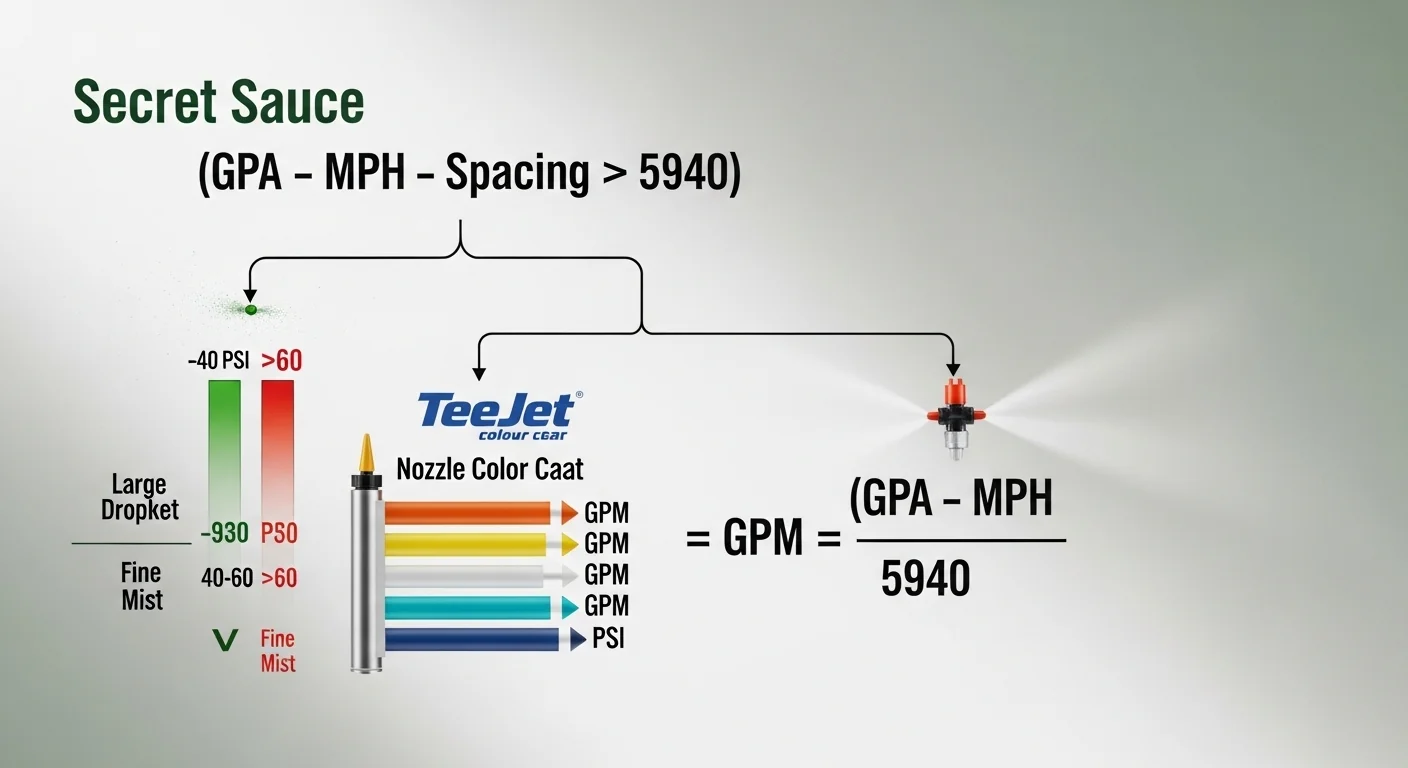
The formula is the industry-standard Cooperative Extension sprayer calibration equation used across land-grant university extension programs in the United States:
GPM per nozzle = (GPA x MPH x Spacing_inches) / 5940
Step 1: Multiply GPA by MPH. This represents the volume demand per mile of travel per unit width.
Step 2: Multiply by nozzle spacing in inches. This scales the demand to the coverage width of a single nozzle.
Step 3: Divide by 5940. This constant converts the product from mixed units (gallons-per-acre x miles-per-hour x inches) into gallons per minute. It is derived from: 1 acre = 43,560 square feet, 1 mile = 5,280 feet, 1 foot = 12 inches. The combined unit-conversion factor resolves to 5,940.
Rounding rule: Results are displayed to three decimal places. When comparing to nozzle chart values, select the nozzle whose rated output meets or exceeds your calculated GPM at your target pressure.
Assumptions and Limits
- All nozzles on the boom are assumed to be identical in type, size, and wear condition. A worn nozzle delivering 15% more flow than nominal causes that section of the boom to over-apply, which the formula cannot detect.
- Ground speed is assumed to be constant during the spray pass. Decelerating at field ends while the boom is still open produces localized over-application.
- Nozzle GPM ratings in the reference chart are based on water at standard temperature. Spray solutions with significantly higher density than water will alter actual output; the difference is small for most herbicide tank mixes but worth confirming for suspension formulations.
- The pressure entered should be measured at the nozzle body. Friction losses across long boom lengths mean the pump gauge reading can be 5 to 20 PSI higher than the pressure actually arriving at the nozzle tip.
- The formula does not account for boom height. Pattern overlap from adjacent nozzles changes as boom height varies; most flat-fan nozzle patterns are designed for a specific height above target (commonly 18 to 24 inches for 20-inch spacing).
- Drift thresholds in the calculator (40 PSI warning, 60 PSI danger) apply to standard flat-fan nozzle types. Flooding nozzles, hollow-cone nozzles, and Air Induction nozzles each have different pressure operating ranges and droplet-size characteristics. Do not apply these thresholds to nozzle types other than flat-fan tips without consulting the nozzle manufacturer's charts.
Standards, Safety Checks, and Secret Sauce Warnings
Critical Warnings
- The 40 PSI flat-fan ceiling is a drift boundary, not just a performance spec. Flat-fan nozzles above 40 PSI produce a high proportion of droplets under 200 microns. That droplet size class is classified as "fine" to "very fine" by the ASABE droplet spectrum standard. These droplets remain airborne long enough to travel off-target under ordinary agricultural wind conditions. The calculator flags this zone in yellow and recommends Air Induction (AIXR) nozzles, which entrain air bubbles to shift the droplet spectrum to "medium" or "coarse" at the same flow rate.
- Above 60 PSI with standard flat-fan tips, you are generating a mist, not a spray. Droplets under 150 microns are in the fog-drift size class. A 5 mph breeze, which is common and below the 10 mph threshold on most herbicide labels, can carry this mist several hundred yards. Legal exposure under FIFRA and state pesticide regulations does not require intent; documented off-target movement is sufficient for a damage claim.
- Odometer-based speed errors compound silently. Tire slip on soft or wet ground causes ground-drive tachometers and pull-driven wheel meters to read faster than actual travel. If your entered speed is 10% too high, your actual application rate is 10% too high without any visible indicator.
- Nozzle wear changes the calibration without warning. Nozzles delivering more than 10% above their rated output should be replaced. A boom that has not been tip-flow-tested in two seasons may have substantial nozzle-to-nozzle variation that makes any calibration calculation inaccurate.
Minimum Standards
- Standard flat-fan herbicide nozzles (TT, XR, TeeJet equivalent): operate within 15 to 40 PSI.
- Air Induction flat-fan nozzles (AIXR, Turbo TeeJet Induction): operate within 30 to 60 PSI, which is why they are the correct upgrade when pressure must exceed 40 PSI.
- Nozzle flow-rate uniformity: replace any nozzle deviating more than 10% from its rated output at your operating pressure.
- Do not spray broadcast herbicides when sustained wind exceeds 10 mph at boom height; check the product label, which may specify a lower limit.
Competitor Trap: Many online "boom sprayer calculators" stop at computing GPM and leave the user to interpret whether that result is safe or even achievable at their chosen pressure. The gap this creates is dangerous: a user can receive a valid GPM number and then configure their pump to 70 PSI to reach the required flow through a nozzle rated for 40 PSI maximum. The result is a technically "calibrated" sprayer that is generating fog-class herbicide drift. The pressure-threshold warnings and Air Induction upgrade guidance in this tool exist specifically because that failure mode is where chemical drift litigation originates.
For understanding how field equipment coverage and overlap interact in adjacent passes, the cultivator sweep overlap calculator covers the geometry of pass-to-pass spacing that applies equally to boom sprayer coverage patterns.
Common Mistakes and Fixes
Mistake: Using the Tractor Dash Speedometer for Ground Speed Input
Tractor dash speedometers are driven by a ground-drive wheel or transmission output; on soft or saturated soil, tire slip causes the reading to be higher than actual over-ground travel speed. A sprayer calibrated at a stated 6 mph that is actually covering ground at 5.2 mph will apply roughly 15% more product per acre than intended. This is a silent overapplication. The fix is a GPS-based speedometer, confirmed during a calibration pass on the same field conditions you plan to spray. The tractor ground speed calculator provides an additional method for estimating travel speed from measured distances and time if GPS hardware is not available.
Mistake: Reading Pump Outlet Pressure Instead of Nozzle Body Pressure
Pressure drops across boom plumbing, valves, screens, and nozzle check valves mean the pump outlet gauge can read 10 to 20 PSI higher than actual nozzle pressure on a 60-foot boom. Operators who run the pump at 45 PSI expecting nozzle delivery at 45 PSI may actually be at 35 PSI at the far wing tips, causing uneven application across the boom width. The fix: install an inline gauge at a nozzle body near the far end of the boom and calibrate to that reading, not the pump gauge.
Mistake: Installing a Larger Nozzle and Reducing Pressure to
Compensate
When the calculated GPM exceeds what the desired nozzle can deliver at safe pressure, some operators install the next larger nozzle and then throttle the pump down to maintain flow, dropping pressure below the nozzle's minimum rated operating range. At sub-minimum pressure, the flat-fan pattern collapses and coverage becomes uneven. The correct fix is to either reduce ground speed, reduce target GPA (if the label permits), or move to an Air Induction nozzle in the correct flow class that operates at higher pressure without generating drift-prone droplets.
Mistake: Assuming All Nozzles on the Boom Are Performing Identically
A boom that was calibrated correctly at the start of the season is not guaranteed to be calibrated at the end of it. Abrasive suspension herbicide formulations wear polyacetal nozzle tips faster than water; a nozzle that started the season at 0.30 GPM may be delivering 0.36 GPM or more after 30,000 acres. Running a jug collection test on 10 nozzles across the boom at the start of each season costs 15 minutes and prevents season-long systematic overapplication in worn sections. Replace any tip exceeding 10% deviation from rated output.
Mistake: Spraying When Conditions Invalidate the Drift Thresholds
The pressure thresholds in this calculator are based on nozzle droplet physics under neutral atmospheric conditions. A temperature inversion, which often occurs in the early morning hours, causes even large droplets to remain aloft far longer than they would under midday convective mixing. High relative humidity reduces evaporation and extends droplet lifetime. Wind at boom height can be substantially different from wind at the 10-foot height reported by weather stations. The pressure warning is a baseline check; it does not replace on-the-day judgment about atmospheric conditions before a herbicide application.
Next Steps in Your Workflow
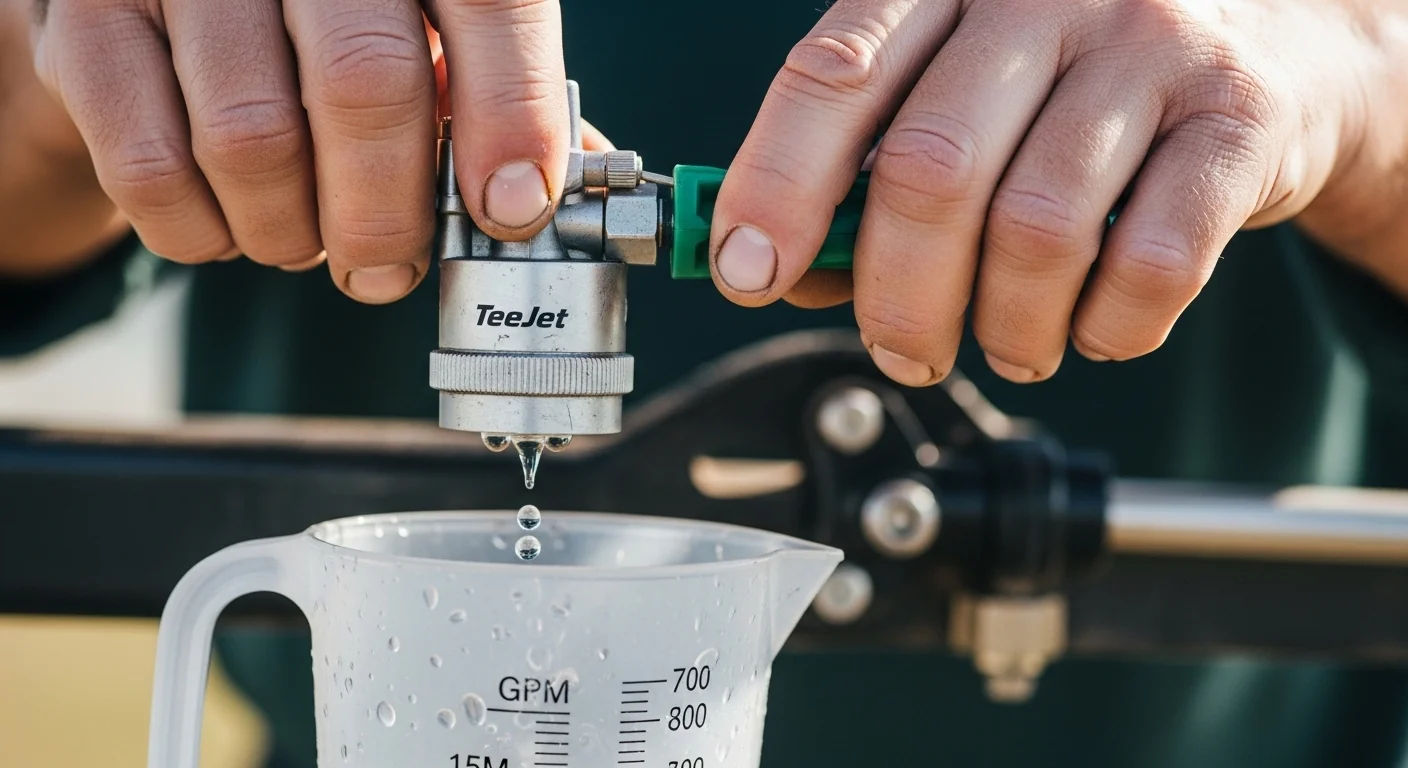
Once you have the nozzle size and confirmed your pressure is within the safe operating range, the next physical step is a jug calibration test. Collect output from five to ten individual nozzles into graduated containers for exactly one minute at your planned operating pressure and compare to the rated nozzle output on the manufacturer chart. This test catches worn tips, clogged screens, and plumbing inconsistencies that the formula cannot detect. If you are also matching the sprayer to a specific tractor, the drawbar horsepower calculator can confirm the tractor's available power is appropriate for the implement load at your planned spraying speed.
After completing the sprayer calibration, record your nozzle size, spacing, operating pressure, ground speed, and date in a spray record before the application. Most state pesticide regulations require a written application record for restricted-use herbicides, and many require it for general-use products on commercial operations as well. For operations that also run grain drills or planters, completing the 3-point lift capacity check for your sprayer's mounting system is worth doing at the same time, particularly if you are running a large tank or boom configuration that stresses the rear hitch.
FAQ
What does GPM per nozzle actually tell me?
It tells you the exact flow rate each individual nozzle must produce to deliver your target GPA at your planned speed and spacing. This number is what you look up in the nozzle manufacturer's chart to select the correct tip size. Nozzle charts are always expressed in per-nozzle flow rates, not total boom output, so this is the critical output for hardware selection.
Why do some sources use 5940 and others use 495 in the sprayer calibration formula?
The constant changes based on the units used in the inputs. The 5940 constant applies when nozzle spacing is entered in inches. If spacing is entered in feet, the constant becomes 495 (5940 divided by 12). Both forms of the formula produce identical results when used with matching units. This calculator uses the inches version, which matches how nozzle spacing is physically marked on most boom sprayers.
What is the TeeJet nozzle color code, and is it universal?
TeeJet nozzle colors indicate flow rate class. The color coding follows the ISO 10625 standard, which most major nozzle manufacturers adopted. An Orange tip from Greenleaf, a TeeJet, or a Wilger will have approximately the same rated flow at the same pressure, though exact values differ slightly. Always confirm output against the specific manufacturer's chart before finalizing your selection.
When should I use Air Induction nozzles instead of standard flat-fan tips?
Use Air Induction nozzles any time your required operating pressure for standard flat-fan tips exceeds 40 PSI, when you are spraying herbicides near sensitive neighboring crops or organic operations, or when wind conditions are borderline. Air Induction tips shift the droplet size distribution toward coarser classes, which resist drift, while maintaining equivalent coverage on the target surface at the same GPM.
Can I recalibrate by adjusting ground speed instead of changing nozzles?
Yes. Ground speed is directly proportional to GPM per nozzle in the formula. Slowing down increases the required GPM (you spend more time over each acre). Speeding up reduces GPM but introduces boom turbulence concerns above 8 to 10 mph and increases the risk of coverage gaps. Changing speed is a valid calibration lever but should be confirmed with a jug collection test at the new speed before a field application.
How often should I recalibrate my boom sprayer?
Calibrate at the start of each spray season, after any nozzle change or repair, and after 30,000 to 50,000 acres of use with suspension formulations, which wear nozzle orifices faster than solution products. If you switch herbicide products that require a different GPA, recalibrate for that product's labeled rate before spraying, even mid-season.
Conclusion
Boom sprayer calibration is the point where field equipment management and chemical application law intersect. The GPM per nozzle formula is straightforward; the consequences of getting the inputs wrong are not. Operating pressure is the single input most likely to be set incorrectly in practice, because operators frequently increase it to compensate for worn nozzles or to push more flow through an undersized tip, without recognizing that above 40 PSI the spray pattern transitions from a targetable stream to an airborne mist capable of traveling substantial distances.
Use the calculator's nozzle recommendation as your hardware starting point, then confirm with a physical jug test before spraying. The one mistake that causes the most downstream damage, both agronomic and legal, is treating calibration as a one-time setup task rather than a per-season verification. For a comprehensive view of your tractor's sprayer operation across field conditions, the tractor implement load calculator covers additional PTO and hydraulic load considerations relevant to mounted sprayer configurations.