
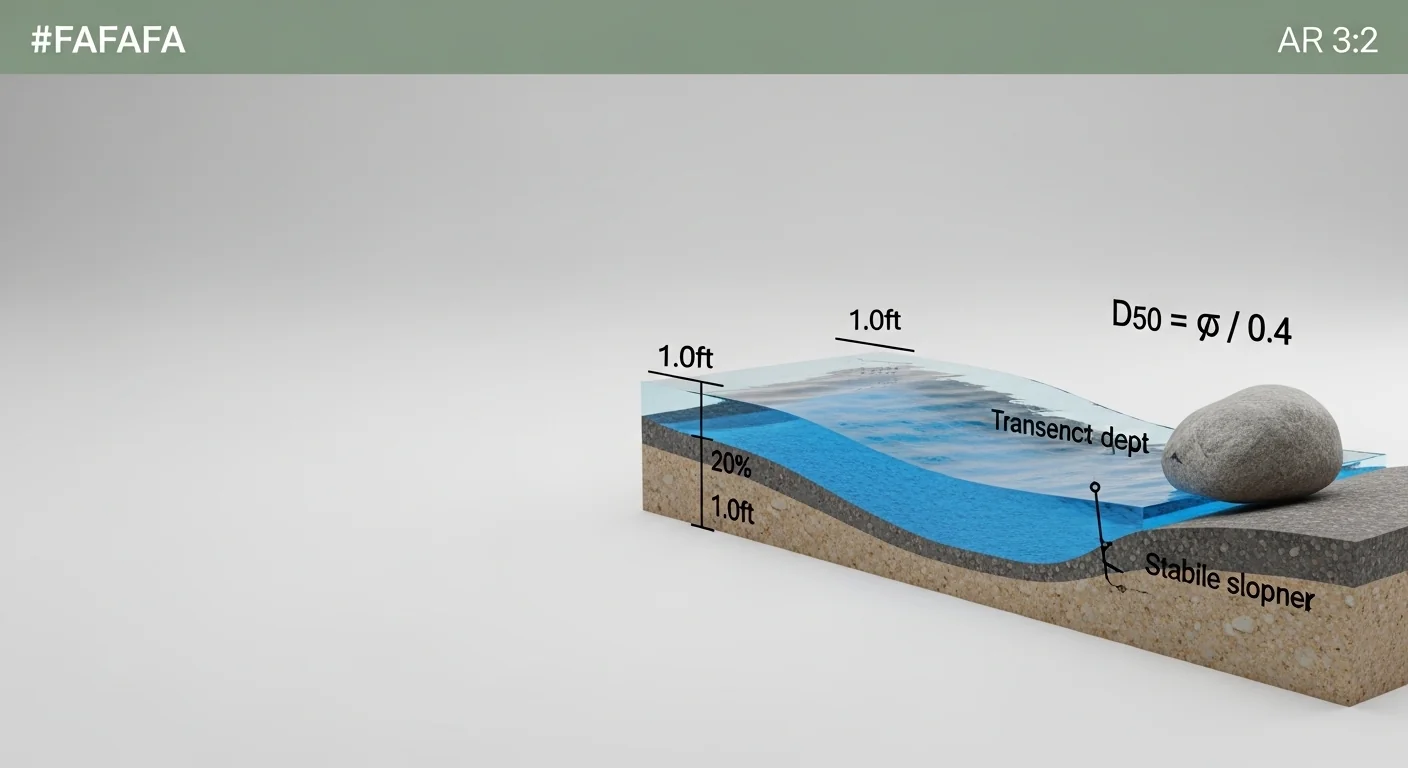
Dry Creek Bed Cobble Sizing Calculator
Calculate the minimum D50 stone diameter using tractive force hydrodynamics — prevent washout before it happens.
| Slope (%) | Depth (ft) | Tractive Force (lb/ft²) | D50 Required (in) | Status |
|---|
How This Calculator Works
τ is the shear stress (lb/ft²) that flowing water exerts on the channel bed. 62.4 is the unit weight of water in lb/ft³. Slope is entered as % and divided by 100.
0.4 lb/ft² is the critical tractive force coefficient for natural rounded cobble. Derived from Shield’s parameter for typical river rock (Ss ≈ 2.65, τ* ≈ 0.047).
High velocity creates dynamic lift forces beyond simple tractive stress. The velocity checks apply real-world thresholds from erosion control engineering practice (FHWA HEC-15).
The calculator always takes the governing (larger) requirement between the two methods.
Assumptions & Limits
- Assumes natural rounded cobble with specific gravity ≈ 2.65 (granite, river rock). Angular crushed rock may allow a 10–15% smaller D50.
- Tractive force formula valid for uniform, steady-state flow conditions — actual storm surges may be higher.
- Landscape fabric underlayment is strongly recommended for all slopes > 3% to prevent piping failure beneath the stone layer.
- For slopes > 15%, consider concrete toe protection or riprap engineering design per local municipality code.
- Velocity inputs should derive from the Rational Method (Q = CiA) or NRCS TR-55 for the 10-year or 25-year design storm.
- Width input is for reference context; the tractive force calculation is per-unit-width and does not change with channel width.
- For slopes > 8 ft/s velocity, engineering review by a licensed civil engineer is strongly recommended.
- This tool is for preliminary design guidance only and does not replace a licensed professional’s stamped design.
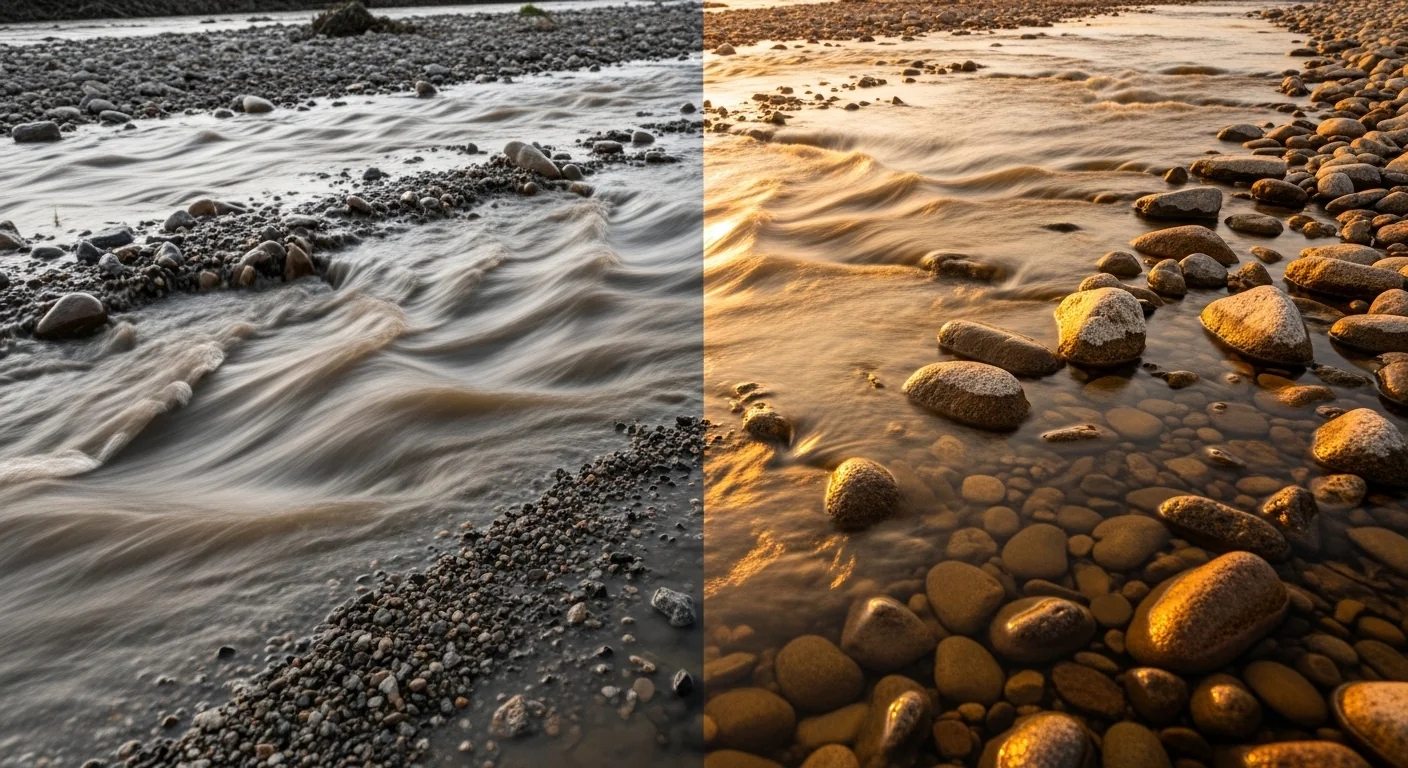
The failure mode that destroys a dry creek bed is not usually heavy rain. It is rock that was sized by appearance rather than by the physics of moving water. A stone that looks substantial can weigh less than the shear force the water exerts on it during a single peak-flow event, and once that threshold is crossed, the entire bed migrates downstream in minutes. Tractive force hydrodynamics quantifies that threshold precisely, using the channel slope and flow depth to calculate the drag force per square foot of bed surface.
This dry creek bed stone size calculator applies the tractive force method to determine the minimum D50 (median stone diameter in inches) required to resist displacement under design storm conditions. It also applies velocity override thresholds that activate independently of the tractive force result, because high-velocity flow creates dynamic lift forces that simple shear stress formulas do not fully capture. What the tool does not do: it does not replace a licensed civil engineer’s stamped stormwater design, does not account for curved channel geometries, and does not model sediment transport over time.
After running this calculator, a user can determine the minimum cobble size for their specific slope and flow conditions, confirm whether their project falls within residential landscaping practice or requires engineered riprap, and decide whether woven landscape fabric underlayment is required before stone placement.
Use the Tool
Before entering values, have three measurements ready: the channel slope as a percentage (vertical drop divided by run, multiplied by 100), the estimated peak water velocity from the design storm (calculated via the Rational Method or taken from a local stormwater study), and the expected maximum water depth in the channel during that same event. Channel bottom width is also required. If you are sizing material for a project that involves calculating total stone volume after determining the correct size, the river rock calculator can help estimate quantity once you have your D50 target from this tool.
Quick Start (60 Seconds)
- Slope (%): Enter the channel grade as a percentage, not a decimal. A 1-in-20 run is 5%, not 0.05. Valid range is 0.1 to 30. Do not enter the swale’s full profile slope if the channel transitions; use the steepest sustained section.
- Peak Water Velocity (ft/s): This must be the estimated peak velocity at design storm conditions, not average base-flow velocity. Use Rational Method output or Manning’s equation if you have roughness and cross-section data. Range accepted: 0.1 to 20 ft/s.
- Creek Bed Bottom Width (ft): Measure the flat base of the channel at its narrowest point. Do not include the side slopes. For trapezoidal channels, measure only the invert. Range: 0.5 to 100 ft.
- Expected Peak Water Depth (ft): The maximum flow depth during the design storm, not the typical low-flow depth. This is the value that drives the tractive force result most directly. Range: 0.05 to 15 ft.
- Units matter: All inputs must be in US customary units. Slope is in %, velocity in ft/s, dimensions in feet. The formula uses 62.4 lb/ft3 for the unit weight of water.
- Rounding rule: Always round up to the nearest commercial stone size. If the calculator returns 3.4 inches, specify 4-inch cobble or larger.
- Gravel vs. cobble: If you are estimating total cubic yards of material after determining size, a gravel volume calculator is a useful companion once D50 is confirmed.
Inputs and Outputs (What Each Field Means)
| Field | Unit | What It Means | Common Mistake | Safe Entry Guidance |
|---|---|---|---|---|
| Swale / Creek Bed Slope | % | The longitudinal grade of the channel floor. Drives tractive force directly: doubling slope doubles shear stress on the bed material. | Entering the side-slope of the bank instead of the channel longitudinal slope. | Measure rise over run along the channel centerline. A 6-inch drop over 10 feet = 5%. |
| Estimated Peak Water Velocity | ft/s | The design-storm peak flow velocity in the channel. Used independently to apply velocity override thresholds (5 ft/s and 8 ft/s) derived from erosion control engineering practice. | Using observed base-flow velocity from a garden hose test, which is far below design storm conditions. | Use Rational Method (Q = CiA), divide by cross-sectional area, or consult local stormwater tables for your return period. |
| Creek Bed Bottom Width | ft | The flat invert width of the channel. Contextual input used for interpretation; the tractive force formula operates per unit width so this field does not change the D50 output. | Measuring overall channel width including sloped banks and entering that wider value. | Measure only the flat bottom. For V-shaped channels, enter the invert point width (effectively 0) or the minimum flat section. |
| Expected Peak Water Depth | ft | The vertical depth of flow at peak design storm conditions. The single most sensitive input: doubling depth doubles tractive force and therefore the required D50. | Entering the channel bank height instead of actual expected flow depth, which overstates the required stone size. | Use hydraulic design tables or Manning’s equation for a realistic flow depth estimate. For simple residential swales, 6 to 18 inches is a common range. |
| D50 (Primary Output) | inches | The minimum median stone diameter required to resist displacement. Half the stones in the specified gradation must be at least this diameter. | Ordering stone by the maximum size label rather than the median. A “4-6 inch” bag may have a median of 3.5 inches. | Specify D50 in the purchase order, not maximum size. Ask suppliers for gradation curves when available. |
| Tractive Force (Output) | lb/ft2 | The shear stress applied by flowing water to the bed surface. Calculated as 62.4 x Depth x Slope(decimal). This is the intermediate value feeding the D50 calculation. | Assuming tractive force is low because the slope looks gentle. A 0.5 ft depth on a 10% slope generates over 3 lb/ft2. | Review this value independently. If tractive force exceeds 2.5 lb/ft2, geotextile anchoring of the fabric layer is worth considering. |
| Min Rock from Velocity (Output) | inches | The velocity-based minimum stone size, applied as an override when velocity exceeds 5 ft/s. Independent of the tractive force result. | Ignoring this output because the D50 from tractive force looks adequate. At 6 ft/s, lift forces are not captured by the shear stress formula alone. | Take the larger of D50 and velocity minimum as the governing design requirement. The calculator does this automatically. |
| Fabric Required (Output) | Yes / Recommended | Whether woven geotextile underlayment is flagged as required or strongly recommended based on slope and velocity inputs. | Skipping fabric because the stone layer looks stable. Without fabric, fine soil migrates upward through stone voids over multiple storm cycles, causing settlement and stone displacement. | Treat “Recommended” as required for any project expected to carry meaningful stormwater flow. Fabric is inexpensive insurance against piping failure. |
Worked Examples (Real Numbers)
Scenario 1: Residential Downspout Diversion (Moderate Slope)
- Slope: 5%
- Peak water velocity: 3 ft/s
- Creek bed bottom width: 2 ft
- Expected peak water depth: 0.5 ft
Calculation: Tractive force = 62.4 x 0.5 x 0.05 = 1.56 lb/ft2. D50 = 1.56 / 0.4 = 3.9 inches. Velocity is below 5 ft/s, so no velocity override applies.
Result: Minimum D50 = 3.9 inches. Specify 4-inch river cobble or larger.
This is the most common residential scenario. The 4-inch minimum is well within the range of standard landscape cobble, but the fabric underlayment is still required given the 5% slope. Stone sized at 1 to 2 inches would be displaced in this condition.
Scenario 2: Steep Backyard Drainage Swale
- Slope: 10%
- Peak water velocity: 6 ft/s
- Creek bed bottom width: 3 ft
- Expected peak water depth: 0.75 ft
Calculation: Tractive force = 62.4 x 0.75 x 0.10 = 4.68 lb/ft2. D50 from tractive force = 4.68 / 0.4 = 11.7 inches. Velocity exceeds 5 ft/s, triggering a 4-to-6 inch velocity minimum. The tractive force result (11.7 inches) governs.
Result: Minimum D50 = 11.7 inches. Specify 12-inch riprap class or larger.
This result is outside standard residential landscaping cobble. Material this size is sold as Class I or Class II riprap at masonry suppliers, not as decorative creek rock. Landscape adhesive on the toe and transition stones is strongly advisable at this velocity.
Scenario 3: Gentle Rain Garden Outlet Swale
- Slope: 2%
- Peak water velocity: 2 ft/s
- Creek bed bottom width: 4 ft
- Expected peak water depth: 0.4 ft
Calculation: Tractive force = 62.4 x 0.4 x 0.02 = 0.50 lb/ft2. D50 = 0.50 / 0.4 = 1.25 inches. Velocity is below 5 ft/s, no override.
Result: Minimum D50 = 1.25 inches. Specify 2-inch cobble or larger.
The tractive force is low at this slope and depth combination, and 2-inch stone is adequate. Fabric underlayment remains important here, however, because fine soils below the outlet are susceptible to piping during repeated saturation cycles even at low velocity.
Reference Table (Fast Lookup)
| Slope (%) | Peak Depth (ft) | Tractive Force (lb/ft2) | D50 Required (in) | Velocity Threshold Flag | Recommended Stone Type |
|---|---|---|---|---|---|
| 1 | 0.5 | 0.31 | 0.78 | None (vel. context dependent) | 1″ river pebble with fabric |
| 2 | 0.5 | 0.62 | 1.56 | None | 2″ cobble with fabric |
| 3 | 0.5 | 0.94 | 2.34 | None | 2-3″ cobble with fabric |
| 5 | 0.75 | 2.34 | 5.85 | Check velocity (4-6″ min if >5 ft/s) | 6″ cobble minimum |
| 5 | 1.0 | 3.12 | 7.80 | Check velocity | 8″ cobble or Class I riprap |
| 8 | 1.0 | 4.99 | 12.48 | Velocity override likely active | 12″ riprap class |
| 10 | 1.0 | 6.24 | 15.60 | Engineering review required | Class II riprap; concrete toe |
| 10 | 1.5 | 9.36 | 23.40 | Engineering review required | Engineered riprap only |
| 15 | 1.5 | 14.04 | 35.10 | WASHOUT WARNING zone | Licensed engineer design required |
| 2 | 0.3 | 0.37 | 0.94 | None | 1-2″ pebble with fabric |
Values in the D50 column are computed directly from the tractive force formula and rounded to two decimal places. Always round up to the next commercially available stone size when purchasing material.
How the Calculation Works (Formula + Assumptions)
Show the calculation steps
Step 1: Calculate Tractive Force
Tractive force (tau, in lb/ft2) represents the shear stress that flowing water exerts horizontally on the channel bed surface.
Formula: tau = 62.4 x Depth (ft) x Slope (as decimal)
The constant 62.4 is the unit weight of water in lb/ft3 at standard conditions. Slope is entered as a percentage and divided by 100 internally. A 5% slope becomes 0.05 in the formula.
Step 2: Convert Tractive Force to D50 Stone Diameter
Formula: D50 (inches) = tau / 0.4
The divisor 0.4 lb/ft2 is the critical tractive force coefficient for natural rounded cobble. It is derived from Shield’s parameter for typical river rock (specific gravity approximately 2.65, Shield’s critical stress parameter approximately 0.047). Angular crushed rock has slightly higher resistance and may tolerate a smaller D50, but this calculator uses the rounded stone coefficient as the conservative default.
Step 3: Apply Velocity Override Thresholds
If peak water velocity exceeds 5 ft/s, a minimum stone size of 4 to 6 inches is imposed regardless of the tractive force result. This threshold is derived from erosion control engineering practice (FHWA HEC-15) and accounts for dynamic lift forces in high-velocity flow that the basic shear stress formula underestimates.
If velocity exceeds 8 ft/s, a washout warning is triggered. At this velocity, conventional landscaping cobble of any size is at risk, and the calculator flags the condition for engineering review.
Step 4: Return the Governing Value
The final recommended D50 is the larger of the tractive force result and the velocity minimum. This ensures both failure modes are covered simultaneously.
Rounding Rule
The calculator returns computed values to one decimal place. When specifying stone, always round up to the next commercially available size. A result of 3.9 inches should be purchased as 4-inch cobble, not 3-inch.
Assumptions and Limits
- The formula assumes steady, uniform flow. Real storm surges are unsteady; peak forces may exceed model predictions during the leading edge of a surge event.
- The 0.4 coefficient is calibrated for natural rounded river cobble with specific gravity of approximately 2.65 (granite, basalt, river rock). Angular crushed limestone or quartzite may be slightly more resistant but this tool does not apply a shape correction factor.
- The tractive force formula is valid for relatively straight, prismatic channels. Curved channels generate secondary currents that increase local bed shear by a factor that depends on bend radius and cannot be captured by this one-dimensional model.
- Width is collected for interpretive context. The tractive force and D50 calculations are per-unit-width and are mathematically independent of channel width. Total volume of material required scales with width but required stone size does not.
- The velocity input depends entirely on the accuracy of the upstream hydrology calculation. Rational Method estimates are sensitive to the runoff coefficient (C) and drainage area delineation. Errors in those inputs propagate directly into the velocity figure and therefore the D50 result.
- For channels on slopes exceeding 15%, local stormwater management ordinances may require a concrete apron at the outlet, energy dissipators at grade changes, or a licensed engineer’s design. This calculator does not check regulatory thresholds, which vary by jurisdiction.
- The tool assumes stone is placed in a single, loosely packed layer. Mortared stone, wire-enclosed gabion baskets, or stacked-stone designs have different resistance characteristics and would require separate analysis.
- Long-term performance depends on maintenance. Fine sediment accumulates between stones over years, altering hydraulic roughness. Periodic inspection after major storm events is always advisable.
Standards, Safety Checks, and “Secret Sauce” Warnings
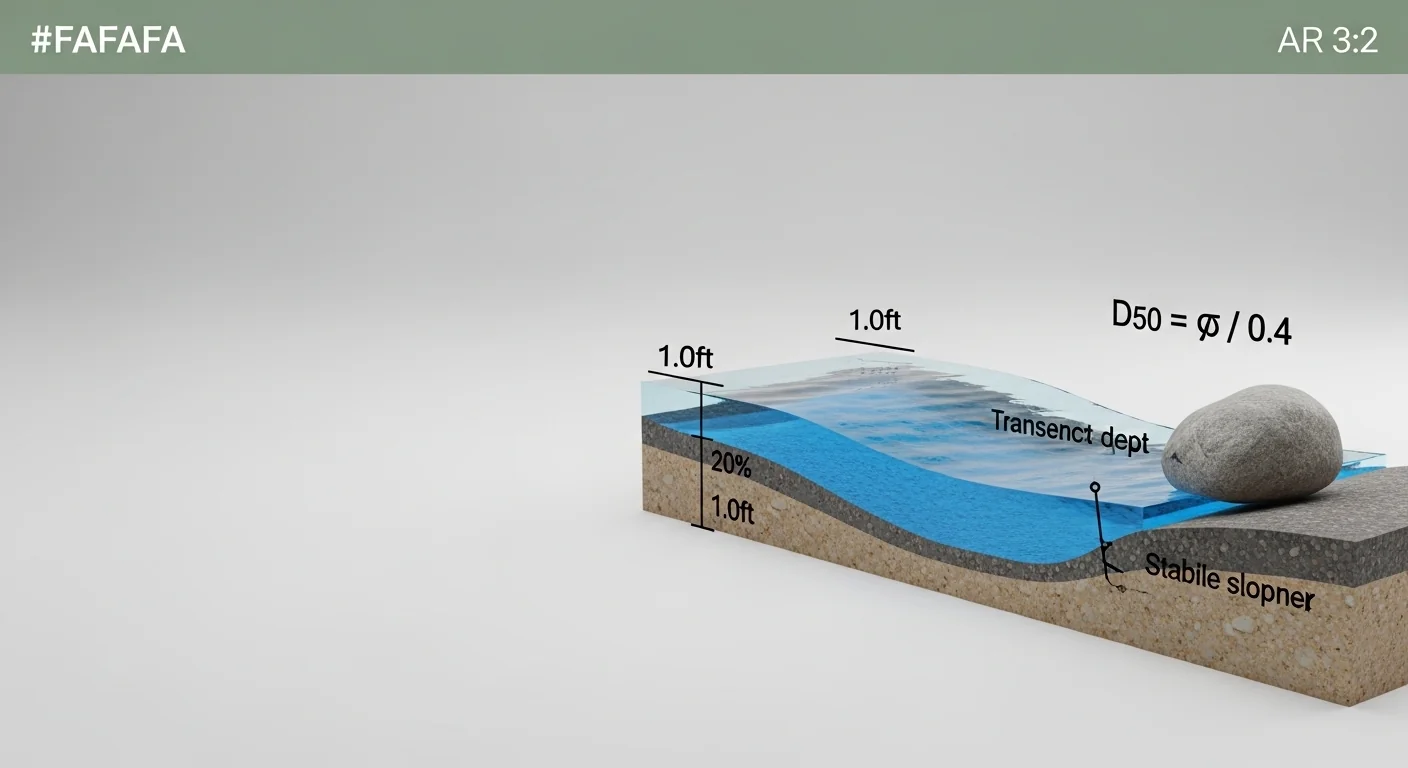
Critical Warnings
- The 1-inch river rock failure: A channel lined with 1-inch stone on a 10% slope carrying 6 ft/s flow will experience complete stone displacement during a design storm. Tractive force at that condition exceeds the critical threshold for 1-inch cobble by a factor of roughly 7. The failure is not gradual; stones go airborne and migrate several feet within a single event. The calculator prevents this by computing D50 directly rather than relying on visual stone-size selection.
- Velocity override is not optional: At velocities above 5 ft/s, the tractive force result alone is not sufficient. The formula captures shear stress but does not model the dynamic lift component that develops at higher flow speeds. The 4-to-6 inch velocity minimum is a hard floor, not a suggestion. Ignoring it because the tractive force calculation returns a smaller number is the specific failure mode that leads to partial-bed washouts in mid-slope sections of residential creek beds.
- No fabric means eventual failure at any slope: Even correctly sized stone will migrate over multiple storm cycles if laid directly on bare soil. Fine particles wick upward through the stone voids under repeated wetting and drying, gradually undermining the stone layer from below. Woven geotextile fabric breaks this cycle entirely and is required on any slope exceeding 3%.
- Velocity above 8 ft/s requires professional design: The washout warning is not a theoretical edge case. It is triggered at conditions that are achievable in typical residential and commercial drainage situations during 10-year or 25-year storm events in regions with steep topography or large impervious areas. If the calculator flags this condition, the project scope has moved beyond standard landscaping practice.
Minimum Standards
- D50 must be the median diameter of the installed gradation, not the maximum. Verify with supplier gradation data or ask for the D50 specification when ordering bulk stone.
- Landscape fabric underlayment should overlap a minimum of 12 inches at seams and extend up the channel banks at least 6 inches beyond the stone layer’s edge. This is consistent with standard practice for erosion control geotextile installation.
- Velocity calculations should use the 10-year or 25-year design storm as the minimum return period for residential drainage applications. The 2-year storm is not adequate for sizing erosion control material.
Competitor Trap: Most dry creek bed guides online instruct homeowners to select stone based on visual categories like “small,” “medium,” or “large” cobble, or they recommend a fixed minimum size (typically 3 to 4 inches) regardless of slope or flow velocity. This one-size-fits-all guidance fails in both directions: it over-specifies stone on very gentle, low-velocity channels (adding unnecessary cost), and catastrophically under-specifies stone on steeper channels or those carrying concentrated roof runoff. The tractive force method used here is the same physics-based approach applied in highway culvert and riprap channel design; the underlying calculation simply scaled down to residential site conditions.
For projects involving controlled water discharge into a rock-lined basin, the rain garden sizing calculator can help determine whether a rain garden is an appropriate outlet structure downstream of the creek bed. If your property also includes a gravel driveway that intercepts runoff before it enters the swale, the gravel driveway slope calculator is useful for confirming that the approach grade directs flow correctly toward the drainage feature rather than pooling at the apron.
Common Mistakes and Fixes
Mistake: Using Average Rainfall Depth Instead of Peak Flow Velocity
Annual rainfall totals or average storm intensities do not translate directly into flow velocity. Velocity depends on watershed area, imperviousness, slope, and the specific storm return period being designed for. Entering a low estimated velocity because “it doesn’t flood here often” produces a critically undersized D50 for the actual design event.
Fix: Use the Rational Method (Q = CiA) with the appropriate runoff coefficient and IDF curve for your location, then divide peak discharge by the estimated channel cross-sectional area to get velocity.
Mistake: Measuring the Channel Bank Height as Flow Depth
The bank height of an installed dry creek bed is a construction dimension, not a hydraulic depth. Peak flow depth is a function of discharge and channel geometry, and it is almost always less than the full bank height. Entering full bank height inflates the tractive force result and overestimates the required D50.
Fix: Use Manning’s equation with the design discharge to compute normal flow depth, or size the channel so that full bank capacity equals the design storm discharge, then use that depth as input.
Mistake: Specifying “4-to-6 Inch Cobble” When D50 = 4 Inches Is the Minimum
A bag or bulk delivery labeled “4-6 inch cobble” may have a D50 of 3.5 to 4 inches, meaning half the stones are smaller than the required minimum. Ordering by size range without confirming the median allows undersized material to be delivered and installed, negating the calculation entirely.
Fix: Specify the minimum D50 in the purchase order. Request a gradation curve or sieve analysis from the supplier for high-slope or high-velocity applications. For retaining-wall-adjacent channels, where stone displacement could undermine a structural base, this is especially important; the retaining wall calculator addresses base material requirements separately.
Mistake: Installing Stone Without Fabric on “Low Risk” Channels
A 2% slope with 2 ft/s velocity may produce a D50 result below 2 inches, which feels like a low-risk project. Homeowners often skip the fabric step on these installations because the stone seems stable immediately after installation. Over one to three seasons, fine particles migrate upward through the voids, soil-to-stone contact shifts, and stones begin to rock and settle unevenly.
Fix: Treat woven geotextile underlayment as a required installation step for every dry creek bed, regardless of how benign the tractive force output appears. The fabric also suppresses weed emergence, which is a secondary benefit that matters for long-term maintenance.
Mistake: Applying the Formula to Curved or Braided Channels Without Adjustment
The tractive force formula assumes a straight, prismatic channel with uniform flow. In bends, secondary circulation increases local bed shear substantially on the outer curve. Installing straight-channel D50 stone into a tightly curved creek bed concentrates erosion forces on the outer bank, leading to partial failures that look puzzling because the stone elsewhere in the bed remains intact.
Fix: Increase the D50 specification by at least one commercial stone size class at bends and transitions. Alternatively, use landscape adhesive or grouting at curved sections to mechanically supplement stone-to-stone friction.
Next Steps in Your Workflow
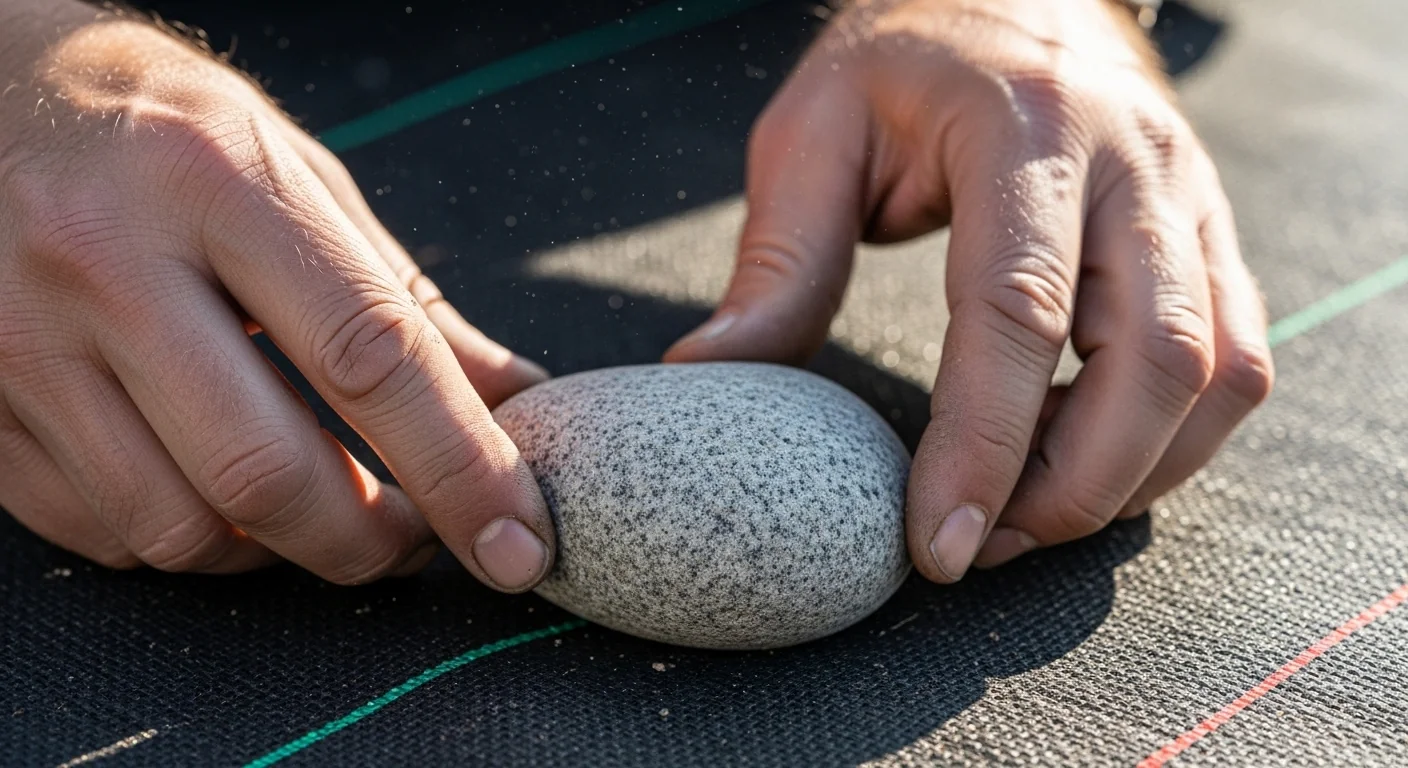
Once the minimum D50 is confirmed, the next decision is procurement. Verify with your stone supplier that the gradation they stock meets the specified D50 as a median, not a maximum. For high-velocity or steep-slope applications, request a gradation data sheet. After stone selection, order the geotextile fabric first, since it takes the most time to cut, overlap, and pin correctly before any stone is placed. If your project involves an upstream channel component that will concentrate flow from a lawn or planted area, the compost blanket erosion calculator can help determine whether a temporary erosion control layer is needed during the establishment period before permanent stone is installed.
The final installation sequence matters as much as the material selection. Stone should be placed starting from the outlet end and working upstream, so that each stone’s downstream edge is supported by the layer below it, not resting on open fabric. At transitions where the dry creek bed meets a patio, driveway, or other hardscape, check that the adjacent surface grade directs water into rather than under the stone layer; the patio slope calculator is useful for confirming those transition grades are set correctly.
FAQ
What is D50 and why does it matter for stone sizing?
D50 is the median stone diameter in a gradation: half the stones by weight are larger, half are smaller. It is the standard engineering specification for erosion control stone because it reflects the typical resistance of the installed mass rather than the largest or smallest individual stones. Specifying only a maximum size allows a large fraction of undersized material to be installed, creating weak points where displacement initiates.
Can this calculator be used for a French drain surface rock layer?
The tractive force formula applies to open-channel surface flow, not subsurface drainage. For a French drain, the stone functions as a filter medium and its sizing is governed by soil gradation and filter criteria, not flow velocity. If there is a surface cobble layer over a French drain that will carry overland flow, this calculator is applicable to that surface layer only.
What velocity does a typical residential downspout generate?
That depends on roof area, intensity of the design storm, and the discharge path geometry. A single 2-inch downspout from a 1,000 square foot roof section discharging onto a 3% slope can produce localized velocities of 3 to 5 ft/s at the outlet. Using a single-outlet concentration point without a spreader or energy dissipator tends to produce the highest local velocities and should be sized conservatively.
Is the 0.4 coefficient constant for all stone types?
No. The 0.4 lb/ft2 value used here is calibrated for natural rounded river cobble with a specific gravity of approximately 2.65. Angular crushed stone of the same diameter has greater mechanical interlock and somewhat higher resistance to displacement. Dense stone types like basalt (specific gravity approximately 2.9) also provide more resistance per unit diameter. This calculator uses the conservative rounded-stone coefficient for all inputs.
At what slope does a dry creek bed become an engineering project?
There is no single universal threshold, but as a practical guideline, slopes above 8% that also carry concentrated stormwater flow from a sizeable drainage area begin to generate tractive forces and velocities that exceed what residential landscape stone can reliably handle. Above 15%, most local stormwater codes require engineered channel design. Always check with the local municipality before installing drainage structures on steep slopes.
Does channel width affect the required stone size?
No, width does not change the D50 result in this formula. Tractive force and the resulting D50 are calculated per unit width of channel bed and depend only on depth and slope. A 2-foot-wide channel and a 10-foot-wide channel on the same slope with the same flow depth require the same stone size. Width does affect total material volume and peak flow capacity, but not the resistance specification for individual stones.
Conclusion
The single most important mistake to avoid is sizing stone by visual inspection or category labels rather than by computed D50. A creek bed installed with correctly sized material, proper geotextile underlayment, and correct stone placement sequence will function through repeated storm cycles without remediation. If your project also involves calculating how much stone material you need by volume once size is confirmed, the boulder weight calculator can help estimate material weight for delivery planning on larger projects.