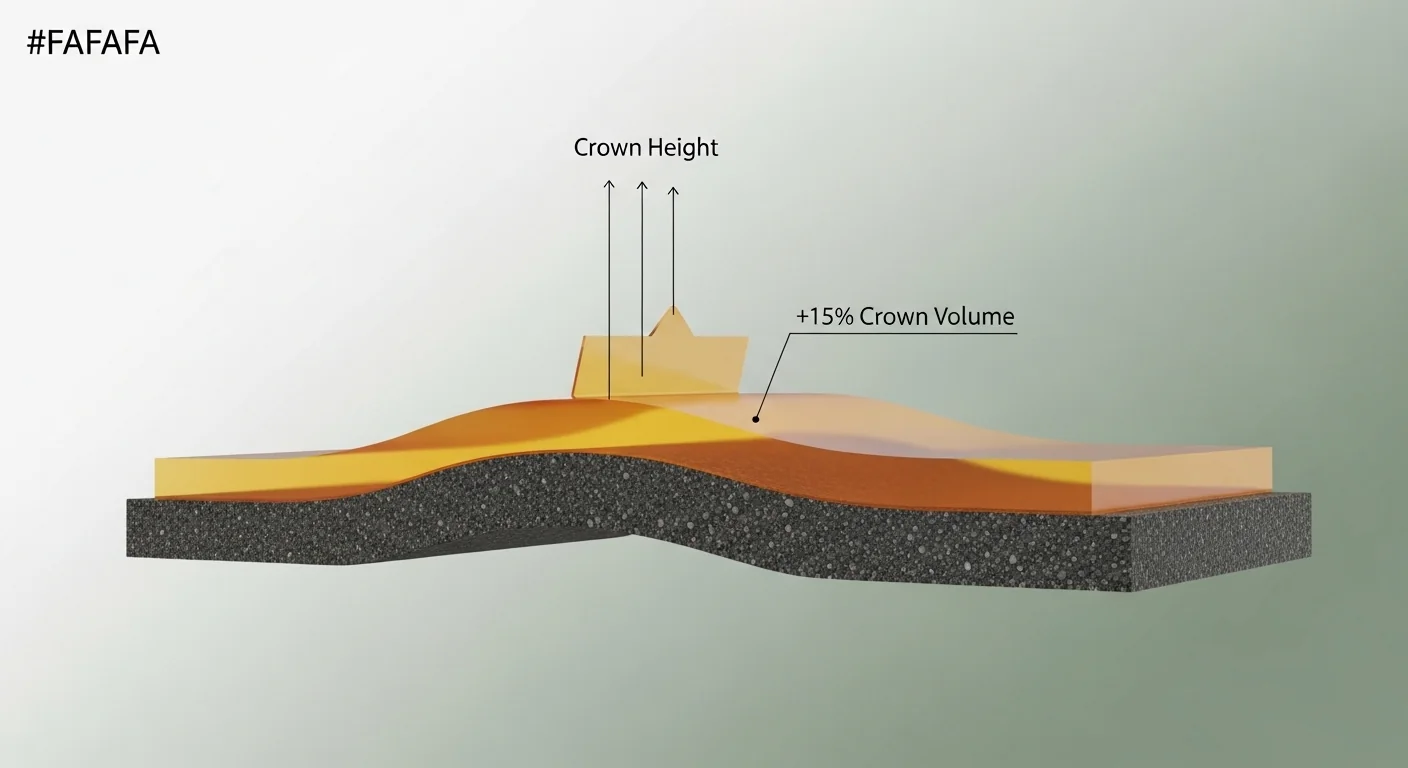
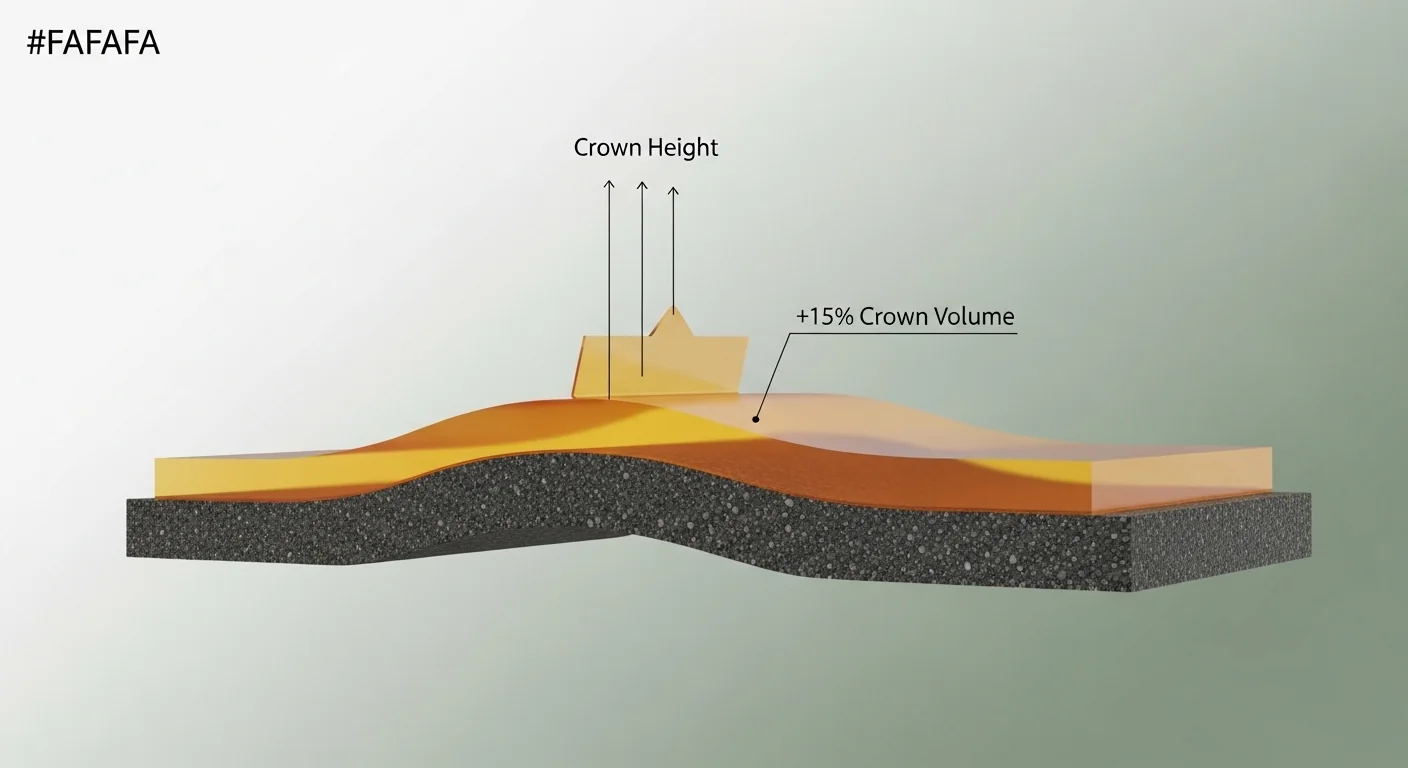
A gravel driveway fails from the center out. When the surface lacks a proper cross-slope, water no longer sheds to the edges. It pools. It softens the subgrade beneath the aggregate layer. Then a vehicle tire strikes that saturated spot, and hydraulic pressure physically ejects the gravel upward, leaving a pothole. This is not wear and tear. It is a drainage engineering failure, and it begins the moment a driveway is graded flat.
This gravel driveway slope calculator computes three things: the crown height your driveway centerline needs to rise above its edges, the base cubic yardage of aggregate required at your chosen depth, and the additional volume needed to form the crowned profile. It does not calculate longitudinal (end-to-end) slope, subgrade bearing capacity, or drainage ditch sizing. Those are site-specific civil engineering questions that require field assessment.
After running this calculator, you will know the exact crown height to target when grading, the cubic yards of crusher run to order, and whether your intended pitch triggers a pothole-risk warning before a single truck is dispatched.
Use the Tool
Before entering values, have a tape measure or laser distance meter on hand. You need the full finished length and width of the driveway surface, not the lot line. Measure crown pitch in inches of rise per horizontal foot, not as a degree angle or fraction of grade. If you are planning a new surface and need to think through your aggregate base layer separately, the paver base calculator covers compacted depth planning for aggregate sub-layers. Gravel depth is the finished settled depth of the surface course, not the loose dump depth.
Quick Start (60 Seconds)
- Driveway Length: Enter the total finished length in feet. Measure parallel to the centerline, not at an angle across the lot. Valid range is 10 to 2,000 ft.
- Driveway Width: Enter the full driving surface width in feet, edge to edge. Do not include grassed shoulders or drainage swales. Valid range is 6 to 40 ft.
- Crown Pitch: Enter the rise per foot in decimal inches, such as 0.5 for a standard half-inch-per-foot crown. Do not enter a slope ratio like "1:24" here; convert it first (1 inch per 24 feet = 0.04, which is dangerously flat).
- Gravel Depth: Enter the target finished depth in inches. This is the compacted depth, not the loose dump thickness. Loose material typically compacts to roughly 80 to 85 percent of dump volume depending on aggregate gradation.
- Click Calculate. Results will not display until all four fields contain valid numbers within their stated ranges.
- Review the Crown Pitch Safety Gauge. Any reading in the red or amber zone requires corrective action before ordering material.
- Use the cross-section diagram to confirm the crown height makes visual sense for your driveway width before finalizing your grading plan.
Inputs and Outputs (What Each Field Means)
| Field | Unit | What It Represents | Common Mistake | Safe Entry Guidance |
|---|---|---|---|---|
| Driveway Length | feet | Total centerline length of the paved surface from start to end | Measuring lot boundary instead of finished surface | 10 to 2,000 ft; round to nearest whole foot |
| Driveway Width | feet | Full driving surface width, edge-to-edge of gravel | Including drainage swales or unmaintained shoulders | 6 to 40 ft; residential single lane is typically 10 to 14 ft |
| Crown Pitch | inches per foot | How much the centerline rises above each edge per horizontal foot of half-width | Confusing pitch with total slope ratio or degree angle | 0.0625 to 2.0 in/ft; 0.5 is the standard recommendation |
| Gravel Depth | inches | Compacted final depth of the surface aggregate course | Using loose dump depth instead of compacted settled depth | 1 to 12 in; minimum 4 in recommended for vehicle traffic |
| Crown Height (output) | inches | The vertical rise at the centerline above the driveway edge | Assuming crown is optional; it is not | Should visibly arc; too shallow means inadequate drainage |
| Base Cubic Yards (output) | yd³ | Flat-layer volume before crown adjustment | Ordering only this amount and skipping the crown volume | Always use Total with Crown for purchasing |
| Total with Crown (output) | yd³ | Final gravel volume including the 15-point crown adjustment factor | Treating base and total as interchangeable | This is the purchase quantity; add 5 to 10 extra for waste and fill |
| Estimated Tons (output) | short tons | Approximate weight based on 1.4 tons per cubic yard for crusher run | Using this figure for lightweight gravel or river rock | Density varies; confirm with your specific aggregate supplier |
Worked Examples (Real Numbers)
Example 1: Standard Residential Single-Lane Driveway
- Length: 100 ft
- Width: 12 ft
- Crown Pitch: 0.5 in/ft (recommended standard)
- Gravel Depth: 4 in
Crown Height = (12 ÷ 2) × 0.5 = 3.00 inches
Base Yards = (100 × 12 × 4/12) ÷ 27 = 400 ÷ 27 = 14.81 yd³
Total with Crown = 14.81 × 1.15 = 17.03 yd³ (approximately 23.8 tons)
Result: A 100-ft by 12-ft driveway at the industry-standard half-inch crown requires just over 17 cubic yards. The 3-inch center rise is enough to shed water cleanly without creating a jarring ridge that disrupts vehicle stability.
Example 2: Long Rural Farm Access Lane
- Length: 500 ft
- Width: 16 ft
- Crown Pitch: 0.5 in/ft
- Gravel Depth: 4 in
Crown Height = (16 ÷ 2) × 0.5 = 4.00 inches
Base Yards = (500 × 16 × 4/12) ÷ 27 = 2,666.7 ÷ 27 = 98.77 yd³
Total with Crown = 98.77 × 1.15 = 113.58 yd³ (approximately 159 tons)
Result: A 500-foot access lane is a substantial material commitment. The 4-inch crown rise at center is visible to the eye and must be maintained with each re-grading pass. Skipping crown restoration after heavy rain events is the primary reason long rural driveways develop persistent low spots and standing water.
Example 3: Wide Double-Lane Driveway With Below-Recommended Pitch
- Length: 200 ft
- Width: 20 ft
- Crown Pitch: 0.375 in/ft (below the 0.5 recommendation; pothole-risk amber zone)
- Gravel Depth: 6 in
Crown Height = (20 ÷ 2) × 0.375 = 3.75 inches
Base Yards = (200 × 20 × 6/12) ÷ 27 = 2,000 ÷ 27 = 74.07 yd³
Total with Crown = 74.07 × 1.15 = 85.18 yd³ (approximately 119.3 tons)
Result: This scenario triggers an amber warning. At 0.375 in/ft on a 20-foot-wide surface, water will sheet off slowly. In heavy rain or frozen-thaw cycles, the inner lane may experience pooling before it reaches the edge. Increasing pitch to 0.5 in/ft would add only about 1.25 inches of crown height but meaningfully reduce drainage risk.
Reference Table (Fast Lookup)
All values below assume a 4-inch finished gravel depth and 0.5-inch-per-foot crown pitch over a 100-foot section. The Total column accounts for the 15-point crown volume factor. Use this table as a quick sanity check before running the full calculator.
| Width (ft) | Crown Pitch (in/ft) | Crown Height (in) | Base yd³ per 100 ft | Total w/ Crown per 100 ft | Drainage Risk Level |
|---|---|---|---|---|---|
| 8 | 0.5 | 2.00 | 9.88 | 11.36 | Safe |
| 10 | 0.25 | 1.25 | 12.35 | 14.20 | Marginal |
| 10 | 0.5 | 2.50 | 12.35 | 14.20 | Safe |
| 12 | 0.25 | 1.50 | 14.81 | 17.03 | Marginal |
| 12 | 0.5 | 3.00 | 14.81 | 17.03 | Safe |
| 16 | 0.5 | 4.00 | 19.75 | 22.72 | Safe |
| 20 | 0.375 | 3.75 | 24.69 | 28.40 | Marginal |
| 20 | 0.5 | 5.00 | 24.69 | 28.40 | Safe |
| 24 | 0.5 | 6.00 | 29.63 | 34.07 | Safe |
| 24 | 0.125 | 1.50 | 29.63 | 34.07 | High Risk |
Note: Base and Total yardage are identical between pitch variants of the same width because the 15-point crown factor applies uniformly regardless of pitch magnitude. Pitch affects crown height and drainage safety, not the volume multiplier.
How the Calculation Works (Formula + Assumptions)
Show the calculation steps
Step 1: Crown Height
Crown Height (inches) = (Driveway Width in feet ÷ 2) × Crown Pitch (inches per foot)
This gives the vertical distance the centerline sits above the edge of the driveway. The formula assumes a parabolic crown approximated as a straight slope from edge to center. At widths under 30 feet, the straight-slope approximation is accurate enough for material planning purposes.
Step 2: Base Cubic Yards
Base Yards = (Length × Width × Depth ÷ 12) ÷ 27
Dividing depth by 12 converts inches to feet. Dividing by 27 converts cubic feet to cubic yards. This gives the flat-layer volume as if no crown were built.
Step 3: Crown-Adjusted Total
Total Cubic Yards = Base Yards × 1.15
The 1.15 multiplier accounts for the extra material required to build the crowned center profile. The center of the driveway receives more aggregate than the edges, which requires additional volume beyond the flat-layer baseline.
Step 4: Pothole Warning Threshold
If Crown Pitch is less than 0.25 inches per foot, the tool triggers a Pothole Factory warning. If pitch falls between 0.25 and 0.5, it triggers an amber caution. These thresholds are based on industry drainage standards for unpaved rural roads and residential gravel driveways.
Rounding: All intermediate values are carried to full floating-point precision. Final results are rounded to two decimal places for display. Volume ordering should round up to the nearest whole cubic yard.
Unit conversions applied:
- Depth in inches converted to feet: Depth ÷ 12
- Cubic feet converted to cubic yards: ÷ 27
- Cubic yards converted to approximate tons: × 1.4 (crusher run density assumption)
Assumptions and Limits
- The 1.4 tons per cubic yard density factor applies to 3/4-inch crusher run. Washed gravel, river rock, and other aggregate types have different densities and will produce inaccurate weight estimates if this tool is used for them.
- The 15-point crown multiplier assumes a standard residential driveway crown profile. Steeper pitches or cambered road profiles may require a higher factor; consult a grading contractor for pitches above 0.75 in/ft.
- The tool does not account for compaction. Loose aggregate typically requires 10 to 15 additional volume to account for settling under roller or traffic compaction.
- Longitudinal slope (the grade running front to back on the driveway) is not modeled. Sites with greater than 5-degree longitudinal grade may require drainage culverts, dips, or water bars in addition to crown shaping.
- Subgrade condition is not assessed. Clay-heavy or hydric soils may require geotextile separator fabric beneath the aggregate to prevent migration. This calculator does not account for that layer.
- The valid input range is: Length 10 to 2,000 ft, Width 6 to 40 ft, Pitch 0.0625 to 2.0 in/ft, Depth 1 to 12 in. Values outside these ranges are rejected by the tool's validation system.
- This tool is a planning aid, not a substitute for professional grading design on challenging sites.
Standards, Safety Checks, and Secret Sauce Warnings
Critical Warnings
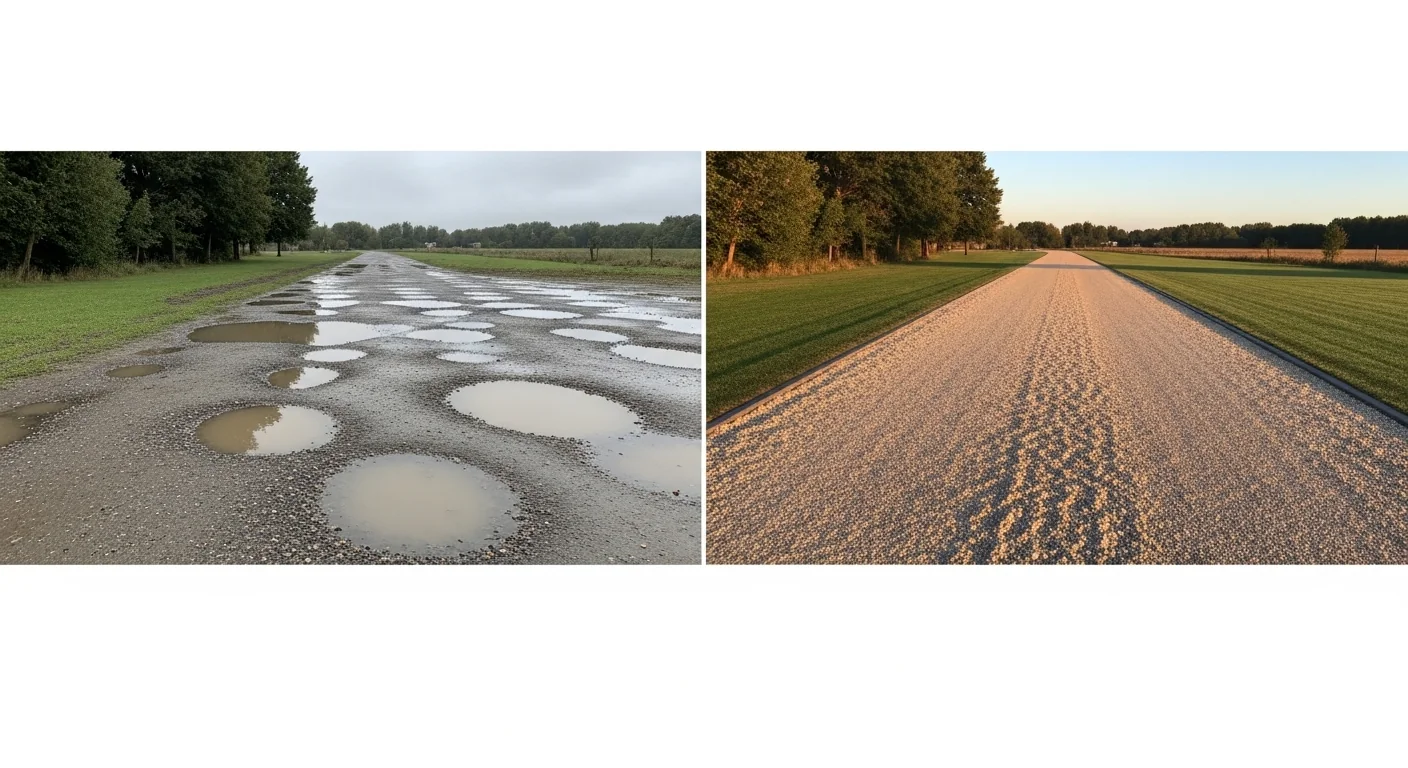
- The Pothole Mechanism Explained: A flat gravel driveway does not simply wear out; it fails through hydraulic ejection. Water pools in low spots, saturates the subgrade, and when a vehicle tire displaces that water laterally under pressure, it carries aggregate with it. The result is a pothole that appears suddenly after a single storm. No amount of gravel topping repairs this if the crown pitch is not corrected first.
- Thin Surface Layers: A gravel depth under 3 inches cannot maintain a stable crown profile under vehicle traffic. The aggregate redistributes too readily, quickly collapsing the center rise back to a flat surface. Four inches compacted is the functional minimum for any residential application with regular vehicle use.
- The False Flat Grade: A box blade or grading scraper set to remove all surface irregularities will produce a visually perfect, level surface that fails hydraulically. The goal of grading is not flatness; it is controlled cross-slope. These are not the same objective.
- Geotextile Omission: In clay subgrades, skipping woven geotextile separator fabric means aggregate gradually punches into soft soil under vehicle load, reducing effective depth over time and negating the crown profile. Material volume calculations are irrelevant if the base layer is not stabilized.
Minimum Standards
- Minimum crown pitch for pothole prevention: 0.25 in/ft. Below this, standing water is expected after moderate rainfall.
- Recommended crown pitch for residential driveways: 0.5 in/ft (1/2 inch per foot). This standard aligns with guidance for unpaved rural road design and provides meaningful margin against drainage failure.
- Minimum compacted aggregate depth for vehicle traffic: 4 inches of crusher run surface course, ideally over a prepared subgrade or geotextile separator.
- Aggregate specification: 3/4-inch crushed stone (crusher run, also called dense-graded aggregate) interlocks under compaction and resists displacement better than round washed gravel or pea stone. For drainage and slope planning on adjacent hardscaped surfaces, the patio slope calculator covers the same drainage principles applied to impervious surfaces.
Competitor Trap: Most gravel driveway guides focus exclusively on cubic yardage, treating the driveway as a flat rectangular volume. They calculate how much gravel to order, but never address the shape that gravel must be graded into. A homeowner can order exactly the right tonnage and still have a drainage catastrophe if the surface ends up flat. Crown pitch is the variable that separates a functional driveway from a pothole factory, and it is the one variable most online calculators omit entirely. For projects that also involve managing site drainage beyond the driveway edge, calculating your rain garden sizing as part of the same planning session can prevent downstream erosion that flat driveways accelerate.
Common Mistakes and Fixes
Mistake: Grading to Visual Flatness Instead of Measured Crown
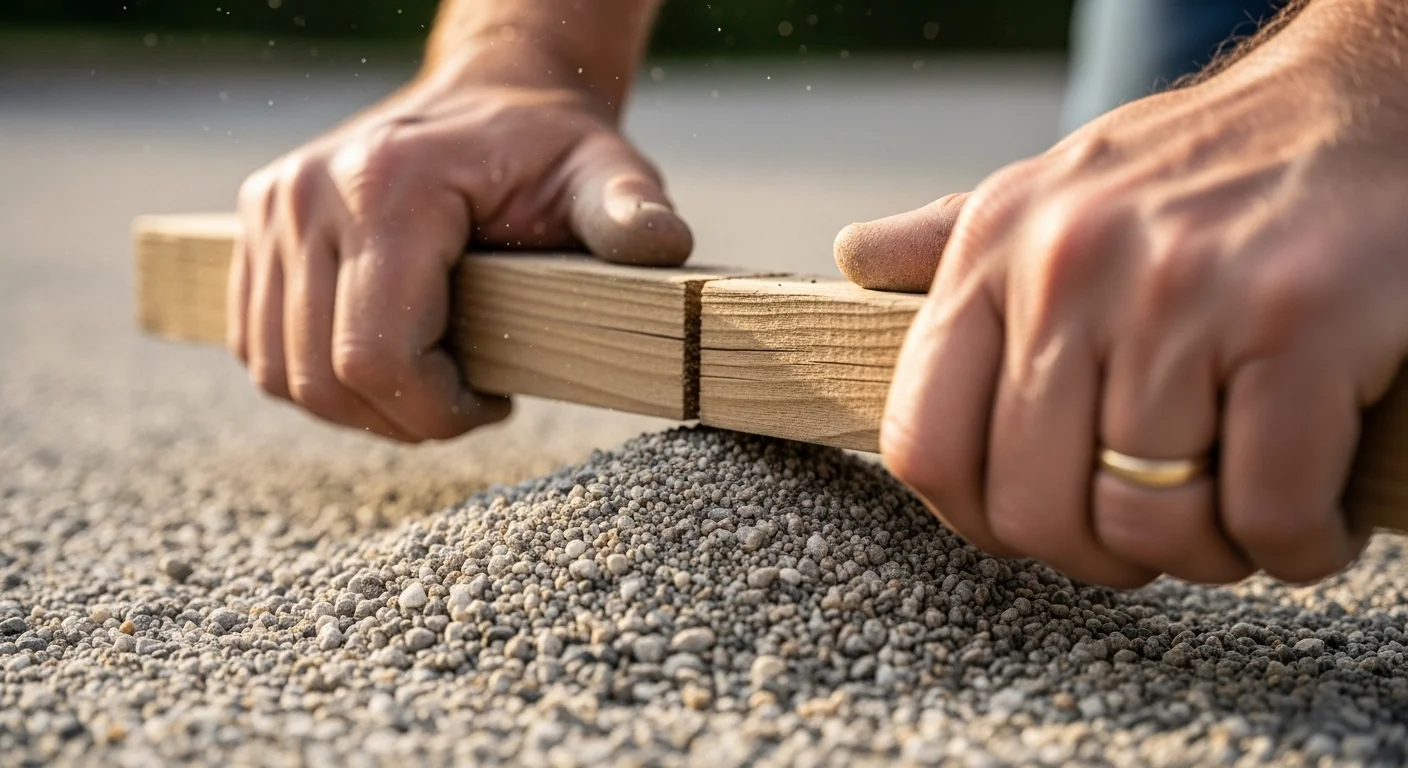
Operators using a box blade or laser-leveled grader often target a surface that looks smooth and even from the cab. At eye level, a properly crowned driveway looks slightly humped, which counterintuitively feels like an error. Without a physical crown board or laser grade check confirming the centerline rises to the correct height, the surface ends up flat and drainage fails at the first rain event.
Fix: Build a simple crown rod by marking the calculated crown height on a straight 2x4 the width of the driveway, then check it against the graded surface as you work from edge to center.
Mistake: Ordering Gravel by Flat-Layer Volume and Running Short
The flat-layer calculation (length times width times depth divided by 27) is the correct starting point, but the crown profile requires 15 additional volume above that baseline. Contractors and homeowners who skip the crown adjustment consistently run short, especially on wide driveways where the center rise is substantial.
Fix: Always use the crown-adjusted total from this calculator as the purchase quantity, then add a 5 to 10 buffer for waste, access road spillage, and fill of existing ruts before the new layer is placed. If you need to estimate gravel requirements across multiple surfaces on the same property, the general gravel calculator handles non-driveway shapes.
Mistake: Using Round Washed Gravel Instead of Crusher Run
Round washed stone or pea gravel cannot interlock under compaction. Vehicle tires displace it laterally with each pass, the crown collapses rapidly, and the smooth stones become a steering and traction hazard. The 1.4 tons-per-cubic-yard density factor in this tool is calibrated for crusher run; substituting a different material without adjusting for its actual density produces an inaccurate weight estimate.
Fix: Specify 3/4-inch crushed aggregate (crusher run or dense-graded aggregate) for all driveway surface courses. Reserve rounded stone for drainage applications only.
Mistake: Ignoring Longitudinal Grade When Calculating Crown Pitch
Crown pitch addresses side-to-side drainage, but a driveway that slopes steeply front to back creates a second problem: water running longitudinally accelerates and channels down the center of the driveway, overwhelming the crown entirely. On sites with greater than 5 degrees of longitudinal slope, crown pitch alone is insufficient and water bars or cross-drain culverts are required.
Fix: Survey the end-to-end elevation change of the driveway route before finalizing the grading plan. If the longitudinal grade is steep, a grading contractor should assess whether cross-drainage structures are needed before the surface course is placed.
Mistake: Skipping Geotextile Fabric on Clay Subgrades
Aggregate placed directly on clay or silt subgrades migrates downward under vehicle load, a process called aggregate punching or subgrade intrusion. Over one or two seasons, effective aggregate depth decreases significantly, the crown profile collapses, and the driveway requires complete re-graveling. Addressing a retaining structure on the property at the same time? The retaining wall calculator handles the structural side of managing grade changes adjacent to driveways.
Fix: On any soil with significant clay content, install woven geotextile fabric over the prepared subgrade before placing aggregate. This single step is the most cost-effective long-term investment in a gravel driveway.
Next Steps in Your Workflow
Once the crown height and gravel volume are confirmed, the grading sequence matters as much as the numbers. Start by establishing the centerline grade with stakes and string at the correct crown height, using the computed value from the calculator as your target. Grade from center to edges, checking the crown profile every 20 to 30 feet with a crown rod or level. If existing ruts are deep enough to require fill before the new surface layer, account for that fill volume separately; it is not captured in the surface-course calculation this tool produces.
For properties where the driveway connects to other landscaped surfaces, consider how surface water exits the driveway edge. A gravel driveway that sheds water correctly but discharges it against an unstabilized slope or into a flat lawn area can cause erosion at the transition point. The dry creek bed stone size calculator is useful for sizing channel stone at driveway edges where sheet flow needs to be managed, and the topsoil calculator can help plan regrading of any areas disturbed during gravel placement.
FAQ
What is the correct crown pitch for a gravel driveway?
The standard recommendation for residential gravel driveways is 1/2 inch of rise per horizontal foot of half-width, which is 0.5 inches per foot in this calculator. The absolute minimum to prevent pooling is 1/4 inch per foot (0.25). Below that threshold, standing water is expected after rainfall, which initiates pothole formation through hydraulic ejection of aggregate from the saturated subgrade.
How do I measure crown pitch on my existing driveway?
Place a straight board the full width of the driveway across the surface at the centerline. Measure the gap between the board and the ground at the center. Divide that measurement in inches by half the driveway width in feet. The result is your current crown pitch in inches per foot. Compare this to the 0.5 in/ft standard to determine whether re-grading is needed.
Why does the calculator add 15 extra volume for crown?
A crowned driveway is not a flat slab. The center receives more aggregate than the edges to create the raised profile. Across the full length and width, this extra center material represents approximately 15 additional volume above a flat-layer calculation. Ordering only the flat-layer volume consistently leaves contractors short of material before the crown shape is complete.
Can this calculator be used for road base gravel or only surface course?
The volume formula works for any aggregate layer once you enter the correct depth. The 1.4 tons-per-cubic-yard weight estimate is calibrated specifically for 3/4-inch crusher run. For base course or subbase layers using different aggregate gradations, confirm the actual material density with your supplier before using the weight output for ordering.
What gravel type works best for a crowned driveway?
3/4-inch crushed limestone or granite crusher run (dense-graded aggregate) is the standard recommendation. Crusher run contains fine particles that fill voids and interlock under compaction, holding the crown shape under repeated vehicle traffic. Washed round stone, pea gravel, and river rock do not interlock and migrate laterally, which collapses the crown profile quickly.
How often does a gravel driveway crown need to be restored?
Under normal residential vehicle traffic and seasonal freeze-thaw cycling, a gravel driveway crown typically needs restoration every one to three years. High-traffic driveways, areas with heavy spring thaw, and driveways lacking geotextile underlayment on clay soils require more frequent re-grading. Checking crown profile after the first significant rain each spring is a practical maintenance indicator.
Conclusion
A gravel driveway slope calculator does more than compute how much stone to order. When used correctly, it exposes the single design decision that separates driveways that last from driveways that require constant repair: the crown pitch. The hydraulic failure mechanism that creates potholes is deterministic and preventable. Water pooling on a flat surface, subgrade saturation, and tire-driven aggregate ejection follow a predictable sequence that begins the moment crown pitch falls below a functional threshold. Calculating the correct volume without calculating the correct shape is the most common and expensive mistake in residential driveway planning.
Run the numbers before ordering material, verify the crown height target before the grader starts, and specify 3/4-inch crusher run as the surface aggregate. Those three steps, executed in sequence, eliminate the conditions that produce pothole failure. For projects involving adjacent aggregate surfaces or drainage structures, the river rock calculator covers drainage channel and dry swale stone sizing that often pairs with driveway drainage planning.