
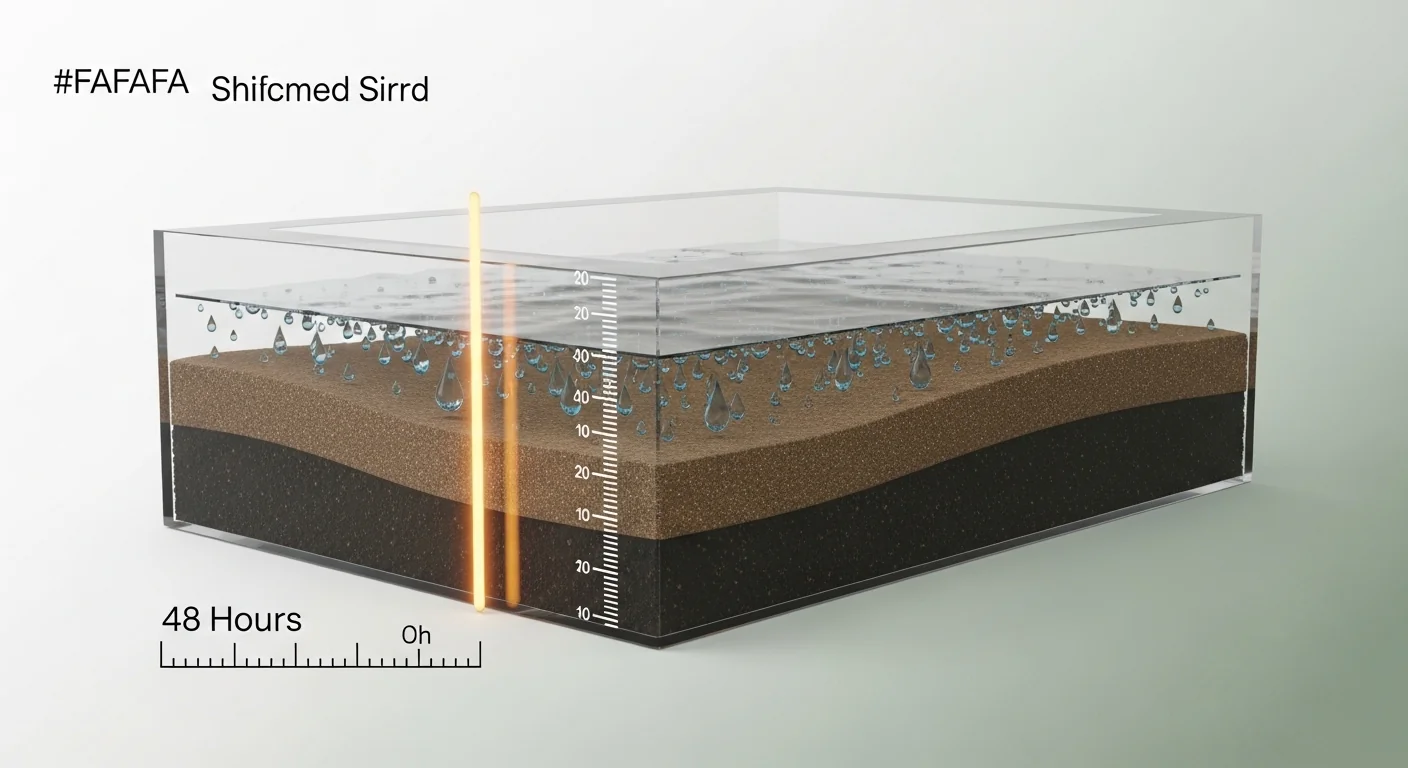
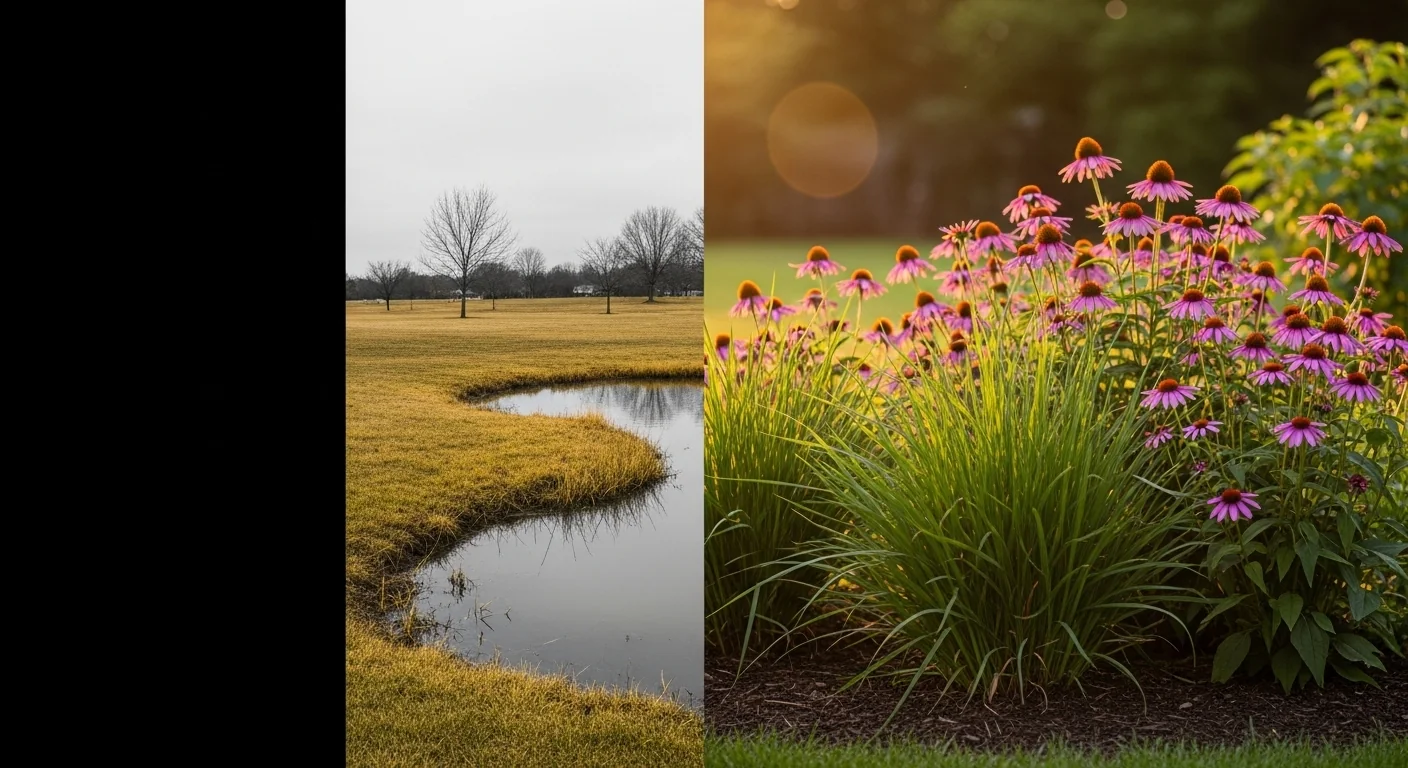
Stormwater sizing is often reduced to a single ratio: make the garden roughly 5–10% of the catchment area. That shortcut ignores the one variable that determines whether a rain garden actually works or turns into a standing-water hazard. Soil percolation rate controls how long water sits in the bowl after a storm, and that number changes everything about whether your garden is safe, functional, or a mosquito breeding ground by Thursday.
This rain garden sizing calculator computes three outputs from your site conditions: the required garden area in square feet, the total captured runoff volume in cubic feet, and the expected drain time in hours. It then applies a deterministic safety check against the 48-hour biological threshold for mosquito development and root rot risk. What it does not do is account for subsurface drainage structures, regional storm frequency analysis, or partially pervious surfaces with mixed runoff coefficients. Those factors require site-specific engineering, and this tool is a pre-design sizing instrument, not a permit document. For overflow situations where runoff cannot be fully captured, pairing your garden with a secondary conveyance channel is worth considering alongside dry creek bed stone sizing to route excess flow safely across the yard.
After using this calculator, you will know whether your soil can drain the captured volume fast enough to avoid a biological hazard, and if it cannot, you will have the corrected garden area needed to fix the problem before breaking ground.
Use the Tool

Rain Garden & Bioswale Sizing Calculator
Accurately size your rain garden or bioswale for stormwater management. Enter your catchment and soil data below.
| Catchment | Perc Rate | Garden Area | Drain Time | Status |
|---|
- Bulk Organic Compost (soil amendment)
- Native Seed Mixes: Milkweed & Coneflower
- Heavy-Duty Bypass Loppers (root clearing)
- Laser Level (find lowest yard grade)
How This Calculator Works
- Runoff coefficient = 1.0 (impervious surface). Adjust for partially permeable areas.
- Soil percolation rate is assumed uniform throughout the soil profile.
- No subsurface drainage or overflow structures included in base formula.
- Native plant selection should match USDA hardiness zone and local hydrology.
- Results are planning estimates only. Consult a licensed engineer for permitted installations.
- EPA recommends rain gardens drain within 24–48 hours to prevent mosquito breeding.
Before entering values, gather the following: measure your catchment area (roof, driveway, or paved surface) in square feet, look up or field-test your soil’s percolation rate in inches per hour, identify the design storm depth for your region (commonly 1 inch for a 24-hour storm in most mid-Atlantic and Midwest jurisdictions), and decide on your maximum ponding depth. If you plan to amend your native soil before installation, use your post-amendment percolation rate for the most accurate result. If you are unsure how much native soil or compost will be needed for your amended planting mix, the topsoil calculator can help estimate volumes before you start digging.
Quick Start (60 Seconds)
- Catchment Area (sq ft): Measure the footprint of every hard surface draining toward your garden. A 40 ft x 30 ft section of roof = 1,200 sq ft. Do not include lawn areas unless you have confirmed they run off during your design storm.
- Storm Rainfall Depth (inches): Enter the design storm in inches, not total annual rainfall. A 1-inch storm is the standard sizing event in many municipal stormwater programs. Values above 3 inches are typically used only for detention, not infiltration systems.
- Soil Percolation Rate (in/hr): This is the measured rate at which water moves through your native soil. Sandy loam: 1.0 to 2.0 in/hr. Silt loam: 0.3 to 0.7 in/hr. Clay and clay loam: 0.05 to 0.2 in/hr. Never enter a rate from a reference chart if your site has heavy clay without confirming with a field percolation test.
- Maximum Ponding Depth (inches): This is the bowl depth, not the total garden depth. Six inches is the standard maximum recommended by most extension programs. Deeper bowls concentrate more water in less area but increase drain time directly and proportionally.
- Watch the drain time output: If drain time exceeds 48 hours, the result is not a warning you can ignore. It is a biological threshold. Read the corrected area recommendation before finalizing any dimensions.
- Check the garden-to-catchment ratio: A ratio above 1:3 (garden is more than 33% of catchment) may indicate extremely poor soil drainage. Consider an underdrain system or a different site location.
- Use realistic percolation rates: After compaction during construction, field percolation rates often drop by 30 to 50% compared to undisturbed readings. If your design is close to the 48-hour threshold before construction, plan soil amendment into your design from the start.
Inputs and Outputs (What Each Field Means)
| Field | Unit | What It Means | Common Mistake | Safe Entry Guidance |
|---|---|---|---|---|
| Catchment Area | sq ft | Total hard surface area draining into the garden during a storm event | Including lawn area, which often infiltrates rather than runs off during moderate storms | Measure only impervious or near-impervious surfaces: roofs, driveways, compacted gravel, patios |
| Storm Rainfall Depth | inches | The design storm event depth the garden is intended to capture | Using annual average rainfall instead of a single-event design storm depth | Use 1 inch for most residential applications. Check local stormwater ordinances for required design storm values. |
| Soil Percolation Rate | in/hr | The rate at which water infiltrates through the garden’s native or amended soil | Using published soil textural class averages without a site-specific percolation test | Conduct a field percolation test in the proposed garden location after a rain event. Use the slower of multiple readings. |
| Maximum Ponding Depth | inches | The maximum depth of water that will stand in the garden immediately after the design storm | Selecting a deep ponding depth to reduce garden area without checking the resulting drain time | Keep at or below 6 inches for residential gardens. Deeper bowls extend drain time directly. |
| Runoff Volume (output) | cu ft | Total volume of stormwater that must be captured and infiltrated | Assuming this equals garden capacity without accounting for ponding depth | Compare this number to your garden bowl volume (area x ponding depth / 12) as a sanity check |
| Garden Area (output) | sq ft | Minimum garden surface area needed to hold the runoff volume at the chosen ponding depth | Building the garden smaller and assuming overflow will handle the excess | Add 10 to 15% to the calculated area as a safety margin, especially in clay soils |
| Drain Time (output) | hours | Expected time for all standing water to infiltrate after the storm | Not checking this value at all when sizing from area ratios alone | Must remain below 48 hours. Design target of 24 hours or less is preferred by most extension guidelines. |
| Garden:Catchment Ratio (output) | ratio | Proportion of garden surface to catchment surface | Treating any ratio as acceptable regardless of soil percolation | Typical range is 1:5 to 1:20. Ratios below 1:20 suggest excellent drainage; ratios above 1:5 may indicate a soil or sizing problem. |
Worked Examples (Real Numbers)
Example 1: Sandy Loam Soil, Standard Suburban Roof
- Catchment Area: 1,200 sq ft (40 ft x 30 ft roof section)
- Storm Depth: 1 inch
- Percolation Rate: 0.5 in/hr (silt loam, moderately well-drained)
- Maximum Ponding Depth: 6 inches
Result: Runoff Volume = 1,200 x (1/12) = 100 cu ft. Garden Area = 100 / (6/12) = 200 sq ft. Drain Time = 6 / 0.5 = 12 hours.
A 200 sq ft garden drains in 12 hours, well within the safe window. This scenario represents a well-matched system. A roughly 14 ft x 14 ft garden footprint handles the full roof section with capacity to spare.
Example 2: Heavy Clay Soil, Driveway Catchment (Mosquito Risk)
- Catchment Area: 800 sq ft (driveway apron)
- Storm Depth: 1 inch
- Percolation Rate: 0.1 in/hr (heavy clay)
- Maximum Ponding Depth: 6 inches
Result: Runoff Volume = 800 x (1/12) = 66.7 cu ft. Garden Area = 66.7 / 0.5 = 133 sq ft. Drain Time = 6 / 0.1 = 60 hours.
Drain time exceeds the 48-hour threshold by 12 hours. Standing water at 60 hours presents active mosquito breeding risk. To bring drain time to 48 hours or below, the garden area must be expanded to approximately 167 sq ft or the ponding depth reduced to 4.8 inches to achieve a shallower effective bowl. Soil amendment with coarse compost is strongly recommended to raise the percolation rate before finalizing dimensions.
Example 3: Well-Drained Soil, Larger Storm Event
- Catchment Area: 2,000 sq ft (combined roof and patio)
- Storm Depth: 2 inches (larger design event)
- Percolation Rate: 1.5 in/hr (sandy loam, well-drained)
- Maximum Ponding Depth: 8 inches
Result: Runoff Volume = 2,000 x (2/12) = 333.3 cu ft. Garden Area = 333.3 / (8/12) = 500 sq ft. Drain Time = 8 / 1.5 = 5.3 hours.
Even at a 2-inch storm event and an 8-inch bowl depth, the 5.3-hour drain time is excellent. This soil type allows for deep ponding without biological risk. A 500 sq ft garden is substantial but entirely appropriate for a 2,000 sq ft impervious catchment in a well-drained location.
Reference Table (Fast Lookup)
All rows computed at a 1-inch design storm and 6-inch maximum ponding depth. Percolation rates represent field-tested values, not textbook soil class averages. Garden areas are rounded to the nearest whole square foot.
| Catchment Area (sq ft) | Soil Type (typical) | Perc Rate (in/hr) | Runoff Volume (cu ft) | Garden Area (sq ft) | Drain Time (hrs) | Status |
|---|---|---|---|---|---|---|
| 500 | Sandy loam | 2.0 | 41.7 | 83 | 3.0 | OK |
| 800 | Sandy loam | 1.5 | 66.7 | 133 | 4.0 | OK |
| 1,000 | Silt loam | 0.5 | 83.3 | 167 | 12.0 | OK |
| 1,200 | Loam | 0.4 | 100.0 | 200 | 15.0 | OK |
| 1,500 | Sandy clay loam | 0.25 | 125.0 | 250 | 24.0 | Advisory |
| 1,500 | Clay loam | 0.15 | 125.0 | 250 | 40.0 | Advisory |
| 2,000 | Clay loam | 0.12 | 166.7 | 333 | 50.0 | MOSQUITO RISK |
| 800 | Heavy clay | 0.1 | 66.7 | 133 | 60.0 | MOSQUITO RISK |
| 1,200 | Heavy clay | 0.08 | 100.0 | 200 | 75.0 | MOSQUITO RISK |
| 3,000 | Sandy loam | 1.0 | 250.0 | 500 | 6.0 | OK |
How the Calculation Works (Formula + Assumptions)
Show the calculation steps
Step 1: Runoff Volume
The volume of stormwater generated by a single storm event is calculated by converting rainfall depth from inches to feet, then multiplying by catchment area:
RunoffVolume (cu ft) = CatchmentArea (sq ft) x (RainfallDepth (in) / 12)
A 1-inch rain over 1,000 sq ft produces 83.3 cubic feet of runoff. This step uses a runoff coefficient of 1.0, meaning all rainfall becomes runoff. This is appropriate for fully impervious surfaces like roofs and sealed concrete. For compacted gravel, values of 0.7 to 0.9 are more accurate but must be applied manually before entering the catchment area.
Step 2: Required Garden Area
The garden must hold the full runoff volume at the stated ponding depth. Area is found by dividing runoff volume by ponding depth (converted to feet):
GardenArea (sq ft) = RunoffVolume (cu ft) / (PondingDepth (in) / 12)
A 6-inch bowl depth is 0.5 feet. Divide your runoff volume by 0.5 to get the required surface area. This calculation assumes the entire garden bowl is available at full ponding depth instantaneously, which is a conservative assumption; in practice, some infiltration occurs during the storm event itself.
Step 3: Drain Time
Drain time is the expected duration for all standing water to infiltrate through the soil:
DrainTime (hrs) = PondingDepth (in) / PercRate (in/hr)
This is the most important output from a biological safety standpoint. The formula assumes uniform, constant percolation throughout the entire depth of the bowl. In reality, percolation rates decrease slightly as soil approaches saturation, so actual drain times in field conditions may be 10 to 20% longer than this formula predicts.
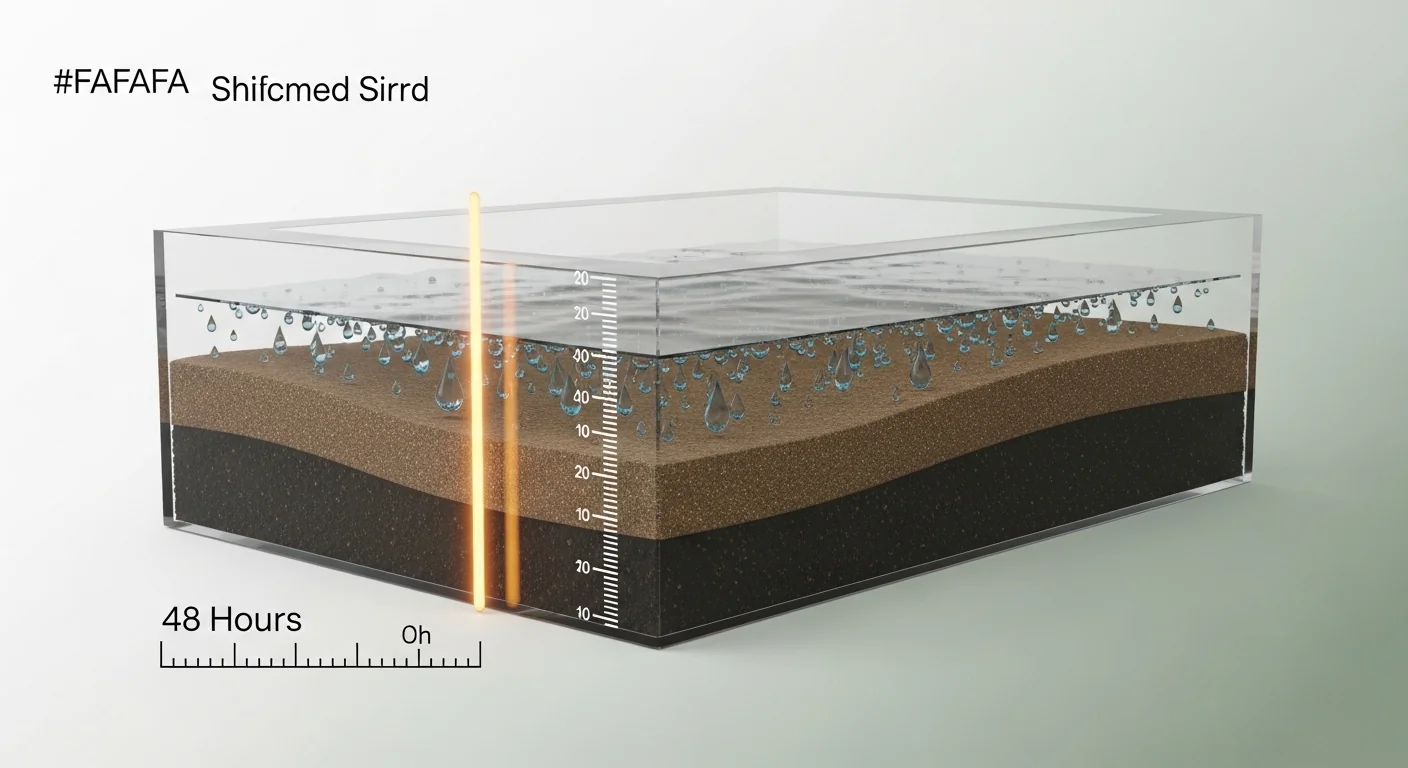
Step 4: Mosquito Threshold Check
If DrainTime is greater than 48 hours, a biological risk exists. Standing water warmer than approximately 50 degrees Fahrenheit can support mosquito egg-laying and initial larval development within 48 to 72 hours. The calculator flags this threshold and computes a minimum expanded garden area that would, at the same soil percolation rate, achieve a shallower effective ponding depth with a shorter drain time.
Rounding Rules: Garden area is rounded to the nearest whole square foot. Drain time and runoff volume are displayed to one decimal place. All internal calculations retain full floating-point precision.
Assumptions and Limits
- Runoff coefficient is fixed at 1.0. Partially pervious surfaces (gravel, pavers, dense turf) will produce less actual runoff and this value should be adjusted before entering catchment area.
- Percolation rate is assumed constant with depth and constant over time. Post-storm soil saturation typically reduces effective percolation by 10 to 25% compared to dry-soil measurements.
- No credit is given for evapotranspiration, precipitation occurring during the drain period, or pre-wetting of the soil from antecedent moisture conditions.
- The formula assumes the garden bowl is a flat-bottomed rectangular depression. Contoured, sloped, or irregularly shaped gardens will have different effective storage volumes.
- No subsurface drainage structures (underdrain pipes, gravel infiltration trenches) are factored in. Adding an underdrain effectively increases the functional percolation rate and can resolve slow-drain scenarios without changing the garden surface area.
- Results are planning-level estimates suitable for pre-design decision-making. Permitted rain garden installations in regulated stormwater management zones require licensed engineering and site-specific hydrologic analysis.
- The tool does not account for off-season frozen ground conditions, which can render an infiltration system temporarily non-functional during winter storm events in northern climates.
Standards, Safety Checks, and “Secret Sauce” Warnings
Critical Warnings
- The 48-Hour Biological Threshold: This is not a guideline with flexibility. Mosquitoes in warm climates can complete egg hatching stages in standing water that has been present for 48 to 72 hours. A garden built in clay with a 60-hour drain time is not a rain garden by function; it is a detention pond with native plants, and those plants will exhibit root rot symptoms within one to two growing seasons as anaerobic soil conditions kill off species not adapted to permanent saturation.
- Percolation Rates After Construction Compaction: Heavy equipment and foot traffic during installation compact native soils significantly. A pre-construction percolation test may read 0.4 in/hr; the same soil after a backhoe has shaped the basin may perform at 0.15 to 0.25 in/hr. Test after rough grading, not before. If drain time approaches the 48-hour threshold at your design percolation rate, build in a 25% safety margin on garden area.
- Ponding Depth as a Dial, Not a Fixed Number: Reducing ponding depth from 6 inches to 4 inches cuts drain time proportionally. A garden that fails at 6 inches of ponding may pass comfortably at 4 inches with a modest increase in surface area. These two variables interact; adjusting one allows the other to compensate.
- Overflow Routing: This calculator sizes for complete capture of the design storm. Storms exceeding the design event will overflow. Plan an overflow pathway before construction. An unplanned overflow that routes toward a foundation or septic system can cause damage that far exceeds the cost of the garden itself.
Minimum Standards
- Drain time must remain below 48 hours under the worst credible soil condition at your site. Use the slowest measured percolation rate, not an average.
- Minimum setback from foundations: most extension guidelines recommend 10 feet minimum from any structure. Infiltration near foundations increases hydrostatic pressure and can compromise waterproofing systems.
- Maximum side slope on garden berms: 3:1 (horizontal to vertical) to prevent erosion during storms and maintain safe pedestrian access around the garden perimeter.
- Amended soil depth for the planting zone should be a minimum of 18 to 24 inches to support deep-rooted native species. Shallow amendment produces surface soil improvements that erode over time. For projects that include compost and erosion protection layers around the garden perimeter, the compost blanket erosion calculator can help determine the appropriate application depth and coverage. Where landscape fabric is used at the garden’s overflow outlet or edge transitions, accurate material estimation with a landscape fabric overlap calculator prevents installation gaps that accelerate erosion.
Competitor Trap: Nearly every competing rain garden guide recommends sizing your garden at 5 to 10 square feet per 100 square feet of catchment area. That rule was derived from average soil conditions in specific mid-Atlantic research plots. Applied blindly to clay soils, it produces gardens that are far too small to drain safely, often by a factor of two to three times. The drain time check that this calculator performs is the single most important calculation that most published rain garden guides either omit entirely or mention only as a footnote. Build to drain time, not to a percentage of catchment.
Common Mistakes and Fixes
Mistake: Using a Percolation Rate from a Soil Survey Map
Web soil surveys and county soil data provide approximate percolation rate ranges for soil series, not site-specific measurements. A loam soil classified as 0.2 to 0.6 in/hr can vary significantly depending on whether it has been compacted by previous construction, has a restrictive layer at depth, or has been altered by fill material. Using the optimistic end of a published range is a common cause of failed installations. Fix: Conduct a field percolation test at the proposed garden location using a perforated pipe or simple infiltration ring after the ground is wetted. Run at least two tests and use the slower result.
Mistake: Sizing Garden Area Without Calculating Drain Time
Two gardens with identical catchment areas, storm depths, and ponding depths will require the exact same surface area regardless of soil type. But their drain times can differ by 20x depending on percolation rate. A landscaper using only the area formula will produce the same plan for a sandy loam site and a heavy clay site. One drains in 6 hours; the other pools for 60 hours and breeds mosquitoes. For sites with questionable drainage, understanding local grading and slope conditions is as important as the garden dimensions themselves. The gravel driveway slope calculator illustrates how even small grade changes across a property dramatically affect where and how fast water moves. Fix: Always calculate drain time as the second step, immediately after sizing the garden area.
Mistake: Ignoring Overflow Volume and Routing
A 1-inch design storm is the sizing event, not the worst event your site will experience. A 2-inch or 3-inch storm will produce two to three times the calculated runoff, and the garden will overflow. If the overflow path has not been designed, water will find one on its own. Uncontrolled overflow carves erosion channels through berms and routes toward structures. For sites where overflow needs to be directed and slowed, incorporating a retention-edge structure or outlet is critical. The pond liner calculator is a useful reference when a controlled overflow sump or secondary retention feature is added adjacent to the garden. Fix: Design and grade an overflow spillway to daylight before any other part of the project.
Mistake: Planting Flood-Intolerant Species in a Slow-Draining Garden
Native plant selection must match the hydraulic reality of the garden, not just the USDA hardiness zone. A garden with a 36-hour drain time is intermittently saturated and seasonally anaerobic at the root zone. Many plants marketed as “native” or “pollinator-friendly” are upland species that die in prolonged saturation. Coneflower (Echinacea) and Black-Eyed Susan (Rudbeckia) are commonly planted in rain gardens but tolerate only brief flooding. For gardens with drain times above 24 hours, select true obligate or facultative wetland plants: Blue Flag Iris, Swamp Milkweed, Soft Rush, and Cardinal Flower. Fix: Look up each plant species’ Wetland Indicator Status (USDA designation) and match it to your expected drain time profile.
Mistake: Treating the Calculator Result as a Final Construction Drawing
This calculator produces a minimum functional area based on three inputs. It does not account for site topography, proximity to utilities, setbacks from structures, local stormwater ordinances, or soil stratification below the garden depth. In many jurisdictions, a rain garden receiving runoff from an area over a certain threshold requires a permit, engineering seal, or inspection. Treating a calculated area as a finished design without ground-truthing the assumptions leads to installations that underperform, require expensive remediation, or fail inspections. Fix: Use the calculator output as a starting point for site evaluation, not as a final specification.
Next Steps in Your Workflow
Once you have a calculated garden area and confirmed that drain time falls within the safe window, the next practical step is preparing the planting mix and native plant procurement. Rain gardens perform substantially better with an amended soil layer that balances water retention during dry periods with rapid infiltration during storms. A blend of 50 to 60% coarse compost, 20 to 30% coarse sand, and the remainder native topsoil is commonly recommended. For gardens where you are establishing plants from seed rather than plugs, calculating the correct native seed mix volume and coverage is important for first-season establishment. The mulch calculator is useful for planning the 2 to 3 inch shredded hardwood mulch layer that stabilizes the garden surface between plantings and reduces splash erosion during the first few storm events after installation.
In the seasons following installation, the garden should be monitored for drainage performance after each significant storm. If a garden that initially drained in 18 hours begins taking 30 or more hours to drain after one or two years, root activity and organic matter accumulation at the soil surface have likely reduced infiltration rates. Core aeration of the planting zone, used in conjunction with understanding current soil moisture dynamics, can restore function without full reconstruction. Managing irrigation between rain events as the plants establish is also worth tracking systematically. The turf watering calculator provides a reference framework for evaluating irrigation timing and volume as surrounding lawn areas transition to a naturalized rain garden edge planting.
FAQ
What percolation rate is too slow for a rain garden?
Any percolation rate that produces a drain time above 48 hours at your intended ponding depth is problematic. In practice, this means rates below approximately 0.12 in/hr with a 6-inch bowl are high-risk without soil amendment or an underdrain system. Heavy clays frequently test at 0.05 to 0.1 in/hr, making them unsuitable for standard rain gardens without significant engineering intervention.
Can I build a rain garden in clay soil?
Yes, but the design must account for the soil’s actual percolation rate. Options include reducing the ponding depth to lower drain time, expanding the garden surface area to achieve a shallower effective depth, incorporating an underdrain pipe that supplements infiltration, or amending the bowl with a coarse infiltration media mix. Unamended heavy clay with a standard 6-inch bowl and a typical residential catchment will almost always produce drain times above the 48-hour safety threshold.
How do I measure soil percolation rate?
Dig a hole 12 inches deep and 12 inches in diameter. Fill it with water and allow it to drain completely. Refill to 12 inches and measure how far the water level drops over 30 minutes, then multiply by 2 for the hourly rate. Repeat twice and use the slowest result. Test in the proposed garden location at the proposed garden depth, after any site grading has occurred and the soil has been wetted.
Does the garden need to capture 100% of the design storm?
This calculator sizes for complete capture of the runoff generated by your design storm depth. Some programs allow partial capture with a defined overflow pathway, which reduces garden size requirements. Check your local stormwater management ordinance for the required capture volume. Municipal programs in the Chesapeake Bay watershed, for example, often require capture of the first 1 inch of rainfall from all impervious surfaces, regardless of garden drain time.
What plants work best in a rain garden?
Plant selection depends on your drain time. For gardens draining within 12 hours, most native meadow and prairie species work well. For gardens with 12 to 48 hour drain times, choose species with higher flood tolerance: Swamp Milkweed, Blue Flag Iris, Cardinal Flower, and Soft Rush. Native sedges such as Pennsylvania Sedge tolerate both flooding and dry conditions, making them reliable choices for variable drain-time gardens.
How large should a rain garden actually be relative to catchment area?
The frequently cited 5 to 10% rule is a simplified starting point derived from specific soil type assumptions. This calculator shows that the correct ratio depends entirely on soil percolation rate and chosen ponding depth. A sandy loam site with 1.5 in/hr percolation and 6-inch ponding may function well at 4 to 6% of catchment area, while a silt loam at 0.3 in/hr with the same ponding depth requires 10 to 15% to stay within safe drain time limits.
Conclusion
Properly sized rain gardens work because they are sized to drain, not just to hold. The calculation this tool performs is straightforward, but the decision it enables is consequential: knowing whether your soil can clear standing water fast enough to remain a functional landscape feature rather than a seasonal standing-water problem. The area calculation alone gives you a number to build to. The drain time calculation tells you whether that number is actually safe to build.
The single most important mistake to avoid is skipping the percolation test and substituting a published soil class estimate. Site conditions, compaction history, and subsurface conditions vary enough that the difference between a correct and incorrect percolation rate input can mean the difference between a 12-hour drain time and a 60-hour one. That gap is the difference between a thriving native plant ecosystem and a breeding site. Build to the measured rate, add your soil amendment before the plants go in, and your garden will perform through every storm event it was designed to handle. For a more complete picture of water management across your entire property, the pond evaporation calculator covers water loss dynamics for adjacent features and helps contextualize how rain garden inputs relate to broader site hydrology.