
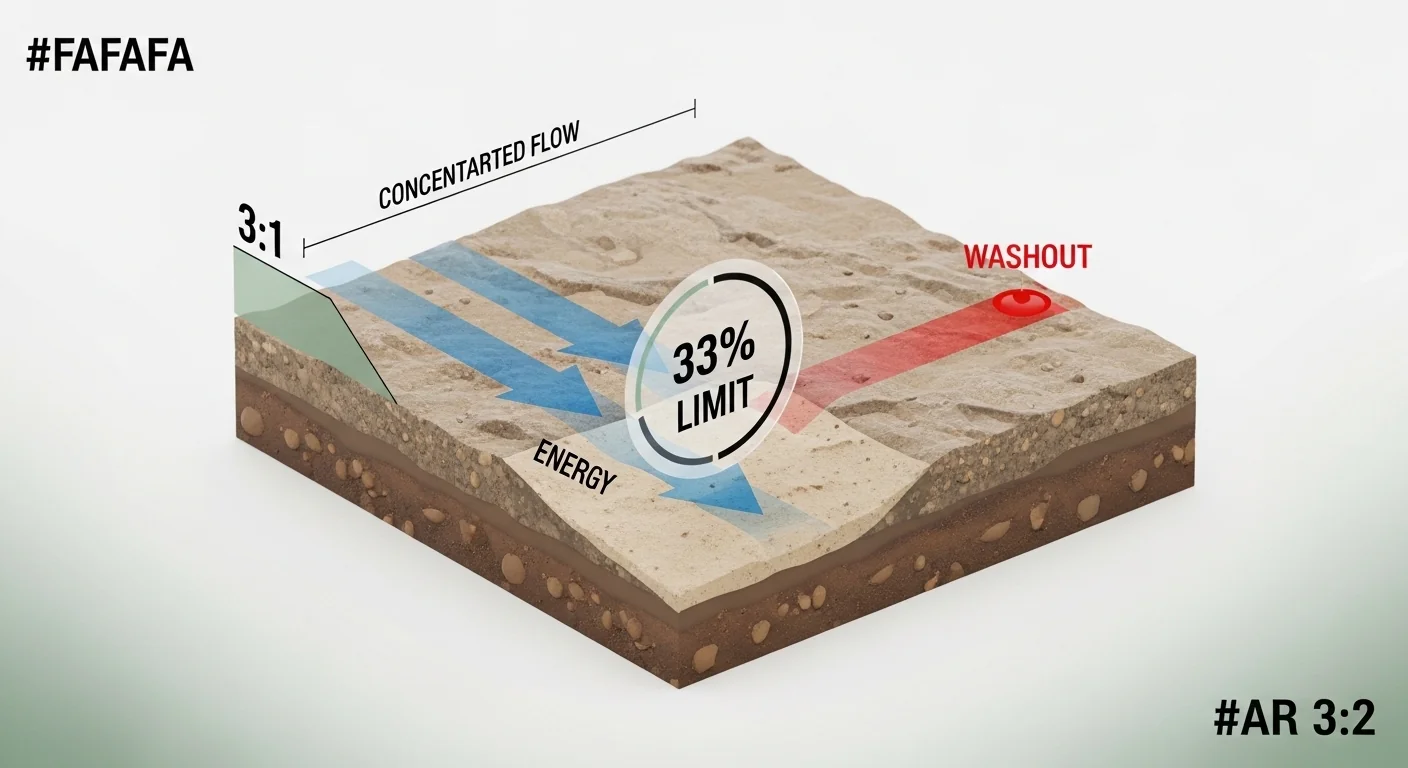
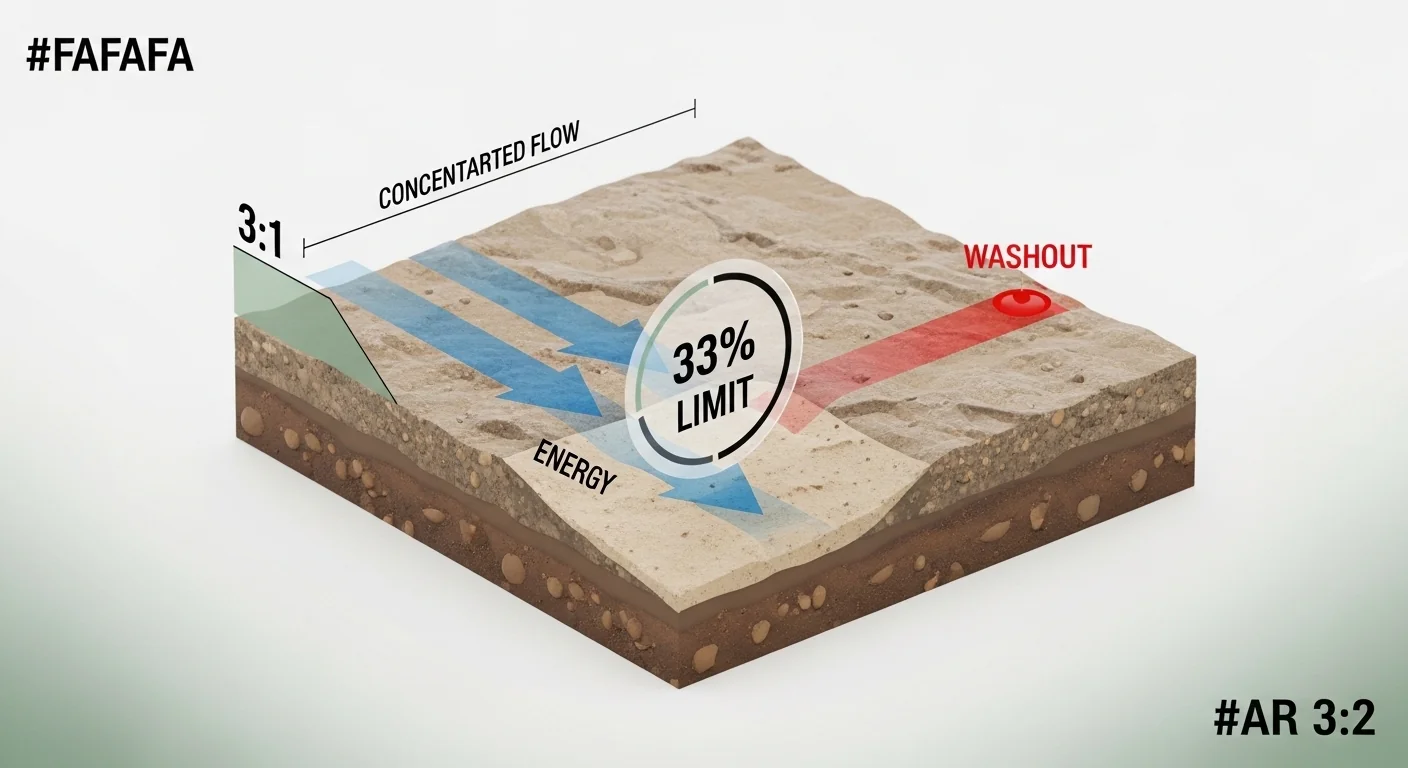
The physics of mulch on a slope are unforgiving. When slope steepness and water energy exceed the friction capacity of your material, the result is not partial erosion: it is total loss. Standard shredded bark mulch is buoyant and has almost no shear resistance on grades above 4:1 (25%). Even heavier compost blankets reach a hard friction limit at 3:1 (33%), the point where gravity reliably overcomes surface adhesion. Understanding that threshold is not optional; it is the difference between a functioning erosion control system and a street-clogging cleanup job after the first rain.
This calculator solves three core problems: it converts your slope dimensions into a precise slope percentage and ratio, flags whether your slope falls within safe, caution, or washout territory based on both grade and flow type, and computes the cubic yards of compost required for your area and target depth. It does not model soil type, infiltration rate, or multi-year vegetation establishment. For sites where those variables are controlling factors, a licensed civil or geotechnical engineer should be consulted. If you are also planning mulch depth for adjacent flat beds, the mulch depth calculator handles flat-area material planning separately.
After running your numbers, you will know whether your slope allows a direct compost blanket application, requires anchored netting, or has exceeded the safe range for any loose organic material.
Use the Tool
Compost Blanket Erosion Calculator
Slope math for mulch & compost erosion control — by The Yield Grid
| Metric | Value |
|---|
| Run (ft) | Rise (ft) | Slope % | Ratio | Risk Level |
|---|---|---|---|---|
| 30 | 3 | 10% | 10:1 | Low |
| 30 | 6 | 20% | 5:1 | Low |
| 30 | 7.5 | 25% | 4:1 | Moderate |
| 30 | 10 | 33% | 3:1 | High Caution |
| 30 | 15 | 50% | 2:1 | Washout Risk |
| 30 | 20 | 67% | 1.5:1 | Severe |
| 30 | 30 | 100% | 1:1 | Extreme |
How This Calculator Works
Step 1 — Calculate Slope Percentage:
Slope % = (Rise ÷ Run) × 100
This converts the vertical rise and horizontal run of your slope into a percentage grade. A 3:1 slope equals 33%.
Step 2 — Determine Slope Ratio:
Slope Ratio = Run : Rise
This is the standard ratio format used in civil engineering. Lower first numbers (e.g. 2:1) mean steeper slopes.
Step 3 — Calculate Material Volume:
Cubic Yards = (Run × Width × (Depth ÷ 12)) ÷ 27
Converts your slope dimensions and blanket depth from feet and inches into cubic yards — the standard unit for ordering bulk compost.
Step 4 — Washout Safety Check:
If the slope exceeds 3:1 (33%) and concentrated flow is present, the calculator triggers a washout warning. Loose mulch and compost cannot maintain friction on steep slopes with channeled water. Erosion control blankets or netting are mandatory.
Assumptions: Compost density is assumed at standard bulk weight (~800–1000 lbs/yd³). All measurements use horizontal run (not slope length). Depth is applied uniformly. Results are estimates — always consult a site engineer for critical slopes.
Assumptions & Limits
Material Limits:
- Standard shredded bark mulch is buoyant and will wash off any slope above 4:1 (25%) in moderate rain.
- Compost blankets are heavier but lose friction on slopes steeper than 3:1 (33%). Gravity overcomes the material’s weight-to-surface-area ratio.
- This calculator limits loose compost application to a maximum slope of 3:1 (33%). Beyond that, physical anchoring is required.
Flow Type Impact:
- Sheet flow distributes runoff evenly — lower shear stress per unit area.
- Concentrated flow channels water into rivulets and gullies, dramatically increasing erosive force. Even moderate slopes (4:1) with concentrated flow can undercut loose compost.
What This Tool Does NOT Cover:
- Soil type and infiltration rate (clay vs. sandy loam).
- Rainfall intensity (design storm events).
- Vegetation establishment timelines.
- Geotechnical stability (deep-seated slope failure).
Always consult a licensed civil engineer or erosion control specialist for slopes steeper than 2:1 or on regulated sites.
Before entering values, have a tape measure or laser distance tool ready. You need the horizontal run (flat distance from toe to crest, not the slope surface length), the vertical rise (elevation change), and the width of the area you are treating. Depth is typically entered in inches, between 1 and 2 for most residential and light commercial projects. If you are unsure whether your site drains as sheet flow or through a concentrated path such as a swale, ditch, or gutter, default to concentrated flow for a conservative result. For a quick review of how slope percentages translate to grading outcomes on hardscape, the patio slope calculator covers the same slope-percent concept applied to drainage surfaces.
Quick Start (60 Seconds)

- Slope Run: Enter the horizontal distance in feet, not the surface length along the slope. Measuring along the slope face will overstate your run and underestimate steepness.
- Slope Rise: Enter the vertical height change in feet. For a hill that drops 10 feet over 30 horizontal feet, enter 10.
- Slope Width: Enter the lateral width of the erosion control area in feet. This determines coverage area and total material volume.
- Target Blanket Depth: Enter in inches. Typical application rates range from 1 inch for light maintenance seeding to 2 inches for bare-soil stabilization. Do not exceed 3 inches on any grade above 4:1 (25%); the added weight does not improve hold, it adds mass that can slide as a unit.
- Type of Flow: Sheet flow describes water spreading broadly across a slope surface. Concentrated flow describes water channeled into a line, path, or low point. When in doubt, select concentrated; the safety checks apply the stricter threshold.
- Click Calculate: Results will not generate until all fields contain valid numbers and a flow type is selected. The traffic light indicates safe, caution, or washout risk.
- Use Reset to clear all fields and start a new scenario without residual values.
Inputs and Outputs (What Each Field Means)
| Field | Unit | What It Means | Common Mistake | Safe Entry Guidance |
|---|---|---|---|---|
| Slope Run | Feet (horizontal) | Horizontal distance from the base of the slope to the top, measured flat | Measuring along the slope face instead of the horizontal projection | Use a level line or laser level to capture true horizontal distance |
| Slope Rise | Feet (vertical) | Total elevation change from the toe to the crest of the slope | Estimating by eye on irregular terrain; visual estimates often understate rise | Use a hand level or contractor’s level rod for accuracy on slopes over 15 ft |
| Slope Width | Feet | The lateral extent of the area to be covered, measured perpendicular to the slope direction | Using the run value as width when the slope is square in plan; they are separate dimensions | Measure the full width of the exposed soil face; add a 2-foot buffer at edges |
| Target Blanket Depth | Inches | The applied thickness of the compost blanket material over the slope surface | Using 3 to 4 inches on steep slopes; greater mass increases slide risk, not stability | Acceptable range: 0.5 to 6 inches; 1 to 2 inches is standard for most erosion control applications |
| Type of Flow | Categorical | Whether runoff spreads across the slope (sheet) or collects into a path or channel (concentrated) | Selecting sheet flow because water appears to spread; upslope impervious surfaces often create hidden concentrated flow paths | If a roof, driveway, or paved surface drains onto or above the slope, select concentrated flow |
| Slope Percentage (output) | Percent | The grade expressed as rise divided by run, multiplied by 100 | Confusing slope percentage with slope angle in degrees; a 45-degree angle equals 100%, not 45% | Output only; review in context of the traffic light safety indicator |
| Slope Ratio (output) | Run:Rise | The horizontal distance for every 1 unit of vertical rise; a 3:1 slope travels 3 feet horizontally for each 1-foot rise | Inverting the ratio; civil engineering convention is Run:Rise, not Rise:Run | Output only; compare to the 3:1 washout threshold in the results panel |
| Cubic Yards (output) | Cubic yards | Total volume of compost blanket material required to cover the slope at the specified depth | Forgetting to add 10 to 15 percent for settling and edge coverage; bulk compost compresses after delivery | Add 10 percent to the output when ordering from a supplier; order in full cubic yard increments |
Worked Examples (Real Numbers)
Scenario 1: Gentle Backyard Slope After Landscaping
- Slope Run: 40 ft
- Slope Rise: 8 ft
- Slope Width: 15 ft
- Target Blanket Depth: 1.5 in
- Type of Flow: Sheet Flow
Result: Slope = 20% (5:1 ratio). Volume = (40 x 15 x 0.125) / 27 = 2.78 cubic yards. Risk zone: Safe.
At 20%, this slope is comfortably below the caution threshold. A standard 1.5-inch compost blanket applied uniformly will provide adequate erosion control. No netting is required at this grade with sheet flow, though staking the perimeter edges is still a best practice on freshly graded soil.
Scenario 2: Moderate Landscape Berm with Uphill Impervious Surface
- Slope Run: 25 ft
- Slope Rise: 7 ft
- Slope Width: 20 ft
- Target Blanket Depth: 2 in
- Type of Flow: Concentrated Flow
Result: Slope = 28% (3.6:1 ratio). Volume = (25 x 20 x 0.167) / 27 = 3.09 cubic yards. Risk zone: Caution.
The slope percentage alone would pass a basic sheet-flow check, but the presence of concentrated flow pushes this project into caution territory. At 28% with channeled water, shear stress in the flow path is high enough to undercut loose compost within a single storm event. Jute netting with 12-inch stakes across the full width, combined with redirecting the concentrated flow path using a berm or diversion swale, is the recommended approach before applying material.
Scenario 3: Steep Construction Embankment with Concentrated Runoff
- Slope Run: 20 ft
- Slope Rise: 8 ft
- Slope Width: 30 ft
- Target Blanket Depth: 2 in
- Type of Flow: Concentrated Flow
Result: Slope = 40% (2.5:1 ratio). Volume = (20 x 30 x 0.167) / 27 = 3.70 cubic yards. Risk zone: Washout Warning.
This scenario triggers the tool’s washout alert. At 40% with concentrated flow, gravity and shear stress exceed the friction capacity of any loose organic material. The calculated 3.70 cubic yards represents what you would need to order, but it cannot be applied as a loose blanket. The correct sequence is: install a pinned erosion control blanket (ECB) or turf reinforcement mat (TRM) first, then apply compost underneath the fabric. Concentrated flow paths must also be redirected or armored with check dams before any surface treatment is effective.
Reference Table (Fast Lookup)
All volume estimates assume a 10-foot width and 1-inch depth. Scale proportionally for different dimensions. The computed volume column uses the formula: (Run x 10 x 0.0833) / 27.
| Run (ft) | Rise (ft) | Slope | Ratio | Slope Angle | CY per 10 ft Width at 1 in | Risk Level | Loose Compost Allowed |
|---|---|---|---|---|---|---|---|
| 50 | 5 | 10% | 10:1 | 5.7° | 1.54 | Low | Yes |
| 40 | 8 | 20% | 5:1 | 11.3° | 1.23 | Low | Yes |
| 40 | 10 | 25% | 4:1 | 14.0° | 1.23 | Moderate | Yes; monitor after first storm |
| 30 | 10 | 33% | 3:1 | 18.4° | 0.93 | High Caution | At limit; netting required |
| 25 | 10 | 40% | 2.5:1 | 21.8° | 0.77 | High Risk | No; ECB or TRM required |
| 20 | 10 | 50% | 2:1 | 26.6° | 0.62 | Severe | No; ECB/TRM + check dams |
| 15 | 10 | 67% | 1.5:1 | 33.7° | 0.46 | Extreme | No; hard armoring required |
| 10 | 10 | 100% | 1:1 | 45.0° | 0.31 | Unsuitable | No organic material of any type |
How the Calculation Works (Formula and Assumptions)
Show the calculation steps
Step 1: Slope Percentage
Slope (%) = (Rise / Run) x 100
This is the foundational measurement. All safety thresholds, product recommendations, and material limits in this tool are indexed to slope percentage. Round to one decimal place for display; the safety threshold logic uses the unrounded value internally.
Step 2: Slope Ratio
Ratio = (Run / Rise) : 1
The ratio format is the construction and grading industry standard. A 3:1 slope has 3 horizontal feet for every 1 vertical foot. Ratios are rounded to one decimal place. On flat or near-flat ground (rise near zero), the ratio approaches infinity and is displayed as “Flat.”
Step 3: Slope Angle in Degrees
Angle = arctan(Rise / Run), converted from radians to degrees
This is a supplemental output for reference. Slope angle in degrees is less commonly used in field erosion control than slope percentage, but it is useful when cross-referencing geotech reports or seed germination guides that specify angle.
Step 4: Cubic Yards of Material
CY = (Run x Width x (Depth / 12)) / 27
Depth is divided by 12 to convert inches to feet, then the three dimensions are multiplied to get cubic feet. Dividing by 27 converts cubic feet to cubic yards. This uses the plan-view area (Run x Width), which is the horizontal footprint, not the actual slope surface area. For slopes below 30%, the difference is minor (less than 5%). For steeper slopes, surface area can be meaningfully larger; advanced users can substitute slope length for run in this formula if surface-area accuracy is required.
Step 5: Washout Safety Check
If Slope is greater than 33% AND flow type is Concentrated Flow, the washout alert fires. If slope is greater than 33% with sheet flow only, the high-risk warning fires without the full washout flag. The 33% threshold (3:1 ratio) is derived from the friction limit of bulk compost on compacted soil: above this grade, gravitational force along the slope face reliably exceeds the material’s resistance to sliding or being displaced by moving water.
Assumptions and Limits
- All calculations use horizontal run, not slope surface length. Entering slope surface length instead of horizontal run will understate slope steepness.
- Compost density is assumed at approximately 800 to 1,000 lbs per cubic yard (standard bulk screened compost). Finer or wetter composts can be heavier; very dry or coarse material can be lighter.
- The volume calculation assumes uniform depth across the entire area. Irregular terrain, berms, or concave slopes will produce variable actual depth and may require more material than calculated.
- The 3:1 (33%) washout threshold applies to loose-applied compost blankets on compacted or graded slopes. Freshly tilled or disturbed soil has lower cohesion and the effective safe threshold may be lower.
- This calculator does not account for soil erodibility class (K-factor), design storm intensity, or return period. Sites subject to regulatory stormwater permits require engineered erosion and sediment control plans.
- Vegetation establishment is not modeled. A compost blanket is a temporary measure. Permanent erosion control requires deep-rooted plant cover; the tool’s material estimate covers the application phase only.
- For slopes where the difference between horizontal run and slope surface length is significant (grades above 50%), substitute slope length for run in the formula for a surface-accurate volume estimate.
Standards, Safety Checks, and “Secret Sauce” Warnings

Critical Warnings
- Bark mulch floats. Standard shredded bark mulch has a density lower than water when saturated. On any slope above 4:1 (25%), even moderate rainfall produces enough shear stress to carry bark mulch downhill as a floating mass. This is not a theoretical failure mode; it is a predictable physical outcome. Bark mulch is not an appropriate erosion control material on any graded slope.
- Compost blankets have a hard upper slope limit. Even screened compost, which is heavier and more cohesive than bark, loses its frictional stability above 3:1 (33%). At a 2:1 (50%) slope, gravity along the slope face generates a force component that exceeds the material’s weight-to-friction ratio. Applying more material does not solve the problem; it creates a larger mass primed to fail.
- Concentrated flow is a multiplier, not just a modifier. A slope that would pass a sheet-flow check at 28% can exhibit complete compost displacement under a concentrated flow path. Any upslope impervious surface (roof, driveway, compacted path) that drains onto the treated area converts what appears to be sheet flow into concentrated flow at ground level.
- Depth creep does not improve erosion control performance. Applying 3 or 4 inches of compost instead of the standard 1 to 2 inches does not increase slope stability. The additional depth adds dead weight, which can cause the entire blanket layer to detach and move as a single unit, a failure mode worse than gradual surface erosion.
Minimum Standards for Safe Application
- Loose compost application is limited to slopes at or below 3:1 (33%). On any steeper grade, a pinned erosion control blanket or turf reinforcement mat is required before compost is applied.
- On slopes between 4:1 (25%) and 3:1 (33%), biodegradable jute or coir netting should be staked over the compost blanket at a minimum of 2 stakes per linear foot. 12-inch wooden landscape stakes driven flush to the netting surface are the standard for most residential and light commercial applications.
- Concentrated flow paths must be redirected or armored with check dams, rock rip-rap, or drainage swales before any organic blanket is applied to the affected slope face. Treating the symptom (erosion on the slope) without addressing the cause (concentrated water energy) guarantees repeat failure.
Competitor Trap: Most erosion control guides online present a single cubic-yard calculation and a generic note to “check slope conditions.” They skip the flow-type variable entirely, treating sheet flow and concentrated flow as interchangeable. The practical consequence is that a landscaper following a generic guide applies a standard compost blanket on a 28% slope with upslope pavement, selects “sheet flow” because the water appears to spread visually, and loses all material in the first storm. The flow type selection is not a checkbox; it is the variable that determines whether an otherwise acceptable slope grade becomes a washout scenario. Use the retaining wall and slope stability context from The Yield Grid’s retaining wall calculator to assess whether your site’s slope requires structural reinforcement beyond erosion control alone. For sites where concentrated runoff originates from upslope drainage, the rain garden sizing calculator can help route and infiltrate that flow before it reaches the treated slope.
Common Mistakes and Fixes
Mistake: Measuring Along the Slope Surface Instead of the Horizontal Run
Walking a tape measure up a slope gives you the hypotenuse distance, not the horizontal run. On a 3:1 slope (33%), the surface length is approximately 5 percent longer than the horizontal run; on a 2:1 slope (50%), it is over 12 percent longer. Entering surface length as the run understates slope steepness and produces a lower, falsely safe slope percentage. The calculator uses the same horizontal-run convention used in civil grading, so inputs must match. Use a laser level or plumb line to capture true horizontal distance; if you only have surface length, measure separately to a plumb stake at the base.
Fix: Measure horizontal run using a level string or laser tool, with the tape held horizontal from the crest to a point directly above the toe.
Mistake: Applying Bark Mulch on Any Graded Slope
Shredded bark mulch is the most commonly misapplied erosion control material in residential landscaping. It is sold in identical bulk quantities to compost and applied using the same equipment, which creates a false equivalence. Bark mulch is a buoyant, low-density material that floats when saturated; it provides zero resistance to moving water on any grade above minimal. The material cost is largely irrelevant because the application will fail. Many landscapers use the same cubic-yard estimate for bark as for compost without understanding the critical difference in material behavior. The gravel driveway slope calculator illustrates how even low grades require armored materials when concentrated flow is present; the same logic applies to slope treatment.
Fix: For any sloped application with erosion control as the goal, specify screened compost or a certified erosion control mix; never shredded bark.
Mistake: Ignoring Upslope Impervious Surfaces When Selecting Flow Type
A slope with no visible drainage channel looks like sheet flow. But if a driveway, roof downspout, or compacted lawn area drains onto or above the treated slope, the runoff arrives as concentrated flow even if it fans out partway down. The concentrated energy at the entry point is sufficient to create a channel in loose compost within the first significant rain event, and once a channel starts, it deepens rapidly.
Fix: Map all impervious surfaces within 50 feet upslope of the treated area before selecting flow type. When in doubt, select concentrated flow.
Mistake: Over-Applying Depth on Steep Slopes to Compensate for Perceived Risk
The intuitive response to a steep slope is to apply more material. Physically, the opposite is true above 25%. Thicker loose compost on a steep grade adds gravitational loading without proportional increases in friction; the material-to-soil contact area per unit of weight actually decreases as depth increases. Three-inch compost on a 2:1 slope creates a block of material large enough to slide as a coherent slab rather than wash incrementally, producing a larger, faster failure than a thinner application would.
Fix: On slopes at or above 25%, apply no more than 1.5 to 2 inches of compost, pinned under biodegradable netting. Depth is not a substitute for mechanical anchoring.
Mistake: Treating the Compost Blanket as the Final Erosion Control Solution
A compost blanket is a bridge treatment: it protects bare soil while vegetation establishes. Without seeding and root development, the compost itself erodes over one to three seasons. Sites that are re-mulched year after year without a permanent vegetative layer are operating in an indefinite temporary condition that costs more over time and provides diminishing protection. Before ordering material volume using this calculator, a seeding plan should already be in place. Soil amendment with quality topsoil and site-appropriate seed selection creates the conditions for permanent stability; see the topsoil calculator if subgrade conditions require amendment before blanket application.
Fix: Pair every compost blanket application with an immediate seeding or plugging plan. The blanket buys time; the roots provide the permanent solution.
Next Steps in Your Workflow
Once you have your cubic yard total and a confirmed risk level, the next step is to source material and plan application sequencing. For slopes in the safe zone, a single delivery of screened compost applied by a drop spreader or hand-raked to uniform depth completes the installation. For slopes in the caution zone, the correct sequence is: stake jute netting first, then apply compost through the netting or beneath it, then secure edges. For any site triggering the washout warning, the slope must be prepared with a pinned erosion control blanket before any compost is placed. Compost goes on top of a TRM only when the TRM is fully staked and its edges are tucked; applying compost first and staking over it dramatically reduces the system’s effectiveness. If the treated area will ultimately support grass or groundcover, running the grass seed calculator alongside this tool ensures your seeding rate is calibrated to the covered square footage.
For larger sites where multiple slope sections have different grades, run each section separately and total the cubic yard outputs rather than averaging across the full slope. A composite slope that averages 25% may contain a 40% upper face and a 15% lower face; the upper face will fail while the lower face holds, and treating them identically misses the critical zone. After material is ordered and application is planned, confirming that surface drainage routes water away from the treated slope rather than across it is the final preparation step. The landscape fabric overlap calculator is a useful reference for ensuring blanket or netting overlap is sufficient at seams where adjacent sections meet.
FAQ
What is the maximum slope for a compost blanket without additional anchoring?
The practical upper limit for loose compost without mechanical anchoring is 3:1, which equals a 33% slope. Above this grade, friction between the compost and soil surface is insufficient to resist gravity and water shear stress. Jute or coir netting with 12-inch stakes is the minimum additional measure for slopes between 3:1 and 2:1 (33% to 50%). Steeper grades require a pinned erosion control blanket or turf reinforcement mat.
What is the difference between slope percentage and slope ratio, and which should I use?
Slope percentage is rise divided by run, multiplied by 100. Slope ratio expresses the same relationship as horizontal distance per unit of vertical rise. A 3:1 ratio equals 33%. Civil engineers and grading contractors typically use the ratio format; stormwater and erosion control standards often reference percentage. Both outputs are provided in the calculator results; use whichever matches your permit, plan set, or material specification.
How does concentrated flow change the risk calculation?
Concentrated flow focuses water energy into a narrow path, dramatically increasing shear stress at that point compared to the same volume of water spread as sheet flow. On a 28% slope under sheet flow, loose compost will typically hold. On the same slope with a concentrated flow path, the water cuts a channel through the compost within a single storm event. The tool applies a stricter warning threshold when concentrated flow is selected, regardless of whether the slope percentage would otherwise clear the safe zone.
Can I use this calculator for hydroseeding instead of compost blankets?
The volume calculation is specific to bulk compost blankets. Hydroseeding uses a slurry of seed, water, and fiber mulch that is spray-applied; it does not have the same depth-based volume relationship as loose material. However, the slope steepness outputs (slope percentage, ratio, and risk zone) are directly applicable to hydroseeding decisions. The same 3:1 threshold that limits loose compost also limits standard hydromulch; crimped fiber mulch or bonded fiber matrix products extend effective coverage to steeper slopes.
Why does this calculator use horizontal run instead of slope surface length?
Engineering convention for slope measurement uses horizontal run because it is the stable, measurable baseline. Slope surface length varies with grade and requires trigonometry to derive. Horizontal run is also consistent with how drainage areas, setbacks, and grading plans are dimensioned on civil drawings. Using surface length instead of horizontal run would produce a longer distance and a falsely lower slope percentage, which is a conservative measurement error in the wrong direction for safety assessments.
Do I need to add extra material to account for settling?
Yes. Bulk compost delivered at standard moisture content compresses after placement, typically by 10 to 20 percent depending on particle size and initial moisture. For erosion control applications, adding 10 percent to the calculated cubic yard total before ordering is a standard practice. Order in full cubic yard increments; partial yards are often rounded up by suppliers anyway. On steep slopes, slight under-application leaves thin spots that become initiation points for channeling.
Conclusion
The core value of a slope-aware compost blanket calculator is not the cubic yard result: it is the washout check. Getting the material volume wrong by 10 percent is a manageable error. Applying loose compost to a 40% slope with upslope impervious drainage and calling it erosion control is not a rounding error; it is a predictable, preventable failure. The 3:1 slope threshold and the flow-type variable are the two inputs that determine whether a compost blanket application will function or become a maintenance liability. Every other output is secondary to getting those two checks right.
The single most repeated mistake on slope erosion control projects is substituting material depth for proper anchoring and flow management. More compost on a steep grade does not mean better protection; it means a heavier load primed to move when conditions are right. Use this calculator to confirm your slope is within safe limits before committing to material, and pair it with a seeding plan from the start. For sites where the slope calculation raises structural concerns beyond surface erosion, the geogrid retaining wall calculator addresses slope reinforcement at the grade level where organic blankets reach their limits.