Potting Soil Calculator: Volume in Quarts and Cubic Feet, With Automatic Watering-Gap Deduction
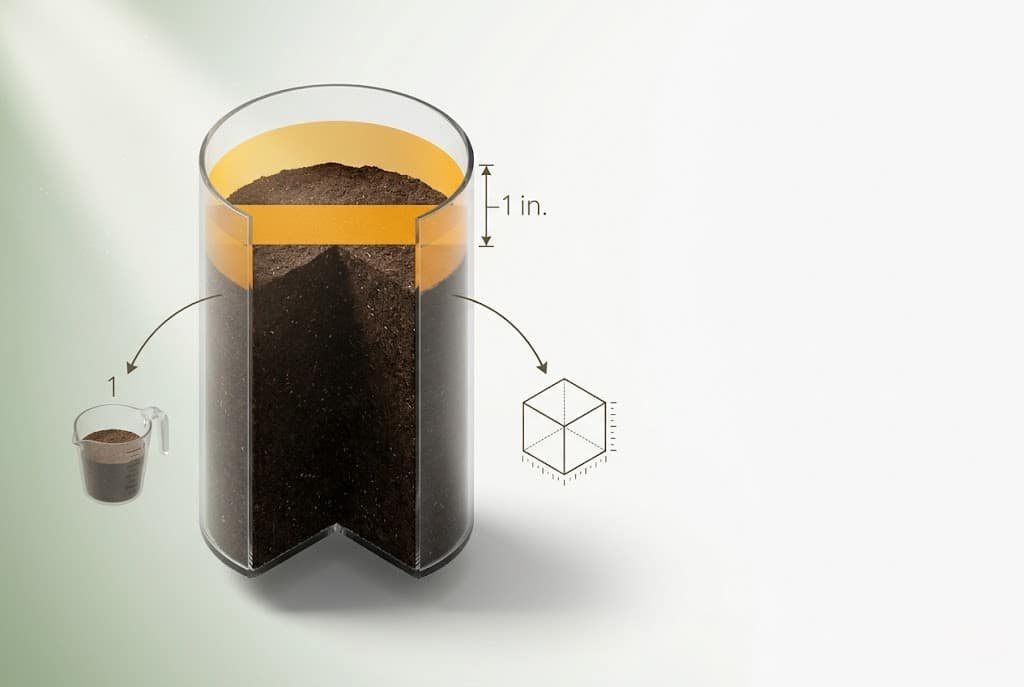
Calculating potting soil volume is a geometry problem, not a guessing game. The fundamental issue is that most gardeners measure the full interior height of a container, then buy soil to fill it completely, which guarantees overflow at the first watering. The correct approach subtracts a 1-inch watering gap before computing volume, converting that depth to quarts (the unit bags are sold in) and cubic feet (the unit bulk media uses). These are not interchangeable shorthand; they encode different purchasing realities.
Potting Soil Calculator
Find exactly how much potting mix you need — in quarts and cubic feet
Choose the shape that best matches your pot
Measure inside the rim of your round pot
Measure the longest interior side of your pot
Measure inside depth from bottom to rim
How many pots of this size do you need to fill?
Fill in the form above and click Calculate
Total Potting Soil Needed
Quarts
Cubic Feet
ft³
Per Pot
Quarts / pot
Standard Bag Coverage (1 cu ft = 7.48 qt bags)
0bags
Warnings & Standards
Quick Reference: Common Pot Sizes
Pot Size
Shape
Quarts (1 pot)
Cu Ft (1 pot)
How This Calculator Works
Formula steps (plain language):
Headroom adjustment: Subtract 1" from your entered height to leave a watering gap at the top. Effective Height = Height − 1"
Volume (Round): Use the cylinder formula. Vol (in³) = π × (Diameter ÷ 2)² × Effective Height
Convert to Quarts: Divide cubic inches by 57.75 (the number of cubic inches in 1 U.S. liquid quart). Quarts = Vol ÷ 57.75
Convert to Cubic Feet: Divide cubic inches by 1,728. Cu Ft = Vol ÷ 1728
Scale by pot count: Multiply both results by the number of pots.
Note: The 1" headroom deduction is applied automatically and reflects the standard watering gap used in horticultural practice.
Assumptions & Limits
A 1-inch watering gap (headroom) is automatically subtracted from the entered height. This is standard practice to prevent overflow during watering.
Round pots are treated as perfect cylinders; tapered pots will yield slightly different volumes in practice.
Square/rectangular pots are treated as rectangular prisms using the side length for both width and depth.
1 U.S. quart = 57.75 cubic inches (standard conversion for potting soil).
1 cubic foot = 1,728 cubic inches.
Bag sizes vary by brand — always verify the quart or cubic foot volume on the product label.
Results represent the volume of empty pot space and do not account for root balls, drainage layers, or soil settling.
Powered by The Yield Grid
This potting soil calculator takes pot shape (round or square/rectangular), the relevant horizontal dimension, interior height, and the number of pots, then returns total volume in quarts and cubic feet for a single pot and for the full batch. It does not account for soil settling, root-ball displacement, or drainage layers, those are physical adjustments the grower makes after filling. The tool calculates the geometric volume of the fillable space, nothing more.
After running this calculator, a grower can purchase the correct number of bags without returning to the store, because the 1-inch watering-gap deduction is already applied and both quart and cubic-foot quantities are shown side by side.
Use the Tool
Before filling in the fields, have a tape measure ready. For round pots, measure the inside diameter, the distance across the opening measured inside the rim, not the outside of the pot wall. For square or rectangular containers, measure the longest interior side. Height should be measured from the interior bottom to the rim. The calculator accepts measurements in inches only; convert centimeter measurements before entering. If you are filling multiple pots of identical dimensions, enter that count in the "Number of Pots" field to get a combined total.
If your project involves building a custom soil blend from components, the soil mix calculator handles proportional mixing once you know the total volume this tool produces.
Quick Start (60 Seconds)
Select pot shape first. Round activates the Diameter field; Square/Rectangle activates the Side Length field. Entering the wrong dimension for the wrong shape produces a large calculation error.
Diameter (round pots, inches): Measure across the inside of the pot at the widest point. Accepted range is 1 to 120 inches. The outside diameter of the pot wall is irrelevant here.
Side Length (square/rectangular pots, inches): Use the longest interior dimension. The calculator treats the pot as a square prism using this single value for both width and depth. For noticeably non-square rectangles, this introduces a small error on the smaller dimension.
Height (inches): Measure from the interior bottom to the top rim. The calculator automatically subtracts 1 inch for the watering gap. Do not pre-subtract it manually or the deduction will be applied twice.
Number of Pots: Enter the total count for pots of this exact size. Run the calculator again for each different size. Accepted range is 1 to 500 pots.
Click Calculate. Results appear only after the button is pressed. The panel remains blank if any field has an error - check the red inline messages beneath each field.
Use the Reset button to clear all fields and results before entering a new pot size.
Inputs and Outputs (What Each Field Means)
Field
Unit
What It Measures
Common Entry Mistake
Safe Entry Guidance
Pot Shape
Selection
Determines whether cylinder or rectangular-prism formula is used
Leaving it on "Round" when calculating a square window box
Check the cross-section of the pot opening, not its profile
Diameter
Inches
Interior width of a round pot measured across the center
Measuring the outside circumference, then dividing by pi incorrectly
Lay the tape across the inside opening; measure at the widest point
Side Length
Inches
Interior longest side of a square or rectangular container
Using the exterior side length including wall thickness
Measure from inside wall to inside wall, not the outside of the container
Height
Inches
Interior depth from the bottom to the rim
Pre-subtracting the watering gap before entry, causing a double deduction
Enter the full interior height; the tool handles the 1-inch deduction
Number of Pots
Count (whole number)
How many identical pots are being filled in this batch
Mixing pots of different sizes into one count
Run the calculator once per unique pot size
Total Quarts (output)
Quarts (qt)
Combined soil volume for all pots in quart units
Treating this as the number of bags without checking bag label volume
Divide by the quart volume printed on your specific bag to get bag count
Cubic Feet (output)
ft³
Same volume expressed for bulk purchases sold by the cubic foot
Confusing 1 cubic foot of media with 1 cubic foot listed on compressed bags
Check whether the bag lists "compressed" or "expanded" volume
Per Pot (output)
Quarts / pot
Volume for one pot before scaling by count
Not checking this value to catch obvious measurement errors
Cross-check against general expectations for the pot size before purchasing
Worked Examples (Real Numbers)
Example 1: A Single 12-Inch Round Nursery Pot
Shape: Round
Diameter: 12 inches
Height: 10 inches
Count: 1
Effective depth after 1-inch deduction: 9 inches
Volume: π × 6² × 9 = 1,017.9 in³
Result: 17.6 quarts (0.59 cu ft)
A calculated bag count removes guesswork from planting day, turning a number into a specific physical action with no mid-session store trips.
A standard 12-inch nursery container holds just over one 16-quart bag at the recommended fill level. Buying two 8-quart bags covers this pot with minimal leftover soil.
Example 2: Six 8-Inch Round Pots for an Herb Garden
Six 8-inch herb pots require just over two 16-quart bags. Purchasing one 2-cubic-foot bag of potting mix covers the batch with roughly 0.95 cubic feet to spare for replenishment later in the season.
Example 3: A 14-Inch Square Planter Box
Shape: Square
Side Length: 14 inches
Height: 12 inches
Count: 1
Effective depth after 1-inch deduction: 11 inches
Volume: 14 × 14 × 11 = 2,156 in³
Result: 37.3 quarts (1.25 cu ft)
This mid-sized square planter falls between two and three 16-quart bags. Three bags is the safe purchase because partial bags store poorly once opened, and 11 quarts of surplus can be used to top-dress existing containers.
Reference Table (Fast Lookup)
Subtracting one inch from entered height before computing volume is what converts a geometric measurement into a usable gardening quantity.
All volumes use the 1-inch watering-gap deduction. The "Bags Needed" column assumes standard 16-quart bags; always round up to the next whole bag.
Pot Description
Shape
Dimension (in)
Height (in)
Effective Depth (in)
Volume (in³)
Quarts
Cu Ft
16-qt Bags Needed
4-inch seedling pot
Round
4 (diameter)
4
3
37.7
0.65
0.02
1 (fills many pots)
6-inch starter pot
Round
6 (diameter)
6
5
141.4
2.45
0.08
1
8-inch herb pot
Round
8 (diameter)
7
6
301.6
5.22
0.17
1
10-inch perennial pot
Round
10 (diameter)
9
8
628.3
10.88
0.36
1
12-inch nursery pot
Round
12 (diameter)
10
9
1,017.9
17.62
0.59
2
16-inch specimen pot
Round
16 (diameter)
12
11
2,211.7
38.30
1.28
3
14-inch square planter
Square
14 (side)
12
11
2,156.0
37.32
1.25
3
20-inch square deck box
Square
20 (side)
16
15
6,000.0
103.90
3.47
7
24-inch round half-barrel
Round
24 (diameter)
16
15
6,786.0
117.53
3.93
8
How the Calculation Works (Formula + Assumptions)
Show the calculation steps
Step 1 - Watering-gap deduction: The entered height is reduced by 1 inch before any volume calculation. This 1-inch clearance is maintained as empty space above the soil so water can pool briefly during irrigation without overflowing. Effective Height = Entered Height - 1 inch.
Step 2 - Volume in cubic inches:
Round pots (cylinder formula): Volume = π × (Diameter / 2)² × Effective Height. The radius is half the entered diameter.
Square or rectangular pots (rectangular prism formula): Volume = Side Length × Side Length × Effective Height. The same side-length value is used for both horizontal dimensions, modeling the container as a square prism.
Step 3 - Convert to quarts: Divide cubic inches by 57.75. This is the standard volumetric conversion: 1 U.S. liquid quart equals 57.75 cubic inches. Potting mix volume is not a liquid volume, but the quart convention is used across the container gardening industry to standardize bag sizing.
Step 4 - Convert to cubic feet: Divide cubic inches by 1,728 (because 12 × 12 × 12 = 1,728 cubic inches per cubic foot).
Step 5 - Scale by pot count: Multiply both the quart total and the cubic-foot total by the number of pots entered. The per-pot output is computed before this multiplication.
Rounding: Quarts are displayed to one decimal place; cubic feet to two decimal places. The reference bar uses ceiling rounding to determine the number of standard bags, ensuring the recommendation always covers the volume.
Assumptions and Limits
The 1-inch watering gap is applied uniformly regardless of pot depth. Very shallow pots (under 3 inches of entered height) will produce a small effective depth; the calculator applies a minimum of 0.1 inches to prevent a zero result.
Round pots are modeled as perfect cylinders. Tapered pots - those that are wider at the rim than at the base - have a true volume smaller than the cylinder calculation predicts, so results for tapered containers should be treated as slight overestimates.
Square/rectangular containers are modeled as square prisms using only the longer side. A container that is 10 inches by 16 inches will be computed as 16 × 16 × effective height, overstating volume for the shorter dimension. For strongly rectangular containers, use the actual smaller dimension to run a separate estimate and average the results.
The conversion factor of 57.75 cubic inches per quart applies to the U.S. liquid quart. Imperial (UK) quarts and dry quarts use different values and should not be substituted.
Bag volume claims on product labels vary. Some compressed-coir and peat-based products list "expanded" volume after hydration, which can be larger than the quart figure printed on the bag. Always check whether the label volume is pre- or post-hydration.
The calculator does not subtract volume for drainage layers (gravel, lava rock), root balls of transplants, or soil that has already settled in a partially filled pot. These are physical adjustments made at the time of planting.
Maximum accepted values: 120 inches diameter, 200 inches height, 500 pots. Inputs outside these ranges are rejected with an inline error message.
Standards, Safety Checks, and "Secret Sauce" Warnings
Critical Warnings
Do not pre-subtract the watering gap. The calculator applies the 1-inch deduction automatically. Entering a height already reduced by 1 inch produces a double deduction, underestimating volume by 1 inch of cross-sectional area across the entire pot.
Outer measurements invalidate the result. Using the outside height or outside diameter of the container - which includes wall thickness - consistently overstates volume. Walls on ceramic and terracotta pots can be 0.5 to 1.5 inches thick; on large fiberglass planters, even thicker.
Bag label volume is not guaranteed to match the calculation. Potting soil bags are sold by stated volume, but media can settle during shipping, and compressed products may expand. Always compare the quart result to the bag's stated volume, not its weight.
Square-prism modeling overstates volume for tapered containers. Pot shapes described as "square" are often tapered for stacking. Treat the calculator output as a ceiling for tapered pots - the actual fill will be somewhat less.
Minimum Standards
A 1-inch watering gap at the rim is the standard clearance used in horticultural practice for container culture. This prevents runoff and allows temporary pooling during slow watering cycles without overflow.
Both quart and cubic-foot outputs should be reviewed together. Quarts are the purchasing unit for bagged mixes; cubic feet are the purchasing unit for bulk and bale media. Comparing both prevents the common error of buying bulk media when bagged is more economical for small volumes, or bagged when bulk is significantly cheaper for large plantings.
Perlite, coir, and other amendments added to modify drainage or weight should be calculated separately using a dedicated blending tool, since their volumes are independent of the base potting mix volume this calculator produces. The peat moss calculator handles amendment volumes for peat-based blends specifically.
Competitor Trap
Most container volume calculators found in search results compute full pot volume - height times cross-sectional area - with no adjustment for fill level.
Without a deliberate watering gap, the first irrigation washes nutrients and fine particles off the soil surface before they can reach plant roots.
This produces a figure that reflects the pot's total geometric capacity, not the amount of soil a grower should actually purchase. Filling a pot to the brim creates a functional problem: the first irrigation floods over the rim, washing fine particles and nutrients onto the surface below. The 1-inch watering-gap deduction is not a stylistic choice - it is the difference between a volume that is mathematically complete and one that is horticulturally usable. Tools that omit this step systematically recommend more soil than is needed and more soil than can actually be used. Checking whether a calculator makes this deduction is the single fastest quality test of any soil volume tool. You can also use the soil bulk density calculator to cross-check whether a given media weight correlates realistically with the volume this tool returns.
Common Mistakes and Fixes
Mistake: Measuring the Outside of the Container
Tape measures are naturally placed at the nearest surface, which is the outside of the pot wall. For plastic nursery pots, wall thickness is small enough to be negligible, but for ceramic, terracotta, concrete, and thick-walled fiberglass planters, outside measurements can overstate interior volume by a meaningful amount. The formula only works correctly when applied to interior dimensions.
Fix: Lower the tape measure inside the container and measure from inner wall to inner wall for diameter or side length, and from the interior bottom to the rim for height.
Mistake: Using the Same Height for Pots With a Drainage Reservoir
Some self-watering containers and specialty planters have a built-in drainage reservoir or false bottom that reduces the actual soil column height. The total exterior height of the container is not the height of the planting zone. Filling to the calculated volume without accounting for the reservoir results in purchasing too much soil.
Fix: Measure only from the top of the growing medium zone to the rim. Consult the manufacturer's specifications for the planting depth if the reservoir floor is not visible.
Mistake: Mixing Different Pot Sizes Into One Calculation
When filling a collection of containers, it is tempting to average the heights and diameters to run a single calculation. Averaging dimensions before applying the cylinder or prism formula does not produce the same result as summing the individual volumes, because the area terms scale quadratically with the dimension. A 6-inch pot and a 10-inch pot averaged to 8 inches will not yield the correct combined volume.
Fix: Run the calculator once per unique pot size and sum the quart results manually. Use the "Number of Pots" field to handle identical containers in a single calculation.
Mistake: Treating the Quart Output as the Number of Bags
Quarts are a unit of volume, not a product count. Bags of potting mix are sold in 8-quart, 16-quart, 20-quart, and 25-quart sizes, among others, and the volume printed on the bag must be checked. Dividing the calculator's quart output by 16 only gives bag count for 16-quart bags specifically.
Fix: Divide the total quart result by the quart volume printed on the specific bag you intend to buy, then round up to the next whole bag number.
Mistake: Ignoring Soil Settling in Used Containers
Existing potting media settles over a growing season as organic matter decomposes and particles compact. A container that appears half-empty by fall has not simply lost soil - it has reduced in volume due to decomposition. Running the calculator for a container that still holds settled old media will overestimate the amount of new mix needed to top up the pot.
Fix: For top-up applications, subtract the current soil depth from the full interior height before entering the height into the calculator, treating the air column above the settled soil as the effective "pot" to be filled.
Related Tools and Next Steps
Once you know how much potting soil you need for your containers, several adjacent calculations become relevant depending on your project scale and growing method.
If you are filling larger ground-level structures alongside containers, the raised bed soil calculator handles rectangular and L-shaped beds with the same unit outputs.
Amending a potting mix with compost changes both the volume and the nutrient profile. Use the compost calculator to determine how much compost to add by volume ratio.
Coco coir is increasingly used as a peat-free potting base. The coco coir calculator converts dry brick weight to expanded volume, which is a necessary step before using this tool's quart result to determine how much coir to hydrate.
The carbon-to-nitrogen ratio of compost mixed into potting media affects both decomposition rate and nitrogen availability. The compost ratio calculator checks whether your blend falls in an agronomically sound range.
Soil texture - the proportion of sand, silt, and clay particles - determines drainage and water retention in blended mixes. The soil texture calculator is useful when formulating a mix from raw components rather than pre-bagged products.
Nutrient planning after filling containers begins with an NPK baseline. The NPK calculator converts fertilizer label percentages into actual nutrient mass per application volume.
Verifying that your potting mix supports the nutrient levels you intend to apply is easier when you can confirm pH is in range. The soil pH sulfur calculator handles acid-side corrections for potting media and container blends.
FAQ
Why does the calculator subtract 1 inch from the height I enter?
The 1-inch deduction represents the watering gap - the space left between the soil surface and the rim of the pot. This gap allows water to pool briefly during irrigation without overflowing. Filling a container to the very rim eliminates this buffer, causing water to run off the surface before it can penetrate the soil. The deduction is applied automatically so you do not need to adjust your height measurement before entering it.
What is the difference between quarts and cubic feet for potting soil?
Both units measure the same volume of space, expressed at different scales. One cubic foot equals approximately 25.7 quarts. Bagged potting mixes are commonly sold in quart-denominated sizes (8 qt, 16 qt, 20 qt). Bulk media purchased from landscape suppliers or in large compressed bales is typically priced and labeled in cubic feet. The calculator returns both so you can match the output to whichever purchasing unit applies to your product.
Does this calculator work for tapered or flared pots?
The calculator models round pots as perfect cylinders and square pots as rectangular prisms. Tapered pots - those that are wider at the rim than at the base - have a true volume smaller than the cylinder result. The calculation will slightly overestimate volume for tapered shapes, which is a conservative direction for purchasing: you may have a small amount of soil left over rather than running short.
How do I calculate potting soil for rectangular pots that are not square?
The current calculator uses a single side-length value for square containers, modeling them as square prisms. For a noticeably non-square rectangular planter, run the calculation twice: once using the shorter interior dimension and once using the longer, then average the two quart results. This approximation handles moderate aspect ratios reasonably well. Strongly elongated window boxes benefit from a simple manual calculation: length times width times effective depth divided by 57.75.
What is a "standard" bag of potting soil, and how does the bag count estimate work?
The bag count shown in the visualization uses a 16-quart bag as the reference size, which is one of the most common retail formats for general-purpose potting mix. The estimate divides total quarts by 16 and rounds up to the next whole number. If your intended product comes in a different size - 8 quarts, 20 quarts, or 2 cubic feet - divide the total quart output from the calculator by that bag's stated volume to get the correct count for your specific product.
Can this calculator handle very large containers like half-barrels or stock tanks?
Yes. The diameter field accepts values up to 120 inches and the height field up to 200 inches, which covers the vast majority of large decorative containers, half-barrel planters, and stock tank gardens. For a standard 24-inch-diameter half-barrel at 16 inches of interior height, the calculator returns approximately 117 quarts or 3.9 cubic feet - information that is far more useful for bulk purchasing than a rough estimate. Enter the actual interior measurements for the most accurate result.
Conclusion
The single most important mistake to avoid is measuring exterior dimensions. Wall thickness is silent in most container measurements because it is easy to overlook, and its impact is invisible until the purchased volume of soil falls short of filling the pot. Measure inside, use the effective fill depth (which this calculator handles automatically), and check the output against the specific bag volume of the product you intend to buy. From there, pH correction of the mix, fertilizer timing, and amendment ratios are the logical next steps before planting.