
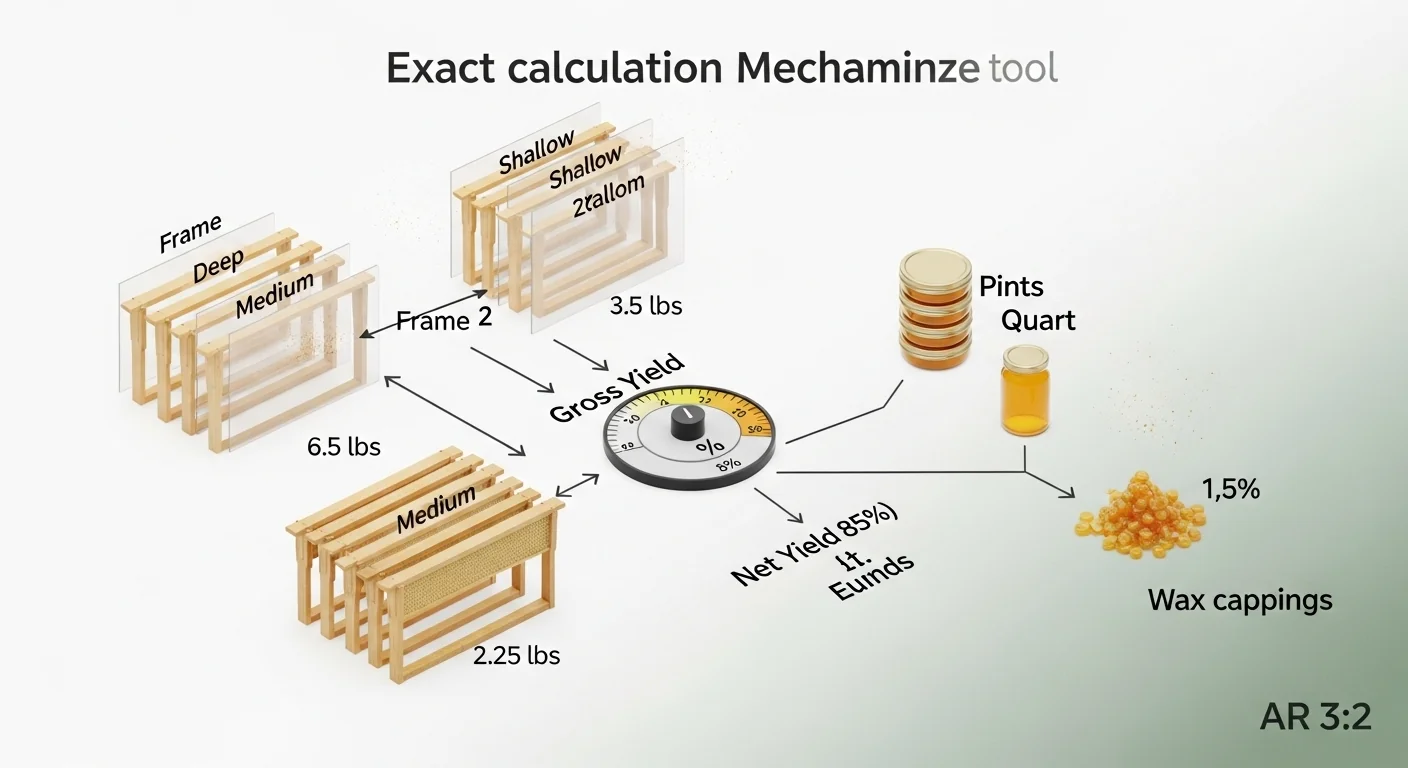
Beekeepers are often surprised by how wide the gap is between pulling frames and knowing what harvest to expect. A fully drawn deep frame does not always mean a full frame of capped honey. The raw frame count gives you a ceiling, not a floor, and the extraction rate you apply to that ceiling changes the outcome more than most planning guides acknowledge.
This honey yield calculator takes three precise inputs, frame count, frame size, and extraction rate, and returns a net yield in pounds, automatically converted into pint and quart jar equivalents and a beeswax byproduct estimate from the cappings. It does not predict nectar flow, account for moisture content above 18.6%, or substitute for refractometer readings before you bottle. If you are using the numbers for food safety decisions, test moisture separately.
After using this tool, you will know how many jars to prepare before extraction day and how much cappings wax to plan for rendering, which removes two of the most common last-minute scrambles on harvest day.
Use the Tool
Beehive Frame Calculator
Honey Yield Calculator — The Yield Grid
Before entering values, have your total frame count ready from your most recent inspection. Know the depth of the supers those frames came from (deep, medium, or shallow) and use a consistent extraction rate based on your extractor type. Centrifugal extractors typically achieve 80 to 90 percent; hand-crush or crush-and-strain methods usually fall below that range. If you are harvesting multiple super sizes in one session, run the calculator once per frame size and add the results. If you track your overall apiary harvest by season, the feed cost calculator pairs well for estimating your per-hive operating cost alongside yield.
Quick Start (60 Seconds)
- Frame Count: Enter the total number of honey frames you plan to extract. This is not the number of supers; it is the individual frame count. A 10-frame deep super with all 10 frames in = 10.
- Frame Size: Select the depth that matches your drawn comb. Deep = full-depth (Langstroth 9-5/8 inch), Medium = Illinois super (6-5/8 inch), Shallow = 5-11/16 inch. Do not mix sizes in a single calculation run.
- Extraction Rate: Enter the percentage of available honey you expect to actually recover. The default is 85 percent. New extractors and experienced operators typically land between 80 and 90. Do not enter 100 unless you have measured it empirically.
- Unit check: All outputs are in U.S. pounds. Jar conversions use 1 lb per pint and 3 lbs per quart as standard fill weights, not jar volume.
- Common input error: Counting partially-drawn or uncapped frames in the total inflates your result. Only include frames you intend to extract.
- After calculating: Note the beeswax estimate before you start. Have a clean container ready to collect cappings wax during uncapping.
Inputs and Outputs (What Each Field Means)
| Field | Unit | What It Means | Common Mistake | Safe Entry Guidance |
|---|---|---|---|---|
| Frame Count | Integer (1 to 500) | Total number of honey frames to be extracted in this batch | Including frames from brood boxes or partially-filled supers | Count only fully-drawn, honey-filled frames you plan to spin |
| Frame Size | Category (Deep / Medium / Shallow) | Langstroth frame depth, which determines the per-frame honey weight midpoint used in the formula | Selecting “Deep” for a medium super because it “sounds right” | Measure your super box depth or check the label on the super body |
| Extraction Rate | Percent (50 to 100) | The fraction of gross honey capacity successfully recovered by the extractor | Entering 100 percent, which is not achievable in practice | Use 80 to 90 for centrifugal extractors; use 60 to 75 for crush-and-strain |
| Net Yield | Pounds (lbs) | Estimated harvestable honey after applying the extraction rate to gross frame capacity | Treating this as a guaranteed weight rather than a planning estimate | Weigh your harvest bucket on a scale to verify against this estimate |
| Pint Jars | Count (whole jars) | Approximate number of pint-size jars fillable at 1 lb net honey per jar | Using volume-based fill expectations instead of weight-based | Pre-label jars and have 10 to 15 percent extra on hand for rounding |
| Quart Jars | Count (whole jars) | Approximate number of quart-size jars fillable at 3 lbs net honey per jar | Assuming quart = 2x pint in honey weight; actual ratio is 3:1 by weight | Confirm your quart jar holds 3 lbs by test-filling one before harvest day |
| Beeswax Byproduct | Pounds (lbs) | Estimated cappings wax yield at 1.5 percent of net honey weight | Discarding cappings wax without weighing or rendering it | Collect all cappings into a clean, food-safe bucket during uncapping |
Honey production varies by season, colony strength, and forage availability. If you are also tracking egg hatching cycles alongside your honey harvest schedule, the hatch date calculator can help you time inspections around brood development windows.
Worked Examples (Real Numbers)
Example 1: Small Backyard Harvest (10 Deep Frames)
- Frame Count: 10
- Frame Size: Deep (6.5 lbs/frame midpoint)
- Extraction Rate: 85 percent
Gross = 10 x 6.5 = 65.0 lbs
Net = 65.0 x 0.85 = 55.3 lbs
Result: 55.3 lbs of honey, filling approximately 55 pint jars or 18 quart jars, with 0.83 lbs of cappings wax.
A 10-deep-frame harvest at standard extraction produces enough honey for retail at a farmers market table or to stock a full season of household use. The wax yield is small but worth collecting.
Example 2: Full Medium Super Extraction (20 Medium Frames)
- Frame Count: 20
- Frame Size: Medium (3.5 lbs/frame midpoint)
- Extraction Rate: 90 percent
Gross = 20 x 3.5 = 70.0 lbs
Net = 70.0 x 0.90 = 63.0 lbs
Result: 63.0 lbs of honey, filling approximately 63 pint jars or 21 quart jars, with 0.95 lbs of cappings wax.
Two full medium supers at a high extraction rate produce output comparable to one deep super box harvest. Medium frames are easier to handle during extraction, which can contribute to slightly higher recovery percentages in practice.
Example 3: Shallow Super Trial (6 Shallow Frames)
- Frame Count: 6
- Frame Size: Shallow (2.25 lbs/frame midpoint)
- Extraction Rate: 80 percent
Gross = 6 x 2.25 = 13.5 lbs
Net = 13.5 x 0.80 = 10.8 lbs
Result: 10.8 lbs of honey, filling approximately 10 pint jars or 3 quart jars, with 0.16 lbs of cappings wax.
A partial shallow super harvest is typical for new beekeepers or hives still building up. At this scale, pint jars for gifting are the most practical use; quart jars would leave too much airspace.
Reference Table (Fast Lookup)
| Frame Size | Frame Count | Per-Frame Weight (lbs) | Gross Yield (lbs) | Net at 80% (lbs) | Net at 85% (lbs) | Net at 90% (lbs) | Pint Jars at 85% | Beeswax at 85% (lbs) |
|---|---|---|---|---|---|---|---|---|
| Deep | 5 | 6.5 | 32.5 | 26.0 | 27.6 | 29.3 | 27 | 0.41 |
| Deep | 10 | 6.5 | 65.0 | 52.0 | 55.3 | 58.5 | 55 | 0.83 |
| Deep | 20 | 6.5 | 130.0 | 104.0 | 110.5 | 117.0 | 110 | 1.66 |
| Medium | 10 | 3.5 | 35.0 | 28.0 | 29.8 | 31.5 | 29 | 0.45 |
| Medium | 20 | 3.5 | 70.0 | 56.0 | 59.5 | 63.0 | 59 | 0.89 |
| Medium | 30 | 3.5 | 105.0 | 84.0 | 89.3 | 94.5 | 89 | 1.34 |
| Shallow | 10 | 2.25 | 22.5 | 18.0 | 19.1 | 20.3 | 19 | 0.29 |
| Shallow | 20 | 2.25 | 45.0 | 36.0 | 38.3 | 40.5 | 38 | 0.57 |
| Shallow | 30 | 2.25 | 67.5 | 54.0 | 57.4 | 60.8 | 57 | 0.86 |
All net yield values are rounded to one decimal place. Pint jar counts use floor rounding (no partial jars counted). Beeswax values use 1.5 percent of net yield as the midpoint estimate for cappings wax only.
How the Calculation Works (Formula + Assumptions)
Show the calculation steps
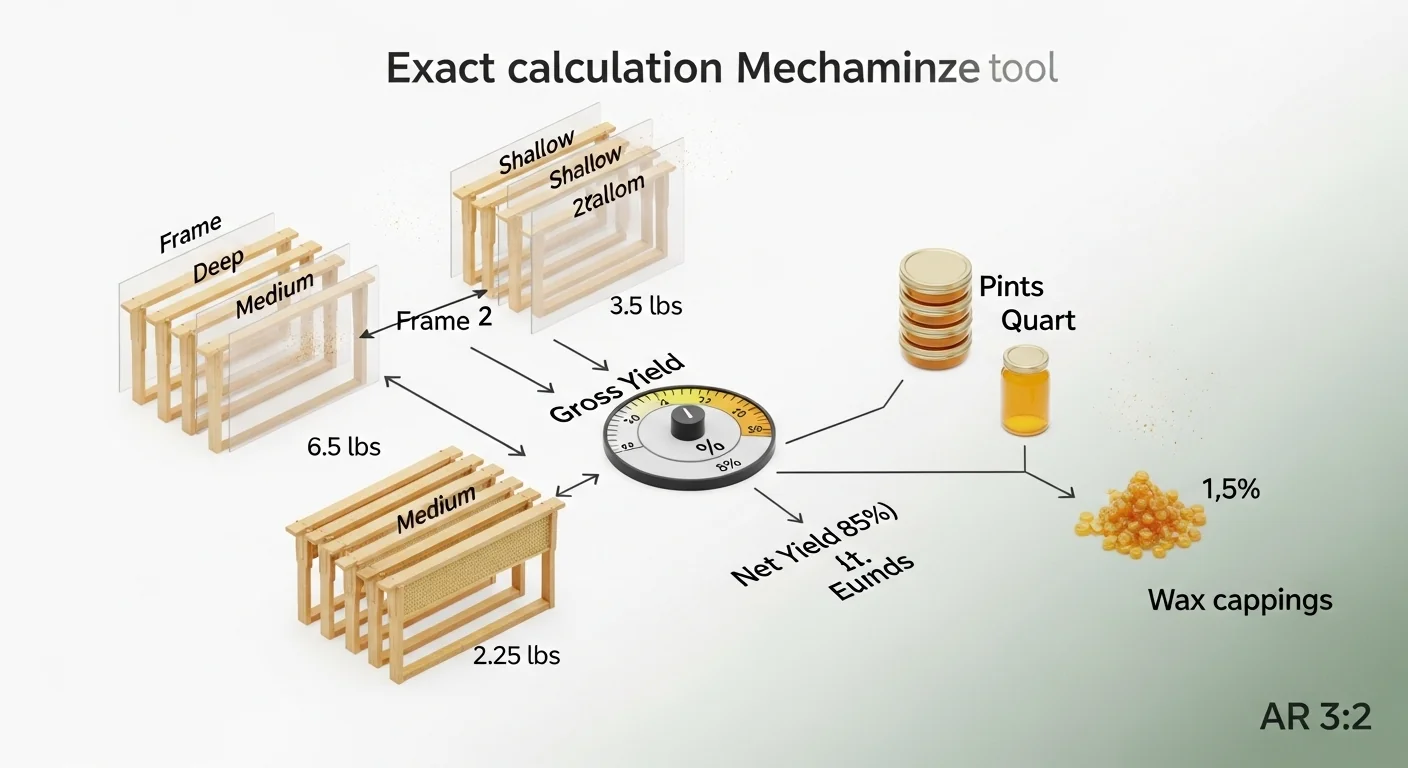
Step 1: Assign per-frame weight by size
The calculator uses the midpoint of published extension-service weight ranges for fully-capped Langstroth frames:
Deep = 6.5 lbs/frame (range: 6 to 7 lbs)
Medium = 3.5 lbs/frame (range: 3 to 4 lbs)
Shallow = 2.25 lbs/frame (range: 2 to 2.5 lbs)
Step 2: Calculate gross yield
Gross (lbs) = Frame Count x Weight Per Frame
This is the theoretical maximum if 100 percent of honey were recovered.
Step 3: Apply extraction rate
Net Yield (lbs) = Gross x (Extraction Rate / 100)
The extraction rate accounts for honey that remains in the comb cells, drips that do not reach the gate, and uncapped cells that were not spun out.
Step 4: Convert to jar counts
Pint Jars = floor(Net Yield / 1.0 lb)
Quart Jars = floor(Net Yield / 3.0 lbs)
Floor rounding is used because partial jars are not counted as sellable units.
Step 5: Estimate beeswax byproduct
Beeswax (lbs) = Net Yield x 0.015
This uses 1.5 percent as the midpoint of the 1 to 2 percent cappings wax yield range relative to honey weight.
Rounding rules: Net yield is displayed to one decimal place. Jar counts are whole numbers (floor). Beeswax is displayed to two decimal places.
Assumptions and Limits
- Frame weights use the midpoint of published ranges. Actual weights vary with nectar source, capping depth, and comb age.
- The extraction rate is user-supplied. The calculator cannot verify whether your extractor type supports the rate you enter.
- Honey moisture content is not checked. Honey above 18.6 percent moisture is at fermentation risk and should not be bottled regardless of yield calculations.
- Jar conversions assume standard U.S. food-grade fill weights: 1 lb net for pints, 3 lbs net for quarts. Actual fill varies by jar wall thickness and headspace.
- Beeswax estimate covers cappings wax only. Foundation wax, burr comb, and propolis are not included.
- The tool assumes all entered frames are fully drawn and honey-filled. Partially-drawn or drone comb frames will inflate the result.
- Frame counts above 200 are unusual for single extraction sessions; the tool accepts up to 500 for apiaries running multiple colonies.
Standards, Safety Checks, and “Secret Sauce” Warnings
Critical Warnings
- Extraction rate below 80 percent: A rate below 80 percent often signals an equipment issue (bent frame, worn extractor basket, insufficient spin speed) or frames pulled before full capping. Diagnose before assuming it is a colony strength problem.
- Moisture content not verified: This calculator does not measure moisture. Honey with more than 18.6 percent moisture can ferment in the jar. Use a refractometer before bottling, regardless of the yield estimate here. Proper storage practices also intersect with your other food preservation workflows; the canning calculator covers related food-safe fill and headspace standards.
- Beeswax underestimation when using cut-comb: If you are producing cut-comb honey, the wax fraction is much higher than the 1.5 percent cappings-only estimate. The byproduct figure here applies to extracted (spun) honey only.
- Jar count is a floor, not a target: The pint and quart conversions use floor rounding. Budget for 10 to 15 percent more jars than the output shows to cover rounding, drips, and overfill.
Minimum Standards
- Centrifugal extractors should achieve at least 80 percent recovery on well-capped frames. Below that threshold warrants extractor inspection.
- Cappings wax from a single extraction session should always be collected and weighed. Even a small harvest yields sellable or usable wax at the 1 to 2 percent range.
- Standard U.S. retail honey fill weights: 1 lb per pint jar, 3 lbs per quart jar. These are the weights used by most farmers market and USDA cottage-food producers.
- Honey labeled for sale must meet moisture and labeling requirements in your state. The jar count output here is a planning figure, not a compliance document.
Competitor Trap: Most online honey yield guides stop at pounds and never convert to jar count or wax byproduct. That forces beekeepers to do the math themselves on harvest day, often with wet hands and an extractor running. Skipping the jar and wax conversion step is how beekeepers end up with 55 pounds of honey and only 30 clean jars on hand, or a bucket of cappings wax that gets thrown away because no container was prepared. Treat the jar and wax outputs as operational logistics, not optional extras. If you work with other value-added preserves alongside honey, the pectin calculator can help you plan the proportions for honey-sweetened jams and jellies from the same harvest season.
Common Mistakes and Fixes
Mistake: Including Uncapped or Partially-Filled Frames in the Count
Uncapped frames contain honey that is too high in moisture to extract safely. Adding them to the frame count inflates your gross yield and produces a jar estimate that will not match your actual harvest. Some beekeepers pull these frames during a nectar flow thinking they will extract everything at once.
Fix: Count only frames where at least 80 percent of the cells are capped before entering the frame count field.
Mistake: Using Volume Instead of Weight for Jar Calculations
Honey is significantly denser than water. A 16-ounce (volume) jar does not hold 1 pound of honey by volume; it holds close to 1.5 pounds by weight. Beekeepers who fill jars by volume underfill by weight and either shortchange customers or fail food labeling requirements. This mistake also appears in fermented and preserved food planning, similar to issues covered in brine ratio work where weight and volume diverge.
Fix: Fill jars on a tare scale and verify net weight before sealing, not by fill line.
Mistake: Entering 100 Percent as the Extraction Rate
No extractor returns 100 percent of comb-stored honey. Even high-end radial extractors leave residue in cell walls and the extractor basket. Using 100 percent produces an aspirational number that will reliably overestimate your actual jar count.
Fix: Track your actual measured yield over two to three harvests, divide net pounds by gross frame weight, and use that as your personal extraction rate going forward.
Mistake: Discarding Cappings Wax Without Collecting It First
The beeswax byproduct estimate in the calculator is based on 1 to 2 percent of net honey weight. At a 55-pound harvest, that represents close to 0.83 pounds of raw wax. Many first-year beekeepers let cappings wax fall into the uncapping tank drain and lose it entirely. Rendered beeswax sells for several dollars per ounce at craft markets and is a direct value-add from every harvest. If you use a dehydrator for other homestead preservation, the dehydrator time estimator can help you plan the rest of your post-harvest processing schedule around wax rendering.
Fix: Set up a clean food-grade bucket under your uncapping station before extraction begins, not after.
Mistake: Running Mixed Frame Sizes in a Single Calculation
If your extraction session includes both medium and deep frames from different supers, entering a single frame size for all of them averages out incorrectly. A mix of 10 deep and 10 medium frames is not the same as 20 “medium-ish” frames.
Fix: Run the calculator twice, once per frame size, and add the net yield totals and jar counts manually before preparing your jar inventory.
Next Steps in Your Workflow
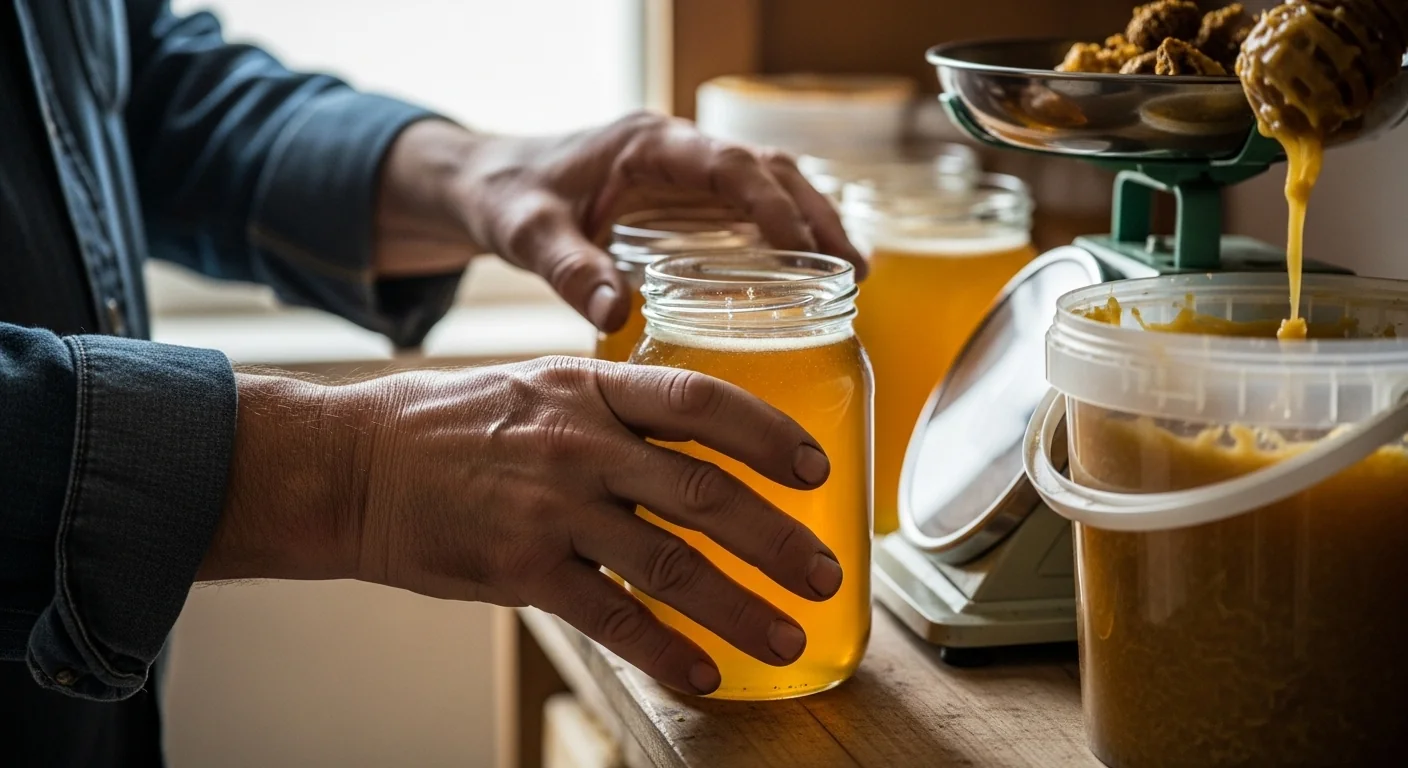
Once you have your yield estimate, the two most immediate actions are jar inventory and wax setup. Count your clean, labeled jars before extraction day, not during. Use the pint and quart output from the calculator to place your jar order or pull from storage with 15 percent extra as a buffer. For the wax, have a stainless or enamel container ready to collect cappings; even if you do not render it immediately, raw cappings store well in the freezer. If you run a diversified homestead operation alongside your hives, the chicken coop sizing calculator and other livestock planning tools on this site help keep your seasonal labor load from stacking up.
After your first extraction using this calculator, weigh your actual yield on a kitchen or postal scale and compare it to the estimate. The difference between your measured net yield and the calculator output is your personal extraction efficiency adjustment. Record it. By the second or third harvest, your entered extraction rate will be calibrated to your actual equipment and technique, and the jar count output will be much tighter. Seasonal harvest tracking alongside feed and operating cost numbers from the hay cost calculator gives a full picture of what your apiary produces and what it costs per season.
FAQ
How much honey does one deep Langstroth frame typically yield?
A fully-capped deep Langstroth frame typically weighs between 6 and 7 pounds of honey, with 6.5 pounds used as the midpoint in this calculator. Actual weight depends on how completely the frame is drawn and capped, the nectar source, and the density of the honey at harvest time. Partially-drawn or wet frames will weigh significantly less.
What is a realistic extraction rate for a beginner beekeeper?
Most first-time extractors using a hand-crank or small motorized tangential extractor recover between 75 and 85 percent of gross frame capacity. Radial extractors and more experienced operators often achieve 85 to 90 percent. Using 80 percent as a conservative starting point is reasonable until you have measured your own equipment’s recovery over two to three sessions.
Why does the calculator use floor rounding for jar counts?
Floor rounding means the jar count never includes a partial jar. A result of 55.3 lbs shows 55 pint jars, not 56, because you cannot sell or store a jar that is not fully filled to net weight. Always add a buffer of 10 to 15 percent extra jars on hand to account for this and for operational drips and losses at the gate.
Is the beeswax estimate accurate for cut-comb honey production?
No. The 1.5 percent beeswax estimate applies to extracted honey from a centrifugal extractor, where only the cappings wax is removed. Cut-comb production removes the entire drawn comb, which is substantially heavier than cappings wax alone. The byproduct figure here should not be used for cut-comb or chunk honey planning.
Can I use this calculator for non-Langstroth hive systems like Warré or top-bar hives?
The frame weight midpoints in this calculator are calibrated specifically to standard Langstroth frame dimensions. Warré and top-bar frames vary significantly in size and drawn-comb volume. Using the Shallow setting as a rough proxy for smaller frames may give a directional estimate, but it should not be treated as accurate for non-Langstroth systems without measuring your own per-frame weights first.
How do I convert lbs of honey to kilograms for export or international sales?
Multiply the net yield in pounds by 0.4536 to get kilograms. A 55-pound harvest equals approximately 24.9 kilograms. For international jar labeling, 1 pound equals 453.6 grams, so a standard pint jar filled to 1 pound net contains 453.6 grams. Always verify labeling requirements for the specific country of sale.
Conclusion
The jump from frame count to jar-ready inventory is where harvest planning either holds together or falls apart. Knowing your net yield in pounds before you start extracting gives you control over jar prep, wax collection setup, and post-harvest storage logistics. The jar conversion and beeswax byproduct outputs exist specifically to close the gap that most yield guides leave open: how many containers do you need, and what do you do with the wax.
The single most common and costly mistake is entering an extraction rate of 100 percent or pulling uncapped frames because “they looked full.” Both errors produce inflated numbers that only reveal themselves on extraction day when jars run short. Use this calculator as a planning floor, calibrate your extraction rate from measured results over time, and collect every ounce of cappings wax before it hits the drain. For beekeepers also managing poultry, livestock, or seasonal garden harvests, the rotational grazing calculator is another planning resource in this library worth bookmarking alongside your honey yield workflow.