
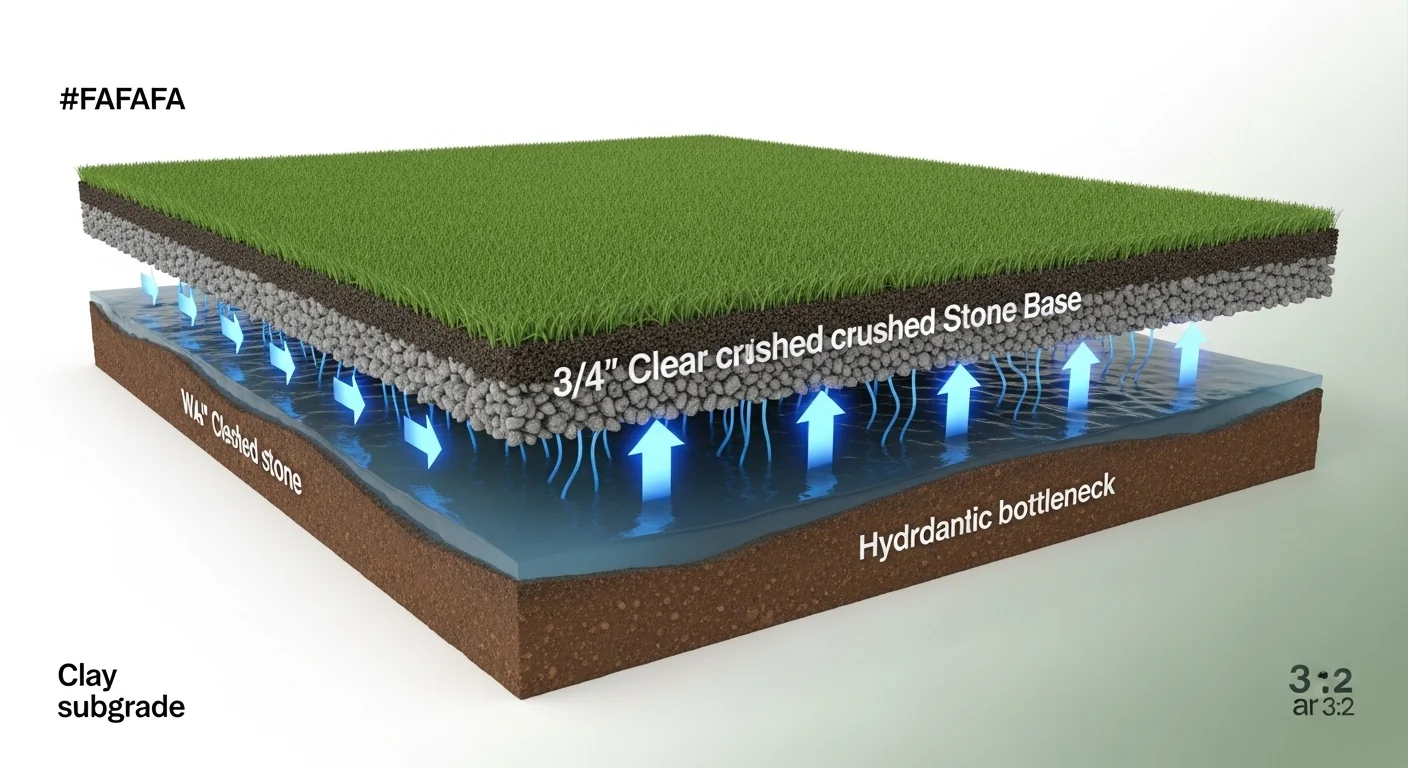
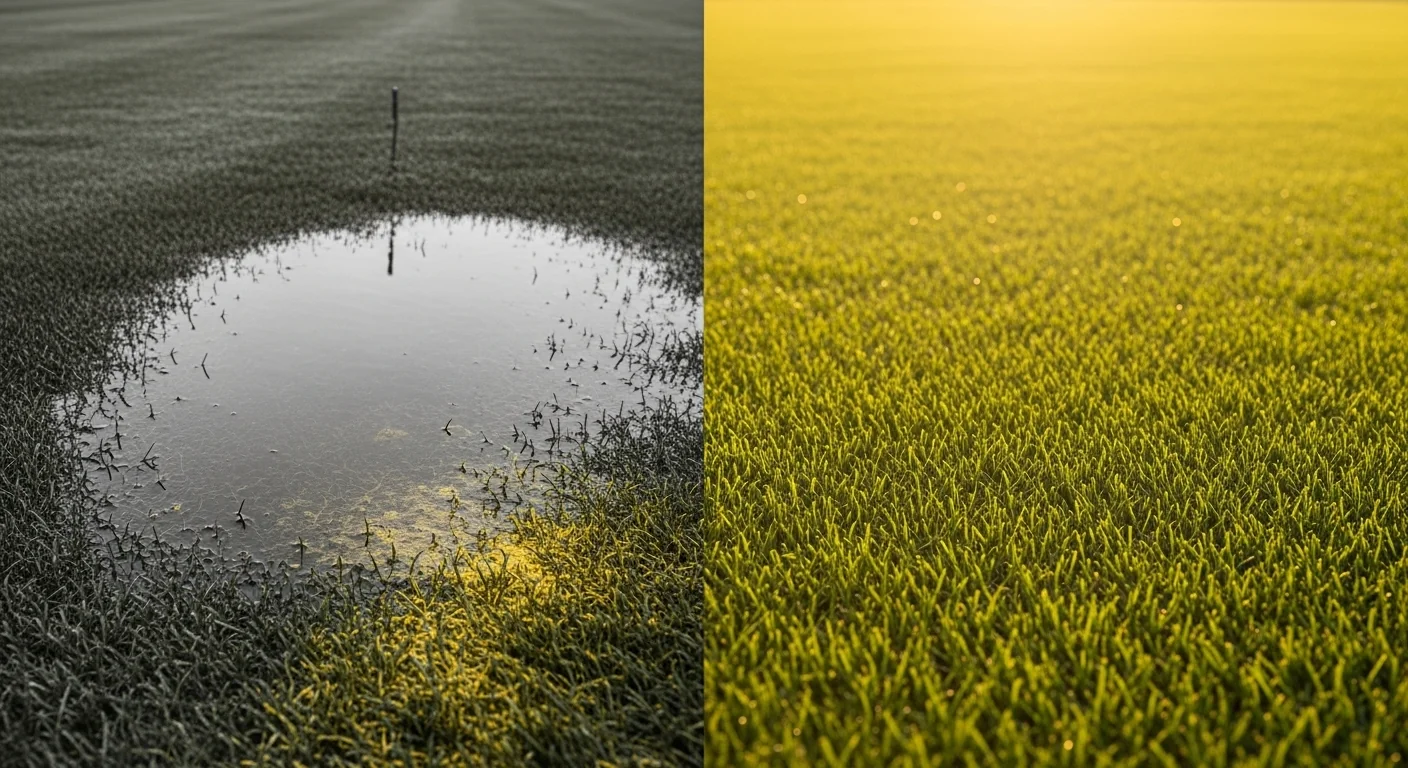
The single most consequential decision in any artificial turf installation is not the turf itself — it is what goes beneath it. Drainage failure starts at the sub-base aggregate layer, and it fails in a specific, predictable way: the wrong material compacts until its internal void space collapses, dropping the hydraulic conductivity to a level that cannot keep pace with even moderate rainfall, let alone repeated pet urination. The math is not complicated, but it is almost never done before installation.
This artificial turf drainage calculator takes four site-specific inputs — area, peak rainfall intensity, sub-base material, and native soil infiltration rate — and computes the effective drain rate for your system, then flags puddling risk and the less-obvious pet urine lockup condition. It does not account for supplemental French drain systems, base depth variations, or freeze-thaw effects on aggregate porosity. If you are also estimating infill type and volume, cross-reference results with a dedicated artificial grass infill calculator to complete the layered decision.
After running the calculator, you will know whether your chosen sub-base material can drain your specific rainfall event, whether pet urine will be hydraulically trapped, and which material change or supplemental drainage measure is required before the first roll of turf goes down.
Use the Tool
Before you start, gather the following: the total turf area in square feet (length x width for rectangular runs, or a rough measurement for irregular shapes), the one-hour peak rainfall intensity for your location (NOAA Atlas 14 is the standard source for the U.S.), the sub-base aggregate specification from your supplier or landscaping plan, and a native soil infiltration rate if you have performed a percolation test. If your gravel volume is still undetermined, the gravel volume calculator can help size the aggregate order once you have confirmed the material type.
Quick Start (60 Seconds)
- Turf Area: Enter square footage only, not linear feet or yards. For irregularly shaped areas, break the space into rectangles, calculate each, and sum them. Range accepted: 1 to 500,000 sq ft.
- Peak Rainfall: Use the 1-hour duration intensity for your design storm (commonly the 10-year return event). Do not use annual average rainfall — the calculator tests worst-case drainage capacity. Typical U.S. values range from 0.5 to 4.0 in/hr; arid climates can fall below that, humid Gulf Coast regions above it.
- Sub-Base Material: Select exactly what your supplier is delivering. “Road base” and “Class II road base” are often treated as interchangeable but both contain compacting fines. If your quote says “crushed aggregate base” or “DG,” select accordingly and note the result carefully.
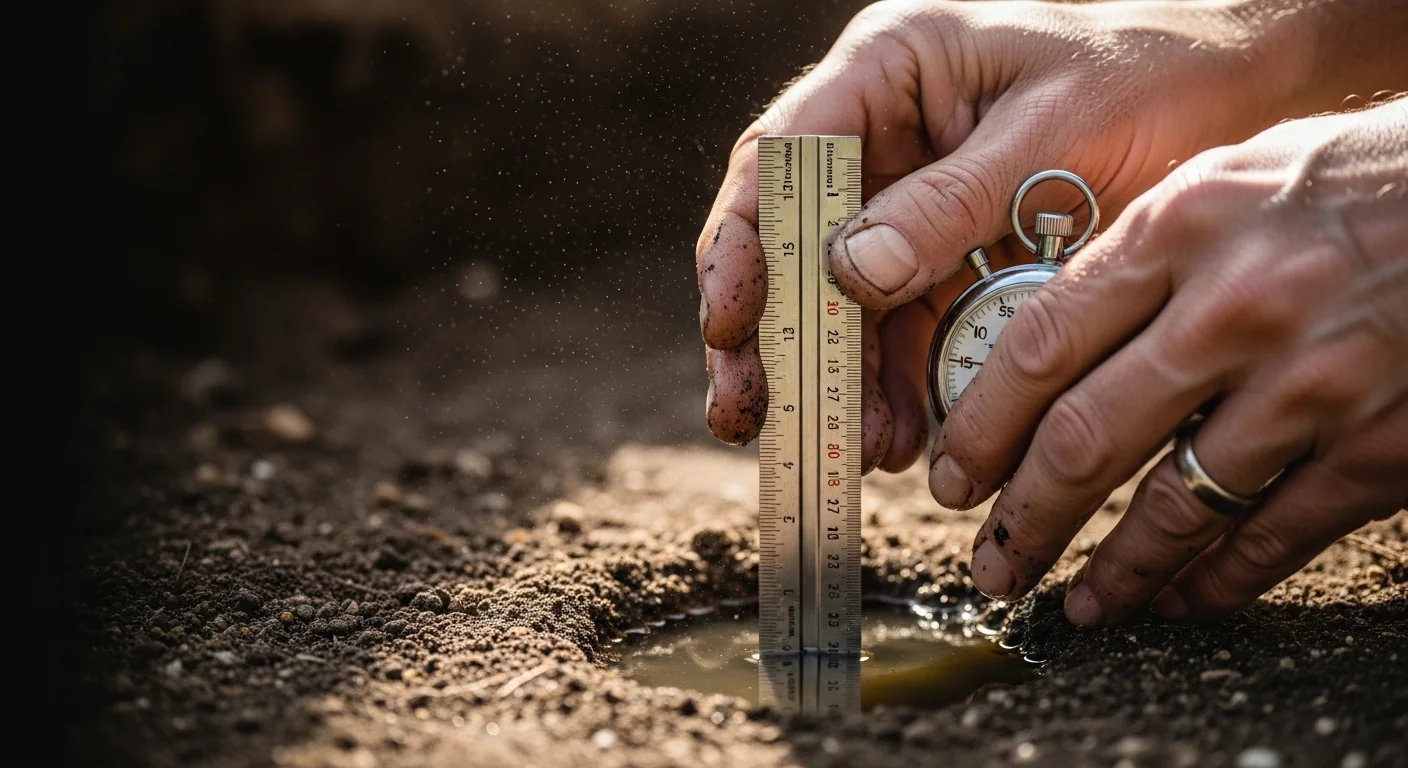
- Native Soil Infiltration Rate: This is the rate the undisturbed soil below the base accepts water. If unknown, use 0.3 in/hr as a conservative starting assumption for clay-dominant soil. Sandy soil is typically 5 to 10 in/hr. A 30-minute percolation test gives a reliable on-site value.
- Unit check: All rate fields use inches per hour (in/hr). Do not enter inches per day or millimeters per hour without converting first.
- Click Calculate only after all four fields are filled. Partial entries will display inline validation errors without running the result.
Inputs and Outputs (What Each Field Means)
The table below maps every input and output field directly to the calculator. Understanding what drives each value prevents the most common data-entry errors. For comparison, note that a paver base calculator uses similar aggregate inputs but targets compressive load rather than hydraulic conductivity — the two goals are often in direct conflict.
| Field | Unit | What It Represents | Common Mistake | Safe Entry Guidance |
|---|---|---|---|---|
| Turf Area | sq ft | Total installed turf footprint | Entering linear feet of perimeter instead of area | Measure length x width; sum sub-areas for irregular shapes |
| Peak Rainfall | in/hr | Maximum expected 1-hour rainfall intensity | Using annual average instead of design-storm intensity | Source from NOAA Atlas 14 for your ZIP code; use 10-year, 1-hour value |
| Sub-Base Material | category | Aggregate type placed directly beneath the turf backing | Selecting “clear crushed” when the delivered material is actually Class II road base with fines | Confirm material spec sheet from supplier; ask specifically about fines content |
| Native Soil Infiltration | in/hr | Rate at which undisturbed subgrade soil accepts water | Assuming sandy soil without testing; many “sandy” yards have a clay hardpan layer 6 to 12 inches down | Perform a percolation test at base excavation depth; valid range 0.01 to 30 in/hr |
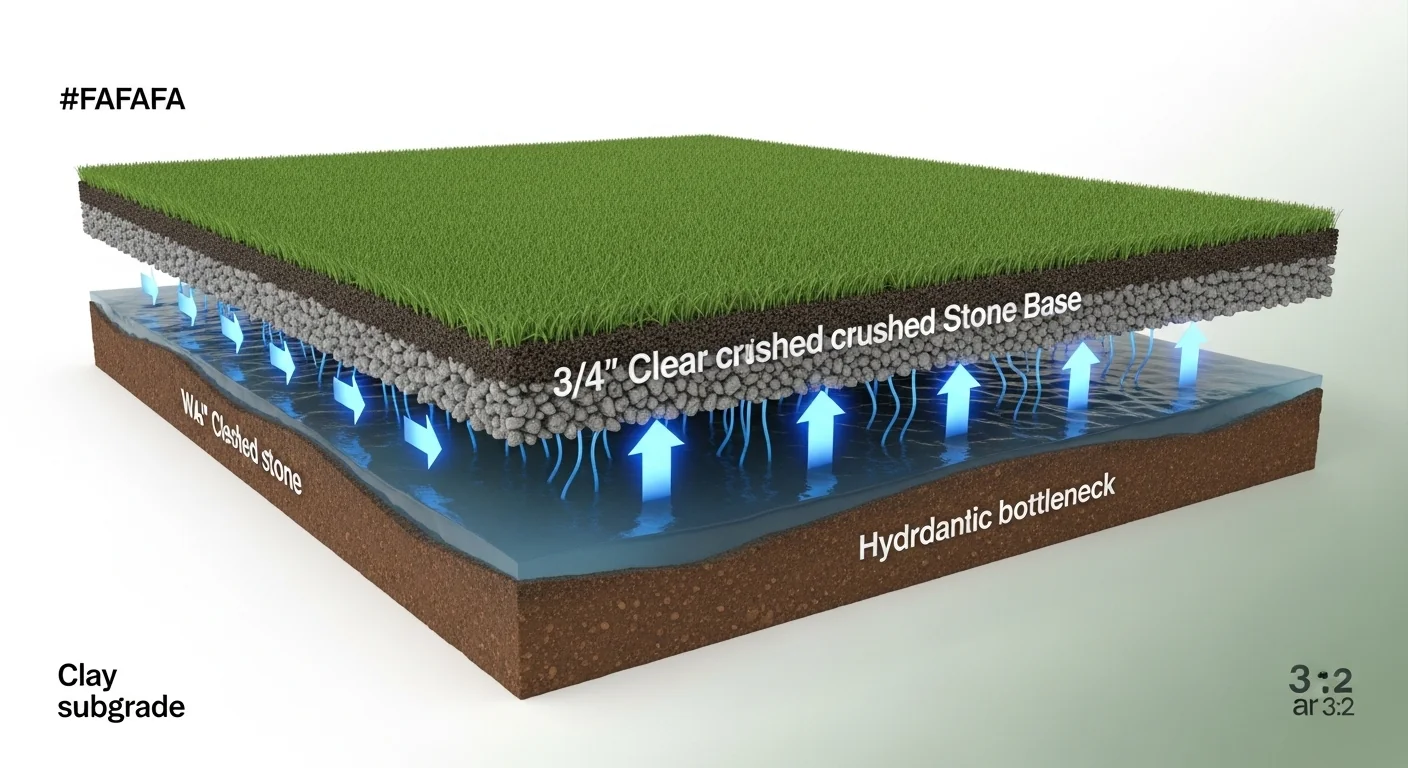
| Effective Drain Rate (output) | in/hr | The minimum of base drain rate and soil infiltration rate; the real hydraulic bottleneck | Assuming the base drain rate alone is sufficient when soil is the actual constraint | Compare directly against Peak Rainfall; must exceed it for a passing result |
| Runoff Volume (output) | cubic in/hr | Total volume of rainfall over the turf area per hour | Ignoring this figure; it sets the minimum drainage capacity any supplemental system must handle | Use as input to size French drain or channel drain if a pass result cannot be achieved through base selection alone |
| Traffic Light Status (output) | Pass / Warning / Fail | Pass = drainage exceeds rainfall and no fines trap. Warning = one condition fails. Fail = both conditions fail. | Treating “Warning” as acceptable for pet turf; a warning on a pet-use installation is a functional failure | For any pet-use installation, accept only a green Pass result before proceeding |
Worked Examples (Real Numbers)
Example 1: Dog Run with Class II Road Base (Failure Mode)
- Turf Area: 200 sq ft
- Peak Rainfall: 1.5 in/hr
- Sub-Base Material: Class II Road Base (with fines)
- Native Soil Infiltration: 0.30 in/hr
Base drain rate for Class II Road Base = 0.1 in/hr. Effective drain rate = min(0.1, 0.30) = 0.1 in/hr. Surplus = 1.5 – 0.1 = 1.4 in/hr unmanaged. Runoff volume = 200 x 144 x 1.5 = 43,200 cubic in/hr generated; only 2,880 cubic in/hr exits.
Result: FAIL. Pet Urine Swamp lockup detected. Drainage deficit of 1.4 in/hr.
This is the most common real-world failure. The road base compacts beautifully under the turf backer, but the stone dust fines fill the voids and seal the layer. Rain sheets off the surface; urine accumulates below the turf fiber where it bakes in radiant heat. The fix is material substitution before installation.
Example 2: Front Yard with 3/4″ Clear Crushed Rock, Slow Clay Soil
- Turf Area: 800 sq ft
- Peak Rainfall: 2.0 in/hr
- Sub-Base Material: 3/4″ Clear Crushed Rock
- Native Soil Infiltration: 1.2 in/hr
Base drain rate for 3/4″ clear crushed = 30 in/hr. Effective drain rate = min(30, 1.2) = 1.2 in/hr. Surplus = 2.0 – 1.2 = 0.8 in/hr; runoff volume: 800 x 144 x 2.0 = 230,400 cubic in/hr generated, 138,240 cubic in/hr exits.
Result: WARNING. Soil is the hydraulic bottleneck. Puddling expected during 2.0 in/hr storm events.
The base material is correct, but the native clay limits the system. The clear crushed rock has done its job by eliminating the urine lockup risk — no fines, no seal. The residual puddling problem requires a French drain interceptor or perimeter channel drain at the low edge of the turf zone.
Example 3: Commercial Property, Ideal Conditions
- Turf Area: 1,500 sq ft
- Peak Rainfall: 1.0 in/hr
- Sub-Base Material: 3/4″ Clear Crushed Rock
- Native Soil Infiltration: 3.5 in/hr
Base drain rate = 30 in/hr. Effective drain rate = min(30, 3.5) = 3.5 in/hr. Safety factor = 3.5 / 1.0 = 3.5x the design storm. No fines, no seal, soil accepts water faster than it arrives.
Result: PASS. Drainage rate is 3.5x the design rainfall. No puddling or odor risk detected.
This configuration represents the installation standard. The 3/4″ open-graded aggregate retains void space under compaction, and the sandy-loam subgrade accepts water at a rate that decouples the system from storm volume. Maintenance focus shifts to infill top-up and fiber brushing rather than drainage remediation.
Reference Table (Fast Lookup)
The table below provides pre-computed drainage status for common sub-base and soil combinations across four typical regional peak rainfall intensities. Use it to shortcut material selection before running the full calculator.
| Sub-Base Material | Base Drain Rate (in/hr) | At 0.5 in/hr Rain | At 1.5 in/hr Rain | At 2.5 in/hr Rain | Pet Urine Trap Risk |
|---|---|---|---|---|---|
| Class II Road Base | 0.1 | FAIL | FAIL | FAIL | High |
| Decomposed Granite | 0.5 | MARGINAL | FAIL | FAIL | High |
| Crushed Concrete (recycled) | 4.0 | PASS | PASS | PASS | Moderate |
| 3/4″ Clear Crushed Rock | 30.0 | PASS | PASS | PASS | None |
| Pea Gravel (reference) | 25.0 | PASS | PASS | PASS | None |
| Native Clay Subgrade (reference) | 0.1 | FAIL* | FAIL* | FAIL* | N/A |
| Native Loam Subgrade (reference) | 0.5 | MARGINAL* | FAIL* | FAIL* | N/A |
| Native Sandy Subgrade (reference) | 8.0+ | PASS* | PASS* | CHECK BASE* | N/A |
* Subgrade-only rows assume a 3/4″ clear crushed base is already installed above the native soil. Status reflects whether soil infiltration is the binding constraint. FAIL and MARGINAL results assume no supplemental French drain. Results will change when soil infiltration is not the bottleneck.
How the Calculation Works (Formula + Assumptions)
Assumptions and Limits
- The base drain rate values are compacted-state hydraulic conductivity estimates. Field variation depends on compaction equipment, lift thickness, and aggregate gradation batch. Actual rates may deviate from lookup values.
- Native soil infiltration is assumed to be steady-state (long-duration saturated condition). During the first few minutes of a storm, unsaturated soil accepts water faster. The calculator conservatively tests the saturated-soil rate.
- Turf perforations and backing fabric are assumed to contribute negligible flow resistance. High-density polyethylene backings with sparse perforations can restrict flow at the fiber level, which this calculator does not model.
- The model does not account for slope. A 2 to 4 degree surface slope redirects runoff laterally, reducing the effective area that must drain vertically. Flat installations are worst-case; sloped installations may perform better than calculated.
- No supplemental drainage (French drain, channel drain, sump) is included. If a system with a supplemental drain is being evaluated, its capacity must be added to the effective drain rate manually before comparison.
- Freeze-thaw cycles can cause fine migration downward into soil pores over time, degrading soil infiltration rates in climates with repeated frost cycles. The calculator reflects a static, newly-installed state.
- Recycled crushed concrete drain rate is listed at 4.0 in/hr as a conservative average for typical recycled aggregate with moderate fines. Pre-washed and screened recycled concrete aggregate can reach rates comparable to clear crushed rock, but field verification of fines content is essential.
Standards, Safety Checks, and “Secret Sauce” Warnings
The hydraulic behavior of compacted sub-base materials is well-established in civil engineering literature, but it is rarely applied in residential and light-commercial turf installation. The gap between what a contractor knows about compaction and what a drainage engineer knows about fines-migration creates the failure conditions this tool is designed to surface. For cases where the calculator returns a fail result due to soil infiltration constraints, a rain garden sizing calculator can help determine whether a bioretention feature adjacent to the turf can absorb overflow volume. For installations where stone selection is also driving lateral drainage decisions, the dry creek bed stone size calculator applies similar aggregate-porosity logic to surface channel design.
Critical Warnings
- The 0.1 in/hr concrete threshold: When Class II Road Base or Decomposed Granite is compacted under artificial turf, stone dust fills the interstitial voids and the material reaches hydraulic conductivity levels as low as 0.1 in/hr — comparable to dense clay. No rainfall event of meaningful intensity can drain through this layer. The material is structurally correct for compaction but hydraulically disqualifying for turf drainage.
- The urine lockup is not reversible post-installation: Once turf is installed over a fines-laden, sealed base, urine cannot drain regardless of how much topical enzymatic treatment is applied. The ammonia compounds concentrate at the base layer, where they are sheltered from UV degradation and enzymatic contact. There is no cost-effective remediation short of removing the turf, replacing the base, and reinstalling.
- Soil infiltration overrides base selection: Installing the correct open-graded base does not guarantee drainage if native soil cannot accept the volume. A 3/4″ clear crushed base over saturated clay behaves identically to a sealed base during a sustained storm event. The soil infiltration input is not optional.
- Marginal safety factor: A base that drains at 1.1 in/hr against a 1.0 in/hr design storm appears to pass but carries no reserve capacity for storm intensification, clogging from fine migration over time, or saturation effects. The calculator flags this as a marginal condition; a safety factor of at least 1.5x is a reasonable design threshold.
Minimum Standards
- Sub-base material for any pet-use artificial turf installation should be zero-fines open-graded aggregate: 3/4″ clear crushed rock or equivalent washed angular aggregate with no stone dust component.
- The effective drain rate must exceed the local design-storm rainfall intensity (typically the 10-year, 1-hour event from NOAA Atlas 14) with a minimum safety factor of 1.5x to account for long-term fines migration and partial clogging.
- For native soil infiltration rates below 0.5 in/hr, a supplemental subsurface drainage system (perforated pipe French drain, sump, or bioretention outlet) is necessary regardless of base material selection.
Competitor Trap: The landscaping industry’s universal recommendation for artificial turf base is Class II road base, and for good reason: it compacts to a smooth, stable, weed-resistant surface that holds the turf backer flat and prevents shifting. Nearly every “how to install artificial grass” guide endorses it without reservation. The trap is that compaction performance and drainage performance are inversely related in aggregate materials. A base that compacts well does so precisely because it fills its internal voids with fine particles. The recommendation is not wrong for hardscaping or natural grass applications; it is wrong specifically for applications requiring liquid drainage through the base layer. This calculator is designed to expose that conflict before it is buried under 1,000 square feet of turf.
Common Mistakes and Fixes
Mistake: Ordering “Class II Permeable Base” When the Supplier Delivers Standard Road Base
The phrase “Class II base” appears in both permeable and non-permeable aggregate specifications, and suppliers often use the terms interchangeably. Standard Class II road base contains stone dust fines by design. Without reviewing the supplier’s gradation spec sheet, you may receive a material with 10 to 15 mass fraction fines that seals under compaction.
Fix: Request the aggregate gradation curve from the supplier and verify that material passing the No. 200 sieve is below 3 mass fraction. Specify “clean, open-graded 3/4″ crushed aggregate with zero dust fines” in your purchase order.
Mistake: Testing Soil Infiltration at the Surface Instead of at Excavation Depth
A percolation test run at grade level gives the infiltration rate of the topsoil, which is often the most permeable layer. The base aggregate sits 3 to 6 inches below finished grade on undisturbed subgrade. A clay hardpan or caliche layer at 8 to 12 inches can reduce actual infiltration to a fraction of the surface measurement.
Fix: Conduct the percolation test at the bottom of the excavation, not at the surface. Dig to final base depth, pour water into the test hole, and measure the drop rate after the soil has reached near-saturation.
Mistake: Ignoring Site Slope in the Drainage Assessment
A flat turf area must drain all rainfall vertically through the base and soil. The same area installed on a 2-degree slope redirects a portion of the runoff laterally to a perimeter drain or lawn edge, reducing the vertical drainage demand. Calculating the flat-site case and applying it to a sloped installation is conservative but may lead to over-engineering the base. Conversely, calculating for a sloped site and then installing on a flat area fails to account for the full vertical demand. The patio slope calculator can help quantify the lateral component of drainage for installations adjacent to hardscape.
Fix: Always run the calculator with the worst-case assumption (flat site, full vertical drainage) unless a perimeter drain has been engineered and installed to handle lateral overflow.
Mistake: Using Enzymatic Deodorizer as a Substitute for Proper Base Selection
Zeolite infill and enzyme-based deodorizers (such as PE-51) are maintenance products designed to manage residual odor in correctly drained systems. They work by absorbing ammonia ions at the fiber level and breaking down uric acid before it reaches the base. In a sealed-base installation, these products cannot reach the concentrated ammonia pool that has migrated below the turf backing, and their application provides no lasting benefit.
Fix: Select the correct base material first. Odor-control infill and enzyme treatments are aftercare products for a system that drains; they are not corrective tools for a system that does not.
Mistake: Assuming a French Drain Compensates for a Sealed Base
A perimeter French drain intercepts water that has traveled laterally to the edge of the turf zone. It cannot pull water through a sealed sub-base, because the sealed base is the barrier that prevents lateral travel in the first place. Water resting above a sealed base has nowhere to go except upward (evaporation) or nowhere. The gravel driveway slope calculator illustrates a related principle: surface grade determines whether lateral drainage to a collection point is feasible, but only if the surface itself is permeable.
Fix: A French drain is a supplement to a properly draining base, not a replacement for one. If the base material is sealed, the French drain will remain dry while water accumulates above the seal.
Next Steps in Your Workflow
If the calculator returns a green Pass result, material selection is confirmed and the installation can proceed. The next decision point is infill selection and loading rate, which affects both odor management and heat retention in the turf system. A turf watering calculator can help establish a cooling irrigation schedule for crumb-rubber or sand-infill systems in high-temperature climates, where surface temperature management becomes the dominant maintenance factor after drainage is resolved.
If the result is a Warning or Fail, the two corrective paths are material substitution (replacing the base aggregate before installation) or supplemental drainage engineering (sizing and routing a perimeter or subsurface drain). For installations where a non-woven geotextile separator is planned between the native soil and aggregate base, verify that the fabric specification does not restrict infiltration below the soil’s native rate. The landscape fabric overlap calculator covers installation geometry for separator fabrics, and fabric permeability ratings should be confirmed against your soil infiltration result before specifying the product.
FAQ
What drainage rate do I need for artificial turf with dogs?
For pet-use installations, the effective drain rate must exceed your peak design-storm rainfall intensity and the base material must contain zero fines. Using the 10-year, 1-hour rainfall event from NOAA Atlas 14 as your rainfall input is a standard starting point. A safety factor of at least 1.5x above that rainfall value is a reasonable design target to account for clogging and long-term fines migration.
Can I use crushed concrete under artificial turf?
Recycled crushed concrete is usable if it has been pre-washed and screened to remove fines. Unwashed recycled concrete contains significant fine particle content that compacts similarly to road base and creates a partial hydraulic seal. Always request a gradation spec sheet and confirm fines content before accepting a crushed concrete delivery for turf base applications.
What is native soil infiltration rate and how do I measure it?
Native soil infiltration rate is the speed at which undisturbed subgrade soil absorbs water, measured in inches per hour. To measure it on-site, dig a hole to the planned base excavation depth, fill it with water, let it drain fully, refill it, then measure the water level drop over 30 to 60 minutes. Divide the drop in inches by the time in hours to get the rate.
Why does Class II road base fail for artificial turf drainage?
Class II road base is engineered to compact into a dense, load-bearing surface by including stone dust fines that fill void space. When compacted under artificial turf, those fines create a near-impermeable layer with hydraulic conductivity as low as 0.1 in/hr. This is adequate for structural support but is far below the drainage rate needed to handle even light rainfall or pet urine volume.
Does artificial turf drainage affect odor?
Directly and irreversibly. A base that drains correctly allows urine to pass through the system and dilute with groundwater. A sealed base traps urine below the turf fiber layer where it concentrates, heats in direct sun, and undergoes bacterial decomposition into ammonia compounds. No topical treatment can access or remediate urine that has pooled below an impermeable base layer.
What is a safe soil infiltration rate for artificial turf without a French drain?
A native soil infiltration rate at or above your peak rainfall intensity allows the system to function without supplemental drainage, assuming the base material also meets the drainage threshold. For most U.S. locations with design-storm intensities of 1.0 to 2.0 in/hr, a minimum soil infiltration rate of 2.0 to 2.5 in/hr provides adequate margin. Below 0.5 in/hr, a supplemental drain is typically necessary regardless of base quality.
Conclusion
The artificial turf drainage problem is not a materials science mystery. The hydraulic properties of common sub-base aggregates are known, the failure modes are deterministic, and the fix is straightforward: open-graded, zero-fines aggregate above native soil that can accept the design-storm volume. What makes the failure so persistent is that the material that fails most reliably — Class II road base — is also the material that performs best on every other installation metric. The calculator makes that trade-off visible before it is made permanent.
The single mistake that compounds every other error in an artificial turf project is installing the base and turf before testing soil infiltration. Everything else is recoverable. A wrong infill choice can be vacuumed out and replaced. A poorly tensioned turf edge can be re-nailed. A sealed, odor-trapping base under a full turf installation cannot be remediated without full removal. If your next project involves transitioning from natural lawn to synthetic surface, the sod calculator is a useful reference for understanding the natural-turf baseline your site is starting from before you commit to a permanent synthetic system.