
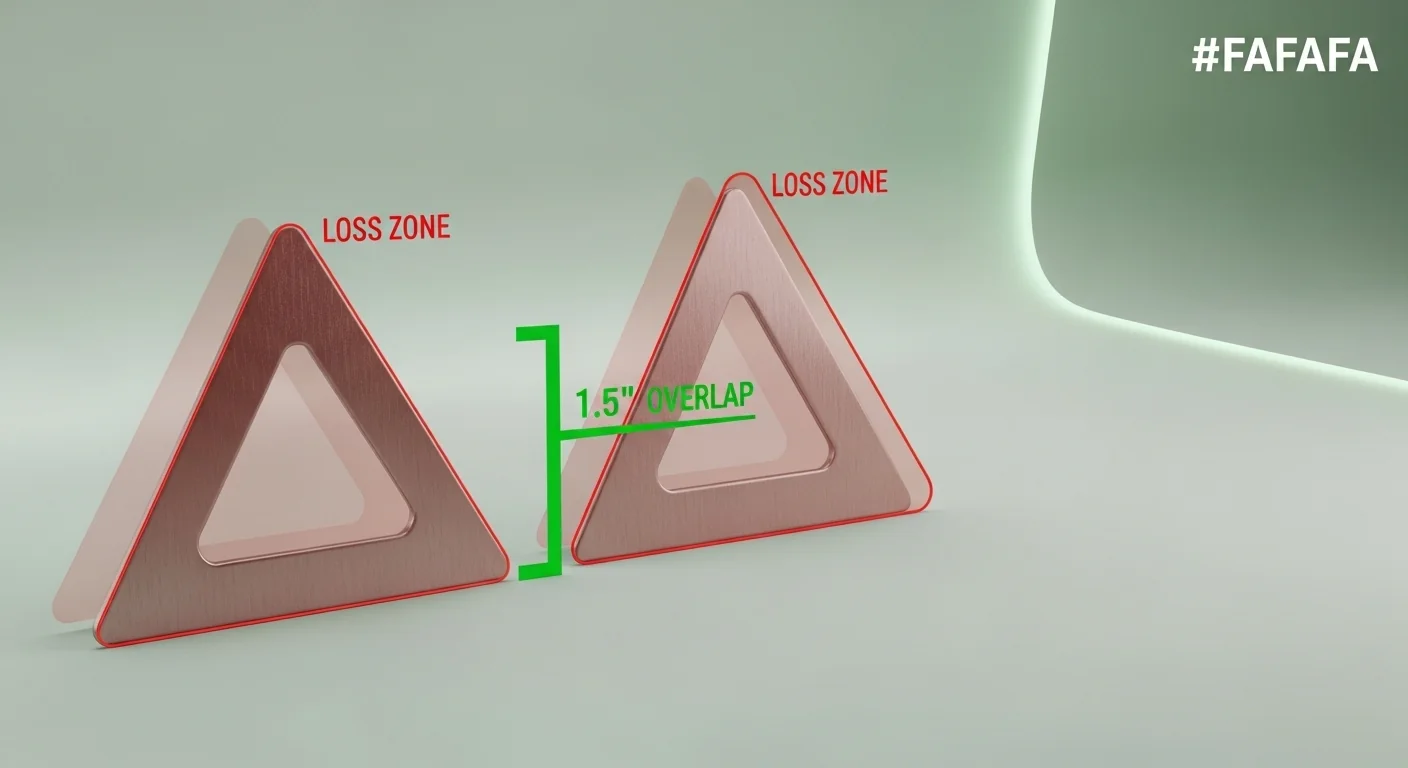
Spacing cultivator sweeps by their rated blade width does not produce 100% soil coverage. Sweep blades are delta-shaped triangles. The cutting edges taper toward the tips, and that taper means the outermost portion of each sweep fails to fully sever weed roots. The result is a narrow strip of uncut soil running the length of every shank gap, and weeds in that strip emerge unharmed to stripe your field. This failure is predictable, measurable, and entirely preventable with correct center-to-center spacing math.
This cultivator sweep overlap calculator computes three values: center-to-center shank spacing, effective sweep cut width after accounting for blade taper, and the overlap between adjacent sweeps. It also flags whether your configuration falls below the 1.5-inch minimum safe overlap threshold. What it does not do is predict weed pressure, account for soil moisture conditions, or replace a tape measure in the shop before you bolt up hardware.
After running your numbers, you will know whether your current shank count and sweep width combination produces safe coverage, marginal coverage that warrants concern, or a confirmed gap that will generate weed escape strips in the field.
Use the Tool

Cultivator Sweep Overlap Calculator
Before entering values, have your toolbar width measured tip-to-tip in inches, your intended shank count, and the full blade width of your sweep in inches. If you are configuring a row-crop pass, have your row spacing ready as well. All measurements should be in inches. If your toolbar width is only known in feet, multiply by 12 before entering. For related field equipment calibration work, the boom sprayer calibration calculator covers a similar precision-setup workflow for liquid application.
Quick Start (60 Seconds)
- Total Toolbar Width: Measure the full working width of the cultivator frame in inches, from the outermost shank position on the left to the outermost on the right. Do not use the transport width.
- Number of Shanks / S-Tines: Enter the total number of shanks you intend to mount, not the total the toolbar is capable of holding. Must be a whole number, minimum 2.
- Sweep Blade Width: Enter the rated blade width printed on the sweep packaging or catalog sheet, in inches. Common sizes: 4, 5, 6, 7, 9, 11, 13 inches. Do not measure an installed worn sweep for this value.
- Row Spacing (optional): If this is a row-crop pass, enter the in-row spacing in inches (example: 30 for 30-inch corn rows). Leave blank for broadcast field cultivation.
- Watch the overlap output: Any result below 1.5 inches triggers a caution or failure. A negative overlap value means you have a gap, not an overlap at all.
- Use the reference table: The results panel generates a scenario table for shank counts above and below your entry. Scan adjacent rows to find the minimum shank count that achieves safe overlap.
- Do not round inputs: Enter fractional toolbar widths if your toolbar is, for instance, 119.5 inches. Rounding up inflates spacing and can push an already-marginal setup into failure.
Inputs and Outputs (What Each Field Means)
| Field Name | Unit | What It Measures | Common Entry Mistake | Safe Entry Guidance |
|---|---|---|---|---|
| Total Toolbar Width | inches | The full working width of the cultivator frame from the first shank position to the last | Entering transport width or total frame width including headstock sections that carry no shanks | Measure between the outermost intended shank mount points, not the structural ends of the beam. Valid range: 12 to 600 inches. |
| Number of Shanks / S-Tines | count (whole number) | The total number of shank assemblies to be mounted on the toolbar for this pass | Entering the toolbar’s maximum capacity rather than the intended configuration | Count only the shanks you plan to install. Must be 2 or greater. Fractional entries are rejected. |
| Sweep Blade Width | inches | The rated tip-to-tip cutting width of the sweep blade as specified by the manufacturer | Measuring a worn or installed sweep rather than using the catalog specification; mixing metric and imperial values | Use the catalog or packaging value for a new sweep. Valid range: 2 to 24 inches. |
| Row Spacing | inches (optional) | Center-to-center crop row spacing for row-crop cultivation passes | Entering row spacing in feet; leaving this field populated when running a broadcast pass | Clear this field entirely when not cultivating in established rows. Valid range: 6 to 120 inches. |
| Center-to-Center Spacing (output) | inches | The calculated distance between adjacent shank centerlines based on your toolbar width and shank count | Treating this as the blade-edge distance rather than the centerline distance | Compare this value directly against your sweep blade width. If spacing exceeds blade width, you have a gap. |
| Effective Cut Width (output) | inches | The actual cutting width of one sweep after subtracting the 20% taper loss at the blade edges | Assuming rated width equals cut width and skipping this adjustment in manual setups | Use this value, not the rated width, when estimating actual field coverage per pass. |
| Sweep Overlap (output) | inches | The distance by which adjacent sweep cutting paths overlap. A negative value means a gap exists between sweeps. | Treating a small positive overlap as safe without checking the 1.5-inch threshold | Minimum acceptable value is 1.5 inches. Values between 0 and 1.5 are flagged as marginal. |
| Coverage Score (output) | percent of toolbar width | The total effective cut area as a percentage of the full toolbar width, using effective cut width per shank | Confusing a high coverage percentage with adequate overlap. Coverage can appear high while individual gaps still exist between shanks. | Use coverage as a secondary check. Overlap is the primary safety metric. |
Precision field spacing is a recurring theme across tractor implements. The seed drill calibration calculator covers a parallel discipline: matching seed placement intervals to your intended plant population without gaps or bunching.
Worked Examples (Real Numbers)
Example 1: The Classic Weed-Stripe Setup (120-inch Toolbar, 17 Shanks, 7-inch Sweeps)
- Toolbar Width: 120 inches
- Shanks: 17
- Sweep Blade Width: 7 inches
Spacing: 120 / (17 – 1) = 7.50 inches. Effective Cut: 7 × 0.80 = 5.60 inches. Overlap: 7 – 7.50 = -0.50 inches.
Result: 0.50-inch gap between every pair of sweeps. Weed Escape Strip confirmed.
Mounting 17 sweeps rated at 7 inches on a 120-inch bar feels like it should work. The math says otherwise. Every shank gap leaves half an inch of uncut soil. Weeds in those strips grow undisturbed, and at cultivation speed, the strips are perfectly uniform, which makes them highly visible at crop canopy closure.
Example 2: Marginal Overlap That Looks Fine on Paper (120-inch Toolbar, 20 Shanks, 7-inch Sweeps)
- Toolbar Width: 120 inches
- Shanks: 20
- Sweep Blade Width: 7 inches
Spacing: 120 / (20 – 1) = 6.32 inches. Effective Cut: 7 × 0.80 = 5.60 inches. Overlap: 7 – 6.32 = 0.68 inches.
Result: 0.68-inch overlap. Below the 1.5-inch safe threshold. Caution status.
Adding three shanks over Example 1 eliminates the gap on paper, but the 0.68-inch overlap sits well below the safe minimum. In cloddy or compacted soils, the delta-blade taper effectively pushes soil laterally rather than cutting cleanly at the edges, and that thin overlap vanishes. This setup will produce intermittent weed escape in adverse conditions.
Example 3: Safe Setup Confirmed (144-inch Toolbar, 21 Shanks, 9-inch Sweeps)
- Toolbar Width: 144 inches
- Shanks: 21
- Sweep Blade Width: 9 inches
Spacing: 144 / (21 – 1) = 7.20 inches. Effective Cut: 9 × 0.80 = 7.20 inches. Overlap: 9 – 7.20 = 1.80 inches.
Result: 1.80-inch overlap. Exceeds the 1.5-inch threshold. Safe coverage confirmed.
The 9-inch sweep compensates for the wider spacing that comes with a 144-inch toolbar at 21 shanks. The 1.80-inch overlap provides a buffer that accommodates minor blade wear and soil irregularity without creating weed escape strips.
Reference Table (Fast Lookup)
The table below shows calculated spacing, effective cut, and overlap for a 7-inch sweep blade on a 120-inch toolbar at shank counts from 14 to 24. The “Derived Coverage” column is computed from the effective cut width, not the rated blade width, making it a realistic rather than theoretical figure.
| Shanks | Spacing (in.) | Sweep Overlap (in.) | Effective Cut (in.) | Derived Coverage | Status |
|---|---|---|---|---|---|
| 14 | 9.23 | -2.23 | 5.60 | 65.3% | Gap |
| 15 | 8.57 | -1.57 | 5.60 | 70.0% | Gap |
| 16 | 8.00 | -1.00 | 5.60 | 74.7% | Gap |
| 17 | 7.50 | -0.50 | 5.60 | 79.3% | Gap |
| 18 | 7.06 | -0.06 | 5.60 | 84.0% | Gap |
| 19 | 6.67 | 0.33 | 5.60 | 88.7% | Marginal |
| 20 | 6.32 | 0.68 | 5.60 | 93.3% | Marginal |
| 21 | 6.00 | 1.00 | 5.60 | 98.0% | Marginal |
| 22 | 5.71 | 1.29 | 5.60 | 100.0% | Marginal |
| 23 | 5.45 | 1.55 | 5.60 | 100.0% | Safe |
| 24 | 5.22 | 1.78 | 5.60 | 100.0% | Safe |
Note: Safe status requires overlap of 1.5 inches or greater. Derived Coverage is capped at 100% because additional shanks beyond full coverage represent redundant passes, not extended width. For this toolbar-and-sweep combination, 23 shanks is the minimum safe shank count.
How the Calculation Works (Formula + Assumptions)
Show the calculation steps
Step 1: Center-to-Center Shank Spacing
With N shanks mounted on a toolbar, there are N minus 1 gaps between shank centerlines. Spacing distributes the total toolbar width equally across those gaps.
Spacing = ToolbarWidth / (Shanks - 1)
Result is in inches. Round to two decimal places for practical use. Do not round intermediate results before computing overlap.
Step 2: Effective Cut Width
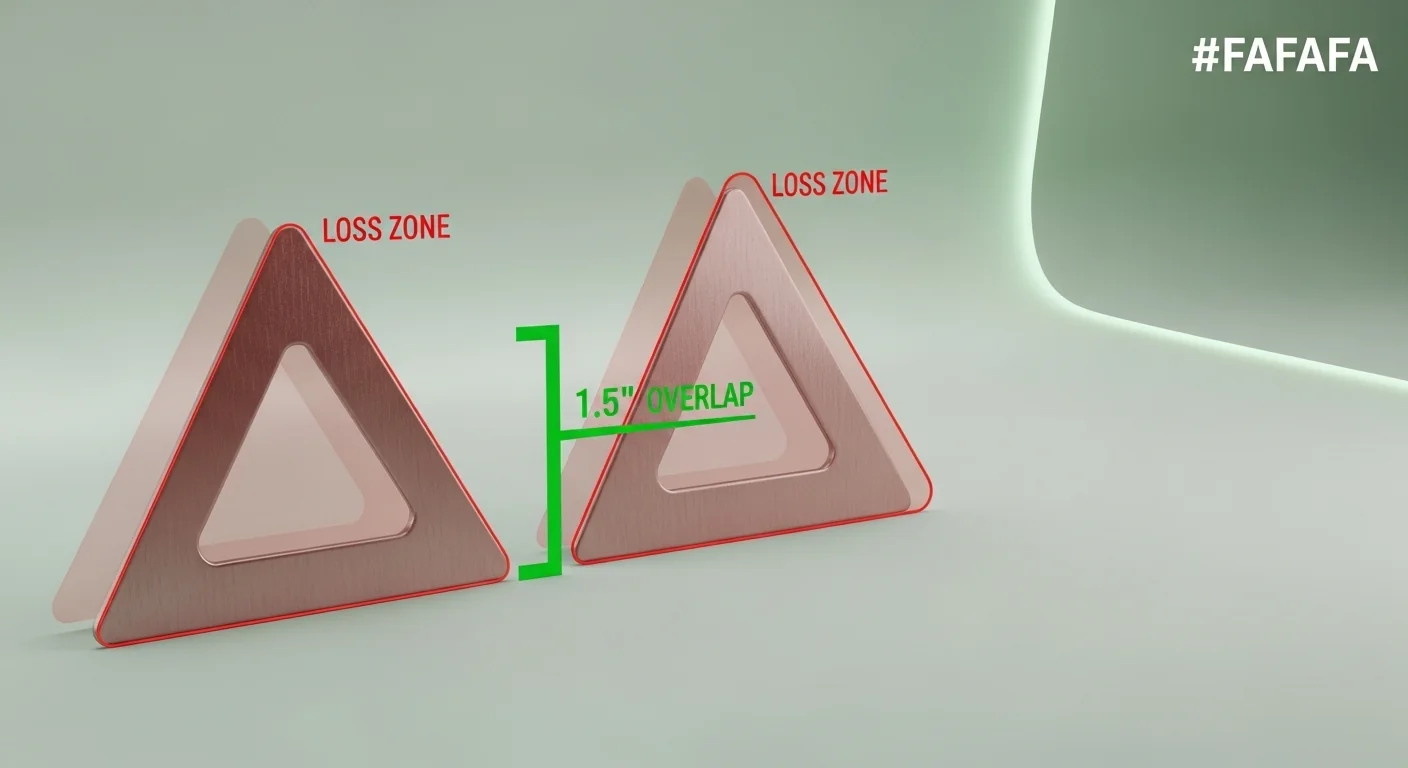
A sweep blade is a symmetrical triangle (delta shape). The outer 10% of each edge tapers to a point and does not maintain full cutting depth into the soil. Combined left and right taper removes 20% of the rated width.
EffectiveCut = SweepWidth * 0.80
This is the realistic per-shank cutting width used for coverage calculations. The rated catalog width is used for overlap calculations, not the effective cut, because the physical blade still occupies that dimension laterally.
Step 3: Sweep Overlap
Overlap is the difference between the rated sweep blade width and the center-to-center spacing. A positive value means blades pass through overlapping soil. A negative value means a gap exists between sweep paths.
Overlap = SweepWidth - Spacing
Step 4: Pass/Fail Threshold
The 1.5-inch minimum is the safe lower bound for overlap. Below this, the taper zone of one blade no longer reliably covers the taper zone of the adjacent blade, and a functional cutting gap appears between shanks.
If Overlap < 1.5 inches: Weed Escape Strip Warning triggered
Step 5: Coverage Score
Total effective coverage computes the ratio of cumulative effective cut area to toolbar width. Values can nominally exceed 100% when shanks are very close together, but this is capped at 100% since no additional field width is covered.
Coverage = min(100, (Shanks * EffectiveCut / ToolbarWidth) * 100)
Rounding rule for coverage: one decimal place. Coverage is a secondary metric only. High coverage does not guarantee absence of weed escape strips if individual overlap values are below 1.5 inches.
Assumptions and Limits
- The 20% effective-cut reduction is an industry-standard approximation for standard delta-shaped cultivator sweeps. Heavier spade or shovel-style sweeps may have a smaller taper loss, but no sweep achieves 100% of its rated width in effective soil cut.
- The formula assumes equal spacing across all shanks on a single-row toolbar. Multi-gang toolbars or offset dual-row configurations require separate per-gang calculations.
- Shanks are assumed to be aligned in a single plane perpendicular to the direction of travel. Angled gang sections invalidate the simple spacing formula.
- The 1.5-inch overlap threshold is a conservative field planning value. Loose, sandy soils may tolerate slightly less; high-residue or cloddy clay fields may require more to maintain consistent coverage.
- Forward speed is not included in this calculation. Higher travel speeds can reduce the lateral soil throw from sweep edges, effectively reducing the functional cutting width below the 80% estimate used here. The tool assumes a typical cultivation speed of 4 to 6 mph.
- This tool applies to new or near-new sweeps. Worn sweeps have a reduced effective width. A sweep worn to 70% of its original width should be treated as a narrower blade for planning purposes.
- Row-crop alignment analysis assumes uniform, equally-spaced rows and a single pass. Skip-row or twin-row configurations require layout math outside this tool’s scope.
- Toolbar width must be the active shank span, not the structural frame length. Including frame sections that carry no shanks will produce spacing values that are too wide and overlap values that are falsely low.
Standards, Safety Checks, and “Secret Sauce” Warnings
Critical Warnings
- Rated width is not cut width. A 7-inch sweep does not cut 7 inches of soil. The delta-blade taper reduces effective cut to approximately 5.6 inches. Planning shank spacing on the rated number without applying this correction virtually guarantees weed escape strips at certain shank counts.
- Overlap below 1.5 inches is unreliable in field conditions. A 0.5-inch or 1.0-inch calculated overlap provides no practical buffer for minor misalignment, blade flex under load, or forward speed above 5 mph. Results in this range will produce inconsistent coverage across variable soil conditions.
- A positive overlap number does not mean safe coverage. Any overlap value between 0 and 1.5 inches falls in the marginal zone. This is the most common misread of cultivator spacing math, and it accounts for striped weed emergence in fields where the operator believed coverage was complete.
- Worn sweeps shrink the overlap margin. A sweep that started at 7 inches and has worn to 6 inches now requires recalculation. The existing shank count may produce a gap where it previously produced safe overlap.
Minimum Standards
- Minimum safe sweep overlap: 1.5 inches, measured as rated blade width minus center-to-center shank spacing.
- Effective cut factor: 0.80 (20% deduction from rated blade width). This is the conservative planning value for delta-shaped sweeps.
- Shank spacing formula: ToolbarWidth / (Shanks – 1). Do not divide by the shank count itself; that formula undercounts gaps and overestimates coverage.
- Minimum shank count for any toolbar: 2. A single shank produces no gap-to-gap spacing calculation and cannot be evaluated with this tool.
Competitor Trap: The majority of cultivator spacing guides on farming forums and equipment dealer sites suggest simply dividing toolbar width by sweep width to get shank count. This approach produces shank spacing equal to sweep width, which means zero overlap before the taper correction. After applying the 20% effective-cut reduction, the result is a guaranteed gap between every pair of sweeps. Following that advice on a 120-inch toolbar with 7-inch sweeps results in 17 shanks spaced at 7.5 inches, producing a confirmed weed-escape gap. The correct question is not “how many sweeps fit?”; it is “what is the minimum shank count that produces 1.5 inches of overlap with my blade width?”
Tillage implement standards share a common thread: the relationship between physical component dimensions and actual field performance is rarely 1-to-1. The disc harrow weight-per-blade calculator addresses the same category of problem for disc gangs, where blade weight distribution governs soil penetration the way sweep overlap governs cultivation coverage.
Common Mistakes and Fixes
Mistake: Using Rated Blade Width as the Coverage Width
Operators configure shanks to space sweeps exactly at their rated width, assuming blade-to-blade coverage with no gaps. This ignores the triangular taper at both blade edges, which reduces the effective cutting width to roughly 80% of the rated value. Two adjacent sweeps spaced at their rated width are not touching at the ground level where the taper zones begin.
Fix: Compute effective cut width as rated width times 0.80, and use the overlap formula to verify that adjacent sweeps exceed the 1.5-inch minimum, not that they merely touch.
Mistake: Dividing Toolbar Width by Shank Count Instead of Gaps
The spacing formula divides toolbar width by the number of gaps between shanks, which equals shank count minus 1. Dividing by shank count instead is a common arithmetic error that produces spacing values that are too small, making the setup appear safer than it actually is. On a 120-inch bar with 17 shanks, dividing by 17 gives 7.06 inches rather than the correct 7.50 inches.
Fix: Always divide toolbar width by (Shanks – 1), never by Shanks. The first shank sits at position zero; the last sits at the toolbar width. The distance is divided into N-1 equal gaps.
Mistake: Ignoring Forward Speed as a Coverage Factor
Sweep cutting width is not purely a static geometry question. At higher forward speeds, the lateral soil throw from the sweep edges decreases, and the effective cutting width narrows below even the 80% estimate. Operators who calibrate at 4 mph and then run at 7 mph may see weed escape strips appear on setups that previously worked. The tractor ground speed calculator can help verify actual travel speed against the speed your cultivator was configured for.
Fix: Run field cultivation passes at a consistent, moderate speed. If weed escape strips appear on a setup the calculator confirms as safe, reduce forward speed before changing shank count.
Mistake: Treating Row-Crop Coverage as Equivalent to Broadcast Coverage
For row-crop cultivation, shank spacing must divide evenly into row spacing or the cultivator will not consistently place sweeps between crop rows. A shank spacing of 6.32 inches on 30-inch rows means shanks land at 6.32, 12.64, 18.96, and 25.28 inches from each row centerline, with none landing at the midpoint of the next row. Coverage between rows is uneven, and some weed zones receive extra passes while others receive none.
Fix: Adjust shank count until the calculator produces a spacing that divides into your row spacing within 0.25 inches. The row-crop advisory in the results panel flags this alignment issue automatically.
Mistake: Calculating Spacing for New Sweeps Without Accounting for Wear Replacement
A configuration with 1.6 inches of overlap using new 7-inch sweeps provides only a 0.1-inch safety margin above the minimum. After those sweeps wear down to 6.5 inches, the same shank count produces only 1.1 inches of overlap, dropping below the safe threshold mid-season without any visible sign of a problem at the toolbar level.
Fix: Design your setup for a target overlap of 2 inches or more to maintain safe coverage throughout the sweep service life. Run the calculator with the worn sweep width you expect at end-of-season to confirm that the setup stays above threshold.
Next Steps in Your Workflow
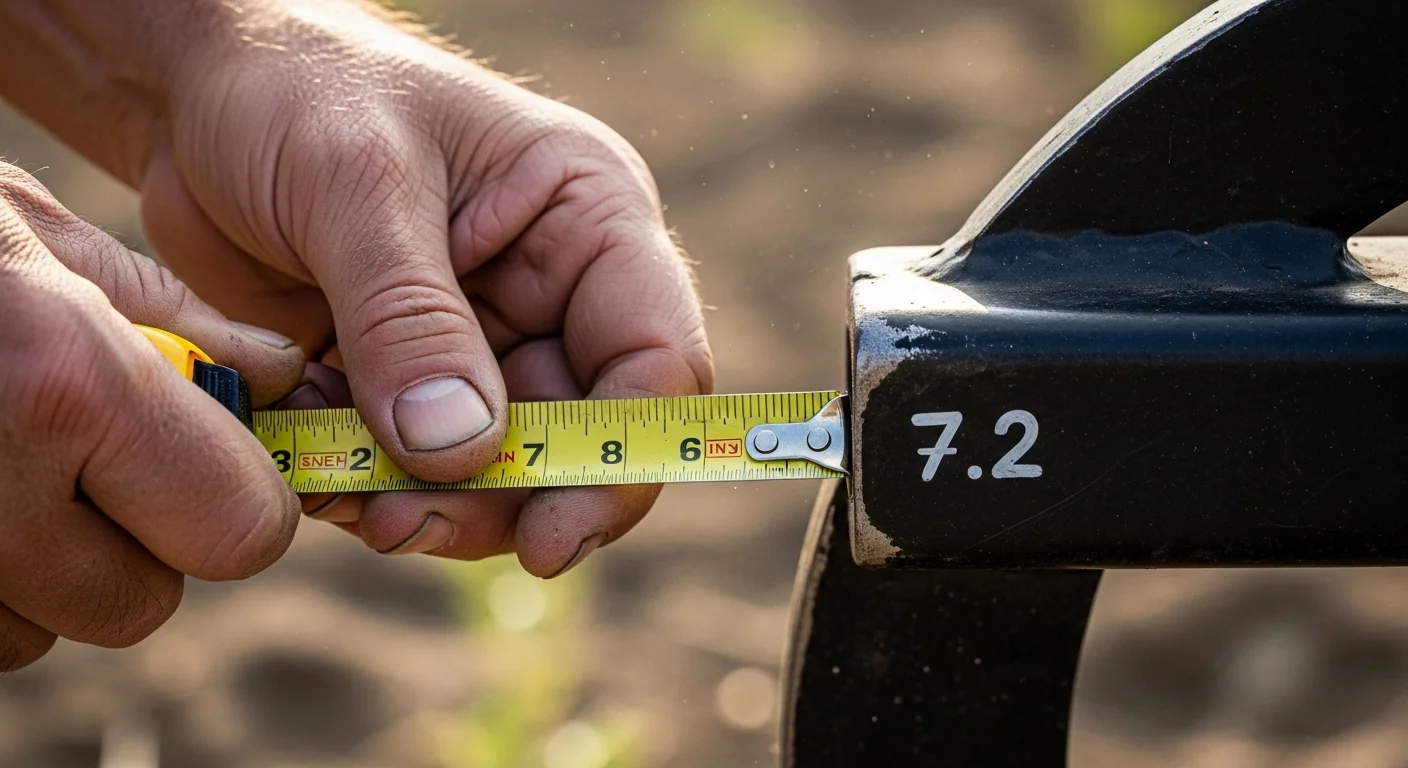
Once the calculator confirms a safe overlap configuration, translate the numbers into physical hardware before going to the field. Mark the calculated center-to-center spacing on your toolbar using a tape measure and a paint pen. Mount one shank, measure to the next mount point, and install the second shank before measuring again rather than pre-marking all positions at once. Accumulated measurement error across a 20-shank toolbar can shift end shanks by a half inch or more from the calculated position. After installation, lay the toolbar flat on sawhorses and check sweep-to-sweep clearance visually. You should see consistent overlap at adjacent blade edges with no visible gaps when viewed straight down the toolbar.
With spacing confirmed, verify that your tractor has sufficient hydraulic capacity to maintain consistent cultivation depth under load. Shallow cultivation depth reduces effective sweep soil engagement and can make a marginal overlap setup perform worse than calculated. The 3-point hitch lift capacity calculator helps confirm whether your tractor can carry the implement weight at working depth across the full toolbar width. If you are also evaluating power requirements for the tillage pass, the subsoiler HP requirements tool provides a reference framework for soil resistance and draft force that carries over to field cultivator planning.
FAQ
What is a weed escape strip in cultivator setup?
A weed escape strip is a narrow band of uncut soil that runs parallel to the direction of travel between adjacent cultivator shanks. It forms when the spacing between shanks exceeds the effective cutting width of the sweep blades. Because sweep blades are triangular, their edges taper and stop cutting before the rated width, leaving a strip where weed roots survive the pass undisturbed.
What is the minimum safe overlap for cultivator sweeps?
The minimum recommended overlap between adjacent cultivator sweeps is 1.5 inches, measured as rated sweep blade width minus center-to-center shank spacing. This threshold accounts for blade taper at the edges and provides a buffer for minor field irregularities. Overlaps between 0 and 1.5 inches are flagged as marginal because they are likely to fail under adverse soil or speed conditions.
Why does the effective cut width use 80% of the rated sweep width?
Cultivator sweep blades are delta-shaped triangles. The outer edges taper toward the blade tips rather than maintaining a consistent cutting angle. The taper zone on each edge contributes roughly 10% of the total rated width, for a combined loss of 20%. Multiplying rated width by 0.80 gives the realistic soil-cutting width used in coverage calculations. This factor applies to standard delta sweeps; heavier shovel-style blades may vary.
Can I use this calculator for a multi-gang toolbar?
This calculator handles single-toolbar layouts with equally spaced shanks in a single row. For multi-gang toolbars where shanks are staggered across two or three rows, calculate the effective shank spacing for each gang separately. The overlap logic is the same, but the inputs per gang will differ from the full-toolbar totals. Using combined shank count and full toolbar width for a staggered gang setup will produce incorrect spacing values.
Does sweep wear change the overlap calculation?
Yes. As sweeps wear, their rated width decreases. A 7-inch sweep that has worn to 6 inches requires a new overlap calculation. The shank spacing (controlled by your toolbar layout) does not change with wear, so reduced blade width directly reduces overlap. A setup that started with 1.8 inches of safe overlap may drop below the 1.5-inch threshold after a season of use without any visible change to the toolbar configuration.
How does forward speed affect cultivator sweep coverage?
Forward speed affects the lateral throw of soil from the sweep cutting edges. At higher speeds, soil displacement is directed more forward than sideways, which narrows the functional cutting width below the 80% estimate this calculator uses. A setup calculated as safe at 4 to 5 mph may produce marginal coverage at 7 mph or above. This tool assumes a moderate cultivation speed and does not include a speed correction factor.
Conclusion
The cultivator sweep overlap calculator turns a common shop-floor assumption, that sweep count times sweep width equals toolbar coverage, into a measurable, verifiable number. The core insight is not complicated: delta-shaped blades taper at the edges, and that taper creates a functional gap between shanks that the rated width does not account for. The 1.5-inch overlap threshold exists precisely because that gap is otherwise invisible until the crop is up and weed stripes are visible across the field.
The single most important mistake to avoid is spacing shanks at exactly their sweep blade width. That produces a calculated overlap of zero, which becomes a real gap once taper loss is applied. Run your numbers before mounting hardware, target an overlap of 2 inches or more to maintain safe coverage through blade wear, and verify spacing with a tape measure in the shop. For operators who want to cross-check additional implement dimensions before heading to the field, the rotary cutter size calculator covers a related category of implement-to-tractor sizing that follows similar clearance and coverage logic.