
Center Pivot Irrigation Calculator
Application Depth & Speed Setting — Powered by field-proven agronomy math
| Speed Setting (%) | Rotation Time (hrs) | App. Depth (in) | Status |
|---|---|---|---|
| Calculate to generate your personalized reference table. | |||
How This Calculator Works
Acres = (π × Length²) ÷ 43,560
Example: 1,320 ft pivot → 125.66 acres
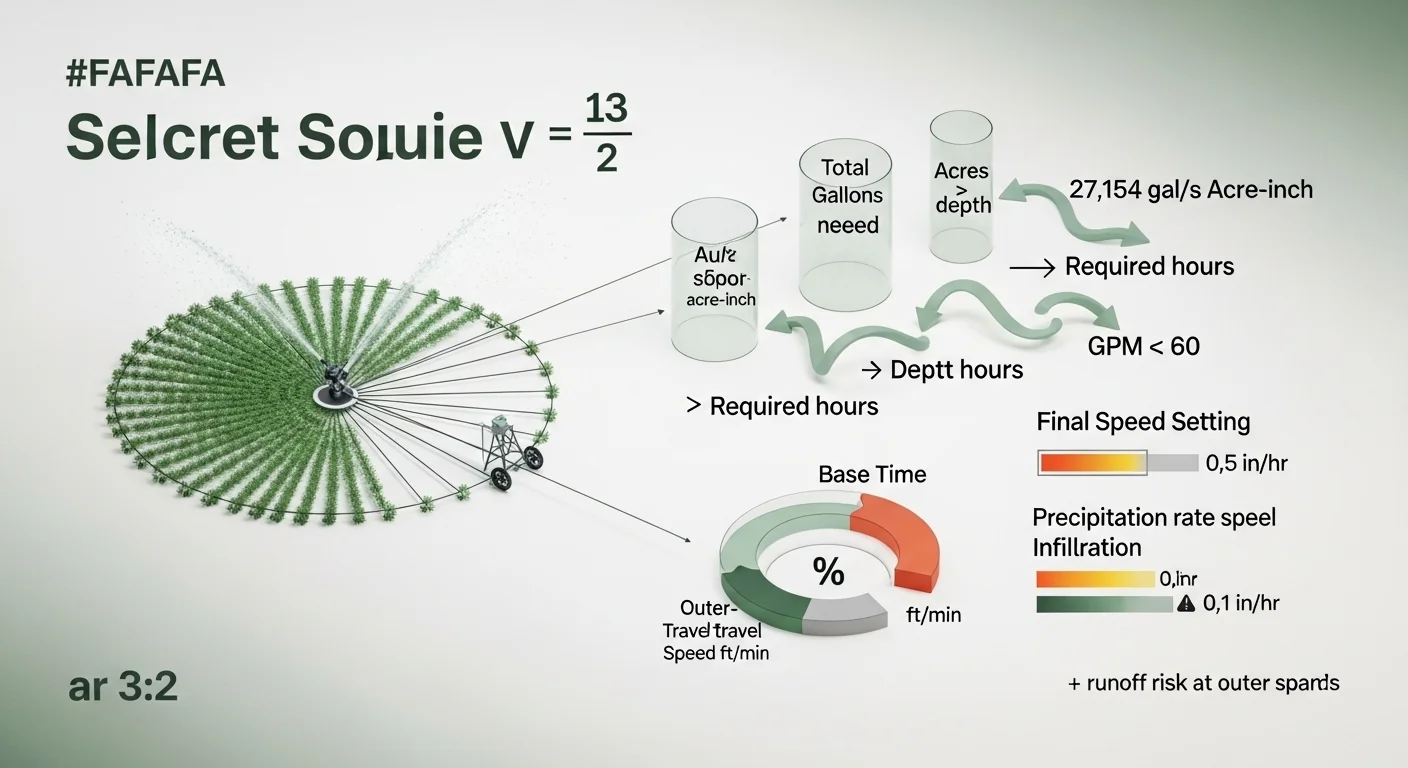
Hours = (Acres × Depth × 27,154) ÷ (GPM × 60)
Speed% = (BaseTime ÷ RequiredHours) × 100
If Speed% < 10%: deep percolation & runoff risk triggered.
EndSpeed = (2π × Length) ÷ (ReqHours × 60) ft/min
Typical safe range: 1.0–5.0 ft/min. Above 6 ft/min risks under-application.
PrecipRate = (GPM × 60 × Depth) ÷ (Acres × 27,154)
Compare to your soil’s infiltration rate. Exceeding it causes runoff.
Assumptions & Limits
- End-gun not included: This calculator assumes no end gun. End guns extend irrigated area and change water application density — account for this separately.
- 1 acre-inch = 27,154 gallons (exact USDA conversion used throughout).
- Uniform flow assumed: Nozzle packages are assumed to deliver uniform distribution across the span. In practice, outer nozzles must be sized larger to compensate for greater arc travel.
- Soil infiltration baseline: Sandy loam ≈ 0.5 in/hr, Clay loam ≈ 0.25 in/hr, Heavy clay ≈ 0.1 in/hr. Warnings trigger when your system’s precipitation rate exceeds these.
- Efficiency losses not modeled: Evaporation, wind drift, and canopy interception are not included. Actual field efficiency is typically 80–90% for low-pressure pivot systems.
- Valid ranges: Length 100–5,280 ft | GPM 50–10,000 | Depth 0.1–6 in | Base Time 6–200 hrs.
- Speed setting % applies to timer-based controller systems (Lindsay, Valmont, Reinke standard). Variable speed drive (VSD) systems use different control logic.
Setting a center pivot’s timer percentage is not as simple as reading an application chart. The outer tower of a center pivot travels a far greater arc distance than any inner span, which means it dumps proportionally more water per unit time over the ground beneath it. At slow speed settings, this can overwhelm a soil’s infiltration capacity at the perimeter of the field long before the inner spans cause any concern. Most nozzle selection guides address distribution uniformity across the span; very few walk through the timing math that determines whether that water actually enters the soil.
This center pivot irrigation calculator computes four core outputs: irrigated acres, required rotation hours, recommended speed setting as a percentage of the base timer, and end-tower travel speed in feet per minute. It does not model nozzle wear, wind drift, canopy interception, or end-gun corrections. If your system flow rate is uncertain, confirm it at the pump before entering a value here; a mismatch between nameplate GPM and actual field delivery is one of the most common sources of irrigation error, and the irrigation pump sizing calculator can help verify whether your pump is rated correctly for your pivot’s acreage and target depth.
After running this calculator, you will know the exact timer percentage to enter on your pivot controller, whether that setting falls in the agronomically safe zone, and whether your precipitation rate risks runoff and fertilizer loss on your specific soil type.
Use the Tool
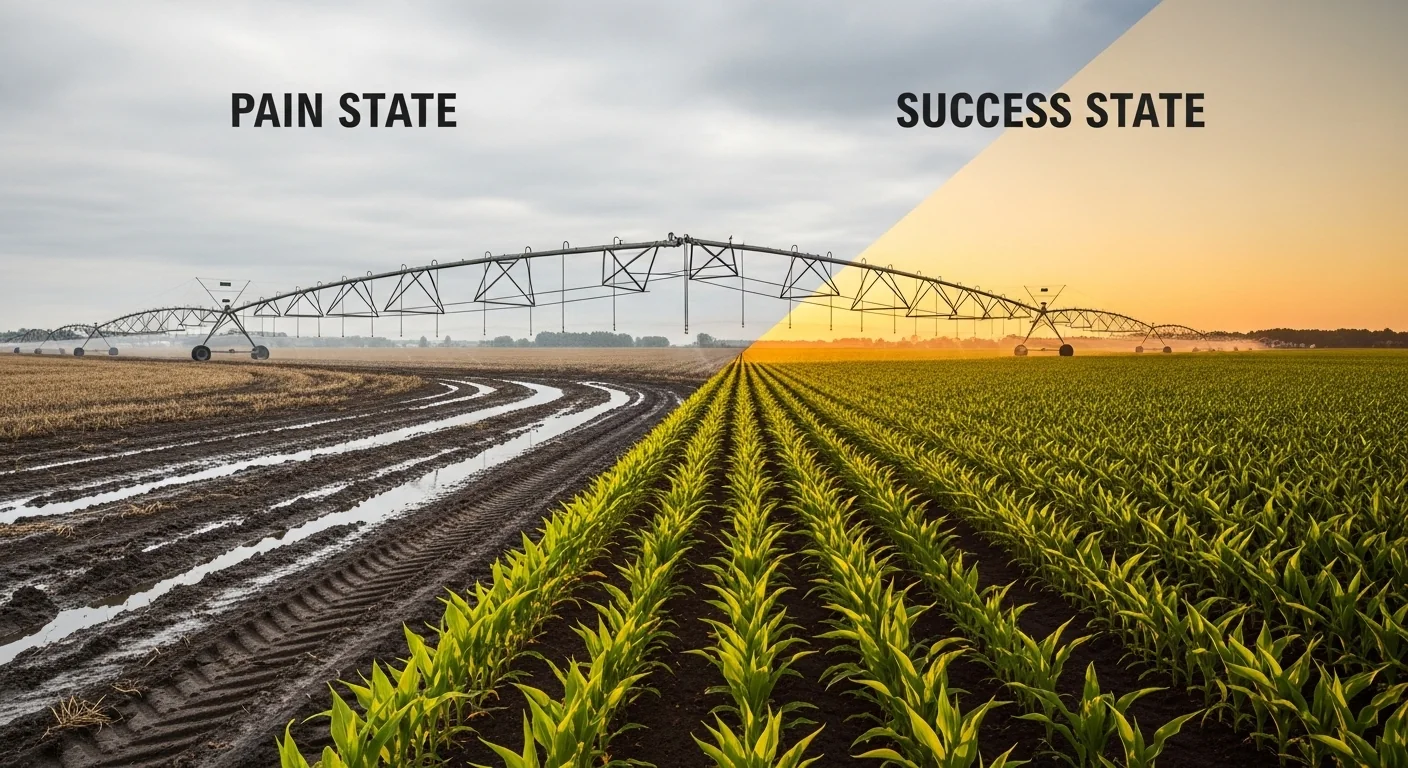
Before entering values, have the following ready: your pivot’s measured lateral length from the center point to the end-of-last-tower nozzle (not including the end gun), your pump’s confirmed flow rate in gallons per minute, your agronomist’s target application depth for this irrigation cycle, and the full-circle rotation time at 100% speed from your pivot controller’s spec sheet or the panel label. Enter all four values, then click Calculate.
Quick Start (60 Seconds)
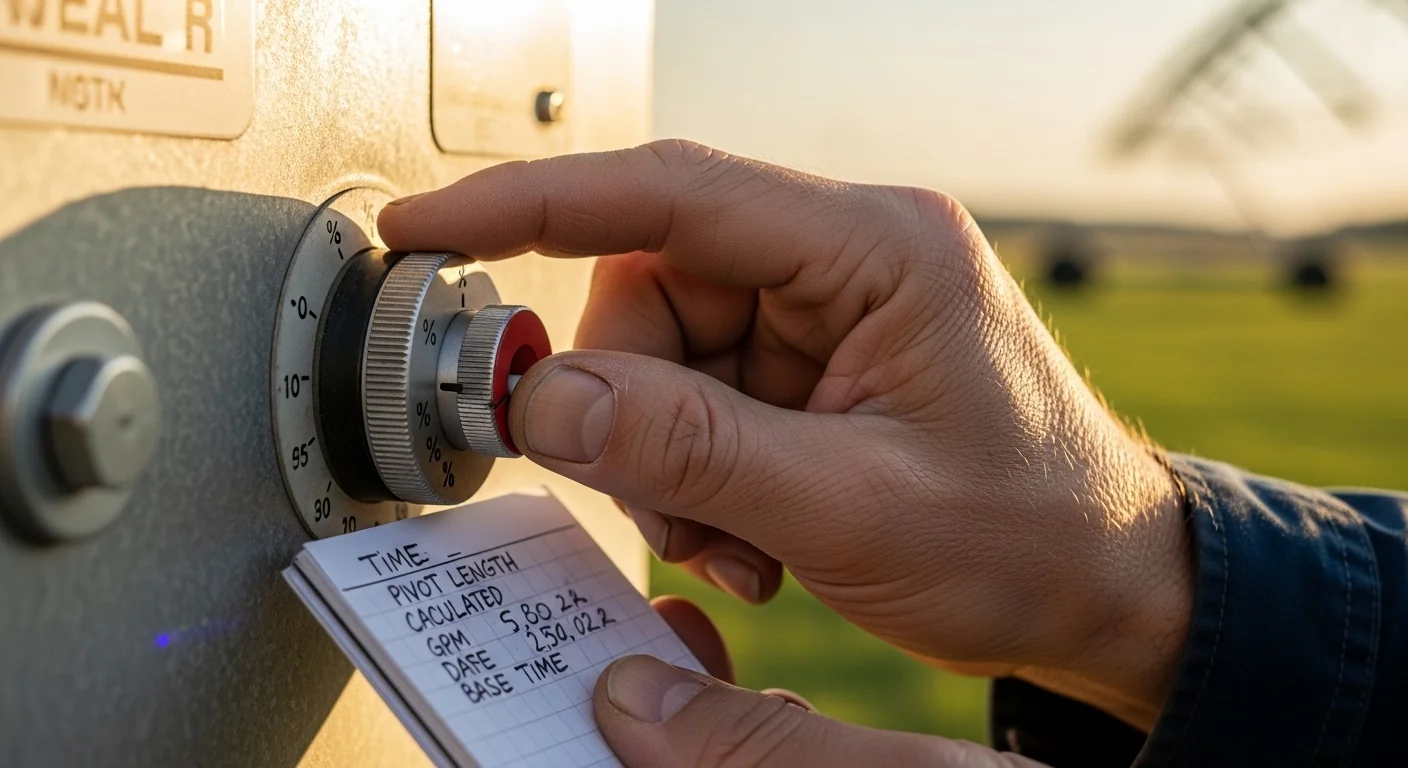
- Pivot Total Length: Measure from the center pivot point to the last nozzle on the final tower, in feet. Do not include the end gun’s wetted radius. A standard quarter-mile pivot is 1,320 ft; a half-mile is 2,640 ft.
- System Flow Rate (GPM): Use the pump’s measured output at operating pressure, not the nameplate capacity. Oversizing this number will cause the calculator to recommend a faster speed than your system can actually sustain, resulting in under-application.
- Desired Application Depth (inches): Enter in decimal inches. Half an inch is 0.5, not 0.50 or 1/2. Typical agronomic recommendations range from 0.5 to 2.0 inches per pass depending on crop stage and soil type.
- Base 100% Speed Rotation Time (hours): This is the full-circle time when the controller is set to 100%. Find it on your pivot panel door or in the owner’s manual. It is fixed for your machine and does not change unless the end gun is toggled or a span is added.
- Units reminder: All lengths must be in feet, flow in gallons per minute, depth in inches, and time in hours. Converting acres or minutes into wrong units is the single most common entry error.
- Do not average: If your pump flow fluctuates with irrigation events from other fields on the same well, use the minimum sustained GPM, not the average. Under-application at peak demand is safer than over-application assumptions.
- Speed setting output: The result is a percentage. Enter that exact value into your pivot’s timer controller. On most Lindsay, Valmont, and Reinke systems, this percentage corresponds directly to the timer dial or digital entry.
Inputs and Outputs (What Each Field Means)
| Field | Unit | What It Represents | Common Mistake | Safe Entry Guidance |
|---|---|---|---|---|
| Pivot Total Length | feet (ft) | Radius of the irrigated circle; determines total acreage and end-tower arc travel distance | Including the end-gun wetted radius or measuring to the end of the pipe instead of the last nozzle | 100 to 5,280 ft; if unsure, measure with a rangefinder or GPS; GPS is preferred for fields with curved runs |
| System Flow Rate | gallons per minute (GPM) | Total water volume delivered to the pivot per minute; the supply side of the equation | Using nameplate pump capacity instead of measured field output; pressure drop and friction loss reduce actual delivery significantly | 50 to 10,000 GPM; if flow has not been metered recently, consider a flow test before irrigating a high-value crop |
| Desired Application Depth | inches (in) | Target soil-water addition per pivot pass; should match the crop’s water deficit at time of irrigation | Setting depth based on a calendar schedule instead of soil moisture data; applying more than the field’s available water capacity in one pass | 0.1 to 6.0 in; values above 2.0 in/pass carry deep percolation risk in most soils; consult an agronomist for preplant loading events |
| Base 100% Speed Rotation Time | hours (hrs) | The manufacturer-specified full-circle time at maximum timer speed; the fixed denominator for all speed-setting math | Confusing the 100% base time with a previously used timer setting; base time is a machine constant, not a target | 6 to 200 hrs; most quarter-mile pivots range from 18 to 72 hrs at 100%; consult the panel sticker or controller documentation |
| Output: Speed Setting | percent (%) | Timer percentage to enter on the pivot controller to achieve the target application depth | Rounding to the nearest 10% instead of using the computed value; each 5% increment can shift depth by several tenths of an inch | Values below 10% are flagged as high-risk; optimal operational window is 25% to 90% for most crop-soil combinations |
| Output: Acres Irrigated | acres | Total land area swept by one full rotation; derived from pivot length using the circle area formula | Assuming a partial-circle or wiper-arm configuration without adjusting the length input | For partial-circle pivots, you must calculate the angular fraction of the full circle and scale the acreage result manually |
| Output: Required Rotation Hours | hours | Total time one full pass must take to deliver the target depth at the given flow rate | Confusing this with the base time; these are different values and the ratio between them determines the speed setting | Very long rotation times (above 500 hrs) at low speed settings often signal a mismatch between GPM and field size |
| Output: End-Tower Speed | ft/min | Linear travel speed of the outermost tower; determines the concentration of water delivery at the field perimeter | Ignoring this value entirely; operators often check percent only and never verify outer-tower travel speed against soil intake rate | Typical safe range is 1.0 to 5.0 ft/min; above 6.0 ft/min, pattern distortion and nozzle performance degradation become factors |
| Output: Precipitation Rate | in/hr | Average application rate across the whole irrigated area; compared internally against soil infiltration thresholds | Treating this as a uniform rate across the field; actual rate at the outer spans is considerably higher per nozzle unit area | Values below 0.1 in/hr are generally safe for any soil texture; above 0.5 in/hr, sandy loam runoff is possible in compacted conditions |
Worked Examples (Real Numbers)
Scenario 1: Standard Quarter-Mile Corn Pivot, Optimal Zone
- Pivot Total Length: 1,320 ft
- System Flow Rate: 850 GPM
- Desired Application Depth: 1.0 inch
- Base 100% Speed Rotation Time: 36 hours
Acres = (3.14159 x 1,320 x 1,320) / 43,560 = 125.7 acres
Required Hours = (125.7 x 1.0 x 27,154) / (850 x 60) = 3,413,878 / 51,000 = 66.9 hours
Speed Setting = (36 / 66.9) x 100 = 53.8%
Result: Set the pivot controller to 53.8%. At this setting, the 1.0-inch application is delivered in a single 66.9-hour rotation, falling squarely in the efficient operating zone. End-tower speed calculates to approximately 2.1 ft/min, well within safe nozzle performance range.
Scenario 2: Half-Mile Pivot, Underpowered Pump, Heavy Preplant Load
- Pivot Total Length: 2,640 ft
- System Flow Rate: 900 GPM
- Desired Application Depth: 2.0 inches
- Base 100% Speed Rotation Time: 60 hours
Acres = (3.14159 x 2,640 x 2,640) / 43,560 = 502.7 acres
Required Hours = (502.7 x 2.0 x 27,154) / (900 x 60) = 27,306,516 / 54,000 = 505.7 hours
Speed Setting = (60 / 505.7) x 100 = 11.9%
Result: A speed setting of 11.9% places this configuration in the slow-speed warning zone (10% to 25%). With a half-mile pivot sweeping over 500 acres, a 900 GPM pump simply cannot deliver 2.0 inches in a reasonable number of rotations. Splitting into two 1.0-inch passes or increasing system flow is the agronomically safer path.
Scenario 3: Short Pivot, High Flow Rate, Depth Near Maximum Speed
- Pivot Total Length: 1,000 ft
- System Flow Rate: 1,200 GPM
- Desired Application Depth: 2.0 inches
- Base 100% Speed Rotation Time: 48 hours
Acres = (3.14159 x 1,000 x 1,000) / 43,560 = 72.3 acres
Required Hours = (72.3 x 2.0 x 27,154) / (1,200 x 60) = 3,927,184 / 72,000 = 54.5 hours
Speed Setting = (48 / 54.5) x 100 = 88.1%
Result: An 88.1% speed setting sits in the upper caution zone (75% to 90%). At near-maximum speed, pattern uniformity degrades on many nozzle packages designed for mid-range timer settings. Verify that nozzle selection charts support this rotation speed before running the pivot. Reducing target depth to 1.5 inches would lower the speed setting to 66.1%, well within the optimal band.
Reference Table (Fast Lookup)
The following table is computed for a representative 1,320 ft pivot with 850 GPM and a 36-hour base rotation time. It shows how speed setting, rotation duration, outer-tower speed, and water volume change across application depths from 0.5 to 3.0 inches. Use it as a quick sanity check against your calculator output before entering a value into the controller.
| App. Depth (in) | Required Rotation (hrs) | Speed Setting (%) | Gal per Acre | End-Tower Speed (ft/min) | Operational Status |
|---|---|---|---|---|---|
| 0.50 | 33.5 | 107.5 | 13,577 | 4.13 | Exceeds pivot capacity at 100% base time |
| 0.75 | 50.2 | 71.7 | 20,366 | 2.75 | Optimal |
| 1.00 | 66.9 | 53.8 | 27,154 | 2.07 | Optimal |
| 1.25 | 83.6 | 43.1 | 33,943 | 1.65 | Optimal |
| 1.50 | 100.4 | 35.9 | 40,731 | 1.38 | Optimal |
| 2.00 | 133.8 | 26.9 | 54,308 | 1.03 | Optimal (lower boundary) |
| 2.50 | 167.3 | 21.5 | 67,885 | 0.83 | Slow speed warning |
| 3.00 | 200.7 | 17.9 | 81,462 | 0.69 | Slow speed warning |
At a depth of 0.5 inches, the required rotation is shorter than the 100% base time, meaning this system physically cannot apply that little water in a single slow-speed pass without exceeding maximum speed. This is not a defect; it simply means the pump is oversized for a very light irrigation event on this acreage. Split applications or temporarily throttling the pump are operational workarounds.
How the Calculation Works (Formula + Assumptions)
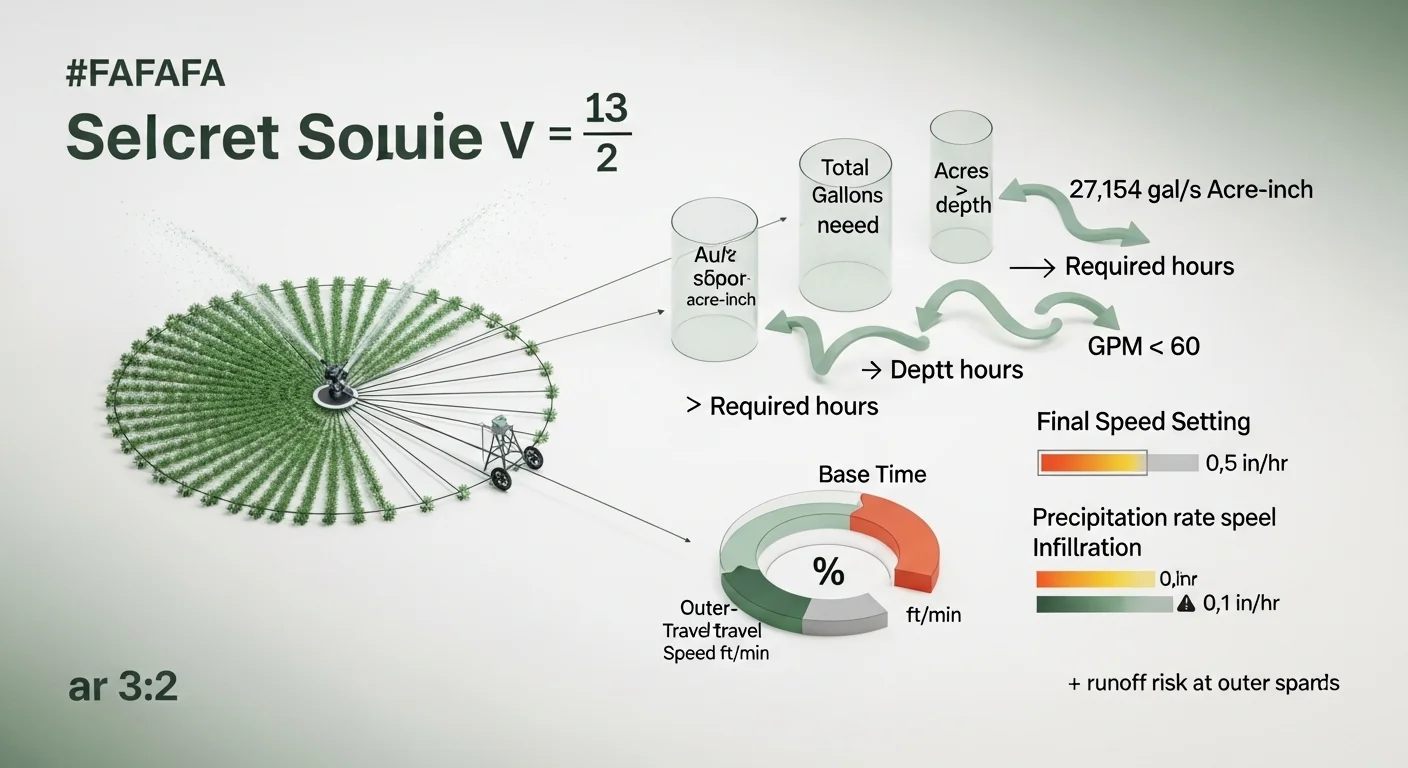
Show the calculation steps
Step 1: Compute irrigated acres
The pivot sweeps a full circle. Its area equals pi times the radius squared, divided by 43,560 square feet per acre.
Acres = (3.14159 x Length x Length) / 43,560
Example: A 1,320 ft pivot yields (3.14159 x 1,320 x 1,320) / 43,560 = 125.7 acres. Round to one decimal place for display.
Step 2: Compute required rotation hours
One acre-inch of water equals exactly 27,154 gallons (USDA conversion). Multiplying acres by depth gives total acre-inches needed. Multiplying by 27,154 converts to total gallons. Dividing by the pump output per hour (GPM x 60) gives the required time in hours.
ReqHours = (Acres x Depth x 27,154) / (GPM x 60)
Round to one decimal place. This is the rotation time needed for the pivot to make a complete circle and deposit the target depth.
Step 3: Compute speed setting
The pivot controller timer runs as a ratio of its maximum speed. If a pivot completes a circle in 36 hours at 100% and you need 66.9 hours, you set the timer to (36 / 66.9) x 100 = 53.8%.
SpeedPct = (BaseTime / ReqHours) x 100
Round to one decimal place. Values below 10% trigger the deep percolation warning. Values above 100% indicate the target depth cannot be achieved in one pass at any timer setting.
Step 4: Compute end-tower speed
The outer tower travels the full circumference (2 x pi x Length) in the required number of hours. Dividing by (ReqHours x 60) converts to feet per minute.
EndSpeed = (2 x pi x Length) / (ReqHours x 60)
Round to two decimal places. Compare against your nozzle package’s design speed range.
Step 5: Compute precipitation rate
The application rate in inches per hour represents how quickly water falls over the irrigated area.
PrecipRate = (GPM x 60 x Depth) / (Acres x 27,154)
This figure is compared against two soil infiltration thresholds: 0.5 in/hr for sandy loam and 0.1 in/hr for heavy clay. Exceeding either threshold triggers the corresponding runoff warning.
Assumptions and Limits
- Full-circle assumption: The calculator assumes the pivot completes 360-degree rotations. Partial-circle or wiper-arm configurations require manual adjustment of the acreage and rotation-time values.
- No end-gun correction: An end gun extends the wetted radius and adds acreage. The calculator does not model this. If an end gun is active, the actual irrigated area is larger and the effective application depth per unit area changes. Enter the end gun’s arc-weighted additional acreage manually or use a dedicated end-gun area calculator.
- Uniform nozzle distribution assumed: The formula treats all gallons as uniformly distributed across the swept area. In practice, outer nozzles must deliver more water per unit time to maintain uniform depth. This is a nozzle-package design problem, not a timer problem.
- Soil infiltration baselines are conservative defaults: Sandy loam at 0.5 in/hr and heavy clay at 0.1 in/hr represent broad textural class averages. Compacted soils, soils with a restrictive layer, and slopes below 2% will have significantly lower effective infiltration rates.
- Pump GPM is treated as constant: The calculation assumes steady-state flow throughout the rotation. Variable-speed drives, pressure-triggered flow changes from end-gun activation, and pressure losses from elevation changes are not modeled.
- Efficiency losses excluded: Wind drift, evaporation during application, and canopy interception are not deducted from the applied depth. Field efficiency for low-pressure pivot systems typically ranges from 80% to 92%. The actual amount reaching the root zone may be 8% to 20% less than the nominal application depth.
- Timer system compatibility: Speed setting outputs correspond to percent-timer controller systems common on Lindsay, Valmont, and Reinke pivots. Variable-frequency drive systems and GPS-guided speed control platforms use different control inputs and cannot use this percentage directly.
Standards, Safety Checks, and “Secret Sauce” Warnings
Critical Warnings
- Speed below 10% triggers deep percolation and nutrient waste: When the required rotation takes so long that the timer must be set below 10%, the water is being applied far faster than the soil can store it in the root zone. Nitrates, potassium, and applied micronutrients move below the root zone with the percolating water, directly into tile lines or groundwater. This is not a theoretical risk; it is a measurable, repeatable loss event. Split the application into two or more passes before accepting a sub-10% speed setting.
- Outer-tower runoff is not visible from the pivot panel: The precipitation rate calculated by this tool is a field-average figure. The actual application intensity at the outer spans is concentrated into a narrower moving strip. On sloped or compacted ground, the outer 15% to 20% of the field can be generating surface runoff even when the field-average rate appears safe. Use the soil infiltration rate calculator to measure actual soil intake before assuming the average rate is representative.
- High speed settings risk pattern distortion on some nozzle packages: Nozzle tables from Nelson and Senninger are indexed to specific end-tower travel speed ranges. Running above the nozzle’s design speed shortens the application time per point, which can cause dry streaks and non-uniform coverage even when the total volume applied is correct.
- Precipitation rate exceeding clay infiltration (0.1 in/hr) affects clay and silty soils: A rate that is safe for sandy loam can generate standing water and downstream field movement on clay soils. The matched precipitation rate calculator can help verify whether your nozzle package is matched to your soil’s actual intake.
Minimum Standards
- Speed settings between 25% and 75% represent the agronomic sweet spot for most crop-soil systems. They allow adequate water contact time while keeping the outer tower moving fast enough to prevent channeling and compaction.
- Application depth per pass should generally not exceed the soil profile’s available water-holding capacity. Applying more than the soil can hold guarantees deep percolation losses regardless of timer setting.
- End-tower speed should be verified against the nozzle package’s rated operating range before each season change or depth adjustment exceeding 0.5 inches.
Competitor Trap: Many center pivot guides and even some manufacturer-supplied charts present application depth tables indexed only to GPM and pivot length, with the speed setting treated as an afterthought. This skips the infiltration-rate comparison entirely. A system that looks “correct” by those tables can still be generating surface runoff at the outer spans on heavy soils, washing fertilizer into field drainage, and leaving the inner spans under-applied due to compaction from repeated wheel-track loading at slow speeds. The timing math and the soil intake math must be done together, not separately.
Common Mistakes and Fixes
Mistake: Using Nameplate Pump Capacity Instead of Measured Flow
Rate
A pump rated for 1,000 GPM at a given impeller speed may deliver only 820 GPM at actual operating pressure, particularly if friction losses in the mainline are significant or if the pump is aging. Entering the nameplate figure produces a speed setting that is too high, meaning the pivot moves faster than it should and under-applies water. Fix: meter the actual flow at the pivot inlet with a flow sensor or perform a timed volume test before entering GPM.
Mistake: Confusing Required Rotation Hours with Base Time
The base time is a fixed machine constant; the required rotation hours are the calculation output. Operators who transpose these two values get a speed setting that is the mathematical reciprocal of the correct value, producing wildly wrong results. Fix: label both values clearly in your records. Base time comes from the panel or manual; required hours come from the calculator.
Mistake: Setting Depth Based on Calendar Rather Than Soil Moisture
Irrigation scheduling by calendar date ignores actual evapotranspiration demand and soil water storage status. This routinely causes over-application at the beginning of the season and under-application during peak demand. The field capacity soil moisture calculator can help determine the actual soil water deficit before each irrigation event, so the target depth reflects real crop need rather than a fixed schedule.
Mistake: Ignoring the End Gun When Calculating Acres
An end gun can add 15% to 25% to the total irrigated area depending on its throw radius and the angular sector it operates. Operators who calculate speed setting based only on the lateral length are underestimating the irrigated acreage, which means the calculator produces a slower speed setting than the system actually needs. Fix: either enter a corrected effective length that accounts for the end gun’s area contribution, or run the lateral-only calculation and adjust manually.
Mistake: Not Auditing Distribution Uniformity After Speed Changes
A change in timer percentage alters end-tower speed and the effective application time per nozzle. Nozzle selection is often done once at installation and never revisited. Over time, wear, pressure changes, and new depth targets can push the system outside the design speed envelope that the nozzle package was optimized for. The irrigation catch-can test calculator provides a structured method for measuring uniformity across the pivot’s span after any significant setting change.
Next Steps in Your Workflow
Once you have a confirmed speed setting, the next decision point is scheduling. How many days does the crop have before the next irrigation event is needed? That answer depends on daily evapotranspiration demand from your crop and climate data. Running the evapotranspiration calculator alongside this tool gives you the full picture: not just how to set the pivot, but when to start the next rotation based on actual water use. Together, these two inputs form the core of a data-driven irrigation schedule rather than a calendar-based one.
If you manage multiple irrigation zones or a mix of drip and overhead systems, the pivot depth and timing calculation is only one piece. Zone-to-zone scheduling coordination and making sure all systems are applying water at comparable rates across the farm can significantly reduce peak pump load. The sprinkler run time calculator covers scheduling for fixed-head systems using the same depth and precipitation rate logic, which simplifies coordination when both system types are operating from the same water source.
FAQ
What does the speed setting percentage actually control on a center pivot?
The percentage is a timer ratio. At 100%, the pivot completes its fastest full rotation in the base time listed on your controller. At 50%, it takes twice as long. Slowing the pivot gives more time for each nozzle to deposit water at every point along the arc, increasing application depth per pass. The percentage controls time, not flow rate; GPM stays constant regardless of the timer setting.
Why does my speed setting come out above 100%?
A result above 100% means the required rotation time is shorter than your pivot’s fastest full circle. In practical terms, the system is delivering water too quickly for the target depth to be applied in a single pass at any speed setting. Options include accepting a shallower application depth, running multiple passes, or reducing pump output if the system allows it.
How do I know if my soil’s infiltration rate is a problem?
The calculator flags your computed precipitation rate against two textural baselines: sandy loam at 0.5 in/hr and heavy clay at 0.1 in/hr. If your soil falls in between, use the warning as a prompt to verify with a field infiltration test, particularly at the outer third of the pivot where the risk is highest. Compaction from wheel track loading can reduce infiltration rate well below the baseline for your soil texture class.
Does this calculator work for partial-circle pivots?
The calculator assumes a full 360-degree rotation. For partial-circle or wiper-arm systems, the irrigated acreage is a fraction of the full circle, and the required rotation hours correspond to the arc sweep, not a full circle. You can adapt the output by entering a corrected effective rotation time that represents one full arc cycle of your system instead of the full-circle base time.
What is the 27,154 constant in the formula?
27,154 is the exact number of US gallons in one acre-inch of water (the amount of water required to cover one acre to a depth of one inch). This is the USDA’s standard conversion factor. Using 27,000 or 27,100 as a rounded substitute introduces a systematic calculation error of roughly 0.5%, which accumulates across large acreages and deep applications.
How does this calculator differ from charts in my nozzle manufacturer’s guide?
Nozzle charts from Nelson, Senninger, and similar manufacturers are designed around distribution uniformity and pressure-flow relationships at fixed end-tower speeds. They do not calculate timer percentage from target depth, GPM, and acreage. This calculator solves the timing problem; nozzle charts solve the pressure and orifice selection problem. Both are needed for a complete center pivot setup; neither replaces the other.
Conclusion
The single most important mistake to avoid is accepting a speed setting below 25% without first verifying that the soil can handle the resulting application intensity at the field perimeter. Splitting applications, reducing target depth per pass, or re-evaluating pump capacity are all preferable to running a slow pivot over a crop and watching fertilizer investment move into tile drainage. For operators looking to go further, the irrigation wire size calculator can help verify that control wiring is properly sized for the panel loads associated with multi-span pivot systems, particularly when upgrading to digital controllers or variable-speed drive panels.