
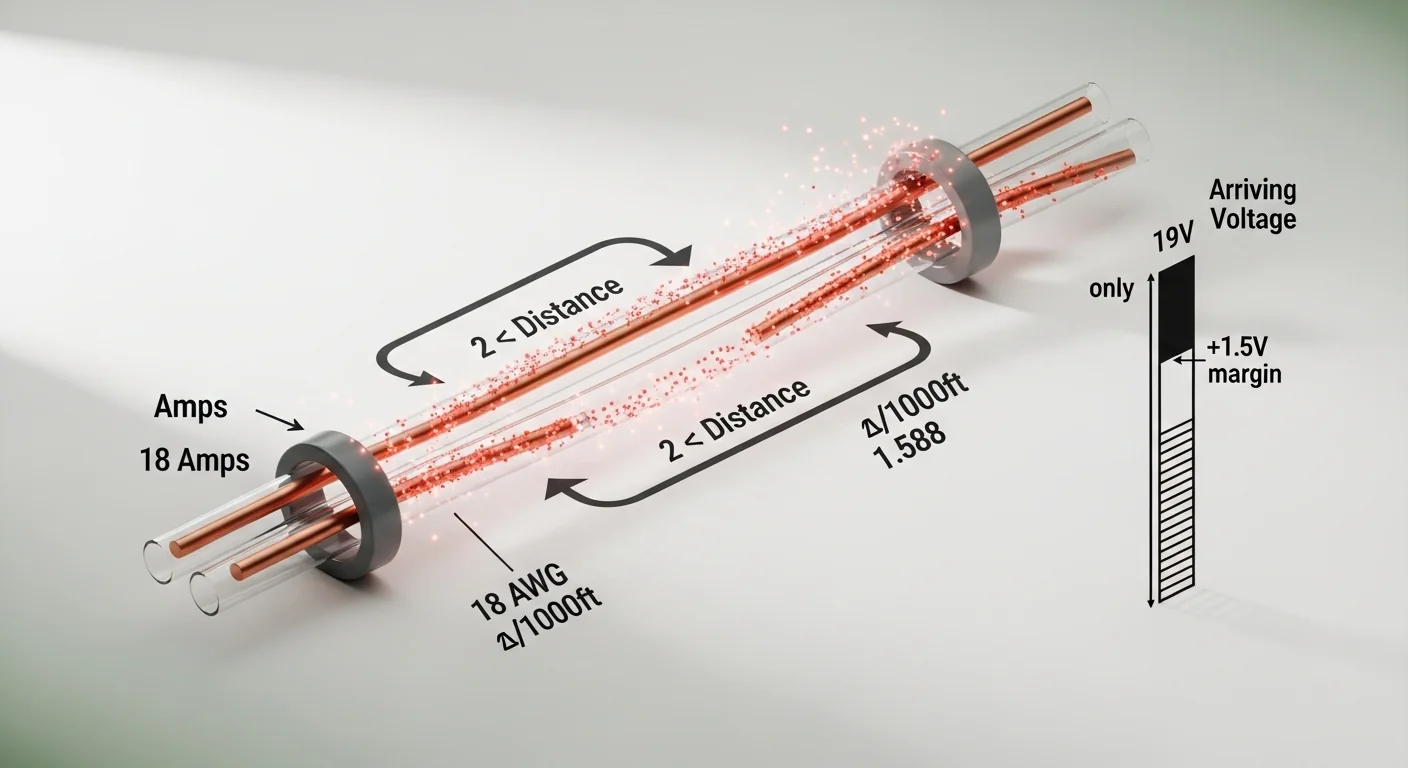
Voltage drop on an irrigation wire run is not a minor inconvenience. It is the hidden cause behind sprinkler valves that open on command but refuse to close, leaving zones running for hours or days. The physics are straightforward: every foot of wire and every gauge reduction adds resistance that strips usable voltage from the 24V AC signal before it reaches the solenoid. When the arriving voltage lands in a marginal band, the solenoid’s electromagnetic pull is strong enough to unlatch the valve but too weak to snap it shut against water pressure.
This irrigation wire size calculator applies the two-conductor voltage drop formula to each of the four standard direct-burial AWG gauges (18, 16, 14, and 12), then compares the computed valve voltage against a user-defined minimum operating threshold. The result is a clear minimum gauge recommendation, a visual voltage gauge, and a per-gauge pass/fail table. What the tool does not calculate: multi-valve circuits running simultaneously, splice or connector resistance, or derating for elevated ambient temperatures. Those adjustments are the user’s responsibility and are addressed in the Assumptions section below.
After running the calculation, you will know the thinnest AWG wire that safely delivers enough voltage to open and close your solenoid reliably. If no standard gauge passes at your distance, the tool will tell you that too, so you can plan for a satellite controller or secondary transformer instead of guessing.
Use the Tool
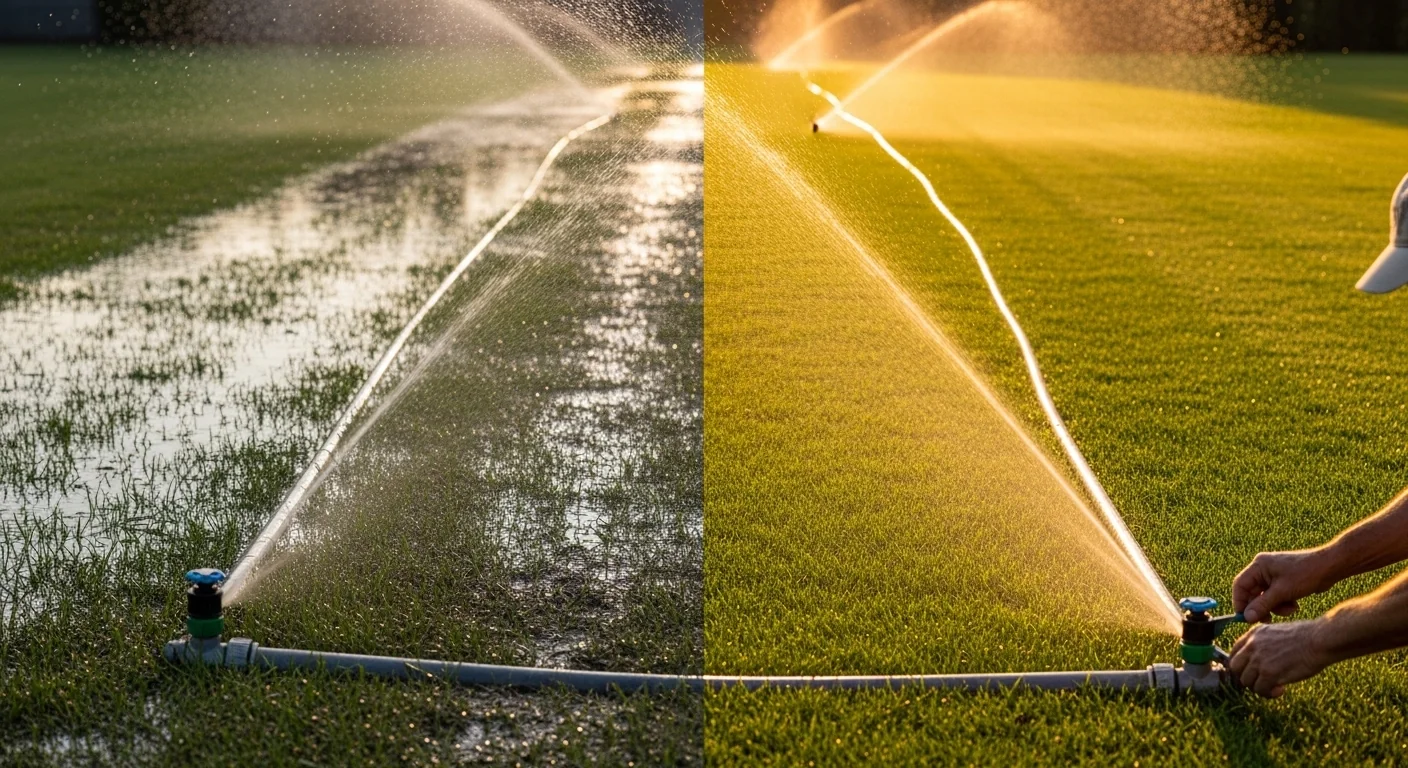
Sprinkler Wire Voltage Drop (AWG) Sizer
Find the minimum wire gauge to keep your irrigation solenoids snapping reliably shut — no flooding, no guessing.
| AWG | Ω / 1000 ft | Round-Trip Drop (V) | Voltage at Valve (V) | Status |
|---|
How This Calculator Works
The Voltage Drop Formula
Wire has electrical resistance. The longer or thinner the wire, the more voltage gets lost as heat before it ever reaches your valve solenoid. The standard formula for a two-conductor (round-trip) circuit is:
The factor of 2 accounts for current traveling to the valve and back to the controller.
The Pass / Fail Check
Why This Matters: The “Stuck Open” Solenoid Risk
An irrigation solenoid is an electromagnet. It needs enough voltage to generate the magnetic force to pull a plunger — and just as importantly, to release it and let water pressure snap the valve shut. At 17–18V, many solenoids can open weakly, but lack the force to close. The result: sprinklers that run indefinitely, flooding your yard, even after the controller turns them “off”.
Resistance values used (solid copper, direct burial):
Assumptions: Solid copper conductor, standard temperature (68°F / 20°C). Stranded wire adds ~2–5% more resistance. Results are per valve circuit — multi-zone common wire sizing may differ.
Assumptions & Limits
What this tool assumes:
• Wire material: solid annealed copper (standard irrigation wire)
• Temperature: 68°F (20°C) — resistance increases ~0.4%/°F above this
• Single zone: one valve active at a time on the evaluated wire run
• Resistance values per NEC / standard AWG tables
• Inrush (holding) current used — surge current at actuation is briefly higher
Limits — this tool does NOT account for:
• Multi-valve zones running simultaneously (add amp loads)
• Stranded vs. solid wire differences (~2–5% resistance variation)
• Wire connections, splices, or corroded terminal resistance
• Extreme ambient temperatures (>100°F or <32°F)
• Wire runs in conduit with derating factors
When in doubt: Size up one gauge. The cost difference between 18 AWG and 14 AWG spool is minimal; a flooded yard from a stuck-open valve is not.
Before you start, have three numbers ready: the one-way wire run length in feet (measure the actual trench path, not a straight-line estimate), the solenoid inrush current from your valve spec sheet (typically 0.35 A for residential valves), and your controller’s rated output voltage (most residential units output 24V AC). If your valve spec sheet lists a minimum operating voltage different from 19V, change that field too. If you are sizing wire for a sprinkler run-time system with multiple sequential zones, calculate each zone’s longest wire run independently.
Quick Start (60 Seconds)
- Distance to Furthest Valve (ft): Enter the one-way wire path length. This is not the distance from your controller to the valve as the crow flies; walk the planned trench route and add 10 ft for slack, depth entry, and connection tails.
- Solenoid Inrush Current (A): Default is 0.35 A, which covers most Hunter, Rain Bird, and Orbit residential solenoids. Commercial or high-flow valves often draw 0.5 A or more. Check the valve label or spec sheet.
- Controller Output Voltage (V AC): Standard residential controllers output 24V AC. Some commercial multi-decoder systems use different voltages. Do not guess; read the controller’s terminal label.
- Minimum Required Operating Voltage (V AC): This is the lowest voltage at which your specific solenoid opens AND closes. Most residential valves specify 19V AC. Using a higher value (e.g., 21V) adds a safety buffer and accounts for wire aging and splice resistance.
- Unit reminder: Distance is in feet, not meters. Amperage is in decimal amps (0.35, not 350 mA). Voltage is AC, not DC.
- Common input error: Entering the total wire spool length instead of the actual run length. If you bought a 500 ft spool and your zone is 200 ft away, enter 200.
- Click Calculate Wire Gauge only after all four fields contain valid numbers. The tool will not run on partial inputs.
Inputs and Outputs (What Each Field Means)
| Field | Unit | What It Means | Common Mistake | Safe Entry Guidance |
|---|---|---|---|---|
| Distance to Furthest Valve | feet (ft) | One-way length of the wire path from the controller terminal to the farthest valve on the zone circuit | Using straight-line distance instead of trench path; forgetting to add slack at each end | Measure the actual planned route; add 10 ft for depth drops and connection tails; 1 to 2000 ft range |
| Solenoid Inrush Current | amps (A) | The current the solenoid draws during operation, used in the voltage drop formula | Using 0.35 A for a commercial valve that actually draws 0.5 A or more; entering milliamps (mA) instead of amps | Check valve label or manufacturer spec sheet; 0.35 A is a conservative default for most residential valves |
| Controller Output Voltage | V AC | The AC voltage the irrigation controller outputs to the valve zone terminals | Entering DC voltage (battery backup voltage) instead of AC output; guessing 24V on a commercial decoder system | Read the terminal label on the controller; nearly all residential units are 24V AC; valid range 1 to 48V |
| Minimum Required Operating Voltage | V AC | The lowest voltage at which the solenoid will both open and close the valve reliably under normal water pressure | Using only the “open” voltage from a spec sheet; some valves open at 17V but require 19V to close under pressure | Use the manufacturer’s minimum operating voltage; default 19V is standard for Rain Bird, Hunter, Toro residential valves |
| Minimum AWG (output) | AWG (dimensionless) | The thinnest wire gauge (highest AWG number) that delivers adequate voltage to the valve; lower number = thicker wire | Confusing AWG direction: 18 AWG is thinner and has more resistance than 12 AWG; a lower number is always better | If output is “None,” no standard gauge passes at this distance; install a satellite controller or secondary transformer |
| Voltage at Valve (output) | V AC | Computed voltage arriving at the solenoid terminals after resistive losses through both conductors | Treating a passing result near the minimum as safely adequate; a 19.2V result leaves almost no margin for wire aging or poor splices | Aim for at least 1.5V above minimum; if margin is under 1.5V, the tool flags the result as marginal and recommends upsizing |
Worked Examples (Real Numbers)
Example 1: Standard Suburban Front Yard (150 ft run)
- Distance: 150 ft
- Solenoid Current: 0.35 A
- Controller Voltage: 24V AC
- Minimum Operating Voltage: 19V AC
Voltage drop on 18 AWG: (2 x 150 x 0.35 x 6.385) / 1000 = 0.670V
Voltage at valve: 24 – 0.670 = 23.33V AC
Result: 18 AWG passes with a 4.33V margin. Any of the four standard gauges will work at this distance. 18 AWG direct-burial irrigation wire is the economical and correct choice.
Example 2: Large Property Perimeter Run (750 ft run)
- Distance: 750 ft
- Solenoid Current: 0.35 A
- Controller Voltage: 24V AC
- Minimum Operating Voltage: 19V AC
Voltage drop on 18 AWG: (2 x 750 x 0.35 x 6.385) / 1000 = 3.352V
Voltage at valve: 24 – 3.352 = 20.65V AC (margin: 1.65V — flagged as marginal)
Voltage drop on 16 AWG: (2 x 750 x 0.35 x 4.016) / 1000 = 2.108V
Voltage at valve: 24 – 2.108 = 21.89V AC
Result: 18 AWG technically passes, but the 1.65V margin is thin. The tool flags this as marginal. At 750 ft, upgrading to 16 AWG costs a modest amount extra per linear foot and eliminates risk from wire aging, temperature, and splice resistance. 16 AWG is the recommended choice here.
Example 3: Acreage Zone, Controller at Far Corner (1200 ft run)
- Distance: 1200 ft
- Solenoid Current: 0.35 A
- Controller Voltage: 24V AC
- Minimum Operating Voltage: 19V AC
Voltage drop on 18 AWG: (2 x 1200 x 0.35 x 6.385) / 1000 = 5.363V
Voltage at valve: 24 – 5.363 = 18.64V AC (FAIL)
Voltage drop on 16 AWG: (2 x 1200 x 0.35 x 4.016) / 1000 = 3.373V
Voltage at valve: 24 – 3.373 = 20.63V AC
Result: 18 AWG fails; 16 AWG is the minimum viable gauge at 1200 ft. Installing 18 AWG here is the exact scenario that produces stuck-open valves. The valve opens at 18.6V but lacks enough magnetic force to close against line pressure, leaving the zone running indefinitely.
Reference Table (Fast Lookup)
Assumptions for all rows: 0.35 A solenoid current, 24V AC controller output, 19V AC minimum operating voltage, solid copper conductor at 68F. The “Min AWG” column is the derived output — the thinnest gauge that passes the voltage threshold at that distance.
| Run Length (ft) | 18 AWG Valve Voltage | 16 AWG Valve Voltage | 14 AWG Valve Voltage | 12 AWG Valve Voltage | Min AWG (derived) |
|---|---|---|---|---|---|
| 100 ft | 23.55V | 23.72V | 23.82V | 23.89V | 18 AWG |
| 200 ft | 23.11V | 23.44V | 23.65V | 23.78V | 18 AWG |
| 400 ft | 22.21V | 22.88V | 23.29V | 23.56V | 18 AWG |
| 600 ft | 21.32V | 22.31V | 22.94V | 23.33V | 18 AWG |
| 750 ft | 20.65V (marginal) | 21.89V | 22.67V | 23.17V | 16 AWG (rec.) |
| 1000 ft | 19.53V (marginal) | 21.19V | 22.23V | 22.89V | 16 AWG (rec.) |
| 1200 ft | 18.64V FAIL | 20.63V | 21.88V | 22.67V | 16 AWG |
| 1500 ft | 17.30V FAIL | 19.78V (marginal) | 21.35V | 22.33V | 14 AWG (rec.) |
| 1800 ft | 15.95V FAIL | 18.34V FAIL | 20.82V | 22.00V | 14 AWG |
| 2000 ft | 15.07V FAIL | 17.09V FAIL | 20.47V | 21.78V | 14 AWG |
How the Calculation Works (Formula + Assumptions)
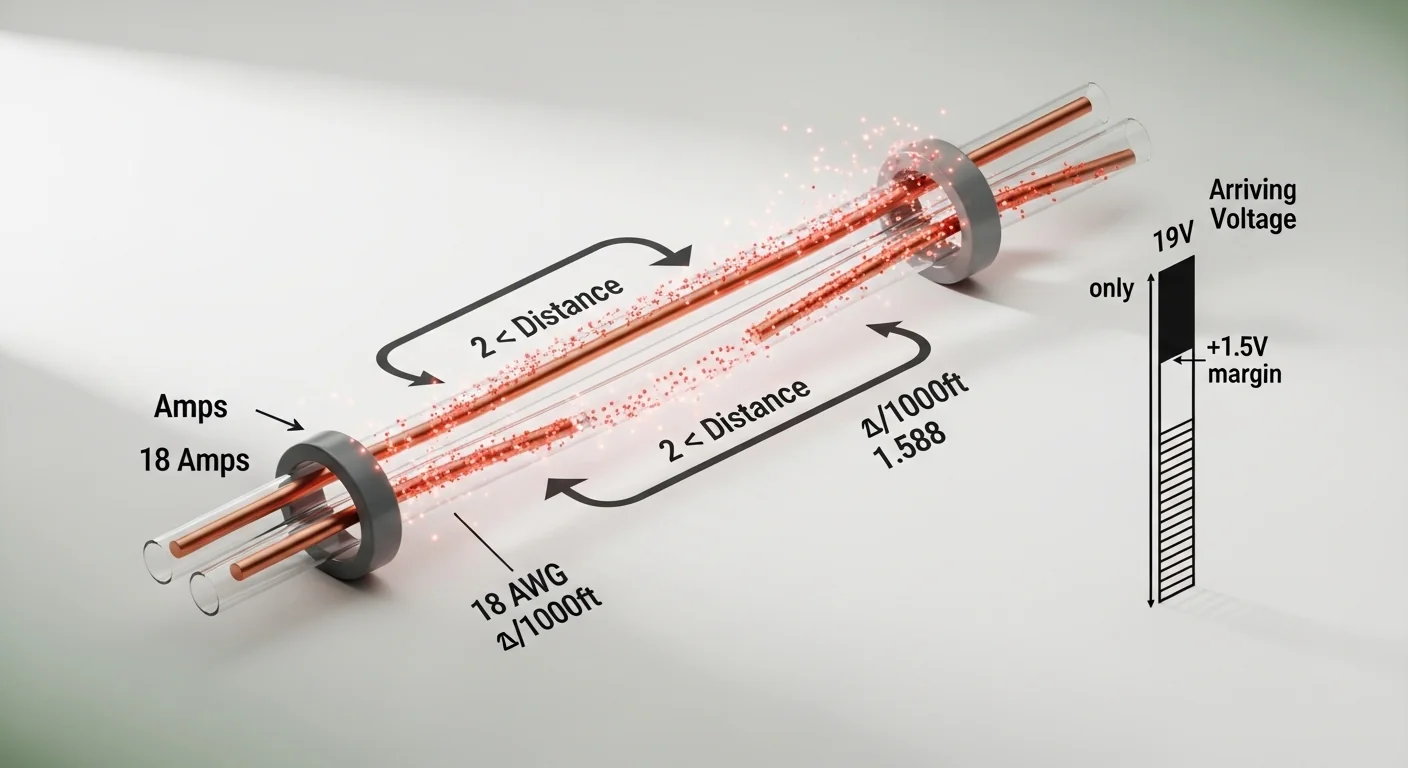
Show the calculation steps
Step 1: Determine maximum allowable voltage drop
Subtract the minimum required valve voltage from the controller output voltage. This is the total voltage budget the wire is allowed to consume:
Max Allowable Drop = Controller Voltage – Minimum Operating Voltage
Example: 24V – 19V = 5V
Step 2: Calculate round-trip voltage drop per gauge
The formula accounts for both conductors (out and return) by multiplying the distance by 2:
V_drop = (2 x Distance x Current x Resistance_per_1000ft) / 1000
Resistance values used (solid copper, 68F / 20C, per NEC and standard AWG tables):
- 18 AWG: 6.385 ohms per 1000 ft
- 16 AWG: 4.016 ohms per 1000 ft
- 14 AWG: 2.525 ohms per 1000 ft
- 12 AWG: 1.588 ohms per 1000 ft
Step 3: Compute voltage arriving at the valve
Voltage at Valve = Controller Voltage – V_drop
Step 4: Apply pass / fail and marginal threshold
A gauge passes if Voltage at Valve >= Minimum Operating Voltage. If the margin above minimum is less than 1.5V, the tool flags the result as marginal and recommends sizing up one gauge.
Rounding: Voltage drop values are displayed to three decimal places. The minimum AWG recommendation is determined before rounding.
Assumptions and Limits
- Wire material is solid annealed copper. Stranded irrigation wire of the same AWG has 2 to 5 ohm/1000ft higher resistance than solid, which means slightly more voltage drop than this tool shows.
- Ambient temperature is 68F (20C). Copper resistance increases approximately 0.4 ohms per 1000 ft for every 10F above this baseline, relevant for wire buried in hot climates or exposed conduit in direct sun.
- One valve is active per zone circuit at the time of calculation. Running multiple solenoids on a shared common wire increases total current draw and requires separate analysis.
- Splice and connector resistance is not included. A corroded wire nut or push-in connector can add 0.5 to 2 ohms per splice point, which is equivalent to adding 100 or more feet of 18 AWG wire to the effective resistance.
- The tool does not account for wire in conduit derating, which applies when multiple current-carrying conductors share a conduit and heat builds up collectively.
- The inrush current used is the holding (steady-state) current. The brief surge current at solenoid actuation is higher but transient and not normally the sizing constraint for 24V AC systems.
- Results apply per individual zone wire circuit. Multi-zone manifolds and common-wire sizing require accounting for the combined load at the controller terminal.
Standards, Safety Checks, and Warnings
Critical Warnings
- The stuck-open failure mode is not detectable by the controller. An irrigation controller sends a signal and considers its job done. It has no feedback mechanism to confirm the valve actually closed. A solenoid operating at marginal voltage will open the zone but fail to close it when commanded off. Water runs until someone physically inspects the yard or the water bill arrives.
- 17V to 18V is a deceptive gray zone. At these voltages, many solenoids produce enough magnetic pull to unlatch the valve plunger from its seat. Opening requires only overcoming spring tension. Closing requires the magnetic field to actively pull the plunger against incoming water pressure. These two operations have different minimum voltage requirements, and manufacturers often list only the lower (opening) value prominently.
- Thermostat wire is not direct-burial irrigation wire. 18 AWG thermostat wire is stranded, has a thinner jacket, and degrades faster underground. Its resistance is slightly higher than solid 18 AWG irrigation wire, which shifts the break-even distance shorter than this calculator shows.
- Wire aging increases effective resistance. A new run that passes with 0.5V of margin may fail within five to eight years as oxidation develops at splice points and the wire’s insulation allows micro-corrosion. Size with adequate margin at installation.
Minimum Standards
- Most residential irrigation solenoids (Rain Bird, Hunter, Toro) specify a minimum operating voltage of 19V AC at the valve terminals under load. This is the closure voltage, not just the opening voltage.
- For any run flagged as marginal (under 1.5V above minimum), the professional practice is to use the next heavier gauge, not to accept the borderline pass. The cost difference between a 500 ft spool of 18 AWG and 16 AWG is small compared to the cost of a flooded landscape or turf disease from overwatering.
- On irrigation systems where the irrigation pump delivers higher static pressure to the valve, solenoid closure requires more force and higher minimum voltage. Increase the minimum operating voltage input accordingly.
Competitor Trap: Most DIY wire sizing guides and competing calculators instruct users to “check if the voltage at the valve is above the minimum” and call it done. This misses the closure problem entirely. A valve that opens is not a safe pass. The relevant test is whether the arriving voltage exceeds the solenoid’s closure voltage under operating water pressure, which is often 1 to 2V higher than the opening voltage. If your valve spec sheet only lists one minimum voltage, assume it is the closure value. If it lists two, always use the higher one.
For systems where matched distribution across zones matters, confirming wire sizing is only one part of the picture. Matched precipitation rate calculations ensure that the zones receiving reliable solenoid operation are also delivering water uniformly across the turf area.
Common Mistakes and Fixes
Mistake: Using the Spec Sheet Opening Voltage Instead of Closing Voltage
Valve data sheets sometimes list a minimum activation voltage (how little voltage is needed to open the valve) and a minimum operating voltage (what is needed to sustain full solenoid function, including closure). Designers who use the lower activation value pass the calculation on paper, but the valve cannot reliably close at that voltage under normal water pressure. The result is a zone that operates normally in summer but floods in spring when line pressure is higher.
Fix: Always use the manufacturer’s minimum operating voltage for closure in the Minimum Required Operating Voltage field. If only one voltage is listed, treat it as the closure value.
Mistake: Measuring Wire Run Distance as Crow-Flies
A valve 200 ft from a controller in a straight line may require 280 ft of wire to reach if the trench follows property boundaries, avoids hardscape, and dips to the required burial depth. Every foot of underestimated distance reduces the margin between computed and actual valve voltage. At longer runs, this error is compounding.
Fix: Walk the planned trench route with a measuring wheel or measure it on a scaled site plan. Add 10 ft to account for the wire slack needed at both the controller cabinet and the valve box.
Mistake: Ignoring Splice Resistance in Long Runs
This calculator models wire resistance only. Each wire splice, whether a twist-and-nut connection or a push-in connector, adds resistance that accumulates across the zone circuit. On a 600 ft run with four splice points, the additional resistance can be equivalent to adding 40 ft of wire length to the calculation.
Fix: Minimize splices on long runs. When splices are unavoidable, use waterproof direct-burial connectors with conductive gel, and factor in the additional effective length when running the calculation. For systems where you are also evaluating pipe friction loss along the same trench, the buried PVC layout can help you count the number of valve boxes and estimate the splice count.
Mistake: Treating 18 AWG as the Universal Default
18 AWG thermostat wire became the default in residential irrigation because it is cheap and plentiful. For runs under 500 ft with a single solenoid, this is usually fine. For runs approaching 1000 ft, this assumption produces marginal or failing results that are invisible to the installer at the time of commissioning, only becoming apparent years later when aging wire and corroded splices push the system past the threshold.
Fix: Run the calculation for every zone circuit before purchasing wire. The reference table above shows the break-even distances clearly. On any run over 700 ft, the default assumption should be 16 AWG or larger, not 18 AWG.
Mistake: Running Multiple Solenoids on the Same Zone Wire Circuit
Some installers connect two or three valves in parallel on a single zone wire to simplify wiring, particularly in small zones. Each additional solenoid adds its inrush current to the circuit load. If the original wire was sized for 0.35 A and the actual load is 0.70 A or 1.05 A, voltage drop doubles or triples, which may push every gauge calculation into failure territory.
Fix: Size for the actual combined current. If running two 0.35 A solenoids in parallel, enter 0.70 A in the current field and recalculate. If the result pushes beyond 12 AWG, run individual zone wires or relocate the controller.
Next Steps in Your Workflow
Once you have the minimum AWG from the calculator, the next step is purchasing the correct wire and planning your trench route. For direct-burial applications, look specifically for wire labeled UF-B (Underground Feeder) or wire marketed as direct-burial irrigation wire. Not all wire sold at home improvement stores is rated for continuous burial; some products require conduit. Buying the right product before digging saves the effort of excavating and replacing buried wire when the insulation degrades.
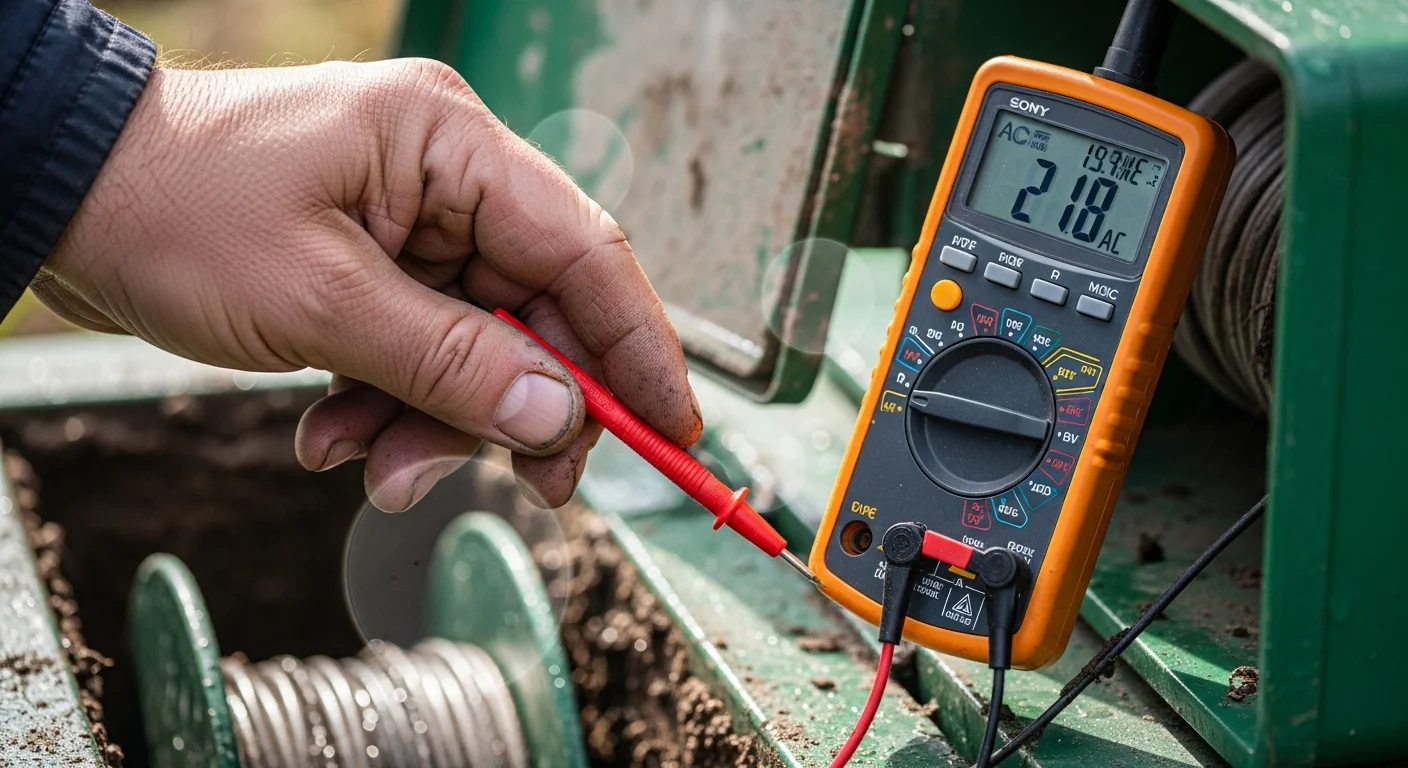
After installation, verify the system is delivering correct voltage at each valve using a digital multimeter set to AC voltage mode during a live zone cycle. A reading at or below your minimum operating threshold at commissioning means the system will fail sooner rather than later as the wire ages. At that point, revisit the calculation with the actual measured resistance of the installed wire if needed. Once wiring and valve performance are confirmed, you can move to optimizing how long each zone should run using the drip irrigation run-time calculator or validating your distribution uniformity with the catch-can test calculator.
FAQ
What is the maximum distance for 18 AWG irrigation wire on a 24V system?
Using a 0.35 A solenoid, 24V AC source, and 19V minimum operating voltage, 18 AWG solid copper wire can run approximately 1,100 feet before voltage at the valve drops below threshold. Runs approaching that limit should be treated as marginal. In practice, because splice resistance and stranded wire tolerances add resistance, the effective safe limit for 18 AWG is closer to 900 to 950 feet.
Can I use 18 AWG thermostat wire instead of direct-burial irrigation wire?
Thermostat wire is typically stranded, not solid, which increases resistance slightly compared to the values in this calculator. More critically, standard thermostat wire (CL2 or CL3) is not rated for direct burial without conduit. It degrades faster underground, develops insulation failures, and introduces corrosion at cut ends. Direct-burial irrigation wire with a solid copper conductor and UV-resistant jacket is the correct product for trenched installations.
Why does my sprinkler valve stay open after the controller turns the zone off?
This is the classic stuck-open solenoid symptom caused by insufficient voltage at the valve. The solenoid needs enough voltage to maintain the magnetic field that pulls the plunger against water pressure during closure. When voltage is marginal, the field weakens and the plunger cannot retract fully. The valve stays open until pressure in the line drops. Upsizing the wire gauge is the solution, not replacing the valve.
Does wire gauge matter if the valve is close to the controller?
For runs under 200 feet, voltage drop on any standard gauge is less than 1 V, and all four gauges pass with significant margin. Wire gauge selection at short distances is a cost decision, not a voltage decision. 18 AWG is appropriate for short runs. The gauge choice becomes critical at distances above 600 to 700 feet where the difference between 18 AWG and 14 AWG at the valve becomes 3 or more volts.
What happens if two zones share a common wire and both activate simultaneously?
Current from both solenoids flows through the common (return) wire simultaneously. If the common wire is sized for one solenoid (0.35 A) but two run at once (0.70 A), voltage drop on the common wire doubles, and both valves may receive insufficient voltage. Size the common wire for the maximum number of solenoids that can be active at the same time, then run this calculator with that combined current value.
Should I size wire for inrush current or holding current?
Inrush (actuation) current on a 24V AC solenoid is brief and typically only 20 to 30 milliamps above holding current. For 24V AC irrigation systems, the holding current listed on the spec sheet is the correct value for wire sizing. DC solenoids have a more pronounced inrush difference, but AC solenoids self-regulate through impedance, making the distinction less significant for wire gauge selection.
Conclusion
An irrigation wire size calculator solves a specific problem that is easy to ignore until it becomes expensive: voltage drop that keeps solenoid valves from closing. The formula itself is straightforward. The insight that makes it useful is understanding that the closure voltage requirement, not the opening voltage, is the binding constraint. A passing result with a thin margin is not a clean pass; it is a deferred failure waiting for a corroded splice or a hot summer to tip it over the edge.
Size the wire conservatively, use direct-burial rated conductors, and verify with a multimeter at commissioning. For related system design checks, the gravity-fed drip irrigation calculator covers pressure-driven flow scenarios where component sizing follows a similar conservative logic. The single most avoidable mistake in irrigation wiring is treating 18 AWG as a universal answer before running the numbers.