
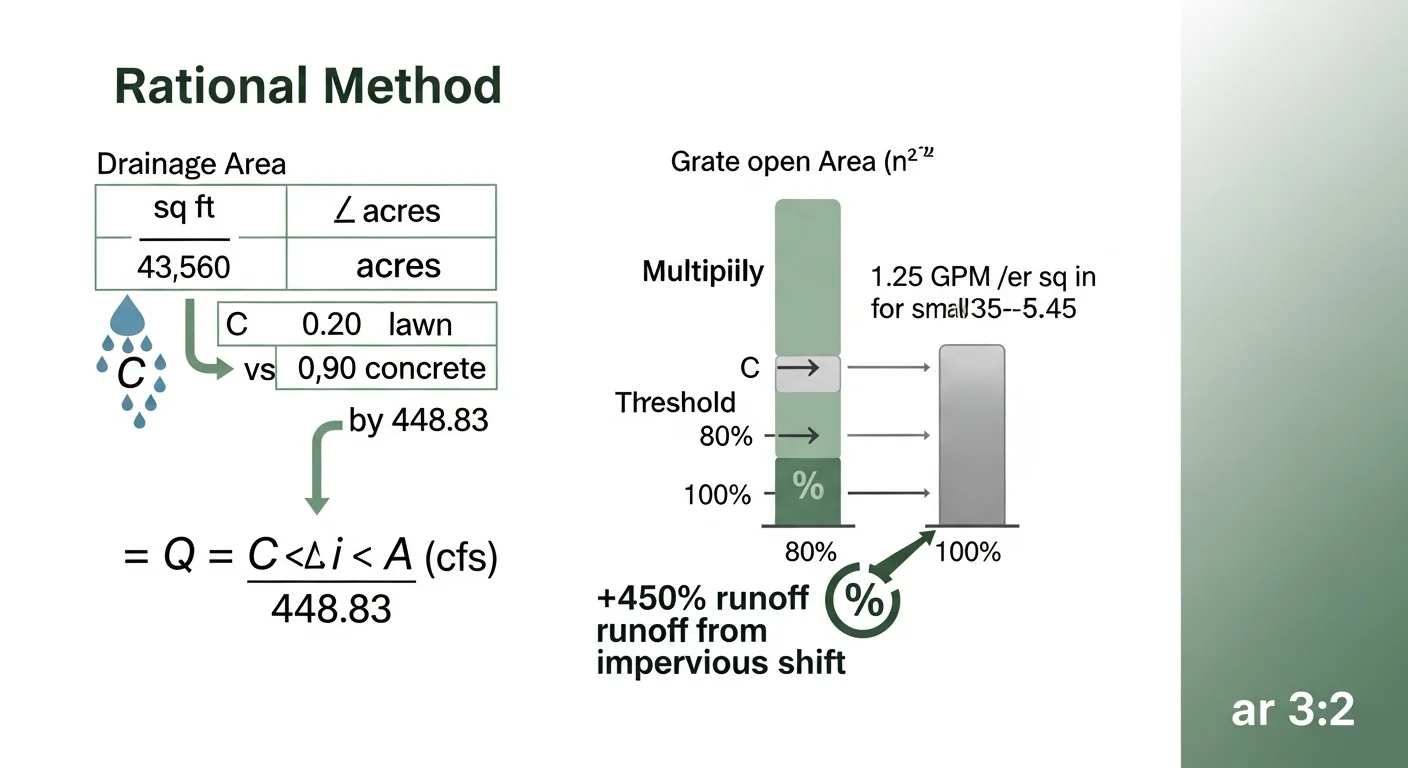
Adding a catch basin to a yard sounds straightforward until the first heavy storm proves the basin undersized. The problem is almost never the basin itself. It is the failure to account for what the drainage area is actually made of. A concrete patio drains like a roof. A lawn drains like a sponge. Most sizing guides treat those two surfaces as interchangeable. The Rational Method does not, and neither does this tool. If you have already installed a French drain system and are now trying to route overflow into a catch basin, the flow rate calculation here is exactly where that design chain begins.
Catch Basin Stormwater Runoff Sizer
Rational Method (Q = CiA) — Size your catch basin for peak stormwater flow
The “Impervious Concrete Flood” effect: Replacing grass (C=0.2) with concrete (C=0.9) increases peak runoff by up to 450%. A standard 6″ catch basin can be instantly overwhelmed. Use this calculator to size correctly.
Warnings & Standards Check
Reference: Common Surface Runoff at Your Storm Intensity
| Surface Type | C Value | Q (GPM) | vs Capacity |
|---|
Recommended Products for This Application
- NDS 12″ Square Catch Basin
- Linear / Trench Channel Drain
- Pop-up Stormwater Emitter
- PVC Primer & Heavy-duty Cement
- NDS 6″ Round Basin Kit
How This Calculator Works — Formula & Method
The Rational Method
This calculator uses the Rational Method, the industry-standard formula for estimating peak stormwater runoff for small drainage areas (< 200 acres). It is widely used by engineers and referenced in ASCE, HEC, and local stormwater management standards.
Formula Steps
Where: C = Runoff coefficient (dimensionless), i = Rainfall intensity (in/hr for 10-year storm), Area is in sq ft converted to acres (÷ 43,560).
Converts cubic feet per second to gallons per minute for practical catch basin comparison.
Estimated grate capacity uses a conservative orifice flow approximation (1.25 GPM per sq in of open area at low head pressure, typical for residential applications). Always verify against manufacturer flow charts.
Assumptions & Limits
- Best suited for drainage areas under 200 acres (residential/small commercial).
- Assumes a single uniform surface cover type across the drainage area.
- Grate capacity estimate (1.25 GPM/sq in) is a conservative residential approximation. Commercial applications require manufacturer flow charts.
- Rainfall intensity must correspond to your local 10-year, 1-hour storm. Look up via NOAA Atlas 14 for your ZIP code.
- Does not account for downstream pipe capacity, detention, or infiltration.
- C values are standard ASCE/HEC-22 mid-range estimates; actual values vary with slope, compaction, and condition.
- This tool is for preliminary sizing only. Consult a licensed engineer for permit-required or complex drainage design.
The Secret Sauce — “Impervious Concrete Flood”
When a homeowner replaces 1,000 sq ft of lawn (C = 0.20) with a concrete patio (C = 0.90), the Rational Method predicts a 450% increase in peak runoff from that surface. The existing 6″ catch basin grate (~28 sq in open area, ≈35 GPM capacity) is typically overwhelmed. This calculator highlights that shift dynamically.
Warning Thresholds (per ASCE/local practice)
- 80% capacity: Approach with caution — minor storms may cause standing water.
- 100% capacity: Basin is undersized for design storm — flooding likely.
- C > 0.75 + Small Basin: High-impervious surface warning — recommend NDS 12″ square or linear trench drain.
This calculator applies the Rational Method formula (Q = CiA) to estimate peak stormwater runoff from a defined drainage area, then compares that flow rate against the hydraulic capacity of your selected catch basin grate. It outputs peak flow in both cubic feet per second and gallons per minute, estimates grate throughput from open area, and flags whether the basin is undersized for the 10-year design storm. What it does not do: model downstream pipe friction losses, account for multiple drainage sub-zones with different surfaces, or replace a licensed engineer’s report where permits are required.
After running this tool, you will know whether your catch basin grate can physically pass the peak runoff volume from your drainage area during a design storm, and if not, by exactly how many gallons per minute it falls short.
Use the Tool
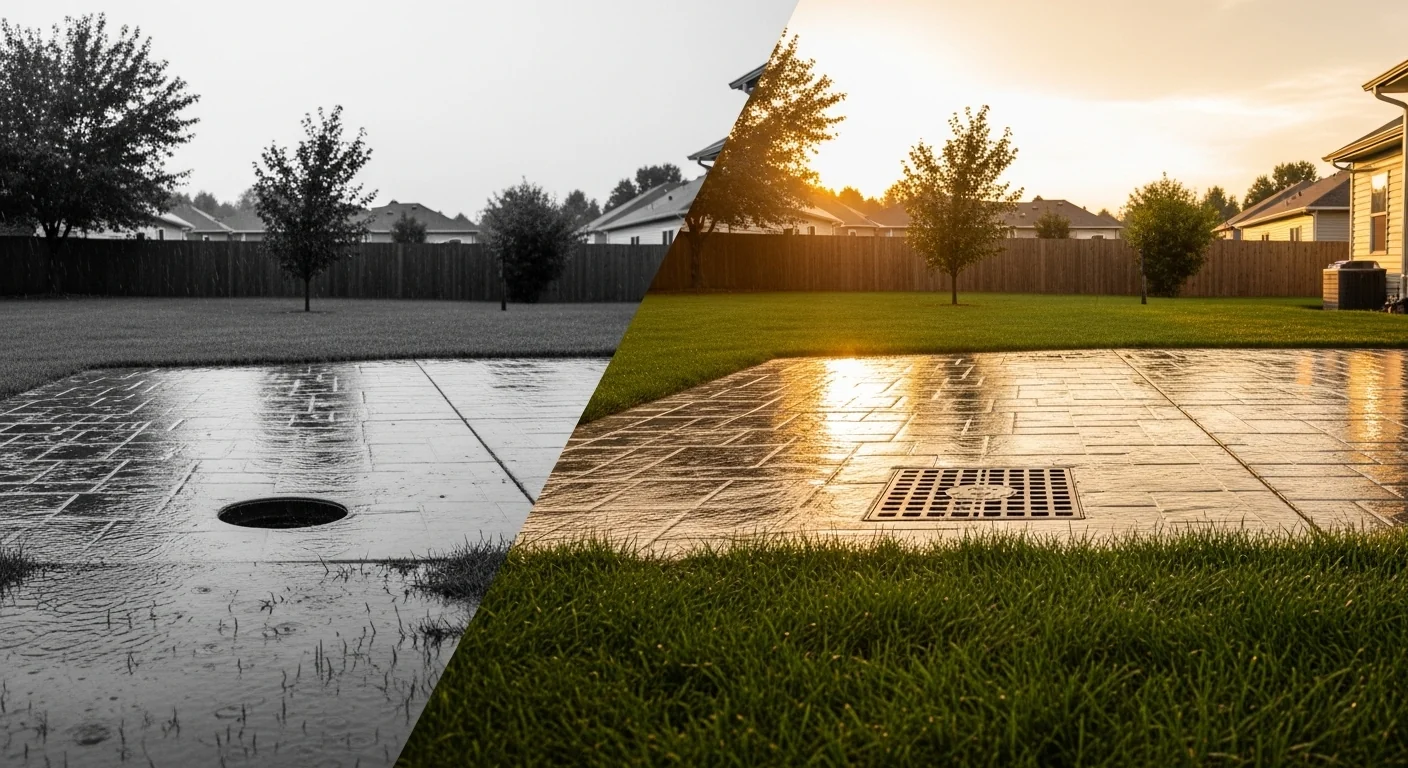
Before running the calculator, gather four pieces of information: the measured area of the surface draining toward the basin (in square feet), the dominant ground cover type, your local 10-year storm rainfall intensity in inches per hour (available from NOAA Atlas 14 by entering your ZIP code), and the grate open area from the manufacturer’s spec sheet. Grate open area is not the same as the overall grate dimensions. It refers only to the perforated or slotted area through which water actually enters.
Quick Start (60 Seconds)
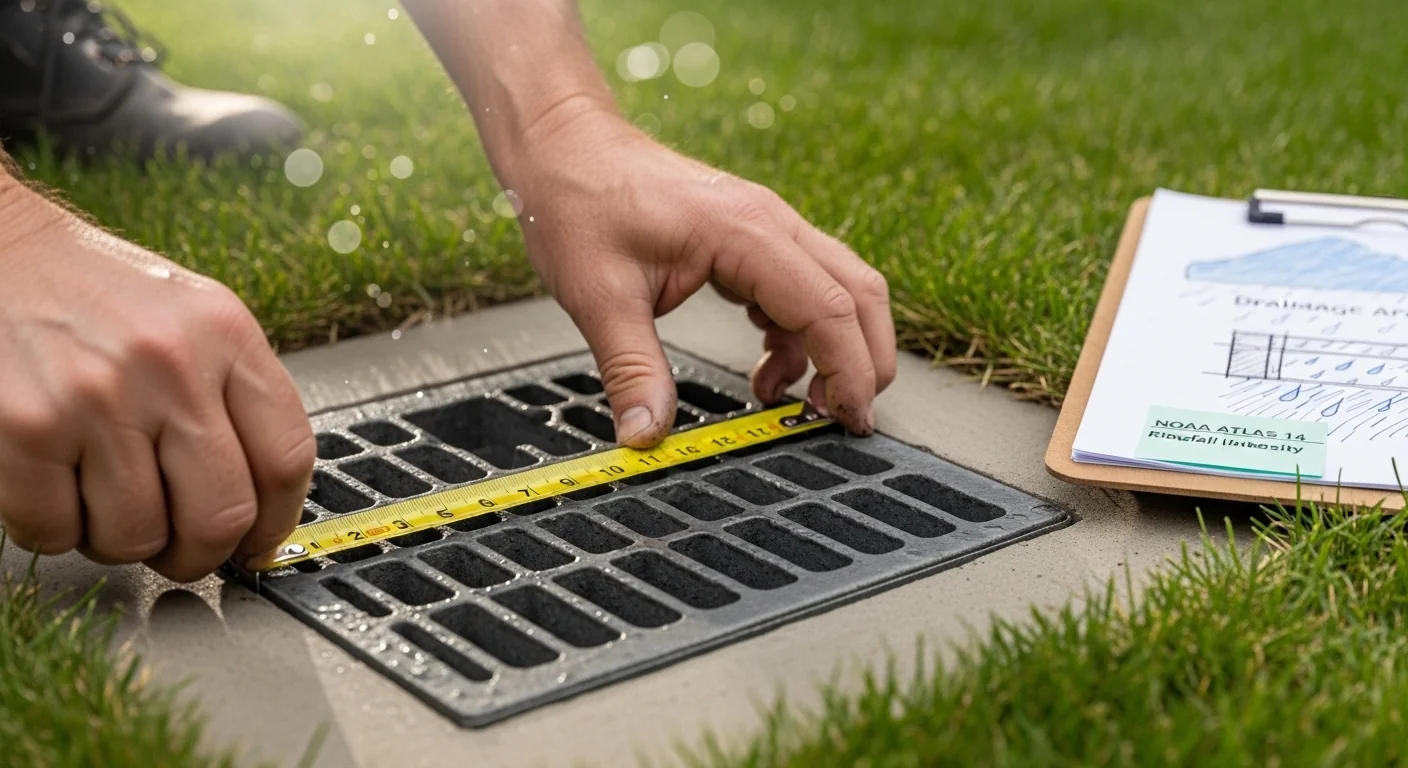
- Drainage Area (sq ft): Measure the total ground surface that slopes toward the basin. For a patio, include the patio plus any adjacent lawn that naturally drains to the same low point. Do not include rooftop area unless a downspout is directing water to this basin.
- Surface Material: Choose the dominant surface type. If your drainage area is a mix of patio and lawn, select “Mixed Lawn + Patio” rather than averaging manually. Each preset already encodes a standard ASCE runoff coefficient.
- Rainfall Intensity (in/hr): This is the 10-year, 1-hour storm value for your location, not annual average rainfall. Typical residential design values range from 2.0 in/hr (Pacific Northwest) to 6.0 in/hr (Gulf Coast and Southeast). Entering 1.0 in/hr when your region calls for 4.5 in/hr will make any basin appear oversized.
- Grate Open Area (sq in): Read this from the product label or NDS spec sheet, not from the grate’s outer dimensions. A 12-inch square NDS grate has an outer dimension of 144 sq in but an open (flow-through) area of 72 to 90 sq in depending on the grate pattern.
- Units matter: Area in square feet, intensity in inches per hour, grate open area in square inches. The calculator handles all unit conversions internally.
- Press Calculate only when all four fields are filled. The tool withholds results if any field is empty or out of range. Errors appear inline next to the relevant field.
- Use Reset between scenarios when comparing an existing 6-inch round basin against an NDS 12-inch square to see exactly how much capacity the upgrade adds.
Inputs and Outputs (What Each Field Means)
| Field | Unit | What It Represents | Common Entry Mistake | Safe Entry Guidance |
|---|---|---|---|---|
| Drainage Area | sq ft | The total surface area that drains by gravity toward the catch basin during a storm | Measuring only the patio footprint and excluding the surrounding lawn that also drains to the low point | Walk the site after a moderate rain and observe where water flows. Measure that entire zone, not just the hardscaped portion. |
| Surface Material | Dimensionless (C) | The runoff coefficient for the dominant surface type, ranging from 0.10 (wooded) to 0.95 (asphalt) | Selecting “Concrete/Asphalt Pavement” for a loose gravel or paver surface that allows some infiltration | When in doubt, select the more impervious option. Overestimating C is conservative; underestimating it risks an undersized basin. |
| Rainfall Intensity (i) | in/hr | Peak rainfall rate for the 10-year design storm at your location, per NOAA Atlas 14 or local IDF curves | Using average annual rainfall divided by hours per year, which produces a meaninglessly small number | Look up your ZIP code in NOAA Atlas 14 (hdsc.nws.noaa.gov/pfds). Use the 10-year, 60-minute duration value. |
| Grate Open Area | sq in | The net perforated or slotted area of the grate through which water can actually flow into the basin | Using the outer grate dimension (e.g., 12 x 12 = 144 sq in) instead of the actual open flow area listed on the spec sheet | NDS and similar manufacturers publish open area in product specs. For a 6-inch round grate, open area is typically 24 to 32 sq in. For NDS 9-inch square: approximately 45 sq in. For NDS 12-inch square: 72 to 90 sq in. |
| Peak Flow Q (CFS) | ft³/s | Calculated peak runoff in cubic feet per second from the Rational Method formula | Not applicable (output only) | Used as an intermediate value for pipe sizing and hydraulic calculations downstream |
| Peak Flow Q (GPM) | gal/min | The same peak runoff converted to gallons per minute for direct comparison with grate capacity ratings | Not applicable (output only) | This is the primary value to compare against your grate’s rated capacity |
| Grate Capacity | gal/min | Estimated throughput of the grate at low head pressure, computed from open area using a conservative orifice approximation | Not applicable (output) | Treat as a conservative estimate. Actual capacity varies with head pressure; always verify against manufacturer flow charts for commercial applications. |
| Surplus / Deficit | gal/min | Positive value means the grate has remaining capacity. Negative value means the grate is overwhelmed by that many GPM. | Not applicable (output) | A deficit of even 5 GPM during a design storm will produce visible surface flooding. Upgrade basin size or add a secondary drain. |
Understanding how different soil types absorb water between storm events can help you choose a more accurate composite C value for mixed surfaces. The soil infiltration rate calculator provides a starting point for estimating how much of your drainage area actively percolates versus contributes to surface runoff.
Worked Examples (Real Numbers)
Scenario 1: Established Lawn Around a Downspout Basin
- Drainage area: 2,000 sq ft of well-maintained lawn
- Surface material: Well-maintained Lawn (C = 0.20)
- Rainfall intensity: 3.0 in/hr (10-year storm, Midwest region)
- Grate open area: 72 sq in (NDS 12-inch square, standard grate)
Result: Q = 0.20 x 3.0 x (2,000 / 43,560) = 0.0276 CFS = 12.4 GPM. Grate estimated capacity: 90 GPM. Capacity used: approximately 14%. Surplus: 77.6 GPM.
A standard NDS 12-inch square basin is significantly oversized for this drainage scenario. A smaller 6-inch round basin (approximately 35 GPM estimated capacity) would also handle the load with margin. This outcome is the baseline before any hardscaping is added.
Scenario 2: Stamped Concrete Patio Replacing Former Lawn (The
Impervious Shift)
- Drainage area: 1,200 sq ft of stamped concrete patio (same footprint as the former lawn in a partial redesign)
- Surface material: Stamped / Poured Concrete Patio (C = 0.90)
- Rainfall intensity: 4.0 in/hr (10-year storm, Mid-Atlantic region)
- Grate open area: 28 sq in (existing 6-inch round cast iron grate)
Result: Q = 0.90 x 4.0 x (1,200 / 43,560) = 0.0993 CFS = 44.6 GPM. Grate estimated capacity: 35 GPM. Capacity used: 127%. Deficit: 9.6 GPM.
The existing 6-inch basin is overwhelmed by nearly 10 GPM. This is the exact failure mode described by the “Impervious Concrete Flood” pattern. The patio did not increase in size; it changed surface material, and that change alone shifted runoff from approximately 12 GPM to nearly 45 GPM. Replacing the grate with an NDS 12-inch square (90 GPM estimated capacity) resolves the deficit.
Scenario 3: Mixed-Use Backyard, Upgraded Basin
- Drainage area: 3,500 sq ft combining lawn, a small patio, and planted beds (composite surface)
- Surface material: Mixed Lawn + Patio (C = 0.50)
- Rainfall intensity: 3.5 in/hr (10-year storm, Northeast)
- Grate open area: 90 sq in (NDS 12-inch square, heavy-duty grate)
Result: Q = 0.50 x 3.5 x (3,500 / 43,560) = 0.1407 CFS = 63.1 GPM. Grate estimated capacity: 112.5 GPM. Capacity used: approximately 56%. Surplus: 49.4 GPM.
The NDS 12-inch square handles this mixed-use yard comfortably at 56% of estimated capacity. If the homeowner later adds another 800 sq ft of concrete patio and shifts the composite C upward, re-running this calculation will reveal whether the basin still has adequate reserve.
Reference Table (Fast Lookup)
All values below assume a 1,000 sq ft drainage area. Use this table to quickly compare surface types at two common design storm intensities and identify the minimum grate open area required to avoid overflow. Minimum grate open area is back-calculated from the estimated peak GPM at a conservative 1.25 GPM per sq in of open area.
| Surface Type | C Value | Peak GPM at i = 3.0 in/hr | Peak GPM at i = 5.0 in/hr | Min Grate Open Area at i = 3 (sq in) | Min Grate Open Area at i = 5 (sq in) |
|---|---|---|---|---|---|
| Wooded / Native Cover | 0.10 | 3.1 | 5.2 | 2.5 | 4.2 |
| Well-maintained Lawn | 0.20 | 6.2 | 10.3 | 5.0 | 8.2 |
| Landscaped / Loamy Soil | 0.35 | 10.8 | 18.0 | 8.7 | 14.4 |
| Mixed Lawn + Patio | 0.50 | 15.5 | 25.8 | 12.4 | 20.6 |
| Compacted Bare Soil | 0.65 | 20.1 | 33.5 | 16.1 | 26.8 |
| Permeable Pavers | 0.75 | 23.2 | 38.6 | 18.5 | 30.9 |
| Stamped / Poured Concrete | 0.90 | 27.8 | 46.4 | 22.3 | 37.1 |
| Concrete / Asphalt Pavement | 0.95 | 29.4 | 49.0 | 23.5 | 39.2 |
Note that the 6-inch round basin (typically 24 to 32 sq in open area) handles only about 30 to 40 GPM under conservative assumptions. For any surface with C above 0.65 draining more than 1,500 sq ft at a moderate design storm intensity, that basin type will frequently be borderline or undersized.
How the Calculation Works (Formula + Assumptions)
Show the calculation steps
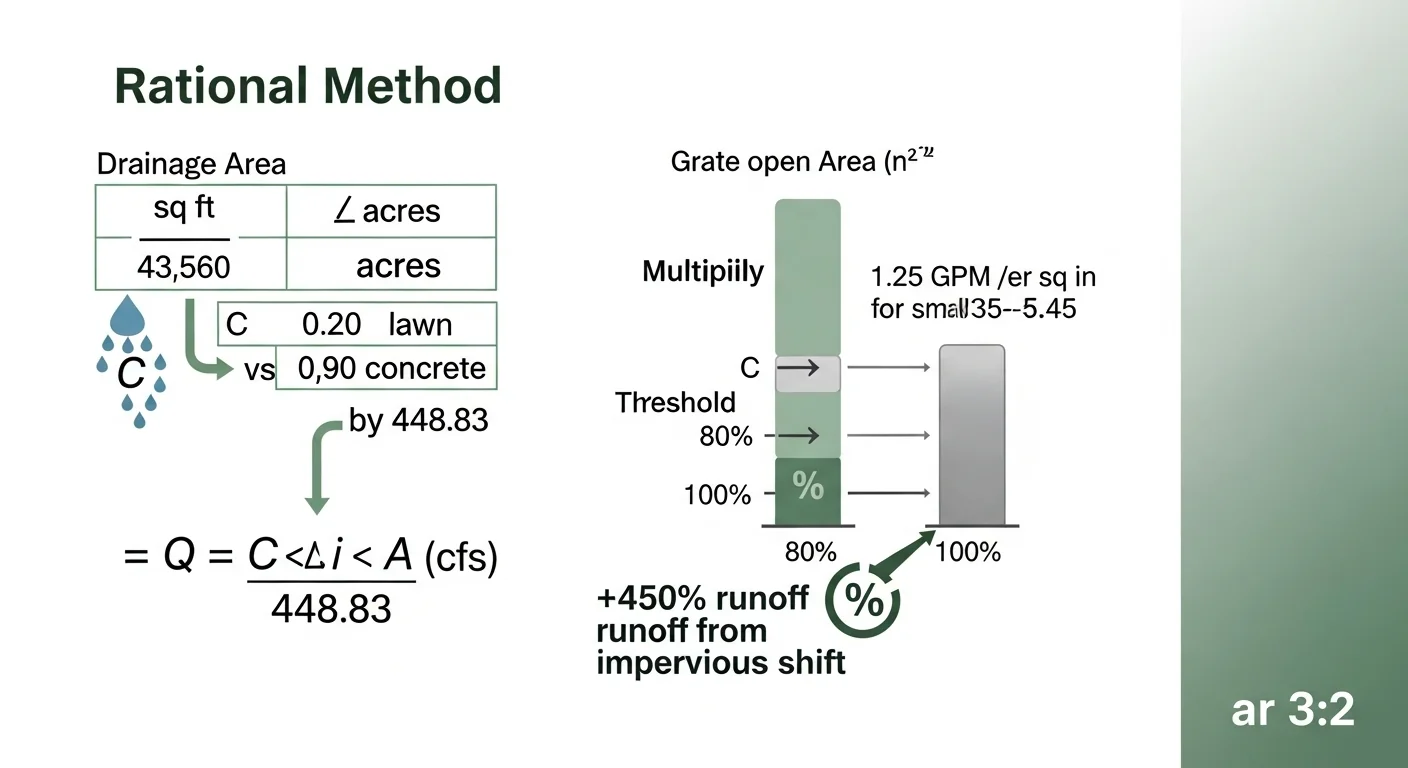
Step 1: Convert Area to Acres
The Rational Method requires drainage area in acres. Divide your square foot measurement by 43,560 (the number of square feet in one acre).
Area (acres) = Area (sq ft) / 43,560
Step 2: Apply the Rational Method Formula
Q (CFS) = C x i x A
Where C is the dimensionless runoff coefficient, i is rainfall intensity in inches per hour, and A is area in acres. The result Q is in cubic feet per second. This formula assumes steady-state, uniform rainfall over the entire drainage area, which is a valid assumption for small residential areas over short storm durations.
Step 3: Convert CFS to GPM
Q (GPM) = Q (CFS) x 448.83
The conversion factor 448.83 is exact for US gallons (1 CFS = 448.83 US gallons per minute). Rounding to one decimal place is applied in this calculator.
Step 4: Estimate Grate Hydraulic Capacity
Grate Capacity (GPM) = Open Area (sq in) x 1.25 for grates up to 100 sq in, x 1.35 for grates 101 to 200 sq in, x 1.45 for grates above 200 sq in. This is a conservative residential orifice approximation. At very low head pressures (shallow ponding), actual grate capacity may be 10 to 20% lower than manufacturer peak flow ratings, which are typically measured at higher head conditions.
Step 5: Surplus or Deficit
Surplus / Deficit (GPM) = Grate Capacity – Q (GPM). A positive number indicates available capacity. A negative number indicates the volume per minute that will bypass the grate and pond or flow over adjacent surfaces.
Capacity Percent Used
Capacity Used (%) = (Q GPM / Grate Capacity) x 100. The traffic-light threshold is 80% for a caution warning and 100% for a flooding risk flag.
Assumptions and Limits
- The Rational Method is most accurate for drainage areas below 200 acres. For residential catch basins, this constraint is rarely a limiting factor, but large commercial parking lots or multi-parcel drainage plans may exceed the method’s reliable range.
- The formula assumes a single, uniform runoff coefficient across the entire drainage area. Real landscapes with mixed surfaces (partial patio, partial lawn, partial mulch bed) require either a weighted composite C value or separate sub-area calculations.
- Rainfall intensity must be the 10-year, 1-hour design storm for your specific location. Using a regional average or a 2-year recurrence interval will produce a meaningfully smaller Q that undersizes the basin for the actual design standard.
- Grate capacity estimates in this tool use a conservative low-head approximation. Manufacturer flow charts should be consulted for commercial or permit-required designs, as head pressure and approach velocity affect throughput significantly.
- This tool does not account for downstream pipe sizing, sump or detention volume, seasonal soil saturation, or antecedent moisture conditions. A saturated soil profile from prior rainfall effectively raises C toward 1.0 regardless of surface type.
- The C values used (0.10 to 0.95) are standard ASCE/HEC-22 mid-range estimates. Actual coefficients vary with ground slope, compaction level, and vegetation density. Steep slopes increase effective C values.
- This tool is intended for preliminary sizing and educational purposes. Permitted drainage projects in most jurisdictions require a licensed civil or drainage engineer to stamp the design.
Standards, Safety Checks, and “Secret Sauce” Warnings
Critical Warnings
- The impervious surface shift is not linear. Replacing 1,000 sq ft of lawn (C = 0.20) with concrete (C = 0.90) increases the runoff contribution from that surface by a factor of 4.5. An existing basin sized for the lawn scenario will be structurally adequate but hydraulically overwhelmed. The physical basin does not fail; the flow rate simply exceeds what the grate can pass.
- A 6-inch round catch basin grate has approximately 24 to 32 sq in of open area. At the conservative 1.25 GPM-per-sq-in approximation, that produces 30 to 40 GPM of estimated throughput. Any impervious surface larger than 800 to 1,000 sq ft draining to this single point at a moderate design storm intensity can exceed that threshold.
- Rainfall intensity from NOAA Atlas 14 is a design storm value, not a typical storm value. Sizing a basin for a 1-year or 2-year recurrence interval rather than the standard 10-year design storm means the basin will overflow roughly twice per decade. Many local codes require 10-year storm sizing as a minimum for residential drainage.
- Grate clogging is not modeled. Leaf debris, sediment, and grass clippings reduce effective open area. In practice, a clogged 72-sq-in grate may perform like a 30-sq-in grate. Add a maintenance factor by treating calculated capacity as 70 to 80% of the computed value for long-term reliability.
Minimum Standards
- Design to the 10-year storm recurrence interval as the baseline for residential catch basins. Many municipal stormwater codes require 10-year minimum, and some require 25-year sizing for basins adjacent to structures.
- Size for no more than 80% of estimated grate capacity at the design storm flow rate. The remaining 20% provides a buffer for partial clogging and storm intensity variability.
- For drainage areas with C above 0.75, consider NDS 12-inch square basins or linear trench drains as the default starting point rather than 6-inch round basins.
- Verify outlet pipe capacity separately from grate capacity. A grate that can accept 90 GPM is useless if the 3-inch outlet pipe beneath it can only carry 20 GPM. The Manning’s equation calculator provides the channel and pipe flow capacity check that follows this sizing step.
Competitor Trap
Most yard drainage sizing guides on the web tell you to pick a basin size based on drainage area alone, typically offering rules like “one 6-inch basin per 500 sq ft.” That shortcut ignores surface type entirely. A 500 sq ft concrete patio at a 4.0 in/hr design storm produces more than triple the peak runoff of a 500 sq ft lawn at the same intensity. Any guide that omits the runoff coefficient from its recommendation is giving you a number that may be correct for lawn and dangerously wrong for hardscape. Run the actual Rational Method calculation, even if it takes two extra minutes.
For projects where the catch basin outlet connects to a buried PVC lateral, the downstream pipe must also be verified for adequate flow capacity. The PVC friction loss calculator covers that downstream check and is the natural companion tool once basin sizing is confirmed.
Common Mistakes and Fixes
Mistake: Measuring Only the Patio and Ignoring Upslope Contributing Area
Homeowners frequently enter only the footprint of the hardscaped surface when the basin actually collects water from a larger upslope area including lawn, raised beds, or an adjacent neighbor’s grading. The Rational Method produces a result proportional to area, so underestimating area by 30% underestimates peak flow by the same proportion.
Fix: Walk the perimeter of the drainage area after a light rain and mark where water naturally flows toward the basin. Measure that entire contributing zone.
Mistake: Using Outer Grate Dimensions Instead of Open Area
A 12×12-inch square grate has 144 sq in of total face area, but the manufacturer’s spec sheet may show only 72 to 90 sq in of actual open (perforated) area. Entering 144 into this calculator inflates the estimated grate capacity by 60 to 100%, making an undersized basin appear adequate.
Fix: Look up the specific grate product on the manufacturer’s site. The specification labeled “open area,” “net free area,” or “open flow area” is the correct number to enter.
Mistake: Using Average Annual Rainfall Instead of Design Storm Intensity
Annual average rainfall in inches divided by 8,760 hours per year gives a value near 0.05 to 0.10 in/hr in most US climates. That number bears no relationship to peak storm intensity. Entering it produces a Q value so small that any basin appears dramatically oversized, and the design fails at the first significant rain event.
Fix: Use NOAA Atlas 14’s Precipitation Frequency Data Server. Enter your location, select 60-minute duration and 10-year return period, and use that value as i.
Mistake: Ignoring Saturated Soil Conditions After Prior Rainfall
The runoff coefficient C assumes typical antecedent moisture conditions. When soil is already saturated from a multi-day rain event, infiltration drops toward zero and effective C values approach those of impervious surfaces regardless of what the ground is covered with. A lawn that normally has C = 0.20 can behave like C = 0.70 or higher after 48 hours of continuous rain. The field capacity soil moisture calculator can help you understand when your soil profile is at or near saturation and should be considered when sizing basins in high-rainfall climates.
Fix: In regions with frequent multi-day rain events, use a C value one tier above the standard for your surface type when computing design storm flow.
Mistake: Treating Grate Capacity as the Full System Capacity
The grate is only the entry point. The outlet pipe, the basin sump volume, and any downstream connection all constrain total system throughput. A grate rated at 90 GPM connected to a 3-inch pipe on a 0.5% slope cannot convey 90 GPM; the pipe becomes the bottleneck. Similarly, a driveway culvert or cross-drain downstream of the catch basin must be sized for the same design flow. The driveway culvert size calculator addresses that downstream check when the basin outlets beneath a paved surface.
Fix: After confirming grate capacity, verify outlet pipe capacity using Manning’s equation for the pipe diameter and slope, and check any culverts or lateral connections downstream.
Next Steps in Your Workflow
Once the calculator confirms that your basin is adequately sized for the design storm, the next question is where the water goes after it enters the basin. Most residential catch basins outlet through a 3-inch or 4-inch PVC lateral that terminates at a pop-up emitter, a daylight outlet, or a connection to the municipal storm sewer. That outlet pipe must be verified independently of the grate. Run the pipe diameter and slope through the pipe volume calculator to confirm it can carry the peak flow without backing up into the basin. Backpressure in a full outlet pipe reduces effective grate intake below the calculated capacity.
If the catch basin is intended to intercept water that would otherwise migrate toward a foundation or basement, consider whether a sump system running in parallel provides redundant protection during extreme events. The sump pump calculator covers pump sizing for that complementary system. Together, the basin and a sump can handle the routine design storm at the surface while the sump intercepts any water that reaches the sub-grade.
FAQ
What is the Rational Method and why is it used for catch basin sizing?
The Rational Method (Q = CiA) is an engineering formula developed in the 1850s for estimating peak runoff from small drainage areas during storm events. It is the standard approach for residential and small commercial stormwater design because it requires only three accessible inputs: runoff coefficient, rainfall intensity, and area. It is accurate for areas below 200 acres with uniform surface conditions.
Where do I find the 10-year storm rainfall intensity for my location?
NOAA’s Atlas 14 Precipitation Frequency Data Server (hdsc.nws.noaa.gov/pfds) provides point-based rainfall frequency estimates for any US location. Enter your address or coordinates, select a 60-minute duration and 10-year recurrence interval. The resulting depth in inches equals the intensity in in/hr for a 1-hour storm. Local engineering departments often publish the same data in tabular IDF curves.
square catch basin for flow capacity?
The primary difference is grate open area. A 6-inch round basin typically has 24 to 32 sq in of open area, yielding an estimated 30 to 40 GPM throughput at low head pressure. An NDS 12-inch square basin provides 72 to 90 sq in of open area and approximately 90 to 115 GPM of estimated throughput. For any drainage area exceeding roughly 1,000 sq ft of impervious surface in a moderate-intensity storm zone, the 12-inch square is typically the appropriate starting point.
Can I use this calculator for a driveway or commercial parking lot?
Yes, with caveats. The Rational Method applies to commercial impervious surfaces. However, commercial drainage design typically requires engineering review, and many municipalities require a 25-year or 100-year design storm rather than the 10-year standard used here. The grate capacity estimate in this tool is calibrated for residential low-head conditions and should be replaced with manufacturer flow charts for commercial inlet grates operating at higher depths of ponding.
What C value should I use if my drainage area has multiple surface types?
Calculate a weighted composite C value: for each sub-area, multiply its individual C value by its area, sum all those products, then divide by the total drainage area. For example, 800 sq ft of concrete (C = 0.90) plus 1,200 sq ft of lawn (C = 0.20) gives a weighted C of (800 x 0.90 + 1,200 x 0.20) / 2,000 = (720 + 240) / 2,000 = 0.48. Select the “Mixed Lawn + Patio” preset (C = 0.50) as a conservative approximation if exact proportions are uncertain.
What does the grate capacity estimate in this tool represent?
The calculator estimates grate capacity using a conservative orifice flow approximation: approximately 1.25 GPM per square inch of open area at low head pressure for grates up to 100 sq in. This is a residential-grade estimate. Real grate throughput depends on head depth above the grate, approach velocity, and grate bar pattern. Manufacturer hydraulic performance curves are the authoritative source. This estimate is intentionally conservative to avoid undersizing.
Conclusion
Catch basin sizing is not a guess or a rule of thumb. It is a calculation, and the Rational Method provides a repeatable, standards-based result when the inputs are entered correctly. The single most consequential input is the runoff coefficient. Changing a drainage area from lawn to concrete does not change the basin size needed by a small increment; it can shift peak runoff by a factor of four or more. Running this yard drainage catch basin calculator before and after a planned hardscape addition shows exactly how large that shift is for your specific area and storm intensity.
The mistake to avoid above all others is entering rainfall intensity as an average or a light-rain value rather than the actual 10-year design storm. Every other input error shifts the result modestly. An intensity error can make a critically undersized basin appear to have comfortable capacity. If you are planning a broader drainage system that routes collected water to a retention area, rain garden, or tank, the rainwater harvesting calculator can help quantify how much of that captured volume is worth redirecting for reuse before it reaches the storm sewer.