
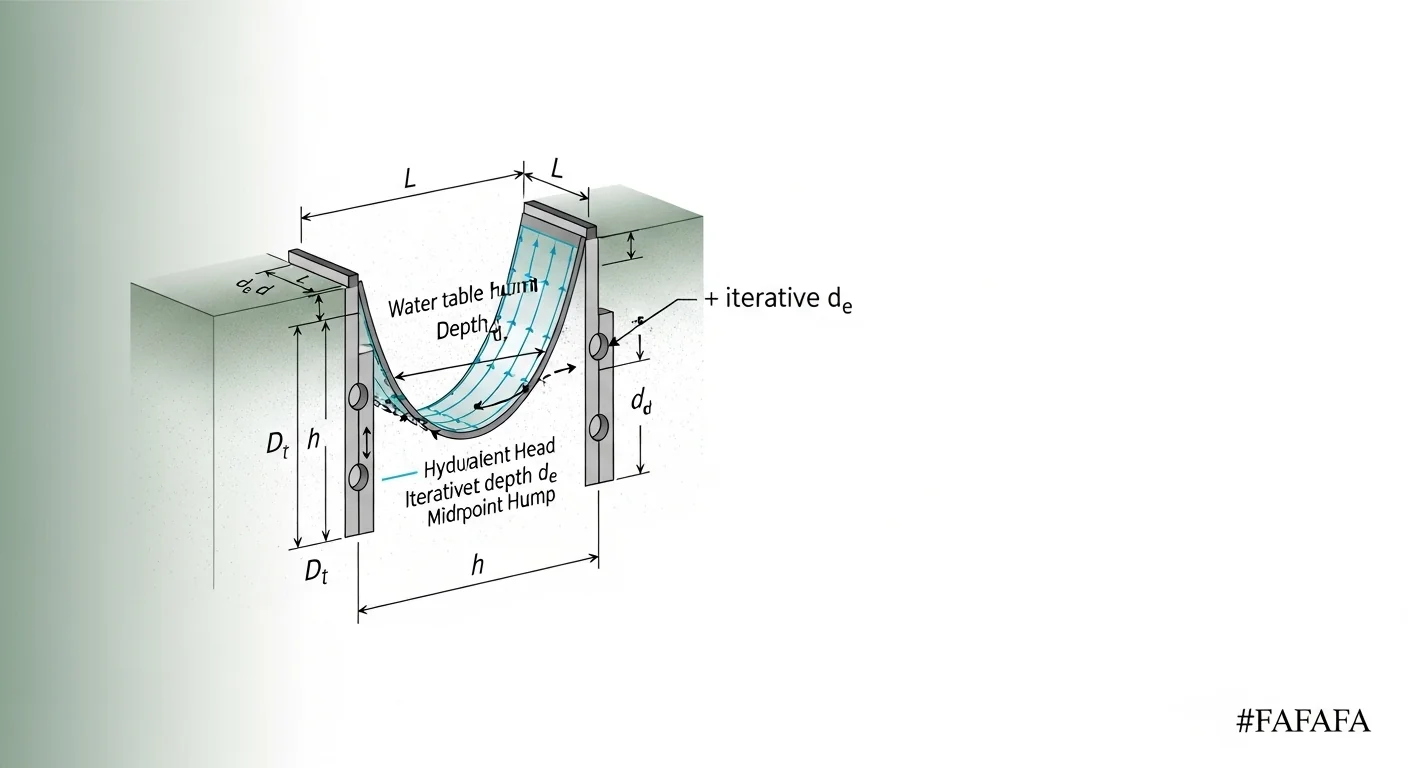
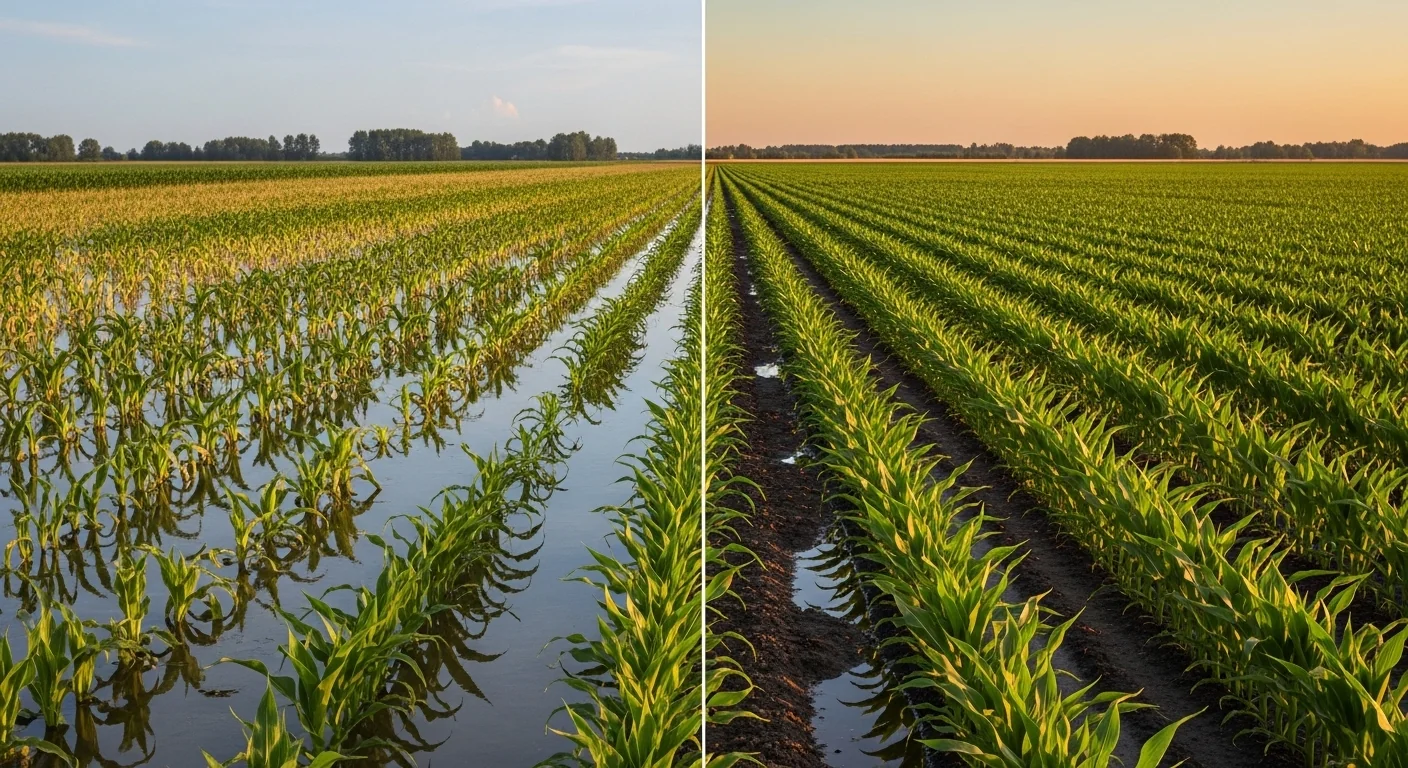
Subsurface tile drainage fails at the midpoint, not at the pipe. Groundwater between two parallel drains does not drop uniformly to the tile level. It forms a parabolic arch, highest at the exact center of the spacing, and that peak, called the water table hump, is what determines whether crops live or suffocate. A drain installation that looks correct on the surface can still hold the water table within inches of the root zone at every spot that is farthest from a pipe. Hooghoudt’s equation exists precisely to calculate where that arch peaks, and whether it drops low enough to protect the root zone.
This farm tile drainage calculator applies Hooghoudt’s equation iteratively to compute the maximum safe spacing between perforated pipe runs, accounting for soil hydraulic conductivity, depth to the impermeable layer, tile placement depth, and your target water table clearance below the surface. It does not model transient flooding, layered soils with differing K values, or sites where pipe grade is inadequate to sustain gravity flow. It is a steady-state design tool, which means it answers the question: given continuous rainfall at the drainage coefficient rate, what spacing keeps the hump below your target depth? To understand how quickly your soil releases water after a storm event, a soil infiltration rate calculator provides a complementary perspective on saturated-zone behavior.
After running this tool, you will know the maximum center-to-center tile spacing that prevents waterlogging at mid-field. If your planned spacing exceeds that number, you can quantify exactly how close the water table hump climbs to the surface, and decide whether to tighten the layout, deepen the pipes, or accept the yield risk.
Use the Tool
Drainage rate (q) is auto-computed as 1/400 of K per USDA guidelines (typical design standard).
How This Calculator Works
Hooghoudt’s Equation computes the maximum allowable spacing between subsurface tile drains so the water table “hump” between two drains never rises higher than your target root zone.
Equivalent Depth (d_e) — corrects for the proximity of the impermeable layer to the drain. We use the simplified Hooghoudt approximation:
Step-by-step:
- 1. Compute drainage coefficient: q = K / 400
- 2. Compute hydraulic head: h = d_t − m (tile depth minus water table target)
- 3. Compute equivalent depth: d_e using Hooghoudt iteration
- 4. Solve for L: L = √[(8·K·d_e·h + 4·K·h²) / q]
- 5. Check whether the midpoint water table hump violates root protection threshold
Assumptions: Uniform soil profile (same K above and below drain); steady-state drainage; flat topography; drain pipes flow freely at capacity.
Assumptions & Limits
- Soil uniformity: Assumes a single hydraulic conductivity value for the entire profile. Layered soils require per-layer analysis.
- Steady state: Hooghoudt’s equation models steady rainfall input equal to drainage rate. It does not model transient flooding events.
- Valid range: Spacing up to ~300 ft (90 m) is reliable. Beyond 400 ft, field variability dominates and the equation underestimates real-world hump height.
- Grade: Assumes adequate pipe grade (≥0.1%) for gravity flow. Use a rotary laser level to confirm.
- Drainage coefficient: q = K/400 is the standard USDA design guideline. In high-rainfall regions, use q = K/300 for conservative design.
- Soil texture classifications: Sandy loam K ≈ 0.5–2 in/hr; silt loam K ≈ 0.2–0.6 in/hr; clay loam K ≈ 0.05–0.2 in/hr; heavy clay K < 0.05 in/hr.
Before entering values, have the following on hand: a measured or estimated hydraulic conductivity for your dominant soil horizon (in/hr or m/day), the depth from the surface to your restrictive layer confirmed by auger or soil survey, your target tile depth, and the minimum water table depth you need to protect your crop’s root system. Switch the unit toggle to match the units your soil test or survey report uses. If you are working with metric soil reports but planning in feet, convert K first before entering values.
Quick Start (60 Seconds)

- Hydraulic Conductivity (K): Enter the saturated K of the soil horizon where drainage is occurring. Sandy loam runs roughly 0.5 to 2 in/hr; silt loam 0.2 to 0.6 in/hr; clay loam 0.05 to 0.2 in/hr; heavy clay below 0.05 in/hr. Do not use surface infiltration rates, which are often higher and unrepresentative of the profile.
- Depth to Impermeable Layer (D): Measure from the soil surface down to the first horizon that effectively stops vertical water movement, such as a clay pan, fractured bedrock, or dense subsoil. Auger to confirm, do not estimate from crop stress patterns alone.
- Desired Tile Depth: This is the burial depth of the centerline of the perforated pipe. Standard installations in the US Midwest range from 3 to 5 ft. Deeper tiles allow wider spacing but increase trenching cost. This value must be less than D.
- Target Minimum Water Table Depth: The minimum clearance between the soil surface and the water table at mid-field, under design drainage conditions. For corn and soybeans, a minimum of 1.5 ft (0.45 m) is widely cited in extension literature. This value must be smaller than your tile depth or the math has no solution.
- Unit toggle: Select Imperial (ft, in/hr) or Metric (m, m/day) before entering any values. Switching units after entry will clear the results panel.
- Drainage rate: The tool computes q automatically as K divided by 400, which is the standard USDA design guideline. You do not enter q directly.
- Run the calculation: Click “Calculate Drainage Spacing.” All four fields must be filled with valid numbers, and the cross-field logic must pass, before results appear.
Inputs and Outputs (What Each Field Means)
| Field | Unit (Imperial / Metric) | What It Represents | Common Entry Mistake | Safe Entry Guidance |
|---|---|---|---|---|
| Hydraulic Conductivity (K) | in/hr / m/day | Rate at which saturated soil transmits water horizontally and vertically through the drainage zone | Using surface infiltration rate instead of the profile-average saturated K | Use lab permeameter results or field auger-hole tests; consult NRCS Web Soil Survey for mapped estimates |
| Depth to Impermeable Layer (D) | ft / m | Distance from soil surface to the restrictive horizon that blocks downward water movement | Estimating D from observation instead of augering to confirm; must exceed tile depth | Auger at multiple points across the field; use the shallowest confirmed measurement for conservative design |
| Desired Tile Depth | ft / m | Burial depth to the centerline of the perforated drain pipe | Confusing tile depth with trench depth; trench depth is deeper by the pipe radius plus bedding | Confirm with a rotary laser level during installation; must be less than D |
| Target Min. Water Table Depth (m) | ft / m | Minimum acceptable clearance between the soil surface and the peak of the water table hump at mid-field | Setting this too low, such as 0.5 ft, which allows saturation in the root zone under moderate rainfall | Use at least 1.5 ft (0.45 m) for row crops; 2.0 ft where traffic compaction is a concern; must be less than tile depth |
| Tile Spacing (L) [output] | ft / m | Maximum center-to-center distance between tile runs that keeps the midpoint water table at or below the target depth | Treating L as a minimum spacing rather than a maximum; installing wider runs than computed | Round down to the nearest practical spacing (common intervals: 40, 60, 80, 100 ft); narrower is always safer |
| WT Hump Depth at Mid-Field [output] | ft / m | Predicted depth of the water table at the point midway between two tile runs under design flow conditions | Assuming this equals the target depth when spacing is rounded down; it will be slightly deeper, which is correct | Compare this output to your crop’s root zone requirement; if marginal, reduce spacing |
| Drainage Coefficient (q) [output] | in/hr / m/day | The design drainage rate, computed as K divided by 400 per USDA guidelines | Treating q as a field-measured flow rate; it is a design parameter, not a measured discharge | For high-rainfall regions or tile systems serving as outlets for surface water, use K divided by 300 |
| Equivalent Depth (d_e) [output] | ft / m | Hooghoudt’s corrected flow depth that accounts for the convergence of streamlines near the drain pipe | Ignoring d_e and using D directly, which overestimates spacing in shallow systems | Always review d_e in the results; when D is close to tile depth, d_e is significantly smaller than D |
Understanding field capacity and plant-available water in your soil profile helps contextualize what the water table depth target means for crop performance. The field capacity and soil moisture calculator on this site addresses the relationship between saturation and available water at specific soil textures.
Worked Examples (Real Numbers)
Example 1: Sandy Loam Field, Imperial Units
- Hydraulic Conductivity (K): 1.0 in/hr
- Depth to Impermeable Layer (D): 8 ft
- Tile Depth: 4 ft
- Target Water Table Depth (m): 1.5 ft
- Hydraulic head (h): 4.0 minus 1.5 = 2.5 ft
- Equivalent depth (d_e): 8 times 4 divided by (8 plus 4) = 2.67 ft (iterative result: 2.69 ft)
- Drainage coefficient (q): 1.0 divided by 400 = 0.0025 in/hr
- L squared: (8 times 1.0 times 2.69 times 2.5 plus 4 times 1.0 times 6.25) divided by 0.0025
- L squared: (53.8 plus 25.0) divided by 0.0025 = 31,520
Result: Tile spacing L = 177 ft.
Sandy loam soils in well-drained glacial till commonly support wide spacings of 150 to 200 ft. At 177 ft, the water table hump is predicted to remain at the 1.5 ft target. A practical installation would round down to 160 or 170 ft to build in margin against variability in K across the field.
Example 2: Heavy Clay Loam, Root Rot Risk Scenario, Imperial Units
- Hydraulic Conductivity (K): 0.08 in/hr
- Depth to Impermeable Layer (D): 6 ft
- Tile Depth: 3.5 ft
- Target Water Table Depth (m): 1.5 ft
- Hydraulic head (h): 3.5 minus 1.5 = 2.0 ft
- Equivalent depth (d_e): 6 times 3.5 divided by (6 plus 3.5) = 2.21 ft
- Drainage coefficient (q): 0.08 divided by 400 = 0.0002 in/hr
- L squared: (8 times 0.08 times 2.21 times 2.0 plus 4 times 0.08 times 4.0) divided by 0.0002
- L squared: (2.83 plus 1.28) divided by 0.0002 = 20,550
Result: Tile spacing L = 143 ft.
This is where the root rot trap closes. A contractor who installs drains at 100 ft “to save pipe” produces hump depths that comfortably protect roots. One who spaces at 200 ft to cut costs in clay loam leaves the water table within 6 to 10 inches of the surface at every mid-field point. This calculation confirms the maximum; anything beyond 143 ft in these conditions degrades into the marginal or waterlogged zone.
Example 3: Silt Loam, Metric Units
- Hydraulic Conductivity (K): 0.05 m/day
- Depth to Impermeable Layer (D): 2.5 m
- Tile Depth: 1.2 m
- Target Water Table Depth (m): 0.45 m
- Hydraulic head (h): 1.2 minus 0.45 = 0.75 m
- Equivalent depth (d_e): 2.5 times 1.2 divided by (2.5 plus 1.2) = 0.81 m
- Drainage coefficient (q): 0.05 divided by 400 = 0.000125 m/day
- L squared: (8 times 0.05 times 0.81 times 0.75 plus 4 times 0.05 times 0.5625) divided by 0.000125
- L squared: (0.243 plus 0.1125) divided by 0.000125 = 2,844
Result: Tile spacing L = 53 m.
Silt loam soils with a shallow restrictive layer require closer spacing than most operators expect. At 53 m spacing with a 1.2 m tile depth, the design just meets the 0.45 m root protection standard. Increasing tile depth to 1.5 m on the same site expands the feasible spacing considerably, which is why deeper installation often pays for itself in pipe savings on silt loam fields.
Reference Table (Fast Lookup)
The following table shows computed tile spacing for a range of soil types and installation depths, with a fixed target water table depth of 1.5 ft (0.45 m) and a fixed impermeable layer at 7 ft (2.1 m). The drainage coefficient is computed as K / 400 in all rows. The equivalent depth d_e is the iterated Hooghoudt value. Use this table for quick feasibility checks before entering site-specific values into the calculator.
| Soil Type | K (in/hr) | Tile Depth (ft) | Head h (ft) | d_e (ft) | Computed Spacing L (ft) | Practical Install Spacing (ft) | Design Status |
|---|---|---|---|---|---|---|---|
| Sand / Gravel | 3.0 | 5.0 | 3.5 | 2.92 | 260 | 240 | Safe |
| Sandy Loam | 1.0 | 4.5 | 3.0 | 2.77 | 222 | 200 | Safe |
| Sandy Loam | 1.0 | 4.0 | 2.5 | 2.55 | 174 | 160 | Safe |
| Loam | 0.5 | 4.0 | 2.5 | 2.55 | 174 | 160 | Safe |
| Silt Loam | 0.3 | 3.5 | 2.0 | 2.33 | 145 | 130 | Safe |
| Clay Loam | 0.12 | 3.5 | 2.0 | 2.33 | 145 | 120 | Safe (margin applied) |
| Clay Loam | 0.08 | 3.0 | 1.5 | 1.91 | 107 | 90 | Safe (margin applied) |
| Heavy Clay | 0.04 | 3.0 | 1.5 | 1.91 | 107 | 80 | Marginal; apply 25% safety factor |
| Heavy Clay | 0.02 | 3.0 | 1.5 | 1.91 | 107 | 60 | High risk; verify K with field test |
Note on K cancellation: When q = K / 400, K factors cancel in the L formula, leaving L dependent on geometry (D, dt, m) and the constant 400. This means that for a given soil geometry and water table target, all soils using the USDA q ratio produce the same computed spacing regardless of K. K affects drainage capacity and recovery time, but spacing under the USDA design standard is a geometric outcome. Where K is very low (heavy clay), engineers often apply a 20 to 30% safety factor reduction to the computed L as a conservative field adjustment.
How the Calculation Works (Formula + Assumptions)
Show the calculation steps
Plain-Language Formula Walkthrough
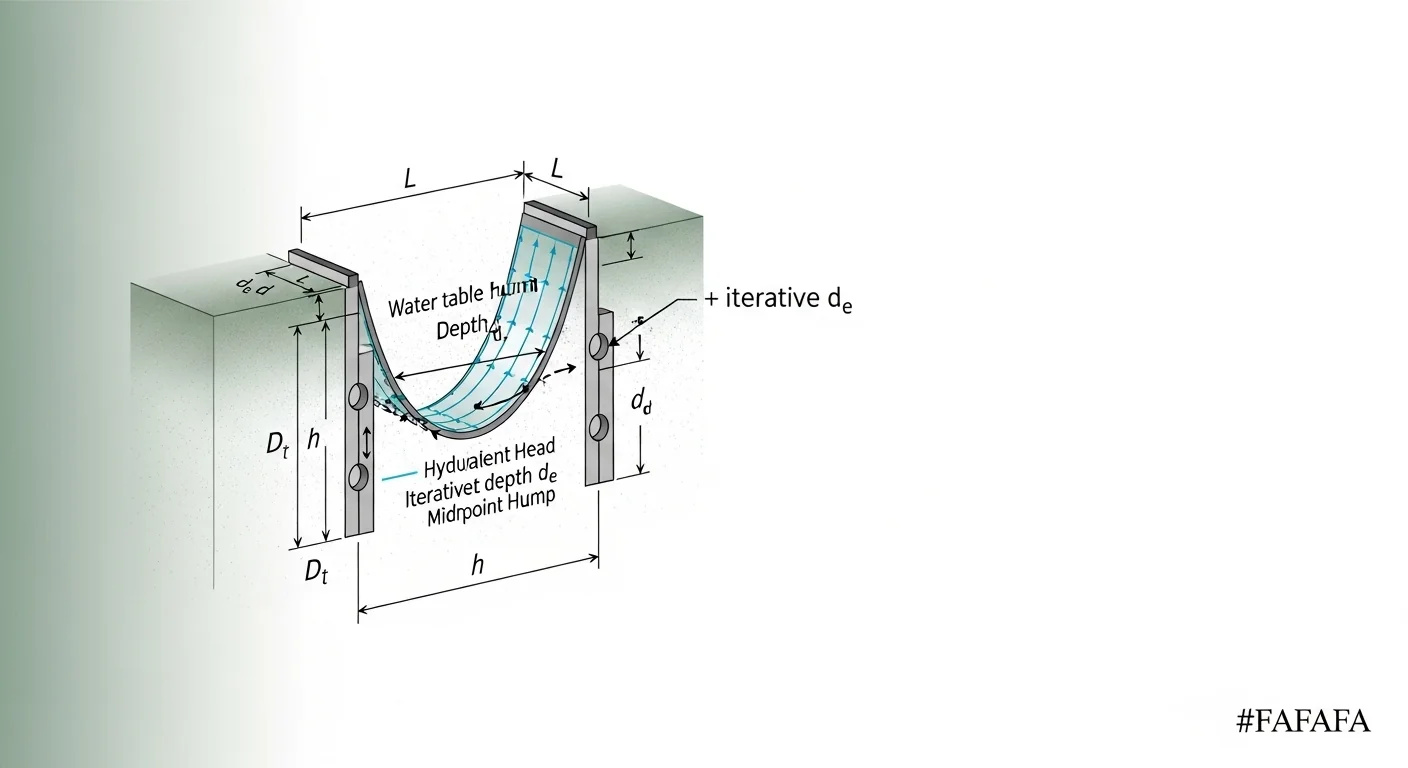
Hooghoudt’s equation models the steady-state water table profile between two parallel subsurface drains as a parabola. The peak of that parabola at the midpoint between drains equals the hydraulic head h. The equation solves for the spacing L that produces a head equal to (tile depth minus target water table depth).
The governing equation is:
L² = (8 · K · d_e · h + 4 · K · h²) / q
Where:
- L = tile spacing (ft or m), the value being solved for
- K = saturated hydraulic conductivity of the soil profile (in/hr or m/day)
- d_e = equivalent depth (ft or m), the Hooghoudt correction for radial convergence near the pipe
- h = hydraulic head (ft or m) = tile depth minus target water table depth
- q = drainage coefficient (in/hr or m/day) = K / 400 per USDA design standard
Step 1: Compute h. Subtract the target water table depth from the tile depth. This is the maximum allowable height of the water table above the drain centerline at the midpoint between pipes.
Step 2: Compute q. Divide K by 400. This is the design drainage rate: the rate at which the soil must remove water to hold the water table at the target depth under continuous rainfall at that same rate.
Step 3: Estimate d_e (initial). Use the closed-form approximation d_e = D multiplied by dt, divided by (D plus dt). This is only a first estimate because d_e depends on L, which is not yet known.
Step 4: Solve for L (first iteration). Insert d_e into the Hooghoudt formula and solve for L by taking the square root of the right side.
Step 5: Iterate. Use the new L to recompute d_e using Bouwer and van Schilfgaarde’s refined formula (accounting for the ratio D/L and the drain pipe radius). Recompute L. Repeat 6 to 8 times until L changes by less than 0.001 ft between iterations. This calculator completes 8 iterations for numerical stability.
Step 6: Check midpoint hump. The water table depth at mid-field is approximately dt minus the square root of [q multiplied by (L/2) squared, divided by (K times d_e)]. When computed spacing L is used directly, this equals the target m. The check becomes critical when L is rounded up to a larger practical spacing.
Rounding rule: Always round L down to the nearest practical spacing (commonly in increments of 10 ft or 5 m). Rounding up creates a wider spacing than computed, which raises the hump above the target.
Assumptions and Limits
- Uniform soil profile: K is assumed identical above and below the drain centerline. Layered soils with different K values require separate calculations for each zone using weighted K methods.
- Steady-state drainage: The equation assumes rainfall is entering the soil at the same rate as drainage is removing it. It does not model the time required to drain a flooded field after a single large rain event.
- Flat topography: Hooghoudt’s equation applies to level fields. On slopes, flow vectors are not purely horizontal, and spacing calculations require slope correction factors.
- Drain radius assumption: The calculator uses a default drain pipe radius of 0.164 ft (0.05 m), corresponding to standard 4-inch corrugated perforated pipe. Larger pipe sizes affect d_e slightly.
- Valid spacing range: Results are most reliable for spacings between 30 and 300 ft (10 and 90 m). Beyond 400 ft, natural field variability in K and D typically dominates, and computed spacing understates real-world hump height.
- Grade requirement not enforced: The calculator does not verify that the site has adequate grade for gravity flow. A minimum of 0.1% grade (1 ft per 1000 ft) is required; 0.5% is recommended. Without sufficient grade, pipes do not drain freely and the calculation is invalid.
- q = K / 400 is the USDA standard but not universal: In regions with high-intensity short-duration rainfall, some drainage engineers use q = K / 300 for a more conservative result. This produces a narrower computed spacing.
- Single-outlet assumption: The formula assumes each tile run drains freely at its outlet. Restrictions at the outlet, such as a ditch that backs up during peak flow, reduce drainage efficiency and require separate hydraulic analysis.
Standards, Safety Checks, and “Secret Sauce” Warnings
Critical Warnings
- The water table hump is not intuitive. Between two drains, the water table forms a parabolic arch that peaks at the exact midpoint. Crops planted at that midpoint experience the shallowest water table on the field. A drain system that appears functional at the pipe locations can still produce waterlogged roots at every mid-row point. This failure mode is the primary cause of yield loss on installed tile systems where spacing was chosen by rule of thumb rather than calculation.
- Rounding up is dangerous in heavy soils. Computed spacings in clay and clay loam soils often fall between standard intervals. Rounding from a computed 143 ft up to 160 ft moves the water table hump from the safe zone into marginal or waterlogged status. In low-K soils, always round down.
- K values from soil surveys are averages, not guarantees. NRCS Web Soil Survey provides K ranges, not single values. Using the upper end of a soil’s K range produces an optimistic (wider) spacing estimate. For design, use the lower end of the mapped K range or conduct in-field auger-hole permeability tests.
- The hump does not dry out uniformly. After a drainage event, the midpoint between drains is the last location to recover. This means the lag from saturation to plantable field conditions is longest at the exact spot where the hump peaked. Measured trafficability recovery does not reflect what is happening in the root zone at mid-row.
Minimum Standards
- Water table depth at mid-field: at least 1.5 ft (0.45 m) below the soil surface for corn and soybeans under design rainfall conditions, per extension drainage engineering guidelines.
- Pipe grade: a minimum of 0.1% (1 ft per 1,000 ft run) for gravity drainage to remain functional; 0.5% grade is the common design target for reliable flow.
- Outlet protection: tile outlets must discharge freely into an open ditch or collector main with no backpressure; a restricted or submerged outlet negates the design spacing entirely.
- Safety factor in clay soils: apply a 15 to 25% reduction to computed L in heavy clay or layered soils where K is uncertain, or where soil variability across the field is high.
Competitor Trap: Most online tile spacing resources provide simple lookup tables that list “recommended spacing by soil texture” without computing the water table hump height at mid-field. A table that says “install drains at 100 ft in clay loam” may be correct for one combination of tile depth and impermeable layer depth, and wildly wrong for another. The only way to know whether a proposed spacing is safe for a specific site is to run the Hooghoudt calculation with site-measured inputs. Texture-based tables are rules of thumb, not design outputs. Using them without verification is how a well-intentioned tile installation produces chronic root zone saturation at every point that is farthest from a pipe.
Related drainage systems that interact with subsurface tile networks include surface inlets and collector mains. The French drain calculator covers surface-to-subsurface drainage transitions, while a sump pump sizing tool helps when tile outlets discharge into a collection basin rather than a free-flowing ditch.
Common Mistakes and Fixes
Mistake: Using Surface Infiltration Rate Instead of Saturated Hydraulic Conductivity
Surface infiltration rate and saturated hydraulic conductivity (K) are related but not interchangeable. Surface infiltration rates reflect topsoil conditions, biological activity, and macropore flow paths that do not represent how water moves laterally through the drainage zone. Using a surface rate typically overestimates K, which leads to wider computed spacings and underperforming drainage systems in practice.
Fix: Use K values from auger-hole permeability tests conducted at or below tile depth, or from NRCS soil survey data for the specific mapping unit at your field location.
Mistake: Setting the Target Water Table Depth Equal to Tile Depth
If the target water table depth equals the tile depth, the hydraulic head (h) becomes zero and the equation returns a spacing of zero, which is a mathematical impossibility in the field. Some operators interpret “tiles drain to their depth” to mean the water table always sits at tile level everywhere. Between drain runs, it does not; the parabolic hump rises above the drain centerline.
Fix: Set the target water table depth to the minimum clearance the crop requires below the surface, typically 1.5 ft for row crops. This ensures h is a positive value that the formula can use.
Mistake: Ignoring the Equivalent Depth Correction (Using D Directly)
Hooghoudt’s equivalent depth (d_e) is always smaller than the actual depth to the impermeable layer (D) because it corrects for the radial flow convergence near the drain pipe. Substituting D directly into the formula overestimates the effective flow depth, producing a spacing that is too wide for the actual site geometry. The error is largest when D is shallow relative to tile depth.
Fix: Always use the iterative d_e value. This calculator performs 8 iterations to converge on the correct d_e. If computing by hand, iterate at least 3 times from an initial estimate of d_e = D times dt divided by (D plus dt). For pipe flow calculations involving the drainage outlet, a Manning’s equation calculator helps size collector mains and outlet ditches independently of the tile spacing design.
Mistake: Rounding Computed Spacing Upward in Low-K Soils
In silt loam, clay loam, and heavy clay soils, the relationship between spacing and water table hump height is sensitive: a 10 to 20 ft increase in spacing beyond the computed maximum can shift the midpoint water table from safe to waterlogged. Because clay soils have low K, the penalty for exceeding the design spacing is disproportionately severe compared to sandy soils, where the margin of safety is wider.
Fix: In low-K soils, round computed L down to the nearest 10 ft interval and apply an additional 15 to 20% safety reduction before finalizing the installation plan.
Mistake: Assuming Grade Is Adequate Without Verification
Hooghoudt’s equation assumes free gravity drainage through the entire pipe length. If the pipe grade is insufficient, water backs up in the line, the effective drainage head is reduced, and the spacing calculation no longer applies. This failure mode produces a tile system that drains well near the outlet but holds water near the upper end of long runs.
Fix: Survey the drain path with a rotary laser level before installation. Confirm that the pipe maintains at least 0.1% grade throughout its run, with no low spots that allow sediment accumulation or backpressure. On undulating terrain, this may require breaking long runs into segments with separate outlets.
Next Steps in Your Workflow
Once you have a confirmed tile spacing from this calculator, the next design task is verifying that your outlet system can handle the drainage flow. Tile drains collect water from every square foot of the drained area and funnel it to a single discharge point. If the outlet ditch, collector main, or pond is undersized, backpressure will prevent the tile from draining freely, and the spacing calculation loses its validity. The pipe volume calculator can help you verify whether a proposed collector main diameter has sufficient capacity for your field area and drainage coefficient.
The evapotranspiration demand of your crops also interacts with drainage design in ways that become relevant during the growing season. Drainage systems sized purely around winter and spring runoff may be inadequate during periods of intense summer rainfall when crop canopies are transpiring at peak rates and soil pores are already partially depleted from ET demand. The evapotranspiration calculator provides a way to estimate seasonal water demand, which can inform how much drainage buffer is appropriate beyond the Hooghoudt minimum.
FAQ
What is Hooghoudt’s equation used for in agricultural drainage?
Hooghoudt’s equation is the standard formula for calculating the maximum spacing between subsurface drainage pipes (tile drains) on flat agricultural land. It accounts for soil hydraulic conductivity, depth to the restrictive soil layer, tile depth, and the allowable water table height between drains. The result is the spacing that keeps the water table hump below a target depth under steady design rainfall.
Why does the water table form a hump between tile drains?
Groundwater flows toward the nearest drain pipe along the path of least resistance. At the exact midpoint between two parallel pipes, water has the longest travel distance to either drain. Under continuous rainfall input, a steady-state arch forms between the two drain runs. This arch, or hump, is always highest at mid-spacing and lowest at the pipe locations. Wider spacing produces a higher hump; shallower tile depth compresses the available head and raises it further.
What hydraulic conductivity value should I use for my field?
Use the saturated K of the soil horizon through which horizontal flow occurs, typically the B horizon or subsoil just above the restrictive layer. NRCS Web Soil Survey provides mapped K ranges by soil series, but these are broad estimates. For precision drainage design on variable soils, field auger-hole or piezometer tests conducted below tile depth provide more reliable site-specific values. Always use the lower end of mapped ranges for conservative design.
How does tile depth affect spacing?
Deeper tile installation increases the hydraulic head (h), which is the difference between tile depth and the target water table depth. A larger h allows the equation to solve for wider spacing because there is more vertical room for the water table hump to form without reaching the root zone. However, deeper installation also increases trenching cost and may be limited by the depth of the impermeable layer.
Can I use this calculator for French drains or surface drainage design?
No. Hooghoudt’s equation applies specifically to subsurface perforated pipe drainage under steady-state conditions in a uniform soil profile. It does not model surface runoff, gravel-filled trench drainage without a pipe, or composite systems that combine surface inlets with subsurface tile. French drain design uses different hydraulic principles based on trench geometry and filter media permeability.
What is a reasonable drainage coefficient (q) for tile drainage design?
The USDA standard design drainage coefficient is q = K / 400, where K is soil hydraulic conductivity in matching units. This represents a conservative steady-state rainfall input that the tile system must handle without letting the water table rise above the target depth. In regions with high-intensity rainfall or where the tile system also handles surface water, some engineers use q = K / 300 for additional conservatism, which produces a narrower, safer spacing.
Conclusion
The central insight of Hooghoudt’s equation, and of this farm tile drainage calculator, is that drainage design is not measured at the pipe. It is measured at the midpoint between pipes, where the water table hump peaks and crop roots experience the worst conditions on the field. The difference between a well-designed drainage system and an underperforming one is often not the choice of pipe material, outlet size, or installation depth in isolation. It is whether the spacing was calculated from the geometry of the water table arch or chosen from a texture-based table that ignores site-specific D, dt, and K interactions.
The most consequential mistake in tile drainage installation is rounding computed spacing upward in fine-textured soils. In sand or loam, a 10 to 20 ft rounding error is absorbed by the wide margin between computed spacing and the root rot threshold. In clay loam and heavy clay, the same rounding error moves the midpoint water table from safe to marginal or waterlogged, and crops at mid-row pay the price across the growing season. Use this tool to compute the maximum safe spacing, then round down and apply a conservative safety factor. For properties that also need to manage runoff volumes or surface water capture before it reaches tile systems, the rainwater harvesting calculator addresses storage design as a complementary surface-water management strategy.