
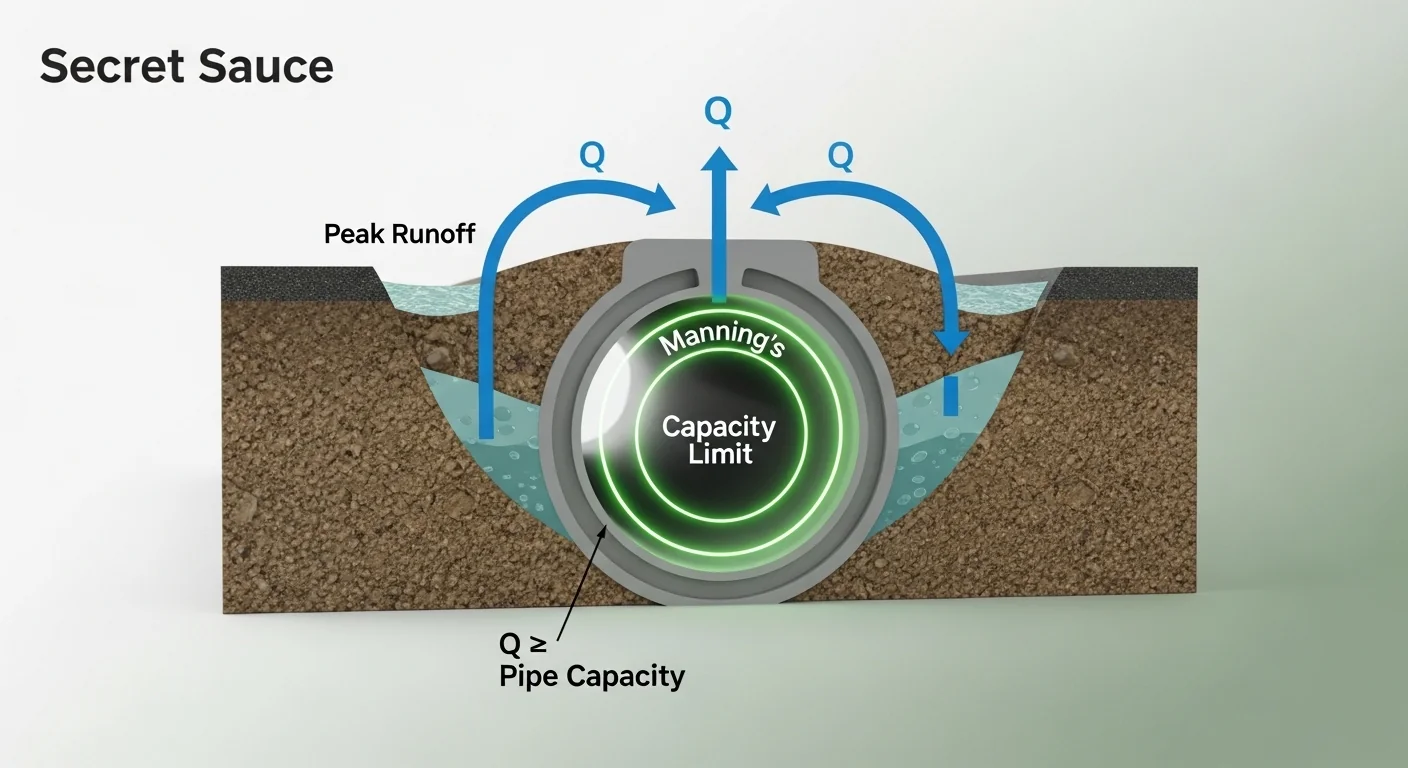
A driveway creek crossing fails not because the pipe corrodes or collapses, but because the pipe was never sized for the actual peak flow it would face. The Rational Method and Manning’s Equation have been the backbone of culvert hydraulics for over a century, yet the majority of residential installations are sized by price and convenience rather than by calculated discharge. A 12-inch corrugated pipe costs less than an 18-inch one. That arithmetic looks different after 5 cubic feet per second overtops a driveway and strips it to bare subgrade. Sizing for the total volume of stormwater your land generates is the starting point; sizing the pipe opening correctly is what keeps the driveway intact.
This driveway culvert size calculator applies the Rational Equation (Q = C x i x A) to compute peak runoff in cubic feet per second, then uses Manning’s full-flow formula to compare that flow against the hydraulic capacity of standard corrugated pipe diameters at your stated slope and roughness coefficient. It identifies the minimum pipe size that will pass the 10-year design storm without overtopping. It does not perform headwater analysis, inlet control sizing, or buoyancy checks. Those require site-specific engineering for higher-value crossings or permitted road approaches.
After running this calculator, you will know whether your proposed pipe diameter passes or fails the 10-year peak flow, what the minimum acceptable diameter is at your slope and pipe material, and exactly how many cubic feet per second of excess flow will overtop your driveway if you undersize.
Use the Tool
Driveway Culvert Pipe Peak Flow
Rational Method & Manning’s Equation — 10-Year Storm Sizing
| Pipe Dia. (in) | Area (ft²) | Hydraulic Radius (ft) | Full-Flow Capacity (cfs) | Status |
|---|
- ADS N-12 Dual-Wall HDPE Culvert Pipe — corrugated exterior for strength, smooth interior for superior flow (n ≈ 0.012)
- Non-Woven Geotextile Filter Fabric — wrap pipe ends & trench walls to prevent soil migration and premature clogging
- Transit / Rotating Laser Level — achieve precise slope grading during installation; critical for design flow velocity
- Heavy-Duty Steel Hand Tamper — compact bedding and backfill in lifts to prevent pipe deflection and washout
How This Calculator Works — Formula Steps
Step 1 — Rational Equation (peak runoff flow):
Where C = dimensionless runoff coefficient (land cover), i = design storm rainfall intensity in inches per hour (10-year return period), and A = drainage area in acres. The equation gives peak discharge in cubic feet per second.
Step 2 — Manning’s Equation (full-flow pipe capacity):
Where n = Manning’s roughness coefficient for the pipe material, A_pipe = cross-sectional area of the full pipe (π r²), R = hydraulic radius = A_pipe / Perimeter = D/4 for a full circular pipe, and S = slope in ft/ft (input % ÷ 100).
Step 3 — Comparison & Upsizing:
The calculator evaluates all standard pipe diameters (12–48 in) and identifies the minimum diameter that can safely pass the design storm peak flow at your stated slope and roughness.
Assumptions & Limits:
- Full-flow Manning’s equation assumes pipe is flowing 100% full — a conservative assumption for peak design.
- Rational Method is calibrated for drainage areas ≤ 200 acres; larger watersheds require TR-55 or HEC-HMS.
- Rainfall intensity should be taken from NOAA Atlas 14 for your location and a 10-year return period (10% annual exceedance probability).
- Entrance/exit losses, debris clogging, and headwater depth are not explicitly computed — add a safety factor (size up one diameter if in doubt).
- Manning’s n values assume new pipe in good condition; aged corrugated metal may require n = 0.027–0.032.
- Design standards: AASHTO HB-17, NRCS Engineering Field Handbook, local DOT drainage manuals.
Assumptions, Limits & Disclaimer
This calculator is a planning tool for driveway culvert size estimation. Results should be reviewed by a licensed civil engineer or qualified drainage contractor before installation, especially for:
- Watersheds > 200 acres or complex topography requiring full hydrologic modeling
- High-value infrastructure or road crossings subject to local/state permitting
- Locations with debris, woody material, or sediment loads that restrict effective pipe diameter
- Sites with standing water (zero-gradient) or tidal influence — special hydraulic analysis required
- Any project requiring stamped engineering drawings for permit submission
Always check your local municipality’s minimum culvert size regulations — many require a minimum 15-inch or 18-inch diameter regardless of calculated flow.
Before calculating, gather the following: the total drainage area flowing toward the crossing (in acres or square feet, from a topo map, county GIS parcel viewer, or surveyed plat), the land cover type so you can match the correct runoff coefficient, the 10-year 1-hour rainfall intensity for your county from NOAA Atlas 14, the measured or estimated slope of the channel through the crossing, and the pipe diameter you are considering. If you already have subsurface drainage in the same watershed, check farm tile drainage capacity to understand what portion of the flow may already be intercepted before reaching the culvert.
Quick Start (60 Seconds)
- Drainage Area: Enter the total land area draining to the crossing. Use acres for fields and rural lots; switch the unit dropdown to square feet for small urban or suburban lots. Do not include area that drains away from the crossing.
- Runoff Coefficient (C): Select the land cover type that best describes the majority of the drainage area. If the watershed contains mixed cover, area-weight the C values before entering a custom value. Rocky or steep terrain (C = 0.60) generates roughly triple the runoff of a wooded lot (C = 0.20) for the same acreage.
- Peak Rainfall Intensity (i): This is not average annual rainfall. It is the peak 1-hour intensity for a 10-year return period at your specific location. Look this up in NOAA Atlas 14 (hdsc.nws.noaa.gov) for your county before entering a value. Do not guess.
- Proposed Pipe Diameter: Select the diameter you plan to install. The calculator will tell you whether it passes and what the minimum acceptable diameter actually is.
- Culvert Length: Enter the full end-to-end pipe length in feet (approximately equal to the driveway width at the crossing). This is used for validation; it does not affect the full-flow Manning’s capacity calculation.
- Slope (%): Enter the longitudinal slope of the channel through the crossing as a percentage. A drop of 2 feet over 100 feet is a 2% slope. Higher slopes increase pipe capacity significantly. Measure with a level and tape, or read from a topographic survey.
- Manning’s n: Select the pipe material. Smooth-bore HDPE and PVC carry more flow than corrugated pipes of the same diameter because of their lower roughness. ADS dual-wall HDPE (smooth interior) uses n = 0.012; corrugated-interior HDPE uses n = 0.024.
Inputs and Outputs (What Each Field Means)
| Field | Unit | What It Represents | Common Mistake | Safe Entry Guidance |
|---|---|---|---|---|
| Drainage Area | acres or sq ft | Total land area whose runoff converges at the culvert inlet during a storm | Using the lot size instead of the actual contributing watershed boundary, which may extend onto neighboring parcels | Trace the watershed boundary on a topographic map or county GIS; measure upslope to the first ridgeline |
| Runoff Coefficient (C) | dimensionless (0.05-0.95) | Fraction of rainfall that becomes surface runoff rather than infiltrating; governed by soil type, slope, and land cover | Choosing “Grass/Lawn” (C = 0.20) for a compacted gravel driveway approach that behaves more like impervious surface (C = 0.70+) | When in doubt, use a higher C value; conservative sizing is cheap insurance against washout |
| Peak Rainfall Intensity (i) | in/hr | Design storm intensity for a 10-year return period (10% annual exceedance probability) at the project location | Using mean annual rainfall or a state-wide average instead of the site-specific NOAA Atlas 14 frequency value | Look up the 1-hour, 10-year value at hdsc.nws.noaa.gov/pfds; values range from roughly 1.0 in/hr (Pacific Northwest) to 7+ in/hr (Gulf Coast) |
| Proposed Pipe Diameter | inches | Nominal inside diameter of the culvert you plan to install; 12-48 inches covering standard corrugated and smooth-bore sizes | Selecting the cheapest available size (12 in) without verifying it against the calculated Q | Use the calculator output to confirm; if in doubt, select the next size up from the computed minimum |
| Culvert Length | feet | End-to-end pipe length; roughly equal to the driveway width at the crossing point | Using the trench length instead of the installed pipe length, which should match the roadway width | Measure the driveway shoulder to shoulder; typical residential crossings are 20-60 ft |
| Slope (%) | percent | Longitudinal gradient of the channel and installed pipe; directly controls flow velocity and hydraulic capacity | Entering channel slope instead of the intended pipe slope, or assuming zero slope on a flat site | Minimum recommended grade is 0.5%; flat sites (<0.5%) require special design attention to avoid sediment deposition |
| Manning’s Roughness (n) | dimensionless | Material-specific coefficient representing internal pipe friction; lower n = smoother bore = higher capacity at identical diameter and slope | Using n = 0.024 for a smooth-bore HDPE pipe that actually has n = 0.012, underestimating capacity by roughly 50% | Match to the pipe interior: corrugated interior = 0.024-0.030; smooth interior HDPE = 0.012; concrete = 0.013 |
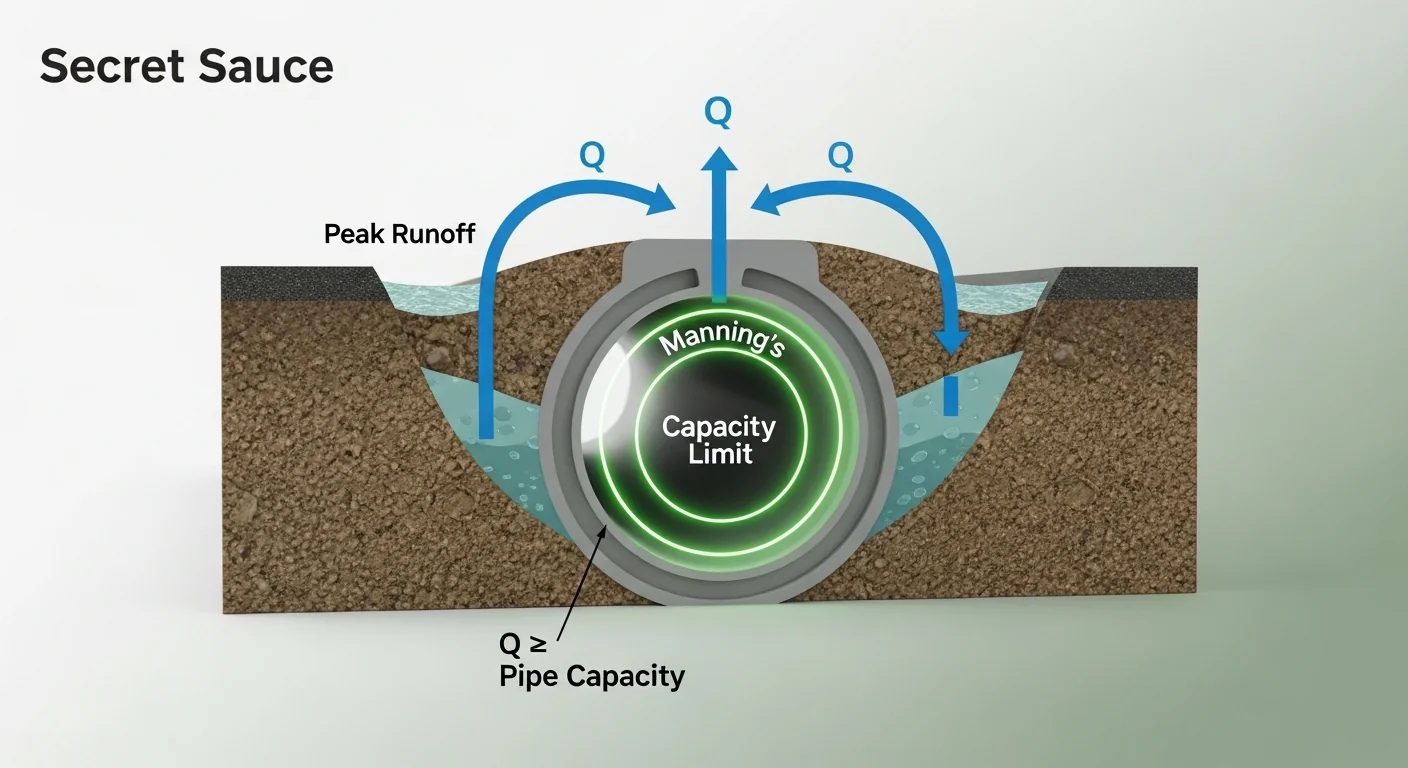
| Peak Runoff Q (output) | cfs (cubic feet per second) | Computed peak discharge from the drainage area during a 10-year design storm; the flow the pipe must carry | Treating Q as average flow rather than a momentary peak; culverts are sized for instantaneous maximum discharge | Compare Q directly to the pipe capacity shown in the reference table; Q must not exceed pipe capacity |
| Minimum Required Diameter (output) | inches | Smallest standard pipe size that passes the computed Q at your slope and n value without overtopping | Installing the computed minimum with no safety factor; a partially blocked inlet can drop effective capacity well below full-flow values | Add at least one standard diameter as a debris and safety margin; many counties mandate a minimum 15-inch or 18-inch regardless of computed Q |
Worked Examples (Real Numbers)
Scenario 1: Small Wooded Lot, Low-Intensity Storm
- Drainage Area: 1.5 acres
- Runoff Coefficient (C): 0.30 (pasture/meadow)
- Rainfall Intensity (i): 2.5 in/hr (10-year, 1-hour)
- Proposed Pipe: 12-inch
- Slope: 1.5%
- Manning’s n: 0.024 (corrugated HDPE)
Result: Q = 0.30 x 2.5 x 1.5 = 1.13 cfs. The 12-inch corrugated pipe at 1.5% slope carries approximately 2.37 cfs at full flow. The pipe operates at roughly 48 of its hydraulic capacity. Status: PASS with a comfortable margin.
This is the scenario where a 12-inch pipe is appropriate. Low coefficient, low intensity, and modest acreage keep the peak flow well within the pipe’s range. The margin is enough to absorb minor inlet blockage from leaf debris.
Scenario 2: Steep Rocky Terrain, Moderate Storm (The Washout Risk)
- Drainage Area: 3.0 acres
- Runoff Coefficient (C): 0.60 (steep rocky terrain)
- Rainfall Intensity (i): 3.5 in/hr (10-year, 1-hour)
- Proposed Pipe: 12-inch
- Slope: 2.0%
- Manning’s n: 0.024 (corrugated HDPE)
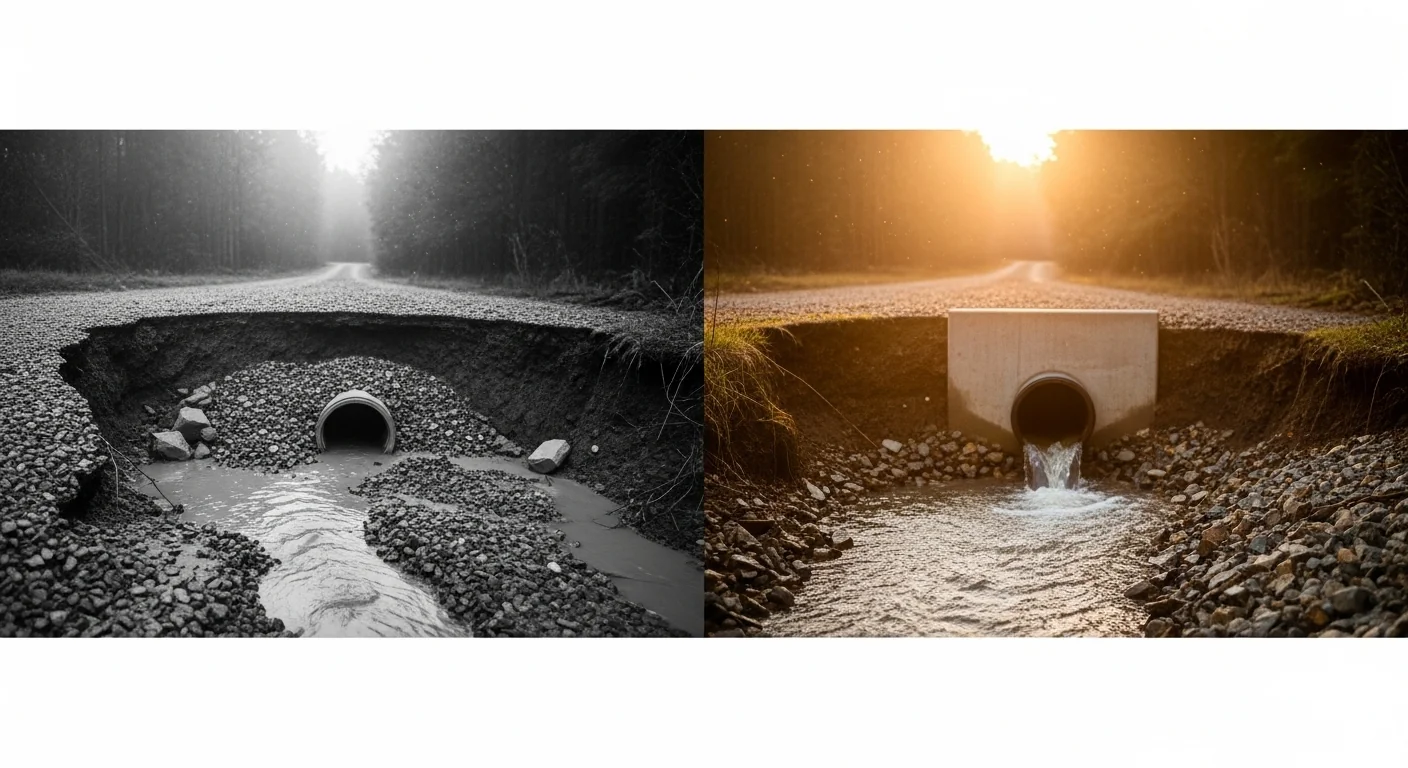
Result: Q = 0.60 x 3.5 x 3.0 = 6.30 cfs. The 12-inch pipe at 2% slope carries approximately 2.74 cfs at full flow. Excess flow: 3.56 cfs overtops the driveway. The minimum pipe that passes is 18-inch (capacity ~8.07 cfs at 2%). Status: OVERTOPPING FAILURE with the proposed 12-inch pipe.
This is the “Corrugated Washout” scenario. Rocky terrain with moderate storm intensity and 3 acres of contributing area generates more than double what a 12-inch pipe can handle. Stepping up to an 18-inch pipe resolves the failure with capacity to spare.
Scenario 3: Paved Parking Area Approach, High-Intensity Storm
- Drainage Area: 0.8 acres
- Runoff Coefficient (C): 0.90 (asphalt/impervious)
- Rainfall Intensity (i): 5.0 in/hr (10-year, 1-hour, Gulf Coast region)
- Proposed Pipe: 18-inch
- Slope: 3.0%
- Manning’s n: 0.013 (smooth-bore concrete pipe)
Result: Q = 0.90 x 5.0 x 0.8 = 3.60 cfs. An 18-inch smooth-bore concrete pipe at 3% slope carries approximately 18.3 cfs at full flow. The pipe operates at roughly 20 of its hydraulic capacity. Status: PASS. The high-intensity storm is offset by the small acreage and the smooth pipe interior.
Even with a near-impervious surface and a high-intensity regional storm, the small drainage area and efficient pipe material keep the flow well within limits. This illustrates how pipe material selection (concrete n = 0.013 vs. corrugated n = 0.024) meaningfully shifts capacity at the same diameter and slope.
Reference Table (Fast Lookup)
Full-flow pipe capacity in cfs computed from Manning’s Equation at Manning’s n = 0.024 (corrugated HDPE, corrugated interior). All values assume full circular flow. Use as a quick pre-check before running the full calculator.
| Pipe Dia. (in) | Flow Area (ft²) | Hydraulic Radius (ft) | Capacity at 0.5% Slope (cfs) | Capacity at 1% Slope (cfs) | Capacity at 2% Slope (cfs) | Capacity at 3% Slope (cfs) |
|---|---|---|---|---|---|---|
| 12 | 0.785 | 0.250 | 1.37 | 1.94 | 2.73 | 3.35 |
| 15 | 1.227 | 0.313 | 2.48 | 3.51 | 4.96 | 6.08 |
| 18 | 1.767 | 0.375 | 4.05 | 5.72 | 8.07 | 9.90 |
| 24 | 3.142 | 0.500 | 8.70 | 12.30 | 17.34 | 21.28 |
| 30 | 4.909 | 0.625 | 15.76 | 22.30 | 31.44 | 38.57 |
| 36 | 7.069 | 0.750 | 25.63 | 36.26 | 51.12 | 62.72 |
| 42 | 9.621 | 0.875 | 38.57 | 54.56 | 76.92 | 94.39 |
| 48 | 12.566 | 1.000 | 55.17 | 78.03 | 110.03 | 135.00 |
For smooth-bore HDPE or PVC pipe (n = 0.012), multiply any table value by approximately 2.0. For smooth concrete (n = 0.013), multiply by approximately 1.85. Capacities scale with the square root of slope; doubling the slope increases capacity by a factor of 1.41.
How the Calculation Works (Formula + Assumptions)
Show the calculation steps
Step 1: Rational Equation (Peak Runoff)
Q (cfs) = C x i x A
Where Q is peak discharge in cubic feet per second, C is the dimensionless runoff coefficient (0.05 to 0.95), i is peak rainfall intensity in inches per hour for the design storm return period, and A is the drainage area in acres. The equation assumes a fully developed storm with a duration equal to or greater than the time of concentration of the watershed. Results are rounded to two decimal places.
Step 2: Manning’s Equation (Full-Flow Pipe Capacity)
Q_pipe (cfs) = (1.49 / n) x A_pipe x R^(2/3) x S^(1/2)
Where n is Manning’s roughness coefficient for the pipe material, A_pipe is the cross-sectional area of the pipe in square feet (pi x r^2 for a full circle), R is the hydraulic radius in feet (equal to D/4 for a full circular pipe), and S is the longitudinal slope expressed as a decimal (slope % divided by 100). The 1.49 constant is the unit conversion factor for US customary units. Results are rounded to two decimal places.
Step 3: Comparison and Minimum Sizing
The calculator evaluates all eight standard pipe diameters from 12 to 48 inches and identifies the smallest diameter whose full-flow capacity equals or exceeds the computed Q. If Q exceeds the capacity of all evaluated sizes, the output flags a requirement for engineering consultation.
Status Thresholds
- Q / Q_pipe at or below 0.70: PASS with safety margin (green)
- Q / Q_pipe between 0.70 and 1.00: CAUTION – pipe is near its hydraulic limit (orange)
- Q / Q_pipe above 1.00: OVERTOPPING FAILURE – pipe is undersized (red)
Assumptions and Limits
- The Rational Method is most accurate for drainage areas up to approximately 200 acres. Larger watersheds require TR-55 or HEC-HMS hydrologic routing.
- Full-flow Manning’s Equation assumes the pipe flows 100% full; this is a conservative assumption used for peak design and overestimates capacity under partial flow at some slopes.
- The calculator does not account for entrance losses, exit losses, or headwater depth. In practice, these energy losses reduce effective capacity and are why real-world culvert design conservatively uses 75-80 of theoretical Manning’s capacity as the design threshold.
- Manning’s n values assume new pipe in undamaged condition. Aged corrugated metal pipe with corrosion or joint offset may have n values 15-25 higher than new-pipe values.
- The Rational Method assumes a single uniform land cover type across the watershed. Mixed-cover watersheds require area-weighted C values before entry.
- Rainfall intensity values must be site-specific 10-year return period values from NOAA Atlas 14 or an equivalent regional IDF curve. Using regional averages or neighboring-county values can introduce significant error in high-gradient intensity zones.
- Debris clogging, beaver activity, root intrusion, and sediment deposition are not modeled. A clogged culvert inlet can reduce effective pipe area to a fraction of its nominal value. Physical maintenance is a required assumption of any calculated capacity.
For a standalone exploration of Manning’s roughness and velocity calculations, the Manning’s Equation calculator on this site lets you test flow scenarios across a range of channel geometries and materials.
Standards, Safety Checks, and “Secret Sauce” Warnings

Critical Warnings
- The Corrugated Washout Catastrophe: Installing a 12-inch corrugated pipe because it is the cheapest option is the single most common cause of residential driveway washout. If upstream acreage includes steep or rocky terrain (C at or above 0.60), even modest storm events generate flows that overwhelm a 12-inch pipe. The excess cubic feet per second do not wait; they overtop the road surface, mobilize gravel aggregate, and erode the subgrade within minutes. The calculator quantifies exactly how many cfs will overtop so the risk is no longer abstract.
- High-C Terrain Multiplier: Moving from a wooded watershed (C = 0.20) to a rocky watershed (C = 0.60) triples peak runoff for identical acreage and storm intensity. Homeowners who successfully used a 12-inch pipe on a heavily wooded lot often replicate that choice on a cleared or rocky lot without recalculating. That assumption fails at the first significant storm.
- Low-Slope Sediment Risk: A culvert installed at less than 0.5% slope may technically pass the peak flow calculation while failing in practice due to sediment deposition inside the pipe. As sediment accumulates, the effective flow area shrinks and the hydraulic capacity drops. The minimum self-cleaning velocity for culverts is generally cited as 2 feet per second; verify this condition separately if your slope is below 0.5%.
- No Safety Factor in the Computed Minimum: The minimum diameter output represents a theoretical full-flow threshold with no margin for inlet blockage, debris accumulation, or entrance losses. Standard practice is to install one standard diameter larger than the computed minimum whenever budget allows, and always to install geotextile fabric at the inlet to reduce debris ingestion. For guidance on adjacent surface drainage that can relieve culvert loading, the yard drainage catch basin calculator helps size interceptor basins upstream.
Minimum Standards
- AASHTO HB-17 / NRCS EFH Chapter 4: Culverts serving driveways and farm crossings must convey the 10-year peak storm without overtopping. The 10-year event is the minimum design standard; state DOT permits for road crossings typically require 25-year or 50-year design storms.
- Local Minimum Diameter Ordinances: Many counties and municipalities impose a minimum culvert diameter of 15 or 18 inches for any driveway crossing, regardless of the computed Q. Always verify local drainage ordinances before ordering pipe.
- Outlet Protection Requirement: Any culvert outlet should be protected with riprap or a flared end section to prevent scour erosion at the discharge point. A properly sized pipe that discharges into an unprotected bank will still produce erosion failure over time. Understanding soil infiltration capacity at the outlet helps predict whether scour protection is critical.
- Geotextile Fabric at Inlet and Trench Walls: Non-woven geotextile filter fabric installed at the pipe inlet and along the trench walls prevents soil migration into the pipe and around it. Without fabric, fine soil particles migrate into the corrugations and progressively reduce effective diameter over several seasons.
Competitor Trap: Generic culvert sizing charts circulating on home improvement forums present a single table of pipe capacities at one assumed slope and one assumed roughness coefficient, with no reference to the storm return period or drainage area. A homeowner using one of these tables who has a steeper slope than the table assumes may install a pipe that is one full size too small. The Rational Method calculation presented in this tool accounts for your specific slope, your specific land cover, and your specific regional storm intensity – three variables that no static chart can combine correctly for your site.
Common Mistakes and Fixes
Mistake: Assuming the Previous Pipe Size Was Correct
A culvert that survived several years without obvious failure is often assumed to be correctly sized. In practice, many residential culverts have failed quietly through progressive inlet scour and partial blockage without a dramatic surface washout. The original installer may have used no calculation at all. Always run the Rational Method calculation against current land cover conditions before replacing a culvert with the same size.
Fix: Treat any replacement project as a new sizing exercise. Land use changes upstream, new impervious surfaces, and cleared vegetation all increase effective C values and raise the design Q relative to when the original pipe was selected.
Mistake: Using Total Property Area as the Drainage Area
The drainage area is the contributing watershed, not the lot. On hilly terrain, a culvert at the bottom of a swale may receive runoff from neighboring parcels, road ditches, or an entire hillside that extends well beyond the property boundary. Underestimating the drainage area directly and proportionally underestimates Q, since Q = C x i x A.
Fix: Trace the watershed boundary on a USGS 7.5-minute topographic quadrangle or a county LiDAR elevation dataset. The boundary is the topographic ridgeline or high-point that divides flow toward the crossing from flow away from it.
Mistake: Ignoring the Difference Between Corrugated and Smooth-Bore Pipe
A 24-inch corrugated HDPE pipe (n = 0.024) carries roughly half the flow of a 24-inch smooth-bore HDPE pipe (n = 0.012) at the same slope. Specifying the wrong roughness coefficient in a calculation, or substituting a corrugated product for a smooth-bore one at a job site after the calculation was done, can result in a technically “correct” design with an installed capacity far below what was calculated. If you are supplementing your culvert with a French drain to intercept lateral flow, the pipe material choice matters in that system as well.
Fix: Match Manning’s n to the actual interior surface of the pipe you will install. When ordering ADS dual-wall HDPE (corrugated exterior, smooth interior), use n = 0.012 in the calculator, not the corrugated value of 0.024.
Mistake: Entering an Incorrect Slope
Slope has a square-root relationship with capacity; doubling the slope increases capacity by a factor of 1.41. A homeowner who estimates slope by eye on a gently rolling site often significantly underestimates the gradient, leading to an overly conservative (and more expensive) pipe selection. The reverse is also possible: overestimating slope on a nearly flat site produces a computed capacity higher than the installed pipe will actually achieve.
Fix: Measure slope with a surveyor’s level, a digital inclinometer, or transit laser level across the channel at the proposed crossing location. Do not estimate by walking the site. A transit laser level is inexpensive and accurate enough for residential culvert sizing.
Mistake: Not Accounting for Future Land Use Changes
A culvert sized for current pasture conditions (C = 0.30) may be significantly undersized if the upstream parcel is later developed, cleared, or paved. Replacing a culvert is an expensive, disruptive project. Design for the likely end-state land use of the contributing watershed, not just its current condition. This is especially relevant for rural residential lots where clearing for structures and driveways can raise the effective C by 0.20 to 0.40 over baseline.
Fix: Use a C value that reflects the most intensive land use likely within the watershed over the design life of the crossing. When uncertain, select the next higher C category. The cost difference between an 18-inch and a 24-inch pipe is minor compared to the cost of a washout and reinstallation within five years.
Next Steps in Your Workflow
Once you have the minimum required diameter from this calculator, the next decision is pipe material selection and installation detail. If your computed capacity is borderline at n = 0.024, switching to a smooth-bore ADS N-12 dual-wall HDPE product (n = 0.012) at the same diameter can recover enough additional capacity to avoid upsizing the diameter entirely. After confirming the pipe size and material, verify that your selected slope produces adequate outlet velocity to prevent sediment deposition. The pipe volume calculator is useful at this stage for estimating material quantities and trench backfill volumes during the procurement phase.
If the drainage area in your calculation is also connected to a low-lying structure, basement, or sump collection point, the culvert sizing result feeds directly into pump sizing decisions downstream. A culvert that successfully passes peak storm flow into a collection basin creates a corresponding surge load on any connected sump pump system. Planning the full drainage pathway from watershed to discharge point before ordering any materials avoids the common outcome of a correctly sized culvert that still floods a structure because the downstream conveyance was not designed to match it.
FAQ
What size culvert do I need for a typical residential driveway?
There is no universal answer. The correct size depends on drainage area, land cover, regional storm intensity, and pipe slope. A 15-inch or 18-inch corrugated pipe is common for small lots with gentle slopes, but the Rational Method calculation must confirm this for your specific site. Many municipalities impose a minimum of 15 or 18 inches regardless of calculated flow.
What is the 10-year storm event and why is it used for culvert sizing?
The 10-year storm event is a storm of sufficient intensity that it has a 10% probability of being equaled or exceeded in any given year. It is the minimum design standard for residential driveway crossings under AASHTO and NRCS guidelines because it represents a frequent enough storm to provide meaningful protection without requiring the extreme over-sizing associated with 50-year or 100-year design storms for low-consequence crossings.
How do I find the rainfall intensity (i) value for my location?
The authoritative source is NOAA Atlas 14, available at hdsc.nws.noaa.gov/pfds. Enter your location coordinates and select the 10-year return period and 1-hour duration. The tool returns a point frequency estimate in inches per hour specific to your county and latitude. Do not use state averages or generic regional tables; intensity varies substantially over short geographic distances in many regions.
Can I use this calculator for a road crossing or bridge culvert?
This calculator applies the Rational Method and Manning’s full-flow equation, which are appropriate for driveway crossings on drainage areas up to roughly 200 acres. Road crossings subject to state or county permitting typically require headwater analysis, inlet control evaluation, and a stamped engineering report. Use this tool for planning and preliminary sizing only; engage a licensed civil or geotechnical engineer for permitted crossings.
What is Manning’s roughness coefficient and which value should I use?
Manning’s n is a dimensionless empirical coefficient representing the internal roughness of the pipe material. Lower values mean smoother interiors and higher flow capacity at identical pipe geometry and slope. Smooth HDPE or PVC pipe uses n = 0.012. Corrugated HDPE with a corrugated interior uses n = 0.024. Corrugated metal pipe uses approximately 0.025. Concrete pipe uses 0.013. Always match n to the interior surface of the product you will install.
What happens if my required pipe size is larger than 48 inches?
A computed Q exceeding the capacity of a 48-inch pipe at your stated slope indicates a large drainage area, steep terrain, or high-intensity regional storm requiring hydraulic analysis beyond the Rational Method. In this range, site-specific hydrologic routing, possible multi-barrel installation, or a bridge structure may be warranted. Consult a licensed civil engineer with drainage and hydraulics experience before proceeding.
Conclusion
The difference between a driveway that survives decades and one that requires emergency repair after its first significant storm is almost always a single calculation that was either never run or run with the wrong inputs. The Rational Equation is not complicated, but the inputs to it require real site data: a measured drainage area, a correctly matched runoff coefficient, and a site-specific storm intensity value from a frequency atlas. Skipping any one of those steps and substituting an estimate or a regional average is how an undersized pipe ends up in a creek crossing that will overtop.
The most important takeaway is this: if your drainage area includes steep, rocky, or cleared terrain with a runoff coefficient at or above 0.60, do not assume a 12-inch pipe is adequate. Run the calculation with your actual area and intensity values. If the result shows overtopping, size up. The cost of stepping from a 12-inch to an 18-inch corrugated pipe is trivial against the cost of a washout, reinstallation, and road repair. For additional context on sizing adjacent drainage infrastructure that works in combination with your culvert, the pond and retention basin planning tools on The Yield Grid address the downstream side of the same drainage system.