
Flow rate determines everything downstream: whether a drip system can reach all zones, whether a sprinkler head runs at its rated pressure, whether a pump is undersized or throttled by a kinked line. The problem is that most homeowners and small-farm irrigators work backward from a labeled hose spec or an assumed PSI value, neither of which accounts for actual on-site conditions. Measuring flow directly, at the point of use, removes that uncertainty.
This calculator takes two measurements from the bucket test method and returns Gallons Per Minute (GPM), Gallons Per Hour (GPH), Liters Per Minute (LPM), and Gallons Per Second (GPS). It does not estimate pressure, does not account for elevation change, and does not model friction losses in the supply line. What it does is convert a timed fill measurement into the flow unit most relevant to your system. For drip irrigation, GPH is the operative number; GPM matters more for sprinkler heads and pump sizing. Both are displayed so nothing gets lost in translation.
After running this calculator, you will know your measured flow rate in the unit your irrigation components require, so you can cross-reference emitter ratings, size runtime, or flag a supply restriction before designing an entire zone around a wrong assumption.
Use the Tool
| Bucket (Gal) | Fill Time (Sec) | GPM | GPH |
|---|
How this calculator works
Formula used (Hose Bucket Test):
Step-by-step with your values:
- Measure bucket size in gallons (Gal)
- Time how long to fill bucket completely (Sec)
- Divide: Gal ÷ Sec = gallons per second (GPS)
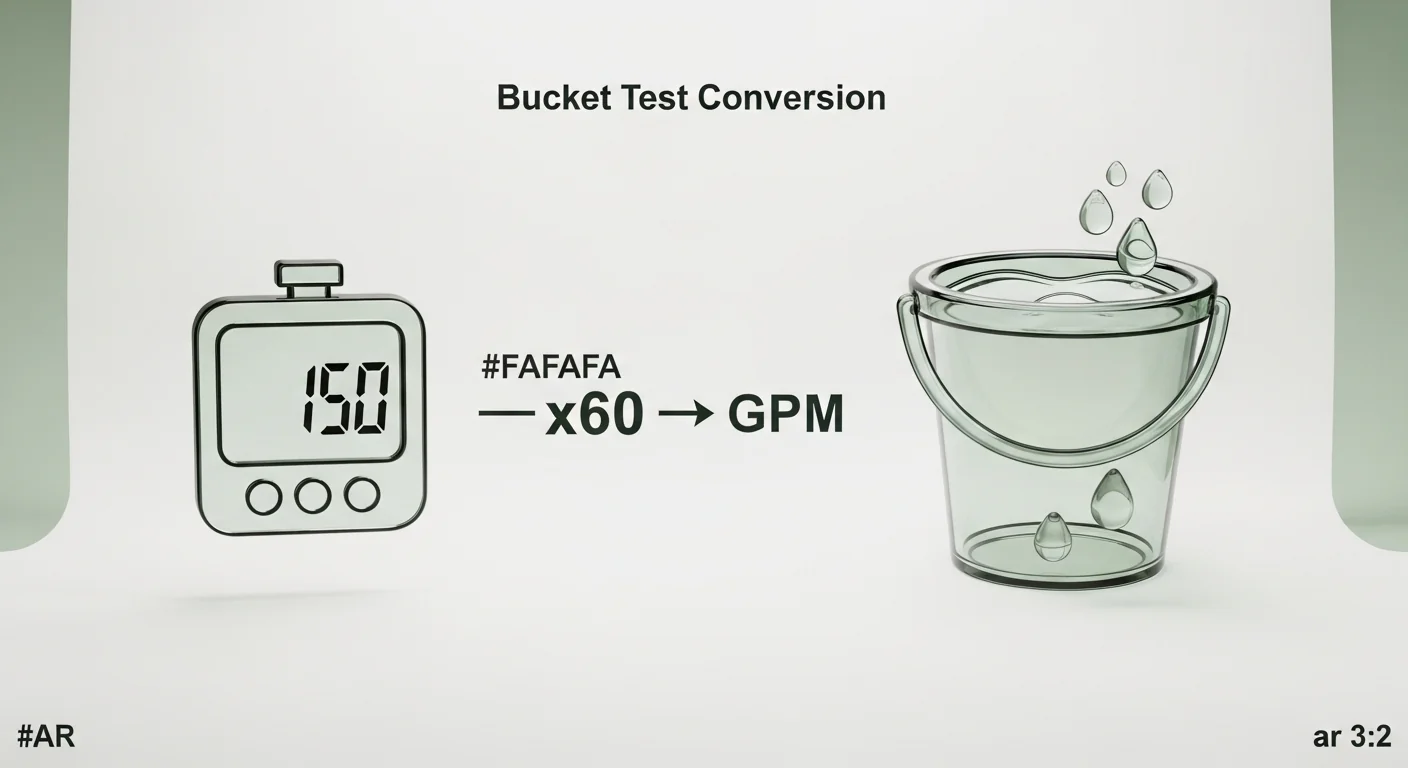
- Multiply by 60 to convert to GPM: GPS × 60 = GPM
- Multiply GPM by 60 to get GPH: GPM × 60 = GPH
Unit conversions applied:
- GPH = GPM × 60 (gallons per hour — useful for drip irrigation)
- LPM = GPM × 3.78541 (liters per minute)
- GPS = GPM ÷ 60 (gallons per second)
| Scenario | GPM | GPH | Use Case |
|---|---|---|---|
| Drip emitter (1 gal bucket / 120 sec) | 0.5 GPM | 30 GPH | Drip irrigation |
| Slow fill (5 gal / 120 sec) | 2.5 GPM | 150 GPH | Sprinkler head |
| Medium flow (5 gal / 60 sec) | 5.0 GPM | 300 GPH | Garden hose |
| Typical hose (5 gal / 30 sec) | 10.0 GPM | 600 GPH | Garden hose (60 PSI) |
| High flow (5 gal / 20 sec) | 15.0 GPM | 900 GPH | Heavy irrigation |
| Fast fill (5 gal / 15 sec) | 20.0 GPM | 1200 GPH | Fire hose / commercial |
Assumptions & Limits
This calculator assumes:
- Water pressure remains constant during the bucket-fill test.
- The bucket volume is accurate (check manufacturer label or use a calibrated container).
- Timing begins the moment water starts entering the bucket and ends exactly when it’s full.
- No backpressure or restrictions in the hose between the faucet and bucket.
Valid input ranges:
- Bucket size: 0.1 – 1,000 gallons
- Fill time: 1 – 86,400 seconds (up to 24 hours)
Note: Actual hose flow varies with hose diameter, length, pressure, and elevation. For precise irrigation planning, consult your local water utility for supply pressure specs.
Before you start, have a container with a known volume ready (a labeled bucket works; a 5-gallon pail is the standard field choice), a stopwatch or phone timer, and clear access to the hose outlet you are actually testing. Measure from the same tap and hose length you plan to use in operation. If you are sizing a drip system, also check your sprinkler run time calculator after getting your GPM, since runtime depends directly on the flow rate entering each zone.
Quick Start (60 Seconds)
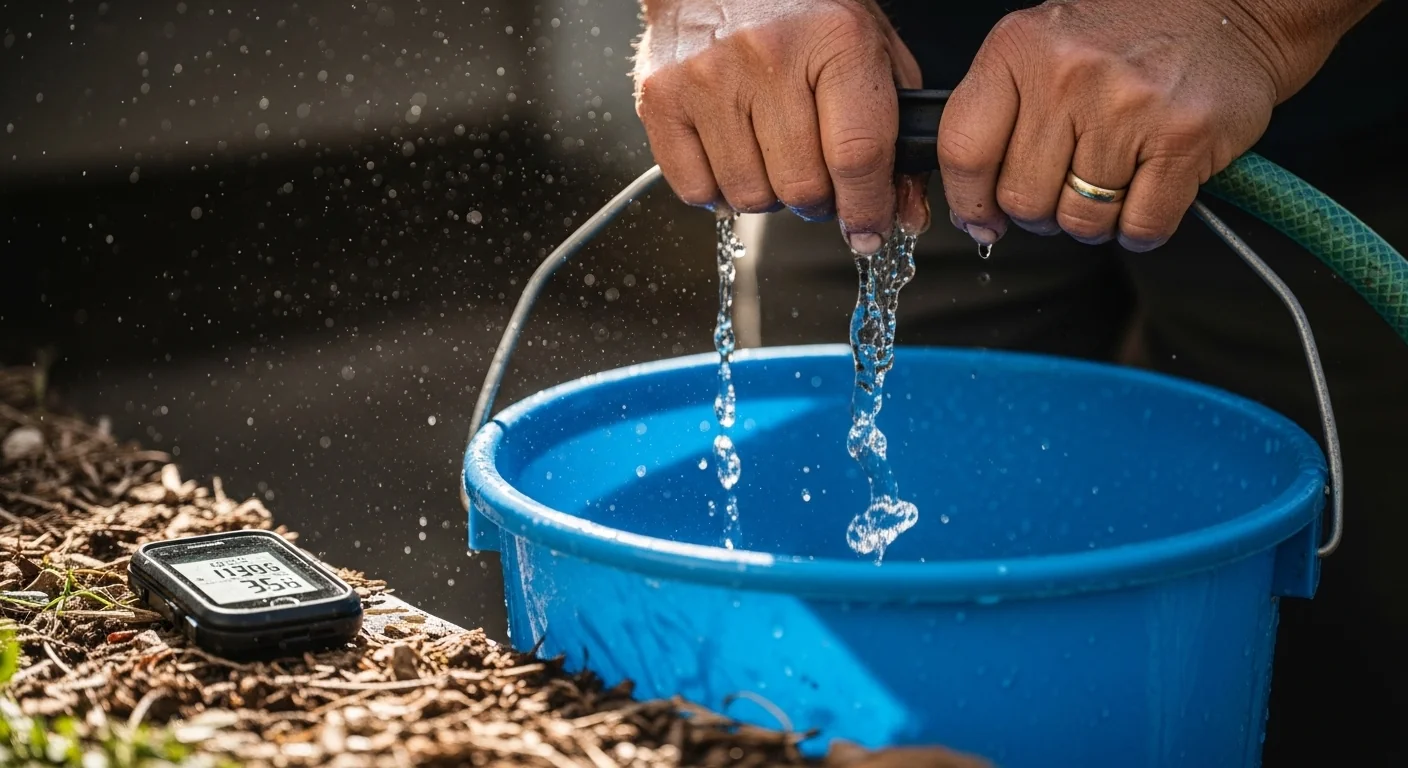
- Grab your bucket and confirm the volume in gallons. Do not estimate. Read the molded label on the bucket or use a calibrated container. Errors here scale directly into the GPM result.
- Run the hose for 30 seconds before timing. Purging air from the line stabilizes pressure and gives you a representative reading rather than a surge-start measurement.
- Enter Bucket Size in gallons. Acceptable range is 0.1 to 1,000 gallons. Fractional values (e.g., 2.5) are valid.
- Start the timer the moment water enters the bucket, stop it the moment it reaches the full mark. Enter this time in whole seconds. Do not round to the nearest five.
- Enter Time to Fill in seconds. Valid range is 1 to 86,400 seconds. For very slow trickle systems, use a larger bucket rather than stopping and restarting.
- Click Calculate. Both fields must be filled; the tool will not run and will not update results if either field is empty or out of range.
- Check the GPH output if you are sizing drip emitters. Drip components are rated in Gallons Per Hour, not GPM. Using the wrong unit when selecting emitters is the most common planning error in low-volume irrigation.
Inputs and Outputs (What Each Field Means)
| Field | Unit | What It Means | Common Mistake | Safe Entry Guidance |
|---|---|---|---|---|
| Bucket Size | Gallons (Gal) | The known volume of the container you are filling during the timed test | Using an unlabeled bucket and guessing the volume | Use a factory-labeled bucket; verify with water weight if uncertain (1 gallon = 8.34 lb) |
| Time to Fill | Seconds (Sec) | The elapsed time from first water entering the container to reaching the full-volume mark | Starting the timer before the hose is fully open or stopping at partial fill | Use a phone stopwatch; count from the first splash, stop at the waterline mark, not overflow |
| GPM (output) | Gallons Per Minute | Primary flow rate; used for sprinkler head rating, pump sizing, and zone capacity planning | Using this value directly for drip emitter sizing (drip uses GPH) | Compare to your sprinkler or pump spec sheet; standard hoses run 9 to 17 GPM at 60 PSI |
| GPH (output) | Gallons Per Hour | Flow rate over one hour; the standard unit for drip emitters, soaker hoses, and micro-irrigation components | Ignoring GPH entirely and sizing a drip system by GPM alone | Match this to the sum of emitter GPH ratings in your drip zone for correct runtime |
| LPM (output) | Liters Per Minute | Metric equivalent of GPM; useful for international equipment specs or metric pipe sizing | Mixing LPM and GPM figures when comparing product spec sheets | 1 GPM = 3.785 LPM; confirm which unit a component's datasheet uses before substituting |
| GPS (output) | Gallons Per Second | Instantaneous flow; useful for hydraulic engineering calculations and high-volume applications | Using GPS in irrigation design formulas that expect GPM or GPH | GPS is informational here; convert back to GPM (x60) for all standard irrigation planning |
Worked Examples (Real Numbers)
Scenario 1: Standard Garden Hose at Typical Residential Pressure
- Bucket Size: 5 gallons
- Time to Fill: 30 seconds
Result: GPM = (5 / 30) x 60 = 10.0 GPM | GPH = 600 | LPM = 37.85
This is the benchmark reading for a 5/8-inch garden hose at roughly 60 PSI supply pressure. A result in the 9 to 12 GPM band confirms the supply line is not significantly restricted and the hose length and diameter are not creating meaningful friction loss.
Scenario 2: Drip Zone Supply Line Test
- Bucket Size: 1 gallon
- Time to Fill: 60 seconds
Result: GPM = (1 / 60) x 60 = 1.0 GPM | GPH = 60 | LPM = 3.785
At 60 GPH, this supply line can support a drip zone with total emitter demand up to 60 GPH before the system runs at maximum capacity. A zone loaded to 75 GPH of emitters would be undersupplied and individual emitter output would drop below rated values.
Scenario 3: High-Flow Hose or Commercial Tap
- Bucket Size: 5 gallons
- Time to Fill: 15 seconds
Result: GPM = (5 / 15) x 60 = 20.0 GPM | GPH = 1,200 | LPM = 75.7
A result above 17 GPM exceeds the typical residential garden hose range. This usually indicates either a 3/4-inch or 1-inch commercial-grade hose, very high supply pressure (above 80 PSI), or a measurement error (partial fill counted as full). Verify the bucket mark and repeat the test before relying on this figure for zone design.
Reference Table (Fast Lookup)
| Bucket (Gal) | Fill Time (Sec) | GPS (Gal/Sec) | GPM | GPH | Typical Application |
|---|---|---|---|---|---|
| 1 | 120 | 0.008 | 0.5 | 30 | Slow drip emitter / trickle feed |
| 1 | 60 | 0.017 | 1.0 | 60 | Micro-sprinkler, single drip zone |
| 5 | 120 | 0.042 | 2.5 | 150 | Low-flow sprinkler head (1 head) |
| 5 | 60 | 0.083 | 5.0 | 300 | Garden hose at reduced pressure |
| 5 | 45 | 0.111 | 6.7 | 402 | 1/2-inch hose at 40-50 PSI |
| 5 | 30 | 0.167 | 10.0 | 600 | 5/8-inch garden hose at 60 PSI |
| 5 | 20 | 0.250 | 15.0 | 900 | 3/4-inch hose at high pressure |
| 5 | 15 | 0.333 | 20.0 | 1,200 | Commercial tap / fire-hose range |
| 10 | 60 | 0.167 | 10.0 | 600 | Larger bucket confirming 5/8-inch result |
| 2 | 30 | 0.067 | 4.0 | 240 | Single pop-up rotor sprinkler head range |
How the Calculation Works (Formula + Assumptions)
Show the calculation steps
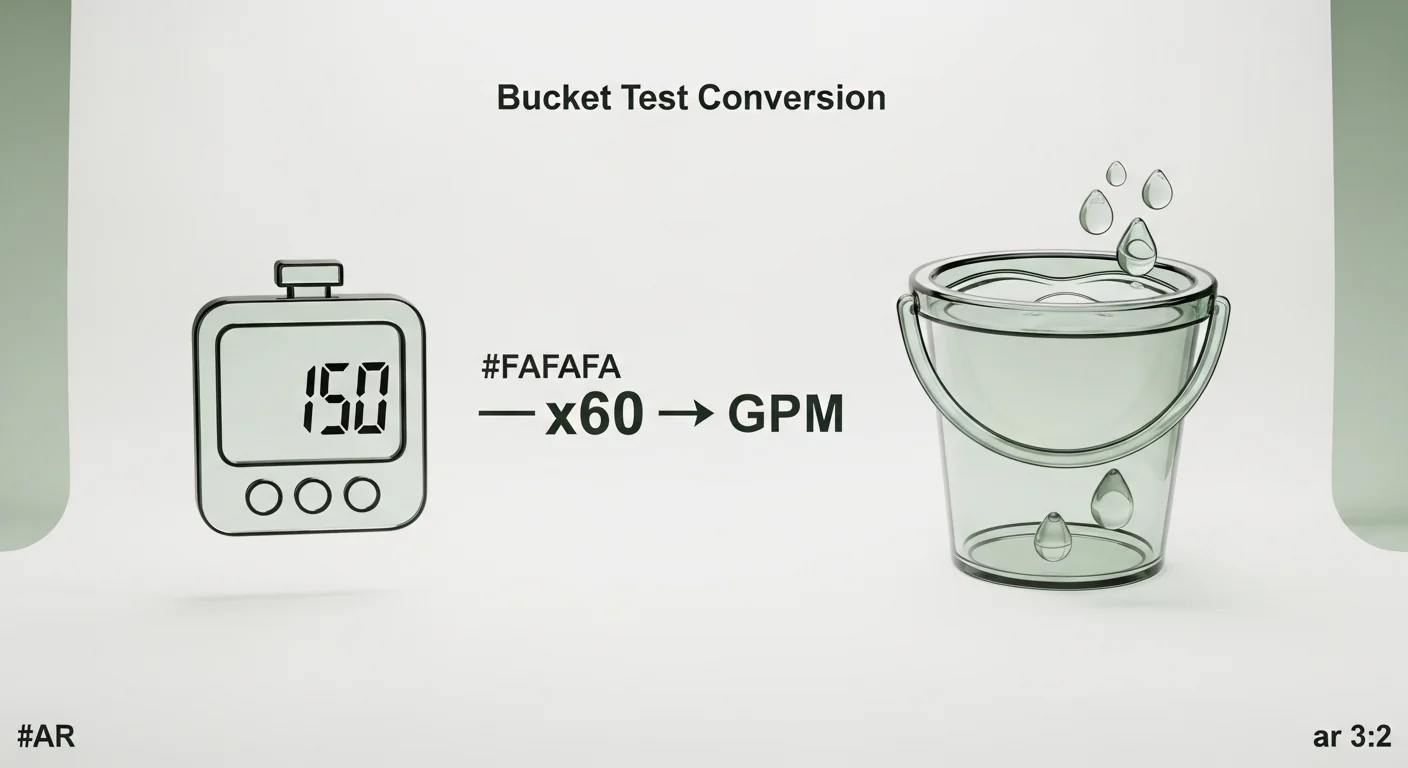
The bucket test uses a single formula derived from dimensional analysis of volume and time:
- Measure volume. Record the bucket capacity in gallons (Gal).
- Measure time. Record fill time in seconds (Sec).
- Compute Gallons Per Second. GPS = Gal / Sec
- Convert to GPM. GPM = GPS x 60 (there are 60 seconds in one minute)
- Convert to GPH. GPH = GPM x 60 (there are 60 minutes in one hour)
- Convert to LPM. LPM = GPM x 3.78541 (exact NIST conversion factor)
Rounding rule: GPM is displayed to 2 decimal places. GPH is displayed to 1 decimal place. LPM is displayed to 2 decimal places. GPS is displayed to 3 decimal places.
Unit conversion factor source: 1 US gallon = 3.785411784 liters (NIST standard). The calculator uses 3.78541 (6 significant figures).
Assumptions and Limits
- Water pressure at the tap is assumed to remain constant for the entire duration of the fill test. Pressure fluctuations during peak demand hours (early morning, evening) will shift results.
- The bucket volume is assumed to be exactly the labeled capacity. Plastic buckets can vary by up to a few ounces from their nominal rating.
- The hose is assumed to be fully open with no partial-open valve restricting flow at the outlet during the test.
- No friction loss correction is applied. A longer hose run between the tap and the bucket will produce a lower GPM reading than a short run at the same pressure. The measurement reflects delivered flow at the test point, not supply flow at the tap.
- Elevation change between the tap and the test point is not accounted for. Significant downhill runs increase flow; uphill runs decrease it.
- The formula applies only to incompressible liquids (water) at ambient temperature. Flow behavior changes measurably at very high or very low temperatures.
- Input ceiling of 86,400 seconds (24 hours) exists for validation only; a fill test that long would indicate flow too slow to be relevant to hose or sprinkler applications.
Standards, Safety Checks, and "Secret Sauce" Warnings
Critical Warnings
- GPM is the wrong unit for drip emitter planning. Drip emitters are rated in GPH (gallons per hour), not GPM. A 1 GPM supply line delivers 60 GPH, which may support a zone of 30 two-GPH emitters. Skipping the GPH conversion and sizing directly from GPM leads to systematic undersupply in drip systems. The calculator displays both outputs precisely to close this gap. For detailed drip zone runtime planning, the drip irrigation run time calculator takes your GPH directly as an input.
- Flow below 5 GPM from a standard garden hose likely signals a restriction, not a low-pressure supply. Common culprits include a partially closed shutoff valve, a kinked section of hose, a flow-restricting spray head left on the outlet, or a clogged filter washer at the hose bib. Treat a sub-5 GPM reading as a troubleshooting flag before using it as a design input.
- A result above 17 GPM from a residential tap warrants a retest. Residential municipal supplies typically provide 40 to 80 PSI. At 80 PSI through a standard 5/8-inch hose, flow above 17 GPM is unusual. Verify the bucket volume, confirm the timer started accurately, and run the test twice. Matching results confirm a genuine high-flow reading.
- Do not use a flow reading taken mid-irrigation-cycle as a baseline. If other zones or fixtures are running simultaneously, supply pressure drops and the measured flow rate will be lower than the available single-tap flow. Test with all other water uses turned off.
Minimum Standards
- Standard 5/8-inch garden hoses at 60 PSI supply pressure should produce 9 to 17 GPM measured at the outlet. Results outside this range indicate either atypical conditions or a measurement issue.
- Drip irrigation supply lines are commonly designed to run at 0.5 to 2 GPM (30 to 120 GPH) with a pressure regulator installed upstream.
- A single rotary sprinkler head typically draws 1 to 4 GPM at operating pressure. Confirm individual head flow against the manufacturer spec sheet, since matched precipitation planning depends on all heads in a zone having the same precipitation rate. The matched precipitation rate calculator can help with that zone-level check.
- Friction loss in a hose run increases with length and velocity. A high GPM reading at the tap can drop meaningfully at the end of a long hose. For supply-line planning, also review friction loss values for your pipe or hose diameter.
Competitor Trap: Most online GPM calculators display only one output and label it "flow rate" without specifying the unit context or flagging whether GPM or GPH is appropriate for the user's use case. A drip irrigation user who reads "1 GPM" and assumes that means 1 unit per hour will systematically missize every emitter in their system. This calculator always displays GPH alongside GPM, includes a drip-specific usage callout in the results, and interprets your reading against the actual application range (drip vs. sprinkler vs. hose). That is not a cosmetic difference; it is the difference between a functional irrigation zone and a chronically underwatered bed.
Common Mistakes and Fixes
Mistake: Timing from When the Hose Valve Opens, Not When Water Reaches the Bucket
There is always a short delay between opening the valve and water reaching the container, especially on long hose runs. Starting the timer at valve-open rather than first-water-in-bucket artificially inflates the recorded fill time, producing a lower GPM result than actual. The fix is to position the hose outlet directly over the bucket and start timing the moment the first water hits the container floor.
Fix: Pre-position the hose and use a visual trigger (first splash) rather than a mechanical trigger (valve turn) to start the timer.
Mistake: Using a Bucket With an Ambiguous Fill Line
Five-gallon utility buckets have a molded volume indicator, but "5 gallons" typically refers to the bucket's total capacity to the brim, not to a marked fill line. Stopping at two-thirds fill and calling it 5 gallons compresses the true fill time and inflates GPM. Similarly, overfilling above the rated line understates flow time. The catch-can test calculator covers related measurement precision issues for precipitation uniformity testing.
Fix: Mark the exact gallon level on the inside of the bucket with a permanent marker, verified against a kitchen measuring jug, before running the test.
Mistake: Running the Test While Other Water Fixtures Are Active
Supply pressure is shared across all open fixtures in a household or irrigation system. A washing machine, toilet refill, or active irrigation zone running simultaneously will depress pressure at the test tap, lowering the measured GPM. This is especially significant on wells with pressure tanks, where drawdown reduces pressure noticeably mid-test. For gravity-fed systems, see the gravity-fed drip irrigation calculator which accounts for head-driven flow rather than pressure-driven flow.
Fix: Confirm all other water fixtures are closed and all irrigation zones are off before starting the bucket test.
Mistake: Testing at the Spigot Instead of the End-Use Point
Flow measured directly at the outdoor spigot does not account for friction loss in the hose run, elevation change, or any filter, pressure regulator, or backflow preventer installed between the tap and the irrigation zone. A 10 GPM tap reading may become 7 GPM at the end of 200 feet of 1/2-inch hose. Designing around tap flow rather than delivered flow creates zones that run short on water on every cycle.
Fix: Run the full hose setup as it will be used in operation, including all fittings and filters, then test at the outlet end.
Mistake: Applying a GPM Reading from One Season to Another
Municipal water supply pressure varies seasonally in many regions. Summer peak demand periods often reduce line pressure by 10 to 20 PSI relative to winter readings, which lowers delivered flow. A spring GPM test used to design summer irrigation zones may overestimate available flow by the time those zones run most often.
Fix: Test flow during the highest-demand period you plan to run the system, typically midsummer midday. Use that reading as the design baseline rather than a favorable off-peak result.
Next Steps in Your Workflow
Once you have a confirmed GPM (and the GPH for drip zones), the next calculation in the sequence is pump or zone sizing. If your supply delivers 10 GPM and your zone design calls for 12 GPM of sprinkler heads, the system will run below rated precipitation. The correct fix is either to split the zone, reduce the number of heads, or evaluate whether the supply can be upgraded. The irrigation pump sizing calculator handles the next step if a pump is in the circuit, using your measured flow and required system pressure as inputs.
For drip systems, the path after getting GPH is runtime calculation. Drip zones are not sized by pressure alone; they are sized by the ratio of GPH supply to total zone emitter demand, then run-time is adjusted to meet target application depth. That sequencing lives in the drip irrigation runtime calculator, which accepts GPH directly and walks through zone demand against supply without requiring a separate unit conversion.
FAQ
What is a normal GPM for a garden hose?
A standard 5/8-inch residential garden hose at 60 PSI supply pressure typically delivers 9 to 17 GPM measured at the outlet. Results below 9 GPM suggest a restriction somewhere in the supply path. Results above 17 GPM from a standard residential tap are unusual and usually indicate a large-diameter hose, very high supply pressure, or a measurement error. Confirm with a second test before using the number in any design calculation.
What is the difference between GPM and GPH, and which one matters for my irrigation?
GPM (gallons per minute) is used for sprinkler heads, pumps, and zone capacity planning. GPH (gallons per hour) is the standard unit for drip emitters, soaker hoses, and micro-irrigation components. The same flow is described by both units: 1 GPM equals 60 GPH. Which one matters depends on the component spec sheets you are matching against. Always check whether your irrigation product is rated in GPM or GPH before sizing.
Can I use a container other than a 5-gallon bucket?
Yes. Any container with a verified, known volume works. Common alternatives include 1-gallon milk jugs (accurate but slow for high-flow hoses), 2.5-gallon watering cans, and 10-gallon stock tanks. The key requirement is a known volume in gallons and a clear fill line. For very high flow rates, larger containers reduce timing error because a 2-second mistake over a 60-second fill is less significant than a 2-second mistake over a 10-second fill.
Why does my GPM result seem lower than the hose manufacturer's rated flow?
Manufacturer flow ratings are typically measured at the inlet of the hose under controlled pressure, often 80 PSI, with no fittings or accessories attached. Your field measurement reflects delivered flow at the outlet end, after friction losses from hose length and diameter, any kinks or bends, connector fittings, and supply pressure at your specific tap. The bucket test result is the operationally accurate number for your setup, even if it does not match the label.
How do I get a more accurate reading for very slow drip systems?
For systems delivering under 1 GPM, use a 1-gallon container and a long fill time rather than a 5-gallon bucket that takes several minutes to fill. Longer fill times reduce the proportional impact of a 1 or 2-second timing error. If the fill time exceeds 5 minutes, consider whether a flow meter rated for low-flow applications would give you a more practical measurement tool for routine checks.
Does the calculator account for water pressure or hose diameter?
No. The calculator uses only the bucket volume and fill time you enter. It does not model pressure, pipe diameter, hose length, or friction loss. Those factors affect the actual flow your setup delivers, and the bucket test implicitly captures all of them in one measurement. The output is the real delivered flow rate at the test point under test conditions, which is more useful for irrigation planning than a theoretical pressure-based estimate.
Conclusion
The bucket test is the most direct method available for measuring actual delivered flow at any point in a water system. The two inputs it requires (volume and time) are easy to collect accurately with basic tools, and the formula converts them into every flow unit relevant to irrigation planning. Using a field measurement rather than a labeled spec or an assumed pressure value removes one of the most persistent sources of error in zone design and runtime calculation.
The single most important mistake to avoid is sizing a drip irrigation system from GPM without converting to GPH. Drip emitters are rated in GPH; the mismatch is not a rounding issue, it is a factor-of-60 error that affects every emitter, every zone, and every runtime calculation downstream. This calculator surfaces GPH automatically alongside GPM so that conversion is built into the workflow, not an afterthought. For any project that moves water from a source through a pressurized line to a distribution network, also review the pipe volume calculator to account for the volume held in the supply line itself, particularly relevant for large drip and irrigation systems where line fill time affects zone startup behavior.