
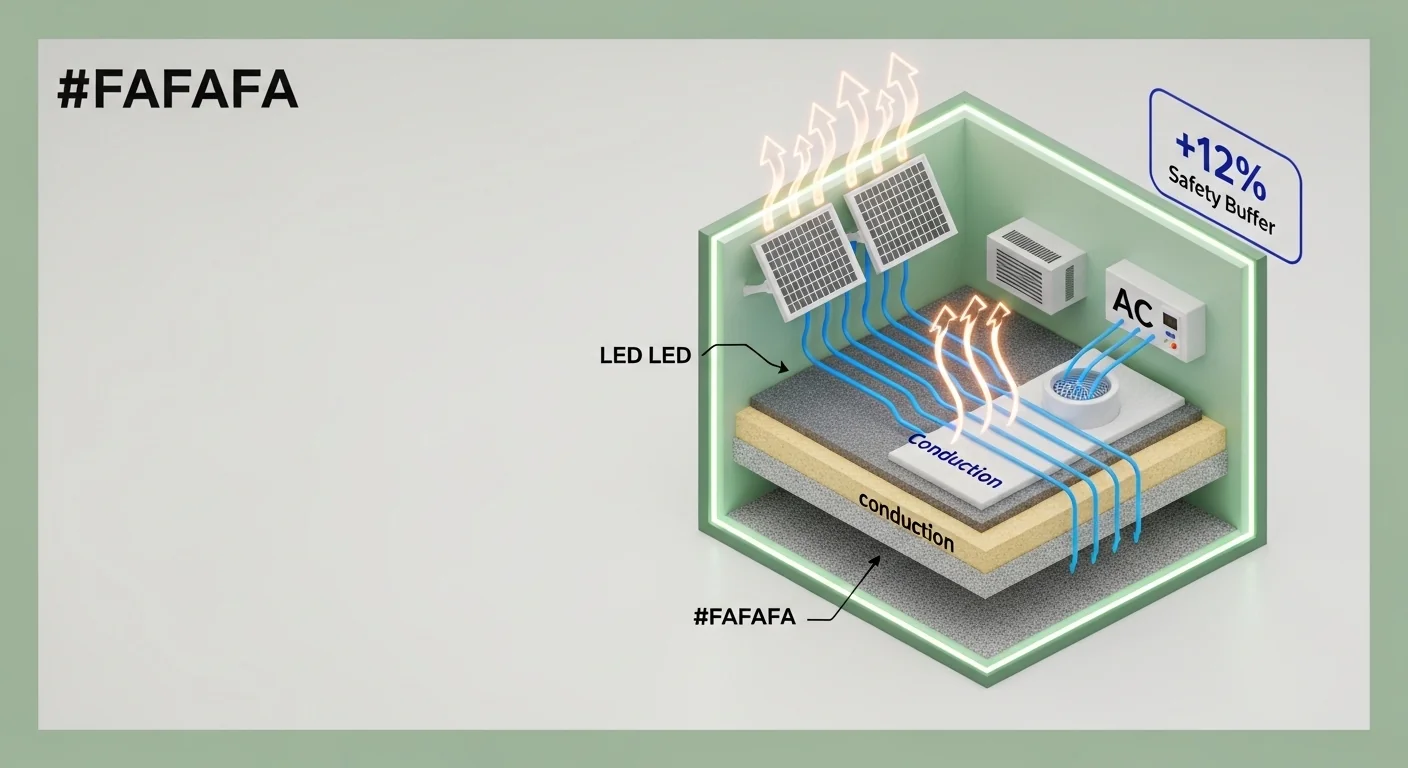
LED Heat Dissipation & HVAC Sensible Load
Grow room AC sizing — BTU/hr & tonnage calculator
| LED Watts | BTU/hr (Lights Only) | Min. AC Tons | Typical Mini-Split |
|---|
How This Calculator Works
Step-by-Step Formula
BTU_Lights = Watts_LED × 3.412Every watt of electricity becomes heat (thermodynamic law). 3.412 BTU = 1 Watt-hour.
2. Dehumidifier Heat Load:
BTU_Dehum = Watts_Dehum × 3.412Dehumidifiers run as heat pumps but still add sensible heat to the room.
3. Envelope (Wall/Roof) Conductive Gain:
BTU_Envelope = (Surface_Area_ft² × ΔT_°F) ÷ R-ValueSurface area = 2(LW + LH + WH). Heat flows through walls at a rate determined by ΔT and insulation.
4. Total Cooling Load:
Total_BTU/hr = BTU_Lights + BTU_Dehum + BTU_Envelope
5. AC Tonnage:
Tons = Total_BTU ÷ 12,0001 ton of refrigeration = 12,000 BTU/hr. Add 10–15% safety buffer for equipment cycling.
Units & Assumptions
- All wattage inputs are in Watts (W)
- Dimensions in feet (ft); ΔT in °F
- Envelope calculation uses total 6-sided surface area (assumes uniform insulation)
- Does not account for infiltration, occupant loads, or latent humidity loads
- Assumes single ΔT for entire envelope (conservative, real design may vary)
- LED heat is 100% sensible (convective); no radiant fraction modeled
Assumptions & Limits
What This Tool Does
- Calculates sensible (dry) heat load only — not total latent load
- Uses simplified envelope model (uniform R-value, single ΔT)
- Intended for initial sizing estimates; always consult a licensed HVAC engineer for final design
Known Limitations
- Does not model solar gain through windows or skylights
- Does not account for air infiltration (gaps, exhaust fans, CO&sub2; injection)
- Does not separate ceiling/wall/floor R-values
- Does not model latent (humidity) loads from plant transpiration
- LED fixture photon efficiency (PPE) reduces heat output slightly vs. raw watts — tool uses conservative 100% electrical = heat
Range Validity
- LED Wattage: 0 – 100,000 W
- Dehumidifier Wattage: 0 – 100,000 W
- Room dimensions: 1 – 10,000 ft per side
- R-Value: 1 – 60 (US common range)
- ΔT: 0 – 100 °F
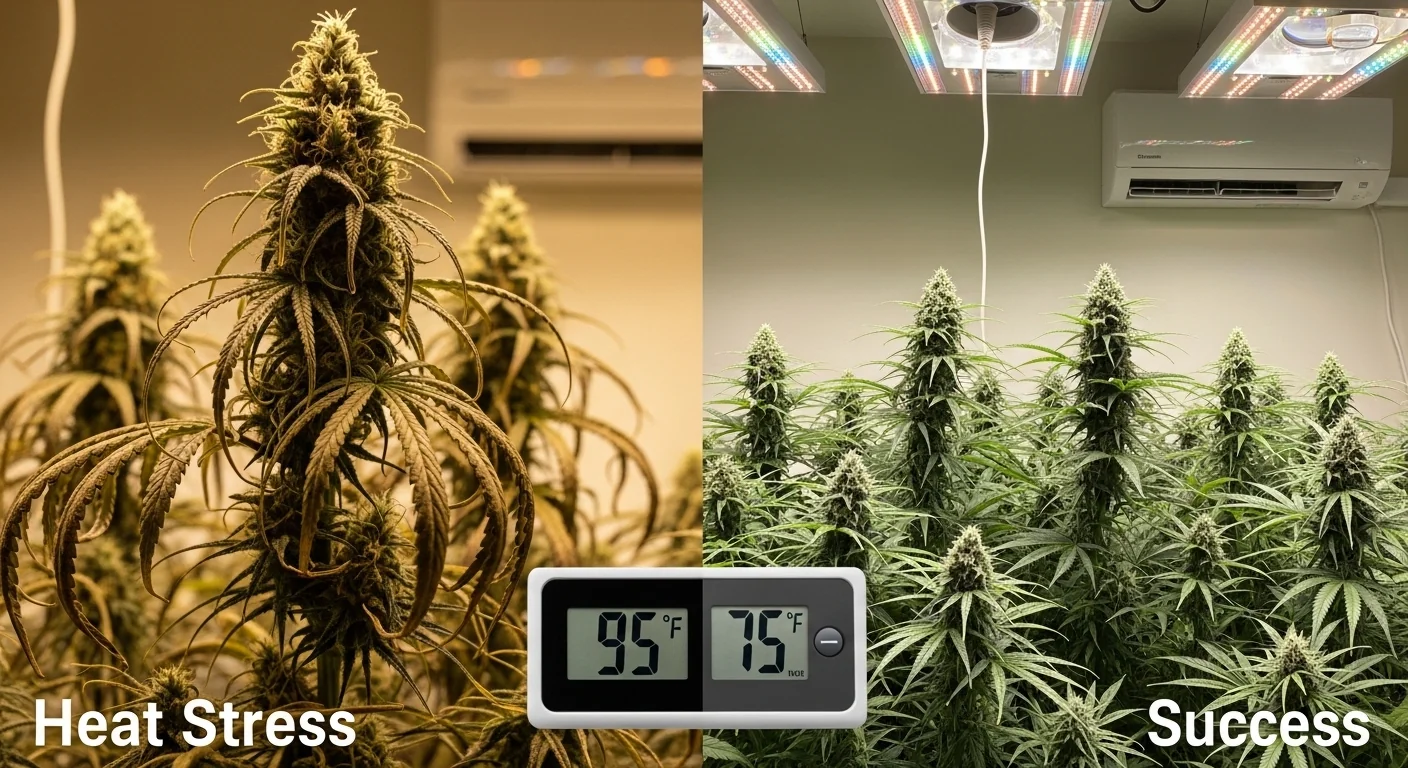
Every watt of electricity consumed inside a sealed grow room converts to heat. Luminaries, dehumidifiers, circulation pumps, controllers: the moment power flows, thermal load begins accumulating. The sizing question is not "how hot does the light feel?" but rather "how many BTU per hour does my equipment deposit into this air volume, and what is the net conductive gain through the walls?" Those two figures, added together, define the minimum cooling capacity that must be removed continuously while lights are on.
This calculator quantifies the sensible (dry) heat load from LED fixtures, dehumidifiers, and building envelope conduction. It does not model latent humidity loads from plant transpiration, infiltration losses through exhaust fans or CO2 injection ports, or solar gain through glazing. If your room has significant plant canopy, your actual total HVAC load will be higher than this tool reports; use the output as a confirmed floor, not a ceiling. For the electrical heat component contributed by dehumidifiers specifically, cross-reference your unit's rated draw with the grow room dehumidifier calculator to confirm which wattage to enter.
After running the tool, you will know the minimum BTU per hour your AC system must remove and the corresponding tonnage required. That number tells you whether a single mini-split covers your space or whether you need a multi-zone or commercial system.
Use the Tool
Before entering values, gather your LED fixture spec sheets and confirm the draw wattage, not the "equivalent" or "replaces" wattage printed on marketing materials. Locate your dehumidifier's electrical label for actual watts. Measure your grow room interior dimensions in feet (not meters), and determine your worst-case outside temperature for your hottest month to compute the temperature difference. If you are sizing ventilation alongside cooling, the grow tent fan size calculator handles air exchange rate separately from sensible thermal load.
Quick Start (60 Seconds)
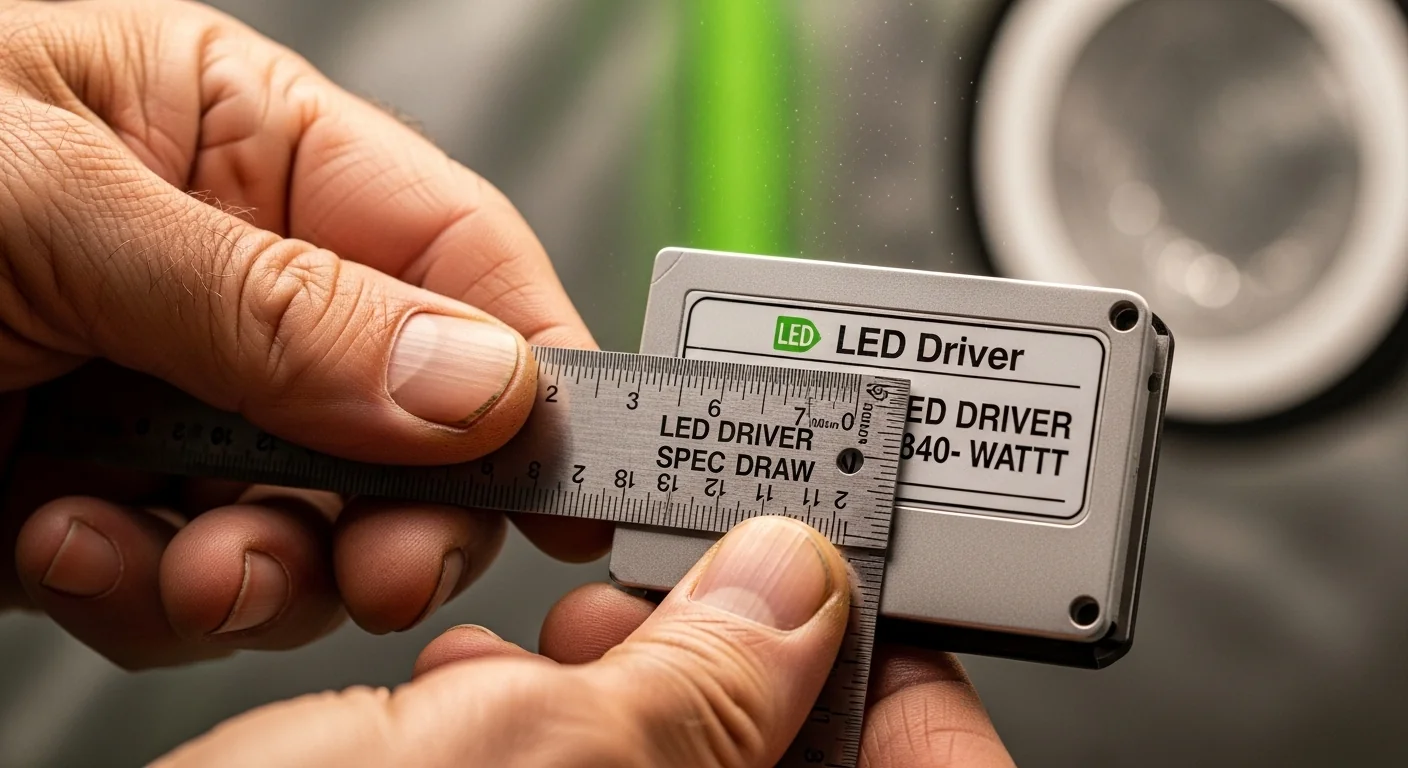
- Total LED Light Wattage: Enter the sum of all fixture draw watts. A 4-light setup with four 400W fixtures is 1,600W. Do not enter lumens, PPF, or PPFD values.
- Total Dehumidifier Wattage: Find the rated watts on the unit's electrical label, not the pint-per-day removal rating. A Quest 335 draws approximately 1,000W at full load.
- Room Length, Width, Height: Interior dimensions in feet only. Measure from drywall to drywall, not from outside framing. Tent fabric counts as the boundary for portable setups.
- R-Value: The insulation resistance of your walls and ceiling. Uninsulated stud bays are roughly R-4; standard 2x4 wall cavities with fiberglass batts are R-13; rigid foam upgrades reach R-19 to R-30. Enter a single representative value across the envelope.
- Temperature Difference (Delta-T): Subtract your target inside temperature from the hottest expected outside ambient. If you target 75 degrees F inside and your summer peak outside is 95 degrees F, enter 20.
- Units are fixed: Watts for power, feet for dimensions, degrees Fahrenheit for temperature. No metric conversion is applied internally.
- Click Calculate only after all fields pass validation: The tool will not run on partial entries. Inline error labels appear next to any field that fails the range or type check.
Inputs and Outputs (What Each Field Means)
| Field | Unit | What It Represents | Common Mistake | Safe Entry Guidance |
|---|---|---|---|---|
| Total LED Light Wattage | Watts (W) | Electrical power drawn by all LED grow fixtures combined; every watt becomes 3.412 BTU/hr of heat | Entering "equivalent HPS" wattage from marketing copy instead of actual draw from the spec sheet | Check the driver or power supply label; sum each fixture individually if wattages differ |
| Total Dehumidifier Wattage | Watts (W) | Electrical draw of dehumidifier(s); the unit operates as a heat pump but still deposits sensible heat into the room | Leaving this blank because "the dehumidifier is outside the tent"; if it exhausts into the room, its heat counts | Enter 0 only if the dehumidifier exhausts directly to an unconditioned space; otherwise enter full rated watts |
| Room Length | Feet (ft) | Interior length used to compute envelope surface area and air volume | Measuring exterior framing rather than interior finished dimensions | Measure from interior wall surface to interior wall surface; accept one decimal place |
| Room Width | Feet (ft) | Interior width; combined with length and height to calculate six-sided surface area | Using tent outer dimensions rather than usable interior space | Same measurement method as length; floor plan dimensions are interior only |
| Room Height | Feet (ft) | Ceiling height; affects both surface area (ceiling and upper wall panels) and air volume | Forgetting to account for a drop ceiling or grow tent hang height | Measure floor to ceiling; for tents, use the actual canopy zone height if significantly lower than max |
| R-Value | ft²·°F·hr/BTU | Thermal resistance of the room envelope; higher R means less heat passes through walls per degree of temperature difference | Entering R-30 for the ceiling while ignoring R-0 uninsulated exterior-facing walls, then using that ceiling value for the whole envelope | Use the lowest common value across your envelope or the weighted average if you know each surface; when uncertain, use a conservative (lower) estimate |
| Temperature Difference (Delta-T) | Degrees Fahrenheit (°F) | Outside peak ambient minus desired inside setpoint; drives the envelope conductive heat gain term | Using average daily temperature instead of peak afternoon temperature on the hottest design day | Use your region's design dry-bulb temperature for July or August; ASHRAE climate data tables list these by city |
| Total BTU/hr (output) | BTU/hr | Total sensible cooling load the AC must continuously remove while equipment is running | Treating this as the AC unit's input BTU rating rather than its required output capacity | Select an AC unit whose cooling capacity (BTU/hr output) meets or exceeds this number; add headroom for cycling |
| Tons Required (output) | Tons of refrigeration | Total BTU/hr divided by 12,000; the standard commercial sizing unit | Confusing "ton" with weight; 1 ton of refrigeration equals exactly 12,000 BTU/hr of cooling capacity | Round up to the next available equipment size; the tool also displays a 12% buffered tonnage to account for cycling |
Worked Examples (Real Numbers)
Scenario 1: Small Hobbyist Tent (4 x 4 x 8 ft, 600W LED)
- LED wattage: 600 W
- Dehumidifier wattage: 400 W
- Room dimensions: 4 ft x 4 ft x 8 ft (surface area: 160 sq ft)
- R-Value: 13 (standard insulated wall assumption)
- Delta-T: 15 degrees F (e.g., 90 degrees F outside, 75 degrees F target)
Result: BTU_LED = 2,047 | BTU_Dehum = 1,365 | BTU_Envelope = 185 | Total = 3,597 BTU/hr | 0.30 tons
A 9,000 BTU/hr mini-split provides substantial headroom for this setup. The dehumidifier contributes nearly as much heat as the LED fixture, which is why eliminating it from the calculation produces a dangerously undersized result.
Scenario 2: Commercial Production Room (20 x 30 x 10 ft, 6,000W LED)
- LED wattage: 6,000 W
- Dehumidifier wattage: 2,000 W
- Room dimensions: 20 ft x 30 ft x 10 ft (surface area: 2,200 sq ft)
- R-Value: 19 (spray foam or high-density batt insulation)
- Delta-T: 25 degrees F (e.g., 100 degrees F outside, 75 degrees F target)
Result: BTU_LED = 20,472 | BTU_Dehum = 6,824 | BTU_Envelope = 2,895 | Total = 30,191 BTU/hr | 2.52 tons
This room requires at minimum a 2.5-ton system. Two 18,000 BTU/hr mini-splits would cover it; a single 36,000 BTU/hr unit is the more practical solution. Note that envelope gain is less than 10% of total load thanks to R-19 insulation and modest Delta-T.
Scenario 3: Mid-Size Dedicated Grow Room (10 x 12 x 9 ft, 3,000W LED,
Poor Insulation)
- LED wattage: 3,000 W
- Dehumidifier wattage: 1,000 W
- Room dimensions: 10 ft x 12 ft x 9 ft (surface area: 636 sq ft)
- R-Value: 11 (partially insulated or thin batt insulation)
- Delta-T: 30 degrees F (hot climate or unshaded exterior wall exposure)
Result: BTU_LED = 10,236 | BTU_Dehum = 3,412 | BTU_Envelope = 1,735 | Total = 15,383 BTU/hr | 1.28 tons
An 18,000 BTU/hr (1.5-ton) mini-split covers this load with reasonable buffer. Upgrading insulation from R-11 to R-19 would reduce envelope gain by more than half, extending equipment life and reducing operating hours at peak load.
Reference Table (Fast Lookup)
| LED (W) | Dehum (W) | Room (ft) | R-Value / Delta-T | Total BTU/hr | Tons Required | Minimum AC Size |
|---|---|---|---|---|---|---|
| 300 | 200 | 4 x 4 x 8 | R-13 / 15 F | 1,891 | 0.16 | 6,000 BTU/hr window unit |
| 600 | 400 | 4 x 4 x 8 | R-13 / 15 F | 3,597 | 0.30 | 9,000 BTU/hr mini-split |
| 1,000 | 500 | 5 x 5 x 8 | R-13 / 20 F | 5,441 | 0.45 | 9,000 BTU/hr mini-split |
| 2,000 | 700 | 8 x 8 x 8 | R-13 / 20 F | 9,803 | 0.82 | 12,000 BTU/hr (1 ton) |
| 3,000 | 1,000 | 10 x 12 x 9 | R-13 / 25 F | 14,871 | 1.24 | 18,000 BTU/hr (1.5 ton) |
| 4,000 | 1,200 | 12 x 15 x 9 | R-19 / 25 F | 18,856 | 1.57 | 24,000 BTU/hr (2 ton) |
| 6,000 | 2,000 | 20 x 20 x 10 | R-19 / 30 F | 29,822 | 2.49 | 36,000 BTU/hr (3 ton) |
| 8,000 | 2,500 | 20 x 30 x 10 | R-19 / 30 F | 39,300 | 3.27 | 2 x 24,000 BTU/hr units |
| 10,000 | 3,000 | 25 x 30 x 10 | R-25 / 35 F | 47,996 | 4.00 | Commercial unit or 2 x 30,000 BTU/hr |
All values computed from the formula: BTU_total = (LED_W x 3.412) + (Dehum_W x 3.412) + [(Surface_Area x DeltaT) / R-Value]. Minimum AC size is the nearest standard equipment capacity that meets or exceeds the computed total. Equipment cycling and derating are not modeled; size up when in doubt.
How the Calculation Works (Formula + Assumptions)
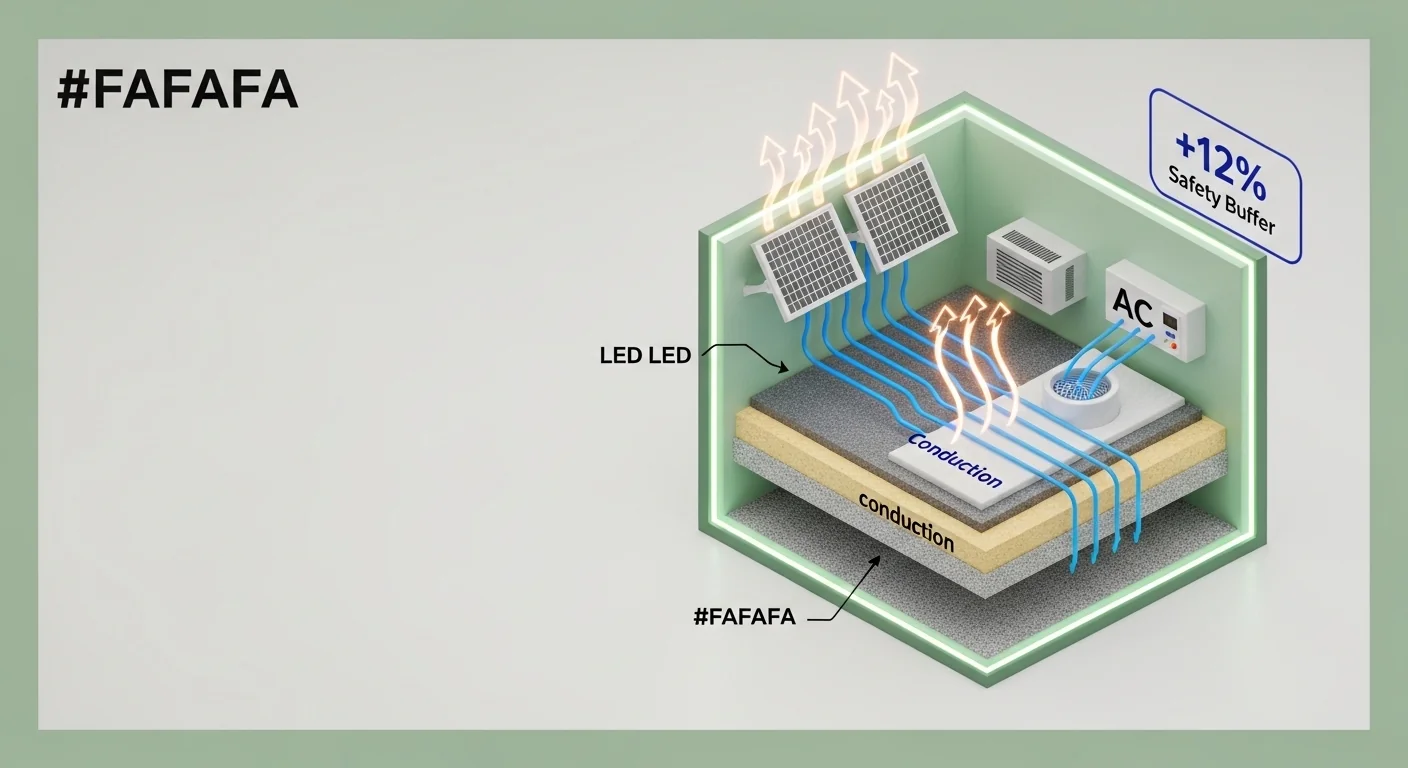
Show the calculation steps
Step 1: LED Heat Load
BTU_Lights = Watts_LED x 3.412
The factor 3.412 is the exact conversion between watt-hours and British Thermal Units. One watt of electrical power, operated for one hour, produces 3.412 BTU of heat. This conversion applies regardless of fixture technology. A 1,000W LED fixture releases 3,412 BTU/hr of heat into the space, identical to a 1,000W HPS fixture at the same draw. The distribution differs (LED heat rises convectively toward the ceiling; HPS radiates downward toward the canopy) but the thermal magnitude is the same.
Step 2: Dehumidifier Heat Load
BTU_Dehum = Watts_Dehum x 3.412
Dehumidifiers operate on a refrigerant cycle: they cool a coil to condense moisture, then the condenser coil rejects heat back into the room. The net result is that nearly all electrical energy consumed by the dehumidifier ends up as sensible heat in the room air. This term is routinely omitted from online guides; omitting a 1,000W dehumidifier understates the cooling load by 3,412 BTU/hr.
Step 3: Envelope (Wall and Ceiling) Conductive Gain
Surface Area = 2 x (L x W + L x H + W x H)
BTU_Envelope = (Surface_Area x Delta-T) / R-Value
Heat conducts through walls, ceiling, and floor at a rate proportional to the temperature difference across the envelope and inversely proportional to insulation resistance. Using total six-sided surface area assumes uniform insulation across all surfaces, which is a conservative simplification. Higher R-value produces a smaller envelope gain term; lower R-value amplifies it, particularly in hot climates with large Delta-T values.
Step 4: Total Cooling Load and Tonnage
Total_BTU/hr = BTU_Lights + BTU_Dehum + BTU_Envelope
Tons = Total_BTU / 12,000
One ton of refrigeration capacity equals 12,000 BTU/hr of heat removal. The tool also displays a 12% buffered tonnage to account for equipment derating at high ambient temperatures and duty-cycle limits on compressors during continuous operation.
Rounding Rules
All intermediate values are computed in full floating-point precision. The displayed BTU outputs are rounded to the nearest whole number. Tonnage is displayed to two decimal places. No rounding occurs until the final display step.
Assumptions and Limits
- The tool models sensible (dry-bulb) heat only. Latent load from plant transpiration, which can be substantial in a fully canopied room, is not included.
- Envelope calculation assumes a uniform single R-value across all six surfaces. Real rooms often have different R-values for ceiling, walls, and floor; using the lowest common value produces the most conservative (safest) estimate.
- Air infiltration through exhaust fan openings, passive intake vents, door gaps, and CO2 injection ports is not modeled. Any unconditioned air exchange adds both sensible and latent load.
- Solar radiation through glazing or translucent panels is not included. Greenhouses and rooms with skylights will have materially higher loads than this tool reports.
- Equipment efficiency derating at high ambient conditions is not applied. Most mini-splits lose rated capacity when outdoor ambient exceeds 95 to 100 degrees F.
- The calculation assumes lights-on continuous operation. If lights follow a photoperiod, actual daily average load is lower; however, AC must be sized for peak load during the lights-on window.
- LED photon efficiency (PPE) means a small fraction of power leaves the room as light energy that is absorbed by plants rather than converted to room heat. This effect is small relative to total load and is conservatively excluded; the tool treats 100% of wattage as heat.
- Input ranges are enforced: LED and dehumidifier wattage 0 to 100,000 W; room dimensions 1 to 10,000 ft; R-Value 1 to 60; Delta-T 0 to 100 degrees F. Values outside these ranges trigger inline errors and block calculation.
Standards, Safety Checks, and "Secret Sauce" Warnings
Critical Warnings
- A watt is a watt, technology does not change thermodynamics: Switching from HPS to LED at the same wattage does not reduce thermal load. The grow room still requires the same AC capacity. Growers who remove cooling equipment after an LED upgrade based on marketing language about "running cooler" risk crop-threatening temperature spikes.
- Omitting dehumidifier wattage produces a dangerously understated result: In a typical 3,000W LED room, a 1,000W dehumidifier adds 3,412 BTU/hr to the cooling load. That omission represents roughly one-quarter of the LED heat load itself. Always enter the dehumidifier's electrical draw, not its pint-per-day removal rating.
- Using average ambient temperature instead of design-day peak creates systematic undersizing: AC equipment must handle the worst-case steady-state load, which occurs on the hottest afternoon of the hottest week. Basing Delta-T on seasonal averages produces a unit that keeps pace most of the time but fails precisely when failure is most costly.
- Ignoring insulation quality in a hot or cold climate compounds every other error: At R-4 (uninsulated wall) versus R-19, the envelope gain term quadruples for the same room size and Delta-T. Retroactively improving insulation is far more cost-effective than upgrading to a larger AC unit.
Minimum Standards
- ASHRAE recommends selecting cooling equipment at or above the calculated design load; never size below it. A buffer of 10 to 15% above calculated load is standard practice to account for equipment tolerance and thermal mass cycling.
- Mini-split systems rated in BTU/hr should be selected so that their nominal cooling output at the expected outdoor ambient temperature meets or exceeds the calculated total. Check the manufacturer's capacity table at your design outdoor temperature, not just the nameplate BTU figure.
- For rooms requiring more than 36,000 BTU/hr (3 tons), multi-zone mini-split systems or commercial packaged HVAC units are appropriate. DIY single-zone mini-splits top out near 36,000 BTU/hr; beyond that, consult a licensed HVAC engineer for equipment selection and refrigerant line sizing.
Competitor Trap: Most "grow room BTU calculator" pages on the web calculate LED heat load only and ignore dehumidifiers, auxiliary pumps, and envelope gain. They also base the formula on HPS-era rules of thumb ("600W HPS needs 12,000 BTU") without deriving from the actual electrical-to-thermal conversion. A grower using one of those calculators in a poorly insulated room with a large dehumidifier will systematically undersize their AC; in rooms where the dehumidifier draw equals a third or more of LED wattage, the omitted load alone exceeds one ton of required cooling capacity. The predictable outcome is a room that holds temperature on mild nights and climbs uncontrollably during afternoon peak hours. Sizing with a complete load calculation, as this tool performs, eliminates that systematic error.
Climate management does not stop at cooling. If your room needs supplemental heat during a cold-weather dark period, the companion greenhouse heater size calculator uses the same envelope and Delta-T logic in reverse to size heating equipment. Separately, maintaining precise vapor pressure deficit alongside temperature is handled by the VPD calculator, which translates temperature and relative humidity into actionable plant-stress targets once your AC has stabilized the thermal environment.
Common Mistakes and Fixes
Mistake: Entering "Equivalent" LED Wattage Instead of Actual Draw Wattage
LED fixture marketing frequently states "replaces 1000W HPS" for a fixture that draws 650W. Entering 1,000W into the calculator overstates the heat load by 350W. Conversely, some drivers pull slightly more than their advertised rating under full load. The electrical label on the driver or power supply is the authoritative source, not the product description.
Fix: Read the wattage from the driver's input spec (often labeled "Input: 120-277V, 5.5A" from which you calculate watts as volts x amps), or use a plug-in watt meter to measure actual draw under operating conditions.
Mistake: Assuming Dehumidifier Heat Is Negligible
A commercial dehumidifier rated at 200 pints per day typically draws 900 to 1,200 watts. At 3.412 BTU per watt-hour, that is 3,070 to 4,094 BTU/hr of additional heat load, continuous during operation. Many growers size their AC for lights only and discover weeks later that the room cannot hold setpoint when the dehumidifier runs at full capacity.
Fix: Enter the full dehumidifier wattage even if you believe the unit is "outside" the thermal envelope. If the condenser coil exhausts into the same room that needs cooling, 100% of its power draw counts as heat load.
Mistake: Using a Single R-Value That Reflects the Best-Insulated Surface Only
Entering R-30 because the ceiling has spray foam, while three exterior-facing walls are single-pane or uninsulated, produces a wildly optimistic envelope gain figure. The weakest surfaces dominate conductive loss; the high ceiling R-value does not compensate for uninsulated walls.
Fix: Identify your lowest-R surface and use that value as the envelope input, or calculate a weighted average using each surface's area and R-value separately before entering a blended figure.
Mistake: Ignoring Delta-T Seasonality and Using a Comfortable Moderate-Weather Value
Setting Delta-T to 10 degrees F because that matches the spring shoulder season produces a system that fails in July. Air conditioning must be sized for the design-day condition, which is the worst-case steady-state the system will ever face. A unit appropriately sized for peak load handles the moderate season with ease, running at partial duty cycle.
Fix: Use the design dry-bulb temperature for your location's hottest month. ASHRAE Fundamentals and many state energy codes publish 1% design-day temperatures by city. If uncertain, add 10 to 15 degrees F to the highest temperature recorded at your site.
Mistake: Overlooking How Dew Point Affects Latent Load Separately from Sensible Load
This calculator handles sensible (temperature-driven) load only. A room with heavy plant canopy produces transpiration vapor at rates that can exceed the dehumidifier's capacity during certain growth stages. Sizing AC for sensible load while having an undersized dehumidifier leads to humidity excursions that the dew point calculator can help diagnose by identifying at what temperature your room air will condense on cold surfaces.
Fix: Treat sensible and latent load sizing as two separate calculations. Use this tool for AC tonnage; use dehumidifier pints-per-day capacity charts alongside the dehumidifier wattage you entered here to confirm both systems are correctly matched.
Next Steps in Your Workflow
Once the BTU total is confirmed, the immediate decision is equipment selection: choose the nearest standard mini-split or packaged unit whose rated cooling output meets or exceeds the calculated load at your outdoor design temperature. Pioneer and Senville publish capacity tables showing output at 95 degrees F and 115 degrees F outdoor ambient; if your design-day temperature exceeds 95 degrees F, use the derated value, not the nominal nameplate BTU. Size up if the numbers are close. The cost difference between a 12,000 and 18,000 BTU/hr unit is modest relative to the cost of a crop failure from a system that cannot hold setpoint on a hot afternoon. Before finalizing your lighting infrastructure, the grow light cost calculator can model the operating expense of running those LED watts continuously, which connects directly to the heat load you just calculated.
Thermal management and airflow work together. Removing heat from the room is only effective if air circulates well enough to prevent hot spots, particularly near the top of the canopy where LED fixtures are closest. Stratification can make a thermometer at mid-room read 76 degrees F while the fixture zone reads 88 degrees F. The greenhouse fan calculator provides airflow volume targets that pair with your AC tonnage to keep temperature uniform across the entire grow volume.
FAQ
Does switching from HPS to LED mean I need less air conditioning?
Not if you keep the same wattage. A 1,000W LED and a 1,000W HPS both produce 3,412 BTU/hr of heat by thermodynamic law. LED fixtures direct heat convectively upward rather than radiating it downward onto the canopy, which affects plant stress but not room thermal load. AC sizing is based on watts consumed, not fixture technology.
What is a good R-value for a grow room?
R-13 is the minimum practical value for an interior wall with standard 2x4 framing and fiberglass batts. R-19 with 2x6 framing or continuous rigid foam is more effective for rooms in climates with high summer Delta-T values. Spray closed-cell foam at R-6 to R-7 per inch allows reaching R-19 or higher in existing stud bays. Uninsulated walls are roughly R-4; the envelope gain term increases sharply as R-value drops below 10.
Why does my calculated BTU seem much higher than online rules of thumb?
Most online rules of thumb account for LED heat only and ignore dehumidifiers. They also frequently use simplified "X BTU per square foot" heuristics derived from commercial office HVAC, not sealed grow rooms with high internal equipment loads. This tool derives from the actual formula: watts times 3.412 plus envelope conduction. The result will exceed simplified rules of thumb whenever a dehumidifier is in use.
Can I use this tool for a greenhouse?
Partially. The tool calculates equipment heat and envelope conduction accurately for any enclosed space. Greenhouses introduce additional heat sources this tool does not model: solar radiation through glazing, which can easily add 50,000 BTU/hr or more depending on orientation and glazing type. Use this tool as one input and add solar gain calculations separately for greenhouse applications.
What does the 12% safety buffer on the tonnage output represent?
It accounts for compressor cycling losses, equipment derating at high outdoor ambient temperatures, and minor thermal mass effects not captured in the steady-state formula. Standard HVAC engineering practice suggests sizing at 110 to 115% of calculated load. The buffered figure in the output reflects a 12% margin; selecting equipment at or above the buffered tonnage value is the conservative design choice.
Should I enter dehumidifier wattage if the unit is in an adjacent room or closet?
Only if the dehumidifier's condenser exhaust, the hot side of its refrigerant cycle, discharges into the space being cooled. If the unit exhausts to an unconditioned hallway, garage, or outdoors, its heat load does not enter the grow room. If it sits inside the room or exhausts air back into it through a duct, enter the full rated wattage.
Conclusion
The core principle this tool enforces is straightforward: every watt of electrical equipment inside a sealed grow room becomes heat that must be actively removed. The LED technology switch changes the direction and character of that heat, not its magnitude. Sizing AC from watts-to-BTU conversion and adding envelope gain produces a defensible, formula-derived number rather than a guess based on fixture marketing copy or rules of thumb designed for different environments.
The single most common error in grow room HVAC sizing is omitting the dehumidifier's electrical load from the calculation. A 1,000W commercial dehumidifier running continuously adds over 3,400 BTU/hr to the room. For a room already challenged by LED heat, that omission reliably produces an undersized AC unit that loses control of temperature during peak afternoon hours. Run the complete calculation with every powered device accounted for. If you run a CO2 burner inside the room, note that combustion burners add both CO2 and heat simultaneously; the CO2 burner heat calculator quantifies that additional BTU contribution so it can be added to the total before you finalize your AC equipment selection.