
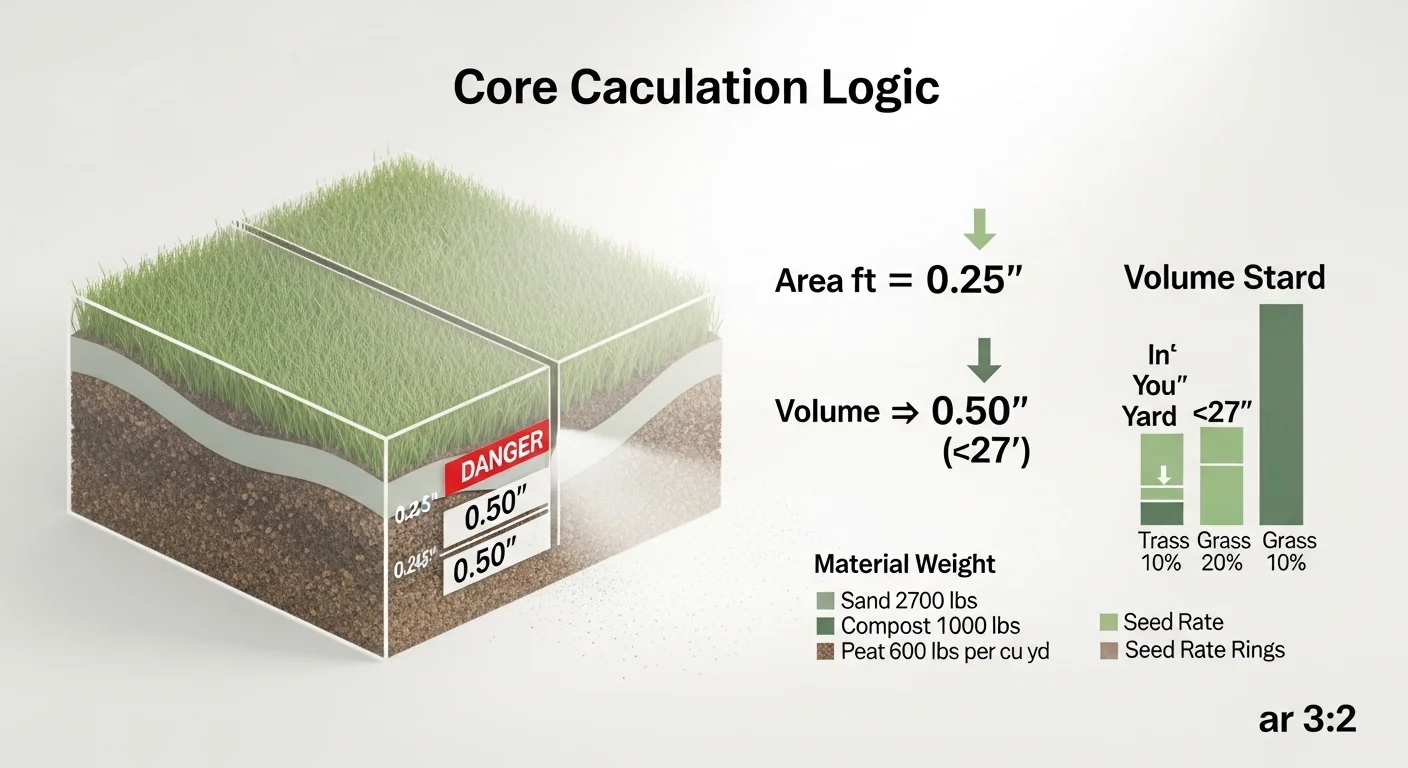
Topdressing a lawn is a volume problem disguised as a soil problem. The math is straightforward, but the critical constraint that almost every generic topsoil calculator ignores is depth. Apply material too thin and you waste money. Apply it too deep and you suffocate the grass crowns sitting just below the surface, triggering turf death within days. The depth threshold is 0.50 inches per application, and the consequences of crossing it with heavy compost are severe enough to warrant a hard stop in any reliable calculator.
This tool calculates the cubic yardage of topdressing material (sand, compost, or peat moss) needed for a given lawn area and application depth, then computes overseeding quantity for six common grass species using published overseed rates. It does not factor in soil compaction levels, existing thatch thickness, or local delivery pricing. Those variables belong in your site assessment, not in a volume formula.
After running the numbers, you will know exactly how many cubic yards to order, approximately how many 40 lb bags that equals, and how many pounds of seed to buy. Pair those outputs with a grass seed quantity check if you are working from seed purity data rather than a simple rate lookup.
Use the Tool
How This Calculator Works
Step 1: Convert your topdressing depth from inches to feet: Depth (ft) = Depth (in) ÷ 12.
Step 2: Calculate volume in cubic feet: Volume (cu ft) = Lawn Area (sq ft) × Depth (ft).
Step 3: Convert to cubic yards: Volume (cu yd) = Volume (cu ft) ÷ 27.
Step 4: Calculate overseeding quantity: Seed (lbs) = (Lawn Area ÷ 1,000) × Overseed Rate (lbs per 1,000 sq ft).
Safety Check: If topdressing depth exceeds 0.50″, a smother warning is triggered. Depths above 0.50″ risk suffocating grass crowns and killing your existing lawn.
Assumptions & Limits
Overseed Rates: Based on standard overseeding rates (not new establishment rates). New lawn seeding typically requires 1.5–2× higher rates.
Material Weight Assumptions: Sand ≈ 2,700 lbs/cu yd | Compost ≈ 1,000 lbs/cu yd | Peat Moss ≈ 600 lbs/cu yd. Actual weights vary by moisture content.
Area Measurement: For irregular lawns, break the area into rectangles and triangles and sum them. Subtract hardscape areas (patios, walkways, beds).
Best Practice: Core aerate before topdressing for best soil integration. Apply seed after topdressing, not before.
Recommended Gear
Walk-Behind Peat Moss Cage Roller: Ideal for distributing peat moss topdressing uniformly across large lawn areas.
Premium Grass Seed (Jonathan Green / Barenbrug): Elite seed varieties with higher germination rates, better disease resistance, and superior turf density.
Tow-Behind Core Aerator: Aerate before topdressing for maximum soil amendment penetration and root zone contact.
Before opening the calculator, have four pieces of information ready: your lawn area in square feet, your intended application depth in inches (0.25″ is the standard starting point), the type of topdressing material you plan to use, and the grass species you are overseeding into. If you are unsure whether topdressing is the right approach or whether a full renovation makes more sense, the sod coverage calculator covers the alternative path. For irregular lawn shapes, divide the space into rectangles, compute each separately, and add the totals before entering the combined area.
Quick Start (60 Seconds)
- Lawn Area: Enter square feet, not acres. One acre equals 43,560 sq ft. For a 60 x 80 ft backyard, that is 4,800 sq ft. Do not include patio, driveway, or bed areas.
- Topdressing Depth: Start with 0.25 inches unless you have a specific leveling goal. Do not exceed 0.50 inches in a single application on established turf. The calculator enforces a 1.0″ maximum input but issues a smother warning above 0.50″.
- Topdressing Material: Sand for leveling and drainage improvement. Compost for organic matter and soil biology. Peat moss for moisture retention in sandy or drought-prone soils. These are not interchangeable; material selection affects weight and material behavior.
- Grass Seed Type: Select the species you are overseeding. The tool applies standard overseeding rates (not new-establishment rates, which run roughly twice as high).
- Units check: Depth must be in inches, not fractions of a foot. Enter 0.25, not 1/48 or 0.0208.
- Result reading: The primary output is cubic yards. Delivery companies and landscape suppliers quote topdressing material by the cubic yard. The bag estimate assumes 40 lb bags, which is the common retail bag weight.
- Reset before re-running: If you are comparing two depths or two materials, click Reset between scenarios to avoid reading stale results.
Inputs and Outputs (What Each Field Means)
| Field | Unit | What It Means | Common Mistake | Safe Entry Guidance |
|---|---|---|---|---|
| Lawn Area | Square feet | The total turfgrass surface receiving topdressing and seed | Including patios, beds, or driveways in the measurement | 1 to 500,000 sq ft; use sub-area math for irregular shapes |
| Topdressing Depth | Inches | The target thickness of material applied across the lawn surface | Entering 1.0″ because “more is better” for leveling | 0.0625″ minimum; 0.50″ maximum per application on existing turf |
| Topdressing Material | Category | The material type being spread; affects weight estimation only | Using compost for leveling when coarse sand is the correct tool | Match material to goal: sand for grading, compost for amendment, peat for moisture |
| Grass Seed Type | Category | The species being overseeded, used to look up overseed rate (lbs per 1,000 sq ft) | Selecting the wrong species and under-ordering seed by half | Use the actual species in the lawn; if mixed stand, select the dominant species |
| Volume (cu yd) [output] | Cubic yards | Total material to order from a bulk supplier or count in bags | Confusing cubic yards with cubic feet; 1 cubic yard = 27 cubic feet | Use this number directly with your supplier quote |
| Material Weight (output) | Pounds | Estimated weight using material-specific bulk density; useful for delivery planning | Assuming all soil materials weigh the same; peat moss is roughly 4x lighter than sand | Actual weight varies with moisture content; treat estimate as a planning guide |
| Seed Quantity (output) | Pounds | Overseeding rate for the selected species applied across the entered area | Using new-establishment rates (too high) or fertilizer spreader settings (wrong calibration) | Apply seed after topdressing, not before; seed requires soil contact to germinate |
Worked Examples (Real Numbers)
Scenario 1: Small Suburban Lawn, Sand Leveling with Tall Fescue Overseeding
- Lawn Area: 3,500 sq ft
- Topdressing Depth: 0.25 inches
- Material: Sand
- Seed Type: Tall Fescue
Result: Volume = 3,500 x (0.25 / 12) = 72.9 cu ft; 72.9 / 27 = 2.70 cubic yards of sand. Estimated weight: 7,290 lbs. Seed needed: (3,500 / 1,000) x 6 lbs = 21 lbs of Tall Fescue.
At this depth, grass crowns remain fully exposed and the sand integrates into the thatch layer. A single delivery of 3 cubic yards from a local supplier covers this job with minimal waste.
Scenario 2: Large Backyard Renovation, Compost Amendment with Kentucky Bluegrass
- Lawn Area: 10,000 sq ft
- Topdressing Depth: 0.50 inches
- Material: Compost
- Seed Type: Kentucky Bluegrass (KBG)
Result: Volume = 10,000 x (0.50 / 12) = 416.7 cu ft; 416.7 / 27 = 15.43 cubic yards of compost. Estimated weight: 15,430 lbs. Seed needed: (10,000 / 1,000) x 2 lbs = 20 lbs of KBG.
This is the upper safe limit for a single-pass compost application. The calculator’s warning indicator will show “Upper Limit” at 0.50″, signaling that precision in spreading is critical. Uneven application in low spots can locally exceed 0.50″ and create dead patches.
Scenario 3: Warm-Season Renovation, Peat Moss Topdressing with Bermuda Overseeding
- Lawn Area: 7,200 sq ft
- Topdressing Depth: 0.25 inches
- Material: Peat Moss
- Seed Type: Bermuda
Result: Volume = 7,200 x (0.25 / 12) = 150 cu ft; 150 / 27 = 5.56 cubic yards of peat moss. Estimated weight: 3,333 lbs. Seed needed: (7,200 / 1,000) x 1.5 lbs = 10.8 lbs of Bermuda.
Peat moss is significantly lighter than sand or compost by volume, which affects delivery logistics. Bermuda’s low overseed rate (1.5 lbs per 1,000 sq ft) keeps seed cost manageable even on larger areas.
Reference Table (Fast Lookup)
| Lawn Area (sq ft) | Depth (in) | Volume (cu yd) | Sand Weight (lbs) | Compost Weight (lbs) | Tall Fescue Seed (lbs) |
|---|---|---|---|---|---|
| 1,000 | 0.25″ | 0.77 | 2,083 | 772 | 6 |
| 1,000 | 0.50″ | 1.54 | 4,167 | 1,543 | 6 |
| 2,500 | 0.25″ | 1.93 | 5,208 | 1,929 | 15 |
| 5,000 | 0.25″ | 3.86 | 10,417 | 3,858 | 30 |
| 5,000 | 0.50″ | 7.72 | 20,833 | 7,716 | 30 |
| 7,500 | 0.25″ | 5.79 | 15,625 | 5,787 | 45 |
| 10,000 | 0.25″ | 7.72 | 20,833 | 7,716 | 60 |
| 10,000 | 0.50″ | 15.43 | 41,667 | 15,432 | 60 |
| 15,000 | 0.25″ | 11.57 | 31,250 | 11,574 | 90 |
| 20,000 | 0.25″ | 15.43 | 41,667 | 15,432 | 120 |
Sand bulk density: 2,700 lbs/cu yd. Compost bulk density: 1,000 lbs/cu yd. Tall Fescue overseed rate: 6 lbs per 1,000 sq ft. Weights are estimates; actual values vary with moisture content and material source.
How the Calculation Works (Formula + Assumptions)
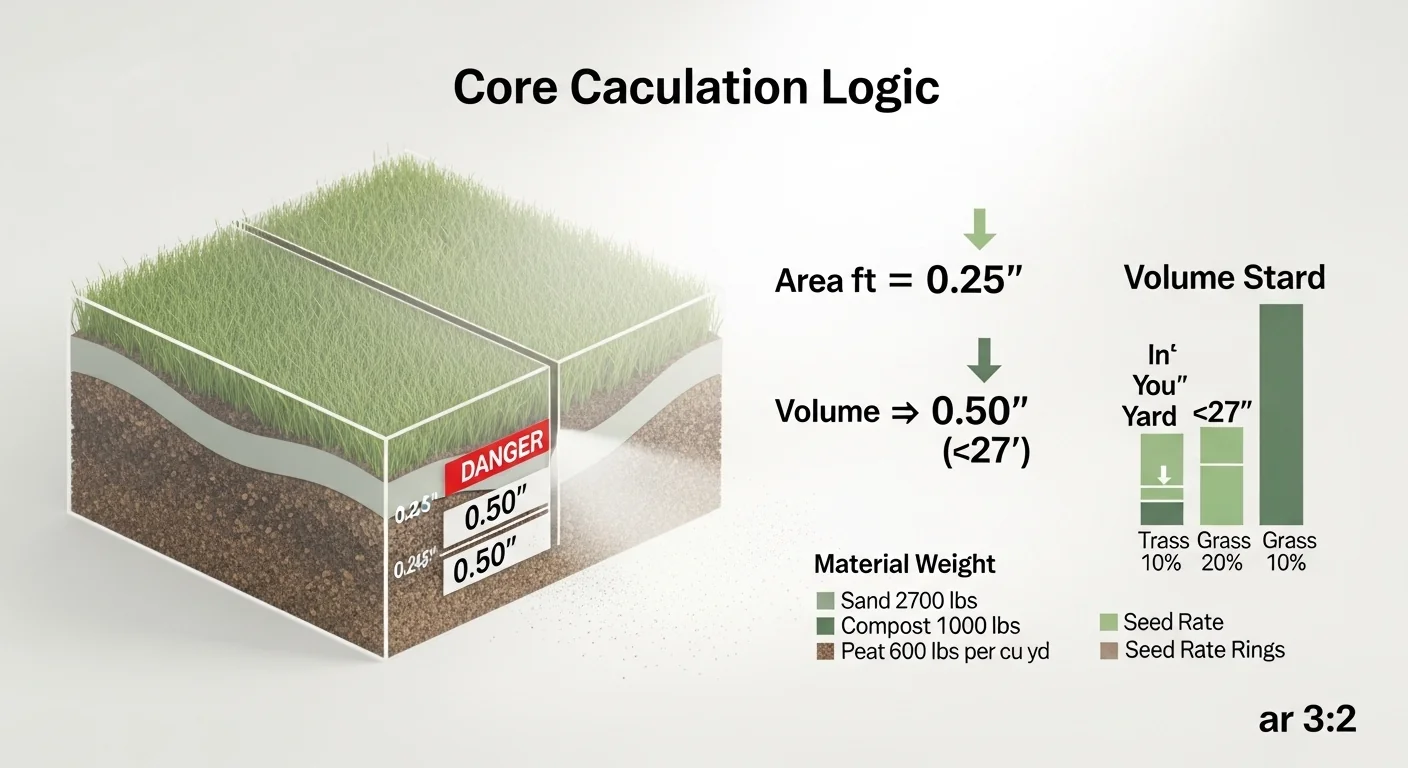
Show the calculation steps
Step 1: Convert depth from inches to feet.
Topdressing depth is measured in inches because it is a thin layer, but volume calculations require consistent units. Divide the depth in inches by 12 to get depth in feet.
Example: 0.25 in / 12 = 0.02083 ft
Step 2: Calculate volume in cubic feet.
Multiply lawn area (sq ft) by depth (ft). This gives the total volume of material in cubic feet.
Formula: Volume (cu ft) = Area (sq ft) x (Depth (in) / 12)
Step 3: Convert cubic feet to cubic yards.
Divide cubic feet by 27 (there are 27 cubic feet in one cubic yard). Suppliers quote bulk material by the cubic yard.
Formula: Volume (cu yd) = Volume (cu ft) / 27
Step 4: Estimate material weight.
Multiply cubic yards by the material’s bulk density. Sand: 2,700 lbs/cu yd. Compost: 1,000 lbs/cu yd. Peat Moss: 600 lbs/cu yd. Divide weight by 40 and round up for bag count.
Formula: Weight (lbs) = Volume (cu yd) x Bulk Density
Step 5: Calculate seed quantity.
Divide area by 1,000, then multiply by the species-specific overseed rate. Overseed rates used in this calculator: Tall Fescue 6 lbs, Perennial Ryegrass 5 lbs, Fine Fescue 4 lbs, Kentucky Bluegrass 2 lbs, Zoysia 2 lbs, Bermuda 1.5 lbs (all per 1,000 sq ft).
Formula: Seed (lbs) = (Area / 1,000) x Overseed Rate
Rounding rule: Cubic yards are shown to two decimal places. Seed is shown to one decimal place. Bag count rounds up to the nearest whole bag.
Assumptions and Limits
- Area is assumed to be flat. Slopes do not change the volume calculation in any meaningful way for typical topdressing depths.
- Bulk density values are averages. Wet compost can weigh significantly more than dry compost. Peat moss density varies by brand and compression in packaging.
- Overseed rates are standard overseeding rates for thinning or recovering established turf, not new lawn establishment rates. New establishment typically requires 1.5 to 2 times higher seed quantity.
- The calculator does not account for germination rate or pure live seed (PLS) percentage. If you are working with a seed lot that has germination below 80%, you will need to adjust seed quantity upward.
- Material waste and spreading inefficiency are not modeled. Add 5 to 10 cubic yards buffer on large orders to account for uneven spreader output and low spots.
- The 0.50″ smother threshold is based on turf physiology, not soil science. Light, sandy soils may tolerate slightly deeper applications than heavy clay soils. When in doubt, stay at 0.25″.
- Mixed-species lawns should use the dominant species rate. Blended seed mixes sold by weight require label-based rate calculations, not species lookups.
Standards, Safety Checks, and “Secret Sauce” Warnings
Critical Warnings
- The 1-inch compost kill: Applying 1.0 inch of compost over an established lawn to “fix” a bumpy surface is one of the most common self-inflicted lawn disasters. Grass crowns (the biological junction between above-ground leaf tissue and below-ground root tissue) require direct air contact to survive. Physically burying them under a dense, moist material like compost blocks that airflow and can kill the existing stand within 72 hours. This calculator enforces a smother warning above 0.50″ for this exact reason.
- Sand on clay without aeration creates hardpan: Spreading coarse sand over clay soil without first core aerating can actually worsen drainage by creating a discontinuous texture layer. Sand particles settle above clay without integrating, producing a compaction zone. Always aerate before topdressing clay-heavy soils.
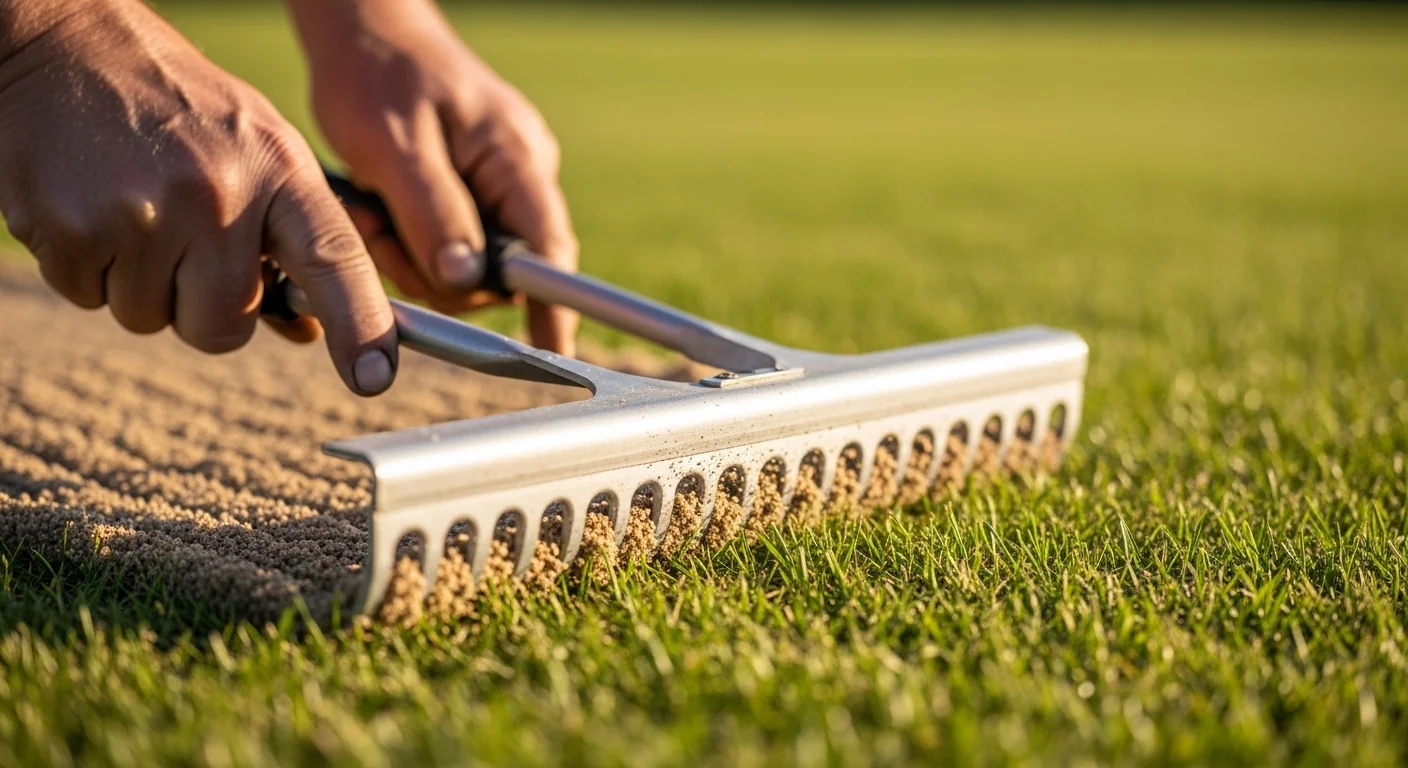
- Uneven spreading concentrates depth: A spreader set to 0.50″ average application depth will create zones that are 0.75″ to 1.0″ in low spots where material accumulates. The overall average may be safe, but localized depths can exceed the turf tolerance threshold. Use an aluminum leveling rake to drag material into a consistent thin film.
- Overseeding before topdressing buries seed too deep: Seed needs light soil contact at the surface, not 0.25 to 0.50 inches of material placed on top of it. Always apply seed after topdressing is raked level.
Minimum Standards
- Maximum application depth per pass: 0.50 inches. Multiple passes (spaced 4 to 6 weeks apart) are required for deeper leveling projects.
- Core aerate before topdressing whenever soil compaction is present. Aeration opens channels for material to work down toward the root zone. The lawn aeration density calculator can help you determine appropriate plug spacing for your soil type.
- Allow material to dry down before mowing after application. Running a mower over fresh compost or peat moss can clump material and create uneven distribution.
- For organic matter topdressing with compost, a thin application integrated via aeration outperforms a thick surface application on virtually every soil health metric. Less, applied more often, beats more applied once.
Competitor Trap: Most generic topsoil calculators online accept any depth input and return a volume with no physiological guardrail. A homeowner enters 1.0 inch, gets told to order 37 cubic yards of compost, spreads it, and returns three weeks later to a dead lawn. The volume math was technically correct. The application was catastrophic. A topsoil calculator that stops at the number without flagging the turf biology consequence is an incomplete tool, not a useful one. If a calculator you find elsewhere does not raise a warning at depths above 0.50 inches for established turf, treat its output as a material ordering reference only, not a lawn care recommendation. Understanding how compost blanket depth affects soil behavior is equally relevant when you are working with slopes or erosion-prone areas.
Common Mistakes and Fixes
Mistake: Measuring the Wrong Area
Homeowners frequently measure total lot size or the fenced backyard perimeter and include patios, garden beds, walkways, and pool decks in the square footage. The result is an inflated volume order and material left over. Topdressing gets applied to the turfgrass surface only. Fix: Walk the boundary of the grass area specifically, exclude all hardscape and planted bed areas, and total only the green zones.
Mistake: Ignoring Seed Germination Rate When Ordering
Seed bags list a germination rate on the label, and rates below 80 to 85 are common in commodity bulk seed. The calculator uses species rates based on viable seed, not total seed weight. If you are working with a lot that has a germination rate of 70, ordering by the standard rate will leave you 15 to 30 short of the actual live seed target. Cross-referencing against a pure live seed calculator before purchasing prevents under-seeding on large renovation projects.
Mistake: Applying Topdressing Without Knowing Soil Texture
Spreading coarse builder’s sand over a loam lawn to improve drainage often produces no benefit because the sand layer is too thin to affect water movement through the profile. One thin pass (0.25″) of sand does not change soil texture in any measurable way. Where drainage improvement is the genuine goal, sand topdressing requires repeated applications over multiple seasons, combined with aeration. Expecting single-pass results leads to frustration and repeat orders.
Mistake: Converting Cubic Yards to Cubic Feet Incorrectly
A 2.5 cubic yard order is not the same as 2.5 cubic feet. One cubic yard contains 27 cubic feet, a fact that catches many first-time bulk orderers by surprise at the delivery. Ordering 3 cubic feet when you meant 3 cubic yards means your truck arrives with roughly 11 times too little material. The calculator outputs cubic yards, which is the standard bulk supplier unit. When in doubt, verify with your supplier whether they quote in yards or feet.
Mistake: Seeding Into Wet, Freshly-Spread Material
Applying grass seed immediately after a peat moss or compost topdressing, especially when the material is damp, can cause seed to clump and redistribute unevenly during watering. Some seed will wash to the perimeter; coverage in the center becomes thin. Fix: Allow the topdressing material to settle for one to two hours, rake level, then broadcast seed uniformly across the surface. Water with a light mist rather than a heavy spray to avoid displacement.
Next Steps in Your Workflow
After the calculator returns your cubic yardage and seed quantity, the next decision is whether to broadcast seed by hand or use mechanical assistance. Hand-broadcasting is accurate for areas under 5,000 sq ft; larger lawns tend to show inconsistent coverage when spread manually, especially with fine-seeded species like Kentucky Bluegrass or Bermuda. A slit seeder quantity and pass-pattern calculator helps you plan mechanical overseeding coverage before renting equipment.
The other critical post-application variable is watering schedule. Topdressed lawns with freshly broadcast seed need light, frequent irrigation for the first 10 to 14 days to maintain surface moisture without saturating the thin material layer. A deep soak will displace seed before germination. The turf irrigation calculator can help you match your zone output rate to germination moisture requirements so you are not guessing at run time.
FAQ
What is the difference between topdressing depth of 0.25 and 0.50 inches?
At 0.25 inches, material integrates with the thatch layer and grass crowns remain fully exposed. This is the standard maintenance depth used in lawn programs. At 0.50 inches, you approach the physiological limit for established turf; grass crowns are partially covered, and the margin for error in spreading decreases significantly. The volume of material needed doubles between these two depths for the same area.
Can I use this calculator for new lawn establishment?
The cubic yardage formula works for any area and depth. The seed rate lookup, however, uses overseeding rates, which are typically half the rate needed for new establishment on bare soil. For a new lawn, consult the species label for full seeding rates. Most cool-season species require 8 to 10 lbs per 1,000 sq ft for new establishment, compared to 4 to 6 lbs for overseeding into existing turf.
Why does material type matter for the weight calculation but not for the volume?
Volume is purely a geometry result: area times depth. Material type has no effect on that arithmetic. Weight, however, depends on the material’s bulk density. Sand is roughly 4.5 times heavier than peat moss per cubic yard, which matters for delivery logistics, truck weight limits, and bag counts. The calculator keeps volume and weight separate so you can distinguish the ordering number from the logistics number.
Is peat moss topdressing bad for lawns from a sustainability standpoint?
Peat moss harvesting is slow to renew; peat bogs accumulate at roughly 1 millimeter per year. Compost is the more sustainable amendment for most lawn topdressing applications, providing comparable moisture retention with faster renewability. Peat moss remains valuable in specialty situations such as overseeding fine fescue or ryegrass in very sandy, fast-draining soils where water retention is a priority.
How many cubic yards fit in a standard pickup truck?
A standard half-ton pickup (Ford F-150, Chevy Silverado 1500) can safely carry roughly 0.5 to 0.75 cubic yards of sand at its rated payload. Compost is lighter; a full cubic yard may be within payload limits. Peat moss, depending on dry vs. wet compression, is lighter still. For orders above 2 cubic yards, bulk delivery by a landscape supplier is almost always more cost-effective than multiple truck trips.
Should I topdress before or after aeration?
Always topdress after aeration, not before. Core aeration creates open channels in the soil profile. Applying topdressing material immediately after aeration lets sand or compost work into those channels and make direct contact with the root zone. Topdressing before aeration wastes material that sits on the surface without any pathway to integrate downward, especially in compacted or thatch-heavy turf.
Conclusion
The topsoil calculator handles the arithmetic reliably: cubic yards, material weight, and seed quantity are deterministic outputs once you supply area, depth, material, and seed type. Where the tool adds genuine value beyond generic calculators is in the depth enforcement logic. A number returned without a physiological guardrail at the 0.50-inch threshold is an incomplete answer. The grass crown is not a concept that appears on most supplier order forms, but it is the reason that topdressing depth is the single most consequential variable in the formula.
Order your material, arrange delivery for after your next aeration pass, and keep the leveling rake within reach. For adjacent coverage calculations on the same project, the mulch depth and cubic yard calculator follows the same volume logic for bed areas and borders. The math is simple. The limits are what matter.