
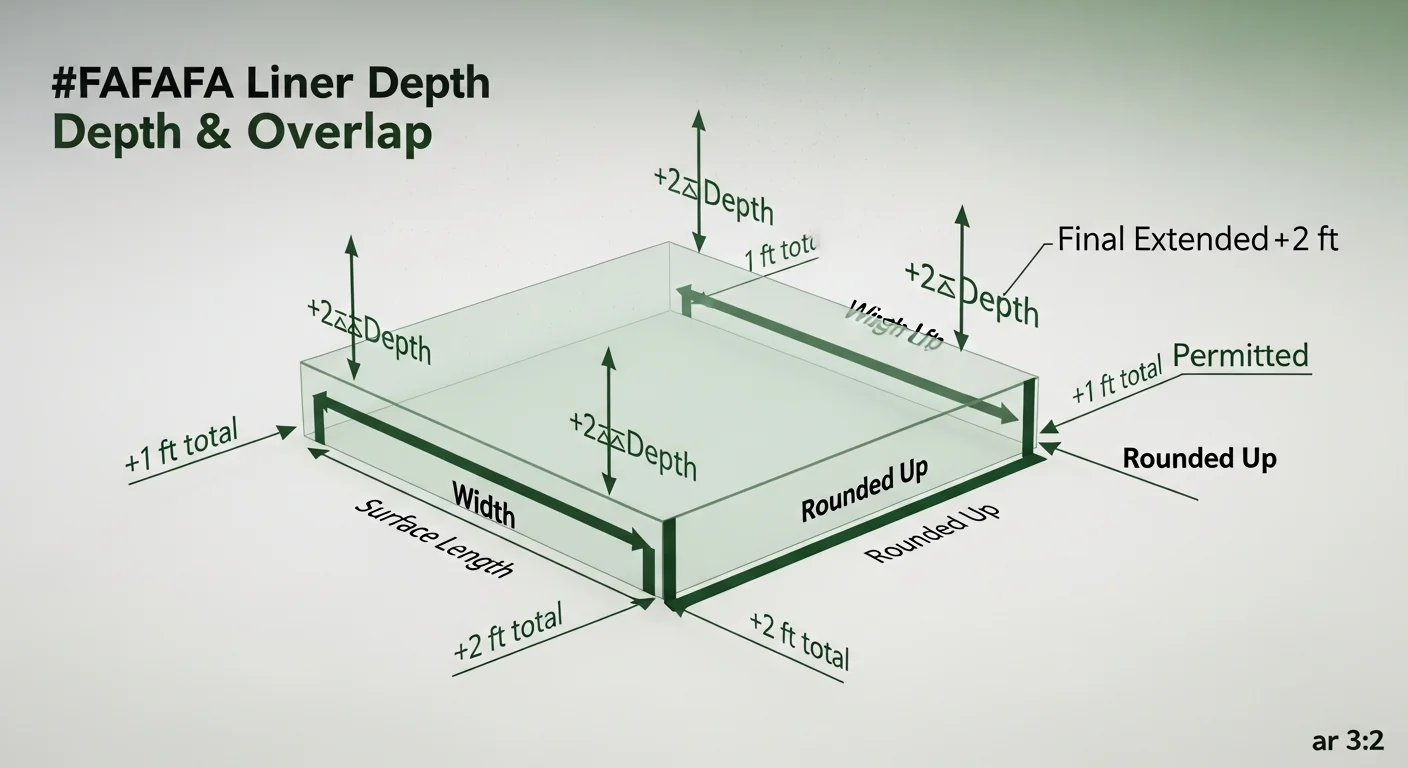
Pond liner failures almost always trace back to a measurement made at the surface, not at the bottom. The liner has to travel down both walls, across the floor, and back up the other side, then extend far enough over the edge to stay pinned beneath rock or coping. Skipping any part of that path leaves the liner short, and a liner that comes loose at the edge will not stay in place under water pressure.
| Component | Length (ft) | Width (ft) |
|---|
| Pond (L×W×D) | Liner Needed | Area (sq ft) |
|---|
How This Calculator Works
Step 2: Add twice the maximum depth to account for both sides:
Length + (2 × Depth)Step 3: Add 2 feet of extra material (1 foot per side) for overlap and anchoring with rocks.
Formula:
Liner Length = Pond Length + (2 × Depth) + 2 ftStep 4: Repeat the same for width:
Liner Width = Pond Width + (2 × Depth) + 2 ftStep 5: Round each dimension up to the nearest whole foot for standard sizing.
Assumptions: Measurements are maximum dimensions. The +2 ft overlap (1 ft per side) follows industry standard for securing liner edges beneath anchoring rocks or coping stones. This method works for rectangular, kidney, and free-form ponds when measured at their widest/longest points.
Assumptions & Limits
Max depth: Up to 20 ft supported.
Overlap allowance: Fixed at 1 ft per side (2 ft total per dimension) for standard rock-edge anchoring.
Shape: Works for rectangular, oval, kidney, and free-form ponds when you use the maximum measurements.
Material: Compatible with EPDM, PVC, RPE, and other flexible pond liner materials.
Note: For very irregular shapes or multi-level ponds, add extra material as a safety margin.
This calculator uses the standard depth-and-overlap formula to give you the correct liner dimensions for length and width independently. It accounts for maximum pond depth, adds the required anchoring allowance, and rounds the result up to the nearest whole foot. It does not estimate liner thickness, material cost, or water volume. For water loss tracking once the pond is built, a separate tool like the pond evaporation calculator handles that side of pond management.
After running this calculator, you will know the minimum liner dimensions to order. That number can go straight to a supplier for a cut or stock-size check.
Use the Tool
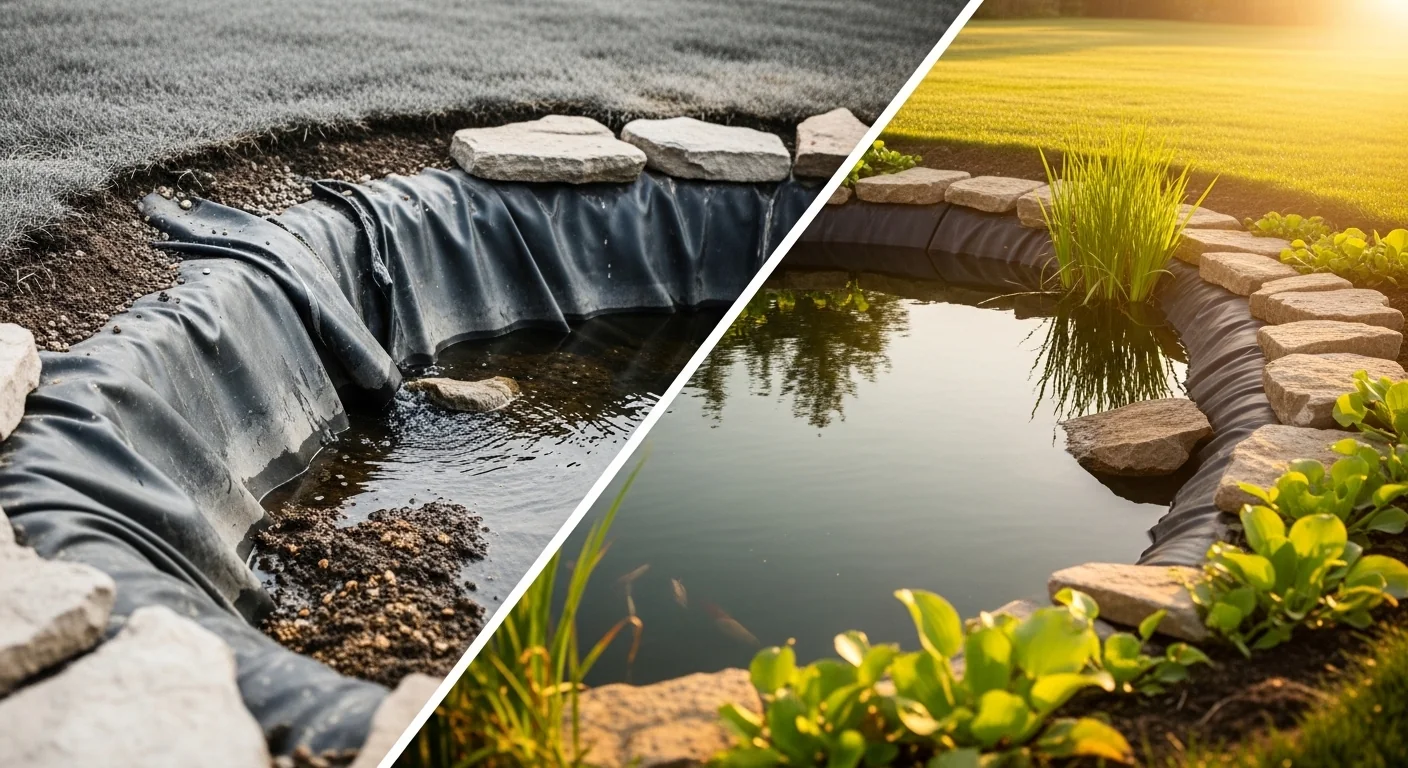
Before entering values, have a tape measure and your pond plan ready. Measure the longest point for length, the widest point for width, and the deepest intended water level for depth. All three inputs are in feet. Partial feet (for example, 3.5 ft) are accepted. If you are building a koi pond and expect to add a waterfall return, think through your pump placement now as well; sizing the pump system early avoids replanning later. The waterfall pump calculator pairs directly with this step.
Quick Start (60 Seconds)
- Max Length: Measure the longest interior dimension of the pond at the water surface, not at the bottom. Unit is feet. Do not convert to inches.
- Max Width: Measure the widest interior point at the surface. For kidney or freeform shapes, use the absolute widest span.
- Max Depth: Measure the deepest point you intend to fill with water. Use the planned water depth, not the excavation depth. Acceptable range is 0.5 ft to 20 ft.
- Common input error: Entering average depth instead of maximum depth. The liner must reach the deepest point; using an average will leave one section of the liner short.
- Units stay in feet throughout. The calculator does not accept inches or meters. Convert before entry.
- Click Calculate only after all three fields are filled. The result rounds up to the nearest foot automatically.
- Check the breakdown table in the results to verify each component of the calculation before ordering.
Inputs and Outputs (What Each Field Means)
| Field | Unit | What It Means | Common Mistake | Safe Entry Guidance |
|---|---|---|---|---|
| Max Pond Length | feet | The longest horizontal dimension of the pond measured at the water surface | Measuring at the bottom of the excavation, which is narrower | Measure at ground level across the opening; accepted range: 1 to 200 ft |
| Max Pond Width | feet | The widest horizontal span, independent of the length axis | Using half the width for a kidney shape instead of the full widest point | Span the tape across the absolute widest point; accepted range: 1 to 200 ft |
| Max Pond Depth | feet | The deepest point the pond will hold water, not the excavation depth | Using average depth or excavation depth rather than maximum water depth | Measure or plan to the deepest water point; accepted range: 0.5 to 20 ft |
| Liner Length (output) | feet | The required liner dimension along the long axis, including depth runs and overlap | Assuming the output matches a stock roll width without checking supplier sizes | Verify this dimension against available stock or order a custom cut |
| Liner Width (output) | feet | The required liner dimension along the short axis, including depth runs and overlap | Swapping liner length and liner width when placing the material | Mark which dimension runs which direction on the pond plan before laying |
Worked Examples (Real Numbers)
Example 1: Small Backyard Water Feature
- Max Length: 8 ft
- Max Width: 6 ft
- Max Depth: 2 ft
Result: Liner Length = 8 + (2 x 2) + 2 = 14 ft. Liner Width = 6 + (2 x 2) + 2 = 12 ft. Recommended liner: 14 x 12 ft (168 sq ft).
A 14 x 12 ft liner is a common stock size and should be available from most suppliers. The 2 ft overlap gives 1 ft of material on each side to tuck under edging stones.
Example 2: Mid-Size Koi Pond
- Max Length: 12 ft
- Max Width: 10 ft
- Max Depth: 3 ft
Result: Liner Length = 12 + (2 x 3) + 2 = 20 ft. Liner Width = 10 + (2 x 3) + 2 = 18 ft. Recommended liner: 20 x 18 ft (360 sq ft).
At 3 ft deep, this pond supports koi comfortably. The 20 x 18 ft size approaches the upper end of standard roll widths, so confirm availability before finalizing the pond dimensions.
Example 3: Large Formal Water Garden
- Max Length: 20 ft
- Max Width: 15 ft
- Max Depth: 4 ft
Result: Liner Length = 20 + (2 x 4) + 2 = 30 ft. Liner Width = 15 + (2 x 4) + 2 = 25 ft. Recommended liner: 30 x 25 ft (750 sq ft).
At this scale, a single EPDM panel may require a seamed join. Consult the liner supplier about seaming tape or factory-welded seams before ordering. A seam placed on the pond floor is more durable than one placed on a sloped wall.
Reference Table (Fast Lookup)
| Pond L (ft) | Pond W (ft) | Pond D (ft) | Liner L (ft) | Liner W (ft) | Liner Area (sq ft) |
|---|---|---|---|---|---|
| 6 | 4 | 2 | 12 | 10 | 120 |
| 8 | 6 | 2 | 14 | 12 | 168 |
| 10 | 8 | 2.5 | 17 | 15 | 255 |
| 10 | 8 | 3 | 18 | 16 | 288 |
| 12 | 10 | 3 | 20 | 18 | 360 |
| 15 | 10 | 4 | 25 | 20 | 500 |
| 20 | 15 | 4 | 30 | 25 | 750 |
| 25 | 20 | 5 | 37 | 32 | 1,184 |
| 30 | 20 | 6 | 44 | 34 | 1,496 |
The "Liner Area" column is derived by multiplying the rounded liner length by the rounded liner width. Use it to cross-check pricing quotes, which suppliers sometimes give per square foot.
How the Calculation Works (Formula + Assumptions)
Show the calculation steps
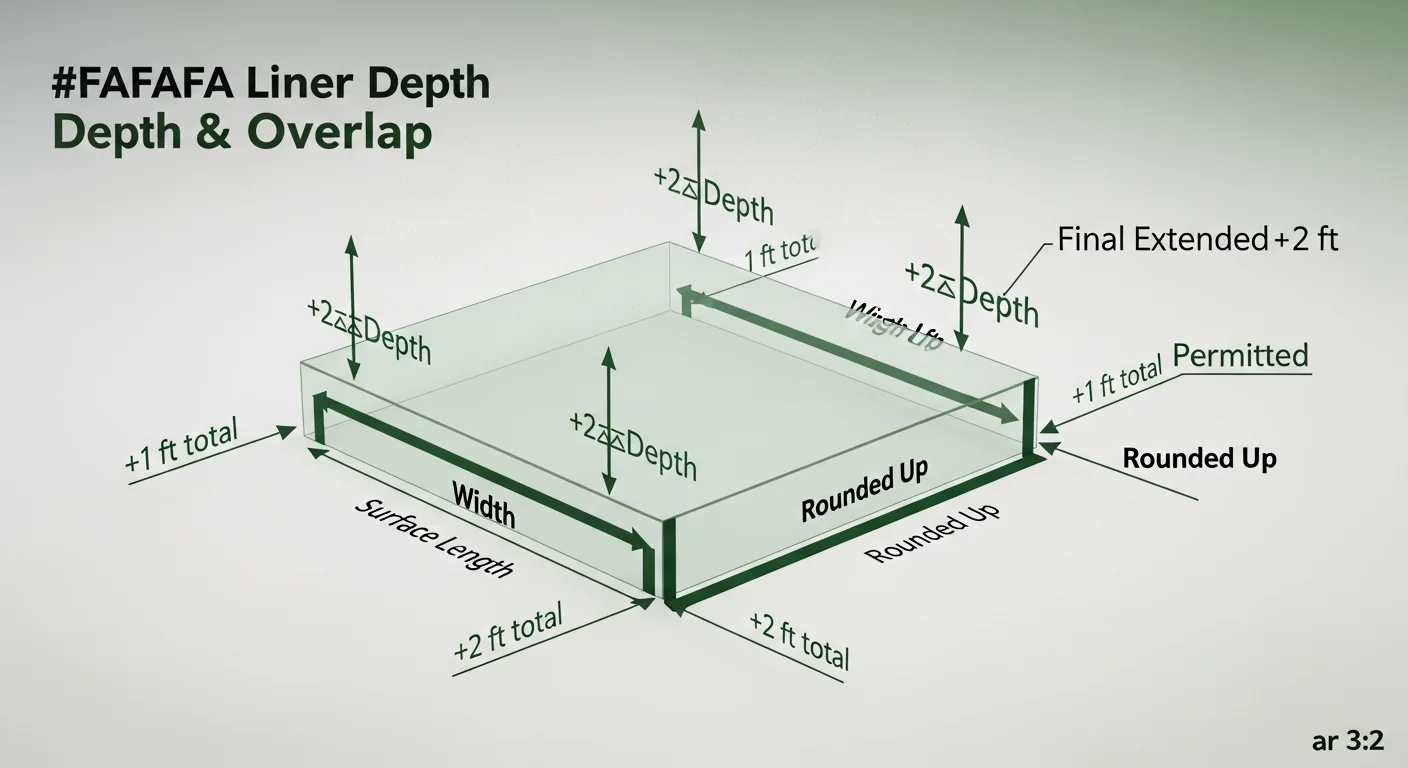
The formula is applied identically to length and width:
- Start with the pond surface dimension. This is the measurement taken at the top edge of the pond, not at the bottom.
- Add twice the maximum depth. The liner must travel from the top edge down one wall, across the floor, and back up the opposite wall. That path equals two full depth measurements:
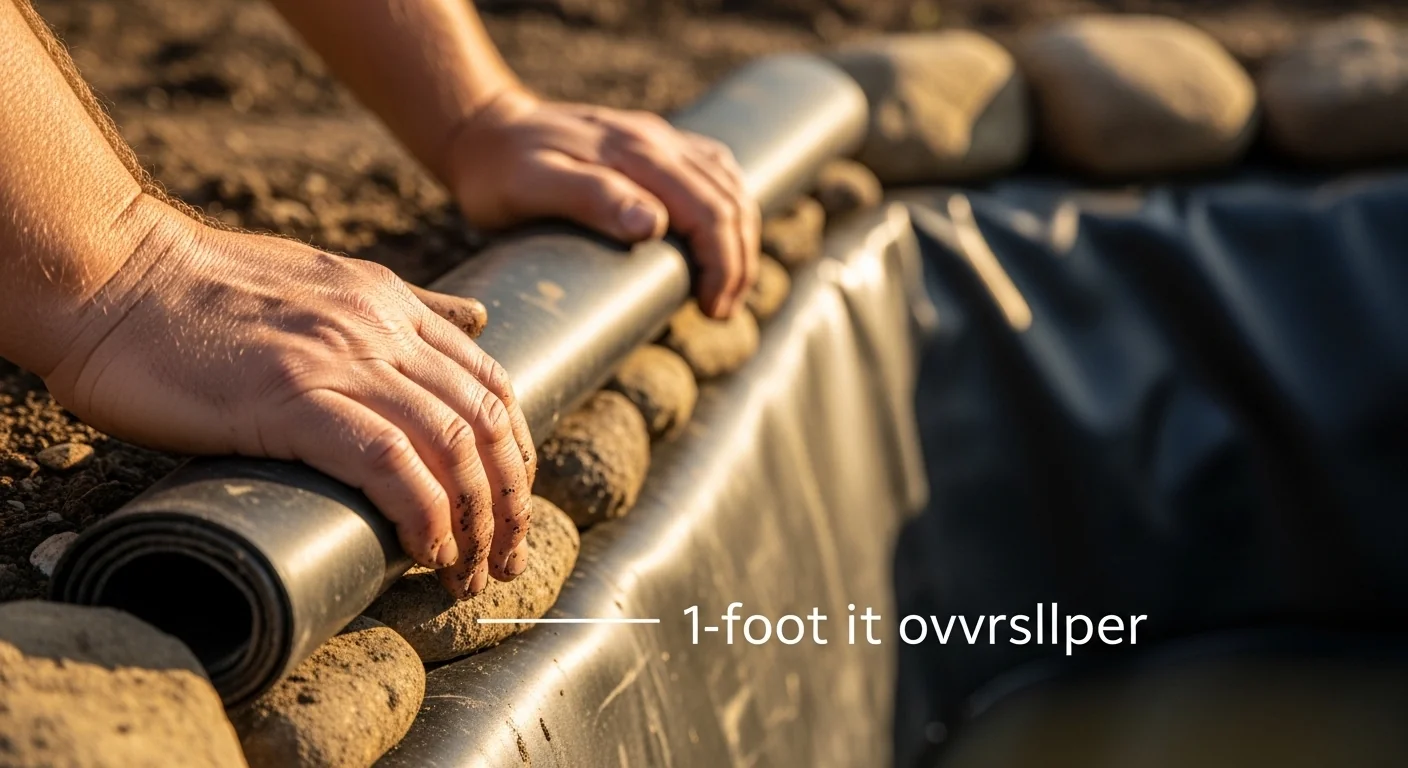
2 x Depth. - Add 2 ft for overlap. A minimum of 1 ft of material per side must extend beyond the pond edge to allow anchoring beneath rock or coping. This is a fixed allowance:
+ 2 ft. - Round up to the nearest whole foot. Liner materials are cut or sold in whole-foot increments. Any fractional result rounds up, never down.
Written as a formula: Liner Dimension = Pond Dimension + (2 x Depth) + 2, then round up to nearest whole foot.
Assumptions and Limits
- The formula assumes vertical or near-vertical walls. Shallower sloped walls will consume less liner material on the sides, meaning this formula is conservative and safe for slopes.
- Maximum supported pond length and width is 200 ft per dimension. Values outside this range are rejected by the calculator.
- Minimum accepted depth is 0.5 ft. Shallower installations are outside standard liner sizing practices.
- The +2 ft overlap allowance (1 ft per side) is a fixed industry minimum. Projects requiring wider stone coping or formal concrete edging may need an additional 0.5 to 1 ft per side, which must be added to the calculator inputs manually.
- This formula does not account for shelf or ledge features inside the pond. Internal plant shelves change the side-wall path length. Measure depth to the deepest zone only, and verify shelf coverage separately.
- The formula treats ponds as rectangular for calculation purposes. For freeform or kidney shapes, use the maximum length and maximum width as if drawing a rectangle around the shape. This approach is intentionally conservative.
- Liner seaming requirements for large ponds are outside the scope of this calculator. Seam placement decisions require a supplier consultation.
Standards, Safety Checks, and "Secret Sauce" Warnings
Critical Warnings
- Never omit the overlap allowance. A liner cut exactly to the depth-adjusted dimension will have no material to anchor at the edges. Water pressure and soil movement will pull it inward over time, leading to edge failure and water loss.
- Always use maximum depth, not average depth. If a pond has a shelf at 1.5 ft and a main basin at 3 ft, the liner must be sized for the 3 ft depth. Using the average undercuts the liner length by the full depth difference on both sides.
- Round up, never down. A liner cut 0.5 ft short cannot be extended in the field. Rounding down to save material is the most common source of short orders.
- For ponds deeper than 4 ft, verify liner thickness as well as size. The calculator flags this condition in the results, but material selection (45-mil or thicker EPDM, or RPE) must be confirmed with the supplier independently.
Minimum Standards
- Overlap at pond edges: minimum 1 ft per side (2 ft total per dimension). This is the value built into the formula.
- Anchoring method: the overlap must be secured beneath a continuous row of coping stones, rock edging, or concrete. Loose flaps at the surface are not adequate anchorage.
- Liner material for standard backyard ponds: 45-mil EPDM is the widely accepted baseline for durability and UV resistance. Thinner materials may be acceptable for temporary or very shallow installations only.
Competitor Trap: Many pond liner sizing guides online instruct readers to add a flat "2 feet" to each dimension and leave it there. That advice collapses when pond depth changes. A 2 ft deep pond needs 4 ft of extra material across each dimension just for the walls, plus the 2 ft overlap, for a total addition of 6 ft. Adding a flat 2 ft to the surface dimension produces a liner that is 4 ft too short per axis. The formula used here applies depth correctly and treats the overlap separately so the two are never confused. For reference, the same principle of correct overlap math applies when sizing other landscape containment materials, which is why the landscape fabric overlap calculator follows an analogous approach. If your pond project also requires a recirculating or solar-powered water system, sizing that separately with the solar pump calculator prevents underpowering the water flow.
Common Mistakes and Fixes
Mistake: Using Average Depth Instead of Maximum Depth
A pond with a plant shelf at 12 inches and a main basin at 36 inches has an average depth of roughly 24 inches. Sizing the liner to 24 inches of depth means the wall run on the deep side is 12 inches short per wall, a total deficit of 2 ft on each axis. That liner will not reach the edge at the deepest section and cannot be anchored correctly.
Fix: Always identify the single deepest point in the design and enter that value as the depth input.
Mistake: Ordering the Liner Before Verifying Stock Sizes
A calculated result of 19 x 17 ft is precise but may not match any stock roll. Many EPDM suppliers cut from rolls in standard widths such as 10, 15, 20, and 25 ft. Ordering a "19 x 17 ft" liner may trigger a custom cut fee or a longer lead time.
Fix: Take the calculated dimensions to the supplier first. If the next available stock size is 20 x 20 ft, order that and fold the excess neatly into the pond edge rather than trimming it.
Mistake: Forgetting to Account for Gravel or Rock Backfill Depth
Placing a gravel layer on the pond floor after installation reduces effective depth and changes the visual depth of the water. Some installers plan the pond depth for the liner, then add gravel afterward, which raises the floor and reduces water volume unexpectedly. If the gravel and the gravel quantity are planned together before liner sizing, the finished depth can be specified correctly from the start.
Fix: Decide the finished water depth (above the gravel layer) and add the gravel depth to get the excavation depth. Use the finished water depth in this calculator.
Mistake: Treating Liner Length and Width as Interchangeable
The formula produces two separate numbers for two different axes. A pond that is 15 ft long and 10 ft wide requires a liner that is longer on the length axis and shorter on the width axis. Transposing those values when laying the liner means the material runs out along one edge while excess bunches up on another.
Fix: Label the calculated liner length and liner width on the pond plan with directional arrows before delivery. Mark one edge of the liner at the supplier's yard if possible.
Mistake: Ignoring Liner-Edge Exposure to Sunlight
The 1 ft overlap that extends beyond the pond edge will be exposed to UV if not covered. EPDM handles UV well, but PVC and thin polythene liners degrade faster when left uncovered at the surface. A pond sized and installed with correct overlap but no coping coverage will experience edge brittleness and cracking within a few seasons. Water gardens designed with exposed liner edges also tend to attract birds and wildlife that can puncture or displace the material. For reference on projects that combine water features with adjacent planted areas, the rain garden sizing calculator covers adjacent infiltration zone planning.
Fix: Plan for continuous coping, rock edging, or soil cover over the overlap before the liner is ordered. This determines whether the 1 ft standard allowance is sufficient or whether extra material is needed.
Next Steps in Your Workflow
Once you have the liner dimensions, the next decision is the liner material and thickness. EPDM in 45-mil thickness is the standard recommendation for ponds that will hold fish or support plant roots over many years. For very large or commercial installations, RPE (reinforced polyethylene) panels offer higher puncture resistance at lower weight. Take your liner length and width to at least two suppliers and compare pricing per square foot rather than per panel, since stock size differences can obscure the real cost. After the liner is installed and the pond is filled, the biological system needs attention. Sizing your filtration and clarification equipment correctly from the start prevents chronic water clarity problems. The pond UV clarifier sizing tool helps match UV output to pond volume, which should be calculated after you confirm final pond dimensions.
Edging and surround materials require their own planning step. If the pond is being set into a slope or a raised area, the surrounding grade may need adjustment before the liner goes in. Retaining structures around the pond edge are sized separately from the liner itself. For projects where soil volume calculations are also part of the scope, the retaining wall calculator covers the adjacent structural element. Keep both calculations in the same project notes so the contractor or installer has complete dimensions in one place.
FAQ
What is the standard overlap for a pond liner?
The standard minimum is 1 foot per side, giving 2 feet of total extra material per dimension. This allows the liner to extend far enough over the pond edge to be anchored beneath a continuous row of coping stones or rock edging. Projects with wider decorative borders or formal concrete edging may require a larger overlap, which must be added to the depth input before calculating.
Does liner shape matter for the calculation?
The formula treats any pond shape as a rectangle for sizing purposes. For freeform, kidney, or irregular shapes, measure the longest possible length and the widest possible width, as if drawing a rectangle around the entire shape. This approach ensures the liner covers every point of the outline, with some excess at the concave sections that folds neatly into the edge.
What is the difference between EPDM, PVC, and RPE pond liners?
EPDM (ethylene propylene diene monomer) is a synthetic rubber that is flexible in cold temperatures and resistant to UV over many years. PVC is lighter and less expensive but degrades faster under sunlight if uncovered. RPE (reinforced polyethylene) is lightweight and strong but less flexible in cold climates. The sizing formula applies equally to all three materials; material selection depends on budget, climate, and intended use.
Can I use this calculator for a koi pond specifically?
Yes. Enter the planned maximum water depth for the koi pond, which is typically 3 to 4 feet for standard koi. The formula outputs the liner dimensions needed to cover that depth plus anchoring overlap. Koi ponds deeper than 4 feet trigger an advisory in the calculator results recommending verification of liner thickness with the supplier.
What does "round up to the nearest foot" mean in practice?
If the raw calculation produces a liner length of 18.5 ft, the calculator returns 19 ft. If the result is exactly 18 ft, it stays at 18 ft. Rounding always goes up, never down, because ordering a liner that is half a foot too short creates an anchoring gap that cannot be fixed on site without a seam or a second panel.
How accurate is this calculator for irregular pond shapes?
The formula is deliberately conservative for irregular shapes. Using maximum length and maximum width from a rectangle drawn around the shape guarantees the liner covers every point of the outline. For highly irregular forms with deep concave curves, the excess material at the concave sections should be folded, not trimmed. Trimming removes the safety margin built into the overlap allowance.
Conclusion
The single mistake most worth avoiding is entering average depth instead of maximum depth. It is the input most frequently estimated rather than measured, and the error compounds on both axes of the liner. Measure to the deepest point, enter that value, and verify the output against available stock sizes before placing the order. For projects where liner sizing is one part of a larger pond system plan, the pond liner size calculator offers a companion reference for cross-checking dimensions and order quantities.