
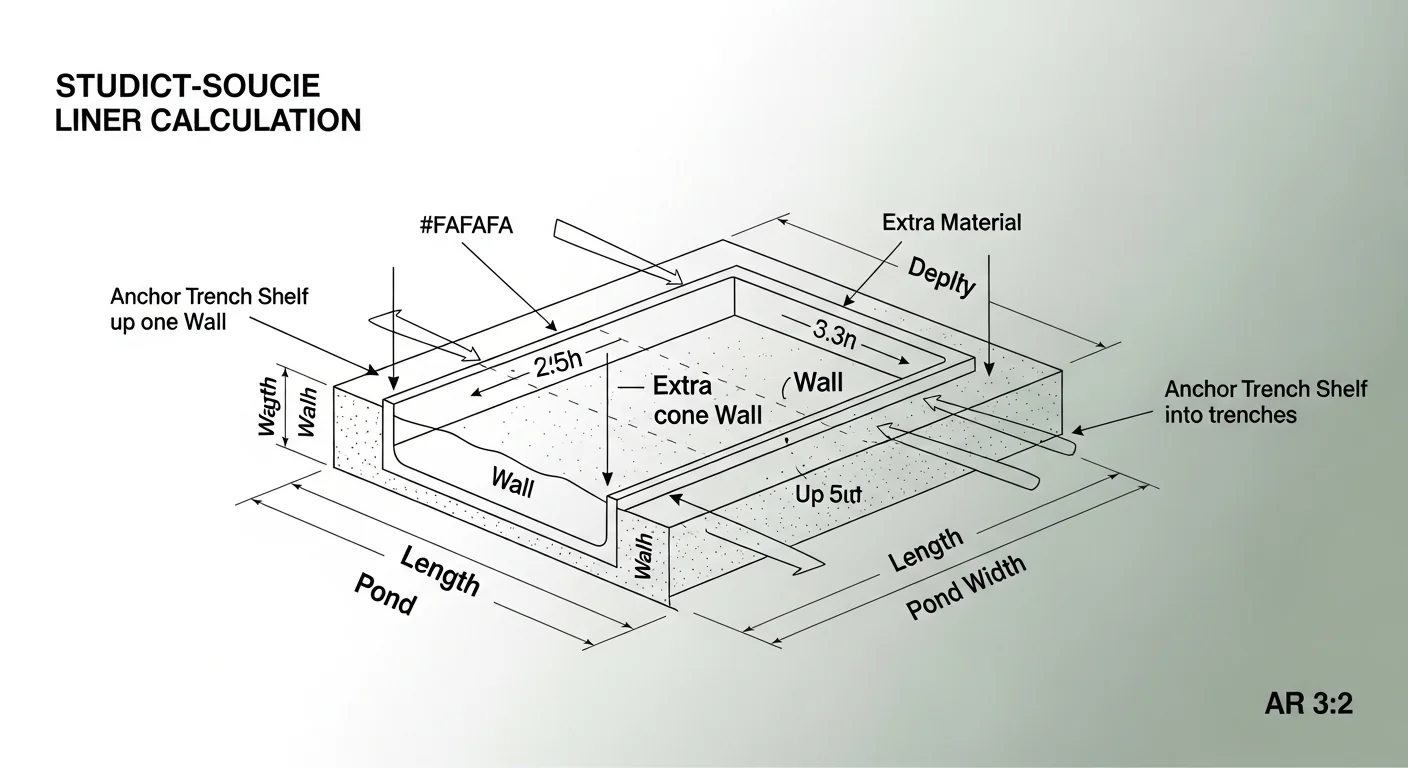
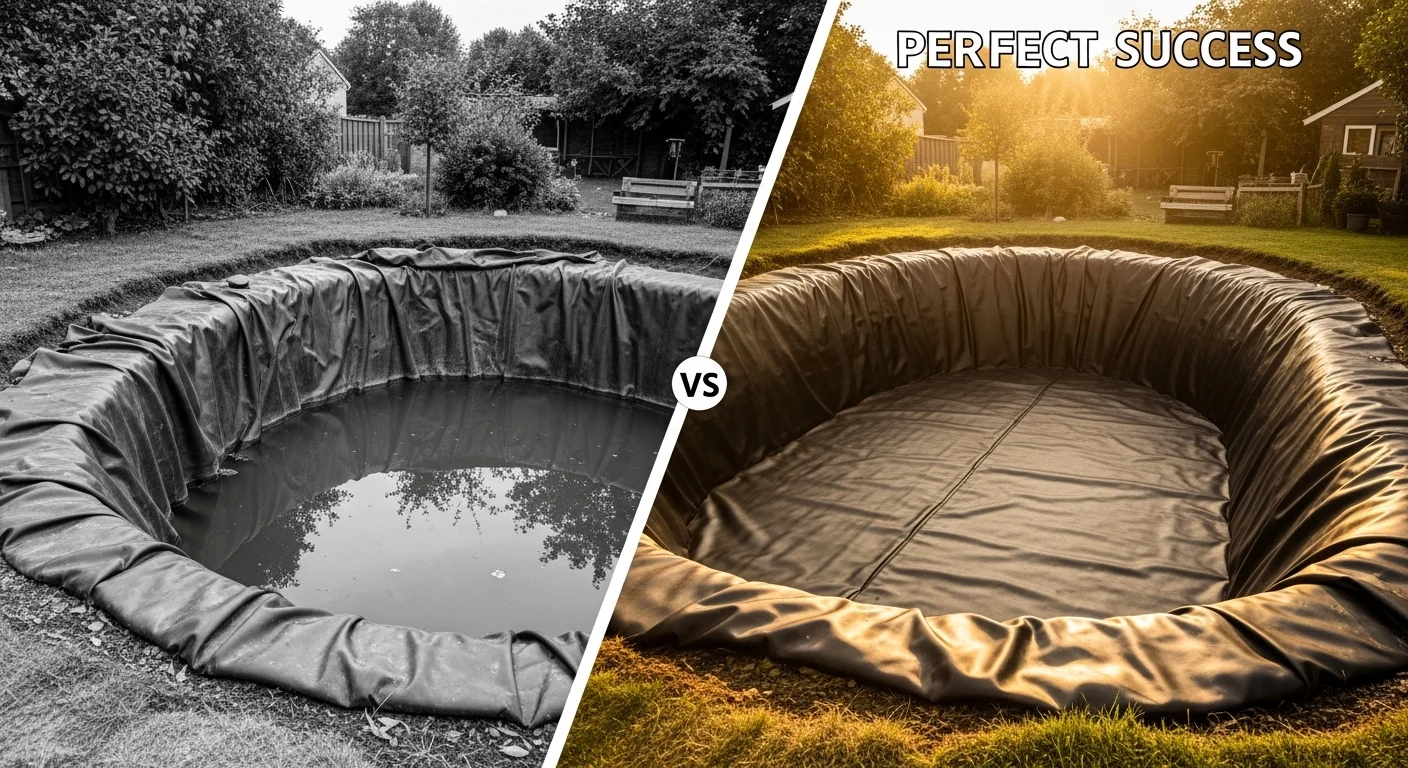
A pond liner’s dimensions are not the same as the pond’s dimensions. That distinction sounds minor until you’re watching a newly filled pond drag an undersized liner off the edge and down into the water. The geometry is unforgiving: every inch of wall depth requires liner material to travel down one side, across the bottom, and back up the opposite side. Buy a liner the size of your hole and you have bought a disaster on a delay timer.
This pond liner size calculator takes four measurements and a material choice, then applies the depth-times-two formula across both the length and width axes to produce the correct liner sheet dimensions and total square footage. It also outputs the matching underlayment area, identifies anchor trench requirements, and triggers material-specific warnings when inputs fall outside safe operating ranges. It does not account for irregular kidney shapes, sloped walls, or decorative shelves built into the excavation profile; users with non-rectangular ponds should use the maximum bounding dimensions and treat the result as a conservative estimate.
After running your measurements through this tool, you will know the exact liner sheet size to order, the underlayment square footage to match it, and whether your planned anchor trench shelf is wide enough to prevent liner migration once the pond fills with water.
Use the Tool
EPDM Pond Liner Size & Anchor Trench Calculator
Calculate the exact liner and underlayment dimensions for your pond project
| Pond (L×W×D) | Anchor | Liner Needed | Sq Ft |
|---|
How This Calculator Works
Liner Length = Maximum Pond Length + (Maximum Depth × 2) + (Anchor Trench Width × 2)
Liner Width = Maximum Pond Width + (Maximum Depth × 2) + (Anchor Trench Width × 2)
Total Square Footage = Liner Length × Liner Width
Underlayment Sq Ft = Same as Total Square Footage (full coverage under the liner)
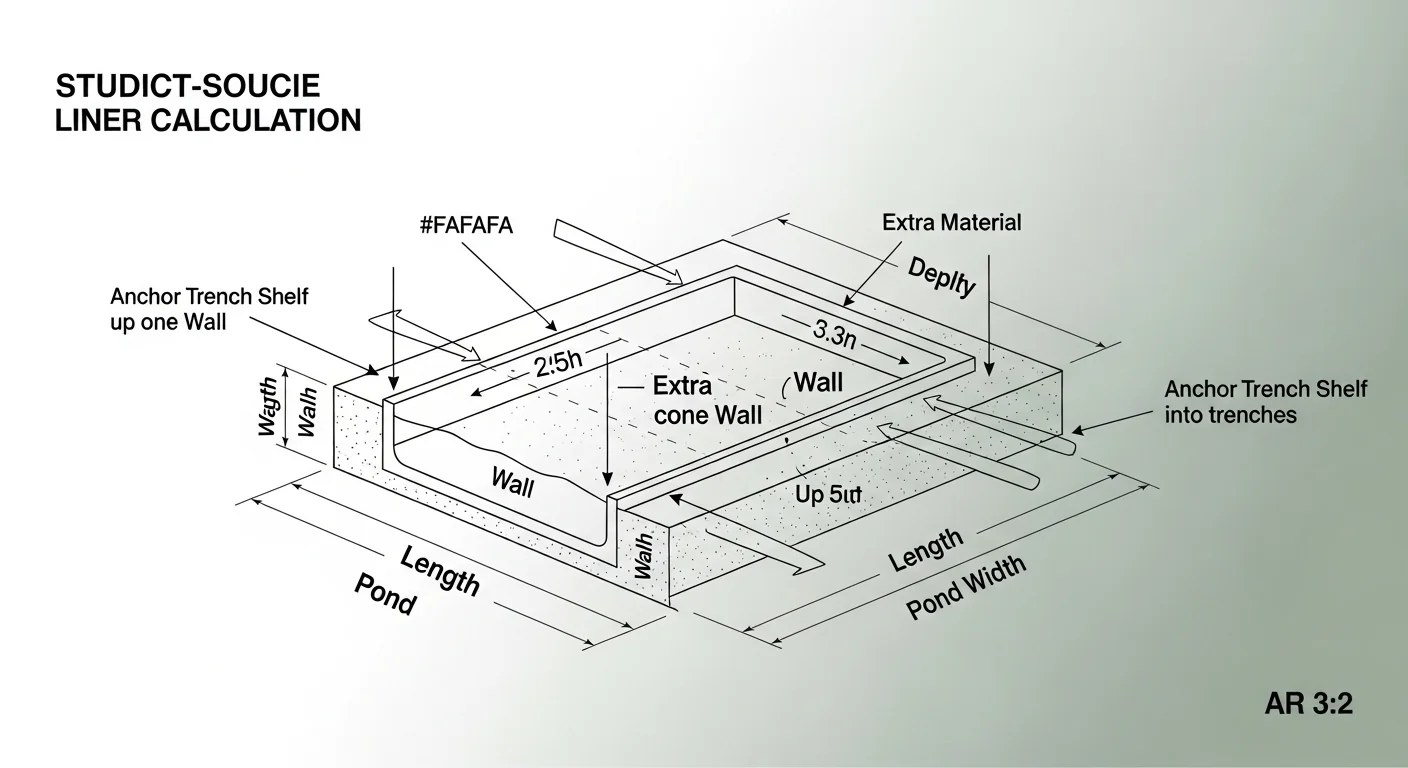
The “Depth × 2” accounts for the liner going down one wall, across the bottom, and up the opposite wall. The “Anchor × 2” ensures extra material extends past the pond edge into anchor trenches on all sides, preventing slippage under thousands of pounds of water pressure.
Assumptions: Rectangular approximation. Irregular shapes should use maximum measurements. Depth does not exceed 20 ft. Anchor trench shelf between 0.5 ft and 4 ft.
Assumptions & Limits
This calculator uses maximum dimensions (rectangular bounding box). Irregular or kidney-shaped ponds should measure the longest and widest points.
Standard anchor trench shelf width: 1–2 ft. Using less than 1 ft risks liner pull-in under hydrostatic pressure.
Depth range: 0.5–20 ft. Ponds over 6 ft deep may require engineered reinforcement beyond liner sizing.
Results assume a single continuous liner sheet. For liners requiring seams, add 6 inches of overlap per seam and use manufacturer-approved seam tape and primer.
Always use non-woven geotextile underlayment (minimum 8 oz/yd²) beneath the liner to prevent punctures from rocks and roots.
Before entering values, have a tape measure ready and confirm you are capturing the maximum pond length, maximum width, and maximum depth at the deepest point, not an average. Anchor trench shelf width is the flat edge that will extend beyond the pond rim to secure the liner; if you have not yet designed this, the standard starting point is 1 foot on all sides. If you are also planning a raised stone or timber edge around the pond, the retaining wall calculator can help you estimate that separate material quantity before finalizing your excavation plan.
Quick Start (60 Seconds)
- Maximum Pond Length: Measure the longest axis of the finished excavation in feet, not the liner roll. Enter a value between 1 and 200 ft.
- Maximum Pond Width: Measure the widest axis, perpendicular to the length. For circular ponds, enter the diameter in both fields.
- Maximum Pond Depth: Measure from the planned water surface down to the deepest point of the excavation. Accepted range: 0.5 to 20 ft. Do not enter the depth from ground level to the water surface; measure the pond cavity itself.
- Anchor Trench Shelf Width: The flat horizontal margin the liner will extend over and beyond the pond edge before entering the anchor trench. A value below 1 ft triggers a safety warning; 1.5 ft is a common working standard for residential ponds.
- Liner Material: Select 45-mil EPDM Rubber if you are installing a permanent pond. Select PVC only if you understand the UV and puncture limitations; the tool will display the relevant advisory.
- Click Calculate Liner Size. The tool will not run until all four numeric fields contain valid entries.
- Note both the liner dimensions (length x width in feet) and the total square footage for your material order. The underlayment figure matches the liner area exactly.
Inputs and Outputs (What Each Field Means)
| Field | Unit | What It Represents | Common Mistake | Safe Entry Guidance |
|---|---|---|---|---|
| Maximum Pond Length | feet | Longest horizontal dimension of the finished excavation | Measuring the planned liner roll instead of the pond cavity | 1 to 200 ft; measure at water surface level |
| Maximum Pond Width | feet | Widest horizontal dimension, perpendicular to length | Using an average width on tapered ponds; always use maximum | 1 to 200 ft |
| Maximum Pond Depth | feet | Deepest point of excavation measured vertically | Entering depth from grade to water surface rather than total cavity depth | 0.5 to 20 ft; use deepest single point |
| Anchor Trench Shelf Width | feet | Horizontal liner extension past the pond rim, buried or weighted to prevent liner migration | Treating this as cosmetic rather than structural; skipping it entirely | 0.5 to 4 ft; minimum 1 ft recommended |
| Liner Material | selection | 45-mil EPDM rubber or PVC; controls which material warnings appear | Choosing PVC because it is less expensive without accounting for service life difference | EPDM strongly recommended for permanent installations |
| Liner Length (output) | feet | Required sheet length = Pond Length + (Depth x 2) + (Anchor x 2) | Ordering a roll that matches pond length, not this calculated value | Always round up to nearest foot when ordering |
| Liner Width (output) | feet | Required sheet width = Pond Width + (Depth x 2) + (Anchor x 2) | Same as liner length mistake, applied to the other axis | Always round up when ordering |
| Total Square Footage (output) | sq ft | Liner Length x Liner Width; also equals the required underlayment area | Ordering underlayment equal to the pond surface area instead of the full liner footprint | Order underlayment matching this number, not the raw pond dimensions |
For overlapping liner fabric in applications adjacent to your pond perimeter, the landscape fabric overlap calculator can determine the additional material needed at seam edges.
Worked Examples (Real Numbers)
Scenario 1: Small Backyard Water Garden
- Pond Length: 6 ft
- Pond Width: 4 ft
- Pond Depth: 2 ft
- Anchor Shelf: 1 ft
- Material: 45-mil EPDM
Result: Liner Length = 6 + (2 x 2) + (1 x 2) = 12 ft. Liner Width = 4 + (2 x 2) + (1 x 2) = 10 ft. Total = 120 sq ft liner and underlayment.
A 10 x 10 ft liner purchased for this pond would have failed. The 12 x 10 ft sheet accounts for both side walls on each axis and still leaves 1 ft of anchor material past the rim on every edge.
Scenario 2: Medium Residential Koi Pond
- Pond Length: 12 ft
- Pond Width: 10 ft
- Pond Depth: 3 ft
- Anchor Shelf: 1.5 ft
- Material: 45-mil EPDM
Result: Liner Length = 12 + 6 + 3 = 21 ft. Liner Width = 10 + 6 + 3 = 19 ft. Total = 399 sq ft liner and underlayment.
The naive 12 x 10 ft purchase would have covered 120 sq ft. The correctly sized liner is 399 sq ft, more than three times larger. The additional material is not waste; it is the structural system that holds the liner in place under hydrostatic load.
Scenario 3: Large Water Feature with Deep Zone
- Pond Length: 20 ft
- Pond Width: 15 ft
- Pond Depth: 4 ft
- Anchor Shelf: 2 ft
- Material: 45-mil EPDM
Result: Liner Length = 20 + 8 + 4 = 32 ft. Liner Width = 15 + 8 + 4 = 27 ft. Total = 864 sq ft liner and underlayment.
At 4 ft depth, the deep pond advisory in the tool activates. The 2 ft anchor shelf on this size pond is appropriate; going below 1.5 ft at this scale would increase migration risk significantly given the water volume and corresponding hydrostatic pressure on the liner walls.
Reference Table (Fast Lookup)
| Pond L x W x D (ft) | Anchor (ft) | Liner L (ft) | Liner W (ft) | Total Sq Ft | Underlayment Sq Ft |
|---|---|---|---|---|---|
| 6 x 4 x 2 | 1 | 12 | 10 | 120 | 120 |
| 8 x 6 x 2.5 | 1 | 16 | 14 | 224 | 224 |
| 10 x 8 x 3 | 1.5 | 19 | 17 | 323 | 323 |
| 12 x 10 x 3 | 1.5 | 21 | 19 | 399 | 399 |
| 15 x 12 x 3.5 | 1.5 | 26 | 23 | 598 | 598 |
| 18 x 14 x 4 | 2 | 30 | 26 | 780 | 780 |
| 20 x 15 x 4 | 2 | 32 | 27 | 864 | 864 |
| 25 x 18 x 5 | 2 | 39 | 32 | 1,248 | 1,248 |
How the Calculation Works (Formula + Assumptions)
Show the calculation steps
Step 1 - Liner Length
Liner Length = Maximum Pond Length + (Maximum Depth x 2) + (Anchor Trench Width x 2)
The "Depth x 2" term accounts for the liner traveling down one long wall and back up the opposite long wall. The "Anchor x 2" adds the overhang margin on both ends of that axis.
Step 2 - Liner Width
Liner Width = Maximum Pond Width + (Maximum Depth x 2) + (Anchor Trench Width x 2)
The same logic applies across the width axis independently. The formula treats the pond as a rectangular basin regardless of actual shape.
Step 3 - Total Square Footage
Total Sq Ft = Liner Length x Liner Width
This is also the required underlayment area. Underlayment must cover the full liner footprint, not just the pond base.
Rounding rule: The calculator outputs exact decimal values. When placing a material order, always round liner dimensions up to the next whole foot. Do not round down under any circumstances.
Unit note: All inputs are in feet. The output square footage is in square feet. No unit conversion is required within this formula.
Assumptions and Limits
- The pond is treated as a rectangular basin. Irregular, kidney-shaped, or freeform ponds should use maximum bounding dimensions, which will over-estimate material slightly. That overage is preferable to shortfall.
- Wall angles are assumed to be vertical. Sloped or battered walls require less liner material per linear foot of depth; this tool calculates the conservative vertical case.
- Depth is uniform at the entered maximum. Multi-level ponds with shallow shelves and deeper zones should use the deepest single measurement.
- The anchor trench shelf is assumed to be horizontal and flat on all four sides. Raised stone copings or angled trench walls may require additional liner beyond this calculation.
- The formula does not account for liner seams. If two liner panels must be joined, add a minimum 6-inch overlap per seam and use manufacturer-specified seam tape and primer.
- This calculation is valid for ponds up to 20 ft deep and 200 ft in either horizontal dimension. Applications outside these ranges involve engineering considerations beyond the scope of a residential sizing tool.
- Underlayment is sized equal to the liner area. Highly rocky or root-heavy subgrade may warrant extending underlayment past the liner edge by 6 inches on all sides as added puncture protection.
Standards, Safety Checks, and "Secret Sauce" Warnings
Critical Warnings
- The Slipping Liner failure mode: A liner sized to match only the pond's opening dimensions will pull away from the edges and sink to the bottom when the water fills. Hydrostatic pressure from several thousand pounds of water has sufficient force to drag an improperly anchored liner completely inward. No amount of perimeter weighting compensates for insufficient linear footage; the sheet itself must be large enough to reach into the anchor trench with material to spare.
- PVC liner UV and puncture degradation: PVC liners exposed to sunlight along their above-grade anchor section can begin to show brittleness and micro-cracking within five to ten years. EPDM rubber (Ethylene Propylene Diene Monomer) at 45-mil thickness does not share this UV sensitivity and carries a substantially longer functional service life for permanent pond installations.
- Shallow anchor shelf risk: An anchor trench shelf narrower than 1 ft provides insufficient resistance to liner migration, particularly in ponds deeper than 3 ft where hydrostatic forces on the sidewalls are significant. The 1 to 2 ft shelf standard exists precisely because thinner margins fail under load.
Minimum Standards
- Anchor trench shelf width: 1 ft absolute minimum; 1.5 ft standard for ponds up to 15 ft in any horizontal dimension; 2 ft recommended for ponds 15 ft or larger.
- Underlayment specification: non-woven geotextile fabric, minimum 8 oz per square yard. This weight class provides meaningful puncture resistance against subgrade rocks and roots. Lighter fabrics are not a substitute.
- Liner seam overlap: minimum 6 inches with seam tape and primer for any joined sheet application. The seam itself is the weakest point of any multi-panel installation.
The competitor trap: Nearly every generic "pond liner calculator" online asks for length, width, and depth and then adds a fixed 2-foot margin across the board. That approach fails when depth exceeds 1 foot because the margin should scale directly with depth, applied twice per axis. A 3 ft deep pond needs 6 ft of additional material per side just for wall coverage, plus the separate anchor allowance. Fixed-margin calculators systematically underestimate liner size for ponds of any meaningful depth, and the user has no way to know they received a wrong answer until the pond is full and the liner has already migrated.
For ponds intended to support filtration systems, proper UV clarifier sizing is as important as liner sizing. The pond UV clarifier sizing tool uses pond volume to help determine appropriate filter capacity once your excavation dimensions are finalized. For the water feature category more broadly, understanding overflow and drainage behavior is relevant; the rain garden sizing calculator addresses adjacent drainage design for properties managing runoff near water features.
Common Mistakes and Fixes
Mistake: Ordering a liner equal to pond surface dimensions
This is the single most common and most damaging error in DIY pond construction. The excavation opening looks like it needs a 10 x 12 ft liner, so a 10 x 12 ft liner is ordered. When the pond fills, that liner has no excess material to ride the walls, anchor into the trench, or accommodate any settling movement. It pulls inward immediately. Fix: Always run the Depth x 2 formula on both axes before any purchase and use those calculated dimensions as the minimum order size.
Mistake: Skipping underlayment or using lightweight fabric
Underlayment is sometimes treated as optional padding rather than a structural layer. Even apparently clean, sandy subgrade can contain sharp particles that puncture liner material under thousands of pounds of hydrostatic load. Lightweight landscaping fabric (typically 2 to 3 oz per square yard) compresses and tears under these conditions. Fix: Specify non-woven geotextile at a minimum of 8 oz per square yard and size it to match the full liner area, not just the pond base.
Mistake: Using average depth instead of maximum depth
Ponds with graduated shelves or decorative ledges have varying depths across the excavation. Using an average depth underestimates the liner footage needed to clear the deepest zone. When the liner drops into the deep section under water pressure, there is no excess material to compensate. Fix: Always enter the deepest single point in the depth field. The additional liner material over shallower sections creates harmless folds, not structural problems.
Mistake: Ignoring anchor trench requirements when estimating gravel backfill
Anchor trench material quantities are a separate calculation from the liner itself, and they are often forgotten during the planning phase. The trench must be excavated, lined, and backfilled with appropriate aggregate. Skipping this in the material estimate creates a mid-project supply gap. Fix: Once liner dimensions are confirmed, use the gravel calculator to estimate the backfill volume for your anchor trench before ordering materials.
Mistake: Selecting PVC liner for a permanent outdoor installation
PVC liners cost less per square foot than 45-mil EPDM rubber, which makes them appear to be the economical choice. The service life difference makes that comparison misleading when viewed over a 10 to 20 year installation horizon. PVC exposed to UV at the anchor shelf line degrades structurally; the pond must then be drained and the liner replaced. Fix: Select 45-mil EPDM rubber for any pond intended to be permanent. Reserve PVC for temporary or heavily shaded installations where UV exposure is genuinely minimal.
Next Steps in Your Workflow
With liner and underlayment quantities confirmed, the immediate next step is preparing the subgrade. Remove all rocks, roots, and protrusions from the excavation floor and walls before laying underlayment. Compact loose soil to reduce settling risk. If you are planning decorative stone around the pond perimeter or naturalistic edge treatments, the river rock calculator can help estimate the stone volume needed for coping and surrounds before you begin liner installation. Lay underlayment first, smooth it against the contoured excavation without stretching, then place the liner centered over the hole with equal overhang on all sides before adding any water.
Once the liner is installed and the pond is filled, circulation and water quality become the operational priorities. Pump selection for a waterfall or stream return line is a logical next step, and the waterfall pump calculator can size a submersible pump based on your head height and flow requirements. For ponds in full sun with significant evaporation potential, running the pond evaporation calculator will give you a baseline estimate of water loss to plan your top-off schedule or auto-fill valve settings.
FAQ
Why is my liner size so much larger than my pond size?
The liner must cover the pond base, travel up both side walls on the length axis, travel up both side walls on the width axis, and then extend past the rim into anchor trenches on all four sides. Every foot of depth adds two feet of liner requirement per axis. For a 3 ft deep pond, that is 6 ft of additional material per dimension before the anchor allowance is added. The final liner sheet is always substantially larger than the pond opening.
What is an anchor trench and why does it matter?
An anchor trench is the channel or flat shelf dug around the pond perimeter where the liner extends past the rim and is buried, weighted, or covered with coping stone. Without it, hydrostatic pressure from the filled pond pushes outward on the liner walls, eventually pulling the material inward and downward. The anchor trench uses the weight of soil or stone to counteract this migration force. A minimum 1 ft shelf is the accepted baseline for residential pond construction.
Can I use this calculator for a circular or kidney-shaped pond?
Yes, with one adjustment. Enter the maximum diameter in both the length and width fields for a circular pond. For irregular shapes, enter the maximum overall length and maximum overall width as if the pond fit inside a rectangle. The result will slightly over-estimate the required material, which is the appropriate approach when undersizing carries significant failure risk.
What is the difference between 45-mil EPDM and PVC liner for pond sizing purposes?
The formula and output dimensions are identical regardless of material selection. The difference is in material performance over time. 45-mil EPDM rubber is flexible in cold temperatures, resistant to UV degradation, and has a documented long service life in pond applications. PVC is stiffer, more vulnerable to UV breakdown at exposed sections, and has a shorter typical service life in outdoor environments. The tool triggers a specific warning when PVC is selected to surface this distinction before purchase.
Does this calculator account for pond shelves or planting ledges?
No. The formula treats the pond as a simple rectangular basin with vertical walls to its maximum depth. If your design includes decorative ledges at intermediate depths, the actual liner required may be slightly less than this tool calculates, because the liner transitions to the ledge rather than continuing straight down. Using maximum depth remains the conservative and recommended approach; the extra material on ledged sections folds harmlessly beneath stone or gravel.
How much should I add for liner seams if one sheet is not large enough?
If your calculated liner dimensions exceed what a single manufactured sheet can cover, panels must be joined. Allow a minimum 6-inch overlap at every seam and use liner-grade seam tape paired with the manufacturer's primer for that specific material. Seams that are not properly bonded are the most common source of leaks in large-pond applications. Order extra material beyond the calculated total to account for seam overlaps before cutting.
Conclusion
The core insight this pond liner size calculator enforces is geometric rather than product-specific: a liner cannot cover a pond's walls if it is only as large as the pond's opening. The depth-times-two formula applied to both horizontal axes, combined with a properly sized anchor trench shelf, is the structural foundation of a pond that holds water without migrating. Every calculation this tool produces is derived from that single principle, applied to your specific dimensions.
The one mistake with the highest consequence is also the most intuitive-looking error: ordering a liner that matches the pond's surface dimensions. That purchase feels correct until the moment water fills the excavation and the physics of hydrostatic pressure make the error impossible to ignore. Run this calculator before ordering, verify your anchor shelf width exceeds 1 foot, and match your underlayment order to the full liner square footage. For the adjacent soil and drainage work that surrounds any pond installation, the topsoil calculator can help you estimate fill and surround volumes as you finalize the complete project material list.