
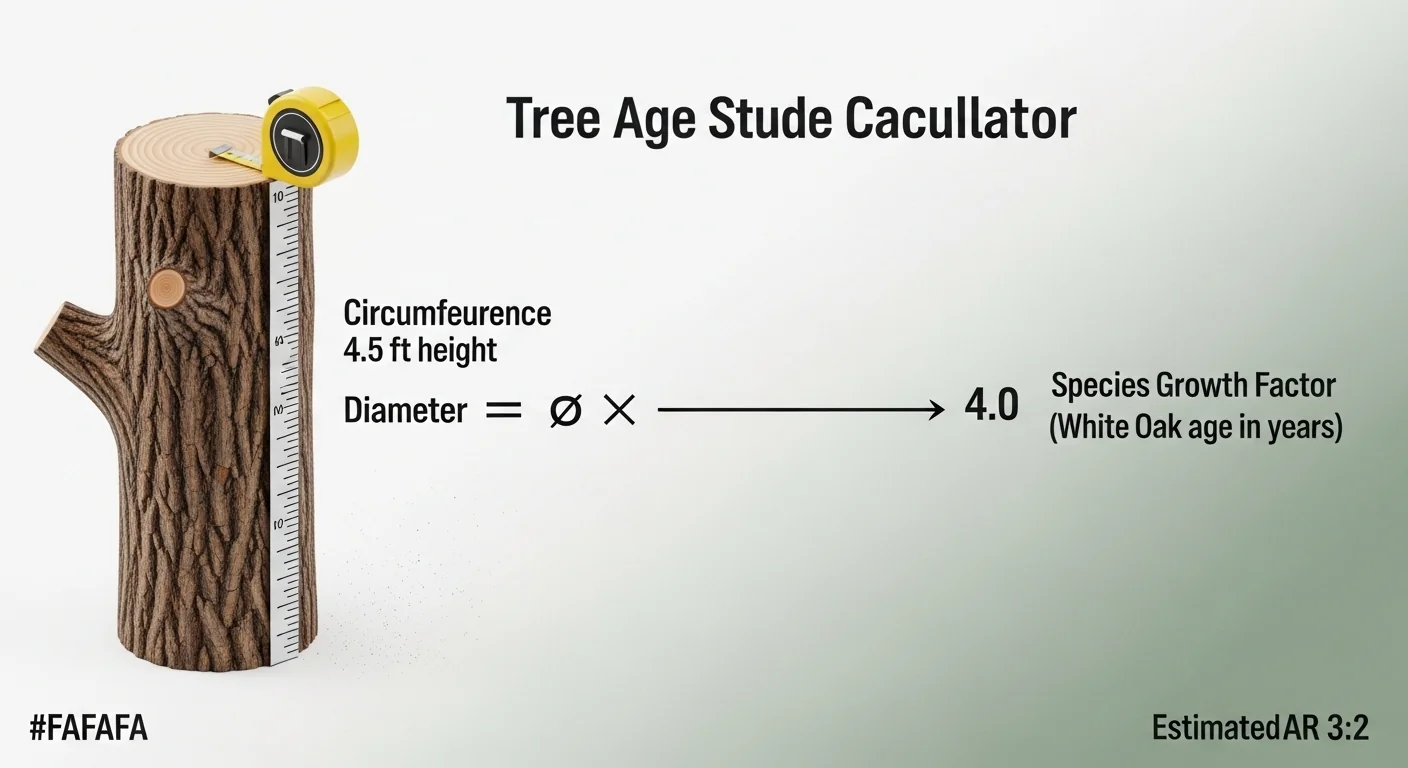
A tree’s age cannot be read from the outside, but its trunk can reveal a reliable estimate. The relationship between trunk circumference, trunk diameter at breast height (DBH), and species-specific growth factor produces an age range consistent with what arborists use in the field when core sampling is unavailable or impractical. This approach is not a guess. It is a formula with documented assumptions, and understanding those assumptions is what separates a useful estimate from a misleading one.
| Species | Growth Factor | Age at 60" Circ. |
|---|
How This Calculator Works
Step 1: Measure the trunk circumference in inches at 4.5 feet above the ground (called “breast height” or DBH standard).
Step 2: Calculate the diameter: Diameter = Circumference ÷ π (3.14159)
Step 3: Multiply the diameter by the species-specific growth factor: Estimated Age = Diameter × Growth Factor
Example: A White Oak with a 60-inch circumference has a diameter of ~19.1 inches. With a growth factor of 4.0, the estimated age is ~76 years.
Assumptions & Limitations
- Growth factors are averages and vary by climate, soil, moisture, and sun exposure.
- Urban trees may grow slower due to compacted soil and pollution.
- Forest trees may grow slower due to canopy competition for light.
- Measurement should be taken at 4.5 ft (1.37 m) above ground — the forestry standard (DBH).
- Damaged, diseased, or multi-trunk trees may yield less accurate estimates.
- This method provides an approximation — core sampling (dendrochronology) gives exact ring counts.
This tool calculates a tree’s estimated age by converting circumference to diameter and multiplying by a species growth factor. It also returns the estimated planting year and a maturity classification. What it does not do: it does not account for soil quality, water availability, sun exposure, or competition from neighboring trees. Those variables can shift results by 10 to 30 years in either direction. The tool gives you a working baseline, not a certified assessment.
After running the calculation, you will know whether to treat the tree as a young specimen, a mature asset worth protecting, or a candidate for heritage tree review by a certified arborist.
Use the Tool
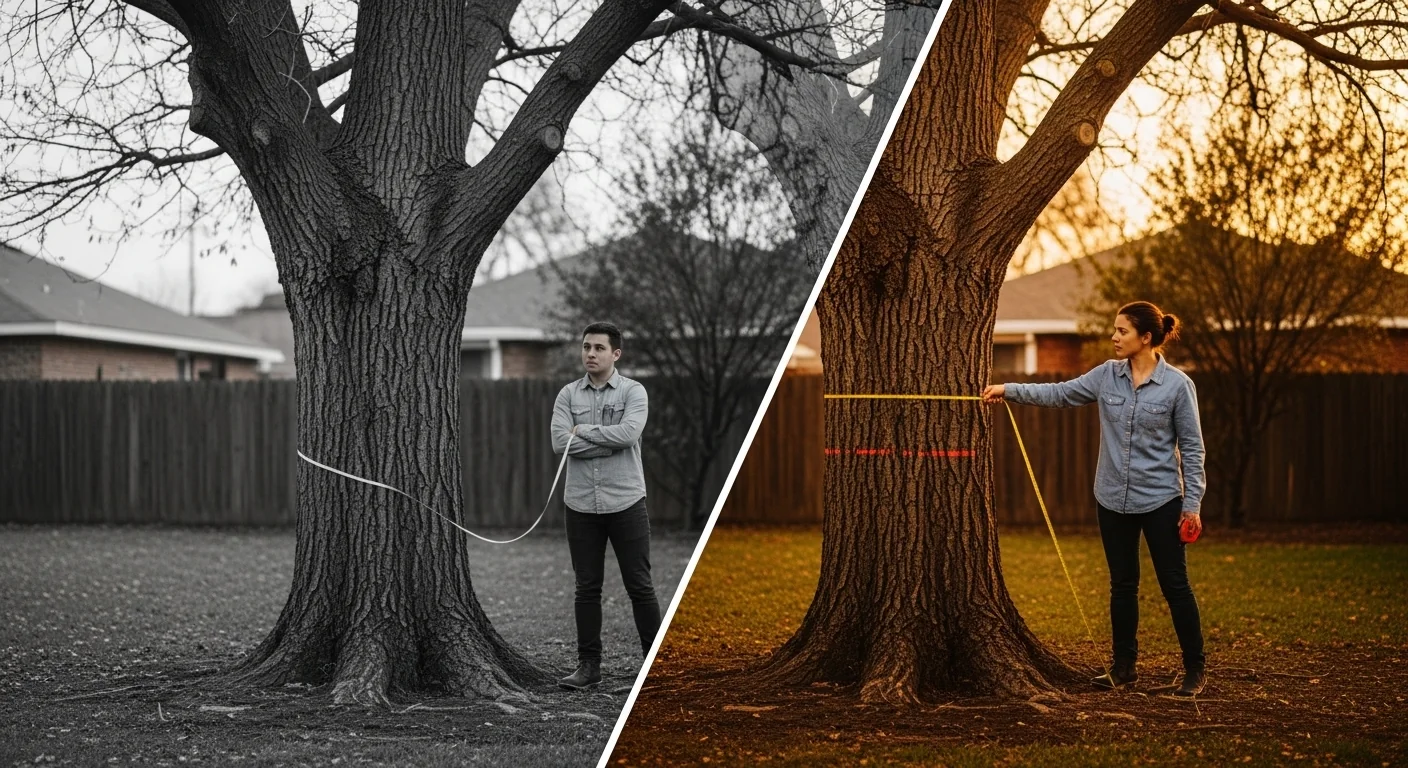
Before entering values, have a flexible measuring tape ready. Measure the trunk circumference at exactly 4.5 feet above the ground, which is the forestry standard known as diameter at breast height (DBH). Avoid measuring at root flares, branch unions, or points of damage. Select the species that most closely matches your tree from the dropdown. If you are unsure of the species, a tree height measurement can sometimes narrow down species candidates alongside trunk proportions.
Quick Start (60 Seconds)
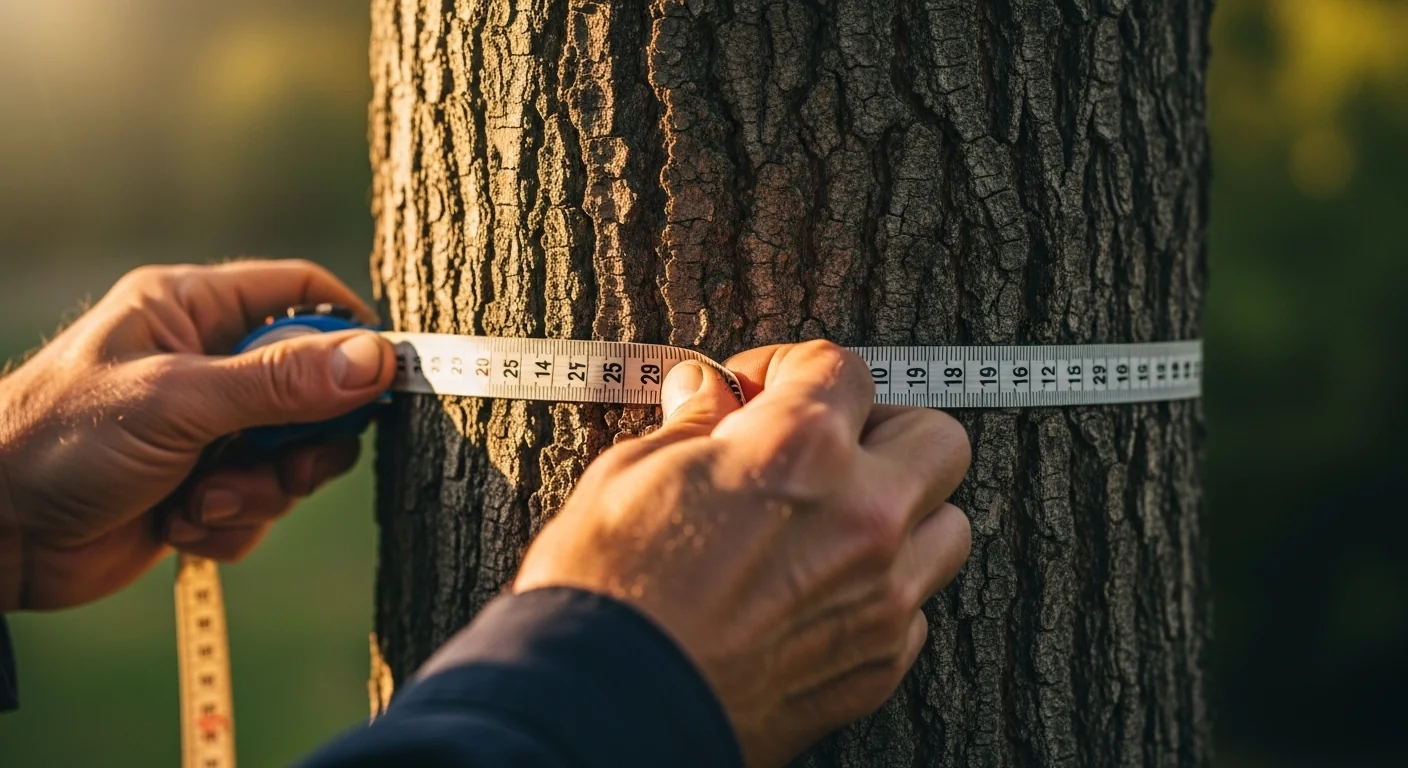
- Measure circumference in inches, not centimeters. Wrap a flexible tape around the trunk at 4.5 ft above ground and note the measurement where the tape meets itself.
- Do not measure at the ground. Root flare dramatically inflates circumference and will produce an overstated age estimate.
- On sloped ground, measure 4.5 ft from the uphill side of the trunk, not the average between uphill and downhill.
- Select the species carefully. Growth factor differences between species can shift the age estimate by 20 or more years on a medium-sized tree.
- For multi-trunk trees, measure only the largest single stem, not the combined girth of all stems.
- Input range is 1 to 1,200 inches. Extremely large values (above 500 inches) are valid for ancient specimens like coastal redwoods; just confirm your species selection is appropriate.
- Check the traffic light result. The green/orange/red indicator tells you at a glance whether the tree falls in the young, mature, or ancient category, each of which has different management implications.
Inputs and Outputs (What Each Field Means)
| Field | Unit | What It Means | Common Mistake | Safe Entry Guidance |
|---|---|---|---|---|
| Trunk Circumference | Inches | The outer perimeter of the trunk measured at breast height (4.5 ft above ground) | Measuring at ground level or including the root flare | Use a flexible tape; read to the nearest half inch; measure at 4.5 ft on the uphill side if on a slope |
| Tree Species | Selection | Determines the growth factor, which reflects how many inches of diameter a species typically adds per year on average | Selecting a fast-growing species when the tree is actually a slow-growing one, or guessing without verification | If uncertain, consult a local extension service or use a tree identification app before entering |
| Estimated Age | Years | Output: the calculated age based on diameter times growth factor | Treating this as a certified or exact value | Use as a planning estimate; verify with core sampling for legal or heritage tree determinations |
| Diameter | Inches | Output: trunk diameter computed from circumference divided by pi (3.14159) | Measuring diameter directly with calipers across an irregular cross-section instead of using circumference | The formula-derived diameter is more consistent than a direct caliper measurement on non-circular trunks |
| Estimated Planted Year | Year (CE) | Output: current year minus estimated age; indicates when the tree likely began growing at the measurement location | Assuming the tree was planted by a person; many trees germinate naturally | Cross-reference with property records, old photographs, or historic maps for contextual validation |
| Maturity Class | Category | Output: Young (under 50 years), Mature (50-149 years), Ancient/Heritage (150 years and above) | Ignoring this classification when planning nearby construction or excavation | Trees classified as Ancient should trigger a consultation with a certified arborist before any site disturbance |
Worked Examples (Real Numbers)
Scenario 1: White Oak in a Residential Backyard
- Trunk circumference: 60 inches
- Species: White Oak (growth factor: 4.0)
Diameter = 60 / 3.14159 = 19.1 inches
Age = 19.1 x 4.0 = 76 years
Result: Approximately 76 years old, planted around 1950.
This tree falls in the mature category. It predates most post-war suburban development and has likely established a root zone extending well beyond the visible canopy edge. Any driveway or utility work within 30 to 40 feet of the trunk warrants careful review.
Scenario 2: Sugar Maple Near a Historic Structure
- Trunk circumference: 94.25 inches
- Species: Sugar Maple (growth factor: 5.0)
Diameter = 94.25 / 3.14159 = 30.0 inches
Age = 30.0 x 5.0 = 150 years
Result: Approximately 150 years old, planted around 1876.
At exactly 150 years, this tree sits at the threshold for heritage review in many jurisdictions. A planted year of 1876 places it in the post-Civil War period, meaning it may have significance to local historic preservation records.
Scenario 3: Silver Birch in a New Garden
- Trunk circumference: 31.4 inches
- Species: Silver Birch (growth factor: 2.0)
Diameter = 31.4 / 3.14159 = 10.0 inches
Age = 10.0 x 2.0 = 20 years
Result: Approximately 20 years old, planted around 2006.
A young tree at 20 years. Silver birch is among the faster colonizers and produces relatively small diameters given its age, which is why it carries a lower growth factor. The result is consistent with a tree planted or self-seeded in the early 2000s.
Reference Table (Fast Lookup)
All age estimates below are calculated using the formula: Age = (Circumference / 3.14159) x Growth Factor. Circumference values shown represent common trunk sizes encountered in the field.
| Species | Growth Factor | Age at 31″ Circ. | Age at 63″ Circ. | Age at 94″ Circ. | Age at 157″ Circ. |
|---|---|---|---|---|---|
| White Oak | 4.0 | 39 yrs | 80 yrs | 120 yrs | 200 yrs |
| Red Oak | 3.0 | 30 yrs | 60 yrs | 90 yrs | 150 yrs |
| Sugar Maple | 5.0 | 49 yrs | 100 yrs | 150 yrs | 250 yrs |
| Red Maple | 4.5 | 44 yrs | 90 yrs | 135 yrs | 225 yrs |
| White Pine | 3.0 | 30 yrs | 60 yrs | 90 yrs | 150 yrs |
| Douglas Fir | 3.0 | 30 yrs | 60 yrs | 90 yrs | 150 yrs |
| Silver Birch | 2.0 | 20 yrs | 40 yrs | 60 yrs | 100 yrs |
| Dogwood | 7.0 | 69 yrs | 140 yrs | 210 yrs | 350 yrs |
| Beech | 4.5 | 44 yrs | 90 yrs | 135 yrs | 225 yrs |
| Hickory | 3.5 | 35 yrs | 70 yrs | 105 yrs | 175 yrs |
Note: Dogwood’s high growth factor (7.0) reflects its exceptionally slow diameter growth. A dogwood with a 63-inch circumference is unusual and would indicate a very old specimen; this row is included for reference completeness rather than as a typical field case.
How the Calculation Works (Formula + Assumptions)
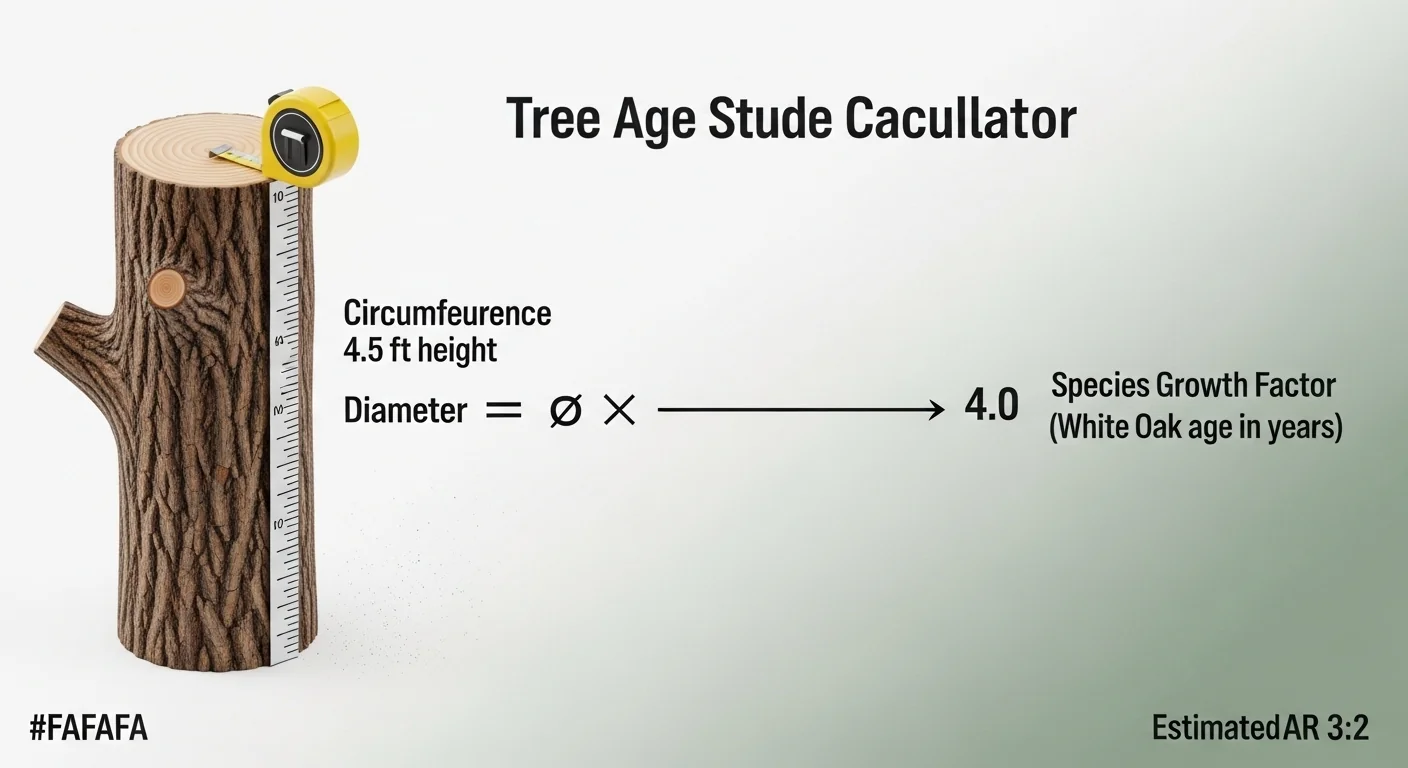
Show the calculation steps
Step 1 – Convert circumference to diameter:
Diameter (inches) = Circumference (inches) / pi
pi = 3.14159265
Round the diameter result to one decimal place.
Step 2 – Apply the species growth factor:
Estimated Age (years) = Diameter (inches) x Growth Factor
Round the age result to the nearest whole year.
Step 3 – Derive planted year:
Planted Year = Current Year – Estimated Age
This assumes the tree has grown continuously from a seedling or transplant at the measurement site.
Growth factor source: Growth factors used in this calculator are derived from International Society of Arboriculture (ISA) reference values and widely published urban forestry guidelines. Each factor represents the average number of years of growth per inch of trunk diameter for that species under typical conditions.
Rounding rule: Diameter is rounded to one decimal. Age is rounded to the nearest integer. No intermediate rounding is applied during formula execution.
Assumptions and Limits
- Growth factors represent average conditions. Trees growing in nutrient-rich soil with full sun and adequate water will have smaller diameters for their age than the formula predicts, yielding an underestimate of age.
- Urban trees in compacted soil or with limited water access grow more slowly, which can cause the formula to overestimate age relative to actual ring count.
- Forest-grown trees competing for canopy light often grow more slowly than the growth factor assumes, skewing estimates older.
- The measurement must be taken at 4.5 feet above ground on the uphill side. Any deviation introduces systematic error.
- The formula assumes a single-trunk tree. Multi-stemmed trees require measuring each stem individually; the result represents only the measured stem.
- This formula does not apply to trees that have been significantly pruned at the trunk, topped, or that have experienced major growth interruptions from disease, fire, or mechanical damage.
- Accuracy decreases for species not listed in the dropdown. Use the closest relative by growth habit, not by appearance alone, if no exact match is available.
Standards, Safety Checks, and “Secret Sauce” Warnings
Critical Warnings
- Heritage tree threshold at 150 years: Trees that calculate at or above 150 years should be flagged for review under local heritage, specimen, or landmark tree ordinances before any construction, pruning, or chemical treatment within the root zone. Many municipalities require a permit or arborist report in these situations, and the tree root protection zone becomes a legally relevant calculation.
- Planting year tied to historical context: If the tool returns a planted year before 1900, treat the result as historically significant. Trees predating the twentieth century on residential or agricultural land may be tied to original land surveys, historical easements, or deed covenants. Cross-reference with county parcel records before any site work.
- Do not use circumference estimates from photographs: Visual scale comparisons from photographs introduce errors of 30 to 50 inches in circumference, which translates to 40 to 100 years of error depending on the species. Measure physically before relying on the output.
- Non-standard measurement height invalidates the formula: If the trunk was measured at 3 feet instead of 4.5 feet, the circumference is typically 5 to 15 inches larger, inflating the age estimate meaningfully. The DBH standard exists specifically to ensure comparability.
Minimum Standards
- Measurement instrument: flexible fabric or fiberglass tape only. Metal tapes and rigid rulers introduce parallax and fitting errors on curved surfaces.
- For trees with significant buttressing or root flares extending above 4.5 feet, the measurement point should be raised to just above the flare and the deviation noted.
- Species identification should be confirmed before entry, not assumed from leaf shape alone. Bark pattern, seed type, and branching habit all inform species classification. A critical root zone calculation also depends on accurate species and age information for regulatory compliance purposes.
Competitor Trap: Most tree age articles online either present the growth factor formula without explaining species variance, or they apply a single generic factor across all tree types. This produces results that can be off by 40 to 80 years for slow-growing species like Dogwood or Sugar Maple. Applying a White Oak factor to a Sugar Maple is not a minor calibration issue; for a tree with a 94-inch circumference, that single substitution shifts the age estimate from 150 years to 90 years, which is the difference between triggering heritage review and skipping it entirely.
Common Mistakes and Fixes
Mistake: Measuring at Ground Level Instead of Breast Height
Root flare at the base of the trunk is consistently wider than the trunk proper, sometimes by 30 to 80 inches of circumference on mature trees. Entering a ground-level circumference will produce an age estimate 30 to 100 years higher than the actual tree age, depending on species growth factor. Fix: always measure at exactly 4.5 feet above the ground, on the uphill side if the tree is on a slope.
Mistake: Selecting the Wrong Species Due to Visual Similarity
Red Oak and White Oak look nearly identical to non-specialists, but their growth factors differ by a full point (3.0 vs. 4.0). On a 63-inch circumference tree, that difference produces a 20-year gap in the age estimate. Hickory and Black Walnut are similarly confused. Fix: confirm species using bark texture, leaf shape, and seed or fruit type before selecting from the dropdown, or consult a local cooperative extension service.
Mistake: Adding Together Multiple Trunks on a Multi-Stem Tree
Multi-stemmed trees (common in naturally occurring specimens of Beech, Birch, and Dogwood) have separate growth histories per stem. Summing all stem circumferences and treating the result as a single trunk input can triple or quadruple the reported age. Fix: measure and calculate each stem independently; the oldest stem gives the most useful age estimate for the tree as a whole. A tool like the critical root zone calculator also needs per-stem data for accuracy.
Mistake: Treating the Estimated Age as Certified for Legal or Permit Purposes
Circumference-based age estimation is a field approximation technique, not a certified arborist assessment. Submitting calculator output as evidence in a permit application, insurance claim, or property dispute without professional verification creates liability and will likely be rejected by reviewing agencies. Fix: use the calculator to determine whether to engage a certified arborist for core sampling, which is the only method that produces a legally defensible ring count.
Mistake: Ignoring Planted Year as a Decision Signal
The planted year output is often skipped by users who focus only on the age number. A tree planted around 1890 on a property with structures built in 1920 may have predated those structures entirely, which has implications for root encroachment, deed considerations, and the question of whether removal affects protected original vegetation. Fix: compare the planted year against the property’s title history. If the tree predates the earliest known structure on the lot, treat root zone conflicts seriously before any stump removal or chemical treatment decisions are made.
Next Steps in Your Workflow
Once you have an estimated age and planted year, the practical next step depends on the maturity class the tool returns. For young trees (under 50 years), the result mainly informs care decisions: mulching, watering schedules, and early structural pruning. Understanding the correct mulch volume for the root zone is a useful follow-on task that directly depends on knowing the tree’s approximate age and canopy spread. For mature and ancient trees, the age estimate triggers a different set of questions around protection zones, construction buffers, and whether a professional assessment is warranted.
For trees that fall in the mature or ancient categories, consider running a tree staking tension calculation if the tree has been subject to any recent soil disturbance, grade change, or storm damage. Older trees with compromised root plates are more vulnerable to wind throw than the canopy size alone would suggest, and proper staking tension varies significantly by trunk diameter and root zone condition. These two data points, age and diameter, are exactly what the current tool has already given you.
FAQ
How accurate is the tree circumference to age formula?
Under standard conditions and with the correct species growth factor, the formula typically produces results within 10 to 20 years of the actual ring count for most common North American species. Accuracy decreases for trees growing in highly unusual conditions such as severe drought stress, waterlogged soils, or dense forest competition, where actual growth rates diverge significantly from species averages.
What is a growth factor and where do the values come from?
A growth factor is the average number of years required for a tree to add one inch of trunk diameter under typical growing conditions. Values used in this calculator are derived from ISA arborist reference tables and urban forestry field guides. Fast-growing species like Silver Birch have low factors (2.0) while slow-growing ornamentals like Dogwood have high factors (7.0), reflecting their fundamentally different annual diameter increment rates.
Can I use this calculator for palm trees or bamboo?
No. Palms and bamboo are monocots and do not grow through secondary thickening the way dicot trees do. They do not produce annual growth rings in the same manner, and trunk circumference does not correlate with age in the same way. This calculator is designed specifically for temperate deciduous and coniferous trees that follow the standard DBH-based aging model.
Why does the tool use circumference instead of diameter as the primary input?
Circumference is significantly easier to measure accurately in the field. A flexible tape wrapped around the trunk gives a consistent circumference reading regardless of trunk shape, while measuring diameter directly requires calipers or a diameter tape and assumes a perfectly circular cross-section. The formula converts circumference to diameter internally using pi, preserving measurement accuracy while simplifying the user’s task.
What should I do if my tree estimates as older than 200 years?
First, verify the measurement at 4.5 feet above ground and confirm the species selection is correct. If both check out, contact a certified arborist for a professional assessment. Trees over 200 years are rare in most settled areas but do exist. Many jurisdictions have heritage tree registries, and a confirmed ancient tree may qualify for legal protections that affect what you can do on the property.
Is this the same method foresters use professionally?
Foresters most commonly use increment borers for core sampling, which counts annual rings directly and is the only method that gives an exact age. The circumference times growth factor approach is a widely accepted field estimate used when core sampling is not practical, such as on living trees where minimizing damage is a priority. It is the same underlying formula referenced in urban arboriculture textbooks and ISA training materials.
Conclusion
The most consistent mistake is using ground-level circumference instead of the 4.5-foot DBH standard. That single measurement error can add decades to the output and, on a tree near the heritage threshold, can lead you to skip a professional review that would have been warranted. Use this calculator as your starting point, validate species identification before entering data, and let the planted year and maturity class guide your next decision rather than just the raw age number. For trees measuring into the ancient category, a certified arborist consultation is the appropriate next step, supported by the tree root protection zone data this estimate helps you frame.