
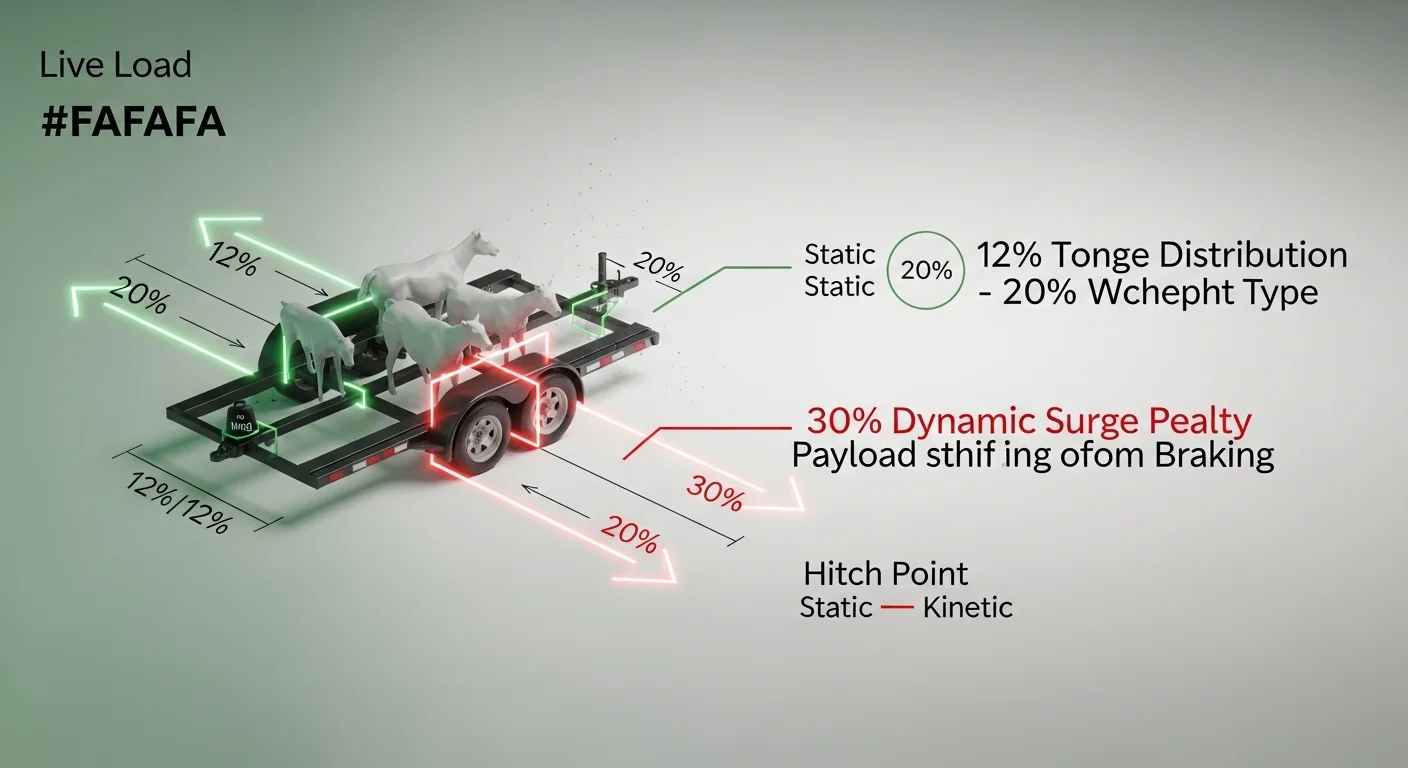
A trailer that tows perfectly when empty can behave completely differently with a full load of cattle on board. The physics of live loads create forces that static weight ratings do not capture: animals walk, shift, and surge forward under braking, adding dynamic stress that the trailer’s Gross Vehicle Weight Rating (GVWR) was never designed to predict. Understanding the relationship between tongue weight, payload distribution, and kinetic surge is what separates a routine haul from a roadside emergency.
This livestock trailer weight calculator computes payload, total loaded weight, target tongue weight for both bumper pull and gooseneck hitch configurations, and a dynamic surge penalty that estimates the forward kinetic force your animals generate during hard braking. What it does not do: it does not account for tow vehicle GCWR limits, hitch receiver ratings, terrain grade, trailer partition placement, or water and feed weight unless you factor those into your empty weight manually. Those variables are your responsibility to verify before every haul.
After running this calculator, you will know whether your planned load is within your trailer’s rated capacity, what tongue weight to expect at the hitch, and whether your surge penalty warrants a proportional brake controller upgrade before you leave the property. If you manage rotational moves across multiple pastures, knowing your safe animal load per trailer trip is also the foundation of a sound pasture stocking rate plan.
Use the Tool
Livestock Trailer Live-Load & Axle Distribution
Calculate tongue weight, payload, and live-weight surge risk for safe livestock towing.
Weight Breakdown
| Item | Value |
|---|
Reference: Common Livestock Weights
| Animal | Avg Weight | 4-Head Payload | Surge Force (30%) |
|---|---|---|---|
| Beef Cattle (market) | 1,300 lbs | 5,200 lbs | 1,560 lbs |
| Dairy Cow | 1,500 lbs | 6,000 lbs | 1,800 lbs |
| Horse (avg) | 1,100 lbs | 4,400 lbs | 1,320 lbs |
| Draft Horse | 1,800 lbs | 7,200 lbs | 2,160 lbs |
| Hog (market) | 280 lbs | 1,120 lbs | 336 lbs |
| Sheep / Goat | 150 lbs | 600 lbs | 180 lbs |
Recommended Safety Equipment
- Bluetooth Trailer Brake Controller (Curt Echo / Tekonsha P3) — Precise, real-time braking for live loads
- Weight Distribution Hitch System — Equalizes tongue weight across tow vehicle axles
- Heavy-Duty Trailer Breakaway Switch — Auto-brakes trailer if detached
- Rubber Stall Mats — Prevents animal slipping and reduces surge movement
How This Calculator Works
Step 1: Calculate Payload
Payload = Number of Animals × Individual Animal Weight
Step 2: Calculate Total Loaded Weight
Total Weight = Trailer Empty Weight + Payload
Step 3: Calculate Target Tongue Weight
If Gooseneck: Tongue Weight = Total Weight × 20%
If Bumper Pull: Tongue Weight = Total Weight × 12%
Step 4: Calculate Dynamic Surge Penalty
Surge Force = Payload × 30%
This represents the kinetic force of live animals shifting forward during hard braking.
Assumptions & Limits:
- Tongue weight percentages (12% bumper, 20% gooseneck) are industry-standard targets for safe towing stability.
- The 30% surge penalty is a conservative estimate for unrestrained livestock during emergency braking.
- Actual surge forces depend on animal type, trailer partitions, stall mats, and braking severity.
- GVWR must never be exceeded; payload includes all animals, feed, water, and tack.
- This tool assumes level ground. Hills increase tongue weight and braking forces significantly.
- Always verify your tow vehicle’s tow rating, hitch receiver rating, and axle ratings independently.
Assumptions & Limits
- This calculator provides estimates for planning purposes only. It is not a substitute for professional towing assessment.
- GVWR is set by the trailer manufacturer and must never be exceeded, per FMVSS regulations.
- Tongue weight targets assume proper load distribution; front-heavy or rear-heavy loading changes these ratios.
- Surge force is an approximation. Actual forces depend on the number of partitions, animal behavior, trailer length, and deceleration rate.
- Does not account for additional cargo (feed, water, tack, hay) — subtract those from available payload before loading animals.
- Hitch ratings, receiver ratings, and tow vehicle GCWR must all be verified separately.
Before entering your numbers, have your trailer's door placard or title paperwork on hand for the empty weight and GVWR. Weigh individual animals when possible; use breed averages only as a fallback. If you are also hauling hay bales for feed on the trip, calculate their contribution to payload separately using a hay bale weight reference and add that figure to your total before comparing it against available payload capacity.
Quick Start (60 Seconds)
- Trailer Empty Weight: Use the weight listed on the trailer's title or door placard, in pounds. Do not guess; a 1,000 lb estimation error directly shifts your safe payload headroom.
- Trailer GVWR: Also on the placard. This is the legal and structural maximum for the trailer, including everything on it. Never enter a number higher than what the manufacturer stamped.
- Hitch Type: Select Bumper Pull if the coupler connects to the back of your tow vehicle. Select Gooseneck if the hitch ball sits in the bed of a pickup truck. This selection changes the target tongue weight calculation.
- Individual Animal Weight: Enter the average weight of one animal, in pounds. For mixed loads, use a weighted average across the group. If animals were recently weighed on a livestock scale, use that figure directly.
- Number of Animals: Enter a whole number. Fractions are not valid. If you are splitting a herd across multiple trailers, enter only the animals assigned to this trailer.
- Common unit mistake: Do not enter weights in kilograms. The calculator works exclusively in pounds. Convert before entering: 1 kg equals approximately 2.205 lbs.
- What the tool will not know: Feed, water buckets, tack, and tools stored on the trailer all count as payload. Estimate and add those weights to your empty trailer weight before entering it, or subtract them from your calculated remaining capacity afterward.
Inputs and Outputs (What Each Field Means)
| Field Name | Unit | What It Means | Common Mistake | Safe Entry Guidance |
|---|---|---|---|---|
| Trailer Empty Weight | lbs | The weight of the trailer with nothing loaded, exactly as the manufacturer built it | Using estimated or "ballpark" figures instead of the placard or scale weight | Use the door placard or a certified scale; accepted range is 500 to 40,000 lbs |
| Trailer GVWR | lbs | Gross Vehicle Weight Rating: the maximum total weight the trailer is designed to carry, including its own weight | Confusing GVWR with payload capacity; GVWR includes the trailer itself | Find on the manufacturer's placard or title; accepted range is 1,000 to 60,000 lbs |
| Hitch Type | N/A | Determines the formula used to compute target tongue weight (12% for bumper pull; 20% for gooseneck) | Selecting the wrong hitch type, which miscalculates the tongue weight target by a significant margin | Bumper pull: coupler attaches to ball mount behind the rear bumper. Gooseneck: ball sits in the truck bed |
| Individual Animal Weight | lbs | The average weight of a single animal being loaded, used to compute total live payload | Using breed-standard weights when animals have not been weighed recently, especially in growing stock | Scale-weigh animals when possible; accepted range is 10 to 5,000 lbs |
| Number of Animals | count | The number of individual animals being loaded on this specific trailer for this specific trip | Entering total herd size instead of the animals assigned to this trailer | Whole numbers only; accepted range is 1 to 100 |
| Total Loaded Weight (output) | lbs | Trailer empty weight plus live payload; compared against GVWR to determine if the load is within legal and structural limits | Not accounting for secondary payload (hay, water, tack) that increases this figure beyond what the calculator can see | Must remain below GVWR; the tool flags overloaded conditions automatically |
| Target Tongue Weight (output) | lbs | The ideal weight pressing down on the hitch ball or gooseneck coupler; affects steering stability of the tow vehicle | Assuming tongue weight is fixed; it shifts as animals move within the trailer | Verify your tow vehicle's hitch receiver rating can handle the calculated tongue weight |
| Dynamic Surge Penalty (output) | lbs | An estimate of the forward kinetic force generated when live animals surge during hard braking; equal to 30% of total payload | Ignoring this figure entirely, since most static weight calculators do not compute it | Compare this number to your tongue weight; if surge approaches or exceeds tongue weight, risk of jackknife increases |
| Remaining Payload Capacity (output) | lbs | How many pounds of additional load the trailer can legally and structurally carry after the animals are counted | Treating remaining capacity as free space for equipment without accounting for it | Reserve at least 200 lbs buffer for weight estimation error |
Understanding how individual animal weight feeds into your feed conversion ratio planning can help you maintain more accurate animal weight records over time, which directly improves the accuracy of this calculator's payload output.
Worked Examples (Real Numbers)
Scenario 1: Four Beef Cattle on a Bumper Pull
- Trailer Empty Weight: 7,000 lbs
- Trailer GVWR: 14,000 lbs
- Hitch Type: Bumper Pull
- Individual Animal Weight: 1,300 lbs
- Number of Animals: 4
Result: Payload = 4 x 1,300 = 5,200 lbs. Total Loaded Weight = 7,000 + 5,200 = 12,200 lbs. Target Tongue Weight = 12,200 x 0.12 = 1,464 lbs. Dynamic Surge Penalty = 5,200 x 0.30 = 1,560 lbs. Remaining payload = 1,800 lbs.
This load is within GVWR with 1,800 lbs of remaining capacity. The surge penalty of 1,560 lbs slightly exceeds the target tongue weight, meaning emergency braking could momentarily overwhelm the hitch and destabilize the tow vehicle. A proportional brake controller is appropriate at this payload level.
Scenario 2: Two Draft Horses on a Gooseneck
- Trailer Empty Weight: 8,500 lbs
- Trailer GVWR: 16,000 lbs
- Hitch Type: Gooseneck
- Individual Animal Weight: 1,800 lbs
- Number of Animals: 2
Result: Payload = 2 x 1,800 = 3,600 lbs. Total Loaded Weight = 8,500 + 3,600 = 12,100 lbs. Target Tongue Weight = 12,100 x 0.20 = 2,420 lbs. Dynamic Surge Penalty = 3,600 x 0.30 = 1,080 lbs. Remaining payload = 3,900 lbs.
A well-managed load within GVWR with meaningful headroom. The gooseneck configuration's higher tongue weight target (20%) absorbs surge forces more effectively here, and the surge penalty of 1,080 lbs stays well below the tongue weight target of 2,420 lbs. This is an example of a configuration where the hitch type directly improves safety margin.
Scenario 3: Six Dairy Cows on a Bumper Pull (Over-GVWR Example)
- Trailer Empty Weight: 6,500 lbs
- Trailer GVWR: 14,000 lbs
- Hitch Type: Bumper Pull
- Individual Animal Weight: 1,500 lbs
- Number of Animals: 6
Result: Payload = 6 x 1,500 = 9,000 lbs. Total Loaded Weight = 6,500 + 9,000 = 15,500 lbs. This exceeds GVWR by 1,500 lbs. Dynamic Surge Penalty = 9,000 x 0.30 = 2,700 lbs.
The calculator flags this as a DO NOT TOW condition. The trailer's structural components, axles, and tires are all rated to the GVWR; exceeding it risks axle failure, tire blowout, and brake fade. The only safe fix is to reduce the number of animals or use a trailer with a higher GVWR. The surge penalty of 2,700 lbs also illustrates why overloaded dairy cow hauls are among the most common contributors to cattle trailer accidents on rural highways.
Reference Table (Fast Lookup)
The table below shows computed results for common livestock haul configurations. Tongue weight and surge penalty values are derived from the formula. Use this for pre-planning before your animals are on a scale.
| Animal Type | Avg Wt (lbs) | Head Count | Live Payload (lbs) | Surge Penalty (lbs) | Tongue Wt Bumper Pull (lbs) | Tongue Wt Gooseneck (lbs) | Example Trailer GVWR Needed (lbs)* |
|---|---|---|---|---|---|---|---|
| Market Beef Cattle | 1,300 | 4 | 5,200 | 1,560 | 1,464 | 2,440 | 12,200+ |
| Dairy Cows | 1,500 | 4 | 6,000 | 1,800 | 1,560 | 2,600 | 13,000+ |
| Horses (average) | 1,100 | 2 | 2,200 | 660 | 792 | 1,320 | 7,200+ |
| Draft Horses | 1,800 | 2 | 3,600 | 1,080 | 936 | 1,560 | 11,100+ |
| Market Hogs | 280 | 8 | 2,240 | 672 | 637 | 1,061 | 7,240+ |
| Sheep / Hair Sheep | 150 | 10 | 1,500 | 450 | 540 | 900 | 6,500+ |
| Dairy Goats | 135 | 12 | 1,620 | 486 | 584 | 974 | 6,620+ |
| Mixed Beef Herd (cow + calf) | 1,050 | 6 | 6,300 | 1,890 | 1,476 | 2,460 | 13,300+ |
| Breeding Bulls | 1,900 | 2 | 3,800 | 1,140 | 876 | 1,460 | 11,300+ |
*GVWR needed column assumes a 7,000 lb empty trailer as a baseline. Actual GVWR requirement = live payload + trailer empty weight. Tongue weight figures assume total loaded weight = live payload + 7,000 lb trailer.
How the Calculation Works (Formula + Assumptions)
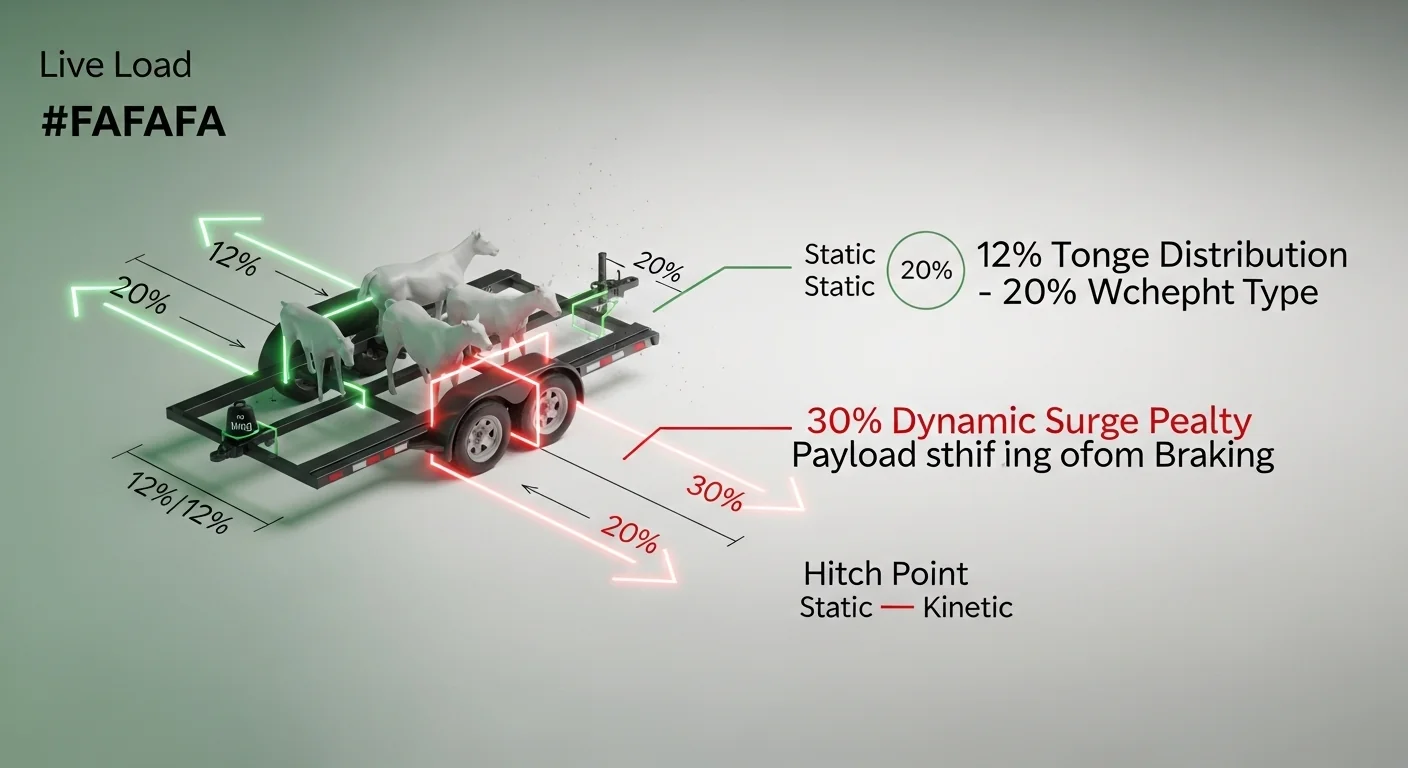
Show the calculation steps
Step 1: Live Payload
Multiply the number of animals by the individual animal weight in pounds.
Payload (lbs) = Number of Animals x Individual Animal Weight (lbs)
Step 2: Total Loaded Weight
Add the trailer's empty weight to the payload computed in Step 1.
Total Loaded Weight (lbs) = Trailer Empty Weight (lbs) + Payload (lbs)
Step 3: Target Tongue Weight
Multiply total loaded weight by the tongue weight factor for the hitch type.
If Gooseneck: Tongue Weight = Total Loaded Weight x 0.20
If Bumper Pull: Tongue Weight = Total Loaded Weight x 0.12
These factors are industry-standard targets for towing stability. They represent the fraction of total weight that should press down on the hitch.
Step 4: Dynamic Surge Penalty
Multiply the live payload by 0.30 to estimate the forward kinetic force during hard braking.
Surge Penalty (lbs) = Payload (lbs) x 0.30
This is a conservative approximation, not a physics-certified engineering value.
Step 5: Remaining Payload Capacity
Remaining Capacity (lbs) = GVWR (lbs) - Total Loaded Weight (lbs)
A negative result means the load exceeds GVWR and should not be towed.
Rounding: All weight outputs are rounded to the nearest whole pound. No decimal precision is implied or warranted given the variability of live animal weights.
Assumptions and Limits
- The 12% tongue weight target for bumper pull and 20% for gooseneck are general industry recommendations, not universally mandated by FMVSS regulation. Specific trailer designs may have different optimal ranges.
- The 30% surge penalty is a conservative planning estimate. Actual surge forces depend on deceleration rate, animal behavior, partition design, and trailer length. This tool cannot measure or simulate those variables.
- The calculator assumes all animals weigh the same. Mixed-weight loads, such as cows and calves together, require manual averaging before entry.
- Secondary payload (hay bales, water tanks, tack, tools) is not included unless the user manually adds it to the empty weight before entering it. Omitting this is the most common source of calculation error.
- The formula assumes level ground. Grades and hills increase effective tongue weight on downslopes and alter braking force distribution significantly.
- Tow vehicle GCWR, hitch receiver class rating, and fifth-wheel or gooseneck pin weight capacity are not verified by this tool. Each must be checked independently against the vehicle manufacturer's specifications.
- This calculator is a planning aid only. It does not replace a certified scale weigh-in, a professional trailer inspection, or manufacturer load guidance.
Standards, Safety Checks, and "Secret Sauce" Warnings
Critical Warnings
- The Live-Weight Surge Jackknife: A trailer that tows fine when empty can jackknife violently when loaded with live animals and subjected to emergency braking. The physics: cattle do not brake with the truck. When your truck decelerates, 1,000 to 6,000 lbs of unsecured livestock continues forward at road speed, transferring kinetic force directly into the hitch. This surge force can momentarily negate tongue weight, sending the rear of the tow vehicle sideways. The calculator's surge penalty field quantifies this risk. If your surge penalty exceeds your target tongue weight, your setup is high-risk under hard braking conditions.
- GVWR Is Not Optional: Exceeding GVWR is not a margin of safety question -- it is a structural and legal limit. Axle ratings, tire load ratings, and frame welds are all engineered to the GVWR. A loaded weight 500 lbs above GVWR is not "close enough." It increases axle stress, reduces tire life, compromises brake performance, and, in many states, constitutes a commercial vehicle violation even on a personal farm haul.
- Tongue Weight Below Minimum Causes Trailer Sway: While this tool highlights overloading risk, it is equally dangerous to have too little tongue weight. A bumper pull with less than 10% of total weight on the tongue is prone to fishtailing oscillation, which amplifies at highway speeds and can be unrecoverable without a sway control device.
- Animal Shifting Is Not Predictable: A calm load at departure can become a chaotic one when animals react to road noise, wind, or adjacent vehicle traffic. Rubber stall mats reduce slipping, which measurably reduces the frequency and magnitude of group surge events.
Minimum Standards
- Target tongue weight: 12% of total loaded weight for bumper pull; 20% for gooseneck. These are the planning targets the calculator uses.
- Total loaded weight must remain at or below the trailer's GVWR at all times. No exception for "short hauls" or "back roads."
- A proportional brake controller (not a time-delayed controller) is the appropriate choice for live loads because it adjusts braking force to actual deceleration, not a fixed timer.
- A trailer breakaway switch that automatically applies brakes if the trailer separates from the tow vehicle is a minimum safety baseline for any live animal haul.
Competitor Trap: Most livestock trailer weight calculators ask for total weight and compare it to GVWR. That is a useful check, but it misses the most dangerous element of live animal towing: the surge. A calculator that shows "within GVWR" with 4,000 lbs of cattle on board has told you the trailer is legal to tow. It has not told you that those 4,000 lbs will generate 1,200 lbs of forward kinetic force under emergency braking. This tool adds the surge penalty precisely because static weight compliance and dynamic towing safety are two different questions. Knowing only one of them is how accidents happen on otherwise routine hauls.
If your operation involves tractors and equipment on uneven terrain alongside livestock trailers, the tractor side slope limit calculator covers a parallel set of weight and stability risks on grades. Both tools address scenarios where static ratings do not tell the full story under dynamic conditions. Water weight is also frequently underestimated during summer hauls; planning your herd's hydration needs alongside your payload math using a cattle water requirement calculator prevents the common mistake of bringing full tanks without adjusting remaining payload accordingly.
Common Mistakes and Fixes
Mistake: Using Breed-Average Weights Instead of Scale Weights
Breed averages are useful planning benchmarks, but an individual animal can deviate from the average by 200 to 400 lbs in either direction depending on age, frame score, and condition. A 1,200 lb average applied to six animals introduces up to 2,400 lbs of potential error before you have even started loading. That error can be the difference between a legal load and an overloaded trailer. Fix: weigh animals before any haul where you are operating within 1,000 lbs of GVWR.
Mistake: Forgetting Secondary Payload
Hay bales for the return trip, a full water tank, tack and saddles, veterinary supplies, and loading ramps all add weight that the calculator cannot see unless you account for them in your empty trailer weight entry. Ranchers frequently treat "remaining payload capacity" as equivalent to "safe additional animal weight," ignoring the 300 to 800 lbs already riding on board in gear. Fix: weigh or estimate all secondary cargo first, subtract from remaining capacity, then calculate how many animals fit.
Mistake: Selecting the Wrong Hitch Type
Bumper pull and gooseneck configurations require different tongue weight targets, and selecting the wrong one produces a meaningfully incorrect tongue weight output. A bumper pull loaded to the 20% gooseneck target will have dangerously high tongue weight, compressing the tow vehicle's rear suspension and reducing front axle traction. Fix: verify hitch type visually before every entry; do not rely on memory.
Mistake: Ignoring the Surge Penalty Output
Many operators review the total loaded weight and GVWR comparison, see a green result, and proceed. The surge penalty is the number that should stop them mid-check. A legal load with a 2,000 lb surge force and no proportional brake controller is a controlled emergency in progress. Brake controllers calibrated to the surge of live loads are not optional equipment on heavy livestock hauls; they are the difference between a minor sway event and a jackknife. Fix: always compare surge penalty to tongue weight before finalizing your haul plan. The electric fence joule calculator is a different domain of farm safety physics, but the principle is the same: the number that looks small on paper is the one that causes injury when ignored.
Mistake: Assuming GVWR Covers the Whole Rig
GVWR applies only to the trailer. The tow vehicle has its own GCWR (Gross Combined Weight Rating), which is the maximum total weight of truck plus loaded trailer. A trailer within GVWR can still overload the tow vehicle's GCWR, particularly with heavier half-ton trucks rated to modest combined weights. Fix: look up your specific tow vehicle's GCWR in the owner's manual and compare it to the sum of your truck's curb weight plus your calculated total loaded trailer weight.
Next Steps in Your Workflow
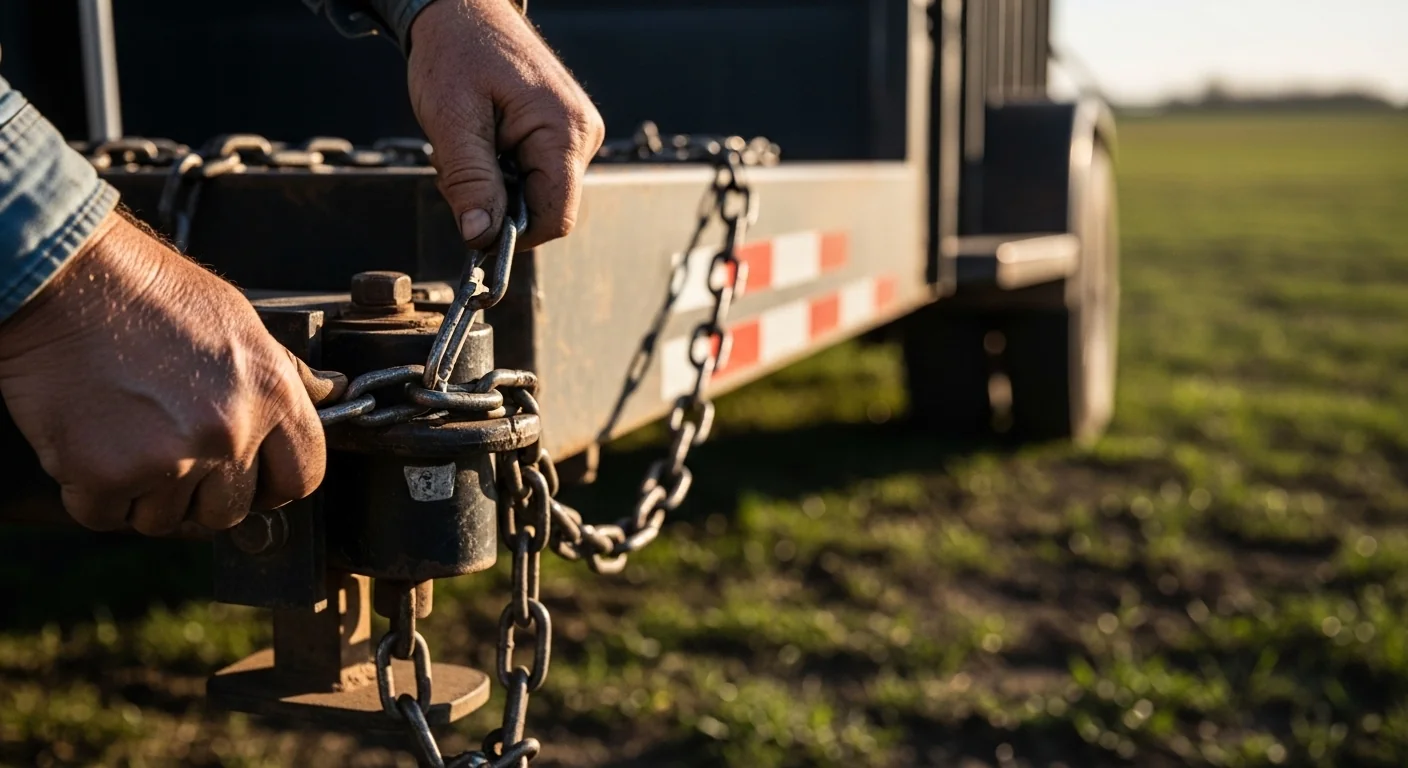
Once your load passes the weight check, verify the physical equipment before departure: confirm your brake controller is calibrated to the current load, test the breakaway switch cable, and visually inspect tire sidewalls for cracks or bulging. Animals shift weight when the trailer is in motion, so plan your driving style accordingly -- gradual acceleration, early braking, and wide turns reduce the frequency of surge events that the calculator models as a worst-case estimate. If you are moving cattle between grazing units on a regular schedule, calculating trailer load on each move also feeds directly into your broader land management math, which a rotational grazing calculator can help you structure across the full season.
After the haul, record the actual animals loaded, their weights, and any load-related issues (sway, brake events, animal stress indicators). This data improves your weight estimates over time and reduces reliance on breed averages. For operations that move cattle through winter, combining accurate trailer payload data with projected feed requirements for the herd using a winter cattle feed calculator produces a more complete picture of the logistics and costs associated with each transport event.
FAQ
What is the difference between GVWR and payload capacity?
GVWR is the maximum total weight the trailer can handle, including its own empty weight. Payload capacity is what remains after subtracting the empty weight from the GVWR. A trailer with a 14,000 lb GVWR and a 7,000 lb empty weight has a 7,000 lb payload capacity. These are often confused, leading to overloaded trailers that appear "within range" to operators doing rough mental math.
Is 12% tongue weight required by law for bumper pull trailers?
No federal law mandates a specific tongue weight percentage for private livestock hauls. The 12% figure is an industry-recommended target for towing stability. Operating below that threshold increases sway risk; operating above it overloads the tow vehicle's rear axle and reduces front tire traction. It is a physics recommendation, not a regulation, though some commercial carrier rules do specify tongue weight ranges.
Why does the calculator use 30% for the surge penalty?
The 30% figure is a conservative planning estimate for the kinetic forward force generated when live animals surge during hard braking. It is not derived from a single published standard; it reflects a practical safety margin used in trailer design and livestock transport planning. Actual surge will vary based on animal size, species behavior, number of partitions, braking severity, and road surface.
Does hitch type affect how much I can haul?
Hitch type affects tongue weight distribution and the stability of the tow vehicle, not the trailer's GVWR. You cannot haul more animals just by switching from bumper pull to gooseneck; your limiting factor is still the trailer's GVWR and your tow vehicle's GCWR. What changes is how the load transfers to the tow vehicle and how stable the rig behaves under that load.
Can I use this calculator for horse trailers?
Yes. The formula is identical: payload equals the number of horses multiplied by individual horse weight. The same tongue weight percentages and surge penalty apply. Horse trailer haulers should also account for saddles, water, and hay in their secondary payload totals, which can add several hundred pounds beyond the animals themselves on longer trips.
What should I do if my total loaded weight exceeds GVWR?
The only correct options are to remove animals until the total drops below GVWR, use a second trailer for the remaining animals, or use a larger trailer with a higher GVWR rating. There is no safe workaround. Exceeding GVWR risks structural failure, tire blowout, axle damage, and legal liability. "Short hauls" and "slow speeds" do not change the structural loads on axles and welds.
Conclusion
Static weight compliance and dynamic towing safety are related but not identical. A livestock trailer that passes a GVWR check can still produce a dangerous setup if the surge forces generated by live animals under emergency braking are not considered alongside tongue weight. The unique contribution of this livestock trailer weight calculator is forcing both questions into the same workflow: is the load legal, and is the load dynamically stable under the worst-case braking event you might encounter on the road?
The single most common mistake this tool is designed to prevent is the confident departure of a technically legal load with a surge penalty that has never been calculated or compared to tongue weight. Run the numbers before every haul, verify your brake controller calibration matches the live payload, and keep the surge penalty output in view alongside the total weight result. For operations where livestock transport intersects with broader farm infrastructure planning, the hay cost calculator covers the economics that often accompany the logistics of each animal move.