
A boom sprayer loaded with the wrong herbicide can eliminate a pasture’s free nitrogen supply in a single afternoon. Clover is a broadleaf plant. So is thistle. Standard 2,4-D kills both with equal efficiency, and most sprayer calibration guides never mention that distinction. The question before you fill any tank is not just “how much chemical per gallon” but “what am I actually willing to destroy?”
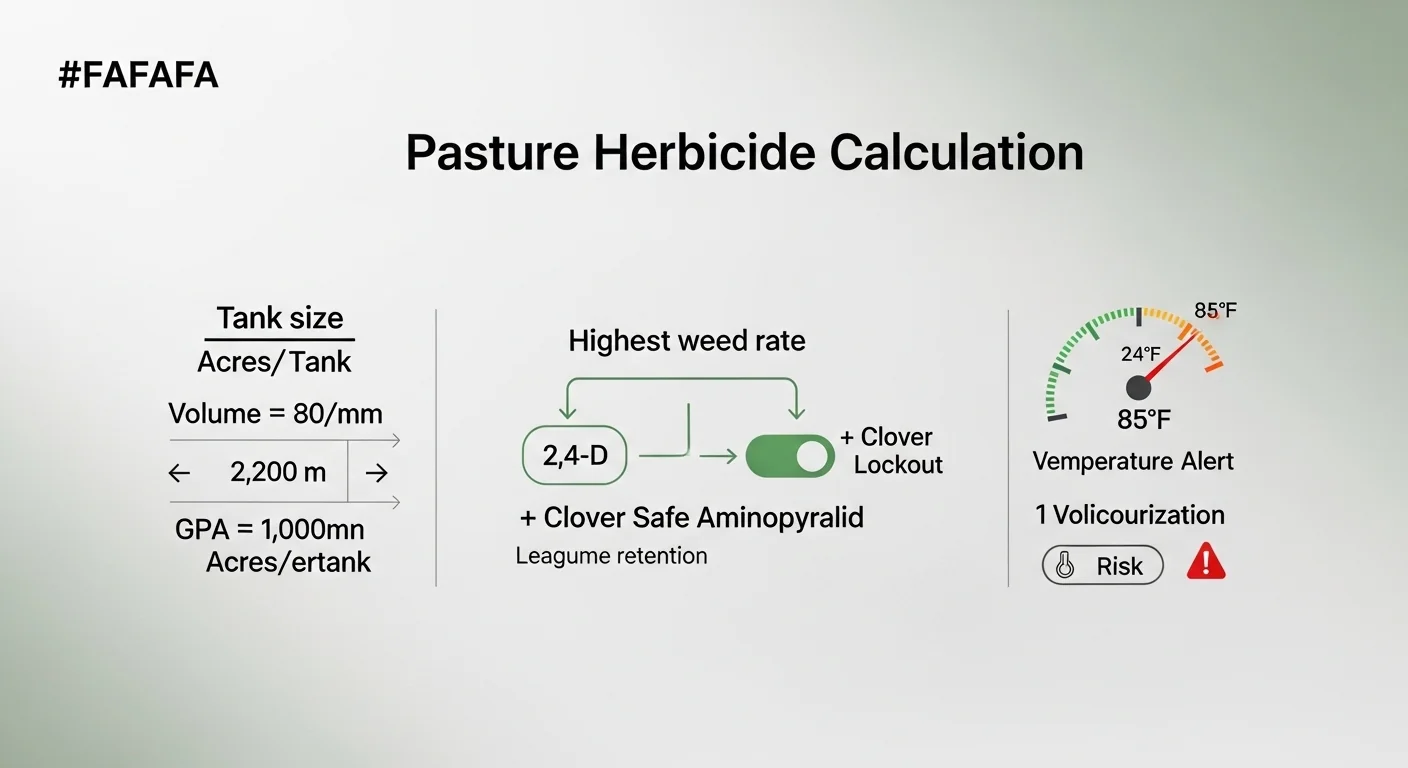
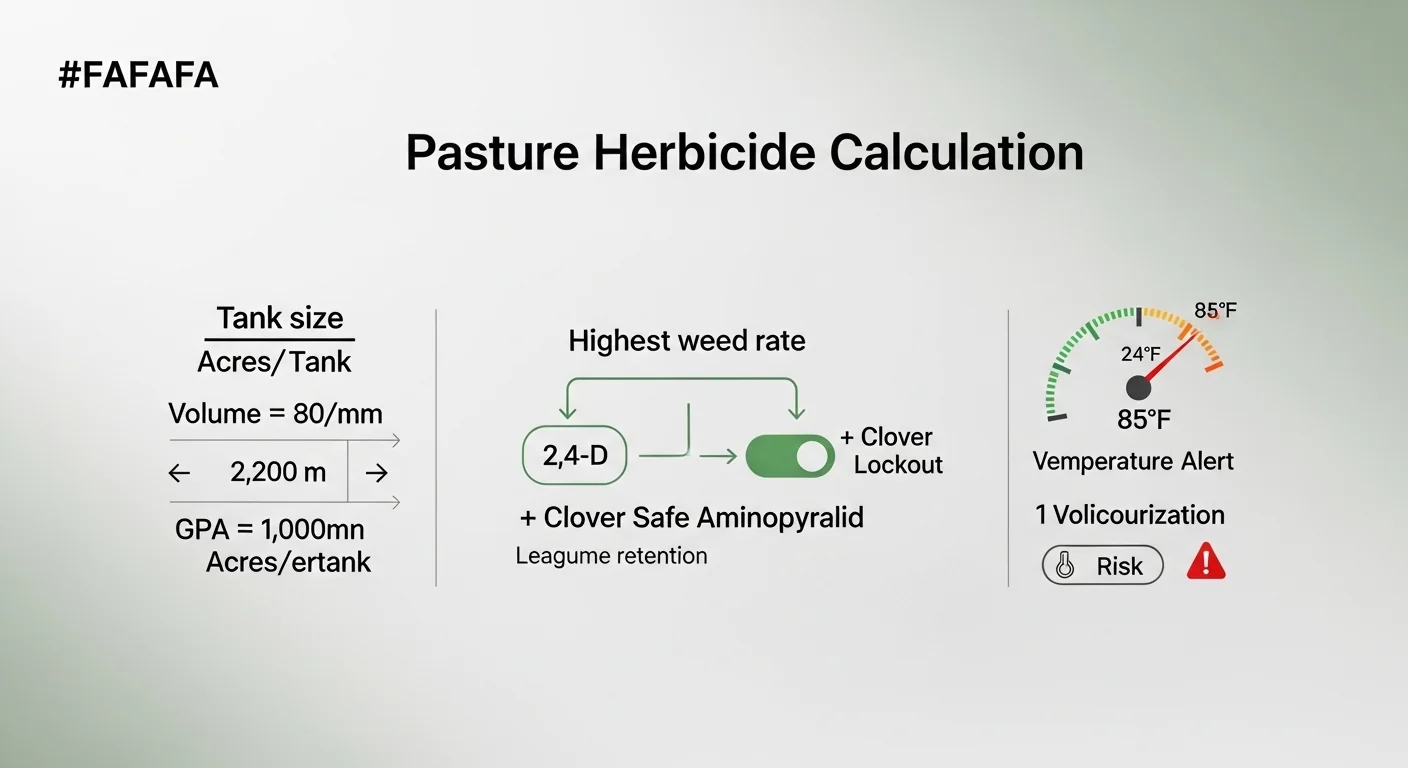
This pasture weed killer calculator takes five inputs: the weeds you are targeting, your legume retention preference, tank size in gallons, sprayer output in gallons per acre (GPA), and ambient temperature. It returns the exact ounce-per-tank herbicide dose, triggers a clover lockout warning when your selected combination would eliminate nitrogen-fixing legumes, and flags volatilization risk when temperature exceeds 85 degrees F. It does not replace label instructions, account for wind speed, or recommend specific product brands. If you are managing your total land carrying capacity alongside spray decisions, the pasture stocking rate calculator pairs directly with this workflow.
After running this tool, you will know exactly how many ounces of the correct herbicide to add per tank fill, whether you should be using a clover-safe alternative, and whether today’s temperature makes spraying a liability rather than a solution.
Use the Tool
Pasture Herbicide Boom Calibration & Clover Lockout
Calculate exact mix rates, protect legumes, and avoid costly spray errors
Your Spray Breakdown
| Parameter | Value |
|---|
Common Pasture Herbicide Reference Rates
| Weed | Herbicide | Rate (oz/acre) | Clover Safe? |
|---|---|---|---|
| Thistles | 2,4-D Amine | 32 | No |
| Thistles | Aminopyralid | 7 | Yes |
| Buttercup | 2,4-D Amine | 24 | No |
| Buttercup | MCPA Amine | 16 | Partial |
| Pigweed | 2,4-D Amine | 16 | No |
| Pigweed | Aminopyralid | 5 | Yes |
How This Calculator Works
- Acreage Per Tank:
Tank Size (gal) ÷ GPA = Acres per tank. This tells you how many acres one full tank will cover. - Herbicide Per Tank:
Acres per tank × Herbicide Rate (oz/acre) = Total oz per tank. The herbicide rate is selected based on the highest-rate weed you chose. - Clover Lockout Check: If you selected “Keep Clover = Yes” but the recommended herbicide (2,4-D) is a broadleaf killer, the calculator triggers a Clover Kill Warning. 2,4-D kills all broadleaf plants including clover, which is your pasture’s free nitrogen source.
- Volatilization Check: If ambient temperature exceeds 85°F, a Chemical Volatilization Warning fires. Ester-based herbicides can vaporize and drift to non-target crops at high temperatures.
- Safe Alternative: When clover retention is needed, the tool recommends Aminopyralid (Milestone) at a clover-safe rate instead of 2,4-D.
Assumptions & Limits
- Herbicide rates are based on label-standard 2,4-D Amine (3.8 lb/gal) and Aminopyralid (2 lb/gal) formulations for improved pastures.
- GPA (gallons per acre) should be determined by a calibration test: measure output at a known speed over a known area.
- Rates assume broadcast boom application, not spot spraying. Spot spray rates differ.
- Clover recovery timeline assumes no re-seeding; typically 2+ growing seasons after 2,4-D application.
- Temperature threshold of 85°F is a conservative industry guideline. Some labels specify 90°F.
- This tool is for educational planning only. Always read and follow the product label, which is the law.
- Wind speed is not factored. Spraying above 10 mph increases drift risk dramatically.
Before you start, have the following ready: your sprayer tank capacity from the tank label or spec sheet, your calibrated GPA figure from a recent catch test, the current ambient temperature from a thermometer (not a phone weather app, which lags), and a clear list of the weed species you are targeting. If you have not run a GPA calibration recently, do not guess. Even a 20 percent discrepancy in output translates directly into under- or over-application across every acre you spray.
Quick Start (60 Seconds)
- Target Weeds: Check every weed species present in the pasture. If you have both thistles and pigweed, select both. The calculator uses the highest application rate among your selections to protect against underdosing the harder-to-kill species.
- Desired Legume Retention: Choose "Yes, Keep Clover" only if white clover, red clover, or other legumes are actively growing in the pasture and you want them to survive. Choosing "No" runs 2,4-D rates and includes a nitrogen-loss cost notice.
- Sprayer Tank Size: Enter your actual usable tank capacity in gallons, not the tank's maximum-fill line. Enter whole numbers or decimals (for example, 25 or 37.5). Valid range is 1 to 1,000 gallons.
- Sprayer Output (GPA): This is gallons per acre delivered at your normal spraying speed and pressure. It must come from a calibrated catch test, not a manufacturer's claim. Valid range is 5 to 80 GPA. Most ATV boom sprayers fall between 10 and 20 GPA.
- Current Temperature: Enter the ambient temperature in degrees Fahrenheit at the time you plan to spray, not the forecast high. Spraying window often closes mid-morning in summer. Valid range is 0 to 130 degrees F.
- Common unit mistake: GPA is not the same as tank concentration. GPA is a field-output figure; tank concentration is a separate calculation. Confusing them is one of the most frequent dosing errors in pasture management.
- Run the calculator only when all fields are filled. The tool will not compute with empty or out-of-range inputs, preventing silent errors from propagating into your mix.
Inputs and Outputs (What Each Field Means)
| Field | Unit | What It Means | Common Mistake | Safe Entry Guidance |
|---|---|---|---|---|
| Target Weeds | Species selection | The weed species you need to control. Determines which herbicide family and rate the tool uses. | Selecting only the most visible weed while a second species is also present, causing underdose for the overlooked target. | Walk the field before spraying. Select every species you observe, even if one is sparse. |
| Keep Clover | Yes / No | Whether nitrogen-fixing legumes are present and should survive the application. | Answering "No" by default without checking whether clover exists. Removing unnoticed clover eliminates free nitrogen without realizing the loss. | Walk the pasture and look at ground-level forage. If you see white or red clover, answer Yes. |
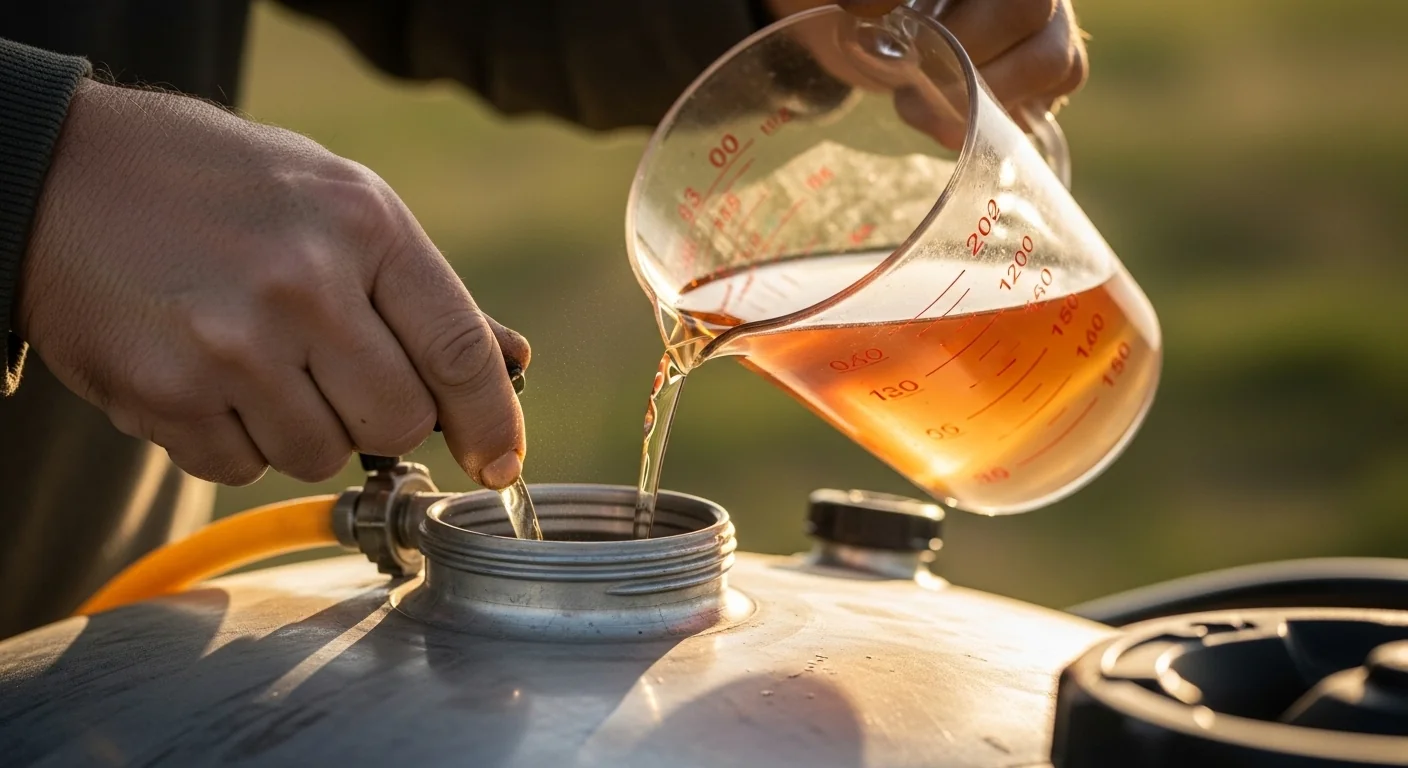
| Tank Size | Gallons (1-1,000) | The total fill volume per tank load used to compute how many acres each tank covers. | Using rated capacity instead of actual usable capacity. Foam, agitation space, and minimum pump-prime depth reduce effective fill volume. | Fill the tank to your normal working level and record that number, not the tank's maximum-rated capacity. |
| Sprayer Output (GPA) | Gallons per acre (5-80) | Volume of spray solution deposited per acre at your operating speed and pressure. Gates the acres-per-tank calculation. | Using the default GPA printed in a sprayer manual. Actual GPA changes with nozzle wear, pressure, and ground speed. | Perform a calibration catch test. Collect nozzle output for 30 seconds at operating pressure and speed, then use the nozzle spacing formula to derive GPA. |
| Temperature | Degrees F (0-130) | Ambient air temperature at time of application. Used to trigger the 85-degree F volatilization safety check. | Using the daily forecast high instead of the actual temperature at spray time. Mid-morning temperatures can exceed 85 degrees F before the forecast peak. | Use a handheld thermometer or weather station at field level, not a phone app. Check again if the spraying session extends past 90 minutes. |
| Herbicide oz per Tank (Output) | Fluid ounces | The calculated amount of herbicide concentrate to add to one full tank. This is the primary result. | Treating this number as ounces of water-diluted product rather than concentrate. Always use concentrate volume at the rate specified on the label. | Double-check against the label's stated oz-per-acre rate multiplied by your acres-per-tank figure manually before mixing. |
| Acres per Tank (Output) | Acres | How much pasture area one full tank will cover at the entered GPA. | Assuming a round number. Fractional coverage (1.67 acres per tank) is normal and should not be rounded up when mixing. | Use the exact decimal. Rounding up means over-applying chemical per acre on the final pass. |
Worked Examples (Real Numbers)
Example 1: Small ATV Sprayer, Thistle Control, Clover Retention
- Tank size: 25 gallons
- GPA: 15
- Target weed: Thistles
- Keep Clover: Yes
- Temperature: 72 degrees F
Acres per tank = 25 / 15 = 1.67 acres
Clover lockout triggered: switches from 2,4-D (32 oz/acre) to Aminopyralid (7 oz/acre)
Herbicide oz per tank = 1.67 x 7 = 11.7 oz
Result: 11.7 oz Aminopyralid per 25-gallon tank.
At 72 degrees F with a clover-safe herbicide selected, no safety flags trigger. The small coverage area (1.67 acres per tank) is typical for ATV boom setups and means multiple refills for fields larger than 2 acres.
Example 2: Tractor Pull Sprayer, Buttercup Elimination, No Legume Retention
- Tank size: 100 gallons
- GPA: 20
- Target weed: Buttercup
- Keep Clover: No
- Temperature: 78 degrees F
Acres per tank = 100 / 20 = 5 acres
Herbicide rate: 2,4-D Amine at 24 oz/acre
Herbicide oz per tank = 5 x 24 = 120 oz (7.5 pints)
Result: 120 oz (7.5 pints) of 2,4-D Amine per 100-gallon tank.
Temperature is within a safe spraying window. The nitrogen-loss notice appears because removing buttercup with 2,4-D also eliminates any clover in the field. Plan for supplemental nitrogen fertilization if grass recovery is a priority the following season.
Example 3: Large Tank, Mixed Weeds, Clover Retention, High Temperature Warning
- Tank size: 200 gallons
- GPA: 12
- Target weeds: Thistles and Pigweed
- Keep Clover: Yes
- Temperature: 91 degrees F
Acres per tank = 200 / 12 = 16.67 acres
Highest clover-safe rate selected: Aminopyralid at 7 oz/acre (for thistles, which requires a higher rate than pigweed)
Herbicide oz per tank = 16.67 x 7 = 116.7 oz (7.29 pints)
Result: 116.7 oz (7.29 pints) Aminopyralid per 200-gallon tank. Volatilization warning active.
At 91 degrees F, ester-based herbicides become volatile enough to drift onto non-target crops. Aminopyralid is an amine-based formulation with lower volatility risk than 2,4-D Ester, but the 85-degree threshold still applies as a conservative industry standard. Delay application until early morning temperatures drop below 85 degrees F.
Reference Table (Fast Lookup)
All values computed using the formula: Acres/Tank = Tank Size ÷ GPA; Herbicide oz/Tank = Acres/Tank x Rate. Rates used: 2,4-D Thistles 32 oz/acre, Aminopyralid Thistles 7 oz/acre, 2,4-D Buttercup 24 oz/acre, Aminopyralid Pigweed 5 oz/acre.
| Tank (gal) | GPA | Acres/Tank | 2,4-D Thistles (oz/tank) | Aminopyralid Thistles (oz/tank) | 2,4-D Buttercup (oz/tank) | Aminopyralid Pigweed (oz/tank) |
|---|---|---|---|---|---|---|
| 15 | 10 | 1.50 | 48.0 | 10.5 | 36.0 | 7.5 |
| 15 | 15 | 1.00 | 32.0 | 7.0 | 24.0 | 5.0 |
| 25 | 10 | 2.50 | 80.0 | 17.5 | 60.0 | 12.5 |
| 25 | 15 | 1.67 | 53.3 | 11.7 | 40.0 | 8.3 |
| 50 | 10 | 5.00 | 160.0 | 35.0 | 120.0 | 25.0 |
| 50 | 20 | 2.50 | 80.0 | 17.5 | 60.0 | 12.5 |
| 100 | 15 | 6.67 | 213.3 | 46.7 | 160.0 | 33.3 |
| 100 | 20 | 5.00 | 160.0 | 35.0 | 120.0 | 25.0 |
| 200 | 15 | 13.33 | 426.7 | 93.3 | 320.0 | 66.7 |
| 200 | 20 | 10.00 | 320.0 | 70.0 | 240.0 | 50.0 |
How the Calculation Works (Formula + Assumptions)
Show the calculation steps
Step 1: Determine acres per tank.
Divide your tank size in gallons by your calibrated GPA figure.
Acres per Tank = Tank Size (gallons) / GPA (gallons per acre)
A 50-gallon tank at 10 GPA covers exactly 5 acres. The result is precise only if GPA is calibrated.
Step 2: Look up the herbicide rate for the target weed.
The tool uses a built-in rate table. When multiple weeds are selected, it uses the highest rate among them to ensure the hardest-to-kill species receives a full lethal dose. Underdosing leads to partial kill and resistance selection pressure.
Step 3: Apply the clover lockout.
If Keep Clover = Yes and the target weed's standard herbicide would kill broadleaf plants (as 2,4-D does), the tool substitutes a clover-safe alternative rate. It does not blend both herbicides.
Step 4: Calculate herbicide ounces per tank.
Herbicide oz per Tank = Acres per Tank x Herbicide Rate (oz/acre)
Round the final answer to one decimal place. Do not round intermediate values.
Step 5: Temperature check.
If ambient temperature exceeds 85 degrees F, a volatilization warning is generated. This is a conservative threshold derived from industry guidance. Some product labels set a higher cutoff. Always consult your specific product label after reviewing this output.
Assumptions and Limits
- Herbicide rates are based on 2,4-D Amine (3.8 lb active ingredient per gallon formulation) and Aminopyralid (2 lb active ingredient per gallon formulation). Ester formulations have different oz-per-acre guidelines.
- GPA entered is assumed to be measured at the actual operating speed and nozzle pressure. A catch test deviation of 15 GPA versus an assumed 10 GPA changes herbicide concentration by 33 percent, enough to severely under-apply.
- The clover-safe substitution is a planning signal, not a label endorsement. Confirm that any selected alternative is labeled for use on improved pastures in your state.
- Volatilization risk varies by formulation type (amine vs. ester), not just temperature. Amine versions are less volatile than ester versions. The 85-degree threshold is conservative and applies most strictly to ester formulations.
- Wind speed is not included in this tool. Spraying above 10 mph significantly increases drift regardless of temperature. A digital anemometer or wind meter should be part of any spray decision.
- Multi-weed scenarios assume broadcast boom application. Spot spray volumes and concentrations differ from broadcast rates and require separate calibration.
- This tool does not account for nozzle type, boom height, droplet size (coarse vs. fine), or buffer zone requirements near water bodies. These factors alter label compliance independently of the concentration calculation.
Standards, Safety Checks, and Warnings
Critical Warnings
- The Nitrogen-Fixer Massacre: 2,4-D is a broadleaf herbicide. Clover is a broadleaf plant. A standard 2,4-D application kills both thistles and clover simultaneously. White clover in a productive pasture fixes between 40 and 200 pounds of atmospheric nitrogen per acre per year depending on density and soil conditions. Eliminating it without a plan for synthetic nitrogen replacement creates a grass-growth deficit that can persist for two or more growing seasons. Factoring this into your hay cost planning before you spray can change the economics of the decision entirely.
- Volatilization at High Temperatures: At temperatures above 85 degrees F, certain herbicide formulations convert from liquid to vapor. That vapor moves with air currents and has no respect for property lines. Sensitive broadleaf crops including soybeans, tomatoes, and grapes have been damaged by drifting herbicide vapor from pasture applications made on hot afternoons. The window for safe warm-weather application is early morning before temperature rises above the threshold.
- GPA Calibration Decay: Nozzle orifices wear over time, increasing GPA. A nozzle delivering 10 GPA when new may deliver 12 GPA after a season of heavy use. That 20 GPA increase means your tank covers fewer acres, but your concentration calculation was built on the old GPA. The result is systemic underdose without any visible error signal.
- Clover Recovery Timeline: After a 2,4-D application, clover does not simply bounce back. Germination from seed bank is possible, but established clover root systems are typically destroyed. Pastures dependent on legume nitrogen often need two or more full growing seasons to rebuild productive clover density. Plan accordingly when budgeting for supplemental fertilizer or monitoring through the feed cost calculator.
Minimum Standards
- Calibrate GPA before every season and after any nozzle replacement. Do not use manufacturer-default GPA figures for actual tank mixing calculations.
- Check the product label for the specific lot purchased, not the general product family. Formulation strengths change between label revisions.
- Record spray date, temperature, wind speed, GPA, tank size, herbicide used, and rate per tank for every application. This documentation is required for some state pesticide applicator compliance programs and is essential for diagnosing failures later.
Competitor Trap: Most pasture herbicide guides online publish a single "2,4-D at 1 quart per acre" recommendation and stop there. That single number is simultaneously correct for some scenarios and a financial and agronomic disaster for others. It ignores whether clover is present, whether the temperature is safe, whether the sprayer is calibrated, and whether a different chemistry would have protected the pasture's built-in nitrogen supply. A guide that tells you only how much chemical to pour without asking what you are willing to destroy is not a safety check. It is a shortcut that shifts the risk entirely to the operator.
Common Mistakes and Fixes
Mistake: Using the Manufacturer GPA as the Calibration Value
Sprayer specifications list a GPA range at a given speed and pressure under test conditions. Field conditions, nozzle wear, terrain slope, and actual ground speed deviate from those test conditions consistently. Mixing a tank based on spec-sheet GPA and then driving 2 mph faster than assumed means your herbicide concentration per acre drops in proportion.
Fix: Perform a catch test at your actual operating speed and pressure, and repeat it every season.
Mistake: Selecting "No Clover Retention" Without Walking the Field
Clover often grows at a density that is not immediately obvious from a tractor cab or a quick glance at the field perimeter. A pasture with thin grass cover and intermittent broadleaf ground cover may have significant clover nitrogen value that cannot be seen without close inspection. Choosing "No" by default eliminates that value without any awareness it existed.
Fix: Walk a representative transect of the field before every spray decision. Look at the soil-level plant composition, not just the canopy.
Mistake: Spraying a Single Weed Rate When Multiple Species Are Present
Thistles require a higher application rate than pigweed for control with most herbicides. Spraying at the lower rate to "be conservative" while both species are present results in full pigweed kill and partial thistle kill, producing selection pressure toward thistle regrowth and requiring a follow-up application at higher cost.
Fix: Select every weed species present. Let the calculator set the rate based on the most demanding target.
Mistake: Ignoring the Relationship Between Clover Loss and Supplemental Feed Costs
Nitrogen that clover fixes does not appear on a fertilizer invoice, so its loss is invisible until grass production slows and hay intake or supplement requirements increase. Operators who eliminate clover with 2,4-D and do not replace that nitrogen often observe reduced forage yield over the following two seasons without connecting the cause. The winter cattle feed calculator can help quantify the downstream cost before the sprayer is loaded.
Fix: If 2,4-D is necessary and clover will be killed, budget for 40 to 80 pounds of supplemental nitrogen per acre in the seasons following application.
Mistake: Spraying on Slopes Without Checking Equipment Safety
Tractor-mounted boom sprayers and 3-point tank setups shift the machine's center of gravity rearward and upward when full. Operating on side slopes that would be safe with an unloaded tractor may exceed stability limits with a full spray tank. This is a terrain and load management issue, not a chemical issue, but it belongs in any spray planning checklist. The tractor side slope limit calculator addresses exactly this scenario.
Fix: Calculate your safe operating slope before driving a loaded sprayer onto terrain with more than minimal grade.
Next Steps in Your Workflow
After confirming your tank mix, the next decision is whether your pasture's weed pressure reflects an underlying forage management gap. Thistle and buttercup populations tend to expand in overgrazed or poorly rested pastures where grass canopy is too thin to outcompete broadleaf seedlings. Spraying removes the visible symptom. Without adjusting the rest period and grazing intensity, those weeds often return within one to two seasons. Running your pasture through the rotational grazing calculator after a successful spray program gives you a data-backed rest schedule that reduces weed re-establishment pressure by thickening the grass stand.
On the equipment side, the period immediately after a spray application is a practical time to review nozzle condition and recalibrate GPA for the next use. Nozzles that drift high on output deliver less herbicide per acre than your tank mix assumes, and nozzles that are clogged or damaged create uneven coverage that leaves weed escapes. Scheduling your next pasture spray with fresh calibration data, combined with an updated stocking rotation from your grazing plan, tends to reduce total chemical use over a two-year window because weeds are not allowed to rebuild between treatments. The rotational grazing calculator and this pasture weed killer calculator address adjacent parts of the same pasture productivity system.
FAQ
Does 2,4-D kill grass?
No. 2,4-D is a selective broadleaf herbicide. It targets plants with broadleaf physiology, which includes thistles, buttercup, plantain, and clover, while leaving grass species unharmed. This selectivity is why it is widely used in pastures, but it also explains why clover, a desirable broadleaf, is collateral damage when it is applied without a legume retention consideration.
What does GPA mean and why does it matter for tank mixing?
GPA stands for gallons per acre, the volume of spray solution your boom deposits over one acre at your operating speed and pressure. It is the denominator in the acres-per-tank formula. An incorrect GPA figure shifts every downstream calculation, including herbicide concentration per acre, making it the single most important variable to calibrate before mixing a tank.
Can I mix 2,4-D and Aminopyralid in the same tank?
Some products are pre-mixed formulations that combine multiple active ingredients. Whether two separate products can be tank-mixed depends on label compatibility for each specific formulation purchased, your state's pesticide regulations, and the application target. This calculator does not produce tank-mix recommendations. Consult the labels of both products and contact the manufacturer's agronomic hotline if uncertainty exists.
At what temperature is it too hot to spray herbicide?
This calculator uses 85 degrees F as a conservative threshold, which aligns with general industry guidance. Some product labels specify 90 degrees F or higher. Ester formulations of 2,4-D carry higher volatilization risk than amine formulations at the same temperature. The specific label for the product in your tank is the controlling document, not a general calculator threshold.
Why does the calculator switch herbicides when I select "Keep Clover"?
Standard herbicides used for thistle and buttercup control, particularly 2,4-D, kill all broadleaf plants including clover. When legume retention is selected, the calculator substitutes a clover-tolerant alternative at the appropriate rate for each weed target. This prevents the common error of eliminating a nitrogen-fixing forage species while intending only to remove weeds.
How often should I calibrate my boom sprayer's GPA?
At minimum, calibrate once per season and after any nozzle replacement. Nozzle orifices wear with use, increasing flow rate and GPA over time. A nozzle that tests 10 GPA when new may flow 12 or 13 GPA after heavy use, reducing effective herbicide concentration per acre below the intended dose without producing any visible sign of the error.
Conclusion
The pasture weed killer calculation is a two-part problem. The first part, ounces per tank, is a straightforward formula that depends on accurate GPA and tank size inputs. The second part, what those ounces will actually do to the full plant community in the field, is where most spray decisions go wrong. 2,4-D does exactly what it is designed to do. The damage comes from applying it without knowing that clover is in the path. This calculator exists specifically to surface that second part before the tank is mixed, not after the legumes are gone.
The single most costly mistake in pasture herbicide management is treating weed control as a chemistry problem when it is also a nitrogen management and grazing system problem. If you are spraying thistles every other year in the same fields, the spray is managing symptoms rather than causes. A spray-free year following a well-managed rest and rotation cycle often produces a thicker, more competitive grass stand than a spray year without a grazing plan. For a broader look at how perimeter management connects to overall pasture health, the electric fence calculator helps structure the infrastructure that makes rotational rest periods practical in the first place.