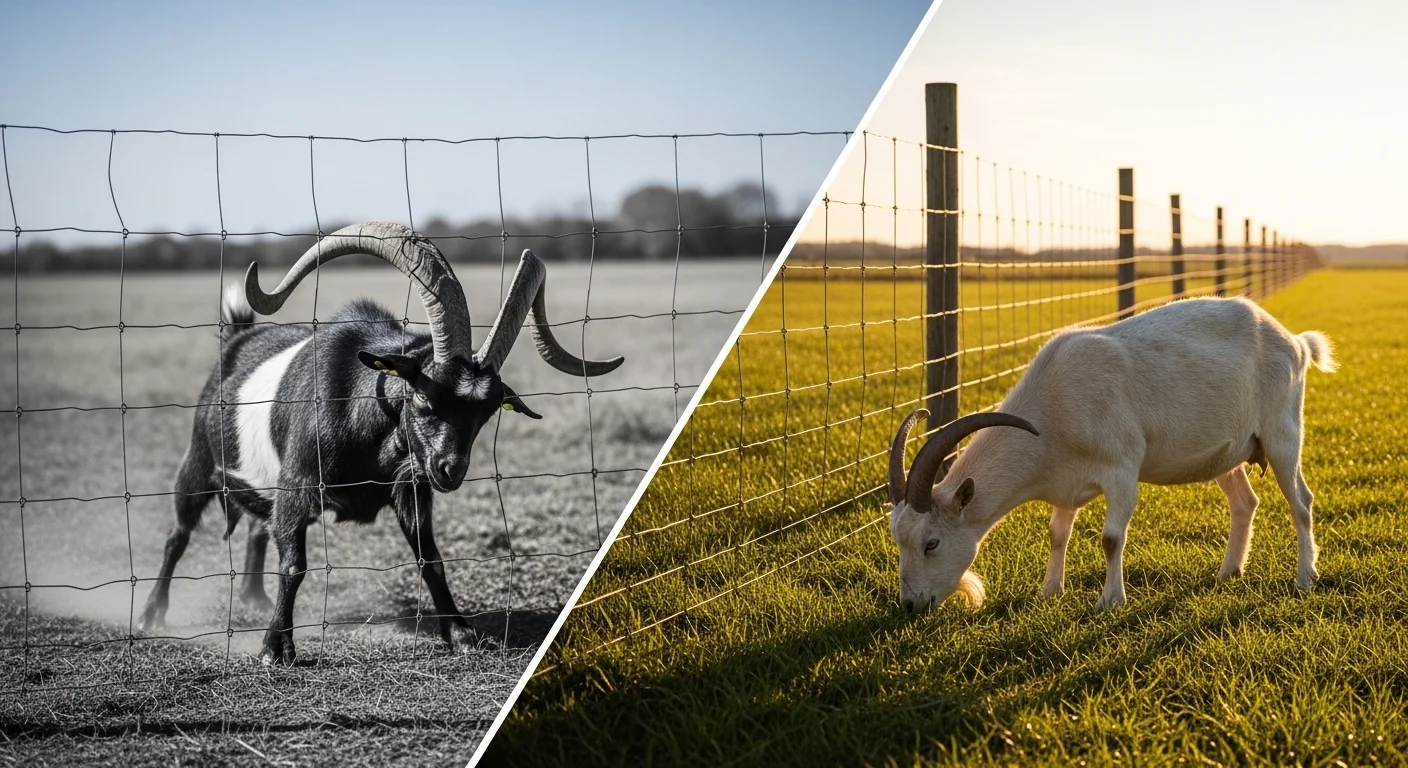
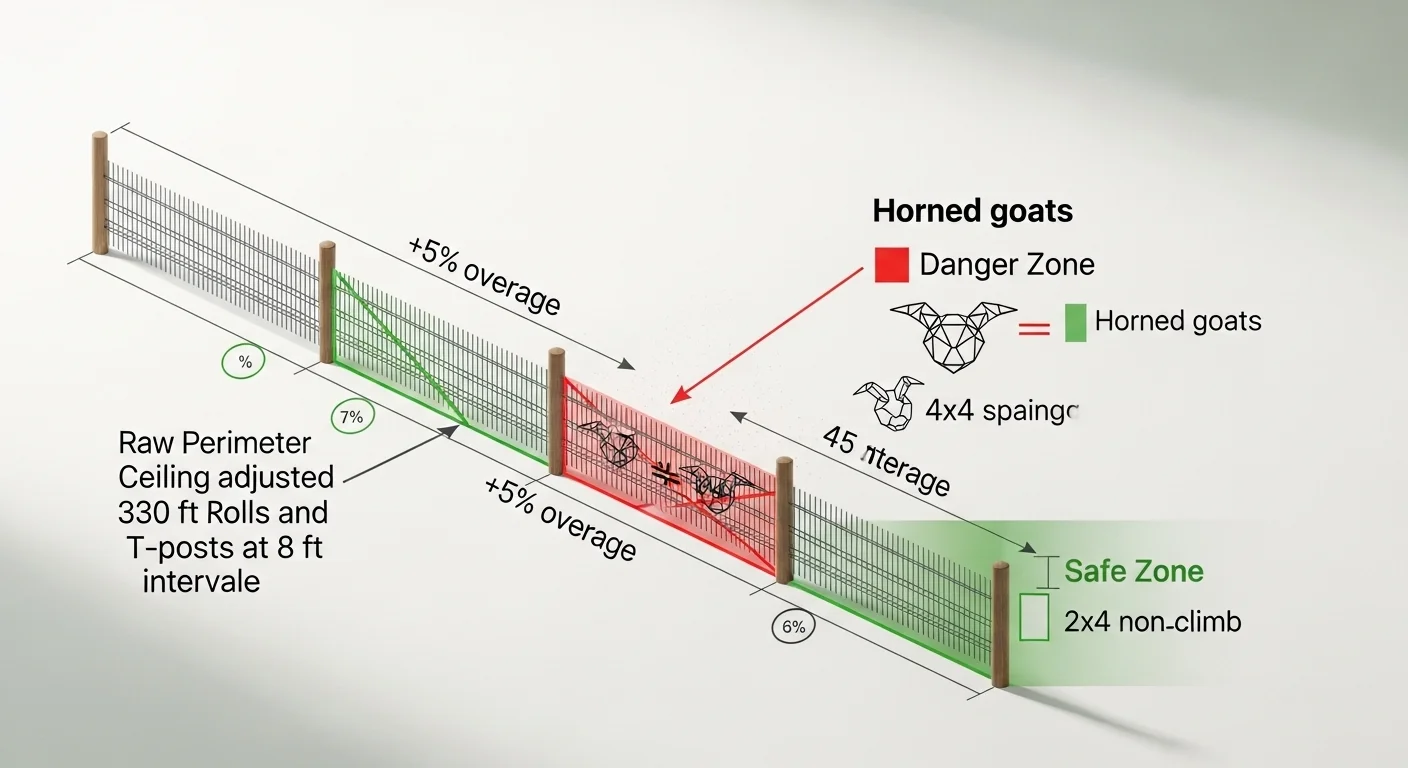
The wire spacing on a woven wire fence is not a preference setting. For horned goats, it is a life-or-death specification. A goat can push its head and horns forward through a 4-inch square opening without difficulty. Pulling back is a different story: the angular geometry of the horns catches the horizontal wire, and the animal is physically locked in place. It panics, it screams, and it becomes stationary prey. This happens with cheap woven wire sold in every farm supply store in the country, and it is entirely preventable with the right mesh selection before the fence goes in the ground.
This woven wire fence calculator takes your perimeter footage, livestock type, mesh spacing, and brace post count, then outputs roll quantities, T-post counts, a wire waste buffer, and a hard-coded safety verdict on your spacing choice. It does not account for terrain slope, soil type, or multi-species paddocks. It calculates material quantities based on standard 330-foot roll lengths and flags configurations that create documented injury or mortality risk for the selected livestock.
After running this calculator, you will know exactly how many rolls to order and whether your chosen mesh spacing is safe for your specific animals, before you spend money on wire that may need to be replaced.
Use the Tool
Before opening the calculator, have three measurements ready: the total perimeter of the area you are fencing in feet, the mesh opening size printed on the wire tag or product listing, and a count of all corner and end locations that will need brace post assemblies. If you are still designing your layout and have not settled on an H-brace configuration, the H-brace fence calculator can help you determine how many assemblies are structurally appropriate for your run length before you return here with a final brace count.
Quick Start (60 Seconds)
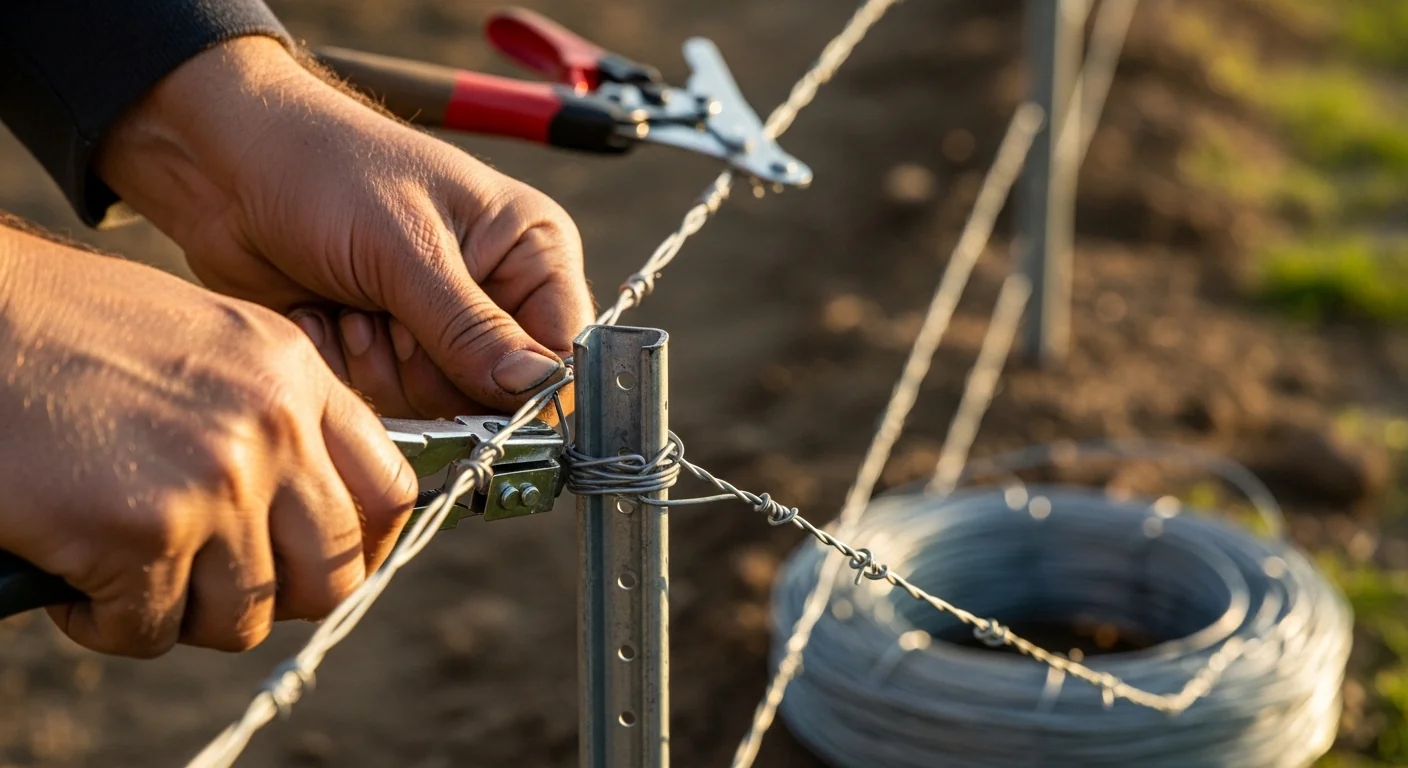
- Livestock Type: Select the primary species this fence will contain. If your paddock holds multiple species, select the one with the most restrictive spacing requirement. Horned goats are always the most restrictive choice.
- Perimeter Length: Enter the total fence-line distance in feet, not acres. Walk the boundary or use a mapping tool. Do not estimate from acreage alone; irregular lots produce perimeters that differ significantly from square-lot math.
- Wire Mesh Spacing: This is the opening size, not the wire gauge. Check the roll tag. “Non-climb” refers to 2″x4″ or similar small-vertical-opening patterns. “Field fence” is often 6″x6″ or graduated opening, which is a different product entirely.
- Brace Post Count: Count every corner post assembly and every end post assembly. A standard rectangular paddock with four corners has four assemblies. A gate opening on each of two sides adds two more, for a total of six.
- Roll length assumption: This calculator uses 330-foot rolls, which is the U.S. industry standard. If you are sourcing 100-foot or 200-foot rolls from a regional supplier, adjust your perimeter input proportionally or contact the supplier before ordering.
- The 5% buffer is built in: The output already accounts for splicing waste and stretching loss. Do not add your own manual buffer on top of the calculator result.
- Read the safety verdict: The colored traffic light below the output is not decorative. A red result means the mesh spacing you selected is documented as a lethal configuration for your selected livestock. Change the spacing input before finalizing your materials list.
Inputs and Outputs (What Each Field Means)
| Field | Unit | What It Measures | Common Mistake | Safe Entry Guidance |
|---|---|---|---|---|
| Livestock Type | Category | Determines which spacing safety checks are triggered | Selecting “Sheep” for a mixed goat-sheep herd when horned goats are present | Always select the species with the highest entrapment risk in a mixed herd |
| Perimeter Length | Feet (ft) | Total linear distance of the fence run | Using the square-lot acreage formula on an irregular parcel; can be off by 20% or more | Walk the line with a measuring wheel, or use satellite map tools and convert to feet |
| Wire Mesh Spacing | Inches x Inches | The opening dimension of each grid cell in the woven wire | Confusing “field fence” graduated openings with fixed-opening woven wire | Read the roll label directly; do not infer spacing from the wire gauge or product photos |
| Brace Post Count | Count (assemblies) | Number of corner and end brace assemblies in the fence layout | Counting individual posts instead of complete assemblies; an H-brace uses 3 posts but counts as 1 assembly | Count corners plus gate ends; a basic 4-corner rectangle with 2 gates = 6 assemblies |
| Rolls Needed (output) | Rolls (330 ft each) | Final order quantity including 5% waste buffer, rounded up to whole rolls | Ordering the raw math result without the buffer; even a 1-roll shortage stops the job | Use the calculator output directly; the buffer is already embedded in the result |
| T-Post Count (output) | Count | Number of steel T-posts at 8-foot spacing along the perimeter | Using this count for hilly terrain, where 6-foot spacing is more appropriate | Add 33% to the T-post result if your terrain has significant grade changes |
| Safety Verdict (output) | Red / Yellow / Green | Deterministic pass-fail check: Lethal, Warning, or Safe for the livestock + spacing combination | Ignoring a yellow result because the wire was already purchased | A red result requires changing the spacing input before ordering any materials |
Worked Examples (Real Numbers)
Example 1: Quarter-Acre Horned Goat Pen
- Livestock: Horned Goats
- Perimeter: 418 ft (square lot approximately 104 ft per side)
- Mesh Spacing: 2″x4″ Non-Climb
- Brace Post Assemblies: 4 (four corners)
Result: 2 rolls of 330 ft wire, 53 T-posts, 4 brace assemblies. Safety verdict: Green.
The 5% overage produces a final adjusted quantity of 2 rolls, covering 660 linear feet against a 418 ft perimeter. The surplus provides adequate splice material and stretching allowance. The 2″x4″ non-climb spacing passes the horn trap check for horned goats.
Example 2: Half-Acre Sheep Pasture with 4″x4″ Wire
- Livestock: Sheep
- Perimeter: 590 ft (square lot approximately 148 ft per side)
- Mesh Spacing: 4″x4″
- Brace Post Assemblies: 4
Result: 2 rolls of 330 ft wire, 74 T-posts, 4 brace assemblies. Safety verdict: Green.
Sheep without horns do not trigger the cranial hook trap in 4″x4″ openings. The calculator issues a clean pass. Two rolls cover 660 ft against a 590 ft perimeter, leaving 70 ft of reserve for waste and field splices.
Example 3: One-Acre Horse Paddock
- Livestock: Horses
- Perimeter: 835 ft (square lot approximately 209 ft per side)
- Mesh Spacing: 2″x4″ Non-Climb
- Brace Post Assemblies: 6 (four corners plus two gate ends)
Result: 3 rolls of 330 ft wire, 105 T-posts, 6 brace assemblies. Safety verdict: Green.
With 4″x4″ wire selected instead, this scenario triggers a yellow hoof shear warning. Non-climb horse fence at 2″x4″ removes that risk entirely. Three rolls produce 990 ft of wire against an 835 ft perimeter, leaving 155 ft as buffer.
Reference Table (Fast Lookup)
| Perimeter (ft) | Raw Rolls (no buffer) | With 5% Overage | Order Qty (whole rolls) | T-Posts @ 8 ft spacing | Wire Surplus vs. Perimeter |
|---|---|---|---|---|---|
| 330 | 1.00 | 1.05 | 2 | 42 | 330 ft (100% buffer) |
| 500 | 1.52 | 1.59 | 2 | 63 | 160 ft |
| 660 | 2.00 | 2.10 | 3 | 83 | 330 ft |
| 1000 | 3.03 | 3.18 | 4 | 125 | 320 ft |
| 1320 | 4.00 | 4.20 | 5 | 165 | 330 ft |
| 2000 | 6.06 | 6.36 | 7 | 250 | 310 ft |
| 2640 | 8.00 | 8.40 | 9 | 330 | 330 ft |
| 5280 | 16.00 | 16.80 | 17 | 660 | 330 ft |
Notice that perimeters that land exactly on multiples of 330 ft still require an additional roll after the 5% buffer is applied. The overage pushes the fractional result above the next whole number. Ordering one roll short on a large pasture project causes a full-day work stoppage while a replacement roll is sourced.
How the Calculation Works (Formula + Assumptions)
Show the calculation steps
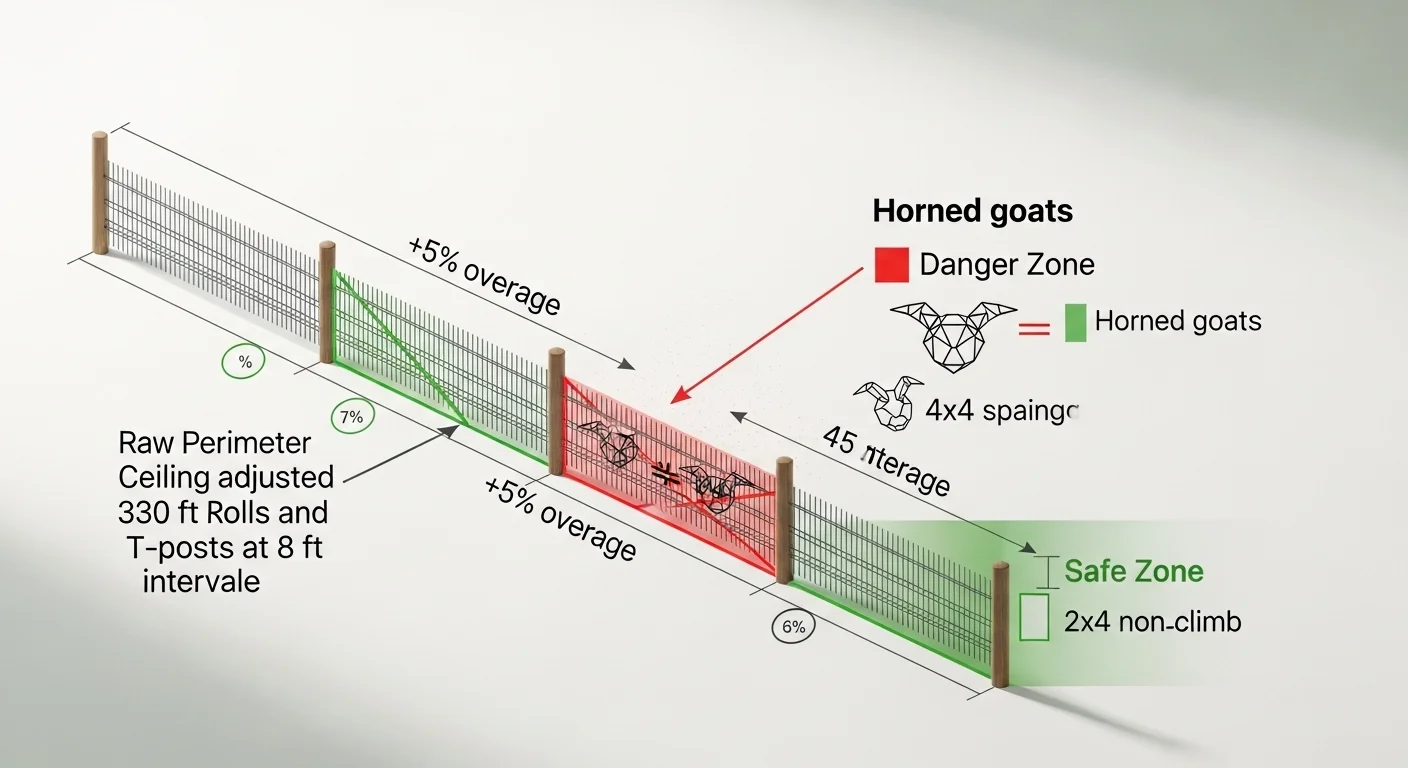
- Raw roll count: Divide total perimeter in feet by 330. This is the theoretical minimum number of rolls with no waste:
Raw Rolls = Perimeter / 330 - Apply the 5% overage factor: Multiply raw rolls by 1.05 to account for wire lost at splice points, post wraps, and stretching loss under tension:
Adjusted Rolls = Raw Rolls x 1.05 - Round up to whole rolls: You cannot purchase partial rolls. Always round up the adjusted figure using ceiling math. A result of 2.01 becomes 3 rolls.
- T-post calculation: Divide the perimeter by 8 (standard T-post spacing in feet) and round up:
T-Posts = Ceiling(Perimeter / 8) - Safety verdict: The tool applies a conditional check. If Livestock = Horned Goats AND Spacing = 4″x4″, the result is flagged as a lethal configuration. If Livestock = Horses AND Spacing = 4″x4″, the result is flagged as a hoof shear warning. All other combinations are evaluated for mesh size adequacy relative to the selected species.
Assumptions and Limits
- 330 ft roll standard: Some regional suppliers carry 100 ft, 165 ft, or 200 ft rolls. If your source uses a different roll length, multiply the output roll count by 330 and divide by your actual roll length to get the correct order quantity.
- Flat terrain assumed: The T-post spacing of 8 ft applies to level ground. On hillsides, posts may need to be as close as 6 ft apart, which increases the T-post count by approximately 33% for that run.
- Single-species verdict: The safety check evaluates only the species you select. If a paddock holds horned goats and horses simultaneously, select horned goats; it produces the more restrictive and correct spacing requirement.
- Brace post assemblies vs. posts: The brace post count field refers to complete assemblies (H-brace, N-brace, or floating brace), not individual posts. Each H-brace assembly typically uses 2 vertical posts and 1 horizontal, plus wire tensioning.
- Wire height not modeled: This calculator handles linear roll quantity, not wire height selection. Goats typically require 48-inch fence height; horses, 52 to 60 inches. Select your roll height separately from your fence supplier.
- No gate wire: Gate panels are a separate line item. The perimeter input should reflect fence-line distance only. Do not subtract gate openings; the wire still runs to gate posts, and the buffer covers that connection material.
- Graduated-opening field fence: Products labeled “field fence” often use variable opening sizes (larger at the top, smaller at the bottom). This calculator’s safety logic applies to fixed-opening woven wire only. Graduated products require a separate species-specific evaluation.
Standards, Safety Checks, and “Secret Sauce” Warnings
Critical Warnings
- The Lethal Horn Trap (4″x4″ + Horned Goats): A 4-inch square opening is wide enough for an adult horned goat to push its head through while grazing. The horn geometry, angled rearward relative to the skull, creates a mechanical hook when the animal attempts to withdraw. The goat cannot back out. Entrapment in open pasture is fatal: coyotes respond to distress calls within hours, and dehydration becomes life-threatening within a day in summer conditions. The only compliant wire for horned goats is 2″x4″ non-climb, where the 2-inch horizontal dimension prevents head insertion entirely.
- Hoof Shear Risk (4″x4″ + Horses): Horses paw at fencing under stress, during feeding anticipation, or when separated from herd mates. A steel hoof inserted into a 4-inch opening and twisted under body weight can shear the deep digital flexor tendon or fracture the navicular bone. Injuries of this type frequently result in permanent performance loss. Non-climb horse fence (2″x4″) is the ASTM-recognized standard for horses in direct contact with woven wire.
- Large Mesh and Predator Ingress: Mesh openings of 6″x6″ or larger allow a coyote to push its body through from a standing position at ground level. For small livestock including sheep, goats, and alpacas, the mesh size is a predator deterrent as much as it is a containment barrier. Consider reviewing your electric fence setup as a perimeter deterrent layer if your primary fence uses a mesh larger than 4″x4″.
- Tension Loss in Temperature Extremes: Woven wire installed in summer without appropriate tensioning will go slack in winter cold. Sagging wire drops to the ground at the base, creating gaps that allow livestock to step over or predators to crawl under. Pre-tensioning practices and appropriate come-along tension during installation reduce this effect significantly.
Minimum Standards
- 2″x4″ non-climb woven wire is the minimum specification for any paddock containing horned goats or horses in direct wire contact.
- T-posts should be driven a minimum of 24 inches into undisturbed soil. In sandy or loose soils, use longer posts or concrete footings at intervals.
- H-brace assemblies at every corner and end are required to maintain wire tension over the life of the fence. Wire tension pulls horizontally; T-posts are designed for vertical loads and cannot substitute for braced corners.
- For predator-proof containment of sheep, the University Extension standard for woven wire is 4″x4″ or smaller, combined with a bottom electric wire positioned 6 to 8 inches above ground level. Review the electric fence joule calculator to size the energizer for that deterrent wire before finalizing your design.
Competitor Trap: Most woven wire fence calculators online output only a roll count based on perimeter. They say nothing about mesh spacing safety, species-specific risk, or predator vulnerability. A homesteader searching for “goat fence spacing math” gets a materials list, buys 4″x4″ wire because it costs less per roll, and discovers the horn trap consequence after losing an animal. The spacing selection is not a secondary detail. It is the primary decision, and the roll count is secondary to it.
Common Mistakes and Fixes
Mistake: Measuring Acreage Instead of Perimeter
A one-acre square has a perimeter of about 835 feet. A one-acre L-shaped lot or narrow rectangle can have a perimeter of 1,100 feet or more. Using an acreage-to-perimeter conversion formula without accounting for lot shape produces a materials shortfall that can exceed two full rolls on irregular parcels. Fence-line distance is the only valid input. Fix: walk the boundary with a measuring wheel, or trace the actual boundary in a satellite map tool and convert the result to feet before entering it in the calculator. If you are sizing a new paddock from scratch, the rotational grazing calculator can help you determine the right paddock dimensions before measuring.
Mistake: Counting Individual Posts as “Brace Post Assemblies”
A standard H-brace uses two vertical posts, one horizontal brace rail, and two diagonal tensioning wires. It is one assembly. Entering “8 posts” when you have four H-brace corners enters the wrong number and distorts the materials estimate for the corner hardware list. Fix: count assemblies (corner locations and end locations), not the individual posts inside each one.
Mistake: Assuming “Field Fence” and “Woven Wire” Are Interchangeable
Field fence is a specific product with graduated opening sizes: smaller near the ground, larger near the top. Some products labeled “woven wire” have openings that vary by zone. The safety logic in this calculator applies only to fixed-opening woven wire where the mesh spacing is uniform from top to bottom. A product with 6-inch openings at the top and 3-inch openings at the bottom cannot be evaluated accurately with a single spacing input. Fix: read the roll label and confirm whether your product has a fixed or graduated pattern before using this calculator. If you are evaluating stocking capacity for the pasture you are fencing, the pasture stocking rate calculator pairs well with this tool once the fence design is finalized.
Mistake: Skipping the 5% Waste Buffer
Ordering the exact raw roll count leaves no room for the wire consumed at splice points between rolls, the wraps around corner posts, and the tension loss during stretching. A fence that runs 660 feet of perimeter requires exactly 2 rolls at face value. The overage calculation brings the final number to 2.10 adjusted rolls, which ceilings to 3. Ordering 2 rolls leaves a site crew short on the second run. Fix: use the calculator output directly without subtracting the buffer yourself.
Mistake: Installing Woven Wire Without Proper Tensioning Tools
Woven wire hung loosely on T-posts sags within one season. A come-along fence stretcher or inline wire tensioner is required to achieve the working tension that keeps the bottom wire off the ground and the mesh rigid enough to resist livestock pressure. Under-tensioned woven wire is the primary cause of livestock breaches in installations that passed an initial visual inspection. Fix: rent or purchase a proper wire stretcher rated for the wire gauge you are using, and tension each run from a braced end before stapling to intermediate T-posts.
Next Steps in Your Workflow
Once you have your roll count and T-post quantity, the next procurement decision is brace hardware. Each corner assembly needs a brace rail, two corner posts, and tensioning wire or rod. The H-brace fence calculator sizes the brace span and wire gauge requirements based on your specific soil conditions and fence line tension. Running both tools before placing your materials order prevents the common situation where wire arrives on site before brace posts are in the ground and properly set.
After installation, wire tension changes with temperature. A fence tensioned correctly in October can be slack by February in cold climates, and overtightened by July in warm ones. The fence tension temperature calculator helps you set the correct initial tension based on your installation temperature and local temperature range, so the fence maintains working tension year-round without manual seasonal adjustment.
FAQ
What is the standard roll length for woven wire fencing in the U.S.?
The U.S. industry standard for woven wire is 330 feet per roll. Some suppliers offer shorter rolls at 100 or 165 feet, typically for specialty products or small orders. Always confirm the roll length on the product label or specification sheet before ordering. This calculator is built around the 330-foot standard; adjust your order manually if your supplier uses a different length.
Can I use 4″x4″ woven wire for Nigerian Dwarf or other small horned goat breeds?
No. Small horned breeds are at higher horn trap risk than standard-sized horned goats because their smaller skull size allows even easier head insertion through 4-inch openings. The 2-inch horizontal dimension of non-climb wire is the only configuration that reliably prevents head insertion for all horned goat breeds, regardless of size.
Does this calculator work for high-tensile woven wire?
Yes for quantity calculations. The roll-length math and the 5% overage factor apply to high-tensile woven wire in 330-foot rolls the same way they apply to standard gauge wire. The spacing safety logic also applies directly, since horn trap geometry depends on opening dimension, not wire tensile strength.
What T-post depth should I use with woven wire?
Drive T-posts to a minimum of 24 inches below grade in firm soil. The above-ground height needed depends on your fence height selection (typically 48 to 60 inches for livestock). Add the above-ground height to the minimum burial depth to select post length. In loose or sandy soils, a 30-inch burial depth reduces post lean under lateral wire tension.
How do I fence a mixed herd of horned goats and sheep?
Use the most restrictive spacing for the entire fence line. In a mixed horned-goat-and-sheep paddock, 2″x4″ non-climb wire is required for the entire perimeter. Dividing the paddock into species-specific sections with a shared fence line is a common approach that also allows the sheep section to use 4″x4″ if the shared line is non-climb.
Does the calculator account for gate openings?
No. Gate panels are purchased separately and are not included in the roll count. Do not subtract gate openings from the perimeter input. Wire still runs from the gate post back to the corner assembly, and that connection material is covered within the 5% overage buffer already embedded in the calculator output.
Conclusion
The woven wire fence calculator reduces a multistep materials estimate to a 30-second input sequence. But the more consequential output is the spacing verdict. Roll counts are correctable after the fact by ordering more wire. A 4″x4″ mesh installed around horned goats is not correctable after an entrapment event. The mesh spacing decision comes before the materials list, not alongside it.
The single most common mistake homesteaders make on woven wire fencing projects is selecting wire based on price per roll without checking the mesh opening against their livestock species. A roll of 4″x4″ wire typically costs less than a roll of 2″x4″ non-climb. That price difference is not relevant if the cheaper wire creates a lethal hazard. Run this calculator before you shop, verify the safety verdict before you order, and consult the feed cost calculator alongside your fencing budget to keep the full livestock setup cost in view.