
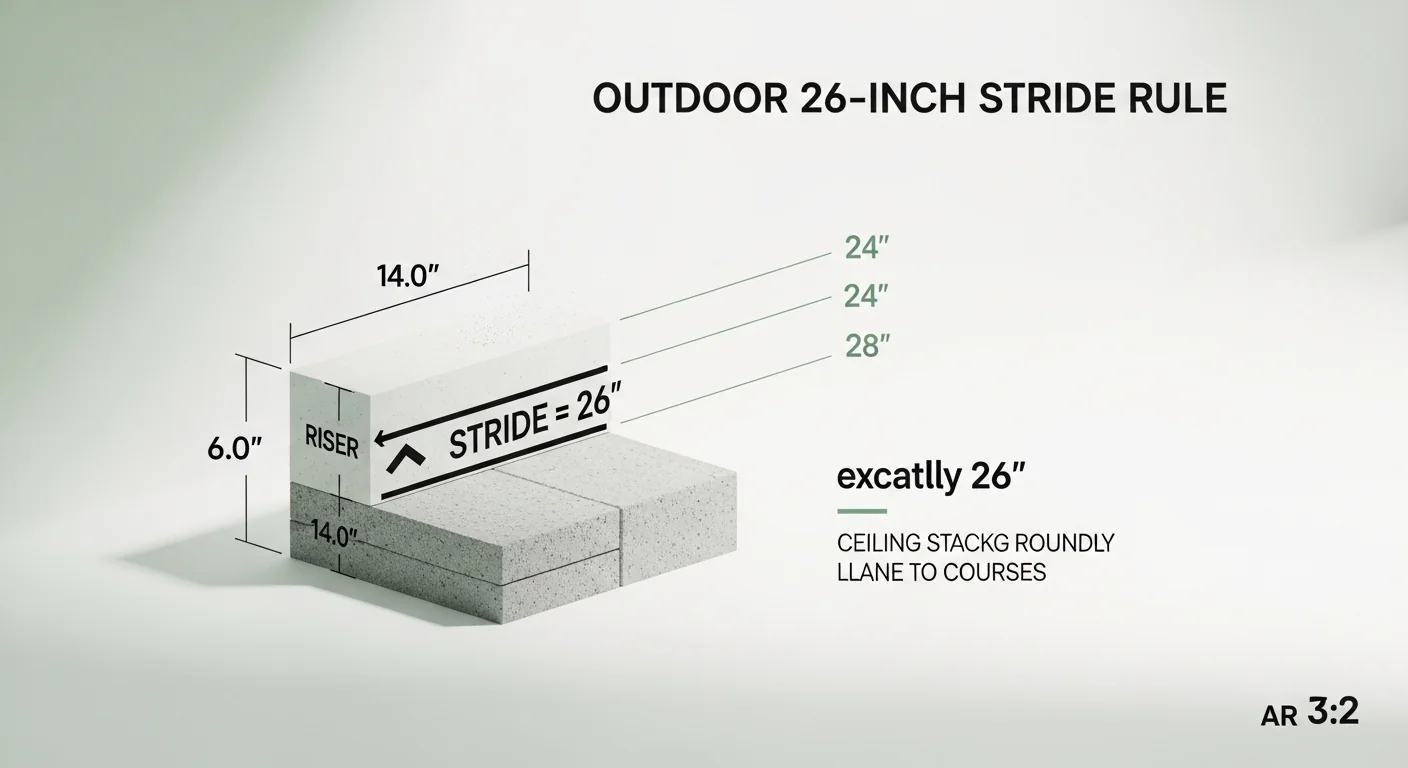
Hardscape stair geometry is not the same as interior stair geometry. The residential building code defaults most contractors and DIYers know by memory (7-inch riser, 10-inch tread) produces stairs that are technically legal indoors but physiologically wrong for outdoor walking. Outdoor stride is longer and more relaxed than indoor stride, and stairs built to the indoor standard create a steep, exhausting climb that feels wrong every single time someone uses them. The math is different. The target is different. The failure mode, if you get it wrong, is baked permanently into masonry.
This calculator applies the outdoor kinesiology standard for hardscape steps: a target riser of 6 inches, a tread range of 12 to 14 inches, and a stride formula check (2 x Riser + Tread = 26 inches) that confirms the geometry is correct for a natural outdoor walking gait. It computes the number of steps, actual riser height, actual tread depth, and the number of block courses required per riser based on your block thickness. It does not account for mortar joint compression, nosing overhang, or ADA ramp slope requirements; those are site-specific adjustments you confirm with a tape measure on the actual material. For projects where the stair connects to a raised patio surface, checking the finished surface drainage angle with a patio slope calculator beforehand prevents water pooling at the base of the lowest riser.
After using this tool, you will know whether your proposed rise and run dimensions produce outdoor-safe geometry, how many steps to cut, and whether your block thickness requires trimming to hit the exact riser height.
Use the Tool
Outdoor Stair Riser & Tread Calculator
Precision hardscape stair geometry — paver steps, retaining wall stairs & stringer layout
Landscaping & Hardscape| Status | Riser (in) | Tread (in) | 2R+T | Classification |
|---|
How This Calculator Works
This tool applies the outdoor kinesiology standard for patio and hardscape steps — not the indoor residential code. Steps are computed in this order:
- Target riser range (outdoor standard): 5.5″ – 6.5″. Indoor stairs use 7″ risers; outdoors, this feels steep and fatiguing.
- Number of Steps = Total Rise ÷ Target Riser (rounded to nearest whole step)
- Actual Riser = Total Rise ÷ Number of Steps
- Actual Tread = Total Run ÷ Number of Steps
- Stride Check (Secret Sauce): 2 × Riser + Tread must equal 26″ (±2″ tolerance). This is the Outdoor 26-Inch Rule based on human stride length.
- Courses of Block = Riser Height ÷ Block Thickness (rounded up — you may need to trim)
Assumptions & Limits
- This calculator is for outdoor hardscape stairs (patio, landscape, retaining wall). Indoor code (IRC) has different requirements.
- The Outdoor 26-Inch Stride Rule (2R+T = 26) is based on biomechanics research for relaxed outdoor walking gait, not ADA or IRC residential code.
- Inputs assume all steps are uniform height and depth (equal-rise, equal-run design).
- Block courses assume single-course stacking; mortar joint thickness (typically ⅜″–½″) is not included — verify final height on site.
- Tread overhang (nosing) of 1″ is typical for appearance; add this to the Total Run for final material take-off.
- Minimum outdoor tread depth is 11″ per most local landscape codes; confirm with your jurisdiction.
- ADA accessible ramps require a maximum 1:12 slope — stairs steeper than 4.8° rise:run may not be ADA-compliant.
- Always consult a licensed landscape architect or contractor for permitted structures.
Before entering values, have three measurements ready: the total vertical rise from the finish grade at the bottom landing to the finish surface at the top landing (in inches), the total horizontal distance available for the entire stair run (in inches, not feet), and the nominal thickness of your wall block or paver unit in inches. Measure rise and run from final finished grade, not from subbase. If you are building steps into a retaining wall structure, confirm the wall geometry first with a retaining wall calculator before running stair calculations against it.
Quick Start (60 Seconds)
- Total Elevation Rise: Measure the vertical distance from bottom finished grade to top finished surface in inches. If your rise is 3 feet 6 inches, enter 42, not 3.5. Do not include subbase depth.
- Total Run Distance: Enter the full horizontal depth available for all steps combined, in inches. This is the footprint of the entire staircase, not the depth of one tread. A 6-step stair with 13-inch treads needs at least 78 inches of run.
- Block/Paver Thickness: Enter the actual height of your wall block or paver unit in inches (commonly 4 inches, 6 inches, or 8 inches). Verify with the manufacturer spec sheet, not the nominal name.
- Do not mix units: All three fields require inches. Do not enter decimal feet (3.5) when you mean 42 inches. The calculator does not convert units.
- Mortar joints are not included: If you are using a wet-set mortar installation, each joint adds roughly 0.375 to 0.5 inches to the actual stacked height. Verify your final riser height on-site against the formula output before cutting all material.
- Pressed the Calculate button? The results will not appear until all three fields contain valid numbers within the accepted ranges. Check for any red error messages under each field.
Inputs and Outputs (What Each Field Means)
| Field | Unit | What It Means | Common Entry Mistake | Safe Entry Guidance |
|---|---|---|---|---|
| Total Elevation Rise | inches | Vertical height from bottom to top finish surface | Entering feet (e.g., 3.5) instead of inches (42) | Measure from finished grade to finished grade, 2 to 300 in |
| Total Run Distance | inches | Horizontal footprint of the full staircase | Entering one tread depth instead of total run for all steps | 6 to 1,200 in; multiply tread estimate by step count as a sanity check |
| Block/Paver Thickness | inches | Actual height of one block or paver unit | Using nominal product name (e.g., “6-inch block” that measures 5.625 inches) | Measure the actual unit with calipers; use 1 to 24 in |
| Number of Steps (output) | steps | Whole step count derived by dividing total rise by 6-inch target riser and rounding | Assuming steps = rise / block; block thickness does not determine step count | Output only; verify that steps x actual riser = total rise |
| Actual Riser Height (output) | inches | Exact riser height after distributing total rise equally across all steps | Assuming riser equals block thickness exactly | Safe outdoor range: 5.5 to 6.5 inches |
| Actual Tread Depth (output) | inches | Depth of each step measured from riser face to riser face | Confusing tread depth with paver slab width (nosing overhang is extra) | Outdoor standard: 12 to 14 inches minimum |
| Courses of Block (output) | courses | Number of block layers to stack per riser, rounded up | Forgetting that rounding up means the last course may need a height adjustment | Courses x block thickness should equal or slightly exceed actual riser; trim the top course if needed |
Worked Examples (Real Numbers)
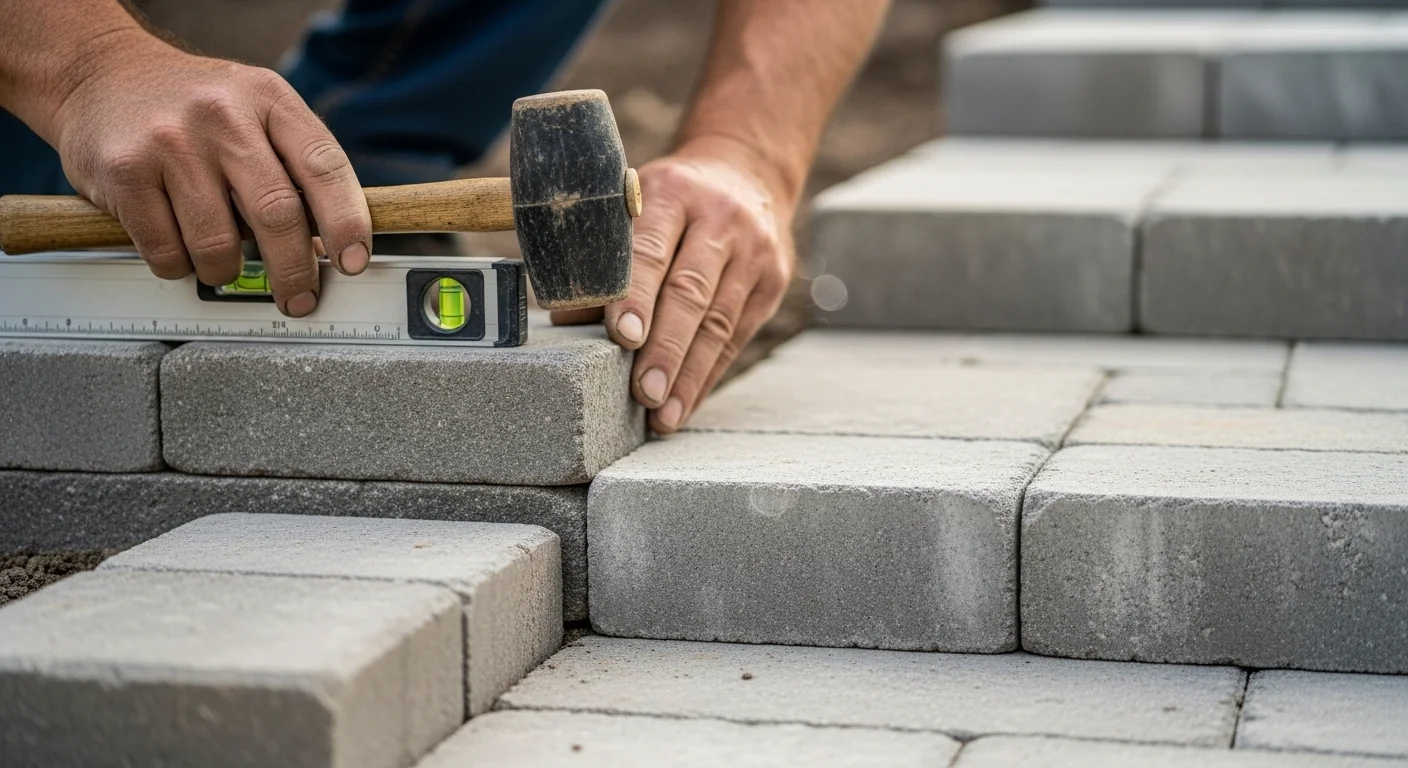
Example 1: Standard Patio Entry with 6-Inch Wall Block
- Total Rise: 36 inches
- Total Run: 84 inches
- Block Thickness: 6 inches
Result: 6 steps, 6.00-inch riser, 14.00-inch tread, 1 block course per riser. Stride formula: 2(6.00) + 14.00 = 26.00 inches. Perfect outdoor standard score.
This is the textbook outdoor stair configuration. One course of 6-inch block per riser requires no trimming, and the 14-inch tread depth is at the comfortable upper end of the outdoor standard. The stride formula hits the 26-inch target exactly.
Example 2: Shallow Garden Path with Wide Landing Zone
- Total Rise: 24 inches
- Total Run: 72 inches
- Block Thickness: 6 inches
Result: 4 steps, 6.00-inch riser, 18.00-inch tread, 1 block course per riser. Stride formula: 2(6.00) + 18.00 = 30.00 inches. Marginal (above the 28-inch upper threshold).
The riser height is correct, but the long available run produces an 18-inch tread, which pushes the stride formula above the comfortable outdoor range. A pedestrian will naturally shorten their stride to hit the step, which feels slightly off-rhythm over time. Reducing the total run to roughly 56 inches would bring the tread to 14 inches and the stride score to 26 inches.
Example 3: Retaining Wall Access Steps with 4-Inch Block
- Total Rise: 42 inches
- Total Run: 91 inches
- Block Thickness: 4 inches
Result: 7 steps, 6.00-inch riser, 13.00-inch tread, 2 block courses per riser. Stride formula: 2(6.00) + 13.00 = 25.00 inches. Passes outdoor standard.
Two courses of 4-inch block stack to 8 inches, which is 2 inches more than the 6-inch riser target. The top course will need to be cut or replaced with a thinner cap unit. Verify this before ordering material. The tread and stride score both fall cleanly within outdoor standards.
Reference Table (Fast Lookup)
The table below shows common riser and tread combinations, their stride formula score (2R+T), and whether they pass the outdoor kinesiology standard. Use it to quickly evaluate whether a proposed design is worth running through the full calculator.
| Riser (in) | Tread (in) | 2R+T Score | Riser Status (Outdoor) | Tread Status (Outdoor) | Overall Verdict |
|---|---|---|---|---|---|
| 5.5 | 15.0 | 26.0 | Pass | Wide (marginal) | Pass |
| 5.5 | 13.0 | 24.0 | Pass | Pass | Pass (low end) |
| 6.0 | 14.0 | 26.0 | Pass | Pass | Ideal outdoor target |
| 6.0 | 13.0 | 25.0 | Pass | Pass | Pass |
| 6.0 | 12.0 | 24.0 | Pass | Pass (minimum) | Pass (tight) |
| 6.5 | 13.0 | 26.0 | Pass (max) | Pass | Pass |
| 7.0 | 12.0 | 26.0 | Fail (indoor riser) | Pass | Fail outdoors |
| 7.0 | 10.0 | 24.0 | Fail (indoor riser) | Fail (indoor tread) | Indoor stairs outdoors |
| 7.5 | 11.0 | 26.0 | Fail (too steep) | Fail (too shallow) | Dangerous outdoors |
How the Calculation Works (Formula + Assumptions)
Show the calculation steps
The calculator uses a fixed outdoor target riser of 6.0 inches to find the step count, then distributes the actual rise and run equally across all steps.
- Step count: Steps = round(Total Rise / 6.0). The result is always a whole number. Rounding happens at the half-step boundary, so a 39-inch rise gives round(39/6) = round(6.5) = 7 steps, not 6.
- Actual riser: Actual Riser = Total Rise / Steps. This distributes the exact rise equally. A 39-inch rise over 7 steps gives 39/7 = 5.57 inches per riser.
- Actual tread: Actual Tread = Total Run / Steps. Run is distributed equally in the same operation.
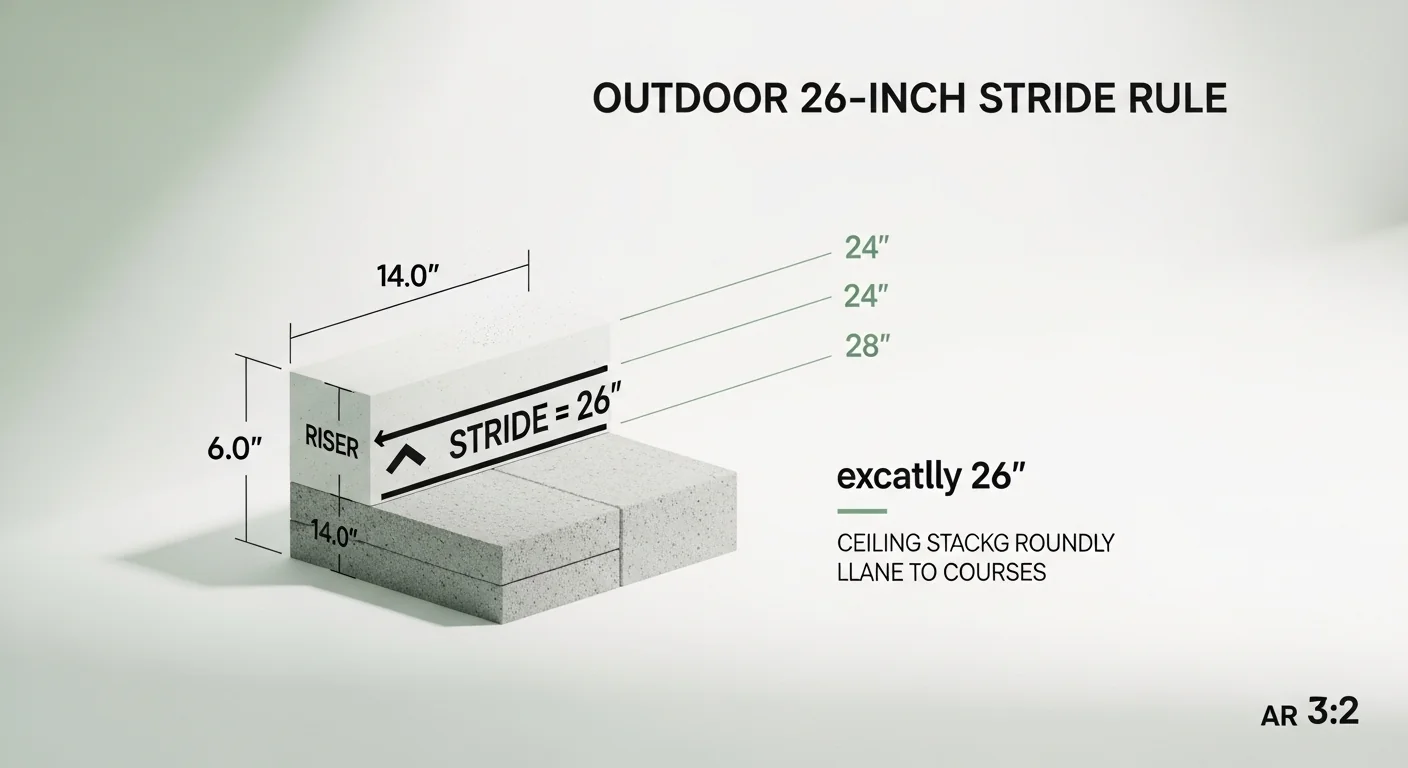
- Stride check: Stride = (2 x Actual Riser) + Actual Tread. The outdoor target is 26.00 inches. The safe band is 24.00 to 28.00 inches. The marginal band extends to 22.00 to 30.00 inches. Outside that range, the design is flagged as unsafe.
- Block courses: Courses = ceiling(Actual Riser / Block Thickness). Ceiling rounding means the result is always rounded up to the next whole integer. For a 6.0-inch riser and a 4-inch block, ceiling(6.0 / 4.0) = ceiling(1.5) = 2 courses.
All arithmetic uses decimal inch values throughout. No unit conversion is performed. Inputs in feet will produce incorrect results.
Assumptions and Limits
- All steps are assumed to be uniform in rise and run. Unequal steps (split-level or curved stringers) require manual calculation per step.
- The 6-inch target riser is a starting point for the step count calculation. The actual riser will differ once rounded steps are divided back into the total rise.
- Mortar joint thickness (typically 0.375 to 0.5 inches per joint) is not included in the block course stacking math. Wet-set installations require on-site verification.
- Tread nosing overhang (typically 1 inch) is not included in the tread depth output. If you are ordering slab material with a nosing, add 1 inch to the computed tread depth when specifying material width.
- The stride formula (2R+T = 26) is an outdoor biomechanics guideline, not a building code requirement enforceable by an inspector. Local landscape codes may specify separate minimum tread depths (11 inches is common). Check your jurisdiction.
- ADA accessibility requires a maximum 1:12 slope for ramps, not stairs. Any stair design producing a rise greater than roughly 4.8 inches per foot of run is not an ADA-compliant accessible path.
- The calculator does not account for frost heave, drainage slope behind risers, or geotextile base requirements. Structural base preparation depends on soil conditions and local frost depth.
- Block thickness must be the actual measured unit height, not the nominal product name. Nominal “6-inch block” typically measures 5.625 inches.
Standards, Safety Checks, and “Secret Sauce” Warnings
The single most important standard in outdoor stair design is not a building code section. It is a biomechanics formula derived from human stride length:
Outdoor Stride Rule: 2 x Riser + Tread = 26 inches
A score between 24 and 28 is acceptable. Below 24 or above 28 creates a gait mismatch. The stair feels wrong on the first step and fatiguing over repetitive use.
Critical Warnings
- Do not apply indoor riser heights outdoors. A 7-inch riser with a 10-inch tread scores 24 on the stride formula, which is marginal indoors and wrong outdoors. Outdoors, the same dimensions feel steep because walkers expect a longer, more relaxed step. This is the most common expensive mistake in residential hardscape.
- Tread depth below 12 inches is a trip hazard outdoors. Indoor code permits 10-inch treads because the enclosed environment, handrails, and visual cues calibrate the user’s gait. Outdoors, without those cues, a shallow tread causes foot overhang and mid-step stumbling, especially in footwear without rigid soles.
- Courses-of-block output is a ceiling value. If the calculator returns 2 courses of 4-inch block for a 6-inch riser, that means 8 inches of block for a 6-inch target. The extra 2 inches must be absorbed by cutting the top course, shimming the cap, or choosing a thinner cap unit. Stacking without adjustment produces a riser that is consistently taller than calculated, which skews every step above it.
- Total run is the full staircase footprint, not one tread. Entering a single tread depth (13 inches) when the run field expects the total footprint (91 inches for 7 steps) will produce a one-step calculation with a 13-inch stride score, triggering a danger flag for a geometry that does not actually exist. Always multiply your estimated tread by your anticipated step count and use that total for the run input.
Minimum Standards
- Outdoor riser height: 5.5 to 6.5 inches. Below 5.5 inches produces toe-stubbing geometry. Above 6.5 inches replicates indoor code on outdoor terrain.
- Outdoor tread depth: 12 to 14 inches (face of riser to face of riser). A 1-inch nosing overhang is in addition to this measurement, not included in it.
- Stride formula score: 24 to 28 inches is the acceptable outdoor band. A score of exactly 26 is the design target.
- Block courses: the ceiling count is a minimum material order. Always verify the stacked height on actual block units before fabricating all risers.
The Competitor Trap: Most stair calculators online ask for rise and run, then report the number of steps and a riser height. None of them flag whether that riser height is appropriate for outdoor use versus indoor code. A calculator that accepts a 7-inch riser on a patio entry without warning the user has done nothing useful. The check that matters is the stride formula, and it requires both the riser and tread values to evaluate. A riser in isolation tells you almost nothing about whether the staircase will feel natural or exhausting to walk.
For projects that pair stairways with structural retaining walls, the wall geometry must be solved before the stair geometry. A wall that is 2 inches taller or shorter than planned changes the total rise and invalidates the stair calculation entirely. The geogrid retaining wall calculator handles wall height and batter setback before you commit to a step count.
Common Mistakes and Fixes
Mistake: Using the Indoor 7-11 Rule for Outdoor Stairs
The IRC 7-inch riser and 10-inch tread combination is widely memorized by contractors and DIYers. Applied outdoors, it produces a 24-point stride score (2 x 7 + 10), which sits at the absolute floor of the marginal band and below the outdoor comfort threshold. Walkers on these stairs consistently describe the experience as “steep” even though the rise-to-run ratio looks standard on paper.
Fix: Use 6 inches as your target riser and calculate tread depth from your available run. If the run is too short to achieve a 12-inch tread, the site needs to be regraded or the stair layout needs to change.
Mistake: Measuring Rise from Subbase Rather Than Finish Grade
Taking the rise measurement from the excavated subbase or compacted gravel base produces a number that is 4 to 8 inches shorter than the actual finish rise. The calculator then underestimates the step count, producing a smaller number of taller steps than planned. When the base material and cap pavers are added, the actual stair is significantly steeper than calculated.
Fix: Always measure from finish surface to finish surface. If the base is not yet installed, add the base depth to your raw measurement before entering the value. Verifying your planned base depth with a paver base calculator before locking in stair geometry prevents this compounding error.
Mistake: Ignoring Block Thickness in Riser Stacking
A 6-inch riser target does not mean one 6-inch block. Many wall block products are 4 inches high, requiring two courses per riser (2 x 4 = 8 inches stacked). Builders who calculate step count and order block based on the riser target alone run short on material or produce risers that are 2 inches taller than spec after stacking.
Fix: Enter your actual block thickness into the calculator. The courses-per-riser output tells you exactly how many layers are needed and flags when the stacked height exceeds the riser target, so you can plan a cap adjustment before cutting material.
Mistake: Confusing Total Run with Tread Depth
The run field expects the full horizontal footprint of the entire staircase, not the depth of one step. Entering a single tread estimate (14 inches) when 7 steps are planned produces a one-step geometry with a 14-inch total run, which the calculator correctly flags as a stride score of 2(14)+14 = 42 inches, triggering a danger warning for an input that was never correctly entered. The confusing warning message sends many users to re-check their measurements when the real problem is understanding what the run field represents.
Fix: Multiply your estimated tread depth by the expected number of steps and enter that product as the total run. For 7 steps at 13 inches each, enter 91. Finishing the paver joints with polymeric sand is only relevant after you have the step count confirmed and the slabs set.
Mistake: Skipping the Stride Formula Check After Adjusting the Layout
A design that passes the stride formula on the first calculation may fail after a site constraint forces a change. Shortening the available run by 18 inches to avoid a utility line, for example, reduces every tread by 18 / step count inches. On a 6-step stair, that is 3 fewer inches per tread, dropping a 14-inch tread to 11 inches and the stride score from 26 to 23, which is below the safe threshold.
Fix: Re-run the calculator any time a constraint changes your total rise or run, even slightly. The stride formula check is the final gate, not an optional confirmation.
Next Steps in Your Workflow
Once the stair geometry confirms safe riser, tread, and stride values, the next decision is base preparation. Hardscape steps require a compacted aggregate base that extends at least 6 inches below the frost line in cold climates. The depth and volume of that base material depends on the stair footprint, which you now know precisely from this calculation. Running a gravel calculator against the stair footprint (steps x tread depth x stair width x base depth) gives you the aggregate volume before you order material.
After the base is confirmed and blocks are set, the final structural concern is the tread slab itself. If your project uses natural stone or concrete cap slabs over a block riser, the overhang dimension and joint width both affect the finished tread depth that pedestrians actually experience. A 1-inch nosing is standard; wider overhangs can cause slab rocking on uneven block tops. Before closing out the hardscape phase, verify the approach grade and drainage slope leading to the bottom step using a patio slope calculator so water does not pool at the base of the lowest riser after rain.
FAQ
What is the outdoor stair riser height standard?
For outdoor hardscape steps, the accepted riser range is 5.5 to 6.5 inches. The 6-inch midpoint is the common design target. This differs from the IRC residential code, which allows up to 7.75 inches indoors. Outdoor risers above 6.5 inches apply indoor geometry to an outdoor context, producing stairs that feel steep and tiring to walk repeatedly.
What does 2R+T = 26 mean in stair design?
It is the outdoor stride formula, where R is riser height in inches and T is tread depth in inches. The result (the stride score) should equal 26 inches for comfortable outdoor walking. A score between 24 and 28 is acceptable. The formula reflects the average horizontal distance covered per stride on a relaxed outdoor gait, adjusted for the vertical component of stepping up.
How do I calculate the number of steps for a patio stair?
Divide your total vertical rise (in inches) by the target riser height (6 inches for outdoor stairs), then round to the nearest whole number. That gives you the step count. Divide total rise by the step count again to get the exact actual riser height. Use that actual riser, not the 6-inch target, for all material calculations afterward.
How many courses of block do I need per riser?
Divide the actual riser height by your block thickness and round up to the next whole number. For a 6-inch riser with 4-inch block, that is ceiling(6 / 4) = 2 courses. Two courses of 4-inch block stack to 8 inches, meaning the top course needs to be cut or replaced with a 2-inch cap unit to hit the 6-inch riser target exactly.
Can I use the same stair formula for retaining wall steps?
Yes. The outdoor stride formula applies to any exterior masonry stair regardless of whether it is freestanding, built into a slope, or integrated into a retaining wall face. The only difference is that retaining wall steps typically use the same block product as the wall face, which constrains your block thickness input and may require more frequent course trimming than a dedicated step block would.
Is there a minimum tread depth for outdoor stairs?
Most local landscape and hardscape codes specify a minimum outdoor tread depth of 11 inches, measured from riser face to riser face (not including nosing overhang). The outdoor biomechanics standard is higher: 12 to 14 inches is the recommended range for a comfortable gait. Confirm the specific minimum with your local building department, particularly for permitted structures over 30 inches in height.
Conclusion
The gap between indoor stair code and outdoor stair comfort is 1 inch of riser height and 2 to 4 inches of tread depth. That gap, compounded across every step of a masonry staircase, is the difference between a patio entry people walk naturally and one that visitors unconsciously hesitate at. The outdoor 26-inch stride rule exists precisely because human gait changes when there are no walls, no handrails, and no visual depth cues. Getting the riser and tread geometry right before mortar is mixed is the only time that correction is free.
The single most expensive mistake in hardscape stair design is applying the indoor 7-11 rule to an outdoor project. It produces a stair that is technically measurable and structurally sound but biomechanically wrong. This calculator prevents that by flagging the stride score on every calculation, not just the riser height. If your project also involves edging the perimeter of the stair approach or defining a planting boundary along the stair run, a landscape edging calculator can help size the linear material before the border work begins.