
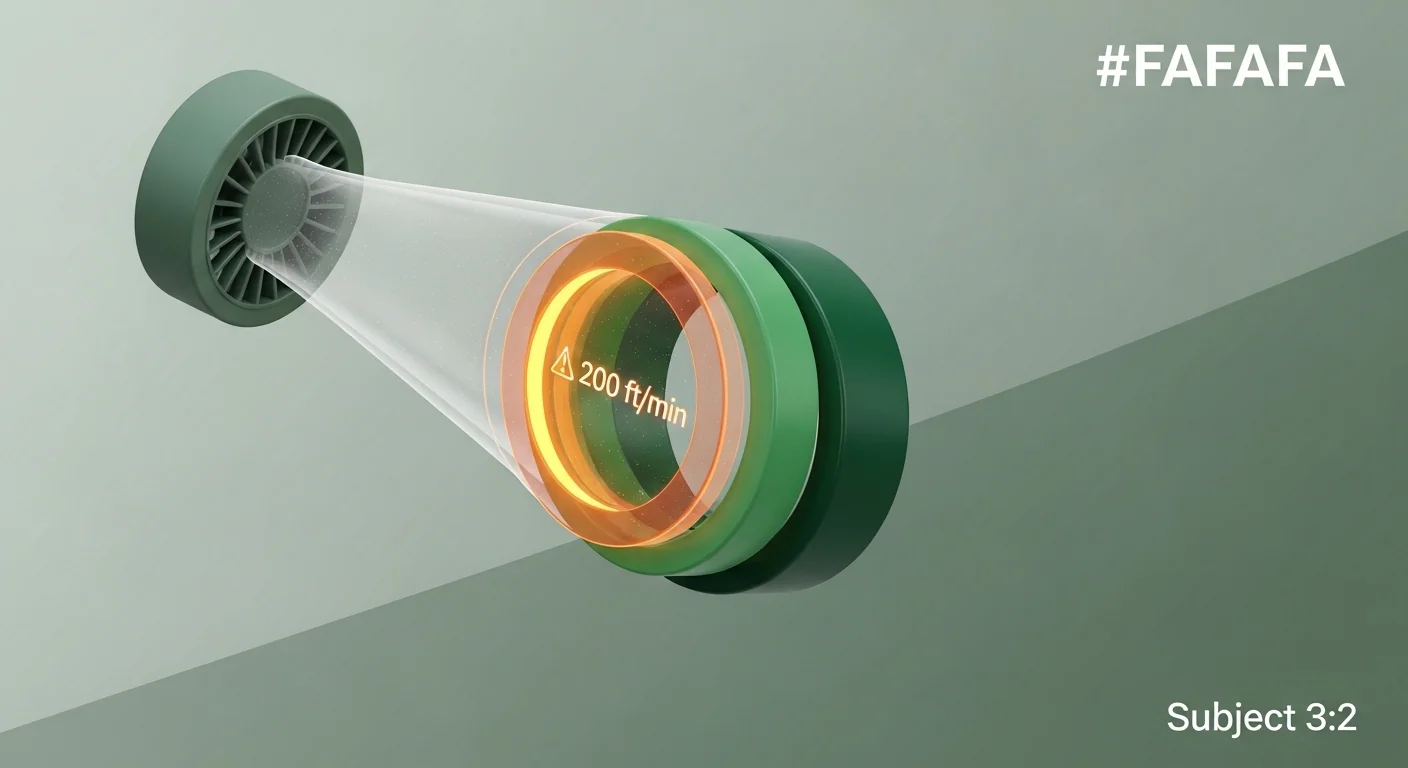
Internal air circulation fails in two opposite directions. Too little airflow and the grow room develops pockets of CO2-depleted, humidity-saturated air that stunt growth and invite disease. Too much direct airflow and the plant’s own defense mechanism kicks in: stomata clamp shut, gas exchange stops, and photosynthesis effectively pauses despite everything else being dialed. Most guides cover only the first failure. This tool is built to catch both.
The calculator on this page computes three values from your inputs: total internal CFM (cubic feet per minute), room air turnover rate in minutes, and an estimated canopy wind velocity in feet per minute. It uses an inverse-square-law model to estimate how concentrated the airflow is at the plant surface given the distance between fan and canopy. What it does not do is account for ducted systems with static pressure losses, rooms with complex obstructions, or the heat load requiring exhaust ventilation — those are separate calculations handled by dedicated tools.
After running your numbers, you will know whether your current fan setup risks triggering stomatal closure at the canopy, whether your room volume is turning over fast enough to prevent CO2 depletion zones, and how far to mount fans from the plant canopy to stay within safe velocity limits.
Use the Tool
| Room Size (ft) | Volume (ft³) | Min CFM (1-min turnover) | Ideal CFM (2-min) | Wind Risk |
|---|
How This Calculator Works
Volume (ft³) = L × W × H
Total CFM = Number of Fans × CFM per Fan
Turnover (min) = Volume ÷ Total CFM
Target: 1–3 minutes. >5 minutes = stagnant risk.
Velocity (ft/min) ≈ Fan CFM ÷ (π × Distance²)
Wind Burn Risk if Velocity > 200 ft/min
Assumptions & Limits
- Air velocity model uses inverse-square-law approximation; real airflow is affected by obstructions, ductwork, room shape, and fan oscillation arc.
- Fan CFM ratings are as-listed (not accounting for static pressure losses in ducted systems).
- This tool covers internal circulation only — it does not replace exhaust/intake CFM calculations for heat removal.
- The 200 ft/min stomatal closure threshold is based on published horticulture research and is widely cited for controlled-environment agriculture.
- Plants at different growth stages may exhibit sensitivity at lower velocities; seedlings and clones are more susceptible than mature plants.
- Oscillating fans reduce peak velocity exposure — results represent peak (non-oscillating) estimates for worst-case safety.
- Distance minimum: 0.5 ft. Distances under 1 ft are flagged as high-risk regardless of CFM.
Before entering values, have the following ready: a tape measure for room dimensions in feet (length, width, ceiling height), the CFM specification from your fan’s label or product page, a count of all fans used exclusively for internal air movement (not your exhaust or intake), and a measured or estimated distance from the fan outlet to the top of the canopy. Fan CFM ratings on packaging refer to free-air delivery at zero static pressure — if your fans are shrouded or ducted, treat the rating as an optimistic upper bound. For grow rooms that also require dedicated ventilation planning, the greenhouse fan calculator covers combined exhaust and circulation scenarios.
Quick Start (60 Seconds)
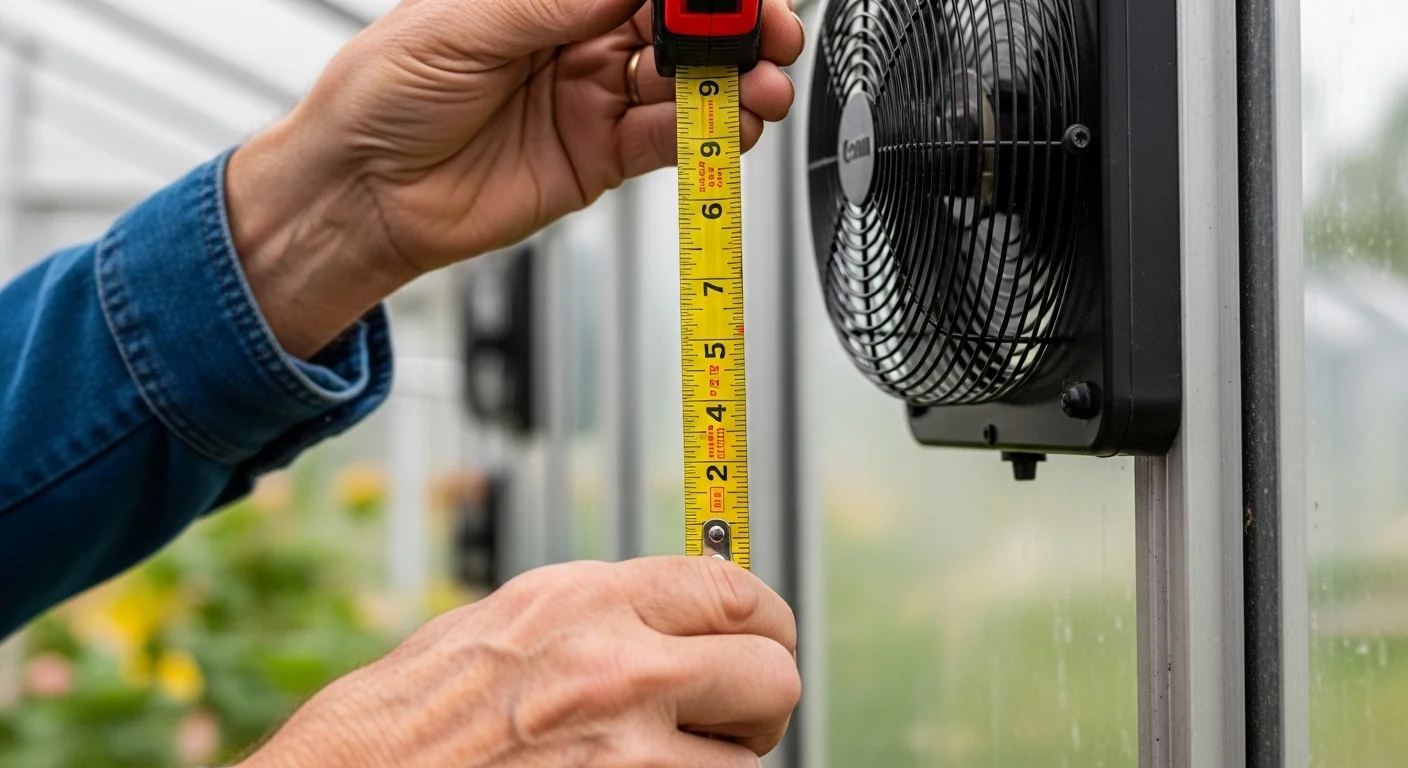
- Room Length and Width (ft): Measure interior wall-to-wall in feet. If you have a grow tent, use the listed dimensions — they are accurate enough. Do not convert to inches; the tool expects feet only.
- Ceiling Height (ft): Measure floor to ceiling at the tallest point. For sloped or greenhouse roofs, use the average height. Accepted range is 1 to 30 ft.
- Number of Oscillating Fans: Count only fans used for internal air movement — not your exhaust inline fan, not passive intake vents. An 8×8 room with one clip-on and one wall-mount has two fans.
- Fan CFM Rating (each): All fans in this field should be the same model, or use the average if they differ. The tool multiplies this number by fan count, so mixing very different CFM values will skew the result. Use the lowest-CFM fan’s rating for a conservative estimate.
- Distance from Fan to Canopy (ft): This is the single most impactful input for wind burn assessment. Measure from the face of the fan housing to the top of the plant canopy, not the mounting point on the wall or pole. Minimum accepted value is 0.5 ft.
- Units check: Everything is in feet and feet per minute. The tool does not accept metric inputs directly. Divide centimeters by 30.48 to convert to feet if needed.
- Click Calculate only when all fields are filled: The calculator will not run on partial inputs and will display an inline error for each missing or out-of-range value.
Inputs and Outputs (What Each Field Means)
| Field | Unit | What It Measures | Common Entry Mistake | Safe Entry Guidance |
|---|---|---|---|---|
| Room Length | ft | Interior length of the grow space | Using exterior wall measurement or tent model number instead of interior dimensions | Measure inside wall to inside wall; accepted 1 to 200 ft |
| Room Width | ft | Interior width of the grow space | Swapping length and width in non-square rooms (result is the same, but worth being consistent) | Same principle as length; accepted 1 to 200 ft |
| Ceiling Height | ft | Vertical interior space available for air volume | Using grow light hang height instead of actual ceiling; this significantly underestimates volume | Measure floor to ceiling; accepted 1 to 30 ft |
| Number of Oscillating Fans | count | Total fans contributing to internal circulation | Including exhaust fans or intake fans in the count, inflating the apparent CFM | Count only recirculation fans; accepted 1 to 50 |
| Fan CFM Rating (each) | ft³/min | Volumetric airflow delivered by each fan at open air | Using “max speed” ratings from marketing copy rather than spec-sheet values; some fans are rated at 30 to 50 ft/min overstatement | Use spec-sheet free-air CFM; accepted 1 to 5000 CFM |
| Distance: Fan to Canopy | ft | Physical separation from fan face to top of plant canopy | Measuring from the wall rather than from the fan housing outlet face | Measure from fan housing face; accepted 0.5 to 30 ft |
| Total CFM (output) | ft³/min | Combined volumetric airflow from all circulation fans | Assuming this number alone indicates adequate circulation without checking turnover rate | Use alongside turnover rate for a complete picture |
| Air Turnover Rate (output) | min/cycle | Time to replace the room air volume once at the given CFM | Confusing this with exhaust air changes per hour — these are different metrics | Target: 1 to 3 minutes; above 5 minutes indicates stagnation risk |
| Canopy Wind Velocity (output) | ft/min | Estimated air speed at the canopy surface based on fan CFM and distance | Ignoring this output because the room turnover looks healthy — turnover and canopy velocity are independent risks | Hard limit: 200 ft/min. Above this, stomatal closure is the likely outcome |
Worked Examples (Real Numbers)
Example 1: Small Tent, Two Clip-On Fans
- Room: 4 ft x 4 ft x 8 ft
- Number of fans: 2
- CFM per fan: 200 CFM
- Distance to canopy: 3 ft
Calculation: Volume = 4 x 4 x 8 = 128 ft³. Total CFM = 2 x 200 = 400 CFM. Turnover = 128 / 400 = 0.32 minutes. Canopy velocity = 200 / (3.14159 x 3²) = 200 / 28.27 = 7.1 ft/min.
Result: Turnover rate 0.32 min (well within ideal). Canopy velocity 7 ft/min (safely below the 200 ft/min threshold).
Two 200-CFM fans at 3 ft provide excellent air movement in a 4×4 without any wind burn risk. The room turns over in under 20 seconds, making CO2 depletion extremely unlikely at this scale.
Example 2: 10×10 Grow Room, Three High-CFM Fans
- Room: 10 ft x 10 ft x 8 ft
- Number of fans: 3
- CFM per fan: 600 CFM
- Distance to canopy: 2 ft
Calculation: Volume = 10 x 10 x 8 = 800 ft³. Total CFM = 3 x 600 = 1800 CFM. Turnover = 800 / 1800 = 0.44 minutes. Canopy velocity = 600 / (3.14159 x 2²) = 600 / 12.57 = 47.7 ft/min.
Result: Turnover rate 0.44 min (excellent). Canopy velocity 48 ft/min (safe).
Three 600-CFM fans at 2 ft keep a 10×10 room well-circulated and comfortably below the stomatal closure threshold. The 2-ft mounting distance provides enough dispersion to reduce peak velocity despite the relatively high CFM per fan.
Example 3: Wind Burn Scenario — High CFM Fan Too Close
- Room: 8 ft x 8 ft x 8 ft
- Number of fans: 2
- CFM per fan: 750 CFM
- Distance to canopy: 1 ft
Calculation: Volume = 8 x 8 x 8 = 512 ft³. Total CFM = 2 x 750 = 1500 CFM. Turnover = 512 / 1500 = 0.34 minutes. Canopy velocity = 750 / (3.14159 x 1²) = 750 / 3.14 = 238.7 ft/min.
Result: Turnover rate 0.34 min (excellent). Canopy velocity 239 ft/min — WIND BURN ALERT, exceeds the 200 ft/min stomatal closure threshold.
This is the classic false-positive scenario: room turnover looks outstanding, which might lead a grower to believe the setup is ideal. The problem is entirely in the 1-ft fan placement. Increasing distance to 2 ft drops velocity to 750 / (3.14 x 4) = 59.7 ft/min, fully resolving the risk without changing fans or CFM.
Reference Table (Fast Lookup)
| Room Size (ft) | Volume (ft³) | Min Total CFM for 3-min Turnover | Min Total CFM for 1-min Turnover | Max Safe CFM/Fan at 1 ft | Max Safe CFM/Fan at 2 ft | Max Safe CFM/Fan at 3 ft |
|---|---|---|---|---|---|---|
| 4 x 4 x 8 (tent) | 128 | 43 | 128 | 628 | 2,513 | 5,655 |
| 5 x 5 x 8 | 200 | 67 | 200 | 628 | 2,513 | 5,655 |
| 8 x 8 x 8 | 512 | 171 | 512 | 628 | 2,513 | 5,655 |
| 10 x 10 x 8 | 800 | 267 | 800 | 628 | 2,513 | 5,655 |
| 12 x 12 x 9 | 1,296 | 432 | 1,296 | 628 | 2,513 | 5,655 |
| 16 x 16 x 10 | 2,560 | 853 | 2,560 | 628 | 2,513 | 5,655 |
| 20 x 20 x 10 | 4,000 | 1,333 | 4,000 | 628 | 2,513 | 5,655 |
| 30 x 30 x 12 | 10,800 | 3,600 | 10,800 | 628 | 2,513 | 5,655 |
| 40 x 40 x 14 | 22,400 | 7,467 | 22,400 | 628 | 2,513 | 5,655 |
Note on the Max Safe CFM columns: These values are derived from the formula Max CFM = 200 ft/min x π x distance² and are independent of room size. A 750-CFM fan at 1 ft exceeds the safe limit regardless of whether it is in a 4×4 tent or a 40×40 commercial room. Distance, not room size, controls canopy velocity risk.
How the Calculation Works (Formula + Assumptions)
Show the calculation steps
Step 1: Room Volume
Volume (ft³) = Length x Width x Height
All dimensions in feet. Rounding: carry full decimal through intermediate steps; round final outputs to two decimal places for turnover, nearest whole number for velocity.
Step 2: Total Internal CFM
Total CFM = Number of Fans x CFM per Fan
This assumes all fans operate at rated free-air CFM simultaneously at the same speed setting. No derating for static pressure is applied by the tool.
Step 3: Air Turnover Rate
Turnover (minutes) = Volume (ft³) / Total CFM
Interpretation thresholds: 1 to 3 minutes is the controlled-environment horticulture standard for internal circulation. 3 to 5 minutes is considered sluggish for active canopies. Above 5 minutes, stagnant air pockets are likely in any room with significant leaf mass.
Step 4: Canopy Wind Velocity (Inverse-Square Model)
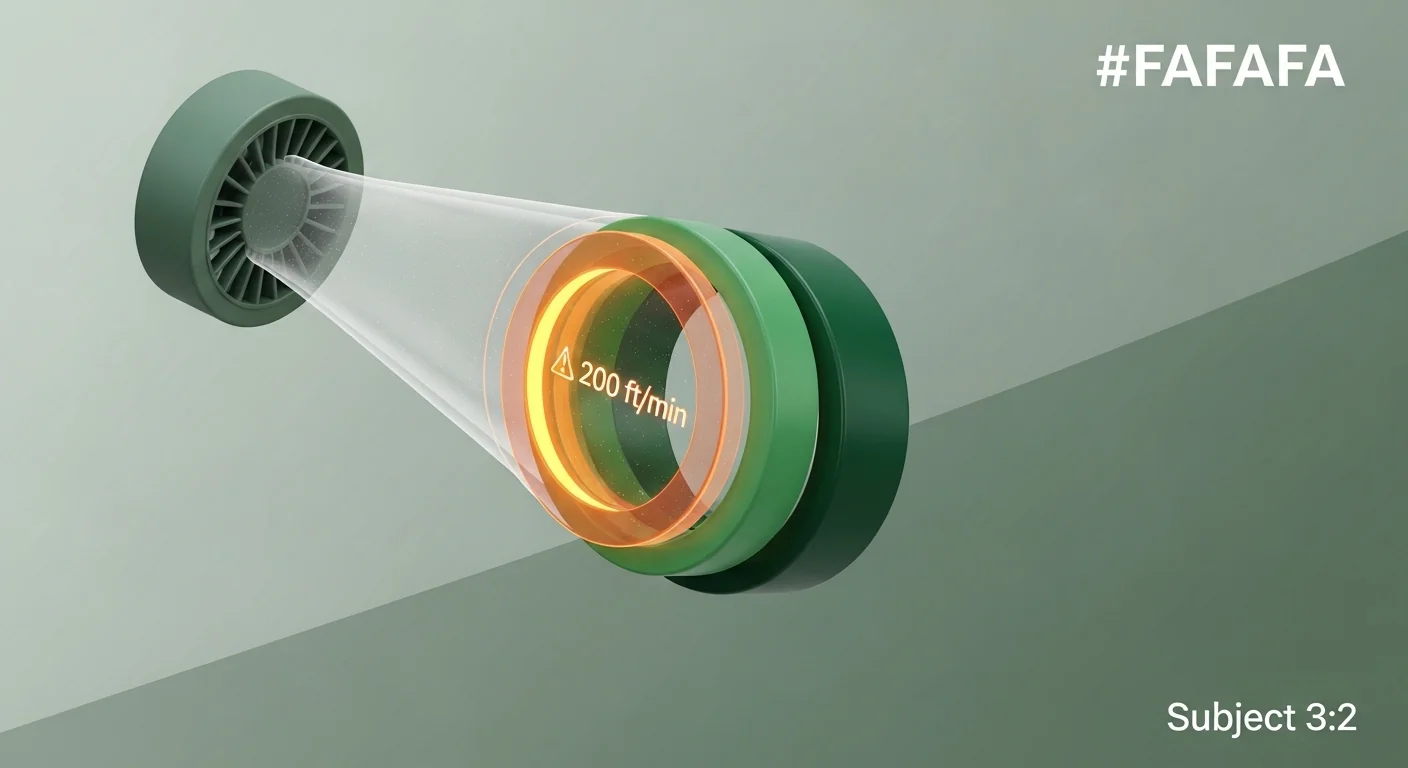
Velocity (ft/min) = CFM per Fan / (π x Distance²)
This models air expanding from the fan face as a cone, where the cross-sectional area at distance d equals π x d². The formula applies per-fan CFM (not total CFM) because each fan represents a concentrated stream. Velocity at the canopy is primarily a function of individual fan CFM and mounting distance, not the aggregate total across all fans.
Step 5: Wind Burn Threshold Check
If Velocity exceeds 200 ft/min, the tool triggers a wind burn alert. This threshold reflects the published point at which stomata initiate closure as a drought-stress response. Growth suppression, tip browning, and leaf clawing follow sustained exposure above this level.
Assumptions and Limits
- Fan CFM ratings used are free-air (zero static pressure) values. Shrouded, ducted, or obstructed fans will deliver less CFM than rated; results will overestimate available airflow in those cases.
- The inverse-square velocity model assumes an unobstructed cone of airflow from the fan face. Plant canopies, equipment, and walls deflect and dissipate airflow in ways the model cannot predict.
- Oscillating fans sweep the canopy rather than sustaining a fixed velocity point, which reduces peak exposure compared to stationary fans. The model uses the peak (non-oscillating) value as a conservative worst-case estimate.
- The 200 ft/min stomatal closure threshold is based on published horticulture and plant physiology literature. Seedlings and clones are typically more sensitive than vegetative and flowering plants; the threshold should be treated as an adult-plant upper limit.
- The tool covers internal circulation only. Exhaust CFM, intake CFM, heat load, and CO2 supplementation requirements are separate calculations with different formulas.
- Multiple fans in the same room create overlapping velocity fields. In tight spaces, two fans pointed at the same canopy section could produce additive velocity effects not captured by the per-fan model.
- Distances below 1 ft produce extreme velocity estimates that should be treated as categorical (high-risk) rather than precise numeric outputs.
Standards, Safety Checks, and “Secret Sauce” Warnings
Critical Warnings

- The stomatal clamp is invisible until damage is done. Plants experiencing wind velocities above 200 ft/min do not immediately show obvious symptoms. The first observable signs — clawing leaves, unusually stiff stems, leaf tip browning — appear after sustained exposure of 12 to 48 hours. By then, the growth interruption has already occurred. Growers who see “strengthened stems” and interpret the wind as beneficial are often looking at early-stage stress hardening, not an adaptation benefit. Use a digital anemometer at canopy level to verify before dismissing the concern. Understanding vapor pressure deficit alongside airflow gives a complete picture of how stomata are behaving under your conditions.
- Room turnover health does not rule out wind burn. A room turning over every 90 seconds can still inflict stomatal damage if a single high-CFM fan is mounted 12 inches from the canopy. These are independent failure modes. The calculator evaluates both simultaneously; a passing turnover score is not a clean bill of health if velocity is flagged.
- CO2 supplementation is ineffective in stagnant zones. Rooms with turnover rates above 5 minutes develop areas of CO2 depletion and elevated humidity near the canopy even when the exhaust system is properly sized. If you are running CO2 supplementation, consult the CO2 dosing calculator to confirm that adequate internal circulation is distributing the CO2 where the leaves actually are.
Minimum Standards
- Air turnover target: 1 to 3 minutes for actively growing crops. Dense canopies at peak flowering may benefit from the lower end of this range.
- Canopy wind velocity ceiling: 200 ft/min (approximately 2.3 mph). Below 120 ft/min is considered the optimal range for stomatal function and stem-strengthening benefit without drought-stress response.
- Fan placement: Wall-mount oscillating fans angled across (not directly into) the canopy provide more uniform distribution and lower peak velocities than floor fans pointed upward at close range.
- Minimum fan-to-canopy distance: At least 2 ft for fans rated under 500 CFM. For fans rated above 500 CFM, use the formula Min Distance = sqrt(CFM / (π x 200)) to find the closest safe mounting point before purchasing or installing.
Competitor Trap: Many grow room fan guides calculate only the exhaust CFM needed to swap air from the room and label the result “the CFM you need.” That number sizes your extraction fan, not your internal circulation. Internal circulation fans operate against no static pressure and serve a completely different purpose: keeping CO2 and humidity uniform at the canopy and providing the mechanical stimulus that strengthens stems. A room with a correctly sized exhaust fan and zero internal circulation fans will still produce heat pockets, CO2 dead zones, and weak stems. Treating exhaust CFM as a proxy for internal circulation is the single most common fan-sizing error in controlled-environment cultivation resources.
Common Mistakes and Fixes
Mistake: Using Exhaust Fan CFM as the Internal Circulation Benchmark
Exhaust fans are sized to remove heat and humidity from the room at a rate that prevents temperature and VPD from climbing above threshold. Internal circulation fans are sized to prevent air stratification and CO2 depletion at the canopy. These are different jobs with different formulas. A 4×4 tent with a 400-CFM exhaust fan and zero oscillating fans has adequate ventilation but no circulation. The grow tent fan sizing calculator can help clarify how internal and exhaust requirements are calculated separately.
Fix: Treat internal CFM and exhaust CFM as two separate calculations. Use this tool for circulation; use a ventilation-specific calculator for exhaust sizing. The grow tent fan size calculator addresses the exhaust side.
Mistake: Mounting Fans Based on Visual Preference Rather Than Calculated Distance
The most consistent wind burn pattern comes from fans mounted at shelf or table height and aimed directly at mid-canopy because that position looks tidy and keeps wires accessible. Unfortunately, at 1 to 1.5 ft distance, even moderate-CFM fans frequently cross the 200 ft/min velocity threshold. The plants suffer while the grower investigates nutrients, root zone temperature, and light intensity as possible causes.
Fix: Calculate the minimum safe distance using Min Distance = sqrt(Fan CFM / (π x 200)) before mounting, then add at least 0.5 ft margin. Use zip ties or adjustable hangers to position fans at the computed distance.
Mistake: Relying on Fan Oscillation to Solve a Velocity Problem
Oscillation reduces the duration of peak velocity exposure at any single canopy point, but it does not reduce the peak velocity itself. A fan producing 300 ft/min at the canopy still briefly reaches 300 ft/min on each oscillation pass. At high oscillation speeds or with plants densely packed around the fan, the exposure time can still be sufficient to trigger partial stomatal clamping.
Fix: Increase fan-to-canopy distance or reduce fan speed rather than relying on oscillation as the primary safety mechanism. Use oscillation as a distribution strategy, not a velocity mitigation strategy.
Mistake: Not Accounting for Canopy Growth During a Grow Cycle
Fan distance is usually set at transplant when plants are small. As the canopy rises toward the fans during the vegetative and early flowering stages, the distance shrinks without any adjustment to the fan mount. A fan that was safe at 4 ft distance in week 2 may be at 1.5 ft distance by week 7, producing dramatically higher canopy velocity.
Fix: Remeasure fan-to-canopy distance and rerun the calculator at each training or trellising adjustment. For fast-growing cultivars, a weekly check during stretch is reasonable. High-humidity conditions from a too-close stagnant canopy can also increase mold risk; check your dehumidifier sizing with the grow room dehumidifier calculator if humidity spiked alongside canopy growth.
Mistake: Ignoring the Per-Fan Velocity When Adding More Fans for Higher Total CFM
A grower with a sluggish turnover rate may add two more 800-CFM floor fans pointed directly at the canopy from 2 ft away. The total CFM improves; the turnover rate drops into the ideal range. The canopy velocity estimate goes from safe to dangerous. Total CFM and canopy velocity must both be evaluated together.
Fix: When adding fans for more circulation capacity, prioritize higher CFM-rated wall-mount or oscillating fans positioned farther from the canopy, rather than adding more floor fans at close range. More, lower-CFM fans at greater distances often provide better coverage without the velocity penalty.
Next Steps in Your Workflow
Once internal circulation is confirmed to be within the safe range for both turnover rate and canopy velocity, the next logical check is thermal load. A well-circulated room that still has heat buildup from lights will see VPD climb and nutrient uptake slow despite adequate airflow. For rooms with high-intensity lighting, running the grow room AC sizing calculator after confirming your circulation numbers ensures that the fan setup you just validated is not fighting a losing battle against radiant heat.
On the filtration side, any room running adequate internal circulation should also have correctly sized carbon filtration to manage odor and particulate loads that get thoroughly distributed by the same fans keeping the canopy healthy. Undersized carbon filters in well-circulated rooms fail faster and perform worse than in stagnant rooms because circulation exposes more of the filter face to air. The grow room carbon filter sizing guide walks through the relationship between circulation CFM and filter media requirements.
FAQ
What is the ideal CFM for internal circulation in a grow room?
There is no single CFM figure because the target is a rate — not a volume. Aim for a room air turnover of 1 to 3 minutes. Divide your room volume in cubic feet by your total fan CFM to get the turnover time. A 1,000 ft³ room needs at least 333 CFM of internal circulation to hit 3-minute turnover, and 1,000 CFM to hit 1-minute turnover.
Can too much airflow actually hurt plant growth?
Yes. When air velocity at the leaf surface exceeds 200 ft/min, stomata close as a drought-response mechanism. With stomata shut, CO2 uptake stops and transpiration falls, effectively pausing photosynthesis. The plant appears to halt growth without obvious mechanical damage. This is sometimes misattributed to nutrient deficiencies or root zone issues.
How does canopy wind velocity differ from the room turnover rate?
Room turnover rate is a whole-room average describing how quickly all the air in the space cycles. Canopy wind velocity is a localized measurement at the plant surface from a single fan’s output. A room can have excellent 1-minute turnover while simultaneously exposing one section of canopy to 300 ft/min from a poorly positioned fan. Both metrics require evaluation independently.
Does oscillation eliminate wind burn risk?
It reduces exposure time but does not reduce peak velocity. Each oscillation cycle still delivers the same air speed at the canopy during the pass. Dense planting configurations with fans at close range can still trigger stomatal response despite oscillation. The safe approach is to position fans at a calculated distance where peak velocity is under 200 ft/min, then use oscillation for even distribution.
Is the internal circulation CFM the same as the exhaust fan CFM I need?
No. They serve completely different functions and are sized with different formulas. Exhaust CFM is calculated based on heat load, humidity removal, and air changes per hour required to maintain temperature and VPD targets. Internal circulation CFM is calculated based on room volume and target turnover rate. A room needs both, and the numbers are often quite different.
What type of fan is best for internal grow room circulation?
Oscillating wall-mount fans and adjustable clip-on fans with speed controls are the most practical choices because they allow distance and angle adjustment. The key selection criteria are: actual CFM output (from spec sheet, not marketing copy), oscillation arc width, and the ability to mount at least 2 ft from the canopy. Industrial floor fans pointed directly at plants at close range are the most common source of wind burn in grow rooms.
Conclusion
Sizing grow room oscillating fans requires evaluating two completely separate risk surfaces: whether the room volume is circulating fast enough to prevent CO2 depletion and humidity stratification, and whether any individual fan is concentrating airflow to the point where stomata physically close. Most resources address the first question and ignore the second entirely. This tool calculates both from the same four inputs, with the canopy velocity model derived from the same inverse-square physics that governs real airflow dispersion.
The single most avoidable mistake in grow room fan sizing is placing a high-CFM fan close to the canopy and reading the resulting “strengthened” stems as a positive sign. The clawing, browning, and growth stall that follow are the plant’s emergency drought response, not adaptation. Run the numbers before mounting, recalculate when canopy height changes, and verify with a digital anemometer at canopy level if the results suggest borderline velocity. For growers also managing light intensity, the DLI calculator pairs directly with circulation planning, since both light and CO2 delivery depend on stomata being open and functional.