
Draft force is not a fixed property of an implement. It is a product of the implement, the soil beneath it, the depth you are pulling, and the speed you are moving. A chisel plow that works fine on sandy loam at 5 mph can demand three times the force when it hits a patch of saturated clay. Most operators discover this mid-field, not before they start. The only way to know your actual load before committing to a configuration is to run the numbers first.
This drawbar horsepower calculator takes your implement type, soil class, working width, depth, tractor weight, and field speed, then returns the draft force your tractor must overcome, the maximum pull your tires can physically generate, and the drawbar horsepower that combination demands. It does not predict fuel consumption, account for slope, or estimate productivity per hour. Its sole purpose is matching implement draft to traction capacity before a wheel-slip failure destroys a field pass or stalls you to the axles.
After entering your configuration, you will know whether your current tractor weight is sufficient for the combination or whether you need to adjust depth, narrow the working width, or add ballast before you take the first pass.
Use the Tool
| Soil Type | Draft Force (lbs) | Max Pull Avail. (lbs) | Drawbar HP | Wheel Slip Risk |
|---|
How This Drawbar Horsepower Calculator Works
This tool calculates the draft force your tractor must overcome, the maximum pull your tires can physically generate, and the resulting drawbar horsepower demand.
Step 1: Draft Force
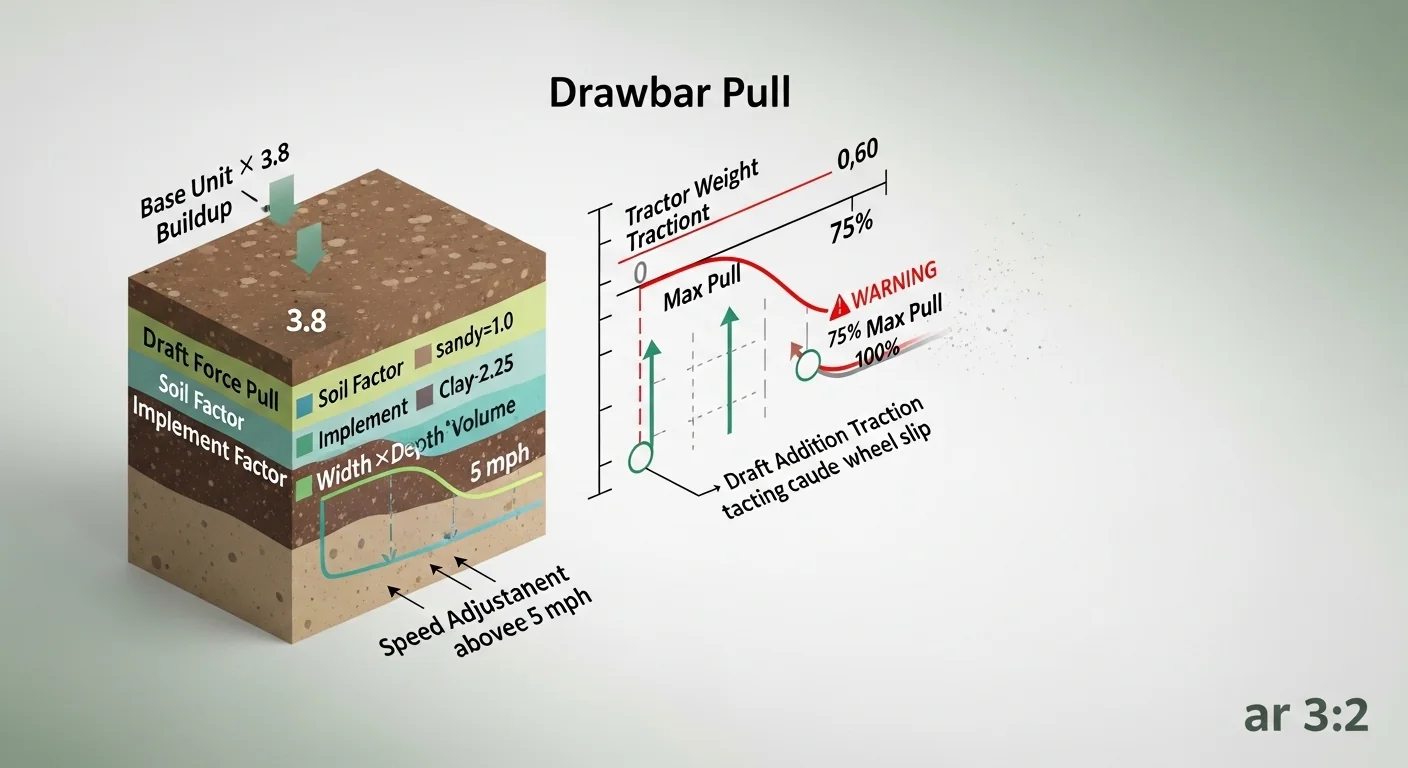
The soil factor multiplies draft resistance: Sandy Loam = 1.0×, Silt Loam = 1.5×, Clay Loam = 2.2×, Wet Heavy Clay = 3.1×. The implement factor reflects tool geometry (e.g. moldboard plow = high resistance, field cultivator = lower). Speed increases draft logarithmically above 5 mph.
Step 2: Maximum Pull Force (Traction Limit)
A traction coefficient of 0.60 represents a typical R-1 agricultural tire on firm soil. This is the physical maximum force the tires can exert before spinning. Adding ballast (wheel weights) increases MaxPull directly.
Step 3: Drawbar Horsepower
This is the standard ASABE formula. 375 is the constant converting ft-lbs/min to horsepower (1 HP = 33,000 ft-lbs/min; at 1 mph = 88 ft/min, so 33000÷88 ≈ 375).
Step 4: Wheel Slip Check
If draft exceeds traction limit, forward motion mathematically ceases — this is the “Concrete Clay Anchor” failure mode. The deficit is shown in pounds of additional ballast required.
Assumptions & Limits
Soil Classification: Sandy Loam corresponds to ASABE S313.3 Light soil class (force factor ~0.65–0.90 lbs/in²). Wet Heavy Clay exceeds Heavy class and reflects saturated field conditions with adhesion — draft can be 3× or more above sandy loam baselines.
Traction Coefficient: 0.60 is the ASAE standard for R-1 agricultural tires on firm, prepared soil. Wet soil or worn tires reduce this to 0.45–0.50. 4WD tractors gain approximately 10–15% additional pull due to powered front axle.
Speed Effects: Draft increases approximately 1–3% per 1 mph above 5 mph for tillage implements (ASABE). At low speeds (<3 mph), inertia forces are negligible and draft is dominated by static soil resistance.
Wheel Weight Deficit Calculation: Required additional ballast = (DraftForce − MaxPull) ÷ 0.60. This assumes ballast is placed on drive axle. Front weights add less traction per pound due to axle geometry.
Drawbar Pin Shear: A Grade 5 drawbar pin (1-inch diameter) has a shear strength of approximately 15,000 lbs. Grade 8 pins can exceed 22,000 lbs. If your draft force approaches these values, inspect and upgrade hardware.
Limits: This tool does not account for side draft, implement draft on curved rows, or hillside operations (slope adds ~1.5% draft per 1° slope). Implements wider than 60 feet may require articulated carriers — consult manufacturer specs. Results are estimates for planning; field conditions vary.
Before you start, have the following ready: the implement working width in inches (not feet), intended tillage depth in inches, your tractor's total operating weight in pounds including any ballast already installed, and your planned field speed in miles per hour. If you do not know your exact operating weight, check the manufacturer's shipping weight and add the weight of any attached front weights, fluid ballast, or rear weights already on the machine. If you are unsure of the correct ballast setup for your tires and load, the tractor tire ballast calculator can help you determine the right ballast before returning to this tool.
Quick Start (60 Seconds)
- Implement Type: Choose the implement closest to what you are running. Deep ripper and subsoiler entries share geometry but differ in shank count. Select by tool family, not brand name.
- Soil Type: Choose based on the heaviest soil class you will encounter in that field pass, not an average. One wet clay pocket can trigger a wheel-slip event even if most of the field is loam.
- Implement Width (inches): Enter the total working width, not the frame width. A 10-foot disc harrow is 120 inches. Gang width, not transport width.
- Operating Depth (inches): This is your target tillage depth, not the maximum possible depth. Every additional inch of depth increases draft force substantially. Start conservative; reduce depth if results show a warning.
- Tractor Weight (lbs): Total weight including ballast. An 8,000-lb tractor with 800 lbs of wheel weights and 400 lbs of front weights is 9,200 lbs. Use the real number.
- Operating Speed (mph): Use the gear and throttle setting you actually intend to run, not your transport speed. At speeds above 5 mph, draft force increases. Entering your maximum transport speed will produce an overstated result.
- All six fields must be filled before the calculator will run. Partial entries do not produce partial results.
Inputs and Outputs (What Each Field Means)
| Field | Unit | What It Means | Common Mistake | Safe Entry Guidance |
|---|---|---|---|---|
| Implement Type | Select | Tool family determines the geometric draft factor applied to width and depth | Selecting "chisel" for a deep ripper understates draft by roughly 44% | Match tool family, not number of shanks |
| Soil Type | Select | Soil class drives the largest single multiplier in the draft formula | Using "average" soil when the field has wet clay patches | Select the worst soil class present in the field |
| Implement Width | Inches | Total soil contact width; draft scales linearly with width | Entering feet instead of inches (60 in, not 5 ft) | Measure gang-to-gang or blade-tip-to-blade-tip |
| Operating Depth | Inches | Tillage depth; draft increases with depth squared in many soil classes | Using maximum capable depth instead of planned working depth | Use target depth, not the implement's mechanical maximum |
| Tractor Weight | Pounds | Total operating weight; directly sets the traction ceiling via the 0.60 coefficient | Using rated engine HP as a proxy for pulling capacity | Add ballast, fluid fill, and front weight to the base shipping weight |
| Operating Speed | mph | Field travel speed; affects both draft force and drawbar horsepower demand | Using rated top speed instead of actual tillage gear speed | Use the gear you will actually run in the field; consult the tractor ground speed calculator if you are unsure of your actual field speed in a given gear |
| Draft Force | lbs (output) | Horizontal force the implement demands at the drawbar to maintain forward motion | Treating it as fixed regardless of soil change | Run the calculator for both your best and worst expected soil class |
| Max Traction Force | lbs (output) | Physical upper limit of what your tires can push against the ground before spinning | Ignoring that this number drops on wet or loose surface soil | Treat this as a firm ceiling, not a target |
| Drawbar HP | HP (output) | Power actually delivered to the hitch point; always lower than engine HP rating | Matching drawbar HP to engine HP; typical drawbar efficiency is 70 to 80% of engine HP | Compare result against your tractor's published drawbar HP, not engine HP |
| Traction Margin | lbs (output) | Remaining pull capacity after subtracting draft from traction limit; negative = wheel slip | Assuming any positive margin is comfortable; margins below 25% are high-risk | Target a margin of at least 25% of maximum pull for field variability tolerance |
Worked Examples (Real Numbers)
Example 1: Compact Utility Tractor, Disc Harrow, Sandy Loam
- Implement: Disc Harrow
- Soil: Sandy Loam
- Width: 84 inches (7-foot gang)
- Depth: 4 inches
- Tractor Weight: 5,000 lbs
- Speed: 5 mph
Result: Draft Force = 638 lbs | Max Pull = 3,000 lbs | Drawbar HP = 8.5 HP | Traction Margin = 2,362 lbs
This is a light application well within the traction envelope. The tractor is using roughly 21% of its maximum pull capacity, leaving substantial reserve for speed variation or occasional denser soil pockets. A compact utility tractor in this weight class can handle this implement and soil combination without ballast adjustment.
Example 2: Mid-Size Tractor, Chisel Plow, Clay Loam
- Implement: Chisel Plow
- Soil: Clay Loam
- Width: 120 inches (10-foot frame)
- Depth: 10 inches
- Tractor Weight: 12,000 lbs
- Speed: 4 mph
Result: Draft Force = 7,387 lbs | Max Pull = 7,200 lbs | Drawbar HP = 78.8 HP | Traction Margin = -187 lbs (wheel slip)
Draft force exceeds traction capacity by 187 lbs. The tractor will stall in this soil-implement combination. To resolve the deficit, approximately 312 lbs of additional rear ballast is required. Alternatively, reducing depth from 10 inches to 9 inches or narrowing the pass width by one shank removes the deficit without adding weight.
Example 3: Large Tractor, Moldboard Plow, Wet Heavy Clay
- Implement: Moldboard Plow
- Soil: Wet Heavy Clay
- Width: 60 inches (5-bottom plow, 12-inch bottoms)
- Depth: 8 inches
- Tractor Weight: 18,000 lbs
- Speed: 4 mph
Result: Draft Force = 5,837 lbs | Max Pull = 10,800 lbs | Drawbar HP = 62.3 HP | Traction Margin = 4,963 lbs
A 18,000-lb machine handles this combination with a strong traction margin. The drawbar HP demand is 62.3 HP, which should be compared against the published drawbar HP for your specific tractor model to confirm the engine can sustain this load at the target speed. Engine HP rating alone is not the check; drawbar-rated HP is.
Reference Table (Fast Lookup)
All rows assume 60-inch working width, 8-inch depth, and 4 mph field speed. The "Min Tractor Weight" column is a derived value: it is the tractor weight needed to avoid wheel slip at a traction coefficient of 0.60 (Draft Force divided by 0.60).
| Implement | Soil Type | Draft Force (lbs) | Drawbar HP @ 4 mph | Drawbar HP @ 6 mph | Min Tractor Weight (lbs) |
|---|---|---|---|---|---|
| Moldboard Plow | Sandy Loam | 1,824 | 19.5 | 29.2 | 3,040 |
| Moldboard Plow | Silt Loam | 2,827 | 30.2 | 45.2 | 4,712 |
| Moldboard Plow | Clay Loam | 4,104 | 43.8 | 65.7 | 6,840 |
| Moldboard Plow | Wet Heavy Clay | 5,837 | 62.3 | 93.4 | 9,728 |
| Chisel Plow | Sandy Loam | 1,313 | 14.0 | 21.0 | 2,188 |
| Chisel Plow | Clay Loam | 2,955 | 31.5 | 47.3 | 4,925 |
| Disc Harrow | Clay Loam | 2,052 | 21.9 | 32.8 | 3,420 |
| Deep Ripper | Sandy Loam | 2,371 | 25.3 | 37.9 | 3,952 |
| Deep Ripper | Wet Heavy Clay | 7,589 | 80.9 | 121.4 | 12,648 |
How the Calculation Works (Formula + Assumptions)
Show the calculation steps
Step 1: Draft Force
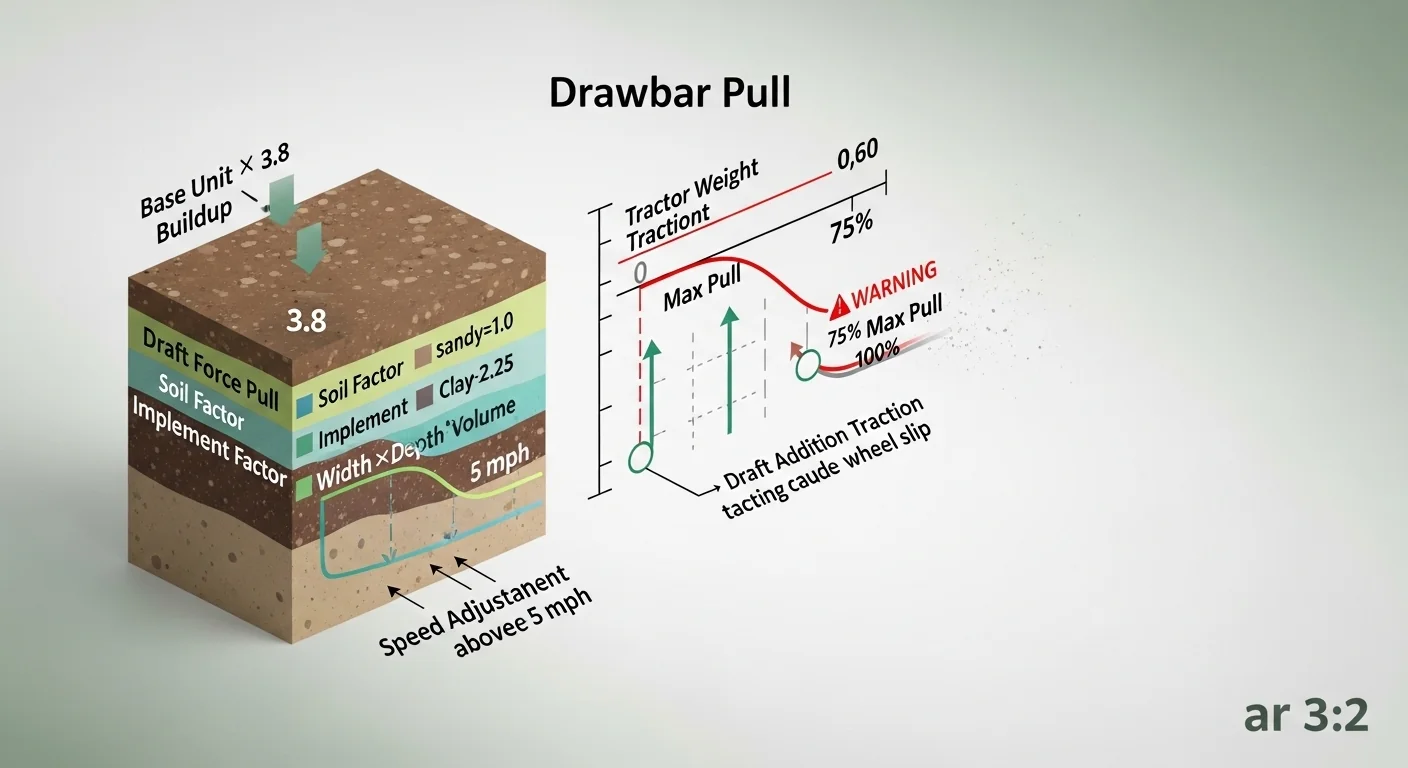
The formula applies a base unit factor of 3.8, multiplied by the soil class factor, the implement geometry factor, the working width in inches, the operating depth in inches, and a speed adjustment factor. At speeds up to 5 mph, the speed factor equals 1.0. Above 5 mph, it increases by 0.022 per additional mph (for example, 7 mph yields a factor of 1.044). This reflects the ASABE observation that inertial forces become relevant at higher field speeds for aggressive tillage implements.
Soil class factors applied: Sandy Loam = 1.00 | Silt Loam = 1.55 | Clay Loam = 2.25 | Wet Heavy Clay = 3.20. Implement geometry factors: Moldboard Plow = 1.00 | Chisel Plow = 0.72 | Disc Harrow = 0.50 | Deep Ripper = 1.30 | Field Cultivator = 0.38 | Row Crop Planter = 0.18.
Step 2: Maximum Traction Force
Max Pull equals tractor weight multiplied by 0.60. The 0.60 traction coefficient is the ASABE standard value for R-1 agricultural tires on firm, prepared soil. The result is the physical ceiling, not a target. Saturated or loose soil surface conditions reduce this coefficient to the range of 0.45 to 0.50 without changing tractor weight, meaning the real ceiling is lower in those conditions. This tool does not dynamically adjust the coefficient for wet surface soil; the user should apply conservatism manually by selecting wet clay as the soil type.
Step 3: Drawbar Horsepower
Drawbar HP equals draft force multiplied by speed in mph, divided by 375. The constant 375 derives from the unit conversion: one horsepower equals 33,000 foot-pounds per minute, and one mph equals 88 feet per minute, so 33,000 divided by 88 equals 375. No rounding is applied to intermediate values; the final drawbar HP result is rounded to one decimal place.
Step 4: Traction Margin and Wheel Slip Check
Traction Margin equals Max Pull minus Draft Force. A negative margin means forward motion cannot be maintained at that configuration. The deficit in pounds, divided by 0.60, gives the minimum additional ballast weight required on the drive axle to eliminate the deficit. The calculator displays the required ballast in the critical warning panel when this condition is triggered. The 75% threshold for the warning state equals 0.75 multiplied by Max Pull; the calculator uses this as the boundary between safe and high-risk zones on the gauge bar.
Assumptions and Limits
- The traction coefficient of 0.60 assumes firm, prepared soil surface and R-1 agricultural tires with adequate lug depth. Worn tires, wet surface conditions, or radial-ply tires on slick sod can reduce this to 0.45 or lower, cutting actual max pull by 25% relative to this tool's output.
- The implement factors are representative values for each implement family. Specific models from different manufacturers may vary by 10 to 20% depending on design geometry, shank angle, and coulter configuration.
- The speed adjustment factor of 0.022 per mph above 5 mph is a generalized approximation. Some implements show higher speed sensitivity (moldboard plow) and others show minimal speed effects (field cultivator). The factor applied here is conservative for planning purposes.
- The tool does not account for slope. On a 10-degree uphill grade, add approximately 17% to the draft force figure. On steep grades, gravitational rolling resistance becomes the dominant load, not tillage draft.
- Side draft from angled implements (offset disc, contour plowing) is not modeled. Side forces can induce steering corrections that create additional effective load on the drawbar.
- The ballast deficit calculation assumes all additional weight is placed on the driven rear axle. Front-mounted ballast contributes less traction per pound due to axle geometry and front-axle weight transfer dynamics.
- Implements with hydraulically adjustable depth may show different real-world draft than the nominal depth entered. If your implement has automatic depth control that hunts under load, the effective average depth may differ from the target setting.
- The drawbar pin shear check is not modeled numerically in this tool. If your draft force result exceeds 15,000 lbs, consult the pin manufacturer's rated shear strength for your pin diameter and grade before operating.
Standards, Safety Checks, and "Secret Sauce" Warnings
The most dangerous mismatch in drawbar pull planning is not one that happens slowly. It happens instantaneously. The "Concrete Clay Anchor" failure mode occurs when a tractor transitions from light loam to saturated clay mid-field. Draft force can triple in the span of a few feet. The traction ceiling does not change. The result is an immediate wheel-slip event that can bury drive tires to the axle within seconds if the operator does not respond. Because the tool uses soil class as a static input, the best practice is always to calculate for the worst soil class in the field, not the average.
High-draft implements on clay soils demand hardware that matches the load, not just a tractor that is nominally capable. If you are running subsoiler-class tools, the subsoiler HP requirements reference provides additional context on matching tractor class to shank count and depth for that specific implement family.
Critical Warnings
- If draft force exceeds max pull, the result is not "some slippage." It is a full wheel-lock event. Continued throttle input after this point accelerates tire burial and soil compaction. The correct response is to reduce depth or width, not to add throttle.
- Operating at 75% to 100% of traction capacity causes continuous wheel slip in the 10 to 20% range. This range is invisible from the seat but compacts soil below the seed zone and doubles tire wear relative to the 0 to 5% slip window where traction is most efficient.
- Grade 5 drawbar pins have a single-shear strength of approximately 15,000 lbs for a 1-inch diameter pin. A deep ripper in wet clay can approach or exceed this value at the configurations shown in the reference table above. Grade 8 pins in the same diameter carry approximately 40% more shear load. Inspect and replace annually regardless of apparent condition.
- Tractor weight as entered must include all ballast currently installed. Pulling with a tractor configured for light-duty loader work (without rear ballast) and then hooking a high-draft implement is one of the leading causes of front-axle lift and loss of steering.
Minimum Standards
- ASABE Standard S313.3 classifies draft force by soil texture class and provides tabulated unit draft values (force per unit cross-section area of soil cut). This tool's soil factors are calibrated to align with the Light, Medium, Heavy, and above-Heavy texture classes defined in that standard.
- The 0.60 traction coefficient used here corresponds to the ASABE standard value for pneumatic tires on firm agricultural soil. This is also consistent with published values from Goodyear and Firestone agricultural tire load-inflation guides for R-1 lug patterns.
- The formula Drawbar HP = (Draft x Speed) / 375 is the standard conversion derived from SAE J708 and ASABE EP496.3. It is the same formula used in Nebraska Tractor Test Laboratory drawbar performance reporting.
Competitor Trap: Many online drawbar calculators accept only engine horsepower as their single input and back-calculate a pull estimate by assuming a fixed drawbar efficiency ratio (usually 70 to 80%). This approach produces a number that looks like a result but contains none of the information that actually matters: soil class, implement type, or tractor weight. A 100-HP tractor in wet clay pulling a deep ripper at 8 inches is a very different situation than a 100-HP tractor in sandy loam with a disc harrow. Calculators that ignore these variables are answering a different, easier question than the one that determines whether your tractor will get stuck.
For implements that attach to the three-point hitch rather than a drawbar clevis, the hitch geometry changes the effective draft measurement point. The tractor 3-point lift capacity calculator covers the weight rating and load-distance relationships specific to category hitch classes, which is a separate constraint from drawbar pull capacity.
Common Mistakes and Fixes
Mistake: Sizing the Tractor to the Implement's Horsepower Requirement Tag, Not the Soil
Implement specification sheets often list a recommended HP range based on average loam conditions at standard depth. The same implement in clay loam at the same depth may require 50 to 100% more traction than the spec sheet implies. An operator who buys a tractor to match the tag number in loam will find the machine inadequate the first time they hit a heavier-textured field.
Fix: Run this calculator for the heaviest soil class present in your fields before purchasing or configuring your tractor-implement combination.
Mistake: Ignoring the Difference Between Engine HP and Drawbar HP
Engine horsepower is measured at the crankshaft. Drawbar horsepower is what remains after drivetrain losses, tire slip, and rolling resistance are subtracted. For most agricultural tractors, this represents a loss of 20 to 30% from the rated engine figure. An operator who compares calculator output to their tractor's 120-HP engine rating is comparing two different things.
Fix: Look up your tractor's published drawbar HP from the Nebraska Tractor Test or manufacturer's performance data. That is the number to compare against calculator output.
Mistake: Treating Flat Traction Margin as a Buffer Against Everything
A traction margin of 500 lbs sounds comfortable, but field conditions are not uniform. A wet low spot, a compaction layer at the headland, or a change in soil type can spike draft force by hundreds of pounds instantaneously. A margin that seems adequate in average conditions disappears the moment conditions deviate.
Fix: Target a traction margin of at least 25% of your maximum pull. Below that threshold, you are relying on the field to cooperate rather than on physics to protect you.
Mistake: Not Accounting for Implement Weight Added to Drawbar Load
Heavy implements with transport wheels down can add significant tongue weight to the drawbar, reducing front axle load and steering response before the tractor even enters the field. This is separate from draft force and does not appear in a standard pull calculation.
Fix: Weigh tongue load on a scale or consult the implement manual. Add front ballast to restore front axle loading to manufacturer specifications before operating. For implements like box blades and box scrapers where scraping geometry adds vertical load, the box blade draft force calculator accounts for the combined cutting and lift forces that standard drawbar formulas do not model.
Mistake: Running Maximum Depth on the First Pass into a New Field
Operators new to a field often set implement depth to the target depth immediately. In fields with buried rocks, root mats, or compaction layers at unexpected depths, this is how implements get bent and drawbar pins get sheared. The load spike from a buried obstacle in clay soil can momentarily double draft force.
Fix: Run the first pass at 60 to 70% of target depth. Check for obstructions, then incrementally increase to target depth on subsequent passes once the soil profile is confirmed clear.
Next Steps in Your Workflow
Once you have confirmed that draft force is within traction limits for your target configuration, the next physical check is the implement-to-tractor attachment point. Clevis hitch rating, drawbar height, and top link geometry all affect how draft force translates through the attachment. If your draft result is above 8,000 lbs, verify that your clevis and drawbar pin are rated for that load before going to the field. For implement sizing on cutting tools with significant blade-specific loading, the disc harrow weight per blade reference provides the per-blade force values that determine whether your gang frame is adequately built for the soil class you selected.
The second check is horsepower delivery. Knowing that your tractor has sufficient traction does not automatically mean the engine can sustain the required drawbar HP at field speed for the duration of the pass. If your drawbar HP result is within 10 HP of your tractor's published drawbar HP rating, you are operating at the edge of the engine's sustained output. At that level, hydraulic load from the implement's depth control system and any PTO-driven accessories will push total demand over the limit. For PTO-driven implements paired with tillage tools, the PTO shaft sizing calculator helps confirm that the shaft is rated for the combined load before committing to the configuration.
FAQ
What is drawbar horsepower and how is it different from engine horsepower?
Drawbar horsepower is the power available at the hitch point after drivetrain friction, tire rolling resistance, and wheel slip losses are subtracted from engine output. Engine HP is measured at the crankshaft on a dynamometer. For most agricultural tractors, drawbar HP is 70 to 80% of engine HP. Always compare drawbar HP calculator results to your tractor's published drawbar HP rating, not its engine rating.
What causes complete wheel slip during tillage?
Complete wheel slip occurs when the horizontal draft force required to pull the implement exceeds the maximum traction force the tires can generate. Traction force is limited by tractor weight multiplied by the tire-to-soil traction coefficient. When draft exceeds this product, the tires spin in place rather than pushing forward. Adding tractor weight through ballast is the primary mechanical remedy.
How does soil type affect draft force calculations?
Soil type is the highest-sensitivity variable in the draft formula. A transition from sandy loam to wet heavy clay multiplies draft force by roughly 3.2 times with no change to implement width, depth, or speed. This is why soil class selection matters more than minor changes to depth or speed when evaluating implement-tractor combinations. Always calculate for the heaviest soil class in the field, not the average.
Is the 0.60 traction coefficient accurate for all tractors?
The 0.60 value is the ASABE standard for pneumatic R-1 agricultural tires on firm, prepared soil. It is a planning coefficient, not a guaranteed field value. Actual traction coefficient depends on tire inflation pressure, lug depth, surface moisture, soil texture, and ballast distribution. Worn tires on wet soil can reduce this to 0.45 or lower. Two-wheel drive tractors with unballasted rear axles will typically perform below 0.60 in field conditions.
Can I use this calculator for tracked tractors?
This calculator applies the 0.60 wheel traction coefficient, which is specific to pneumatic tire-ground contact. Tracked tractors have significantly different ground contact mechanics and typically achieve traction coefficients in the range of 0.80 to 0.90 on firm soil due to their larger contact patch. The drawbar HP formula remains valid for tracked machines, but the traction ceiling calculation would be conservative (understated) by a meaningful margin.
What drawbar pin grade should I use for high-draft applications?
For applications where calculated draft force exceeds 10,000 lbs, Grade 8 drawbar pins are the minimum appropriate specification. Grade 8 alloy steel pins in a 1-inch diameter have a single-shear strength approximately 40 to 60% higher than Grade 5 pins of the same diameter. Inspect pins before each season for deformation, scoring, or elongation of the hole. Replace any pin that shows visible wear regardless of hours of service.
Conclusion
The core insight this drawbar horsepower calculator delivers is not a horsepower number. It is a traction margin: the gap between what your tires can push and what the implement demands. That margin determines whether you complete a field pass or spend an afternoon digging yourself out. The soil-to-soil variability in draft force is large enough that a configuration that works on one half of a field can fail completely on the other half. Calculating that margin before you commit to a configuration is not optional if you operate on fields with mixed soil texture classes.
The single most common mistake in drawbar planning is treating the implement's rated HP range as a complete specification. It is not. Horsepower availability does not guarantee traction. A tractor can have ample engine output and still be unable to move forward if the weight is insufficient for the soil condition. Run this calculator with your actual tractor weight, your actual soil class, and your actual target depth. The result will tell you whether you need to adjust depth, add ballast, or narrow the working width before the first pass.