
How this calculator works
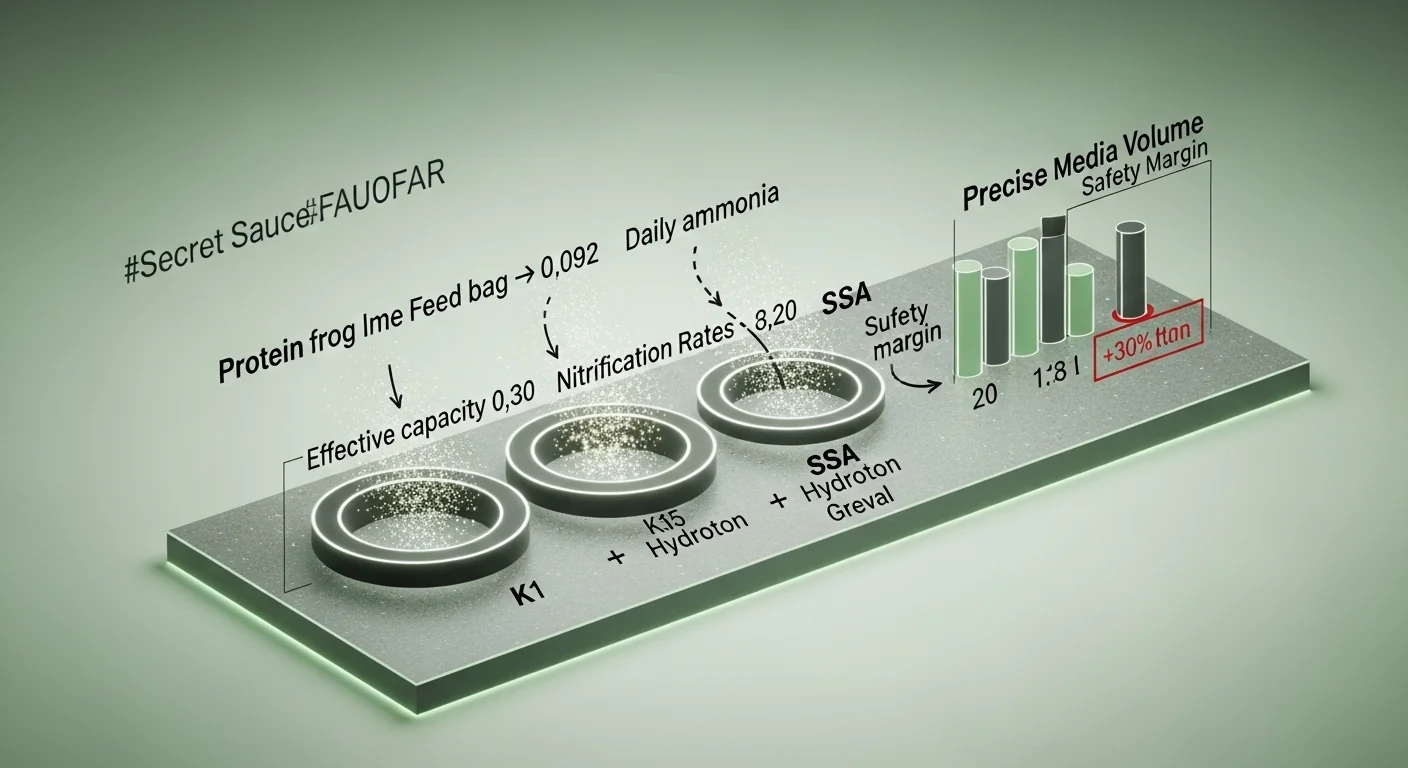
Step 1 — Estimate daily ammonia production:
Fish excrete approximately 9.2% of consumed protein nitrogen as ammonia-nitrogen. This is a well-validated constant from aquaculture research (Timmons & Ebeling, 2010).
Step 2 — Calculate required media volume:
The Nitrification Rate is the average ammonia conversion efficiency of Nitrosomonas bacteria per unit surface area, measured in g NH₃-N/m²/day:
- K1 Kaldnes (MBBR): 0.60 g/m²/day — tumbling media, highly oxygenated biofilm
- Hydroton (clay pebbles): 0.35 g/m²/day — static media, moderate biofilm
- Pea Gravel: 0.20 g/m²/day — dense packing, anaerobic pockets, poor contact
Safety threshold: Target NH₃ < 0.5 PPM. If your calculated volume is below the minimum safe zone, expect a toxic ammonia spike.
Assumptions: Water temperature 22–28°C; pH 7.0–7.5; dissolved oxygen >5 mg/L; system is fully cycled (>6 weeks old). Cold water or low pH will reduce nitrification efficiency by up to 40%.
Assumptions & Limits
What this calculator assumes:
- Water temperature: 22–28°C (optimal for Nitrosomonas). Below 15°C, reduce nitrification rates by 40–60%.
- System pH: 7.0–7.5. Below 6.5, ammonia conversion slows dramatically.
- Dissolved oxygen ≥ 5 mg/L in biofilter. K1/MBBR must be aerated to tumble properly.
- Biofilter is fully cycled (6+ weeks). New filters have minimal bacterial colonisation.
- Ammonia safety target: <0.5 PPM total ammonia-nitrogen (TAN).
- This tool calculates minimum media volume — real systems should add 25–50% safety margin.
- Does not account for solid waste (de-nitrification), plant uptake, or water change dilution.
Not suitable for: saltwater/marine systems, recirculating shrimp systems, or systems with aggressive stocking beyond 50 kg/m³.
| Media Type | SSA (m²/m³) | Nitrif. Rate | Vol. for Your Load | Rating |
|---|---|---|---|---|
| Calculate first to see comparison | ||||
| Step | Formula | Result |
|---|
- K1/K3 Moving Bed Bio Media — The gold standard for aquaponics biofilters. Maximum SSA, self-cleaning, long lifespan. Search “K1 MBBR media aquaponics” on Amazon.
- Commercial Air Pump (High Volume) — K1 media requires aeration to tumble and stay oxygenated. A quality air pump is non-negotiable. Look for >60 L/min for systems over 500g/day feed.
- API Freshwater Master Test Kit — Monitor NH₃, NO₂, NO₃, and pH weekly during cycling and monthly once established. Don’t guess — test.
- High-Protein Tilapia Feed (32–38% protein) — Matched protein content = accurate ammonia predictions. Cheap feed with fillers throws off your calculations.
Ammonia does not accumulate slowly and politely in an aquaponics system. It rises on a curve that is entirely predictable from one variable your fish feed bag already tells you: crude protein percentage. Every gram of protein your fish metabolize releases a fixed proportion of nitrogen as ammonia into the water column. The bacteria that convert that ammonia into plant-safe nitrate live on surfaces inside your biofilter, not in the water itself. That surface area determines whether your system thrives or crashes within days of full stocking.
This aquaponics biofilter calculator uses the validated ammonia-production constant from recirculating aquaculture science (0.092 g NH3-N per gram of dietary protein consumed) to estimate your minimum required media volume. It accounts for three media types with distinct specific surface areas and real-world nitrification rates derived from published MBBR and aquaculture research. What it does not do: model dissolved oxygen depletion, predict solid waste accumulation, calculate nitrate drawdown by plants, or account for a biofilter that has not yet completed its nitrogen cycle.
After running your numbers, you will know whether your planned biofilter media type and volume can realistically process your fish load without triggering a toxic ammonia event, and which upgrade path cuts required volume the most.
Use the Tool
Before entering values, locate your fish feed bag and note the crude protein percentage from the guaranteed analysis panel. Have your daily total feed amount ready in grams, and decide which biofilter media you plan to use or already have. The specific surface area field auto-fills when you choose a media type, but you can override it with a manufacturer specification if your media differs from the defaults. If you are still planning your grow bed layout, the pot size calculator can help you cross-reference container volumes before committing to a filter vessel size.
Quick Start (60 Seconds)
- Total Daily Fish Feed: Enter the combined grams fed to all fish per day, not per meal. If you feed twice daily, add both amounts. Do not estimate by the handful.
- Feed Protein Content: This is the crude protein percentage on your feed label. Values between 25% and 45% are typical for most freshwater fish. Higher protein means more ammonia per gram fed.
- Biofilter Media Type: Select your actual media, not your ideal media. If you are using pea gravel to save money, select Pea Gravel and let the result speak for itself.
- Specific Surface Area (SSA): This field pre-fills based on your media selection. If your K1 manufacturer lists a different SSA, replace the default with their spec. SSA is in m²/m³.
- Click Calculate: All four fields must be filled before the calculation runs. Empty or out-of-range values produce inline error messages, not silent wrong answers.
- Read the status badge first: The colour-coded badge above the gauge tells you immediately whether your configuration is in the safe zone, borderline, or at toxic ammonia spike risk.
- Use the recommended volume, not the minimum: The calculator outputs a minimum. The +30% safety margin figure is the number to actually build toward.
Inputs and Outputs (What Each Field Means)
| Field | Unit | What It Represents | Common Entry Mistake | Safe Entry Guidance |
|---|---|---|---|---|
| Total Daily Fish Feed | grams / day | Combined dry feed mass consumed by all fish in the system over 24 hours | Entering feed per fish or per meal instead of the total daily system amount | Weigh feed on a kitchen scale for at least 3 days and use the average |
| Feed Protein Content | % (crude protein) | Percentage of the feed that is protein, as listed on the guaranteed analysis | Using a generic “Tilapia feed” assumption instead of reading the actual label | Read the crude protein figure from your specific feed bag; values vary by brand and formulation |
| Biofilter Media Type | category | The physical substrate where Nitrosomonas bacteria colonize and convert ammonia | Choosing K1 when the system actually uses gravel, leading to a dangerously optimistic result | Select the media you are actually using or purchasing; do not select aspirational media |
| Specific Surface Area (SSA) | m²/m³ | Total bacterial colonization surface per cubic metre of media; the single biggest driver of required volume | Leaving the auto-filled default when the actual media has a different manufacturer SSA rating | Check the manufacturer datasheet; K1 variants range from 400 to 900 m²/m³ depending on size |
| Daily Ammonia Load (output) | g NH3-N / day | Predicted ammonia-nitrogen excreted by fish, derived from protein catabolism | Assuming this number is the same as the feed amount | A higher number here means your biofilter must work harder; it scales with protein, not total feed mass alone |
| Required Media Volume (output) | litres | Minimum media volume needed to biologically convert the calculated ammonia load | Treating this as the target build volume rather than the absolute floor | Always build to the recommended volume (+30% safety margin) shown below the primary result |
| Nitrification Rate Used (output) | g NH3-N / m² / day | The per-unit-surface ammonia conversion rate assumed for the chosen media type | Assuming all biofilter media perform at the same rate regardless of type | This value reflects conservative real-world rates, not peak laboratory conditions |
| Recommended Volume +30% (output) | litres | Minimum volume plus a 30% buffer to absorb temperature drops, overfeeding events, and partial system cycling | Ignoring this figure because the minimum volume “should be enough” | Design your physical filter vessel to hold at least this volume of media at operating fill levels |
Worked Examples (Real Numbers)
Scenario 1: Small Home Tilapia System with K1 Media
- Total Daily Fish Feed: 100 g/day
- Feed Protein Content: 32%
- Biofilter Media Type: K1 Kaldnes (MBBR)
- Specific Surface Area: 500 m²/m³
Result: Ammonia load = 100 x (32 / 100) x 0.092 = 2.944 g NH3-N/day. Required volume = 2.944 / (0.60 x 500) = 0.00981 m³ = 9.8 litres. Recommended volume (+30%): 12.8 litres.
A correctly aerated K1 moving bed filter of roughly 13 litres handles this system comfortably. The low volume requirement is a direct consequence of K1’s high SSA and superior nitrification rate.
Scenario 2: The Gravel Trap (Medium System)
- Total Daily Fish Feed: 300 g/day
- Feed Protein Content: 36%
- Biofilter Media Type: Pea Gravel
- Specific Surface Area: 300 m²/m³
Result: Ammonia load = 300 x (36 / 100) x 0.092 = 9.936 g NH3-N/day. Required volume = 9.936 / (0.20 x 300) = 0.1656 m³ = 165.6 litres. Recommended volume (+30%): 215.3 litres.
A 165-litre gravel bed is a large structure. Most home systems are not built at that volume for this feed rate, which is precisely how gravel-based aquaponics setups experience catastrophic ammonia spikes despite appearing physically large.
Scenario 3: Larger System, K1 Upgrade Comparison
- Total Daily Fish Feed: 800 g/day
- Feed Protein Content: 38%
- Biofilter Media Type: K1 Kaldnes (MBBR)
- Specific Surface Area: 500 m²/m³
Result: Ammonia load = 800 x (38 / 100) x 0.092 = 27.968 g NH3-N/day. Required volume = 27.968 / (0.60 x 500) = 0.09323 m³ = 93.2 litres. Recommended volume (+30%): 121.2 litres.
At this feed rate, the same load would require 466 litres of pea gravel to achieve equivalent nitrification. K1 media reduces required filter volume by roughly five times at this scale, with a smaller physical footprint and no risk of anaerobic dead zones forming inside compacted media.
Reference Table (Fast Lookup)
All values below are computed from the formula: Ammonia (g/day) = Feed (g) x (Protein% / 100) x 0.092; Volume (L) = Ammonia / (Rate x SSA) x 1000. SSA defaults used: K1 = 500 m²/m³, Hydroton = 450 m²/m³, Gravel = 300 m²/m³.
| Feed (g/day) | Protein % | Ammonia Load (g/day) | K1 Min Volume (L) | Hydroton Min Volume (L) | Pea Gravel Min Volume (L) |
|---|---|---|---|---|---|
| 50 | 32 | 1.47 | 4.9 | 9.4 | 24.5 |
| 100 | 32 | 2.94 | 9.8 | 18.9 | 49.1 |
| 150 | 32 | 4.42 | 14.7 | 28.3 | 73.6 |
| 200 | 36 | 6.62 | 22.1 | 42.5 | 110.4 |
| 300 | 36 | 9.94 | 33.1 | 63.7 | 165.6 |
| 500 | 38 | 17.48 | 58.3 | 112.2 | 291.3 |
| 800 | 38 | 27.97 | 93.2 | 179.5 | 466.2 |
| 1000 | 40 | 36.80 | 122.7 | 236.0 | 613.3 |
| 1500 | 40 | 55.20 | 184.0 | 354.0 | 920.0 |
The gravel column is the clearest illustration of why media type is not a minor variable. At 1,000 g/day feed, pea gravel demands more than 600 litres of biofilter media to safely process ammonia. Achieving that volume in a home or small commercial setting is structurally impractical for most setups.
How the Calculation Works (Formula + Assumptions)
Show the calculation steps
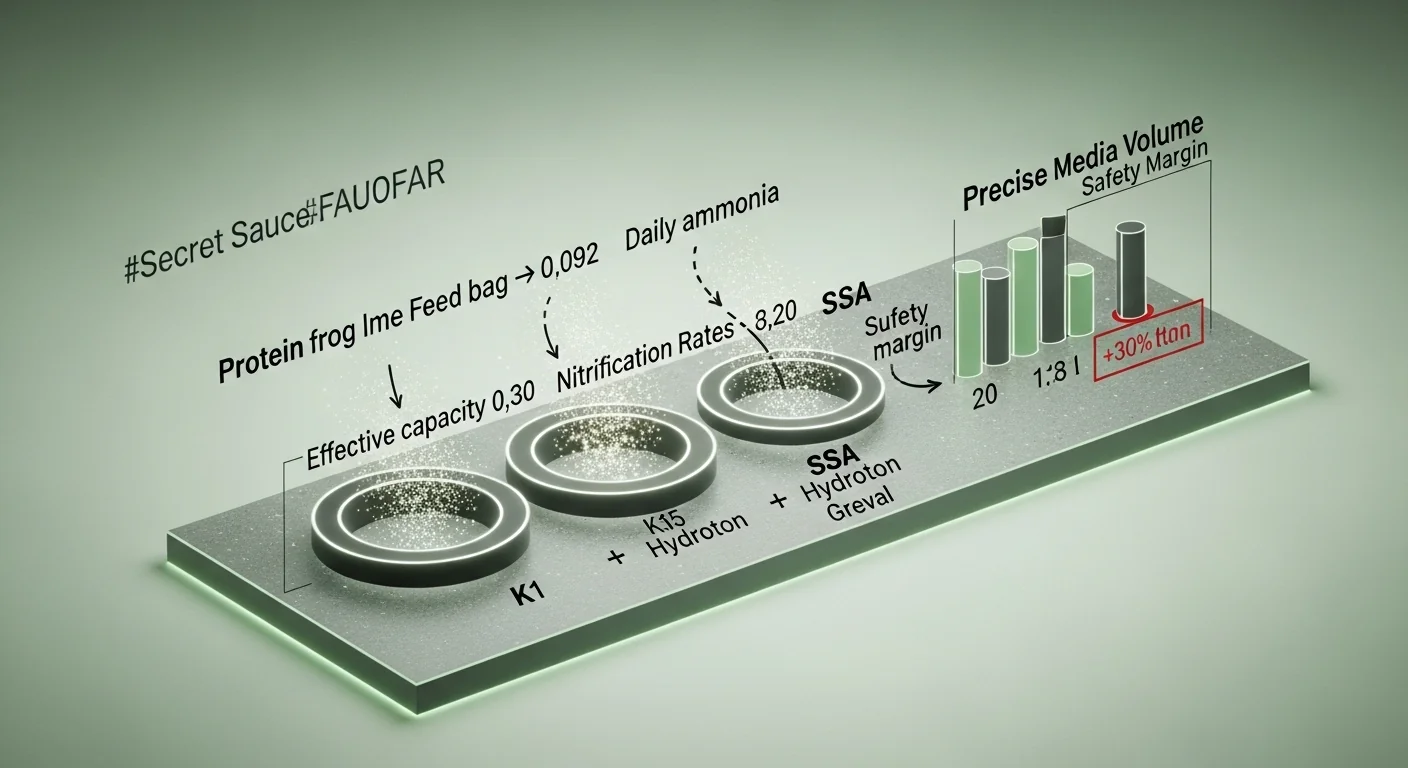
Step 1: Ammonia production estimate
Ammonia (g NH3-N / day) = Daily Feed (g) x (Protein% / 100) x 0.092
The constant 0.092 represents the fraction of dietary protein nitrogen that is excreted as ammonia-nitrogen by most warm-water finfish. This is derived from nitrogen balance studies in intensive fish culture and is widely cited in recirculating aquaculture system design literature. It assumes full feed consumption and normal metabolic activity.
Step 2: Effective nitrification capacity of the media
Effective Capacity (g NH3-N / m³ / day) = Nitrification Rate (g/m²/day) x SSA (m²/m³)
Nitrification rates used in this calculator:
- K1 Kaldnes MBBR: 0.60 g NH3-N / m² / day
- Hydroton expanded clay: 0.35 g NH3-N / m² / day
- Pea Gravel: 0.20 g NH3-N / m² / day
These figures represent conservative field-condition rates, not peak laboratory values. Actual rates vary with dissolved oxygen, temperature, pH, and biofilm maturity.
Step 3: Required media volume
Volume (m³) = Ammonia (g/day) / Effective Capacity (g/m³/day)
Convert to litres by multiplying by 1,000. Round to one decimal place for the primary output. The recommended volume adds 30% to this figure as a conservative operating buffer.
Step 4: Safety threshold check
If the selected media is pea gravel, the widget flags a toxic spike risk regardless of volume, because the combination of low SSA and low nitrification rate creates structural vulnerability at typical home stocking densities. The NH3 target throughout is under 0.5 PPM total ammonia nitrogen (TAN).
Assumptions and Limits
- Water temperature is assumed to be 22 to 28 degrees Celsius. Below 15 degrees, Nitrosomonas activity drops sharply; reduce expected nitrification rates by 40 to 60% for cold-water systems.
- System pH is assumed to be 7.0 to 7.5. At pH below 6.5, ammonia conversion efficiency declines meaningfully and the calculator will underestimate required volume.
- Dissolved oxygen in the biofilter is assumed to be at or above 5 mg/L. K1 media must be tumbling continuously via aeration; a power outage event halts nitrification entirely.
- The biofilter is assumed to be fully cycled, meaning the bacterial colony is mature (typically 6 or more weeks of running with a nitrogen source). A partially cycled system may have 20 to 50% of its theoretical nitrification capacity available.
- The 0.092 protein-to-ammonia constant assumes warm-water finfish such as Tilapia or Catfish. Cold-water species with different nitrogen retention efficiencies may produce different ammonia loads.
- The formula models the minimum volume for steady-state ammonia processing. It does not account for ammonia spikes from sudden overfeeding, fish illness, or mortality events that release additional ammonia rapidly.
- This tool is not appropriate for marine or saltwater systems, which have different bacterial communities and nitrification kinetics.
Standards, Safety Checks, and “Secret Sauce” Warnings
Critical Warnings
- The 0.5 PPM ammonia threshold is not a guideline, it is a toxicity ceiling. Total ammonia nitrogen above 1.0 PPM causes gill damage in most warm-water species within hours. At 2.0 PPM, mortality is probable for juvenile fish. The calculator’s safe-zone determination uses the conservative 0.5 PPM target precisely because ammonia accumulates faster than most hobbyists test for it.
- Gravel biofilters are structurally incapable of handling medium-to-high stocking densities. The low SSA of 300 m²/m³ and low per-unit nitrification rate of 0.20 g/m²/day combine to produce media volume requirements that are physically impractical for most home systems at feed rates above 150 g/day. This is not a matter of building a larger gravel bed: the deeper the gravel, the more likely anaerobic zones form inside it, further reducing effective nitrification and creating hydrogen sulfide pockets.
- A partially cycled system behaves as if it has a fraction of its calculated media volume available. Stocking fish before the nitrogen cycle is complete is the most common cause of new-system ammonia crashes. The formula assumes a mature, stable biofilm. Running the calculator with full stocking numbers before week six of cycling will produce a result that the actual bacterial population cannot yet achieve.
- Temperature fluctuations in outdoor systems are not modelled here. A system that calculates as safe in summer may lose 40% of its nitrification capacity in winter. For systems in variable climates, design for the coldest expected operating temperature, not the average. The growing degree days calculator can help assess seasonal thermal patterns in your specific region.
Minimum Standards
- Total ammonia nitrogen (TAN) must remain below 0.5 PPM in an operational system. Test weekly during the first three months and monthly once the system is established.
- Dissolved oxygen in the biofilter zone must be maintained above 5 mg/L at all times. Nitrification is an aerobic process; oxygen-depleted biofilters stop converting ammonia and can begin releasing it back into the water column.
- Biofilter media must be protected from chlorine and chloramine exposure. Municipal water changes must be dechlorinated before contact with filter media, or the bacterial colony will be significantly damaged.
- K1 Kaldnes moving bed media requires continuous aeration to remain in suspension. A non-tumbling K1 bed functions at a fraction of its rated SSA because biofilm builds up on the contact surfaces between stationary pieces.
Competitor Trap: Many aquaponics guides recommend biofilter sizing rules based on tank volume or fish count alone, such as “one cubic foot of media per 10 fish.” These volume-to-fish ratios ignore the single most important variable in nitrification capacity: how much protein those fish actually consume per day. A 10-fish system fed high-protein feed at double the rate of a reference system produces roughly double the ammonia load, yet the volume-to-fish rule gives the same answer for both. The protein-based formula used in this calculator is not more complicated; it is simply the correct relationship. Systems sized with fish-count rules are routinely underfiltrated, and their owners spend months blaming stocking density when the actual failure is in the biofilter design.
Common Mistakes and Fixes
Mistake: Using the Minimum Volume as the Build Target
The minimum volume output is the theoretical threshold at which nitrification barely keeps pace with ammonia production under ideal conditions. Real systems experience temperature variation, overfeeding incidents, partial cycling, and media fouling with suspended solids. Building exactly to the minimum leaves no buffer for any of these events. The fix: always build to the recommended volume figure, which adds a 30% margin.
Mistake: Not Knowing the Actual Protein Content of the Feed
Feed protein content varies substantially between brands, formulations, and even between bags of the same product. Using a round-number estimate of 32% when the feed label reads 42% introduces a large systematic error in the ammonia prediction. The fix: read the guaranteed analysis on the physical bag for every feed you purchase and update your calculation accordingly.
Mistake: Ignoring the Cycling Period Before Stocking
Running this calculator and immediately stocking fish to the modelled feed rate produces a system with a fully designed biofilter but minimal actual bacterial capacity. Nitrosomonas colonies take 4 to 8 weeks to reach stable populations on fresh media. The fix: cycle the system with a controlled ammonia source before adding fish, and stock gradually over several weeks while monitoring ammonia and nitrite levels. If you are planning your grow bed planting schedule around stocking dates, tools like the succession planting chart can help coordinate those timelines.
Mistake: Assuming SSA Ratings Are Interchangeable Between Media
Brands
K1 Kaldnes is not a single product. Different sizes and generations of K1-style media carry SSA ratings from under 400 to over 900 m²/m³. Using the 500 m²/m³ default when the actual product has a 350 m²/m³ rating will produce an optimistic result that undersizes the filter. The fix: locate the manufacturer datasheet for the specific media product and enter the actual SSA value in the override field.
Mistake: Sizing the Biofilter for Current Feed and Not Future Stocking
Systems grow. Fish grow. Feed rates at full stocking density can be three to five times the rate during the first month of operation. A biofilter sized for 150 g/day in month one may be catastrophically undersized at 600 g/day eight months later. The fix: calculate for your planned maximum feed rate, not your current rate, and build the biofilter to that specification from the start. This also applies to plant management decisions; the vegetable yield calculator can help estimate the plant uptake load your system will need to support at full production.
Next Steps in Your Workflow
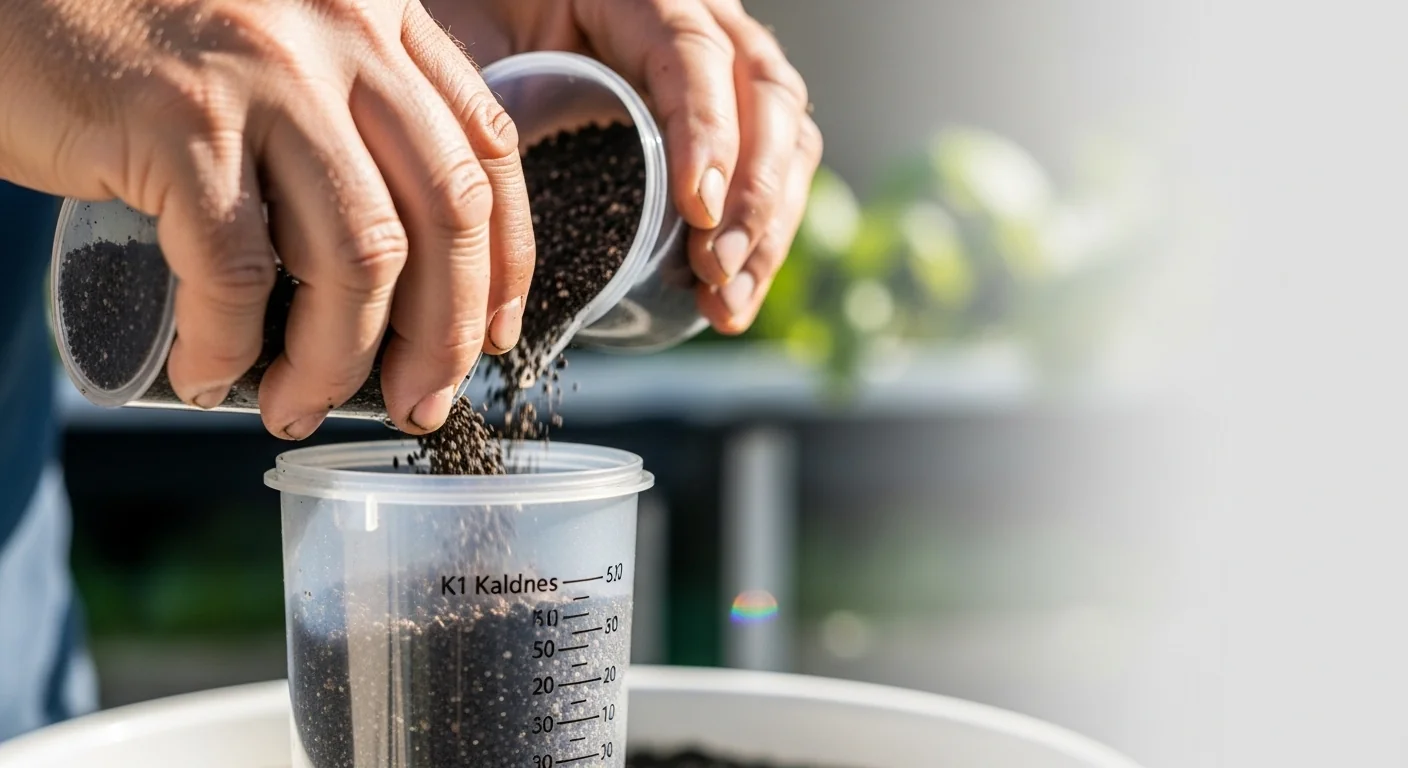
Once you have your required media volume, the immediate next decision is filter vessel design. The interior volume of your chosen vessel needs to accommodate media at its operating fill level, which for K1 moving bed systems is typically 30 to 50% fill by volume to allow adequate tumbling and water flow. Divide your required media litres by the operating fill fraction to determine the vessel volume you need to source or build. For grow bed media filters using Hydroton or gravel, the fill fraction is higher but the vessel must also handle water volume above the media bed and drainage to the fish tank.
The biofilter is the biological engine of the system, but it only processes one form of fish waste. Solids management, plant spacing density, and harvest rotation all interact with how quickly nutrients accumulate in the water. If you are designing the grow bed layout alongside the biofilter, the plant spacing calculator can help you determine how many plant sites your planned bed dimensions will support, which in turn informs how much nutrient uptake capacity your plant canopy will provide at peak production. From there, using the harvest date calculator to stagger your plant cycles creates a continuous nutrient sink that reduces the peak nitrate load the biofilter and water exchange schedule must handle.
FAQ
What is the target ammonia level in an aquaponics system?
The standard target for total ammonia nitrogen (TAN) in a healthy aquaponics system is below 0.5 PPM. Values above 1.0 PPM begin causing physiological stress in most warm-water species. Values above 2.0 PPM can cause gill damage and mortality, particularly in juvenile fish. Test frequency should be weekly during system establishment and at minimum biweekly once the system is stable.
Why does media type matter more than media volume?
Nitrification occurs on surfaces where Nitrosomonas bacteria form biofilms, not in water volume. Two media types with the same physical volume but different specific surface areas provide radically different total bacterial surface area. K1 Kaldnes at 500 m²/m³ provides nearly 1.7 times the colonizable surface of pea gravel at 300 m²/m³, and its higher nitrification rate per unit surface compounds that advantage further.
How long does it take to cycle a new biofilter?
A new biofilter started with no bacterial seed typically takes 4 to 8 weeks to reach stable nitrification capacity. Cycling time can be shortened by adding a bacterial inoculant, seeding with established media from another system, or using a controlled ammonia source such as pure ammonia solution to build the colony before introducing fish. Temperature below 20 degrees Celsius significantly extends cycling time.
Can I use the calculator for a saltwater or marine aquaponics system?
No. The nitrification rates and ammonia production constants in this calculator are validated for freshwater warm-water finfish systems. Marine systems host different bacterial communities with different kinetics. The 0.092 protein-to-ammonia constant may also vary for marine species with different nitrogen retention profiles. This tool is designed for freshwater aquaponics with species such as Tilapia, Catfish, Perch, or Trout.
What happens if my biofilter is undersized?
An undersized biofilter cannot convert ammonia to nitrite and nitrite to nitrate at the rate fish produce it. Ammonia accumulates in the water column, rising until it reaches toxic concentrations. This process can take days in a new system with a partial bacterial colony, or hours following a sudden increase in fish load or feeding rate. Fish show behavioral signs such as gasping at the surface before measurable mortality occurs.
Does the calculator account for nitrite toxicity, not just ammonia?
The calculator models ammonia removal capacity specifically. In a properly cycled system with adequate biofilter sizing, nitrite (NO2) is converted to nitrate rapidly and does not accumulate. However, in partially cycled systems or during periods of system stress, nitrite can spike even when ammonia appears controlled. Testing for both ammonia and nitrite during the first 8 weeks of operation is advisable regardless of what the calculator shows.
Conclusion
The single most important mistake to avoid is sizing for current feed rate rather than maximum operating feed rate. Biofilters are not easily enlarged once a system is running; a fish tank full of growing fish tolerates disruption poorly. Calculate forward, build for full stocking density, add the 30% margin, and cycle the filter before the fish arrive. For a broader view of how your system’s nutrient cycling connects to plant production goals, the square foot gardening planner offers a complementary framework for translating available grow space into expected plant canopy and nutrient uptake capacity alongside your biofilter design.